WE ARE ON THE WRONG TRACK Seventy percent of Americans (and counting) think so. The real wage of a US worker today is less than it was 40 years ago—but there are four times as many multimillionaires. As inequality grows, the politics become more poisonous. Every year, more and more Americans go on shooting sprees, killing strangers and passers-by—and now, increasingly, representatives of the state. Troubling trends of this kind are endlessly discussed by public intellectuals and social scientists. But mostly, they talk about only a small slice of the overall problem. After all, how on earth can yet another murderous rampage have anything to do with polarization in Congress? And is there really a connection between too many multimillionaires and government gridlock? Historical analysis shows that long spells of equitable prosperity and internal peace are succeeded by protracted periods of inequity, increasing misery, and political instability. These crisis periods—“Ages of Discord”—have recurred in societies throughout history. Modern Americans may be disconcerted to learn that the US right now has much in common with the Antebellum 1850s and, more surprisingly, with ancien régime France on the eve of the French Revolution. Can it really be true that there is nothing new about our troubled time, and that similar ages arise periodically for similar underlying reasons? Ages of Discord marshals Structural-Demograpic Theory and detailed historical data to show that this is, indeed, the case. The book takes the reader on a roller-coaster ride through American history, from the Era of Good Feelings of the 1820s to our first Age of Discord, which culminated in the American Civil War, to post-WW2 prosperity and, finally, to our present, second Age of Discord.
So, reading this book in 2014 (a preprint that he posted on his website), has ever since given me an ominous feeling about the year 2020. It's not as if Turchin actually claimed to be able to predict the precise year in which our political crisis would hit a peak, but he did say it would be around the year 2020. Occasionally I would wonder if I should try to get me and my family out of the country before 2020, but it was never really clear to me where else would be safer. So, I entered the year with more than a bit of trepidation. I tried to reassure myself with thoughts like, "he never said EXACTLY the year 2020", and "it's only a theory, maybe he'll be wrong".
Well, thus far, nothing about 2020 has caused me to think he's wrong. But around the middle of the year I realized it might be a good idea to reread it, and see how well it stacks up to the reality in the details. It didn't take long for me to find a detail which I didn't pay much attention to at the time, and didn't recall, on page 11: "...epidemics and even pandemics strike disproportionately often during the disintegrative phase of secular cycles"
If you're wondering what "the disintegrative phase" of a "secular cycle" is, here's a hint: you're living through one right now. It is characterized by things like: - increased political polarization - increased violence, both ordinary homicide and political violence such as riots - peaking inequality of wealth and income, as a few winners take all, and even the lower ranks of the elite get the squeeze, leading to... - challenges to the political elites from "elite aspirants", who are people that are from the lower rungs of the ruling class, trying to climb to the top. Think Lenin (trained as a lawyer) in Russia, Robespierre (lawyer and briefly a judge) in France, Fidel Castro (son of a wealthy farmer) in Cuba, Oliver Cromwell (born into the middle gentry) in Great Britain, etc. So, people who are not really commoners, but not exactly coming from the normal background of a national leader, either, who manipulate popular discontent with the incumbent elites to propel their rise to the top. So recalling that this was actually written (or at least, published on his website) in 2014, that's pretty impressive. He didn't quite say "some middle-rank businessman with no government experience will fan working class discontent to get elected President" in so many words, but that was the pretty clear implication.
So, suffice to say that nothing that has happened in the last four years has proven Turchin wrong about any of this. Given this fact, what does he predict for our future? Well, unfortunately, "disintegrative phases" only end once the ruling elite decide that it is more important to calm discontent, by sharing the wealth, than to hold on to as much as they can. This, in turn, usually only happens once there has been a whole lot of violent death (e.g. in the 1860's) or a credible threat of revolution (e.g. 1919-1920) or a need to maintain unity in the face of an enemy nation (Cold War). Lacking the last one, we would appear to have the very real possibility of a bunch of bloodshed.
It's enough to make one wonder if a pandemic, to convince everyone to stay in their homes instead of gathering together in masses to shoot, stab, and club each other to death, might actually be a good thing. So there's that.
I cannot say that this book is a fun read, but it is an even more interesting one now than it was when I read it the first time. If you have an interest in understanding the underlying issues propelling current events, and you're not frightened by a little mathematical notation, you might take a look.
[original review, which I wrote in 2016]
Full disclosure: Peter Turchin posted a rough draft of this book on his blog a couple years ago, to invite people to provide input. I read (and commented on) it with enthusiasm then, in its previous form, and was surprised to find myself thanked for this in the Acknowledgements of the final version. So, you already know my basic opinion (thumbs-up). But, on to the details, which are more important in a review anyway.
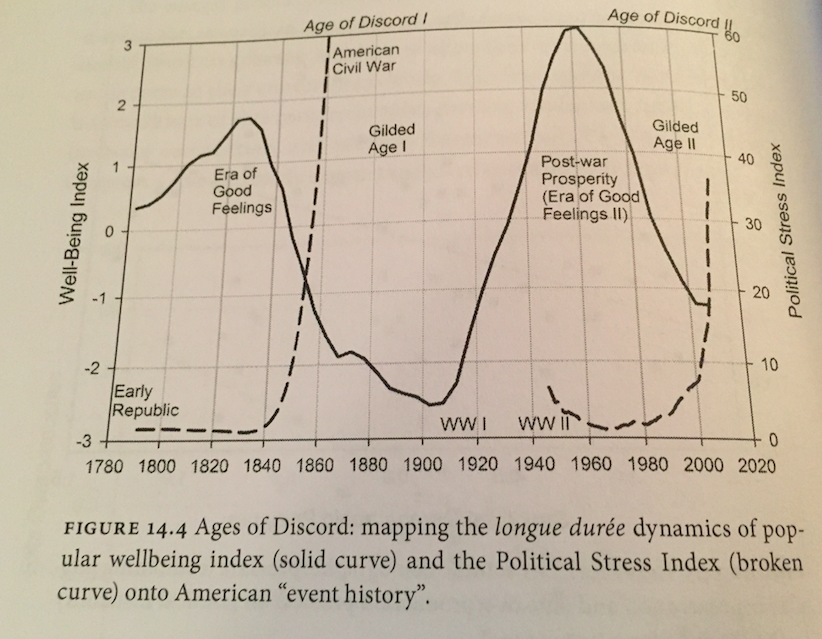
Turchin's book opens and closes with the same figure: the front cover and the last page show a graph of two variables called "Well-Being Index" and "Political Stability Index", with the x-axis showing the years from 1780 to 2020. But what seems like more of an opinion, not much more objective than a Venn Diagram joke, turns out by the end of the book to be backed up with quite a lot of data. That it is not mere hyperbole does not, on the other hand, mean that it is fact. But it is a bit chilling to see the "Political Stability Index" headed into territory not seen in this country since the late 1850's. As Turchin points out, there's nothing inevitable about us going down the path towards civil war again; we have knowledge, we know more about how society works (or fails to) than we did in the mid-19th century, we can choose to do something about it.
For all the drama of that introduction, I now need to mention something that you might find to be a bit of a buzzkill: there's a lot of mathematical notation in this book. Some of it is pretty tame, occasionally it gets a little bit beyond pre-algebra, but nothing too difficult. It's not like YOU need to solve any of the math, anyway, just follow along as he does. Most of the book is history, not math, including some bits you might not have been aware of (fun fact: the only time the U.S. military ever used air power against its own citizenry in this country was in a labor dispute).
I would not do justice to Turchin's basic thesis here if I tried to summarize it, but here's his basic strategy. Unlike the fictional Hari Seldon of Asimov's Foundation series, Turchin does not pretend to be able to predict human history in advance, much less predict it for centuries. However, that is not the same thing as saying that there is nothing we can say, either. Like mathematical chaos, there are patterns in the apparent randomness. Especially in a larger country such as the United States (which is unlikely to be thrown about the map like a roulette wheel ball the way, say, Poland has been), there are shorter and longer term cycles and repeating patterns. Income inequality goes up sometimes, and down sometimes, but it doesn't trace out a random walk. The degree of political polarization goes up sometimes, and down sometimes, but it has long-term patterns as well, and it turns out that they are neither the same as, nor precisely independent of, the patterns on income inequality.
One could imagine an alternate world in which our ability to gather data, and analyze it, and our theoretical machinery for dealing with nonlinear dynamics, all came together to this point when we happened to be about to enter into a period of unusually placid and stable history. I wonder if the Peter Turchin of that alternate timeline would be able to get anyone to listen to him, and his nicely reassuring new theory.
We'll never know, because that's not the world we live in. In fact, one of the things which the couple years since I read that rough draft have convinced me of, is that Turchin is onto something. Again, nothing is certain, but the events of the last couple years have clearly been moving along the lines that his theory suggests. If you have spent the last year or so wondering, "what the hell is going on here, and why?", you may not have expected anyone to actually give you an answer. You may not actually want to get one. But if you really do, and you don't let the occasional equation send you fleeing, then this book has it. Take a deep breath, and dive in.
I'm a sucker for the "grand theory of everything" book genre. The downside to the genre is that all the books in it are wrong. The upside is that some of them manage to be wrong in interesting and new ways which is a pretty impressive achievement in my mind.
Ages of Discord is one such book that seeks to explain why and how recurring periods of prosperity and distress arise focusing on structual-demographic variables.
To start with what I didn't like, I kept getting a sort of vague worry about scientism. Turchin spends a good amount of time talking about the equations he uses to try and model social trends, but he's dealing with such macro variables over such a long time frame that there's no way to get good data. (E.g. No one really knows what real wages were in 1810 America). I think Turchin operates in good faith in trying to piece together such big picture questions, but I think you ultimately can't "prove" anything on the scale at which Turchin is arguing in any meaningful way.
That being said, I think the "person sitting in armchair spit-balling on grand theories of everything" genre is underrated. Aristotle, Kant and Nietzche all fall in that camp and they had some pretty cool ideas so I'm along for that ride.
Read in that light, Turchin's theory is still very interesting. The core of the theory is that social conflict is the result of "elite overproduction." There are only so many senators, Fortune 500 CEOs and Big Law partners and as competition for those limited seats heats up, it causes society to fracture.
Turchin looks at the United States from founding to present, seeing two macrocycles. The first cycle ultimately resulted in a Civil War as Northern and Southern elites clashed over economic policies. Turchin believes the most recent cycle peaked around 1970 and we are headed towards a similar "disintegrative phase" (though not necessarily a Civil War).
Though I think the elite overproduction thesis is oversimplified, it is wrong in an interesting way as I do think that the story of the 1% vs. the 0.1% is perhaps more explanatory than the more popular 1% vs 99%.
I think Turchin is also correct in the important way that we tend to overemphasize legible factors, particularly figureheads (e.g. presidents) and overestimate how much power they actually have. His focus on structural factors and demographics like birth rates and immigration seems much better placed to me.
If anyone can claim to be making Isaac Asimov's dream of psychohistory manifest it's Turchin, who has done more work to create a truly scientific and predictive theory of macrohistorical patterns than probably anyone else. While this is of course impossible in the strictly Asimovian sense of being able to tell exactly when major crises will arise - and unlike Asimov, Turchin does not even pretend to then be able to present timely solutions via hologram - this book makes a convincing argument that we can discern real lessons about general trends in societal upheaval, while still humbly emphasizing how difficult it is to make even modest predictions about the future. Unfortunately, as the title unhappily alludes to, Turchin's prediction is that the 2020s will be even more unpleasant than today, an era of strife that echoes previous periods in history where the existing social order proved unable to accommodate internal divisions, and the political system could not easily resolve these tensions due to elite greed and status-hoarding. While not Marxist in analysis or conclusion, Turchin's Structural-Demographic Theory broadly aligns with the notion that the rich and powerful have diverted too much of society's wealth and privilege towards themselves, and general wage stagnation combined with class immobility is already having dangerously destabilizing effects on our cultural norms. Even though the book's prognosis is negative, it's just as high-quality as Turchin's other recent works, which collectively form one of the most impressive oeuvres in contemporary social science.
The idea that societies have semi-regular patterns of crisis and stability is thousands of years old; Polybius' anacyclosis model in The Histories predates the Caesars, and the Chinese epic Romance of the Three Kingdoms famously begins "The empire, long divided, must unite; long united, must divide. Thus it has ever been." However, since as a rich post-Industrial Revolution nation we have escaped a simple Malthusian equilibrium that would lend itself to the easy use of closed-system dynamics, you have to get more a bit more complex in order to discern any kind of cyclical trends in American history. Picking the right variables can be extremely difficult and frankly, some of the choices Turchin makes come off as questionable; when he was describing how in addition to the steady multi-century Structural-Demographic Theory sine waves of peace --> complacency --> conflict there are also 50-year "fathers and sons" cycles, I was reminded of cargo cult science like the Dow theory model of stock prices, where you hallucinate a bunch of overlapping variable-length "patterns" of main movements, medium swings, and short swings on top of a bunch of random-walk price data in order to derive whatever trendlines look most convincing to your investors. Turchin does his best to avoid pareidolic numbers games, but his well-intentioned attempts to find proxies for inherently squishy concepts like "cooperative social mood" for SDT - measures like "visits to national parks and monuments" or "relative frequency of the phrase 'corporate greed' according to Google Ngram" - have the unavoidable air of arbitrariness, even if he does make a good case that they're measuring something real.
Still, once I got over my quibbles with his exact choice of indices, his basic theory seemed unimpeachable. The highest level of the model is simple: the Political Stress Indicator = Mass Mobilization Potential x Elite Mobilization Potential x State Fiscal Distress. Each of the right-hand terms is then composed of a few variables:
- Mass Mobilization Potential combines measures of real wages, urbanization rates, and the relative proportion of young (20-29 years old) people in society - Elite Mobilization Potential combines elite income and intraelite competition for important governmental positions - State Fiscal Distress combines national debt relative to tax revenue, and popular + elite trust in the ability of the government to service the debt and in institutions more generally
That's it! Or nearly it, because some of the components depend on a few other variables (e.g. real wages are determined by labor supply vs demand, which is also affected by immigration levels and the birthrate and so on). It's a bit more tractable than a gigantic matrix of 330 million Lotka-Volterra equations, or the unreadably long Prime Radiant from Foundation, and though it seems almost impossibly oversimplified (no separate measures of religious sectarianism, racial strife, technological stagnation, etc?), Turchin is able to justify most of his choices well by connecting each part of the model to social science literature that I happen to agree with. The historian Arnold Toynbee had a famous line that "Civilizations die from suicide, not by murder", and in Turchin's view, societies have an amazing ability to create problems for themselves due to selfishness, interpreted broadly. So if you've read Paul Krugman's The Conscience of a Liberal, you will agree that economic inequality is reinforcing partisan polarization as the Republican Party moves ever rightward in response to the wishes of its donor class; per Jacob Hacker and Paul Pierson's Winner-Take-All Politics, our elites have gradually gotten greedier and treat our country as being more profitable to steal from than invest in; as Mark Ames' Going Postal documented, workplace shootings are a frustrated response to the decline of unions and corresponding increase in the worker-as-serf labor model; and so on. This might seem like standard left-wing/progressive/labor liberal analysis, but if you've read anything about social network analysis (Duncan Watts' Everything Is Obvious... Once You Know the Answer) or cultural multilevel selection (Joe Henrich's The Secret of Our Success), or even Turchin's own prior books on asabiya like Ultrasociety, it's hard not to nod along to descriptions of how cooperation within a society can break down over time:
"These four mechanisms, (1) competition between groups, (2) competition within groups, (3) cultural distance between competing groups, and (4) cultural homogeneity within groups are not the only processes that can affect the spread of cooperation norms. However, these four processes are interesting because historical evidence suggests that all of them play a role in trend reversals during secular cycles, and because they happen to be connected by one of the most important formulas in multilevel selection theory, so in a certain sense they are just four aspects of a single, more fundamental mechanism."
I think even a conservative would agree that Democrats and Republicans right now check off all 4 of those points: they're competing intensely with each other for control, there are vicious intraparty struggles, they're far apart from each other on many issues, and they're purging moderates/dissenters via litmus tests. The key point is that they are doing all of those things to a far greater degree than they have in the past, and with no sign of abatement. Even though you can find examples of people writing "it was the best of times, it was the worst of times" about essentially every year since the beginning of time, there are plenty of social indicators that are showing worsening conflict and increasing unhappiness with how our theoretically vast prosperity is actually experienced. It probably won't get better either: vital programs like Medicare, Medicaid, and Social Security are under continuous attack, and the fiscal irresponsibility of the Republican Party is actually starting to look pretty good to left-wing proponents of Medicare For All or Universal Basic Income. Why worry about paying for useful social programs if Republicans don't feel they have to pay for their wars or tax cuts for the rich? We're not quite into the 70s radical era chronicled in Bryan Burrough's Days of Rage, with a climbing murder rate and open domestic terrorist violence, but steady background problems like housing unaffordability, wage stagnation, career precariousness, and so on have become foregrounded, because in the same way as the middle and lower classes are being squeezed, the American elite has worked to close itself off, and so frustrated would-be elites have amplified the struggles of the population at large as inequality and social immobility move up the ladder.
It might not be fully appreciated that many of history's most famous revolutionaries have not been actual poor or working class people, but upper-middle class bourgeois types who leveraged popular discontent into mass movements in conjunction with their own personal grievances. Marx, Lenin, Che, Mao - while they all might have felt genuine sympathy and identification with the lower classes, it's fairly easy to imagine that if the ruling classes had just bought each of them off with a relatively nice government post early on, they might have remained inside the system more or less happily without engaging in violent class struggle. There are many historical examples of this "closing of the patriciate" when there aren't enough elite positions to go around, and indeed the popular caricature of a contemporary Democratic Socialist of America member devoted to the destruction of capitalism is a liberal arts graduate who can't use their expensive college degree to reach the station they think commensurate with their self-identity. This is not to say that they don't have perfectly legitimate problems or that their grievances aren't as real as anyone else's, but it's an important component of Turchin's model, and I think of reality, that when there are more potential elites than elite positions available, that those frustrated elite aspirants will turn against the system more effectively than a prole would. They're certainly much more capable of upsetting the system than the stereotypical laid-off factory worker or fast-food employee who is barely keeping their head above water and doesn't have time to go to rallies and meetings and whatnot. And on the other side, those lucky elites who got in while the getting was good feel little or no broader loyalty to the society that they wield their power in, which explains why so many of them are such awful and craven apologists for a status quo that benefits them at the expense of everyone else. Relative positioning is hugely important to people, and the most common way to resolve this conflict is... conflict.
Now, surely not every single period of internal strife in every country in every historical period is due to the fact that the Marx of the day had idle hands, but Turchin convincingly applies Structural-Demographic Theory to the broad arc of American history, and he analyzes events like the Civil War in ways I had not thought of before. He doesn't deny that the Civil War was fought over slavery, but he does raise the question of why war became unavoidable in 1860 specifically. It's one thing to say that the Compromise of 1850 was "good enough" for another 10 years of peace, or suggest that by 1870 the North would have been too industrially powerful for the South to attempt secession, but Turchin's theory is capable of connecting the Civil War backwards to the Era of Good Feelings and then forward to the Gilded Age in a way that aligns neatly with more orthodox explanations like those of Eric Foner while still showing that immigration patterns, urbanization trends, and elite fragmentation made the 1860 election particularly volatile in a way that 1840 or 1880 was not. Every era has its own problems, but to get an all-consuming crisis like the Civil War, it takes a very particular confluence of internal contradictions, and even those other factors like "states' rights", nullification, or tariff disputes can easily be reinterpreted as intra-elite arguments over distributing wealth and power. I was struck by the difference in partisanship between then and now, however; Foner's excellent book Free Soil, Free Labor, Free Men described the coalescence of the Republican Party out of a whirlwind of competing parties, but these days more of the struggle is within the two major parties rather than between them and the constellation of minor parties like Turchin describes, perhaps due to more sophisticated party organizations and a more entrenched Duverger's Law:
"As David Potter notes, in 1854 voters were presented with a stunning array of parties and factions: Democrats, Whigs, Free Soilers, Republicans, People's Party men, Anti-Nebraskaites, Fusionists, Know-Nothings, Know-Somethings, Main Lawites, Temperance men, Rum Democrats, Silver Gray Whigs, Hindoos, Hard Shell Democrats, Soft Shells, Half Shells, Adopted Citizens, and others. This fragmentation was a remarkable change from the situation 40 years before. During the Era of Good Feelings, after the demise of the Federalist Party, there was only one significant political party in the United States. Even when Democratic Republicans split into Democrats and Whigs, parties represented not ideologies but interests and support for specific leaders. The 1860 presidential election, by contrast, was a four-way race, in which Abraham Lincoln got only 39.8 percent of the popular vote, with candidates from other parties receiving 29.5, 18.1, and 12.6 percent."
One major criticism of SDT that I had was how immigration fits into the model. Immigration was at historic lows during the 1960s and 70s, which were a time of violent social upheaval and the decoupling of wages from productivity growth. Immigration is higher now, but for the most part immigrants are fairly positive for America (they commit fewer crimes than natives, start more businesses, bring better foods, etc) and seem to be used as easy scapegoats rather than truly being actual causes of dysfunction. Turchin ties high immigration to labor oversupply, and therefore to the wage stagnation part of the Mass Mobilization Principle, but while there might be a few visible instances of immigrants lowering wages in a particular sector, like H1-B programmers in Silicon Valley, those sectors are often actually the most supportive of increased immigration, and the areas most opposed to immigration are stereotypically places like Iowa where immigrants not only don't compete with natives, they're absolutely crucial to the agricultural sector and to rural society more generally. The relationship between immigration and political instability seems more likely to be via the channel of greater ethnic diversity lowering general public trust, although even there, the places with the most immigrants (i.e. big cities) typically like them the most, and it's the low-immigrant areas who produce the angry ranting nativist politicians. Either way I think immigration has more complex effects than are being captured in his model, though to be fair I couldn't honestly say that I believe that raising immigration empirically produces greater political stability, especially if I think of international comparisons and the global rise in nativism. Maybe the suggestion that the more the US absorbs Latin American immigrants the more we will develop a Latin American society has some uncomfortable truth to it.
But even if Structural-Demographic Theory may not be completely accurate to the level of Hari Seldon, in the main I think he has captured the dynamics of this "Age of Diminished Expectations", in Krugman's phrase, in a provocative and useful way. Certainly this book is far more readable, and more empirical, than anything Marx wrote, thanks to Turchin's careful grounding in the cliodynamic data of SESHAT and use of familiar scientific models from other disciplines, but as Robert Fitch once said, "vulgar Marxism explains 90 percent of what happens in the world", and a lot of Marxist concepts would fit in comfortably here. Of course, his prediction that the 2020s are going to be even nastier than the 10s were is a real bummer, and he doesn't even pretend to offer solutions - the collective action required to reorient ourselves to the common good is exactly the thing being eroded by elite overproduction, popular immiseration, and our likely imminent fiscal crisis - but it took us a good while to get into our current gridlock, and short of the vanguard of the proletariat violently overthrowing the bourgeoisie, which is a cure worse than the disease, it will take a while to get out of. Nobody likes the "hey guys, all let's work together!" type of liberalism, but here are my quick thoughts on ways that the Political Stress Indicator could be lowered, divided by components:
- Mass Mobilization Potential: Medicare For All to reduce health costs, curtail zoning restrictions to reduce housing costs, institute a points-based immigration system, encourage unionization to increase wages and job security, consolidate welfare programs under a UBI, guaranteed jobs program, bring down college costs via increased state support and reform of alumni donation and endowment policies - Elite Mobilization Potential: institute proportional representation and greatly expand the House, eliminate/disempower the Senate, pass anti-corruption measures like HR1, implement Elizabeth Warren's codetermination proposal, actually prosecute elite criminals, expand meritocratic advancement systems and elite accountability mechanisms more generally - State Fiscal Distress: tax rich people a lot more by whatever means necessary, shift to less regressive taxation methods like Georgist land taxes, enhance macroeconomic stability via Federal Reserve policy reform
Maybe it's not possible to solve every societal problem permanently, especially inherent ones like elite corruption, but there's no reason not to try.
I am skeptical of those who predict the future by looking at the past. It’s not that history follows a random walk, like the stock market. Quite the contrary—it is easy to show certain patterns in history. But predicting how and when those patterns will yield any particular result in any given society seems like astrology. Peter Turchin, however, offers a very convincing, and very well-supported, tying of patterns to data. I’m still not sure it’s not astrology, but I’m half convinced. And this is a good book to read in January 2020—because right now is when Turchin predicts, in America, the swelling discord of the title.
This book is, fortunately, nothing like the terrible The Fourth Turning, a more famous and very stupid book. Like that book, however, it does posit cycles in societies (as do many other books, ranging from Ibn Khaldun’s Muqaddimah to Joseph Tainter’s The Collapse of Complex Societies). “[A] typical historical state goes through a sequence of relatively stable political regimes separated by unstable periods characterized by recurrent waves of internal war. The characteristic length of both stable (or integrative) and unstable (or disintegrative) phases is a century or longer, and the overall period of the cycle is around two to three centuries.” Among many other examples Turchin gives, the integrative phase of the Roman Republic was 350–130 BC; its disintegrative phase was 130–30 BC, to be succeeded by Principate Rome. To take a less commonly known example, the integrative phase of Valois France was AD 1450–1560; its disintegrative phase was AD 1560–1660. Turchin sees America as being in a disintegrative phase that began in the 1970s and will peak starting in 2020. Ages of Discord is an attempt to substantiate that claim, and offers predictions of chaos in America’s near future. Like Hari Seldon in Isaac Asimov’s Foundation, Turchin sees this disintegrative phase as inevitable—but also, maybe, ameliorable.
Since this is the turn of the decade, we have, over the past few weeks, been subjected to endless news articles claiming that the 2010s were the best decade ever. Turchin is having none of that. (And all those claims are stupid on their face—their sole substantive “argument” is that due to the spread of free markets, poverty in the Third World has declined sharply—which is true enough, but totally irrelevant to whether America had a good decade, or is going to have one over the next ten years). The method of Ages of Discord is to use an enormous amount of data and mathematical modeling to add substance to Turchin’s theory of “secular cycles,” developed in an earlier book of that name by Turchin and Sergey Nefedov (where secular has its economic meaning of “a long-term trend of indefinite specific duration”). Turchin calls this the science of “cliodynamics,” a neologism formed from the name of the muse of history and the term for the science of why things change (and also reflecting that society is a web, a “dynamical system”). Cliodynamics is an attempt to view history through science, primarily through the science of statistics. It seeks to offer general principles that can be tested against historical data, and that testing is what Turchin offers here.
Turchin begins with the observation that, however it may feel to us, human societies are fragile. Somewhat melodramatically, he references the American Civil War, while unconvincingly disclaiming that he believes something like that is imminent. He does not think that Steven Pinker is right that we are now more civilized than we used to be; for Turchin, there is no thing new under the Sun, except for, perhaps the science of cliodynamics. Turchin notes that in 2010 (this book was published in 2016) he predicted “the next decade is likely to be a period of growing instability in the United States and western Europe.” He is well-satisfied that he was right, and I think most people would agree.
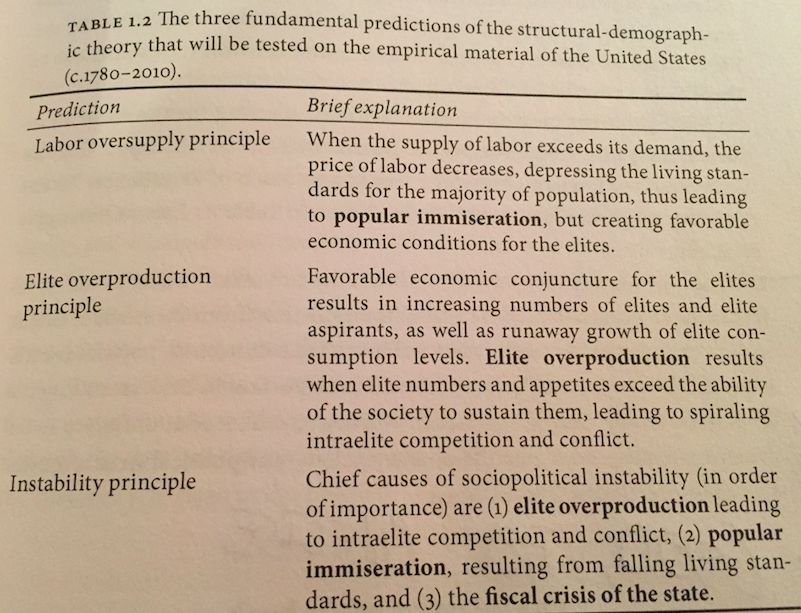
The framework of Turchin’s model, laid out in Part I, is the “Structural-Demographic Theory,” originated by Jack Goldstone to apply to agrarian societies and reformulated by Turchin and Nefedov in their earlier book to apply to industrial societies. SDT consists of three basic claims, or “principles.” First, population growth exceeding productivity (the Malthusian Trap, in essence) leads to falling wages, migration, and ultimately, wage protests such as riots. Actual starvation due to the Malthusian Trap is no longer a problem in industrial societies, of course—population increases rather lead to declining real wages, with similar negative effects on the wellbeing of the masses, “immiseration” (though the mechanics are more complex than in agrarian societies). This is the “labor oversupply principle.” Second, fast population growth also leads to “elite overproduction,” where elites compete for a largely fixed number of elite positions, which leads to elite disunity, the creation of a counter-elite, and elite conflict. This problem is worse in industrial societies, since unlike in agrarian societies, declining real wages actually benefit the elite, who get cheaper labor, and respond by engaging in ever greater, “runaway” consumption, exacerbating the intraelite conflict caused by their swelling ranks. This is the “elite overproduction principle.” And third, the “instability principle,” where population growth also leads to expansion of the state, resulting in increased taxes, which inevitably fail to cover expenses, leading to fiscal crisis. “As all these trends intensify, the end result is state bankruptcy and consequent loss of military control; elite movements of regional and national rebellion; and a combination of elite-mobilized and popular uprisings that expose the breakdown of central authority.” This drives the disintegrative phase of the secular cycle, involving increased mortality, decreased productivity, instability, political violence, war, and, potentially, collapse—followed, ultimately, by a new integrative phase, sometimes with a very different society, sometimes with much the same society, where the three principles reverse in unison.
Turchin is not claiming specific causation. He is showing correlations. He troubles himself to clarify that these three principles are simply proxies “for the movements of structural forces postulated by the theory. In other words, the Structural-Demographic Theory provides a holistic explanation not only for these three particular variables, but for a host of others.” Occasionally he will suggest possible causal links, the most notable being that elites, exhausted after a long period of instability (often including the death of many members of the elite), turn away from competition to cooperation, helping to end a disintegrative phase. (The end of the Roman Republic is the classic example.) Mostly, though, it is patterns tied to data that he offers, and often patterns within patterns.
Thus, his project is to develop mathematical models, then feed them historical data from different eras and see what comes out. This book is specifically written to apply such a model to the United States from its formation (roughly 1780) to the present (2016). It is not an easy read. Lengthy entire chapters are taken up with mathematical formulas—Turchin says the reader can skip these, but that undermines understanding, so I recommend against skipping. The point of the mathematics is to quantify and weight factors in a model that can be applied across different times and places, as well as perform various transforms and shifts, all of which Turchin explains (and he apparently offers most of his data and models for others to review). Complexities abound—for example, finding quantitative proxies for cultural mood, or for the willingness of elites to cooperate with each other, rather than engage in conflict. Much else goes into this, such as rejecting the idea of discrete generations, and instead modeling transmission of behavior across time, paying attention to the “fathers-and-sons dynamic,” feedback loops, and the intersection of different resulting sub-cycles, which aggregate to show certain patterns. Any reader is going to wonder if Turchin is fitting the math to his theories, but looking around, nobody seems to accuse him of doing that.
After introducing the three principles of SDT as applied to industrial societies, and offering an explanation and justification of his mathematical approach, in Part II Turchin expands on each of the three principles as applied to America. In “Demography and Wellbeing,” Turchin examines statistics about and patterns in labor supply since 1780. He analyzes both immigration and native births, compared to real wages over time, both absolutely and relative to GDP per capita. He then ties the resulting graphs to measures of wellbeing, such as height of adults (which declined four centimeters from 1830 to 1900!), life expectancy, age of first marriage (which he notes is “only imperfectly correlated with social optimism”), and so forth.
Tellingly for modern debates, Turchin here draws the firm conclusion that when immigration is high, not only wages, but wellbeing, are low, and not just for a few years, but correlating over decades—including the most recent phase, since 1970, where wellbeing has objectively declined (contrary to the propaganda we are fed), while immigration has skyrocketed and real wages stagnated. He takes this as demonstrating the accuracy of the labor oversupply principle. As he goes along, Turchin is also combining the data, in the form of various graphs, that he discusses. So, for example, he shows that when you overlay a graph of mass wellbeing on a graph for elite overproduction, you see that since 1780 there is a precise inverse relationship between the two—just as the SDT predicts.
In “Elite Dynamics,” Turchin focuses on the ruling class, defined as the (small) fraction of the population in whom social power is concentrated. Different societies exhibit this in different ways—for example, in some societies, the power of the ruling class is largely military, and in others, it is ideological or economic. In most modern societies it is administrative—that is, bureaucratic. But not in America, where there is sociological dispute, as Turchin admits, though for his purposes, he settles on a definition of the ruling class as being primarily economic in nature—the owners of property and capital, and the managers thereof. I think it’s broader—it should include the entire “professional-managerial elite,” as well as cultural centers of power, and the media and universities. No matter; the broader point is that there is a small elite that benefits as the mass is immiserated, which can be shown by measuring wealth disparities and their change over time, along with direct measurement of the percentage of elites on non-wealth metrics and calculation of their competition and fragmentation.
Turchin offers a straightforward analysis of inequality on various measures, and demonstrates that inequality has increased or decreased in America as labor oversupply has waxed and waned. Intraelite competition is measured by, among other statistics, the numbers of law and business students, and their starting salaries over time. His point is that more and more it is winner-take-all, demonstrating increasing intraelite competition. Some newly-minted lawyers get very high salaries, but there is now a bi-modal distribution, where the other peak, with many more students, is low salaries that are inadequate to pay back law school loans. He analyzes law school itself in great detail, such as tracking tuition since 1840 as expressed in terms of manufacturing worker annual wage. If he were writing today, he would doubtless adduce the recent college admissions scandal, where the elite bribed their children’s way into prestigious colleges.
Then he uses as a proxy for elite fragmentation such measures as political polarization in the House of Representatives. Turchin points out that elite conflict is tied to Robert Putnam’s distinction between bridging and bonding social capital, and cites Putnam for the proposition that “cultural dissimilarity within a group tends to decrease the capacity for within-group cooperation.” That is, diversity is the very opposite of our strength—not just because people tend to trust those like them, but because different ethnic groups have their own norms of cooperation, and coordinating those between groups while maintaining trust is difficult or impossible.
Then, for “The State,” which is, I think, the least coherent portion of the SDT, both in the abstract and as applied, Turchin discusses debt, wars, and the like. He points out that American expansion, continentally between 1803 and 1848, and then globally between 1941 and 1970, coincided with the integrative phases of America, which were also peaks in the wellbeing of Americans (and valleys in the overproduction of elites, therefore eras of elite cooperation). He correlates not war, but successful wars, with integrative phases, and ascribes it to societal cooperation in common sacrifice. Not so much in disintegrative phases. Turchin uses, as usual, clever proxies, such as the naming patterns of counties to show trust in government prior to 1950 (when direct polling data on trust in government first became available). No shock, in disintegrative phases, trust in government is low. Finally, Turchin describes what he means by “instability,” a term he seems to apply sometimes to the state and sometimes to broader society, which he says dominates disintegrative phases. In essence, this is violence, from minor riots to civil wars. He is careful not to claim the Civil War was inevitable; there was more to it, much more to it, but it was certainly made possible by the United States being in a disintegrative phase, and on the continuum of violence resulting from instability.
In Part III, winding up to application of the SDT to today . . . [review completes as first comment].
What is the root cause of the rise and fall of nations, of civil wars and the Pax Romana? It is overpopulation in relation to the available resources. Just as animals are evolutionarily selected on a scale from r (plentiful resources, reproduce as much as possible) to K (scarce resources, carrying capacity reached), so too are human societies transformed based on the relationship between the number of people in any given territory and the available food in that territory. When a population boom happens, labor supply increases without concomitant labor demand increase. Therefore the price of labor (real wages) declines. There are too many farmers in the countryside, so many of them flock to the cities (urbanization) to get enough food. The unnatural, unsanitary, chemical-laden atmosphere of the cities decreases health, alongside the lack of monetary resources that the masses have.
Yet, as the condition of the masses declines, the condition of the elites increases. Increased labor supply allows for a decrease in wages, thereby increasing profit margins. More and more people become millionaires with this newfound ability to profit. To further increase their profits, they use their economic power to influence politics so as to increase immigration. Immigration creates an even greater labor supply, thereby further depressing wages and allowing for greater profit. Internationalization/Globalization of corporations works the same way.
As this continues, more and more people get rich. But there are only so many positions of power — so many senators, doctors, and lawyers. Therefore, intra-elite competition increases alongside elite polarization. A small amount of top spots combined with an increased amount of contenders leads to ever more money being spent to get the spots. Public confidence in elites decreases due to the poor conditions of the masses and the ever-tighter government-corporation alliance to increase profits. As overpopulation, urbanization, and decreased public satisfaction creates greater discontent, the state spends ever more money trying to provide bread and circuses to appease the masses. Yet, this often leads to a public debt crisis, which further lowers confidence in government and eventually leads to implosion. Then a civil war happens and chaos reigns. This is what happened before the English Civil War, the French Revolution, and the Roman Civil War.
Does this model work for post-industrial states? Yes. As long as labor supply outpaces labor demand, the laws of economics will depress the wages of the many and lead to elite overproduction. Intra-elite conflict will increase until the powder keg blows up. Applying the model to US history, we see a 2x2 cycle (positive cycles from 1780-1825 and 1920-1965, negative cycles from 1825-1920 [with interlude of Civil War] and 1965-today):
1780-1825: low political conflict, greatly increasing height, low immigration, American West acting as a reservoir for greatly increasing population. A great period of political peace ensues by 1820, with the different religions and ethnicities (German and English) forming together as one, White, Protestant America opposed to the savages in the woods.
1825-1865: immigrants start to flood into America from revolutions in Europe (Germany) and from the Great Irish Famine. The East Coast becomes overpopulated, as the immigrants come en masse into the cities. The "Know-Nothing" movement begins in opposition to Catholic immigration and gets wide support. A great number of millionaires and high-income households are made in the North, many due to railroad companies. Physical conflict increases in Congress (caning of Charles Sumner) and the tensions in relation to slavery greatly escalate. The old, Southern elite (most presidents were from the South in the antebellum era) is replaced by a new, Northern industrial elite. The new and old elites have different economic interests: Southerners want imported industrial goods to trade their cotton for, and Northern industrialists want high tariffs so that they can industrialize the US themselves. Physical violence increases (John Brown, Bleeding Kansas) until the US explodes in the Civil War.
1865-1920: the Northern industrialists win the war and ramp up the immigration flood, now bringing them from Southern and Eastern Europe (Italians and Jews). Immigrants continually make up 15% of America. This labor increase allows big industrialists to make gigantic profits (Rockefeller, Cargenie, etc.). Relative wages of the average man compared to the elite decrease. Average height decreases. Labor conflicts and union protests greatly increase in frequency and often lead to violence (a great percentage led by the newfound immigrants). Racial conflict in the South ramps up (e.g. lynchings), with race riots peaking in the "Red Summer" of 1919. Political assassinations become prevalent, with two presidents being assassinated. Wealth inequality continually increases, and the number of millionaires per one million people reaches its peak (19.3). The number of lawyers per 1,000 people reaches its peak (intra-elite competition).
1920-1965: immigration is greatly halted with the Immigration Acts of 1917 and 1924. Women have low labor participation rates, thereby keeping the labor supply low. Relative wages triple by 1960, and the number of millionaires (total) actually falls. Wealth inequality reaches a trough, and homicides reach their low point. Lynching essentially stops in the South. Labor conflict disappears as more and more Americans join unions and get increased wages. Corporations cooperate with unions and the tax rate for the top income bracket reaches 90%. The number of medical students and lawyers per capita drops, and the American Political Science Association calls for American politics to become more polarized because "voters cannot distinguish between parties". The filibuster is rarely used. People marry and have children younger and younger (social optimism). Tuition of universities reached its lowest (lack of elite overproduction). The WASP upper class comes together and defines America in its image, thereby consolidating the great majority of Americans.
1965-2030 (?): the 1965 Immigration Act opens the floodgates once more, leading to mass immigration. Alongside this, women come into the workforce due to feminism, thus increasing the labor supply even more. The Baby Boomers mature and flood into the workplace. Wages stagnate starting during the mid-1970s and have not increased since. Average height stops increasing. Life expectancy has stagnated or even decreased a little. Political polarization begins increasing and has continued to increase until today. The amount of filibusters expands rapidly. Intra-state violence expands, starting with the race riots of the 1960s and increasing until BLM in 2020. Americans lose trust in their government more and more: today only about 15% of them trust their government. The cost of education inflates rapidly, alongside the numbers of people competing for MDs and JDs. Getting elected becomes ever more expensive. Wealth inequality continually increases, with the top 1% getting more and more of the economic pie (further accelerating after COVID).
"O Clio, muse of history, where are we headed?". Does Clio even need to answer? Anyone with eyes to see and ears to hear can conclude the following: we're headed towards a civil war or a civilizational collapse.
If Peter Turchin's "Ages of Discord" were a person, they would look pretty smug right now. (Maybe Turchin himself is, or at least has a right to be; I don't know, but in any event I am reviewing a book not a person.) On the basis of a demographic theory tested on premodern societies, it correctly predicts that we in 2020 are headed straight into Hell (and then inevitably back.) This is presented, with the particular and also rather smug enthusiasm that accompanies the injection of equations into difficult qualitative fields, as a scientific revelation. I'm not so sure about that, especially about the quantitative model itself, which sneaks in some assumptions that make it a lot less persuasive than it otherwise might be - but ironically, I think this succeeds as a somewhat traditional work of polemical history: that is, it uses historical facts (albeit very quantitative ones) to build a narrative that lends plausibility to a causal account, which in turn means that other historians using other methods may fruitfully investigate this, so that our overall understanding is enriched.
Turchin's rough account is that America went through one complete "demographic-structural cycle" ~1780-1930 and is on the crest of another which started when the last one ended: during the first few decades after the War of Independence, elites were broadly cooperative with each other, and there was plenty of land available for poor white settlers, so everyone (within the boundaries of the citizenry) got along great. Then the high wages that people enjoyed encouraged both large families and immigrants, which made the country more crowded; elites lost the solidarity of the founding generation and competed more with each other, so everyone fought a lot - Turchin presents a model where these violence-producing stressors conveniently peak in 1860, but also emphasizes that leaving the Civil War aside you get an increasing then decreasing peak of within-country violence of all kinds (criminal, lynchings, labor disputes, &c.) Within the progressive era you get a new homogenous ruling elite of technocratic WASPs who go on, together with more favorable demographics at home, to administer the New Deal, hang together while wages grow substantially, and then start fighting again. The Baby Boomers constitute a youth bulge that leads to inherent social instability; businesses embrace a winner-take-all approach, union membership starts dropping, and things progress steadily towards a new wave of instability, stagnant real wages, &c. (Although, inconveniently, violence seems to have not increased, except very possibly in the last year or so.)
What can I say about this? Well, probably just the old saw that "more research is needed," and that I hope people attend to it. His formal models, however, leave a lot to be desired. He presents a dynamic systems model that presents the causal relationship between the variables, but these seem to smuggle in a lot of assumptions that are dubious in just the crucial parts, and that create the illusion of patterns that look like they come from the data but are actually created from the models themselves; these in turn, raise questions about the plausibility of his causal account. For instance, here's a graph that Turchin posted to his blog:
effusing that "this cyclic pattern may look 'too good to be true', but it is true! You can trace all steps of the analysis down to raw data to ascertain this." However, when one "traces all the steps of this analysis," you can see that both trendlines are constructs that depend heavily on the wage component of GDP, how well common people are doing vs. elites, supplemented when necessary by anthropometric data on height (a good thing when a good number of common laborers weren't waged but either independent farmers or enslaved!) As a card-carrying socialist I'm inclined to agree that the labor-capital share of income is historically important, but let's not say there's a pattern in the data when both are constructs involving inversions of the same empirical variables! Likewise, if one "traces the steps," one sees (as he notes in the blog post) that these are not quite as cyclic as they look on the graph, because there are secular as well as cyclic trends in many of the underlying variables, and these have been "detrended." I don't think this is a priori dishonest, but I'm also not sure where it's appropriate, within the logic of the causal model itself, to detrend particular variables vs. not, and not much effort seems to be given to justify the choices in this.
Particular choices in the dynamic model, beyond both "elite overproduction" and "popular well-being" being based on the same variables and looking to have a more systematic relationship than they otherwise might, look pretty dubious, or otherwise assume what they are deployed to prove. For instance, let's delve into elite overproduction. This is estimated partially based on the inverse of relative wage because more surplus for elites leads to more elites which leads to more elites fighting over a smaller pie. But wait, shouldn't more surplus for elites lead to a less competitive environment for them? In his theoretical account Turchin stresses that the elite who runs America, unlike other empires, is a business elite rather than an administrative elite. But then in the model he measures the "too many elites" parts in part by increasing numbers of millionaires and other prosperous entrepreneurs, and "too few positions to fight over" largely by the number of public offices. On theoretically tighter grounds is his discussion of applicants to and graduates of law and medical school - people who want to get into the elite - as a measure of too many people fighting over a small pie. Within the formal model, "elite overproduction" looks like an epicycle. It might be narratively useful or compelling, or good at explaining failed grad students like myself who make up the ranks of radical organizations. But then again you could also say that sectional conflict was pretty narratively fucking compelling in describing the origins of the Civil War, and that it's a credit to the parsimony of Turchin's model that it can predict the peak of violence then without resorting to these narratively compelling arguments. So why not just say that increasing discord results from popular relative immiseration?
Likewise, we see the cycle of rising and declining violence for the first secular cycle, but it doesn't appear to be repeated for the second. (Although note that the one in the first cycle is intranational - what happens if we add in the population of native groups, violence among them, and violence between them and colonizers?) Maybe this results from popular immiseration, but how do we know that this is the result of "the supply/demand for labor," as he says? This is another thing the formal models seems to assume rather than prove, when it assumes for instance, that GPD per capita doesn't change with population but instead competition for labor increases with the number of people in the workforce - an assumption that is reasonable for any particular occupation but faces more problems for the economy as a whole. More total population means more specialization of the division of labor which should raise output per capita, plus there are additional tricky questions of what counts as "entering the workforce." Turchin sees, say, immigrants and ex-homemakers entering the workforce as increasing labor supply thus lowering the return to labor, but foreigners (who can be traded with) and homemakers are engaged in economically productive labor as well. In defense of his account, one could say that while more absolute numbers of workers => greater division of labor => more capital per worker => higher GDP per capita in the long term, more absolute workers => lower capital per worker => lower GDP per capital in the short term, and in fact this disjunction between the long and short term effects is what produces some of this (pseudo?)cyclic behavior.
You may notice that these judgments somewhat mirror my thoughts on Dylan Riley's "Civic Foundations of Fascism in Europe," where I thought the formal methodology was a little overbaked but that the less formally structured case analysis was great. It's a pattern I see again and again (maybe only because the more clearly you state your reasoning the easier it is to find inadequacies.) I don't know that Turchin's less formal parts are *great*, but they're definitely worthy of more investigation. Moreover, while Riley's formal methodology seemed like something filled out because You're Supposed To Have A Methodology, Turchin seems really enthused by his formal models - one could imagine "Civic Foundations of Fascism" without the questionably coded Millian agreement and difference, but it's hard to imagine this book being written without its equations. So while the details of that part are in many ways unlovely - and they're parts whose success, in many ways, depends on the details - I also have to say I'm happy that Turchin is bringing in a different approach to reasoning about history, something that is also good for the broader conversation.
“A topic I've been exploring lately relates to the 50-year cycle that Peter Turchin uncovered in social chaos and civil breakdown in American history, with eruptions circa 1970, 1920, 1870, missing one in 1820, and 1770. On that basis he predicted another eruption circa 2020 -- boy, was he right on the money.” -Agnostic, “The truce in the battle of the sexes during peaks of social harmony, 1940s and 1990s, halfway between peaks of social chaos circa 1920, 1970, and 2020”, February 17, 2025
Easily amongst the best books about current global trends out there. It gets a bit academic and detailed at times but its worth spending the time. Incredibly insightful. The fact that it was written pre-2017 makes it all the more amazing.
Brilliant thesis on factors that lead to better cooperation or rising political violence within societies. Turchin updated his model for agrarian societies and used American history as the test case. The results are very disturbing.
There's a lot of math to back up what he's saying and boils down to a set of linked cycles in what he calls "Structural-Demographic Theory." Political instability mounts as the numbers of elites in society starts to overwhelm its ability to support them. Elites (and would-be elites) start to compete with each other in increasingly aggressively (including in government) and partake in ostentatious displays of wealth (conspicuous consumption). Sometimes this intra-elite competition leads them to ally with outsiders against their own people, or turn against the rest of us (think Caesar taking the legions and marching on Rome).
Popular immiseration sets in as relative wages for workers declines and labor relations sour. The book quantified the link between wages and other factors, including population growth and immigration. As the supply of labor exceeded demand, wages fell and the population suffered. There have been serious spikes of violence and political unrest when these factors hit their nadir, most notably in the 1850s through the Civil War, and again in the early 1900s. Scarcity brings out the worst in people. Conversely its easy to be generous when things are going well.
Finally fiscal crisis in the state and trust in government institutions waxes and wanes in synch with these other factors, and either contributes to the rise in violence and disintegration, or the state has the power and capability to rally cooperation.
This book literally keeps me awake at night because it looks like we are nowhere near the end of the divisiveness and rancor that has escalated since the early 2000s. We are on track for conditions not seen since the Civil War by 2020-2040 unless we can learn from this and restore our capacity to cooperate as a nation. Turchin closes by hoping we can find a non-violent escape from the present cycle and from this wheel of fate altogether.
The work of Peter Turchin has been my most exciting intellectual discovery of 2019. After my mind was blown by War and Peace and War: The Rise and Fall of Empires earlier this year, I was delighted to learn that Turchin has published a more recent book demonstrating how the principles of cliodynamics have played out in America. Ages of Discord is a cutting critique of American history that approaches well-known problems from unexpected angles; it’s a must-read for history buffs and anyone interested in comprehending the precarious, scary trends that dominate 21st-century America.
This review comes with a couple caveats: First, the arguments in Ages of Discord depend heavily on mathematical models that I find difficult to grasp and definitely can’t assess for validity. Although Turchin does a fine job of making his approach accessible to readers unversed in his mathematical background, there is still a lot that went over my head. So I just need to acknowledge upfront that, aside from the normal hiccups one expects from quantitative models of the real world, I’m assuming there’s nothing fundamentally wrong with Turchin’s findings. More than anything, my confidence derives from Turchin’s regular and responsible attempts to highlight the limitations of his mathematical models, even as he advances them with deftness and deserved aplomb.
The second caveat is that the experience of reading Ages of Discord is somewhat difficult to articulate because it’s so visual. In a book shorter than 250 pages, five of them are devoted solely to listing all of the tables and figures contained in the text. I will link to a handful of the most important figures to round out this review, but readers should keep in mind that it’s just a tiny taste of Turchin’s whopping data-punch.
Contrary to the norm in today’s nonfiction, this book’s subtitle––“A Structural-Demographic Analysis of American History”––actually denotes why the author’s method is important and special. “What is Structural-Demographic Theory (SDT),” you ask? The short answer is that it’s our best current tool for applying quantitative analysis to historical information. Given its new-kid-on-the-block status (it was only invented thirty years ago), readers should engage with this theory from a place of healthy skepticism, looking for weaknesses but remaining open to the possibility that Turchin’s on to something.
SDT seeks to understand and predict historical trends by examining the dynamics between three basic principles: the Labor Oversupply principle, the Elite Overproduction principle, and the Instability Principle. Turchin’s definitions here:
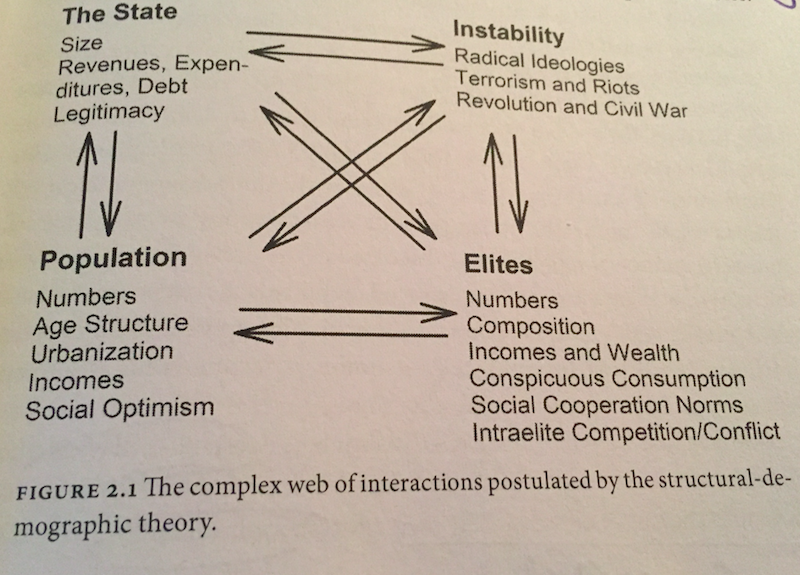
Taken together, these principles represent how the general population, the elite population, the state, and political instability interact and change over time. Here’s a visualization of this complex web of relationships:
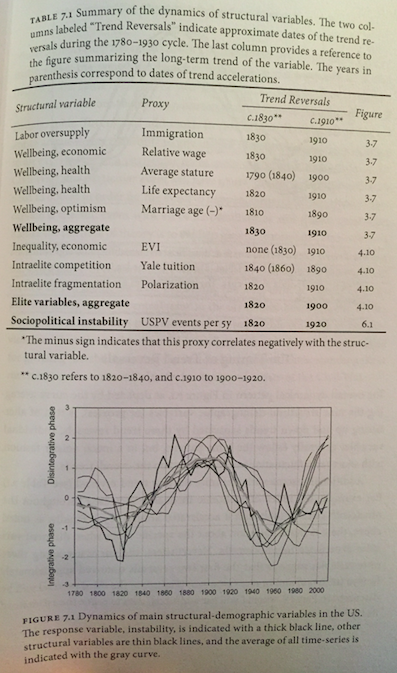
The condition of each principle over a defined period of time can be accessed via different “proxies”––aspects of sociopolitical life for which data are available. Examples of such proxies are immigration, relative wage, and average stature (Labor Oversupply); economic inequality, college tuition, and cost of elections (Elite Overproduction); and homicide, deaths in riots, and public trust in government (Instability). Using these proxies and others, Turchin creates an amazing series of composite graphs that show clear trends. Here is one of them:
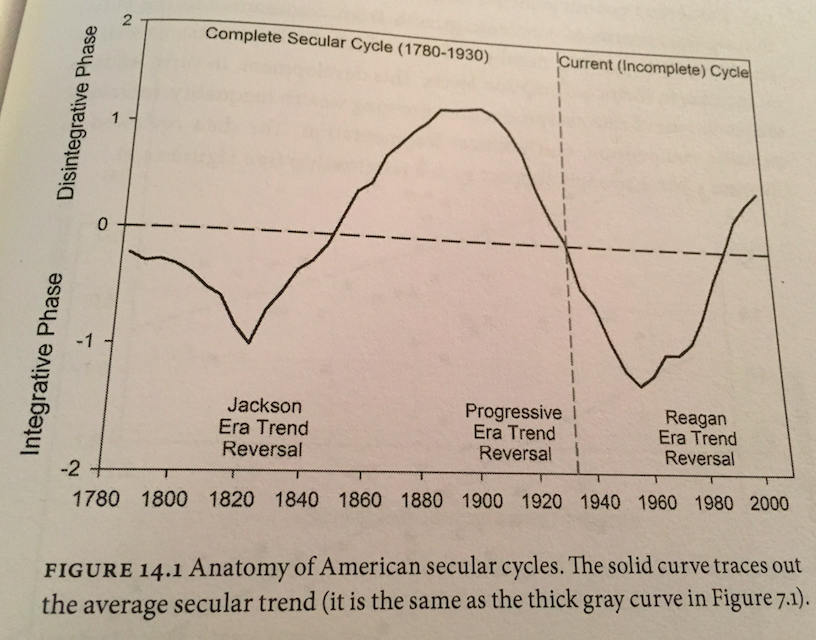
These trends reveal the distinct integrative phases––generally positive eras with low inequality, high social mobility, and strong stability/cooperation––and disintegrative phases––generally negative eras with high inequality, low social mobility, and weak stability/cooperation––of America’s secular cycles. One complete integrative phase plus one complete disintegrative phase equals one complete secular cycle. The above example shows the entirety of America’s first secular cycle (1780–1930), as well as our current, unfinished secular cycle (1930–today). Here are two additional graphs that tell a similar story:
The essential findings are that the first secular cycle began with an integrative phase (the Era of Good Feelings), and then entered a disintegrative phase during the 1830s (Jackson Era). After bottoming out during the Civil War and the Gilded Age that followed, America entered another integrative phase during the early 20th century (Progressive Era). This integrative phase lasted through the Depression, World War II, and the postwar era (Era of Good Feelings II), and then reversed into our current, unfinished disintegrative cycle in the 1970s and 80s (Reagan Era followed by a second Gilded Age).
As you can see, we are currently living through America’s second disintegrative phase, or “Age of Discord.” Although Turchin’s method of getting there is novel, this will not be news to anyone alive in America today, nor to the billions of non-Americans watching on the sidelines as we flounder. Perhaps to avoid seeming overly deterministic or cynical, Turchin is cautiously optimistic about what the immediate future has in store:
"We are rapidly approaching a historical cusp at which American society will be particularly vulnerable to violent upheaval. However, a disaster similar to the magnitude of the American Civil War is not foreordained. On the contrary, we may be the first society that is capable of perceiving, if dimly, the deep structural forces pushing us to the brink. This means we are uniquely equipped to take policy measures that will prevent our falling over it." (242)
Given the remarkable intelligence Turchin displays, it is frustrating that he doesn’t offer an opinion regarding which “policy measures” would give us the best chance to reach our next integrative phase with as little suffering as possible. “I hope that the theory and data explained in this book will contribute to finding solutions that will help us find a non-violent escape from the crisis,” he writes, but his unwillingness to advocate for particular policies makes Ages of Discord feel incomplete––less invigorating and more academic than its urgent message ought to be (248).
Conspicuously, Turchin also doesn’t comment on the ways in which new global pressures such as climate change, technological advancement, and bioengineering might accelerate, retard, or disrupt our current secular cycle or those that may follow. Even so, Ages of Discord is one of the better American history books available. Readers will have to draw their own conclusions about what Turchin’s work demands of citizens eager to save America from itself.
This review was originally published on my blog, words&dirt.
Given Peter Turchin's stated goal of bringing a scientific approach to history, it's not surprising that the progression of his historical books through different eras and regions doesn't resemble the way a historian would approach that set of topics. He made a series of hypothetical quantitative models and then set about finding data with which to test them. His first data-driven book, Secular Cycles, makes what I found to be a very satisfying case for endogenous socioeconomic mechanisms driving broad historical patterns. Population growth in agrarian states creates conditions that support growing populations of elites, until resources are fully utilized and growth stops, at which point, conflict over scarce elite positions drives population down again. It's a neat, self-driving cycle with a period determined by human reproductive capacity.
The problem is, the driver of that cycle stops functioning after the Industrial Revolution. There are no cycles of population growth rates in the United States, so all of the mechanisms downstream from that are no longer inevitable. Land scarcity, elite position scarcity, none of it seems like it should be driving historical cycles anymore. And yet, based on the mere existence of this book and some of his blog posts, it was clear Turchin didn't think these were disqualifying for his model. So I've been looking forward to reading this book largely to hear him explain which parts of the agrarian model still apply and which don't, and why. And since it's focused on American history, I have the idea that it would be even more popularly oriented than his previous books. War and Peace and War certainly is compared to Secular Cycles, and I thought this might continue that trend. There is so much historiography to deal with here, so many existing explanations to engage with, that I assumed he'd want to spend a lot of time justifying how his model either underlies or overrules those ideas.
Instead, he takes the hard opposite approach. He introduces the same structural-demographic model he's used for all these books, and then makes the smallest possible modifications to them to accomodate non-agrarian societies. Then he goes directly to the data to see what they show. The idea, of course, is that he wants to avoid using his prior knowledge to make the model fit better than it should. So when he finds that the data does in fact fit the model, that is interpreted as remarkable empirical support for the hypothesis. As it turns out, the data does fit the model, revealing an dramatic and underappreciated pattern with mechanistic explanations for a broad sweep of American history. Fascinating! It raises a lot of questions. Unfortunately, the book doesn't really have any interest in answering them.
In the broadest strokes, the big question is why American history would follow a pattern driven by population growth and growth rates have been steadily falling. The answer is that the role of population growth has been cleanly and completely replaced by immigration. Turchin simply asserts this, since it emerges from the empirical patterns in his data, and doesn't address the mechanistic assumptions it implies. The mechanisms seem fairly intuitive at first glance. High wages attract immigrants in the same way that they drive population growth. High immigration rates reduce wages, increasing elite opportunities. When immigration outpaces the economy's ability to absorb them, wages fall even farther, elite conflict begins, and immigration rates drop.
Turchin, as far as I noticed, never once mentions immigrant demand, which seems like a key driver in this system. Instead, he focuses on immigration is the result of political negotiation. When wages are high, business leaders pressure politicians to increase immigration in order to lower them. This seems like a fairly straightforward process on both sides. High wages mean high desire to immigrate, and elite support for immigrants to come. It's the other end that seems more sketchy to me. Turchin's first secular cycle reaches its disintegrative phase in the early 20th century, and he attributes the end of open immigration to international political activism by communists and anarchists creating solidarity between natives and immigrants, threatening the control of elites. The mechanisms at work here just don't seem necessary or universal enough to justify the idea that this is the same kind of secular cycle. Why would the dynamics of immigration on wages and politics in industrial economies play out at so precisely the same timeline as those driven by population growth in agrarian economies?
And while Turchin presents the picture going the other way, as if the multiple lines of evidence for his secular cycle must prove the mechanisms needed to explain it, I think a lot depends on the validity of the assumptions he makes about immigration. And those assumptions all go counter to all of the research I know of about immigration industrial economies – not to mention my values. Because the take-home message of this book is basically the Trumpist theory that immigration causes misery. Immigration causes not just lower wages, but lower height and life expectancy (though these two are no longer linked today) and even higher age at first marriage. Despite Turchin's empty and unsupported claims to the contrary, there seems to be no reason to believe that any political choices we make can influence secular cycles, so it doesn't seem to support that idea that our wellbeing would be best served by permanently restricting immigration. Trumpism isn't "right," it's just an inevitable swing of the pendulum. Either way, that is a shitty message and I'm under the impression a lot of economists have good evidence against it, that immigration is a net positive for native well-being. So the fact that Turchin doesn't justify this stuff leaves me feeling a bit skeptical of the whole model.
As a book, it's mathier than ever, feels somewhat less historically engaged, less theoretically coherent, and doesn't address the major questions its premise raises. And yet, it still feels like a major development in American historiography, something that other historians need to respond to and integrate or refute, an important starting place if not a final theory for industrial cliodynamics. Not something to be casually dismissed.
[July 25, 2018] This book uses statistics and demographics to analyze historical trends. Basically he contends that most human history follows a pattern of a period of rising amity followed by a period of rising conflict that likely results in a major war, and that those patterns are fairly regular and even predictable. The whole cycle lasts around 150-200 years, though there are more frequent 50-year spikes of unrest and retrenchment. He posits that we are currently in a period of rising conflict comparable to that which preceded the American Civil War, and he provides detailed statistical evidence for that claim.
I am not a student of statistics or mathematics, so his detailed discussions of statistical methods and formulas often lost me, but I was still able to generally follow his theory. Maybe he sometimes seemed to pick and choose among the factors that he tracked, but often he had no choice. He did not always have available the data from historical periods that he had for the current era. Even so, it was a fairly compelling, even frightening, analysis.
I recommend this book to anyone interested in history or just in the current political situation. If we recognize what is happening, and why, maybe we will have more success at preventing the next major conflict.
I appreciate the ambition in Turchin’s attempt to map social instability through measurable patterns, though Im not convinced political crises can be reduced to tidy metrics. It’s very ~systems theory~, poststructural skepticism toward the autonomous individual, history driven by large forces rather than by singular actors, etc. Compelling and fun to read, but (as a capital R Romantic) it still feels fatalistic to me, even a little Calvinistic. Emphasizing patterns and statistical regularities turns political leaders into symptoms rather than agents. Andrew Jackson and Ronald Reagan (the most damaging US presidents in my opinion) didn’t just reflect structural pressures of their time...they actively made choices that widened inequality and deepened division. Like yes - !!the patterns!! - but also policy decisions (defending slavery, rejecting compromise, escalating hostilities) are what pushed the crisis forward.
I'm continuing my investigation into the deteriorating socio-political situation in the United States. In this book, Peter Turchin provides more illumination than anything else I have read. I'm working on a longer review. I highly recommend the book - more than that, I urge you to read it. The more people who understand what is going on, the greater the chance we can undertake to steer the 'ship' away from the dangerous course we are on.
I lack the mathematical skills to accurately judge Turchin's model. I enjoyed the book, it made me think of how this fits in with evolutionary psychology. I like the dryness in the book, because I'm tired of books which use their larger share of telling a story and a small part about the science.
Ages of Discord de Peter Turchin es un libro estupendo, su trabajo de historiografía desde el lado de la historia económica y de la historia social es sobresaliente, esta muy bien escrito y su explicación es lógica y consistente con su hipótesis sobre la teoría estructural demográfica.
El libro tiene el propósito de adaptar y aplicar la teoría estructural demográfica al caso de Estados Unidos desde su independencia, tal como lo hiciera Turchin y Nefedov para el estudio de las sociedades antiguas, medievales y de la modernidad temprana en Secular Cycles. El resultado es sorprendente, la evolución de los indicadores de salarios reales, desigualdad, conflictos políticos, etc, mapea muy bien las predicciones de su teoría, la gente en general si se comporta de la forma en que se esperaría.
Al final del libro lo más llamativo es su predicción de una nueva era de la discordia, con una inestabilidad política llegando a sus niveles más altos en la década de 2020. El propósito del estudio de la cromodinámica, como llama a este campo Turchin, es el poder aprender del pasado para ser sociedades que por primera vez en la historia tengan la capacidad de evadir el desastre cuando el conflicto causado por la sobre producción de las elites y sus conflictos internos, el empobrecimiento de la población y la mayor desigualdad y la perdida de capacidad del Estado se combinan.
Por lo que vemos ahora mismo en Estados Unidos y en el mundo, parece que no seremos las primeras sociedades en aprender la lección y evitar la catástrofe.
Peter Turchin's modeling of social pressures leading on various kinds of economic and political instability is impressive. Showing a clear relationship in business cycles, wealth concentration, and social attitudes on a two cycle scale does make the kinds of political and health crises we see understandable. While there is some elasticity in his definitions that can make his transhistorical comparisons a little questionable, his model of U.S. is functional and, yes, he predicted we were headed for discord a few years before it was obvious. This is a dense and somewhat technical text, but it is obviously eye-opening.
I skimmed parts and read others more in-depth. There are a lot of interesting ideas presented here pertaining to the causes of the American Civil War and civil strife in general which are thought provoking in these (2020) times. The third explanation of history, that it isn't Great Men or Ideas/Innovation that drive change but a series of inexorable cycles, bears consideration. But really, a cover-to-cover reading is only requisite for someone really needing to engage fully and professionally with this book, and that is not me. I came away with plenty to chew over and I am happy with that.
the author writes about the 4 factors that influence the rise and fall of civilizations. He then maps those factors to the historical time periods of the US - and also to the present-day US.
It’s a dry read, data-heavy, but very interesting.
A very different approach and analysis about the Rise and Fall of civilisations, also very technical and heavy on mathematical modelling. I still prefer the historian Carroll Quigley's book, "Evolution of Civilisations" and his theory of Seven Stages of Civilisations.
Using MATH and LOGIC, Peter Turchin PROVES my long-held suspicion that the ‘70s were the start of everything that’s gone wrong for America. In all seriousness, this is a really neat project – one that has received surprisingly little mainstream attention despite its compelling analysis and unsettling conclusions. Building off his previous efforts, Turchin applies structural-demographic theory (SDT) to the United States in order to chart its cycles of political instability and offer up a predictive model about where our nation is headed. Needless to say, the results ain’t pretty and place us squarely in a period of great undoing.
It’s basically impossible to avoid a comparison between this ‘cliodynamic’ methodology and the fictive mathematical augury of one Hari Seldon; however, while making my way through Ages of Discord, I couldn’t help but think it also represented a perfect manifestation of E.O. Wilson’s consilience dream. Turchin has produced a truly transdisciplinary work, compiling a vast array of historical indicators and processing them by way of a creative analytical toolkit to generate narratives about the secular flux of our societies – how destabilizing ideals can be tracked almost like waves of contagion as they sweep through susceptible populations that eventually become inoculated, recover, grow complacent, and begin the integrative-disintegrative sequence all over again. His primary explanatory arc regarding how labor oversupply yields ‘elite overproduction’ which in turn leads to intraelite competition and a general breakdown of central authority is a captivating addition to the conversation on our current political and social fragmentation. Reading this in late 2020 while holed in a tiny mountain town – pandemic raging, election drama in full swing, the country ripping apart at its seams – was quite a trip. All of Turchin’s ominous predictions appeared to be coming true in real time.
The ambitious vision and unorthodox techniques presented in this text are sure to rankle more staid academics. Indeed, I think it would be reasonable for a reader to approach this exotic terrain with a hearty dose of skepticism – wondering what sort of statistical legerdemain, self-fulfilling assumptions, confirmation biases, QRPs, general apophenia might be lurking under the hood. There’s definitely an air of data woo (not to mention a bit of a timeframe problem given how few full ‘cycles’ this young nation has undergone) one has to work through to fully embrace all the sexy, eerily synchronized graphs. Still, Turchin seems to be operating openly, rigorously, and in good faith; I’ve read far less meticulously crafted ‘grand theories’ over the past few years. While perhaps no psychohistory, this endeavor is assuredly a gauntlet thrown at the feet of its adjacent fields of study – one they would do well to pick up. No matter where the investigation leads, it is sure to enliven the conversation and break open new avenues of exploration into the complex dynamical systems that govern our social order.
One of the oldest and most common endeavors of those who have thought about the long arc of history has been to discern the long trends—sometimes expressed as “laws”—that govern history. The earliest theorists discerned a cyclical pattern, from the earliest myth-histories to the Greeks, and then the great North Africans, St. Augustine and then Ibn-Khaldun. With the Enlightenment, the idea of unending progress arose and even the concept of an “end of history.” But in the 20th century, with the works of Spengler, Toynbee, and Sorokin, the ideas of cycles once again gained traction. Of course, it’s possible to argue that there is progress in history that is marked by cyclical patterns (a “spiral dynamic” as one viewpoint labels it). Both the march of progress perspective and the cyclical perspective have proponents and persuasive arguments in their favor. I adhere to the aphorism that “History doesn’t repeat itself, but it rhymes” (misattributed to Mark Twain, but worthy of him). And I’m just not sure where the long arc of history will take us.
Foremost among those exploring the rhymes of history today is Peter Turchin. I’ve enthusiastically reviewed his work here and here, so I won’t repeat too much in the way of background. In his most recent book, Ages of Discord: A Structural-Demographic Analysis of American History*, Turchin delves into a major issue that he left hanging in his previous work. That is, whether the cyclical patterns that he and his confederates identified in a broad range of pre-industrial societies apply to modern, industrial nations. The work of Thomas Malthus and demography as a field of knowledge play a crucial role in his pre-industrial models. In brief, a national or regional population would overshoot the available food supply, leading to widespread immiseration and discontent among the non-elites. In the 19th and 20th centuries, however, food supply has not been an acute issue in industrialized societies. The expansion of European culture and science into the Americas and other locales around the world opened up new sources of food, and science devised new, more efficient means of agriculture that created unprecedented food supplies and food security. So, would this end the cycle that Turchin explained to the general public in War and Peace and War?
Turchin puts to test his structural-demographic theory by examining the history of the U.S. Does his theory hold in this modern, industrial land with abundant food? The short answer is “yes,” a cyclical pattern can be identified following a template established by older societies. And the new ingredient replaces the Malthusian trap and instead immigration comes to play a crucial role. In short, while food and even land were widely available in the U.S., there were still stressors placed on most individuals by relative wage stagnation. With population growth from both fertility and immigration, there were periods, notably in the 19th and early 20th century, when virtually unlimited immigration caused wages to stagnate. The “give me your tired, your poor” meant that wages would remain lower as the nation’s reservoir of wage labors kept filling to the brim. Given the current political conflict about immigration, Turchin’s statistics provide a bracing reminder of the complexity of this issue. I’m a descendent of Calvinist immigrants from around the time of the Mayflower and the late 19th-century Irish immigration. I’m the product of both the long-established and the newcomer. Xenophobia and ethnic stereotypes are not the only—or the most cogent—grounds for imposing limits on immigration. However, I hasten to add that after the limitation of immigration in adopted in the early 1920s, when the Red Scare and widespread unrest were causing alarm among elites, led to a drastic decline in the number of immigrants. And from this point forward, Turchin does not identify immigration as a significant factor in the down cycle that began in the Regan era. (Turchin also notes that the Red Scare of the 1920s with the Palmer Raids and like instances were not the result of imagining bogeymen in the closet. The revolutionary potential in the U.S. was serious. Even paranoids have enemies. (The same can be said of the McCarthy Era; for all the paranoia and desecration of fundamental standards of decency and lawfulness, Alger Hiss and the Rosenbergs were Soviet spies. Despite our desire to uncomplicate it, history remains complicated.)
I would be remiss, however, if you came away thinking that Turchin’s work is only about population and immigration. Turchin’s formula includes a variety of variables. (He expresses his theory via mathematical algorithms, but don’t let this deter you, as Turchin expects it might. He explains it all very well in plain English in addition to providing the mathematical models.) And Turchin, experienced historian as he is, also recognizes that stochastic variables (unanticipated and unmodeled factors) can affect turn of events and the course of trends. (Turchin emphases that he seeks only to identify and track trends, not forecast events.) In addition to population and labor supply issues, Turchin identifies “elite overproduction,” youth bulges in the population, the fiscal soundness of the state, and “cultural factors” as other key ingredients in identifying what overall trends of well-being and stability (or ill-being and instability) the nation will likely experience. Using a variety of databases, Turchin follows the course of U.S. history from the founding of the republic up to the publication of his book in 2016. Along each step of the way, he draws upon quantitative data supplemented by a narrative of events to further his thesis. For anyone acquainted with U.S. history, it’s an intriguing review from a new perspective.
But like most of us, I’m most interested in what’s happening around me. The incredible turn of events surrounding the 2016 election and initiation of the current presidential administration were particularly intriguing. And here, Turchin does not disappoint, and he offers no comfort. In short, beginning around 1920 and continuing through the Great Depression, WWII, and into the post-war era, the U.S. went through what Turchin labels “The Era of Good Feelings II,” named after the first era in the early 19th century, when the nation was young. But by 1970, cracks in the foundation of this era began to appear, and by the beginning of the Reagan presidency, a deterioration becomes apparent (although Reagan’s charm and optimism hid a great deal, I might add). One of the most widely identified factors in the current phase is the stagnation of wages, which affected voters’ choices in recent elections, especially in 2016, when voters decided to gamble on a complete outsider. But elite overproduction has also continued, and social norms have continued to deteriorate. Statistics about the polarization of Congress are shocking but not surprising. Based upon the trends, which events could alter, we won’t hit a peak of social and political disintegration (that certainly entails violence) until after 2020. In other words, hard times lie ahead.
Turchin’s analysis and perspective on the current trend in America provides a needed contrast or at least a supplement to other diagnoses. For instance, I recently finished reading Pankaj Mishra’s The Age of Anger. In that work, Mishra argued that what we in the U.S. are experiencing, as well as many other nations, is a continuing rebellion against modernity. In other words, a continuation, after a brief reprieve, of the social, political, and economic unrest that the world experienced in much of the 19th and early 20th century. But the shortcoming of Mishra’s analysis is that it does not explain what turns-on or turns-off this discontent. Modernity, while new to some parts of the world, is certainly not new to the U.S. Turchin’s analysis suggests that the turmoil and political upheaval that we’re now experiencing are a part of a much longer term trend.
Turchin offers us one ray of hope. By identifying these trends, by obtaining this knowledge, he suggests that we can intervene to alleviate the bad times that we seemed destined to endure. Alas, I believe that we as a nation and as a species are too stuck in our ways, too myopic, to take advantage of our knowledge. As reflected in St. Paul’s lament, “for the good which I will, I do not; but the evil which I will not, that I do,” aligning human knowledge and will is terrifically difficult and usually occurs only under duress. What might that duress be? It would have to be some “exogenous event,” something outside of Turchin’s model. An alien invasion? A dramatic and devastating change in the climate? Or perhaps some new, emergent property will manifest. The history of the universe is the story of one emergent property unfolding after another, which we can come to understand in hindsight but that we cannot forecast. The cultural evolution of humankind, the development of language, writing, and mathematics; developments of technology and the accumulation of scientific knowledge; the ability to live in cities and vast societies—all are properties and traits that emerged from generations before us. But the hardest change to manifest is within the species itself, within the individual and collective consciousness. And when under threat and stress, more often than not devolution replaces evolution. Can we avoid this? Can we start to navigate our own ship? It’s something that we have to strive for even as the likelihood of success remains low. And Peter Turchin has provided us with useful guidance for our endeavor.
*Turchin just announced that the book is now available on Kindle. He initially declined Kindle publication because of the number of table and charts included in the book, but feeling assured that these could be properly presented, he authorized a version. My reading of the book was delayed until my courier (daughter) brought me the paperback version at our Christmas visit. Thus, my delay in completing and reviewing this book that I had been looking forward to reading. The Kindle version is good news.
Shouldn't we be able to learn from history? Shouldn't we be able to apply the same general quantitative methods that we use in other soft and hard sciences, from physics to psychology, to history as well? Shouldn't we therefore, in some limited sense at least, be able to predict where history is going?
Peter Turchin thinks so, although he sees some key limitations to his method. I'm really surprised that Peter Turchin's books and work generally haven't caught on in history circles as much as they should have. But be warned: this, like his earlier book Secular Cycles (co-authored with Sergey Nefedov), is totally academic. On a scale of 1 to 10, where 1 = "light summer reading" and 10 is "totally academic," this book is a 10. Want something less academic but in the same general area? I'd suggest Ultrasociety or War and Peace and War.
Turchin sees an entire "secular cycle" in American history, from the American Revolution to the Great Depression. He compares this cycle to earlier cycles of agrarian societies in Secular Cycles such as Rome and medieval England. The major political instability of this American cycle is represented by the American Civil War. We are also partially through a second cycle, and the signs are indicating a major period of instability ahead.
Turchin thinks he can predict crises, but he is less confident of the ability to predict their outcome. In a lecture, paper, and blog post on this subject, he indicates that while the entry into a crisis is fairly predictable, how the crisis will be resolved is not. In Secular Cycles, he shows that eight different cycles were generally predictable but they were all resolved in very different ways. Bottom line for today: a major crisis in the U. S. A. is pretty much inevitable; how it will be resolved is not.
What drives this theory? There are several drivers of social instability, and these are cheerfully summarized in the conclusions and discussed throughout the book. (1) "Labor oversupply" is the Malthusian piece of his theory. If conditions are favorable, then population will increase, either naturally (through more births) or through immigration from abroad. Both of these forces really do tend to depress wages. In this sense, the right-wing thesis that "the immigrants are taking away our jobs" is correct even if the right-wing policy implications are cruel. (2) "Elite overproduction" is the Marxist piece. If wages decline, then it's a great day to be a capitalist, and so existing capitalists will thrive and more and more people will want to be a capitalist --- "everyone wants to be a millionaire." But eventually, there will be too many elites, more than the society can support. (3) The "instability principle" connects the demographic pressures with the social structure. Elite overproduction means that there will be rivalry between different elites. "Popular immiseration" means that the ordinary working people will be worse off than ever, and thus restless and unhappy, and the various elites will try to appeal to them. Finally, there may be a fiscal crisis of the state. All of these will create instability. All of what he says about the U. S. A. roughly parallels what was said in Secular Cycles.
There are two interesting things that stand out for me here. (1) He has extended this from agrarian societies (like ancient Rome) to industrial societies (like the United States today). (2) The role of "the masses" in all of this is relatively minimal. Turchin thinks that the elites, as long as they are united, can always suppress a popular revolt. Instability comes not from rising up of the masses, but the civil war between the elites (like the Wars of the Roses). The masses can only have an influence if one of the elites tries to ally themselves with the masses --- this sounds like what both Donald Trump and Bernie Sanders are trying to do.
Not only does Turchin's math and data make sense logically, it also makes sense intuitively. Turchin predicted in 2010 that the coming decade would be one of growing political instability; and this seems to have pretty much turned out just as he forecast. The main thing that I'd like to see Turchin address is the "limits to growth" problem. There is both an upside and downside for Turchin's theory here.
The upside is that Turchin's ideas could be used to explain the failure of the "peak oil" forecasts of the early 2000's. I thought that oil was going to peak about 2010 to 2015, and was surprised when it didn't. I went back to the drawing board to try to figure out why peak oil theory failed. And actually, peak oil theory DIDN'T fail, it's just that we assumed that oil production was limited by economics, whereas it was actually limited by politics.
I thought that as oil grew scarcer, it would grow too expensive and consumption would fall. In fact, politics overruled economics. The elites realized that oil must be kept pumping, no matter what, so we tampered with foreign policy (Bush's invasion of Iraq), or with the economy (Obama and "quantitative easing"), or with the environment (Trump's denialism of climate change and loosening environmental regulations), all using different means to keep oil accessible. The costs are not borne by the consumer, but by society as a whole or even the entire planet's ecosystem as a whole, so we don't see them at the gas pump.
The downside is that there's no discussion of any "limits to growth" parameters by Turchin. We are rapidly approaching a major eco-collapse: the destruction of our society through environmental pressures. I am not so sure that the collapse of the United States will work quite like the collapse of either the Roman Republic or the Soviet Union. We may be dealing with something much bigger here: the collapse of industrial civilization. We may have a set of broad ecological cycles here, on which are superimposed the lesser secular cycles, in the same way that Turchin sees generational "fathers and sons" cycles imposed on the broader secular cycles. These smaller cycles may amplify or dampen the larger cycles, but it is the larger cycles that ultimately determine the course of history. We need to reduce population, reduce industrial consumption, and eliminate livestock agriculture, the leading destroyer of the environment.
This is the math that substantiates Nick Hanauer's claim that the pitchforks are coming (i.e., that income inequality is leading to a massive underclass of people who are angry and uncerserved, as well as an over-large group of elites who are making it worse by buying yachts and stirring up trouble politically).
For people who are not convinced that Trump, Clintonistas, and BernieBros are all growing from the same soil, this is a good book to convince you otherwise. If you don't know who Nick Hanauer is, Google his TED talks and articles first. You may not need all this math to be convinced.
Societies go through secular cycle of integrative and disintegrative (age of discord) phases : prosperous and high on economic and social well-being, with a cooperative mood (a willingness to go beyond one's group narrow interest), then anxiety ridden, low on well-being and cooperation. Turchin shows how the Structural-demographic theory first championed by Jack A. Goldstone in the antic (Roman) and (French, English, Russian) medieval eras can also account for the United States's secular cycle (going from 1780 to 2010, with the Civil War being the first Age of discord).
Structural-demographic theory (SDT) is adapted to industrial societies by going beyond the Malthusian view. Population growing over food and land supply, pushing the surpluses in cities, no longer act as the main driver to the strive for survival. Thanks to a scientifically steered production, and thanks to rational policy making, industrial societies know of no food shortage, while land shortage only matters for a limited transitional phase to urban life. Arguably. Labor oversupply, bolstered by population growth and immigration, takes precedence as the new, neo-malthusian premise of the SDT. So far, so good.
Elite overproduction is the second, main set of variables which SDT use in accounting for secular cycles and in accounting, more specifically, for Political Stress Indicator, and Mass and Elite Mobilization Potentials.
Roughly, SDT goes like this : labor oversupply causes wage reduction. Wage reduction favor elite growth. Elite growth instill a within elite rivalry for decisional / public offices, for high valued academic diplomas, and for conspicuous consumption more broadly. Up to a certain point, elite rivalry turns into an Elite mobilization, "closing the patricians" (closing entry for aspirant), polarizing ideological stances, fragmenting interest groups, and driving real and relative elite wages to extreme, following a winner takes all (looser aspirants bite the dust) scheme. Frustrated aspirants may turn into anti-elites that steer popular and other aspirants contempt.
Labor-oversupply (mass mobilization potential) and Elite overproduction (closure of the patricians) makes for a growing structural, socially disruptive, Political Stress. Within this context, many contingent, contextual events can ignite major crisis. Structural causes, Contextual/Evenemential triggers.
Turchin's use of the SDT is enlightening, not only for its neo-malthusian view on immigration (which act as a mean of keeping wage low, and as a premises for social crisis). But even more so in bringing both Complexity Theory and Cultural Evolution (often labeled Multi-level selection) theory into view.
For complexity theory, evolutionary tendencies are best taken as grand sets of variables interacting in feedback loops. Wage do not fall immediately with labor oversupply; instability do not rise immediately because of wage reduction and elite overproduction, but may follow a Father and son scheme (those who lived long enough to take lesson from a prior crisis, and who act as social moderators, have to die before youngsters got entrapped into radical as-if new ideological stances).
Turchin's recognition of Culture as the major variable that glue grand sets of variables together and that can accounts for the causally complex interaction among these, is worth the read. The fine tuned definition of the sets of variable is also enlightening (cooperative mood can be traced, for instance, by the names given to new counties - be it names given after National figures, or after local figures; elite competition is tracked by, among other things, tuition fees in Harvard, Princeton, Yale for Law and MBA).
Following David Sloan Wilson, Herbert Gintis and other proponents of the Multi-level selection theory, Turchin sees all the structural parameters as, either leading to (i) a broad, social cooperative mood, taken as a disposition to act toward common goals and doing compromises (be it in accepting taxes, in putting confidence in political institutions, in going to war), or leading to (ii) an uncooperative mood, with narrowly defined, partisan interest groups indulging in greed and egoistic celebration.
In line with the Transition view of biology, living matters went through eight transition phases that are similar at the formal level : be it by the first molecular coalescence, by the formation of RNA chromosome, by the formation of DNA, by eukaryote steming from earlier prokaryote, by sexual reproduction rising after self-same, asexual reproduction, and going such until the formation of social groups (be it insect like wasps and ants, or ape and human groups), the same transitional form occur where prior self-sufficient individuals can no longer reproduce and self-regulate except as a part of a greater, new individuality. Fighting against the milieu (of hostile, low-energy substrate, or the milieu of other, energy-consuming rivals) is ofter taken as the main driver for the evolutionary emergence of a new individuality. In defending the ecological niche in which individuals rise their offspring and feed, these same individuals may unite, transcend their rivalry and form one cooperative group outcompeting other, less integrated or uncooperative predators.
This transition view is not taken, word by word, to account for American's success at building their prosperity, well-being and cooperative cultural mood during two eras of Good-Feeling (1780-1830; 1930-1970). But this very same view is easily recognized : first era was one in which heterogenous, European breed settlers put aside their adversity (as Quakers, as Mormon, as Protestant, as Catholic) to better fight and defeat, under a common "White" flag, the American Indians. Second era was one in which middle and upper classes, together with political milieus, on their way to the New Deal, united against the threat of foreign ideologies spreading, through immigration, at home (mainly communism and anarchism), and against prior intra-elite's competition (with massive, losers bite the dust externalities). Reading comments by Rockefeller and Roosevelt favoring cooperation between unions and corporation feels special and contrasting with today.
Turchin tests SDT for the US secular cycle through large sets of variable interacting in feed back loops with trend reversal points and cultural markers, giving the Political Stress Indicator and its reverse : Social and Economic Well-Being. The latter covers age at marriage, life expectancy, stature (or height, taken as indicating how formative years of life are secured against high level of stress and work effort), child living with two parents, portion of GDP per capita distributed through wage policies, degree of inequality. The historical, statistical datas are showed in graphs, compared with the SDT hypothesized curves in an layered way (adding one interacting variable after the other), and showed to match the SDT full hypothesized curves.
All variables for a new, ongoing social crisis are met since 1970, and Turchin's wish is to give us a warning against not taking things seriously, and not endeavoring to look at possible peaceful issues.
This book, for sure, displays a great deal of mathematical sophistication that can discourage the lay reader (like me). But holding on is truly worth the effort since it makes you feel like great books do : wiser.
I'm going to start with a big caveat. Turchin's high level thesis is interesting, fairly compelling, and worth understanding if only because it is talked about by the movers and shakers of the world. However, the book itself is... rather dull. The key thesis is covered in the opening chapters (or a gajillion summaries on the internet). Most of the book cover the mathematical modeling Turchin uses to justify his thesis. I like mathematical modeling, so I still found those chapters interesting. But they aren't light.
The other caveat is that it's important to acknowledge the nuance in Turchin's thesis. The popular flattening is that Turchin can predict secular cycles of integration and unrest. That's not right. What Turchin is saying is that Structural-Demographic Theory (SDT) is a better explanation of long term historical trends than focusing on specific events (e.g., the great man theory of history). Specific events matter but they are, so to say, the symptom, and the interaction of structural demographic factors are the root cause. So when he looks at the data, he isn't looking at it in a predictive sense. He's looking at is in an explanatory sense: does SDT explain the real world data well? And the answer is roughly yes.
So, let's get to it. In this book, Turchin applies SDT to American history. SDT explains long-term political instability, civil unrest, and state collapse by looking at structural forces like populations dynamics (growth, age structure), elite competition, and state capacity. The interconnection between these dynamics leads to broad secular cycles, the idea that overall national stability and well being goes through high level cycles that are driven by these underlying dynamics and modified by specific historical events. This is in contrast to the idea that history is primarily driven by specific historical events. Turchin pays special attention to the version of these factors that drive social collapse or civil war.
Popular immiseration: When the supply of labor exceeds demand, economic prosperity declines even as the economy grows. This leads to a declining standard of living for the general population.
Elite overproduction: As inequality grows, the number of wealthy people grows and more people push to become part of the elite. But this population of elites grows more quickly than the number of elite positions available in government and business. This surplus creates counter-elites, elites who seek to overthrow the existing system. A key insight here is that popular immiseration alone is not enough to bring instability. It generally relies on the competition between elites who channel popular unhappiness into action.
Fiscal crisis and state fragility: Rising social tensions lead to more state spending on the enforcement (military, police) and bureaucracy (e.g., social programs) to maintain order. However, elite power makes it hard to tax them effectively leading to growing debt, loss of public trust, and eventually loss of control. Fragility comes as the state loses control of enforcers such as police or military.
In the bulk of this book, Turchin develops a mathematical model to apply this theory to data from two major cycles in the US. First, the time from the post-revolutionary US (integrative phase) through the Civil War and Reconstruction (disintigrative phase). Second, the era from the New Deal up to the 1960s (integrative phase) and from the 1970s to the present (disintigrative phase).
He concludes that we are approaching a peak of instability. But he's not completely pessimistic. While the dynamics of labor oversupply, elite overproduction, and state fragility need to be resolved to reset the cycle, this doesn't require war or societal collapse to happen. (Although he doesn't offer concrete alternatives ¯\_(ツ)_/¯ )
I haven't the credentials in, or the knowledge of, history, politics, economics, sociology, logarithmic equations or statistics (or any of the other sciences I think are involved in unpacking the information found in this book) to be able to realistically review this book in the way many folks here already have. There are several good reviews already that break it down quite nicely, and even offer counterpoint or criticism (particularly in the area of the mushiness of the data and proxies for missing data that Turchin relies on).
What I do believe is that despite these criticisms, it's clear that Turchin is making valid points, and as someone else mentioned, his argument that the gap in incomes of the elites is very demonstrative. Yes the 1% wealth gap is a terrible problem we face in the world today, but the reality of the overproduction of elites and a society that propels its citizens onto the elite path, but doesn't pay them all equally is clearly a marker for a lot of issues today. We face increasing amounts of "thought leaders" and pundits and media voices and politicians, but more to the point, aspirants to the same who cannot "get in the door." Combine this with the availability of social media (this is not something covered in the book, by the way- my own opinion), and we're inundated with loud voices, but without skeptical thinking. This is to our detriment, and leads us down a path of partisan ideology. Turchin explores why this may be and invites you to consider that it may be a cyclical factor of human society in "modern" states.
More people are paying attention to Turchin as it seems a lot of what he has suggested may come about has come about, and in the timeframe he suggested it might. See this article in the Atlantic for an example: https://www.theatlantic.com/magazine/....
There's a lot of heavy math in the book, and it is not an accessible book for a lay-reader like me, yet it still was rewarding to read, and it remains to be seen how important these ideas may be. Its interesting to note that other well-known authors are going down a similar path too (see Robert Putnam and Shaylyn Romney Garrett's The Upswing, for example, which leans on some of the same ideas, but attempts to suggest there may be ways out of the dilemmas we face: https://www.npr.org/2020/11/02/930271...).*
In short, I can't recommend the book unless you're endowed with the technical ability to grasp the equations behind the idea, but I can recommend the ideas and I believe we should be paying attention to the possibility that Turchin is really on to something. Maybe he will write something more accessible now that some time has passed since this book was written-I sure hope so.
It's also fun to note that Turchin's background before he moved into this area of study was as a biologist/zoologist who studied beetles (and more). His attempts to mathematically model dynamical developments of populations of insects led to where he is now.
Heavy, dense, but fascinating and certainly very worrisome if we don't pay heed and consider ways not to fall prey to the possibility that we're moving cyclically and inevitably toward collapse in the United States.
* Putnam focuses on such things as using Google Ngram to find the instance of certain words in use in our vocabulary over time to indicate changes in popular/societal thought. Turchin only touches on this very briefly, but does reference it toward the end of the book
I am doing so well in 2020 in choosing my books! Another stunning choice. Having read Turchin's Ultrasociety last year, I was fairly sure this would be impressive - and it is.
It is not for the faint hearted. There are equations in this book - and some knowledge of elementary algebra, of (very) elementary calculus, and of statistics up to regression analysis, are needed to follow all the modelling. However, it is quite shocking how little mathematical modelling is actually needed to develop some impressive results against the data.
The basic components of the structural demographic theory leading to a measure of overall political stress are models of population and elite dynamics, and the state. This is, then, a thoroughly macro-materialistic account. That is, it is big picture - looking at trends over decades and centuries - and based on direct or proxy measures of society-wide indicators. You can see how non-idealist this is by taking a look at the index and noting that the only names are historical actors (Rockefeller, Reagan, not thinkers - with the exception of Malthus - e.g. Smith, Ricardo, Marx, Hayek, are nowhere mentioned).
Having said that, it is maybe ironic that - in modelling (through a "real wage" proxy) of well-being (in the more contemporary period) the components are GDP per capita, labour demand over supply, and ... cultural factors. Ironic, because, cultural factors really correspond to the role of ideas in conditioning policy - so this is building in a kind of materialist account of idealism. In this case the Hayek, Rand, Friedman that informed the transition to thorough Neo-liberalism after 1980 via Reagan and Thatcher. It takes this last "culture" component to get the model to really fit history (in this case the real wage index between 1930 and 2010) and fit is does - remarkably well. What is also remarkable is that the proxy for culture (the ideas conditioning policy) is just ... the smoothed trend of the minimum wage! It is really quite astonishing that such very simple modelling can be so effective.
Perhaps naturally, the last few chapters - dealing with the contemporary scene - are most exciting, as we are living through it (though the analysis of the lead up to the civil war is also captivating) and the denouement (the graph on the final page - and the front cover of the book) is frightening: that the political stress indicator is now rising steeply, as it did in the run up to 1860.