An enlightening study of the contradictory character of this canonical fourteenth-century Italian poet.
Born in Tuscany in 1304, Italian poet Francesco Petrarca is widely considered one of the fathers of the modern Italian language. Though his writings inspired the humanist movement and subsequently the Renaissance, Petrarch remains misunderstood. He was a man of contradictions—a Roman pagan devotee and a devout Christian, a lover of friendship and sociability, yet intensely private.
In this biography, Christopher S. Celenza revisits Petrarch’s life and work for the first time in decades, considering how the scholar’s reputation and identity have changed since his death in 1374. He brings to light Petrarch’s unrequited love for his poetic muse, the anti-institutional attitude he developed as he sought a path to modernity by looking backward to antiquity, and his endless focus on himself. Drawing on both Petrarch’s Italian and Latin writings, this is a revealing portrait of a figure of a man of mystique, historical importance, and endless fascination. It is the only book on Petrarch suitable for students, general readers, and scholars alike.
This is the year I read Petrarch and I picked this book up to learn something about him, and to get me excited to read his poetry. I wanted to know who he was, and who his Laura was.
Petrarch is generally considered the Renaissance kick-off point because he bemoaned the "dark ages" (a term he came up with) and the forgotten past of Roman intellectual life. He heavily and successfully promoted Latin and the reading of the Classical Latin works like Virgil, Ovid, Horace, Livy, etc. This is all maybe his biggest claim to fame. He's also famous for this laurel crown, his Latin letters, which are preserved, and especially for his Vernacular poetry, Canzoniere, written in Tuscan and the model for modern Italian.
This is a nice, readable, pretty and somewhat brief overview of Petrarch. It makes a good start for my look into him this year. It made me want to read his poetry, especially his Canzoniere, and it also kind of made me not want to read any of his letters or other works.
(22-yr-old Petrarch being pierced by an arrow emanating from Laura‘s gaze - from a 1470 codex of his poetry. )
I wrote a 1900 word review, but I'm also trying to be more readable this year. So, in that light I'm experimenting with hiding all the stuff you don't need read, but that I still want available to me, as spoilers. These are basically my notes.
1. Petrarch: Everywhere a Wanderer by Christopher S. Celenza published: 2017 format: 246-page hardcover acquired: December read: Jan 1-6 time reading: 7 hr 45 min, 1.9 min/page rating: 4 locations: Avignon, Rome, Vacluse, France, Milan, Venice, Padua, Arquà, Italy, etc. about the author: born 1967 on Staten Island, currently James B. Knapp Dean of the Krieger School of Arts and Sciences at Johns Hopkins
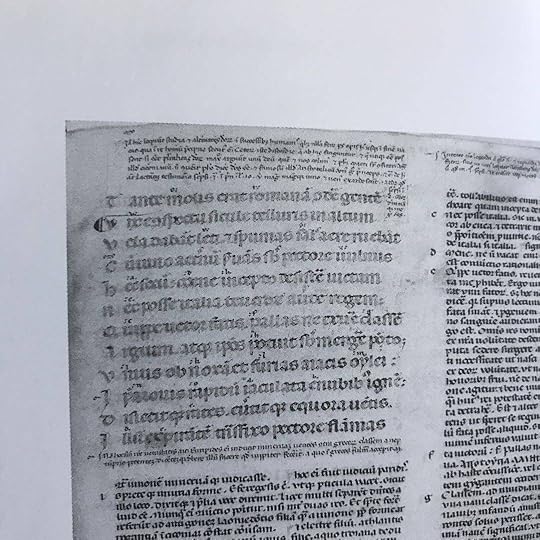
(Petrarch‘s personal copy of Virgil's works. The handwritten note over the beginning of the Aeneid (all in Latin) says, “It is already from this point that the conflicts of the gods and their interventions in human affairs begins. Almost no part of this entire work, all the way up to the end, remains untouched by them. In this respect Virgil follows Homer‘s lead most of all. ...")
Petrarch has endeared himself to me first through his poetry and now reading a bit more about his life. If the sources are there, I would love a big long biography with all the little details, but this one is a good first step to learning more about his life and works. Petrarch's writings form the core of this biography.
If you want to know about the beginnings of the Italian Renaissance and the literary, philosophical, linguistic and cultural revolution it brought to the world, you have got to know something about Petrarch. Celenza's book is a great start. It is a very readable and insightful biography that does not shy away from tackling the many contradictions of Petrarch's life and times.
It could not have been easy for Celenza to write a popular biography of a man known primarily both for and through his writings. Nevertheless, he proves up to the task, painting a compelling literary portrait of a man for whom literature was the art of living. Celenza's style is light, conversational, personable, but his insights are sharp and powerful.
His approach, a good choice for his subject, is to take an exemplary text and unfold it with an eye toward what it reveals about its author. One of Petrarch's endeavors was to craft his sense of self through writing; Celenza picks up that thread at its endpoint and traces it back to its source. The result is vivid, almost cinematic, as if you were in Petrarch's study, watching him put his words on page, hearing him think out loud, experience him forming himself by his art. There are a few drawbacks to this approach. The first is that the book is rather episodic; a few times I felt myself losing touch with the chronology, as Petrarch's life gets overshadowed by his works. Also, occasionally Celenza lingers a bit long over one text, veering toward an exegetical lecture and crowding out others. (I am slightly miffed that my favorite Petrarchan work, "On the Solitary Life," was never discussed.)
All in all, this was a highly enjoyable book and certainly my highest recommendation among English-language biographies. It's appropriate for scholars and non-scholars alike. Scholars just now becoming acquainted with Celenza should check out his thoughts on Renaissance studies in The Lost Italian Renaissance: Humanists, Historians, and Latin's Legacy.
I truly enjoyed this read. From the beautiful cover to the photos of Petrarch's annotated manuscripts to the engaging writing voice of the author, after reading this book you'll come away with a better understanding of Petrarch, the man, poet and humanist. Celenza has a wonderful way of giving Petrarch's words another dimension by placing them firmly within historical and cultural context of the Renaissance.
This is not an introduction to the Canzoniere, the vernacular poems for which Petrarch is now most famous. Celenza gives each element of Petrarch's life and work the emphasis the man himself did. So we get a lot of analysis of the Latin works as well as the vernacular. It is a marvellous book for getting an all round view of Petrarch the man and the writer and the scholar. The linguistic analyses, especially the Latin ones, are excellent as you would expect from Celenza.
An exceptional and contradictory character; much of what Petrarch says of the church is still pertinent today. Understanding the medieval period may well offer insights to our modern era.