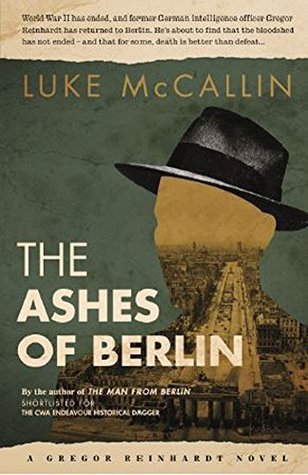
I think it’s important to be honest, so I will confess that The Ashes of Berlin was my first foray into the writing of Luke McCallin and of Captain Gregor Reinhardt. However, I had heard the author on a panel at book festivals in the past and the premise of this latest book sounded really intriguing. I don’t think that I was at any kind of disadvantage in not reading the first two books in the series, other than I think I’m probably missing out on something special. I will remedy that as soon as I can. I have, however, read this book and I think you can absolutely read it as a standalone as you are given considerable information about Reinhardt’s past, without it feeling like overload, so readers new and old are both able to enjoy the read.
Now working for the Police in post-war Berlin, Gregor Reinhardt finds himself called to the scene of a suspicious death – a man who has been found at the bottom of a flight of stairs. The man has no papers, unusual for any person in the new Berlin, and his body looks to have been beaten, but whether it was before or the act which resulted in his fall is not clear. As Reinhardt begins to question the residents of the neighbouring apartments he makes a rather grim discovery – a second body. Steered away from investigating the first death by superior officers who are more than a little suspicious of his relationship with the Allied forces, Reinhardt is left to investigate the second death something that pits him against both the Allied and Soviet authorities and puts his life and career in danger.
What I really enjoyed about this book is that while set in post-war Berlin, it was not dominated by any political or historical dissection of the socio-economic status of the country, and yet it still perfectly captured the essence of what it must have been like at the time to live in Berlin, a city trying to rebuild itself around division and mistrust. The city, and the city’s history, are merely a back drop for what is, in essence, a very well written investigation into a serial killer who has been operating across Germany.
Luke McCallin has managed to incorporate all of the sentiment expected post war; of those who back the Allied forces, those who turned to Soviet rule and those who mourn the loss of Nazi principals in society. The plot integrates all of these opposing forces brilliantly, using them to both aid and hinder the investigation, and on more than one occasion to drive the sense of tension as we wait to see what will happen to Reinhardt as he flirts with danger. He is caught in the middle of it all and yet he has only one mission in mind. To solve the case and bring a murderer to justice. McCallin also uses the ruin of a once magnificent city both literally and politically, and its impacts upon the citizens of Germany, to create a feeling of oppression, a depressive gloom which envelops the city and informs the atmospheric nature of the writing. Everything feels constantly balanced on a knife edge, and on occasion, this couldn’t be more truthful.
I really liked the character of Reinhardt. There was something intrinsically honest about him. He had been a part of both Wars, had served his time in a army who he could not always feel an affinity for, and bore the scars, both physical and metaphorical, of war and loss. He is maligned and ostracised by his colleagues, and both trusted and met with suspicion by Allied and Soviet forces alike. And yet, his most honest relationships, besides that with his friend and housemate, Brauer, are with a British agent called Markworth and a Soviet Agent, Skokov. The dynamic in both relationships is very different as you would expect; one is friendly and companionable, the other stilted and driven by duty and desire to control. And yet with both men, Reinhardt seems to enjoy a certain element of trust and perhaps even respect, even if in Skokov’s case, it is balanced with a healthy dose of fear.
The writing in this novel is excellent. It is in no way a quick read, and nor should it be. The story slowly unfurls, the pacing informing both the tension and the investigation. There are part where the narrative will have you on the edge of your seat, where the stakes are at their highest and Reinhardt is placed in jeopardy. And yet the investigation takes a slower pace, reflecting the challenges that faced the police in the early years following the Allied occupation of Berlin. Many records are destroyed and those that aren’t are difficult to access. This was way before the digital age, where teams of secretaries had to plough through thousands of documents in order to find the key piece of evidence required. Telephone connections cannot be guaranteed, and passage around Germany was hampered further by political and geographic boundaries. The Allies v the Communists. It all added to the authenticity of the text and the level of research and understanding of this point in history rings true and shines through in the quality of writing.
Capturing the sense of hopelessness felt by many residents, the disenfranchisement of former Army personnel, and the forgotten children who hide amongst the shadows, Luke McCallin has managed to clearly illustrate the decimated community which Berlin has become. The jaded weariness of Reinhardt, the stoic nature of his landlady and the constant mistrust between the different factions trying to create a new Germany flow from every page. And then there is the craftiness of the author, the constant misdirection, planting the seed of suspicion in one back yard while cultivating an ancient oak of a lie in another, meaning the killer is hidden until the very end and very skilfully too.
If you enjoy historical fiction, atmospheric reads with criminal investigations at the heart, then do give this book a try. You will not be disappointed.