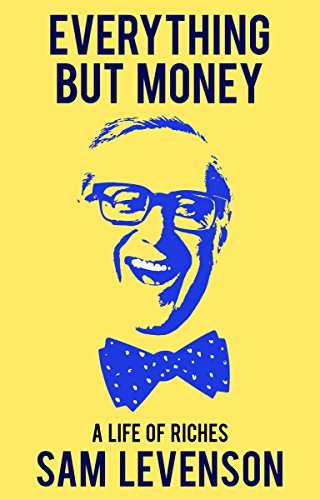
Everything but Money by Sam Levenson, the educator, humorist, and journalist who grew up in a Jewish immigrant family in Brooklyn. He graduated college and secure a masters and taught in NYC schools. The book was recommended by someone in my writing group. I found the description of his early childhood to be amazing. He captures the perspective of his immigrant parents, who came to the US and worked hard, including his mother who cared for the home in a tenement and eight children.
Sam, born in 1911, was the youngest. There was economic poverty, but strong spirit. Parents did not indulge the children, they valued discipline and ruled with determination that their children would have opportunities. They all did. His descriptions of the neighborhood are rich and people might not remember this era, when poverty was common, but there were ways for people to advance. Like many, his siblings leave the neighborhood and eventually his mother has to move into “better” housing, but she misses the old friends and connections.
Social mobility is a reality for him and many in his group, so he comments much on the different challenges his generation faces as parents, who are more likely to indulge their own children while such actions were beyond his own his parents’ means. Furthermore, they did not apologize. The focus on schools, grades, and paths to success in the post-World War II days has been addressed by many. Levenson sees the conformity of this era and the way people get lost.
As a teacher he is in the middle of mess, as appreciation for learning and living to craft a life gets lost in the focus on grades and need for a “career.” He is also cognizant of how many are deprived of opportunities due to class, race and religion. Originally published in 1949, my edition was from 1966, so there are comments about the rise of television, decline of arts and music in schools, and other evidence of the increased commercialization of American life, including how it impact young people who become a target market. The temptations for young adults are many, because they are not pushed into helping to support their families. The post-World War II development of the teenagers is not an explicit focus of his work, but this generation differs from those who came before. As someone raising children in this era, he includes what that means for parents who are trying to balance their own lives.
In ending, he is supporting tolerance, but people need to take actions. They need to live and help others live. Maybe more people are thinking in those terms today when we can see how pursuit of business has led us to some shady places. Writing in the 1960s, Levenson sees the beginnings of efforts to address poverty and discrimination. In his life, he did much to enrich the lives of young people, as well as share his humor in many venues. However, the end does get preachy, but the first part of the book is wonderful.