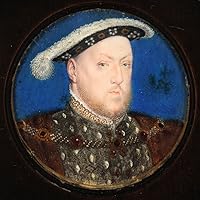
While, I did like this overview of Henry VIII's reign I felt there wasn't quite enough correct information in it to give it a four or five star rating.Many new insights about the Tudors have come out since 1971 when this was first published so I think it was a matter of the author not having the info available at the time of it's writing rather than any biased views or misinterpreted facts.I liked that one of the sources used was Letters and Papers which is very reliable but using the Spainish ones, which are often based on rumors and prejudice,is a mistake.For the most part the author seemed to keep to a middle ground and not get too controversial with anything.I think what made this book especially interesting though, were the many paintings,drawings,maps and real life photos and it was really nice to read the narrative and see the accompanying visuals.It would be a good place to begin an interest in the Tudors.
While there is misinformation (due to what was available at the time of publishing) I have not read so much about the inner workings of the court and household, and that I found very interesting. I also appreciate te d the lavish illustrations, and the dynastic trees and the end were some of the best. Personally, this contained more information on my ancestor, Dr Richard Coxe, than I had found elsewhere (excepting, perhaps, Wikipedia!)
Fairly straightforward depiction of Henry's life as king, but I really liked the focus on how the staffing of his castles was managed and the way the court changed with every new queen. Learned a lot about how many people were needed just to manage one residence and he had so many! Would definitely be interested in reading something like this about the Elizabethan court as well. I also like how it touched on the important events but didn't get caught up in rambling side quests
In the last sentence of this book, Neville Williams reveals his basic thesis: Henry VIII was a transformational king. Well, not in so many words. Instead, he writes that Henry was “the miracle-maker who turned the water of medieval kingship into the heady wine of a personal, national monarchy, with the court as its chosen vessel.” This is neither a full biography of Henry nor is it a full history of his reign, although the book contains elements of both. It is above all a narrative of court life, far-ranging in the topics it covers, including architecture, the decorative arts, music, and diplomacy. It recounts the improbable rise from working-class origins of his two most able ministers, Wolsey and Cromwell (and their fall), as well as the king’s relations with his six wives. The oft-told tale of Henry’s estrangement from his first wife, Catherine of Aragon, and his infatuation with Anne Boleyn takes into account the complex motivations and fears involved. Eternal damnation? Dying without leaving a male heir for the throne? Which would you choose? It was an age when Henry, as well as most of his subjects, took religion very seriously. At the same time, economic pressures and an inchoate nationalism made the pope unpopular. In Williams’ telling, Henry’s faith was most consistently a popeless catholicism, rather than protestant. The book is generously illustrated, including several full-color, full-page reproductions. These were particularly helpful to imagine the seven castles in and around London to which the court moved (including cartloads of furniture). For those who can’t read enough about the Tudor era—so like and unlike our own—there is a helpful annotated bibliography (up to 1970, when this book was first published). I turned to this book to get up to speed on the back story of the people and places while reading the final volume of Hilary Mantel’s Wolf Hall trilogy. It provided what I hoped for.
From 1971...52 years ago...Neville Williams captured the essence of why Henry VIII's reign was so significant for the English nation: the birth of an empire...centred on a windy, wet, foggy, island peopled by barbarians (in the eyes of many a European visitor!) with bad teeth, swinish language & drunkeness, violence & bathed in ignorance. With the rise of a 'modernist', humanist, Protestant perspective on the sins of the venal Roman Catholic church, and with the aid of the likes of Wolsey, Cromwell & Cranmer, Henry was able to establish a viable alternative to a country run by religious, conservative clerics & aristocrats with a rising commercial, well-read (in books printed in English!), politically-astute class of men with the sense to move forward in all walks of life. From the 1520s, Henry strode like a Colossus over the green & pleasant land & his reign saw a renaissance of his own perspectives. Little England would no longer be a mere pawn in the Holy Roman Empire but a thorn on a Tudor rose in the flesh of their overweening self-glorification. From tiny acorns mighty oaks do grow: was Henry the first of our mighty oaks?...or does Thomas Cromwell deserve a place in the forest of green wood that swathed the island...leading to bigger, better ships to trade with a wider, more cosmopolitan world...an empire even? Neville Williams's single, well-illustrated volume is a very good read, & even I was made aware of new perspectives on a king who was more than a tyrant with 6 wives!
Some neat stuff in here. I mainly just read this because it was around and I was reading Wolfhall at the same time. Thought glancing through this would be nice for the pictures (which are great, lots of Holbein) but ended up reading it too. It gets a bit boring at times, but at others it provides a nice overview of Henry's reign without being overly exhaustive of every detail. Definitely well-researched, it includes lots of quotes and poems and such. Good stuff!
This was not any easy book to read. If I had started with a good grasp of the story, I would have appreciated it more. As it was, the cast of characters is long and the intertwining relations are complicated. The best I could do is get a sense of what Henry VIII and his court were like. It left me with a taste for further reading on the subject.
Gives a good picture of life in the royal court during the 16th century. Other books I've read on this subject presented more graphic details about the cruelty of Henry; this one not so much.
The author preceded Elizabeth Hallam at the Public Record Office and was an authority on the Tudor period. Here, he examines the workings of the court under Henry VIII, the consummate Renaissance prince and master of kingship, absolute head not only of the secular nation but of the English church, as well — "a prince ruling in the image of God." Personal monarchy always implies a court and Henry surrounded himself with talented people, both in his household and in the machinery of government, so that a study of the former goes a long way to explaining the latter. Henry made the court dominant over the rest of the kingdom, and he himself thoroughly dominated the court, making it the center of English cultural as well as political life. Where earlier kings had to deal with the great landowners in their distant domains, Henry brought them to him, where they could plot and scheme and quarrel under his eye and have their energies directed to tasks of the king’s choosing. To be banished from court, denied access to the king, was the greatest blow a courtier could suffer, short of the Tower. Williams explores all these themes in depth, from Henry’s use of musicians and the place of his queens’ ladies in waiting to his control over his chief ministers and prelates of the church. And throughout the narrative are woven the lives of the Howards, Clintons, Greys, Courtenays, Cromwells, Poles, Percys, Seymours, Stanleys, Staffords, Veres, Russells, Nevilles, and other leading aristocratic families.
The book is not very long but it is a good account on Henry VIII's court, from the sumptuous banquets, the clothing, the etiquette, and the defining moments in his reign. My only nitpick is since I read this after Alison Weir's Henry VIII and his court, I tend to be a little bias, because her book was packed with more detail and although this has good info, it's not as detailed as hers.
A good overview of the court as a whole, lots of pictures. I always recommended it as a good first book for someone starting on the copurt of Henry VIII
The title of the book gives you pretty much all you need to know about its content. Anyone interested in the reign of Henry VIII, especially with regard to his court, would do well to read this book.