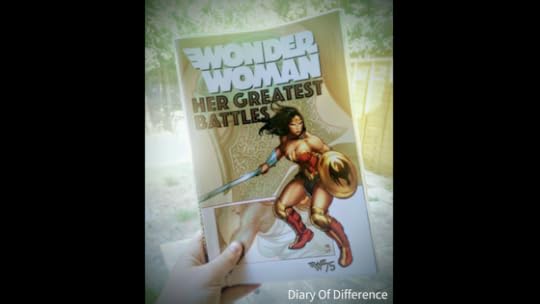
Sometimes I really wish when a collection like this is put together, it would include context for the included stories.
So let me try.
It begins with Wonder Woman #6 from 1987. This was a relaunch following Crisis on Infinite Earths one of the first and among the most famous event comics ever created. Following it, DC did its first major reboot. John Byrne's Man of Steel is usually the comic that comes to mind when thinking about this period, but George Perez (who made his name drawing the immensely popular New Teen Titans comics of the '80s) in the pages of Wonder Woman also did some significant work. In this concluding issue of his first arc, we see Diana defeating Ares, the Greek god of war, to help set up her role as a superhero in the modern world. Perez uses real conflicts happening at the time he worked on this (sadly we can see most of them still being a problem today, in one form or another), as Ares instigates them to, well, crisis level. He distinguishes Diana as not just a warrior but a thinker, whose goal is to bring peace to mankind. This is a version of the character that persists to this day.
Wonder Woman #119 (1997) is actually created by Byrne, who continued for years to be a touchstone in comics (like Perez he made his name in the '80s, with the other popular team of that time, the X-Men), and as such was given a run with Diana, too. This particular story riffs on the then-recent event comic Underworld Unleashed, the basics of which Byrne neatly sums up in his story. Like Perez, he also prefers Diana as a thinker, figuring out how to get one of her perennial foes, Cheetah, back under control.
Wonder Woman #210 & 219 (2005) are both written by Greg Rucka, whose run wasn't properly appreciated until years later. He's since completed another one in the current "Rebirth" era. The first issue gives a glimpse of what his first run was like, which became known as the "embassy era," since he made Diana more directly a diplomat than before or since (and because she literally had an embassy). The minotaur glimpsed in the story was a signature supporting character, someone Diana worked beside in the embassy. Once again Diana uses her smarts to win a fight. Blinding herself stuck around for a few issues, by the way.
The second issue is one of the defining moments in modern Wonder Woman stories, and certainly controversial, in exactly the way Man of Steel has proven for Superman, and for the same reasons, as you can see by how it ends. This was used as part of the setup for Infinite Crisis, a sequel to the event comic I mentioned earlier (in case the similar title doesn't make that obvious). Fans argued that it was a terrible thing to do to Diana, making her a murderer, but as you can see, there's a lot going on. First, she's shown as a match for Superman, and unwilling to unleash all her strength, even. It's a big statement about the character, right there. Second, killing Max Lord seems like the opposite of the conclusions the other stories in this collection make about her. But is it really? I'll leave it to you to decide.
Next comes Wonder Woman #41 (2010). This was several years into a relaunch necessitated by Diana's "damaged" reputation, putting the focus back on what "works" for the character. Anyway, Gail Simone took over after brief runs by author Jodi Picoult and screenwriter Allan Heinberg (his major contribution to comics? creation of the Young Avengers, whose original incarnation lives on in the form of Kate Bishop, Hawkeye). I had my problems with Simone's run. Fans love her, generally, but I didn't think she lived up to the potential Picoult and Heinberg suggested for the new era. But this issue reflects well on her, and clearly hardens back to Diana's preference of brains over braun.
Justice League #3 (2011) is part of the "New 52" era, another company-wide reboot, and depicts much of what the current slate of movies is drawing from. You can see where the Wonder Woman movie itself lifted the funny scene of Diana discovering ice cream.
Wonder Woman #23 (2013) is from the same "New 52" era, from Brian Azzarello's run, widely acclaimed as one of the character's all-time best. You get a good sampling as to why, here.
I would say that this is a good survey of Wonder Woman comics history, and shows newer fans how the character has been depicted and used through the years. It just needed a little explaining.