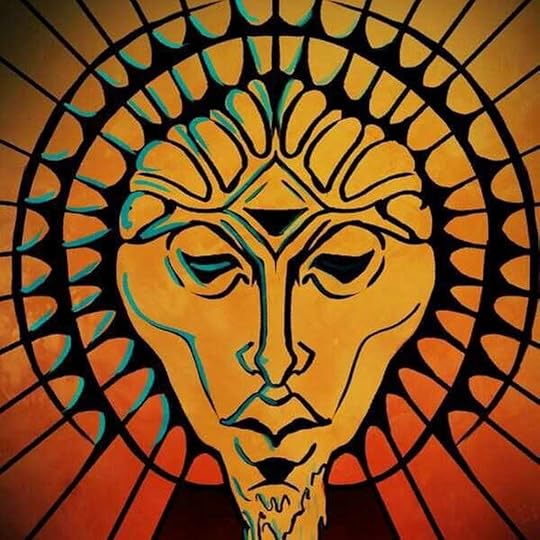
Ursula K. Le Guin is frequently quoted on the jackets of Wolfe's books as having said "Wolfe is our Melville."
Critic and science fiction writer Harlan Ellison, reviewing this book, wrote: "Gene Wolfe is engaged in the holy chore of writing every other author under the table."
It's impossible to talk about Gene Wolfe's cycle of the New Sun (5 books in total, of which this is the 5th and last one) without spoiling the plot. This is not because the story is based on concepts that are given away early in the book - quite the contrary, in fact, is true: Wolfe's style is so peculiar that a first superficial read will send you in a dazed stupor, and if you go too fast, you're going to miss everything and come out believing that the book is a jumbled mess. The fact is, you can only fully understand the plot if you go backward.
If this confuses you, you're not the only one!
How does Wolfe achieve this? Well, first of all, consider that his background was not a literary one: he used to work at P&G as a mechanical engineer, and he was THE mechanical engineer who came up with the mechanism to prepare, cut and sort the famous "Pringles" potato chips.
This helps me, at least, understand where the unique beauty of this series comes from: having read the 5 books, if I look back in a metaphoric sense (with my eyes closed) what I see is not a straight line, or a clear painting, or even a chain made of a ring after another after another. What I see is more similar to the inside of a very sophisticated clockwork mechanism, with many levers, springs, bolts... and the absolute miracle is that everything clicks together perfectly well.
Wolfe is revered (seriously revered) by many SF authors and Fantasy authors as well. From Neil Gaiman, who wrote the preface to my edition, to George RR Martin and Ursula Le Guin, both of whom have called The Book of the New Sun a "masterpiece".
1. Protagonist
TBoTNS follows the story of Severian, a torturer in the decaying Citadel who, in the first few chapters, shows mercy to a prisoner he's fallen in love with. Rather than being killed for his crime, he's exiled, given an ancient sword (Terminus Est) and sent to the distant city of Thrax. On his way out of the vast urban sprawl of Nessus, his adventures include fighting a duel with a flower (more deadly than it sounds), accidentally stealing the Claw of the Conciliator (a glowing jewel) from a temple and fishing a girl, Dorcas, out of a lake where the dead are sunk.
The story is recounted by Severian himself from a position in the future. He is unreliable to a certain extent.
2. Language
Wolfe decided to use a lot of odd words – "fuligin" for black, "carnifex" for torturer, "destriers", which are sort of super-horses. This all adds to the otherness of the world Wolfe has created... a world that is our own Earth but millions of years in the future, in an age when our sun is dying and therefore it shines with a purplish color in a dark-blue sky. The Moon has been terraformed and therefore it shines GREEN at night. I didn't understand some words until I looked them up, but I knew what he meant by them, and I loved his "note on translation" at the end of the first book, when he tells us how he went about "rendering this book - originally composed in a tongue that has not yet achieved existence – into English".
3. World-building
Some say that the world-building is the best element of this series. I disagree, I think the best element of the series is the stunning brain behind it, which is the brain of a top engineer mixed with the imagination of a great poet.
This is a world which Wolfe never explains directly – the reader has to piece its realities together, which is hugely satisfying, because everything DOES click together, it's not just a couple of things here and there.
By the way, in my opinion this series falls squarely in the category "Science-Fiction", even if I've seen discordant opinions on this point.
4. Mood
The mood is pretty dark throughout, although it gets more and more positive and bright towards the end. Here we need to go back to Gene Wolfe's biography: he fought in Korea, saw unspeakable horrors there, and came back to the US with a bad case of PTSD. He would fall on the ground for any loud noise.
So, Wolfe was a soldier, and the fact that his protagonist is someone who has been trained to kill (a torturer) is not a coincidence. There is a realism in how Wolfe describes a man going about killing as a profession, with the hair-splitting and mental compartmentalization that it entails, that gives me the chills. Just like it's not a coincidence that, despite the huge cast of characters, a deep sense of loneliness pervades the whole series. This comes with reflections about one's sense of duty, loyalty to a cause or to a "guild", and, of course, about killing. But very rarely these reflections are expressed by the author or by Severian. They are mostly for the reader to wonder about.
But aside from this base chord in a minor key, let's not forget that this is also, at its core, an adventure story, and a very fun one: the action scenes are masterfully executed.
I would also add that, unless you are a genius (I'm certainly not), you're probably going to miss at least some of the clues that Wolfe peppered his book with. Therefore, if you ever decide to read this magnificent work, do it as a read-along or read it while listening to the EXCELLENT and very detailed chapter-by-chapter analysis done by the "Alzabo Soup" Podcast.
Another great resource is the YouTube channel "Media Death Cult", where the guys from the Alzabo Soup joined a book-by-book conversation with the channel's creator.
Yes, it might feel confusing the first time you read it. Yes, Wolfe makes you do some work. And yes, this is not a book like any other that you've ever read.
But it's SO rewarding, SO clever, SO imaginative, SO much fun, SO original ... and it has probably the broadest scope that I've ever found in Sci-Fi, with the only exception of Arthur C. Clarke. It will stretch your imagination to the utmost limits.