Jump to ratings and reviews
Rate this book

Picasso

Rate this book
Picasso is one of the most original and creative artists of the twentieth century, innovative throughout his long career, his work shows a mastery of many different techniques, but always carries an emotional impact and always bears the stamp of his own individual style.

A master of the traditional forms of art, Picasso quickly absorbed the impressionist influences of the Paris school, exemplified by works such as The Embrace in the Streetand In the Dressing Room. Toulouse-Lautrec's influence is also apparent in the haunting attitudes of despair which characterize his "Blue Period". The life-affirming circus scenes of his "Rose Period" have lighter, softer lines, and paintings such as The Actor are relaxed, even mellow.

Picassogives an outline of the artist's life, essential to understanding his complex work, and over 120 of Picasso's most famous and important works are illustrated in full color. With its informative but accessible text and lavish illustrations, this impressive volume vividly brings to life the paintings of one of the greatest names in the history of modern art.

192 pages, Hardcover

First published January 1, 1958

Loading...
Loading...

About the author

Ratings & Reviews

What do you think?
Rate this book

Friends & Following

Create a free account to discover what your friends think of this book!

Community Reviews

5 stars
720 (46%)
4 stars
518 (33%)
3 stars
256 (16%)
2 stars
37 (2%)
1 star
11 (<1%)
Displaying 1 - 30 of 72 reviews
Profile Image for Glenn Russell.
1,567 reviews13.6k followers
August 3, 2021


The Fall of Icarus, 1958

Art historian Carsten-Peter Warncke's book on Picasso is an extensive examination of the artist’s work from beginning to end, in seven lively chapters: Picasso the Legend, The Early Years 1890-1901, The Blue and Rose Periods 1901-1906, Cubism 1906-1936, Classicism and Surrealism 1916-1936, War, Art and Politics 1937-1953, The Man and the Myth 1954-1973. Since this is a book review and not a book, I will limit myself to the final chapter, the last phase of the artist’s life and work, Picasso between the ages of 73 and 92, a phase I find particularly absorbing. Below are a number of quotes from the renowned art historian’s The Man and the Myth 1954-1973 along with my comments:

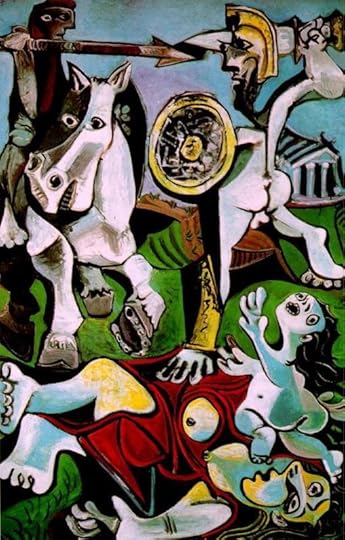
“Picasso’s work from the later 1950s onwards typically drew upon personal material and also worked with constant repetition of his own motifs and compositions.” ---------- The Rape of the Sabine Women is a good case in point. Anybody familiar with Picasso will identify many familiar aspects in this work: the instantly recognizable rendering of the horse, the uplifted, screaming head, the twisted, multi-dimensional head and body of the prone woman. I personally have had several opportunities to view this masterpiece in the Boston Museum of Fine Arts. As with the other pics I’ve included here, a tiny reproduction doesn’t do justice to the actual canvas (195 x 130 cm or about 6 feet high and 4 feet wide). A direct encounter with this Picasso is both astounding and humbling.


The Rape of the Sabine Women, 1963

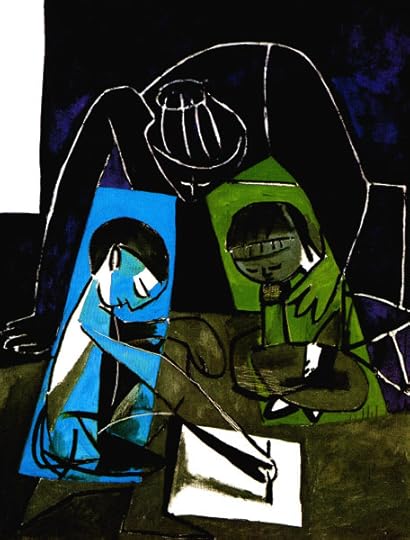
“Picasso was now scarcely concerned to mirror the outside world. Instead, he took his own work as the center of the creative universe.” ---------- With Claude Drawing, Françoise et Paloma, the exclusive focus of attention for all three - woman, little girl and little boy - is the little boy’s process of drawing on paper. Such a tender rendering, the arm around the little girl, each child given its own rectangle of vivid color, the adult’s supportive presence and eyeing of the paper. And, along with his drawing, Claude has such a calm, inward focus, as if his sketch is an extension of his confidence and tenderness. My sense is Claude can represent Picasso returning to his own youthful vision of what it means to be a creative artist.


Claude Drawing, Françoise et Paloma, 1954

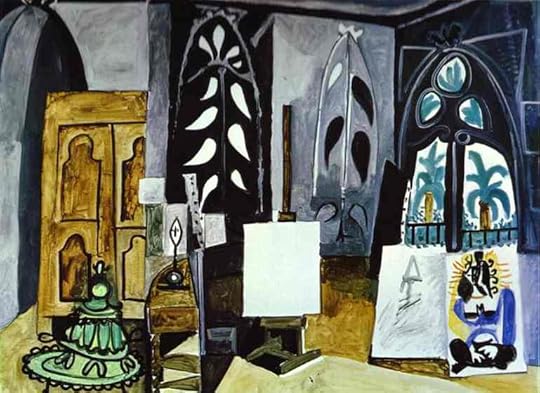
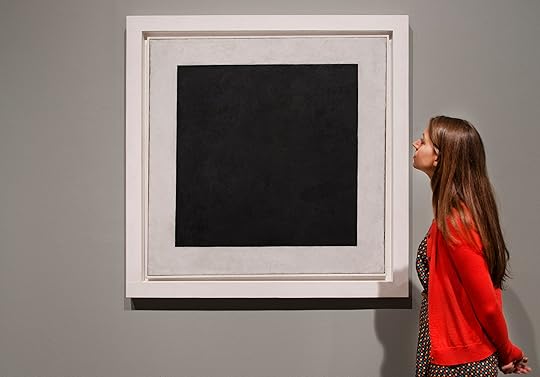
“In the picture done on March 30, 1956, Picasso used a simple but witty device to underline his own creative inventiveness, placing at the center of the studio scene a fresh, virgin canvas awaiting the artist. The pure, white, empty space contrasts with the rest of the picture and is also its prime subject.” ---------- In addition to what Carsten-Peter Warncke notes here, Picasso accomplishes, through a reversal of color, much of what artist Kazimir Malevich accomplished with his Black Square, for example, a painting (the empty white canvas) that isn’t specifically one thing.


The Studio of "La Californie" at Cannes, 1956


Black Square by Kazimir Malevich

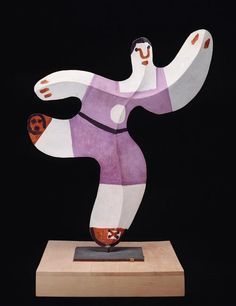
“Calling the figure a football player is sleight of hand. The trick is made plausible purely by the painted shirt, shorts and boots. Sculpture such as this is not intended as a mimetic representation of reality; rather, it sets out to play with the basics of visual experience. And deception is the fundamental principle of this art.” ---------- Actually, I see many elements of dance in athletes playing soccer and other sports. With this sculpture, through his visual genius and creative magic, Picasso captures the very essence of fluid movement in an accomplished player on the field.


Football Player, 1961

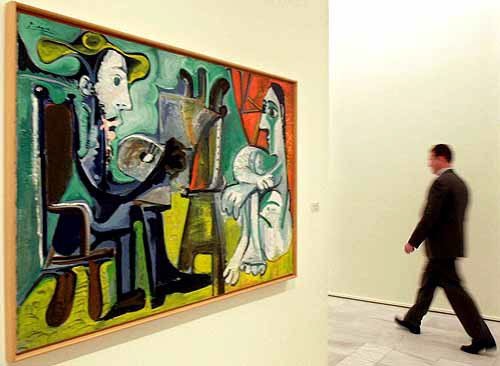
“The picture within a picture was one of Picasso’s traditional motifs; through it, he grants us access to the very essence of the creative process. Picasso is showing us his power. He can make a world out of nothing.” ---------- A few things I specifically relish in this painting (a huge canvas, thus my 2nd pic here): the curving flourish of the artist’s yellow hat, the stunning beauty of the model captured in her Picasso-like wide Spanish eyes and long black hair and how the intensity of the artist’s gaze is transferred directly to his brush and finally the asymmetrical canvas.


Painter and his model, 1963


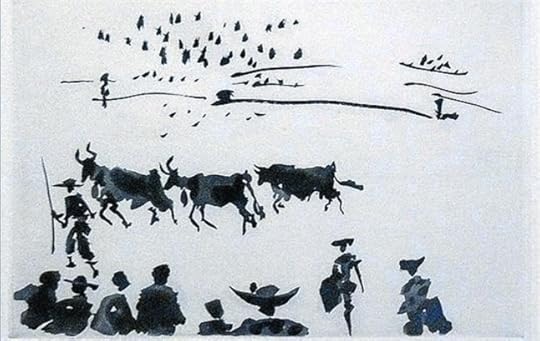
“In old age, Picasso transferred to his art the task of expressing the vitality which was ebbing from his life. Hence, for instance, the new graphic works which, when successful, articulated lifelong fascinations in a succinct and impeccably judged manner. All of the etchings are precise records of carefully-observed scenes, using just a few dabs and strokes, quickly but perfectly done.” ---------- For me, such sparse dabbing and stroking brings to mind Chinese brush painting. What is left unpainted speaks with such subtle power.


Los Cabestros Retiran Al Toro Manso, 1957


Bamboo by Gloria Whea-Fun Teng, 2009

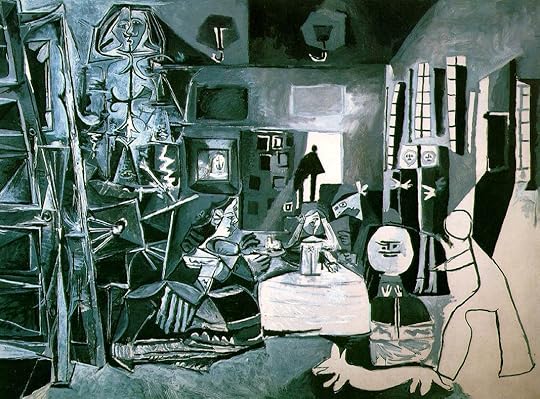
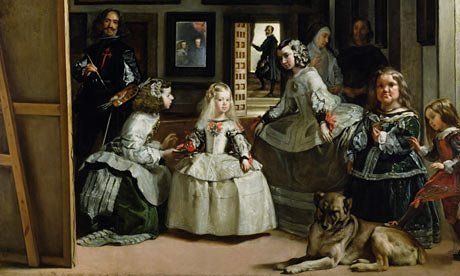
“In Picasso’s ouvre we plainly see a rational, logical, consistent method. At core he was an intellectual artist. In a real sense, Picasso transferred ideas into art, and created unified harmonies of idea and artwork, form and content, which are fundamentally traditional in nature and highlights his classical character.” ---------- Call me a radical, but I find Picasso’s Las Meninas more eye-catching. I know, I know . . . I probably wouldn’t think so if I viewed the original Diego Velázquez.


Las Meninas (after Velázquez), 1957


detail of Diego Velázquez's Las Meninas, 1656

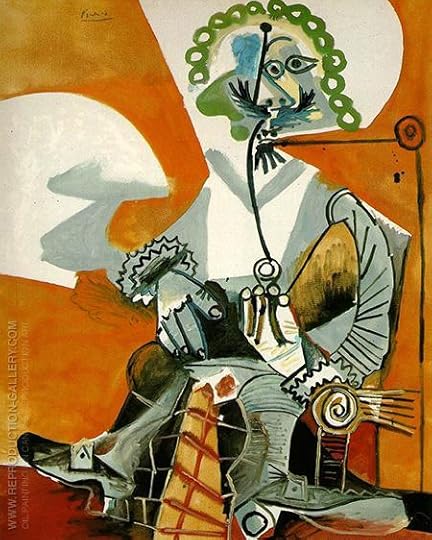
“Picasso’s true greatness and significance lie in his dual role as revolutionary and traditionalist at once. He gave a new vitality to art even as he preserved the creative presence (outside the museums) of its history. For this reason he became the pre-eminent figure in 20th-century art.” ---------- Of the many elements of Musketeer with pipe that I adore is how Picasso paints the shoes of the musketeer as if they are shocked, squealing dachshunds, dachshunds who could be the stand-ins for uptight philistines who think they can stand in judgement of his art. Squeal and judge me all you want, you no-talent cretins!


Musketeer with pipe, 1968
Profile Image for Mikey B..
1,181 reviews511 followers
August 17, 2019
Art Institute of Chicago - 2017

Mother and Child, 1921
Art Institute of Chicago


You can’t go wrong with Taschen art books. This one has a wealth of reproductions of Picasso’s long prestigious life.

Picasso is surely the foremost artist of the 20th century. He changed art. The wide diversity of paintings, collages, and sculptures certainly attest to this.

I can’t say that Picasso is my favourite painter – some of his works strike me as childish and repetitious.

The text in this book has next to nothing to say on biographical details – on his wives and lovers – or his children. Both World Wars are mentioned as if they were distant events even though Picasso was living in Paris.

The book is mostly concerned with Picasso’s voluminous output and is overly intellectualized.

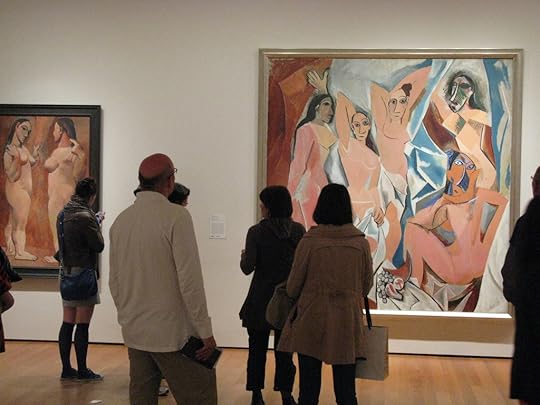
MOMA

Les Demoiselles d'Avignon, 1907
Museum of Modern Art, New York City
Profile Image for Luís.
2,501 reviews1,641 followers
December 12, 2020
Pablo Picasso (1881-1973) was a Spanish painter. "The Dove of Peace", "Guernica", "Les Demoiselles d'Avignon", are some of his most important works. He was one of the creators of "Cubism", one of the most outstanding art movements of the 20th century.
Pablo Ruiz y Picasso was born in Malaga, Spain, on October 25, 1881. He was the son of José Ruiz Blasco, professor of Art History and drawing, passionate about painting, and Maria Picasso y López.

As a boy, Picasso showed his talent for the arts and received encouragement from his father. His first drawings represented bullfights. At the age of 14, he joined the School of Fine Arts in Barcelona. In 1896 his father rented a studio for his son.
That same year, his canvas “First Communion” was accepted by the Barcelona Municipal Exhibition. The painting “Dois Patos” was sent by his father to an exhibition in Malaga, receiving the first official award from the painter.
In 1897 Pablo Picasso was admitted to the Royal Academy of Fine Arts in San Fernando, Madrid, but soon rejected the traditional forms of the school and returned to Barcelona.
In 1900, Picasso travelled to Paris and met with a Catalan industrialist who rented a studio for the artist and put him in contact with a painting dealer, who held the first exhibition of the painter, on June 24, 1901, doing great success.

Pablo Picasso was seduced by Paris and influenced by the Impressionist Style, he adopted it in his works, with the typical brushstroke of pure pigment instead of smooth modelling, as in work The Flower Seller (1901), Glasgow Art Gallery, Scotland.
Suddenly, his work becomes monochromatic. The blue begins to invade his canvases; it is the blue of sadness that appears in the melancholic portraits of his Blue Stage (1901-1904), as in O Velho Guitarrista (1903).
Picasso divided his time between Barcelona, Madrid and Paris, but in 1904 he settled definitively in the famous Bateau Lavoir, which he shared with Juan Gris, Van Dongen and others.
Gradually, Picasso broke free from the melancholy Blue Stage and entered the Pink Stage (1905-1907). In this phase, the main themes are circus figures and women. They are from that period: "The Young Harlequin", "The Young Man with Pipe" and The Saltimbancos Family, (National Galery, Washington), all from 1905.
In 1906, Pablo Picasso started to work on the canvas Le Demoiselles d'Avignon (1907), where he abandoned the mannerism of the two previous phases and with geometric shapes eliminated the spatial depth.
It was the starting point of his research that resulted in “Cubism”, which together with Georges Braque sought new answers to the question of portraying the real three-dimensional world on a flat-screen.
Within Cubism's proposals, Picasso went through several phases. The initial works of Analytical Cubism, as they are known, generally depict single figures or still lifes using a limited range of shades of grey and brown, where the figures are decomposed and rearranged, as in the canvas Nu (1910), Tate Gallery, London.
The next step reaches almost total elimination of the object, where abstraction prevents the real view of the painted object, is Synthetic Cubism, when letters and words appear in the paintings, as in O Aficionado (1912), Kunstmuseum, Basel.
In 1917, with his friend Jean Cocteau, he travelled to Italy, where he made the sets and costumes for the ballet Parade, with music by Erik Satie and choreography by Serguei Diaghilev.
In Rome, Picasso meets Olga Khoklova, and on July 12, 1918, he marries her in Paris. In 1921 his first son, Paulo is born.
Its cubism still extends until the 1920s, but already something stylized within Trois Masques Musiciens (1921), Museum of Modern Art, New York.
In the 1930s, rhythmic, curvilinear forms appear, which foreshadow dramatic representation as in the huge mural “Guernica” (1937), National Museum of Art Rainha Sofia, Madrid.
The work evokes the bombing of the Basque city of Guernica Spanish Civil War; German planes bomb the Basque city of Guernica. The work was exhibited in the Spanish pavilion at the International Exhibition in Paris.
Although more famous as a painter, Pablo Picasso also produced prints and sculptures. In the late 1940s, he started producing ceramics.
In 1954 he married Jaqueline Roque, and in 1959 he bought the castle of Vauvenargues, in the south of France, where he took up residence.
His last paintings were executed with vigour in a simplistic style as in the work Portrait of Jaqueline Roque (1954).

Pablo Picasso passed away at Notre-Dame-de Vie, in Mougins, France, on April 8, 1973.

Source: https://www.ebiografia.com/pablo_pica...
Profile Image for Magdalen.
227 reviews117 followers
January 1, 2018
"I'm no pessimist. I don't loathe art because I couldn't live without devoting all my time to it. I love it as the only end of my life. Everything I do connected with it gives me intense pleasure. But still, I don't see why the whole world should be taken up with art, demand its credentials, and on that subject give free rein to its own stupidity. Museums are just a lot of lies, and the people who make art their business are mostly impostors."

Short version: WOW!
Longer version: Yes obviously as the title gives away (duh) Picasso indeed was a genius. This book tells the reader about his personal life, his work. It explains his paintings, his sculptures. It gives you extra information about the colors, Picasso's motives and how he viewed his art (& art in general). Of course his paintings are all over the pages along with some of his quotes. It's brilliant, he was brilliant and extremely talented, no wonder about it!

"This will do, won't it? What else should I do? What could I possibly add? Everything has been said." (& shown in his masterpieces obviously)

If you are into art give it a try, or even if you are not and you just want to learn about it and about Picasso.
Profile Image for Iulia Sabou.
42 reviews9 followers
April 28, 2021
Câteva cuvinte de-ale lui Picasso care au sădit niște idei încurajatoare pentru un om care iubește arta și încearcă să nu o lase în stand by în sufletul său.

"Nu există nici un moment în care să zici: am făcut treabă bună azi, iar mâine e duminică și pot să mă odihnesc. De îndată ce te oprești, trebuie să pornești din nou. Poți lăsa o pânză deoparte, spunând că nu te vei mai apropia niciodată de ea. Dar niciodată nu ajungi la ."

"Întotdeauna am pictat pentru mine. Nu mi-am luat niciodată asupra-mi povara căutării. Pictez ceea ce văd, uneori într-o formă, alteori în alta. Nu zăbovesc prea mult cu gândul, nici nu experimentez. Când simt că vreau să spun ceva, spun acel lucru în felul în care cred că se cuvine să-l spun. Există doar artiști buni și artiști mai puțini buni."
Profile Image for Daniel Wichers.
11 reviews4 followers
July 13, 2017
Het boek neemt je op een hele boeiende manier mee door de ontwikkeling van Picasso zijn kunstwerken en kunstperiodes.
Profile Image for Valter O.
10 reviews
August 23, 2024
"Cubism is no different from any other school of painting. The same principles and the same elements are common to all. The fact that for a long time cubism has not been understood and that even today there are people who cannot see anything in it, means nothing. I do not read English, and an English book is a blank book to me. This does not mean that the English language does not exist, and why should I blame anyone but myself if I cannot understand what I know nothing about?"
-Picasso
19 reviews
September 10, 2025
I thought it was sick how Picasso was comparing himself to Rembrandt suggesting that he himself was the goat of etching. Picasso was giving off Gojo vibes on that page. I thought he was the goat too until I learned that he decided to court a 17-year-old when he was 45 and married.
99 reviews
April 16, 2018
Reasonable general overview of Picasso & his work. Some of the critiques on his work were either pseudo intellectual or intellectual beyond my appreciation.
Profile Image for Jaime Fernández Garrido.
475 reviews22 followers
June 27, 2023
Si alguien busca el morbo sobre la vida sexual de Picasso y su relación con las mujeres, este libro no es para él. Si lo que quieres es conocer cómo evolucionó su arte, desde el aprendizaje académico hasta su estilo propio, creado de estilos artísticos, bienvenido a sus 726 páginas, ilustradas de manera maravillosa con imágenes de cientos de sus cuadros y esculturas.

Picasso creó de la nada el cubismo, al que se unió Georges Braque durante una temporada, aunque el malagueño lo hizo evolucionar y crecer de manera totalmente personal.

De acuerdo con el libro, Picasso venció a la representación estándar con "Las señoritas de Aviñón", y revivió el género de la pintura histórica con una nueva forma en el "Guernica". Para llegar a la idea final de esos dos cuadros, el pintor hizo decenas de bocetos que desembocaron en dos obras maestras. De hecho, si sólo hubiera hecho esos dos cuadros (que merecen verse en persona al menos una vez en la vida) Picasso ya habría pasado a la Historia del Arte.
Profile Image for Dimi Tsioubris.
88 reviews1 follower
September 5, 2018
Picasso was a genius, but its so disappointing that the majority of people, do not get what he have done, so most of the times they talk about the blue and rose periods, which were just excercises, if you want color check out Matisse or Chagal, Picasso is all about form and how he can explore the space time continuum through it, begin with Cezanne, you ll see the first glimpses of what Picasso finally achived with the "whores of Avignon" and the puzzle will start to connect, its the way he thinks that you admire, his paintings are a mind game but there is a truth in it, unlike Dali who was just doing little "magic" tricks, Picasso realised that there is a universal geometrical language still waiting to be discovered, believe me, there s a lot of science hidden in his paintings, mathematics is one of it for sure, his portraits are human sigils
Profile Image for Sharon Barrow Wilfong.
1,136 reviews3,967 followers
March 8, 2019
Taschen is my favorite art book publisher. The quality is so good. You never have to worry about whether the paintings are printed in color or not. They're always in color on fine grade paper, with a sound researcher providing the biography.

This is a very thick book containing two volumes in one. It is a thick coffee table sized book. The biographer gives us a superficial, but adept overview of Picasso's life and various art periods. I felt it offered good insight and most importantly, a complete collection of his works. Some of the works are printed smaller, but most of them cover the full page. And did I mention they're all in color?

If you are a Picasso fan, this is a must for your art library.
Profile Image for Dodie.
888 reviews4 followers
June 22, 2018
I just finished watching a mini series about Picasso and wanted to know more. Picasso thought being a good artist was more important then being a good person. He was an asshole and cruel to the people around him. To love him was to hate him. This book had a bit of information about him but main discussion this work. The book showed this painting during this blue period, cubism and his most famous mural that he showcased in the Spanish Pavilion in the 1937 World’s Fair in Pairs.
Profile Image for Matt.
521 reviews18 followers
September 22, 2012
A concise and broad biography of Picasso focusing on his art and how it changed from one period to another. I hesitate to say that the art 'evolved' because Picasso seemed to dislike the idea, arguing that each piece was designed to speak to the time it was created, and to express a specific idea, and that there was no evolution towards a more perfect 'art.'
80 reviews
November 23, 2008
"I wanted to be a painter, I became Picasso" said Picasso. If you want to read one book about Picasso's life and career ( paintings, ceramics, graphic work, drawings and sculpture), this study is remarkable.
Profile Image for Lourdes Cambridge.
131 reviews2 followers
February 4, 2016
EVERYTHING BUT FIDELITY. HOW I SURVIVED PICASSSO. STEVE MARTIN'S IF EINSTEIN MET PICASSO.
441 reviews6 followers
October 15, 2020
Kurzer Auszug a.d. viel längeren Rezension m. Links u. Hintergründen i. m. Blog:

Der großformatige, biegbar gebundene Band erinnert an ein teures, dünnes, exklusives Farbmagazin. Die Urheberschaft ist mir nicht völlig klar. Laut Impressum:
Ingo F. Walther: scheinbar Hauptverfasser, aber auch mitverantwortlich für Produktion, Typographie und Herstellung (übrigens auch am Matisse-Band des Taschenverlags an "Redaktion und Produktion" beteiligt)
Matthias Buck, Rainer Metzger, Bernhard Serexhe: Mitarbeit und Redaktion
Der Text machte mich teils sprachlos. Warum bringt ein (vermeintlich) cooler Schuppen wie der Taschen-Verlag solchen Sülzschwulst aufs gestrichene Papier (Zitat S. 6):
Was nun Picassos Biographie betrifft, so beginnt sie recht eigentlich weit vor der Geburt. Denn das Unbegreifliche, Unvorstellbare – eben Geniale – muß nach Meinung der Biographen seine Ursache und Quelle woanders haben.
Oder hier, S. 86:
…ein Spätestwerk andauernder Wiederholungen, Kristallisierungen eines Augenblicks von zeitlosem Glück in dem Bewußtsein letztendlicher Vergeblichkeit.
Auch die vielen Picasso-Zitate in den Randspalten klingen oft wolkig bizarr:
der Künstler ist wie ein Sammelbecken von Empfindungen… (S. 18)
Von allem – Hunger, Elend, Unverständnis des Publikums – ist der Ruhm bei weitem das Schlimmste…. Es ist traurig. Es ist wahr. Erfolg ist etwas sehr Wichtiges! (S.26)
Zudem erscheinen diese Zitate ohne Quellenangabe oder auch nur Jahreszahl.
Profile Image for Maria.
377 reviews24 followers
September 25, 2025
"Picasso (Basic Art)" (1991, Taschen) by German art historian Ingo F. Walther

A richly illustrated and accessible introduction to one of the most memorable personalities of modern art: Pablo Picasso. After visiting Museo Picasso in Málaga myself two years ago, I wanted to have a better overview over his life, and this book was perfect for the bigger picture.

This book, part of Taschen’s Basic art series, offers a full overview of Pablo Picasso’s life and work, from his early training in Spain to his Blue and Rose periods, the radical invention of Cubism with Georges Braque, and later experiments that carried him into fame.

The book is structured chronologically, giving you a sense of Picasso’s constant evolution, how he refused to be trapped in one artstyle for too long. The writing is clear and informative, always paired with images so you’re never told about an art piece without having it visually in front of you. For anyone new to Picasso, this is a fantastic starting point, as it is just over 100 pages, which makes it more of a gateway than a deep study.

★ Backstory of the book:
The Basic Art series by Taschen was designed to bring major artists to a wide audience: affordable, beautifully printed, and approachable.
Profile Image for Jaimie.
1,798 reviews26 followers
May 16, 2017
Could they have made the type in this book any smaller? I get that it’s meant to be a condensed overview of Picasso’s work, but they shouldn’t make the type so small that it becomes difficult to read unless it’s meant to be a minimal amount and basically supplementary to the images (which in this case, it’s clearly not). That being said, the book did meet its goal in providing a brief and accessible overview of the artist; the author went into just enough detail that we gained a reasonable glimpse into Picasso’s life and development as an artist, and a reasonable range of imagery accompanied the text. I fully meant to get Taschen’s full publication on Picasso rather than this condensed version, but it’s still a good starter on the subject and it definitely convinced me to delve further into exploring this artist.
Profile Image for asjabe.
198 reviews1 follower
April 24, 2023
3,5🌟
Picasso był chyba ideałem artysty. przez większość czasu prowadził szczęśliwe do znudzenia życie prywatne, a przy tym malował zachwycające obrazy. nie miał określonego stylu przez całe życie, cały czas eksplorował chyba większość możliwych dziedzin sztuki, wprowadzając techniki o których inni nawet nie myśleli. naprawdę fascynujący człowiek, choć niestety ta biografia momentami naprawdę przynudzała. nie podobały mi się niepotrzebne opisy, podczas gdy ważne rzeczy zostały często ledwie wspomniane. podsumowując: materiał świetny, ale wykonanie raczej średnie.
Profile Image for Jason.
158 reviews50 followers
September 9, 2008
when you begin a picture, you often make some pretty discoveries. You must be on guard against these. Destroy it, do it over several times. With each destruction of a beautiful discovery, the artist does not really suppress it, but rather transforms it, condenses it, makes it more substantial. What comes out in the end is the result of discarded finds. Otherwise you become your own connoisseur. After all, i don't buy my own pictures.

Man, this book was awesome. Picasso, the sad, wallowing genius that he was had the insight of a philosopher-king. It seems that he was always keenly aware of his intentions. ANd it was his intentions that made him such a strong and provocative artist. He knew what art was by the age of 14, and with that knowledge began a furtive journey to manipulate our understandings into simplicity of form, so that there would not be so much bureaucracy about the mundanity of details, but rather the presence of what Art is supposed to mean:

the different styles i have been using in my art must not be seen as an evolution, or as steps towards an unknown ideal of painting. Everything i have ever made was made for the present and with the hope that it will always remain in the present. I have never had time for the idea of searching. Whenever i have wanted to express something, i have done so with out thinking of the past or the future. I have never made radically different experiments. Whenever i have wanted to say something, i have said it in such a way as i believed i had to. Different times inevitably require different methods of expression. This does not imply either evolution or progress, but it is a matter of following the idea one wants to express and the way in which one wants to express it.

Art pieces do not have a meaning that can be derived. If it could be spoken in words that is the way it would come about. Interpretation is internal, hence Picasso's Hegelian notion of his artwork being substantial in its presence and universal for its eternal relation to that presence. He defied style and let the muse speak for him, or rather the muse channeled through him and he relented his style, his fame, his arduor for her beauty:

you can really only ever work against something. Even against oneself. That is very important. Most painters get out their little cake-tins and they start making cakes. The same cakes, agianst and again. And they are very happy with them. A painter should never do what people expect of him. Style is the wrost element of the painter. Art does not find its style until they are dead. It is always stronger.

The secret to Picasso was that he found more important the structure, the research and experiment within the painting than he found the crux of the painting, the insight. He was a scientist. He was conducting experiments and deriving formulas and proofs by a process of patient acceptance of the form which translated into the piece of art:

I cannot bear people who talk about Beauty. What is Beauty? In painting you have to talk about problems! Paintings are nothing but research and experiment. I never paint a picture as a work of art. Everything is research. I keep researching, and in this constant enquiry there is a logical development.

That is why he was a genius, because he respected the canvas as an organism, and his painting came about from a steady unleashing of its life force; he let the painting become itself:

It is my misfortune--and probably my delight--to use things as my passions tell me. What a miserable fate for a painter who adores blondes to have to stop himself putting them into a picture because they don't go with the basket of fruit! How awful for a painter who loathes apples to have to use them all the time because they go with the cloth. I put all the things i like into my pictures. The things--so much the worse for them; they just have to put up with it.

This book chronicles Picasso's life through his paintings. What makes him a genius and how he managed to stay in the game by always remaining constantly aware. Even as his personal life deformed into a madness thanks to the war and his relationship problems, picasso was able to form the life of his genius into a chronicle of historical notion, nothing was gained more than an infinite sense of humanity which Picasso found constantly in discovering his paintings.

Walther shows, for instance in "Female Nude and SMoker," “the way in which the two people's eyes meet and their hands touch shows that the act of painting had become a substitute for the act of sexual intercourse. Thus, by means of his art, Picasso revealed to us his current state of mind. In this picture the painter has become a voyeur, but his glances are no longer passionate or irresistible, and the model is now able not only to withstand it, but also to return it, as if she was accusing the artist of using the female body so frequently in his art. It seems that painting was the only relic of days gone by, because nothing else that used to give him satisfaction was still at his disposal--nothing except his art. Under the guise of the painter-and-model theme Picasso gave a personal justification for his indefatigable creativity: the picture was meant to prove that he was still alive.

And because of his success, he is still alive today.


Profile Image for Arnoldo Garcia.
63 reviews16 followers
April 30, 2009
Picasso said that at 8 years old he painted like Velazquez and when he was 60 or later he wanted to paint like a child. He was right: we are all born artists, but society, the socialization process that sews in class/gender/race in all its dimensions, takes it away from us. That's why there are Picasso's and the rest of us. The superman, the superpainter, the super is the result of the unsuper majorities. But that can and has changed. Discipline, imagination, hard work, resources to be able to more than survive and thrive and give you access to paints, canvasses and the training -- well then almost anyone could be their own Picasso.

Picasso was a magnificent imagination fearless in taking on or portraying his inner worlds and turmoils. Contradictory and cultural, briliiant and male, Picasso's outpourings of color, class and clashes, committed to changing the world through his painting -- however much you may disagree -- his accomplishments, his work has forever transformed what anyone would consider art. Picasso is the artworld, Jimi Hendrix in the electric music ladyland world. Individuals such these two in particular, are still leagues and almost cosmos away from the rest of us, who even in our frenzy to be original by learning from them even copy their mistakes unawares.

I am on volume two of this broad overview of Picasso's work. This volume opens up with Picasso's master ouerve/obra/work, "Guernica." Gernika was a Basque city, a sacred place thought to be one of the places of origin of the Basque people, that was bombed into ashes and history during a three-hour or so carpet bombing by the Nazi's Condor Legion, using German, Italian and Spanish Fascist airforce to obliterate Gernika. The destruction of Gernika happened in April 1937.

Earlier that year, in January, 1937, the Spansh Republican government had commissioned Picasso to paint an artwork for Spain's pavilion hall of exhibition at the Paris World Fair opening that summer. Picasso originally began a work that focused on the artist and his studio, his barricade, his trench, his frontline (metaphorically and actually) in the fight against fascism. The year before, after the Spanish Civil War began in July 1936, the Spanish Republican government appointed him the director of the renown Prado Museum, located in Madrid. Picasso had always been a supporter of the Spanish Republic and however honorary the title of Director of the Prado (he lived in Paris), he accepted to demonstrate to the world his affiliation and commitment to democracy and against fascism.

Picasso knew the brutality of Franco's uprising long before Gernika. For example, iIn March of 1937, Durango, another Basque town was also destroyed by air bombings. Then the destruction of Gernika, a sacred Basque place, happened. He immediately changed his approach to the piece and dedicated his work to the representation of Gernika in his work.

Picasso began painting Gernika on May 1 and by early June, merely five weeks later, he had finished the masterwork we have all come to associate in one way or another with modern ariel warfare.

That's the utilitarian version of Gernika, that it is a painting denouncing a fascist war crime. Yet there are infinite amount of aspects to this masterwork. The preparatory work, sketches, paintings, drawings and other work that Picasso developed and drew upon are in themselves lesser know masterworks. Picasso used for example the triptych, which had become a secular vehicle for painters formerly used in Christian paintings (the "holy trinity" -- the Eurocentric thesis/antithesis/synthesis frameworks), to not only portray Gernika but move beyond and reach another universal symbolism and level of art. The painting herself had mass backing, because of the world outrage against the fascist uprising in Spain and its use for organizing support for Spanish culture and the Republic. Picasso also is said to have decided on only using black, white, greys, because it would reproduce better as a postcard and poster, where color printing was still costlier and limited in distribution. Also, the Spanish writer, Jose Bergamin (I might have the wrong writer) is said to have the only element of color that was on the drafts of the Gernka -- a red star -- that Picasso decided against and took off (a collage element -- Picasso used a technique he learned from his father, that of placing cloth, paper and other media on the painting itself before painting in the color or element to experiment and see what the new element or color or contours or contrast would look like). Picasso also changed the design, re-working and literally editing the piece as he painted on the canvass.

From studying Picasso I learned how painters "edit" their work, much in the same fashion as writers do: crossing out or erasing words, images, colors, forms, positioning and paragraphs of art in the process of creating the final draft or version, as we now know Guernica. The process of Picasso's development of Guernica was photographed by his lover of that decade, Dora Maar. Guernica went through six stages or drafts before he finished in June 1937, approximately less than six weeks after starting to daube the wall-size canvass.

Later, after Germany had invaded and was occupying France, PIcasso was visited by German military officers. And when asked if had painted Guernica, he replied, "No you are the ones who created Guernica."
Profile Image for Mark Murphy.
Author 1 book6 followers
November 27, 2022
Decent introduction to the great and prolific force of nature, very neat color reproductions of his work.
Many books out there on Picasso, this serves as a dip your toes into the water of Picasso's world.
Profile Image for Ray.
5 reviews
March 10, 2024
this lowkey made me like Picasso, still don't like most of his work but thats not the fault of the book.
i enjoyed reading this, except for the 3 column sections, they were a pain to read and also messed with the chronology
Profile Image for Maria.
121 reviews2 followers
March 10, 2021
The fact that he fathered so many different styles is remarkable. He is by far my favourite.
Profile Image for Seher Kader.
6 reviews
March 9, 2022
Deeply researched and carefully written by the author. The book consists of nearly every detail of Pablo Picasso and i learned many things about him. I recommend this book to everyone.
Profile Image for Pat.
52 reviews4 followers
October 27, 2022
Picasso rules but this book was a mess
Profile Image for Hazel.
29 reviews
December 7, 2022
A comprehensive and factual overview of Picasso's lifetime and works.
Displaying 1 - 30 of 72 reviews