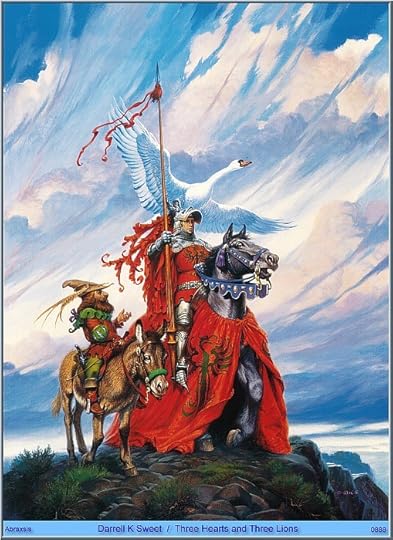
Chosen for inclusion in both David Pringle's "Modern Fantasy: The Hundred Best Novels" and Cawthorn & Moorcock's "Fantasy: The 100 Best Books," "Three Hearts and Three Lions" had long been on my "must read someday" list. This compactly written epic of "hard fantasy" was first serialized in "The Magazine of Fantasy and Science Fiction" in 1953 and released in an expanded book format in 1961. Author Poul Anderson was seemingly well suited to write this tale. The son of Scandinavian parents, a student of medieval lore and a translator of the Norse Eddas, he applied his considerable scholastic background to this, his first fantasy novel (predating his influential work "The Broken Sword" by a year). "Three Hearts" introduces us to Holger Carlsen, a Danish-born engineer living in America at the onset of WW2. A good-natured galoot, he goes back to Denmark to help fight the Nazis and is grazed on the head by a bullet during a beachfront battle. When he awakes, he is in some kind of alternate, medieval universe; a realm where Charlemagne reigns and fairies, trolls, dragons, unicorns and witches are NOT the stuff of fantasy. Holger inevitably becomes embroiled in the upcoming showdown between the forces of Law and those of Chaos. He is aided in his quest for the mystical sword Cortana by Hugi, a gruff but endearing dwarf; by Alianora, a swan-may; by the lusty Saracen Carahue, who seems to know more about Holger than he lets on; and by the valiant black stallion Papillon. In his quest, Holger comes up against Mother Gerd, a cronelike witch; Duke Alfric, one of the lords of Faerie (the entrance into Faerie itself, which Holger reaches merely by crossing an uninhabited wilderness area, may remind some readers of Lord Dunsany's 1924 classic "The King of Elfland's Daughter"); the legendary sorceress Morgan Le Fay; and a wide assortment of malevolent creatures, such as a giant, a fire-breathing dragon, an impressively unkillable troll, cannibal hordes , a bodyless knight, a water sprite and even a werewolf.
"Three Hearts and Three Lions" is not a long book (the whole thing runs to under 170 pages), and it is remarkable how much incident and humor Anderson manages to work in. As Pringle so rightly puts it, "It is a pity that most of the multi-volume fantasy epics of recent years cannot show a comparable degree of wit and economy." Yes, the book is often very amusing (occasionally almost laugh-out-loud funny) at the same time that it is evidently the work of a serious scholar. Prospective readers of the novel are advised to have a good UNabridged dictionary at hand to help with such words as "thutter," "byrnie," "cantrip," "paynim," "carline," "rede," "kittle," "mickle," "maun," "sith," "glaive," "unco," "caitiff," "bigging," "fleer," "jo," "geas," "nixie" and "chine." Besides the archaic language, Hugi and Alianora usually speak in the pure Scottish dialect, and a little adjustment may be necessary. Still, as always, some effort on the reader's part will bring about a much more informed reading experience. The novel is a remarkably imaginative one, and there is no way to predict what will happen to Holger and his friends from one page to the next. With likable characters, many exciting confrontations, a real sense of wonder, a concise and economical writing style and even a surprise ending of sorts, "Three Hearts" should please just about any lover of epic fantasy. I would give the novel a top grade if not for two problems I had with it, one small and one large. The minor problem I had was with Hugi using the word "caboodle" at one point. According to Webster's, this word did not come into use until the mid-19th century, over 1,000 years after the time of Hugi's alternate universe. My major problem with the book, however, is the ending; a terribly rushed affair , I feel, that leaves several major plot threads dangling, and several questions unanswered. Perhaps I will have to look for Anderson's belated sequel, 1974's "Midsummer Tempest," for some explanations. Still, despite my quibbles, I can certainly confirm that "Three Hearts and Three Lions" deserves to be on those top 100 lists mentioned above. With the exception of its last three or so pages, it is as nearly flawless a fantasy creation as you're likely to find.


 "Don't play coy with me Mr. 'one middle name isn't good enough for me.' What the hell does R.R. stand for anyway?"