Georgette Heyer’s first contemporary novel, Instead of the Thorn was published in 1923, when she was just twenty-one years of age.
This book deals with Elizabeth Arden, a naïve teenager who is married to the wealthy and erudite Stephen Ramsay, a writer of some renown, and who discovers that her strict upbringing, her youth, her rampant insecurities and dislike of sex make her unsuited to her new role as a wife.
Georgette Heyer was a prolific historical romance and detective fiction novelist. Her writing career began in 1921, when she turned a story for her younger brother into the novel The Black Moth.
In 1925 she married George Ronald Rougier, a mining engineer. Rougier later became a barrister and he often provided basic plot outlines for her thrillers. Beginning in 1932, Heyer released one romance novel and one thriller each year.
Heyer was an intensely private person who remained a best selling author all her life without the aid of publicity. She made no appearances, never gave an interview and only answered fan letters herself if they made an interesting historical point. She wrote one novel using the pseudonym Stella Martin.
Her Georgian and Regencies romances were inspired by Jane Austen. While some critics thought her novels were too detailed, others considered the level of detail to be Heyer's greatest asset.
Heyer remains a popular and much-loved author, known for essentially establishing the historical romance genre and its subgenre Regency romance.
A copy of this novel (one of four "contemporary" books that the redoubtable GH had suppressed) turned up on TradeMe (our Ebay) for NZ$125.00. This seemed too much for a book that it's own author disliked and is usually described as not being quite as terrible as her other three contemporaries. So I decided to interloan it and I am glad I did. Not because I saved NZ$119, but because after a poor start (I fell asleep reading this. I never do that) this is actually a good book and a very brave one for a very young author to have written in the 1920's.
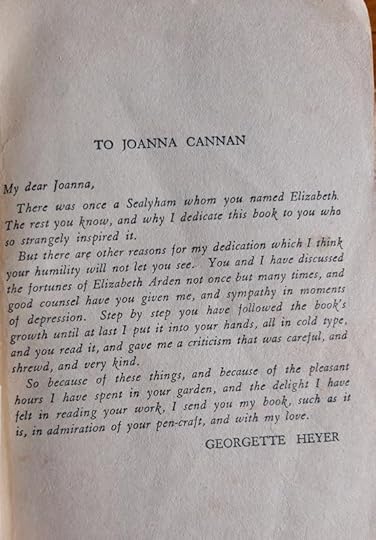
I read first the dedication to her very good friend Joanna Cannan
Very touching, although GH named her heroine after a bitch. Probably unintentional, but at certain parts of this story I could understand why!
In the 1920s, Elizabeth Arden is being brought up by a disinterested father and a maiden aunt like they were still living in Victorian times. Elizabeth has very few friends, very little intellectual stimulation and is discouraged from having any opinions of her own. Add to this an aversion to being touched, her marriage to the ardent Stephen Ramsay, eight years her senior, heads towards disaster.
While it is a mystery why Stephen falls for Elizabeth in the first place, he wouldn't be the first man to fall for a pretty face. The most interesting part of this book deals with Elizabeth's and GH handles this with considerable skill. This book is most interesting as a character study and is quite remarkable both for it being the work of such a young author (GH was only twenty) and it's release in Britain in a time of (mostly voluntary) literary censorship.
I still wouldn't pay $125 for it, but I hope GH's heirs have a reread of this book and consider releasing it for GH's adoring fans.
NB: This doesn't mean I think the other three should be released. I haven't read Pastel but Barren Corn is well written but depressing and Helen is one of the worst books I've ever read! I didn't read Heyer for years after reading that one!
While the writing itself isn't all that compelling, the story has some really worthwhile aspects. This is a story of a young girl who gets married knowing nothing about what marriage will entail, what love is, or anything about sharing your own opinion. She's raised in an overly-sheltered, very suffocated manner that leaves her completely näive and unprepared. This story takes her through the process of growing up, but only after she's married. There are lots of very good concepts explored here, which I think are still plenty relevant today. Though the main character really aggravated me at times, you really can't help but sympathize with the way she's just thrown in the water without even knowing what swimming is. This is one I'd read again after marriage.
This entire review has been hidden because of spoilers.
Instead of the Thorn was Georgette Heyer’s first novel with a contemporary setting. Of course, she wrote it in 1922 or so, so that makes it a period piece for our purposes. In fact, it’s a year or two before the current season of Downton Abbey is set, though the characters are middle-class and the plot is darker in some ways. Not in the occasionally silly dramatic-death soap opera way of DA; this feels like real life.
Our heroine, Elizabeth Arden (no, really), is not at all a modern kind of girl. As her mother died when she was a baby, Elizabeth is raised by her aunt with Victorian morals and manners, and kept very much in the family. She views friends with more modern sensibilities with great fascination and a little fear. As Carson would say to Mrs. Hughes, the times, they are a-changing.
At a dance, Elizabeth meets novelist Stephen Ramsay, who is tall and handsome and heroic, and quickly falls for Elizabeth’s petite prettiness and innocence. Stephen wants to protect her. He also wants to own her. Elizabeth is swept off by romantic notions of marriage, and has no clue about the realities. She and her aunt have A Talk before the wedding, which is not described but is hinted to be upon the lines of Lie Back And Think Of England. Elizabeth does not like to be touched, remember? It follows she won’t like sex. She is also appalled by her husband’s clothes left lying about and grossed out by his morning razor stubble.
Stephen is a writer. Not an author: a writer. He suffers over his art, spending hours every day on his book, being late for meals and not worried much over how his immature wife is occupying herself. He takes her to his ancestral country home, Queen’s Halt. His old nurse is now housekeeper there. Elizabeth is intimidated and leaves everything to her, so she has little to do with her days. She sits around while Stephen writes–in the same room. She doesn’t really get his novels (which in Elizabeth’s opinion are a bit “broad”), so they can’t talk about the thing most important to him. Worse yet, a neighbor, Nina–whom Mater and Cynthia once designed for Stephen’s wife–feels free to drop in and interrupt Stephen’s writing, and he not only doesn’t mind, he is able to discuss the progress of the book with her. Also, he takes to sleeping in his dressing room so that he doesn’t disturb Elizabeth when he sits up writing late at night.
Stephen finishes his book, and expects to pick up where they left off honeymoon-wise. Elizabeth still wants no part of That Stuff. Stephen, having married a rather stupid girl, is horrible to her when she acts stupidly. He grabs her, and kisses her forcibly, and threatens to take what is his by right. The modern (meaning 21st century, not 1920s) reader is thinking, “Oh no, Georgette Heyer, you’re not going to show us marital rape, are you?” which of course would have been perfectly legal then, but fortunately Stephen lets her go. The narrator tells us, “In anger he uttered threats which he would never have carried out.” That’s all very noble, but uttering them–threatening her–is enough. Then, a page later, he agrees to leave her alone for a while, and says, “But I want you to remember, Elizabeth, that if I chose to I could make you.” Because that’s not threatening at all, Rapey McRaperson! And he’ll let her go, but she’ll get her allowance, and he tells her where to stay, and to take a friend, and aren’t we still a controlling SOB?
It’s not a bad book, though the ending is disappointing. In fact, it’s quite good in its way, and involves an interesting subject, especially considering it was written by an unmarried (and we think one may safely assume virginal) 20-year-old, but it doesn’t have the lighthearted, romantic, swashbuckling fun of The Black Moth and The Transformation of Philip Jettan–the last one written almost as a vacation from writing Instead of the Thorn. Heyer must have suffered over Thorn in the same way that Stephen suffers over his clever novels–and he could afford to be as clever as he wanted, at least for a few more years, because he was from a County family, his main income was from stocks, and his country house inherited. Heyer did not have that luxury.
So why did she suppress this book some dozen years later? One sees Heyer–older, married, happy–shrinking from the raw emotion on display in this book rather like Elizabeth shrinks from her husband’s caress. Yet she gave Elizabeth and Stephen a happy ending, even if it took a while to get there, and the 21st-century reader is disappointed that the compromise was mostly on the woman’s side.
This entire review has been hidden because of spoilers.
Since I have absolutely no idea how to rate or review this, I'm just going with what I think I've finally decided to call my running mental commentary while reading.
RMCWR:
Was not planning to start this but it caught my eye--my first contemporary Heyer.
This ebook is not edited well AT ALL. Irritating.
Heyer takes the title from a Biblical quote (though that will probably not be what most people assume).
Uh-oh. A writer looking for his muse. That kind of relationship always goes well.
Mr. Hengist knows what's up.
The phrase that keeps running through my head is, "...oh, honey...no..."
I have wondered for several books now when "head over ears in love" became "head over heels in love" (or, again, if it's a British vs. American thing).
...it's not fair to HIM?! Her being told nothing is not fair to HIM?!
Getting ready to walk down the aisle should not feel like being in a dentist's waiting room...
...is this a horror story?...nope, just a tragedy...
GH writes so skillfully and with such restraint. She can make a point in a discreet way where nine out of ten other writers would be vulgar or graphic.
I have mistakenly been thinking a sunshade was a tiny item. Apparently it's more like a parasol?
Elizabeth's inner monologue in chapter 21 is the thesis statement of this book.
Too much innocence is dangerous.
I like the Regencies better. And the mysteries. The jury's still out on the historicals.
Apparently Heyer had this book suppressed and did not want it published. Interesting.
Georgette Heyer refused to have this early novel reprinted, but because it was published in 1923 and the copyright has expired, the book has recently been made available as an ebook. Set in her own time, this is the story of an unhappy marriage, unhappy because the heroine places her own interests first and because she was raised to be cold and distant. There is a “happy ending” eventually. Some of Heyer’s psychological insights seemed very accurate, but I think she was right not to reprint it because it’s not very good. The characters for the most part do what she wants them to do instead of having a life of their own.
From the brilliant author of detective novels and regency romances, here we have an early manifestation of her literary genius and versatility. G. Heyer masters the art of telling a story and she is telling hers with shocking brutal honesty. In this uncommon social novel one witness the clash of two eras, the fading Victorian one with its prim facade built on lies and deceits and the dawning postwar one with its disruptive nature of rebellions and challenges, as exemplified by its two heroes, Elizabeth Arden and Stephen Ramsay. When a whimsical in work but firm in his love author marries the little maiden who knows nothing about life and hides from it, discontentment and misery ensues. Elizabeth quickly fails to meet all requirements of married life while recoils from physical contact with her husband; her bucolic life in Queen’s Halt becomes unbearable from where she ultimately escapes to find herself. She has an interesting esoteric quest in London, Torquay and Wood End until she acquires the wisdom and the strength to deal honestly with life and Stephen. A casual mention of Mrs Humphrey Wood somewhere in the beginning of the book, subconsciously brought forth the affinities with the recently read Lady Rose’s Daughter (1903).
This book left me feeling torn as it rankled me for so many different reasons but at the same time I have to remember: this was written in 1923. I guess it left me feeling distinctly... uncomfortable as they say that her modern novels reveal autobiographical elements. Great.
As I said, it was a struggle to remember this was written in 1923 about 1923 so it was hard for me to relate with or even agree with choices the characters made in regards to the relationship portrayed. Thankfully this didn't have the preachy-manual-for-the-young feel that Pastel gave off (well, there was still the Farmer's wife and Mr Hengist who gave her Cliff-Notes for Managing a Man Who Is Your Husband). I guess I don't really like or appreciate that a man needs to be managed and in order to manage him, games need to be played. Seems so... sneaky, telling women to be manipulative to get their own way. And rather than compromise the woman must bend to meet the man and his needs? A woman must mother a man (which says to me, hi Oedipus-complex, good morning Freud, do men really marry their mothers?)
While this book didn't quite play up the "settling" aspect (in terms of a spouse, as she married the famous glittering author) I do question staying in a marriage when "physical relations" repulses. Granted it was a given she'd get over it when she fell in love, but I guess I always want to argue--be in love first when you get married. (I also had a problem with Stephen and his reasons for wanting to marry her--merely because he could not stand the idea of anyone else possessing her. The line "mine, mine, mine" was incredibly creepy and I personally would've either laughed or run from the room screaming) I like to think we've come a long ways from the Victorian perspective of "lying back and thinking of England". Why learn to love when one can marry for love? She had the choice and married a.) because she was rushed/pressured into it, b.) wanted independence and c.) play at housekeeping.
The solution in the story? a.) Oh she's so YOUNG. Only 19 (yeah, that's great side cast, way to acknowledge that minor detail after chasing her down the aisle) guess we'll forgive her, b.) separates from her husband and stays at a Baker Street lodging (nothing says independence like living "alone" getting pestered by your landlady) c.) +1 fluffy lamb (what pray tell will you do when its a full-grown sheep ripping up your rustic English lawn?), +1 pony and trap and +assorted ducklings (which I guess where already there but now she takes a more active interest in their well-being). When I read the last bit I paused and considered, "what, is she Marie Antoinette with her little play farm?"
The whole reason why she goes back to Stephen (embarrassing scandal and well, the off-putting allegedly mortifying divorce trials aside) is because she feels lonely. My girl, you've simply never learned to be by yourself. She spends so much time feeling sorry for herself and feeling indignant and ridiculous rather than truly and actively learning to be independent (I don't count learning typing). I honestly wish she had divorced him (though I did always feel bad for Stephen). She never learned to be herself, to have her Season, to see what was out there. Instead we watch this weird process of breaking herself down and molding herself into... something Stephen-like. I don't know that that is truly "Elizabeth" and not instead a reflection of Stephen, something that would be compatible for him, something that's a part of his world. I guess it shows the flexibility and adaptability of women.
Again, must remember the time period. Relics from the Victorian era still lived after all. All I can say is that I'm happy it didn't end with them having a bundle of joy of their own, their own new mini-Christopher. Thank you for small mercies.
This entire review has been hidden because of spoilers.
I was surprised by how much I enjoyed this story of a truly clueless young girl, raised to be prim and proper by her maiden aunt.
Aunt Anne approved of so many things, including most literary works, so even her education was severely lacking. There wasn't a hint of sophistication in Elizabeth.
Aunt Anne's "Nice Girls Don't Read that, Say that, Do That" was drummed into the guileless young Elizabeth. In fact, Aunt Anne eventually advised the bewildered young, newly adult Elizabeth, "Nice Girls Don't Ask Questions," period. Elizabeth was a sheltered bloom, indeed, unprepared for "real life." She was, as Georgette Heyer would have labelled her in one of her historical novels, a "beautiful ninny."
When her father starts escorting her to social events, she soon meets Stephen Ramsay, a handsome young author from a very good family. Her father and aunt encourage her to accept his offer of marriage after he makes it known that he has fallen in love with her winsome "innocent ways."
Stephen was little prepared for how innocent Elizabeth really was and the marriage was a disaster. Elizabeth leaves Stephen and tries to make her own way in the world, hopeful of casting off Aunt Anne's brainwashing so she could become her own person. Elizabeth made many a blunder, and almost ruined her reputation by being seen around town with a disreputable artist, but Stephen stepped in to rescue Elizabeth from their social circle's condemnation by taking her back to live with him at his country estate: in name only, until she could learn to love him or decide to divorce him.
Elizabeth's evolution into awakened womanhood was an interesting journey. I rather enjoyed this book. It was a stark contrast to both Heyer's historical romances and her sophisticated detective novels. I'm rating this one a 5 out of 5 stars because it struck a major chord with my young self. I'd had a very sheltered upbringing so I knew exactly what Elizabeth was feeling once she was let loose as a young married woman, having to fend for herself and come to terms with having an intimate relationship with her new husband. (Aunt Anne had failed Elizabeth disgracefully in this regard! At least we had sex education in our parochial schools - limited as it was.) I loved this one and actually remembered most of the plot as I was writing this review, which says a lot!
Worth reading as a snapshot of women's history in the early 1900's
As a lifelong fan of Georgette Heyer and a writer myself, I didn't read this book with unalloyed joy. It is dreadfully dated and the main characters seem more like caricatures than the real thing. Elisabeth has been brought up by a spinster aunt and a detached father, who shows no interest in her at all until she grows into a lovely young lady who he's proud to be seen with. The aunt infantalizes her, teaching her to be compliant and avoid facing unpleasant truths. She describes the intimate side of marriage as something women have to endure because men are such beasts. As a consequence, Elisabeth has no mind of her own and is totally unprepared not only for marriage but for living as an adult. It's not until she overcomes these obstacles (which she does- it's a romance, after all!) that she can be happy with herself and anyone else. The story is honestly not especially interesting and the relationship between men and women is at its best denigratory towards women. But it's precisely this last aspect that makes the book worth reading. Not a woman today could be Elisabeth! She is an image of what we were. Even the most strident of women's rights campaigners who complain about the inequality we still face would have to admit how far we have come. In this Women's History Month let us read this novel and give thanks! And Georgette Heyer is still Georgette Heyer. Her minor characters, the mother-in-law and the bounder Charles are drawn with a deft and humorous pen. They compensate for the wooden Stephen and the weak-kneed Elisabeth. In the end, we wish them all well.
This book is definitely dated and a little creepy, but it is impressive how much Heyer is able to convey without ever stating anything outright. I probably won't read it again, but I'm not sorry I did.
Not Georgette Heyer's best book, but still incorporates her sense of humor and has an honesty that would have been unusual in the 1920's as Victorian ideas and mores still were having an effect on English society. A young woman who has been extremely sheltered and told what to think for most of her life is forced to become an adult without any preparation, and she finds it impossible. The reader has to root for Elizabeth as she begins to discover who she is and what she wants from life, and although the solution may be irksome to those of us a century removed, it can be seen as an indication of changes to come.
This is not to say that the story has nothing to say about today. There are still many women who try not to appear too intelligent, who defer to men who are "masterful," and who have been brainwashed into thinking, not for themselves but for their segment of society that doesn't allow for disagreement.
I thought this book was simply beautiful. Yes, it takes place 100 years ago, when social mores were utterly different…perhaps better in some ways.
A young girl loses herself under the domineering influence of her Victorian aunt. Although the context is the 1920’s, Heyer describes the girl’s loss of self in a way that is timelessly relatable. Her psychological insight is profound. No wonder Queen Elizabeth thought her a fearfully clever woman.
How the girl eventually frees and rediscovers herself provides the action of the story. I found it deeply engrossing and was moved by the portrayal of the girl’s husband, who displays such self-sacrifice, loyalty and patience.
Books like this, that present beautiful and quietly heroic characters that are meant to inspire, are completely out of fashion… but I love them.
This book was baffling to me. Is Elizabeth a believable character- were there really women like her or was she a caricature? Is it possible to be so prudish? It would make more sense if she just wasn't a fan of sex, or Stephen were a man she could never feel attracted to. But could strong physical revulsion really be felt toward someone you later fall in love with? Also, why would she expect Stephen to see she had started to love him when she had shrunk from all his previous advances AND he had told her he wouldn't talk of love unless she did? What was up with the weird advice from the married woman? Feel as motherly as you can toward your husband?? Don't be direct with him, learn to manage him? Terrible.
This entire review has been hidden because of spoilers.
Essential reading for 13y-olds to show Feminism is necessary
Yes, essential reading for 13 year old girls.
Mainly to show that feminism is absolutely necessary.
This book depicts a wife who only gains personal happiness and marital contentment ( and sex) when she has learned to be unselfish and submissive in a manipulative way.
Also essential reading for 13 year olds to show that careful proofreading also is necessary. The typos are absolutely appalling, the book is littered with them.
So 5 stars ***** for 13 year olds. Anyone else, a 1 star *.
I personally deserve 10 stars ********** for reading to the bitter, sorry, happy, end.
I did not like this book in many ways because I don't like books where the female lead strays. I also felt that it put a lot of blame on the woman for the relationship problems, when the guy rushed her into marriage and then ignored her. Both of them did things wrong, in my opinion.
I did feel it had a few good messages to give married people: don't give up on your marriage, spend time together, talk about your day and problems with each other, and don't spend time alone with other people when you are married.
took me a while to get through this one, and I'm still not really sure how I feel about it — I think a lot of what she was saying re: girls not being prepared for marriage rang true at the time, as well as needing to learn to communicate and be more independent, plus I liked all the character dynamics, but idk if I really felt satisfied by their final reconciliation and the relationships as a whole.
Couldn’t even finish the book. For an introduction to Georgette Heyer, this was such a disappointment. Maybe I will come back to her one day.
Why? Everything takes forever to explain. The girl clearly makes choices that don’t seem like wise ones. It never feels like the story gets anywhere. I finally skipped ahead and read a bit of the end just to see what happened.
This entire review has been hidden because of spoilers.
One of her early novels written in her own time, the 1920's, about a young girl's journey from a outdated Victorian upbringing, through her marriage and eventual maturing. It's a journey that even in the 21st century has relevence even though the societal norms have changed, some attitudes never do!
This was an undeniably interesting story told by the great Georgette Heyer, but that said, it's an early Heyer and there are strong reasons it was not successful, which led to her suppressing the novel the rest of her life. I would recommend it only if you really want to read all of her works.
I loved this story. Having been and known Elizabeth-Annes, it reinforced my long held belief that love can be learned and grown. Emotions can be unreliable. And we can change.
This entire review has been hidden because of spoilers.
I enjoyed this one much more than I expected. This is one of Heyer's early 'suppressed' novels that her son released after her death. This was contemporary and rather silly, but I enjoyed experiencing her early attempts at creating laughably human characters. Someday, Megan, you should try it.
This is one of Georgette Heyer's more modern romances and I didn't like it nearly as well as the regency novels. I disliked the beginning but warmed up to the protagonist in the end.