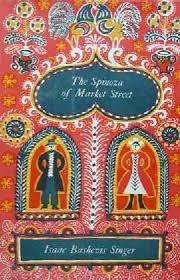
Isaac Bashevis Singer was a Polish American author of Jewish descent, noted for his short stories. He was one of the leading figures in the Yiddish literary movement, and received the Nobel Prize in Literature in 1978. His memoir, "A Day Of Pleasure: Stories of a Boy Growing Up in Warsaw", won the U.S. National Book Award in Children's Literature in 1970, while his collection "A Crown of Feathers and Other Stories" won the U.S. National Book Award in Fiction in 1974.
A short story collection. I thought several were quite good, and the others were not at all my cup of tea. Several stories in the collection were about the Devil inserting himself/herself/it into the lives of people and wreaking havoc.
There are 11 stories. The first one I read I liked a lot…it was called “A Piece of Advice” and it involved a man who by nature was angry and would castigate people or ridicule them. Nobody liked him. He was given advice by a rabbi to essentially flatter people…regardless of what he thought of them he was urged to be nice. As the rabbi said: “Are you angry, perhaps? Go ahead and be angry, but speak gentle words and be friendly at the same time.” So initially the man’s emotions were the same as his subsequent actions…he was angry and he behaved like a total jerk. But then in following the rabbi’s advice, he dissociated his emotions from his actions—he was still angry but acted nicely (“…If one stopped and waited until all the passions ceased, one could never attain holiness.”). Eventually the actions modified his emotions in that eventually he became a nice peaceable man. 😊
Reminds me of a psychological theory espoused by Daryl Bem way back in 1972: self-perception theory of attitude change. According to self-perception theory, people infer their attitudes from their own behavior much as an outside observer might. For example, just as a person might watch someone else giving a pro-Fidel Castro speech and infer that the person is in favor of Castro, a person who is asked to give such a speech would consequently come to view him or herself as more in favor of Castro. Might take a while but there you go.
Here are the 11 stories, in order of appearance and where they were previously published and number of stars I gave them. As you can see, there were some I liked a lot and some I gave a big thumbs down. • The Spinoza of Market Street, published in Esquire, 2.5 stars • The Black Wedding, published in Noonday 3, 1 star • A Tale of Two Liars, published in Noonday 1, 4.5 stars • The Shadow of a Crib, published in Madamoiselle, 2 stars • Shiddah and Kuziba, published in Commentary, 1 star • Caricature, not previously published, 3.5 stars • The Beggar Said So, published in Esquire, 4 stars • The Man Who Came Back, published in Commentary, 1.5 stars • A Piece of Advice, published in Hadassah Newsletter, 4 stars • In the Poorhouse, published in Midstream, 2 stars • The Destruction of Kreshev, not previously published, 1 star (it’s the longest story of the bunch, 54 pages)
Words I had to look up: • Termagant: a harsh-tempered or overbearing woman • Expatiate: speak or write at length or in detail • Iniquitous: grossly unfair and morally wrong
Notes/queries: • Was Schopenhauer a misogynist? Singer had this in one of the stories (Caricature): “Dr. Margolis remembered a saying of Schopenhauer: Woman has the appearance and mentality of a child. If she becomes intellectually mature, she develops the face of a man.” • I learned a new way to insult the world (from The Man Who Came Back): “…Have you no shame before the world?” “The world can kiss what we sit on,” says he. Well! 😮 • Here’s a young woman fancying herself avenging a man who has spurned her (The Shadow of a Crib): “…She fancied herself an avenging knight, stripping Yaretzky and lashing him in the market-square. After the scourging, she bound him to the tail of a pack horse and had him dragged off to the turnpike. And then, after all this torture, she gouged bits of flesh from his body and poured acid into the wounds.” 😮 • How’s this for being in purgatory? (A Tale of Two Liars): “When I told this story to Lilith, she found it very amusing and decided to see these two sinners in Gehenna. I flew with her to purgatory and showed her how they hung suspended by their tongues, which is the prescribed punishment for liars. Under their feet were braziers of burning coals. Devils flogged their bodies with fiery rods.”
I participated in an online book group which devoted two sessions to Rebecca Goldstein's book "Betraying Spinoza: The Renegade Jew Who Gave Us Modernity". A philosopher and novelist, Goldstein works to discover the elusive individual hidden under the difficult, seemingly impersonal philosophy that Spinoza developed in his "Ethics". She draws insightfully from her own experiences in understanding Spinoza.
Goldstein concludes her short list of books for further reading by "heartily recommending" Isaac Bashevis Singer's short story "The Spinoza of Market Street" in which the protagonist, a philosopher, Dr. Nahum Fischelson, betrays Spinoza, in a last line that Goldstein adopts her own: "Divine Spinoza, forgive me, I have become a fool". Our group discussed the meaning of Goldstein's title "Betraying Spinoza" and insight may be drawn from the way Fischelson "betrays" Spinoza in Singer's story. I have read Singer's story many times over the years and was prompted to reread it after our group's discussion of Goldstein's book.
Singer wrote his story in Yiddish in 1943. In 1961, it became the leading work in an eponymous collection of stories. The work is set in Warsaw at the outbreak of the Great War. Fischelson, a crusty ailing old bachelor has made a lifelong study of Spinoza but has failed to publish his long-anticipated book. He lives in poverty in a garret supported largely by the generosity of members of the Jewish community that he has abandoned. Fischelson marvels at the breadth of the cosmos and the stars and at the folly of the life in the streets below. He carries with him Spinoza's masterwork, the "Ethics" which he has virtually memorized and often quotes in the course of the story.
When Fischelson is lying ill and apparently close to death, an illiterate, never-married old woman, Black Dobbe, gradually nurses him back to health. Fischelson becomes moved by Black Dobbe's ministrations and affections and the two marry in a traditional Jewish ceremony that Singer describes in detail. On the wedding night, Black Dobbe comes with flowing hair to Fischelson in her night gown and with the words "my dear husband, mazel tov". Fischelson finds to his surprise that he is able to respond and perform sexually as if he were young. He looks out the window at the sky and at the vast order of nature and at its apparent necessity and contrasts it with the particularism, sexuality and feelings of love he has developed for Black Dobbe.
In less than ten pages, Singer shows a great deal about both Spinoza and about the power of literature. His story may be almost as enigmatic as the philosopher whom he treats. Why does Fischelson feel he has become a fool and how, in Goldstein's terms has he "betrayed" Spinoza? In a broad sense, Fischelson "betrays" Spinoza by coming to his own understanding of the world -- that it is not governed in full by necessity and reason. Specifically, Fischelson realizes the value of individuality and passion, both of which, he concludes, have been slighted by Spinoza's rationalism and focus on the whole. He comes to feel himself reborn through the feelings of love and sex. With these insights, correctly or incorrectly, Fischelson thinks that he has "betrayed" Spinoza. So too, Goldstein in her study while clearly admiring and learning from her subject, "betrays" Spinoza, in her view by her rejection of determinism and by the feelings she has for her two daughters and for her husband.
I enjoyed thinking about Spinoza again, with the book group, with Goldstein and with Singer. It invariably enlivens and inspires me. Readers who want an unforgettable taste of both Spinoza and I.B. Singer will enjoy this beautifully moving story, "The Spinoza of Market Street".
Almost 5-stars to every story herein. 10 short stories + a novella. Amazing and superb dark stories. A couple of them with a philosophical bent, but most of them dark, some narrated by the Evil One, the Satan itself. This being my third short story compilation reading from Singer, I would somewhat agree, that this probably is his "extraordinary work" as it is said. I enjoyed this one more than the previous two collections of his that I have read. As usual, translations do not feel like translations at all. I loved reading all the eleven stories. Much recommended!
I bought this collection almost two years ago after hearing Ernest J. Gaines say he was inspired by the title story. I'm only getting to the collection now, but I'm so glad I did. (I also now understand why critics thought of Singer when reviewing Nathan Englander's For the Relief of Unbearable Urges, which I read some time ago and really liked.)
Of course, I'm reading these stories in translation, but they read effortlessly and smoothly -- the prose is flawless. The plots are unique and inventive -- I was never sure where any story was headed with its individual mixture of superstition and religion, tradition and modernity, demons and humans, love and irony.
I.B. Singer is such a marvelous storyteller. This wasn’t quite a full 5 star book for me because a few of the stories in this collection seemed a little slight, but I'll round up because most of them were terrific. In particular, I loved the title story, A Tale of Two Liars, The Shadow of a Crib, and the novella The Destruction of Kreshev.
Before picking up this collection by Singer, I’d been thinking about reading something by Gabriel Garcia Marquez. I wondered if that was the reason why, as I read the first few stories in this book, it struck me that Singer’s tales could be described as Yiddish magical realism. It's a different type of magical spirit than in Garcia Marquez, or Rushdie. In Singer's stories, the supernatural elements tend to come from Eastern European Jewish folklore and/or Hasidic mysticism, and often involve interventions by demons and spirits who are known by name to the 19th and early 20th century Polish Jews who inhabit these pages. Indeed, several stories are narrated by the devil, who delights in boasting of how he manages to control the affairs of the human world. In others, the turn of events or changes in characters’ lives seem more subtly to be determined by unseen and unnamed spiritual forces.
The characters in these tales are prone to meeting with odd or unexpected fates – bad people become good, the good turn bad, rationalists become believers, believers lose their faith -- as well as gradual or sudden reversals of fortune. Maybe some would see these as events that could only be understood as miraculous or supernaturally influenced. But I didn't feel that way, and was never bothered when Singer offered a supernatural explanation. As I said, he's a great storyteller, and for me the stories work equally well as illustrative tales of human beings being human, and behaving in their infinitely irrational, unpredictable and inexplicable ways.
"He has white skin but inside he is red. He shouts as if he were strong, but really he is weak and shaky. Throw a stone and he breaks; use a thong and he bleeds. In heat he melts. In cold he freezes. There is a bellows in his chest which has to contract and expand constantly. In his left side is a small sac which must throb and quiver all the time. He stuffs himself with mildew of a kind which grows in mud or sand. This mildew he must swallow constantly and after it passes through his body he must drop it out. He depends on a thousand accidents, and that’s why he is so nasty and angry."
Nobel Laureate Isaac Bashevis Singer was called "Perhaps the greatest Yiddish writer of all time," by the Saturday review. I am not knowledgeable enough to say yes or no to this, but I can say that I found this collection of ten stories and one novella enchanting, thought-provoking, and an interesting view of the history of a culture that I did not know a great deal about.
Some of these stories read almost as folklore and cautionary tales. Indeed, several of the stories talk of demons and dybbuks, two of the stories ("A Tale of Two Liars" and "The Destruction of Kreshev") are actually narrated by Samael, "the Evil One", himself. Another of the stories is about a mother demon and her child underground, scared of humans.
While these tales with a more supernatural element are fascinating, the ones that deal more with day to day life are equally engaging, if not more so. I am quite fond of the title story, about an aging professor and disciple of Spinoza's philosophy, starting to lose reason as he falls in love in the autumn of his years. And tales like "Caricature," "The Beggar Said So" and "In the Poorhouse" are certainly comparable to the likes of Chekhov and Gogol.
I am quite happy I stumbled upon this collection at a ten cent book sale at my hometown library, else I never would have known to seek it out and read it. And it was quite a good read.
Singer is effing great. All of these stories basically involve cool Jewish magical mysticism. Lots of death and suffering but also humor and redemption. Singer loves to set a lot of his stories in Poland, which gives them all a tinge if sadness and regret — without necessarily directly referencing the Holocaust at all, it hangs heavily over every story simply because it’s a glimpse at how vibrant the Jewish community in Europe was before it happened. (Also of note: The Devil is a main character in a lot of these stories, and that Singer characterizes him so well.)
A very good collection of short stories. For the most part they are all based on very orthodox Jewish beliefs and a couple of the stories are very dark and satanic. Singer has an extraordinary ability to create some of the most flawed and, often, despicable characters in literature but make them very believable. My favorite stories in the book are the title story "The Spinoza of Market Street" and "The Beggar Said So" but all of the stories were quite good.
Relato judíos ambientados en la Polonia de albores del siglo XX, todos surgidos de un mismo ambiente cultural, pero de variada temática, rozando lo sobrenatural de una manera sutil y armoniosa. Las historias están en general, muy bien escritas, con personajes singulares y un versátil uso de la fe en contraste con la vida diaria, otorgando emoción y comedia por partes iguales, además de un constante buen hacer al cerrar cada una de ellas.
Mis relatos favoritos: "El Spinoza de la calle Market" y "La sombra de la cuna" por lo bellos; "En el asilo" por su visión sarcástica de la vida; y en especial, "La boda negra", el relato más oscuro, una locura satánica sin igual.
En fin, con su novela "El esclavo" me cautivó, más ahora con esta antología, Singer me terminó de conquistar.
Boring. Really boring, with nothing to offer. I already know this writer and I read 3 of his works a couple of years ago, but this time, I'm disappointed. Seriously, I guess this could be his worst book of all time.
Excellent short stories focusing on Jewish culture in rural Eastern Europe. Stories of skepticism, faith, study, and some which revolve around demons and con-men. The stories were originally in Yiddish, but the translation is very good.
Eastern European village folk tales; Singer shows the not-too-romantic and very superstitious side of Jewish village life. Superstition rages and conquers nearly all of the villagers, their mindsets, and is in fact the main guide for their beliefs, goals and aspirations. The real Spinoza fought against superstition; it's no wonder, then, that a failed Spinozist would be the subject of the first of this book's short stories. My favorite two stories were the Shadow of the Crib and the Destruction of Kreshnev. third place goes to A piece of advice. Those three are also the three least pessimistic stories in a collection of short stories that is often overly pessimistic. The Destruction of Kreshnev seems pessimistic but is actually heroic and is a wonderful tale. It's also a fitting end to the book. Lise (the heroine in The Destruction of Kreshnev) is the most true Spinoza type character in the book. Her story shows an extreme but rational act of defiance against an inescapably pervasive and ridiculous environment of superstitious beliefs and irrational reactions. One can argue that Lise committed suicide as an exasperated and defeated response to her degradation and abuse. But Lise accepted her fate willingly without fear, remorse or penance. Rather, she became a sudden rationalist; changing from an intellectual searcher into a confirmed rationalist. Lise' husband was her opposite: he changes from intellectual superstitious heretic to repentant believer. (The story sets the two up as opposites). Her humiliation was a factor in her suicide, but I believe her primary motivation was that her affair enabled her up to experience a world beyond the dictates of superstitious religion, and she found herself a rationalist in an inescapable and destructive superstitious religious environment; one she could not live in or escape.
So this is a bundle of short stories that I picked up in Iceland. It was the name that caught my eye plus I did not want to leave the (2nd hand) bookstore empty handed. A critic is quoted on the front saying: "Life in the ghettos of Poland", which was enough for me to catch my attention. From then on I started carrying it with me at all times, reading a story while waiting, using public transport or when bored. Having a short story collection within hand reach is something I advice at all times to who-ever wants to read more since it's so easy to read 10 or so pages.
The stories featured are all religious based on Jewish folks, something I haven't read before and which was a refreshing theme. One was even written from the perspective of demons that live beneath the earth, with Jewish names and all. Many rabbi's make their appearances, just like beggars, (cheating) women and (deceiving) men. Although this seems to be plenty to write about the stories got boring once in a while and felt a little repetitive. But spreading out the collection in a couple of months was a good way to enjoy them nonetheless.
Although this book is odd, I really enjoyed it. It is a quick read, perfect for a train ride or plane ride. A collection of ghost/occult related stories are grouped together and intertwined with Philosophy, Religion, Culture, History, and Geography. Most of the main characters are Jewish and reside in Poland. It was interesting to learn about customs of the times (18th-20th centuries).
My personal favorites of the 11 stories: -The Destruction of Kreshev: Satan plays a hand in arranging a marriage between a couple that plays out badly -A Tale of Two Liars: Two hucksters, pitted against each other, are caught in a series of escalating lies -The Spinoza of Market Street: The tale of a scholar in the twilight of his life
Reading this was a bit like surfing the interwebz or Wikipedia. I suggest having a tablet nearby since there are many references to interesting topics such as famous Philosophers, Theories, Historical Events and Figures, Locations, Traditions, Religion, etc. I found myself spending much of the reading, researching many topics the author references.
Unlike "Crown of Feathers," these stories are solidly set in the Old Country and Singer is trying to recreate the world that vanished shortly after the Nazis invaded Poland on Sept. 1, 1939. He does a really good job of it, and the stories are very rich and full of twists and turns. Singer often includes supernatural elements without any attempt to provide a plausible parellel explanation as, for example, Alison Lurie does in "Women and Ghosts." I have no problem with that, in fact I like it. In such stories, the only "out" is for the reader to decide the narrator is unreliable; other than that, you either believe it or you don't. Each of these stories is a gem both in the literary and historical sense. The last story especially knocked me out.
A simply wonderful collection of stories set in the long-vanished Jewish villages of eastern Europe, first published in 1963. Richly drawn, passionate, lively and witty tales of everyday lives, with love, lust, faith, ambition and tragedy on vivid display, often all within the same story. For me the highlight is the novella-length "The Destruction of Kreshev", the story of a doomed marriage (and doomed village) narrated by none other than the devil himself (!), but everything here ranges from very good to excellent.
After "Gimpel the fool", this collection continues in similar style of folklores that involve much of the same possession of devil among the rich bog of human lives. The tone is darker, with the exception of the title story, demonstrated in stories such as "Two Liars" and "The destruction of Kreshev". Highly entertaining but the stories seem to show some repetitiveness in themes. (Do we meet one too many badly bedevilled marriages of a rabbi's daughter?) However, "the man who called back" is uniquely interesting.
This is one of the best if not the best short story collections I've read. I read and enjoyed every individual story. There wasn't a specific theme or conceit to the collection but all involved stories of Jewish characters in small Polish towns. Singer's short stories are haunting, sometimes because of the supernatural elements and sometimes because of their bleak realism.
One line description of the book: Book of folk tales. The setting is ultra- orthodox Jewish society and several stories deal with people having either black or white characters. The stories are not intellectual food. They are those kind that you would like to read on short journeys (easily put down). If one finds folk tales interesting then this book is a must read
Another fantastic voyage into another culture, at another time. Haunted by Evil, populated by tinkers and holy men, this handful of stories takes place in various Jewish ghettoes of Poland. Stories are generally grounded in a mundane setting but take off on flights of fancy, weaving superstition and Yiddish patois into parables about life and love, good and evil.
A collection of short stories that savors and preserves - with no rose-colored glasses - European schtetl life before the war, a culture entirely wiped out and lost. Singer's literary voice is sure, here, as he trys on varying points of view. If you are looking to read one book of this type, this book is the one to choose.