Rick Veitch's fierce and darkly comic BRATPACK has long been considered a subterranean classic of the genre. Now, at last, the notorious graphic novel that made the mainstream safe for totally twisted superhero satires is available in a new KING HELL trade paperback edition! Veitch's no-holds-barred dissection of the hoary old 'kid sidekick' phenomena is as harrowing as it is hilarious; subversively subtle yet completely over the top. BRATPACK is an edgy and unforgettable dance macabre that is a must for every graphic novel collection. With an introduction by Neil Gaiman. BRATPACK is a companion volume to Rick Veitch's THE MAXIMORTAL and was nominated for "Best Graphic Album" in the Eisner Awards in 1995.
When Doctor Blasphemy kills the Brat Pack, the kid sidekicks of the heroes of Slumburg, Moon Mistress, the Midnight Mink, King Rad, and Judge Jury have to find some new recruits. Will the new Brat Pack even find their footing before joining the old Brat Pack in their fate?
I've been aware of this book for years, thanks to the iconic cover of Chippy, the Robin analogue, shaving his legs. When I saw it was being brought back into print, I decided it was time to finally read the thing.
Brat Pack reminds me of Garth Ennis' The Boys in that it shows the dark side of living in a world of super heroes. It also asks the question "What kind of sociopath would bring a kid into a life of fighting crime?" The answer is these kinds of sociopaths!
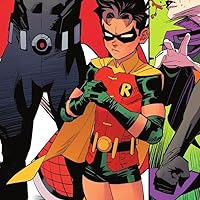
The book is basically Robin, Wonder Girl, Speedy, and Bucky trying to fill the shoes of their disposable predecessors while finding out what kind of people their mentors are. Chippy, Luna, Wild Boy, and Kid Vicious have their work cut out for them. The heroes of Slumburg are pretty terrible, more focused on merchandising than fighting crime. And what the hell do they want sidekicks for anyway?
This is one of those books that I recognize as high quality but I wouldn't say I actually liked it. Rick Veitch's art is spectacular, especially the backgrounds of Slumburg, and he does a great job portraying what pieces of shit the heroes of Slumburg are. There's just not a likable character in the entire book by the end and the ending felt kind of rushed.
Brat Pack is an interesting, if brutal and depressing, piece of comics history. 3.5 out of 5 stars.
Almost nothing about superhero comics and settings makes a lick of sense, but I can't think of any other part of them that's as disturbing as kid sidekicks. Pick up a teenager from the streets, turn him into a warrior instead of letting him go to school, ruin his life, possibly abuse him sexually. A lot of dark implications about a father-/mother-figure, someone they should trust, making them do shit like this.
On one hand, you'd think it should be easy to deconstruct the whole mess, parody it into hell and back, open our eyes about it. On the other hand, reading Bratpack almost convinces me that even that would be too much: the premise makes so little sense that any attempt at parody would just cause the whole thing collapse.
The moment you ask the essential question - "What kind of people would have kid sidekicks?" - what you inevitably get is terrible, terrible people, living in a world that would have to be a hideous wretched hive to allow them to exist. Such a recipe makes for a story and people and setting that are far too awful to be taken seriously, yet there's also too much commentary and tract to truly own up to the joke it has set up - unable to commit to either, it just sits on the fence and ends up doing nothing good.
Could you be more subtle with such an inherently absurd premise as this? Maybe. I haven't seen any, I can't imagine one, but maybe you could. Bratpack isn't one of those, however. Take its low rating as not just about the book itself, but also about the idea of kid sidekicks as a whole.
Where Watchmen was moody and existential, this creation, another popular graphic novel in the age of superheroes getting killed and shown as real, fragile, maybe even antagonistic superhumans. This wacky, outrageous--but still very much grounded in the graphic fantastic--comic has a certain pessimism that carries though the ages. Where Watchmen was the End of the World, Brat Pack is the End of the Sidekick as we know it!!
The artwork is fantastic. Veitch is one of the few artists I notice who really takes advantage of the medium. Using each panel to do inventive things that help the story-telling.
This is The Boys before that comic existed. Here the focus is on the young sidekicks. The super-heroes are all crazy just like in The Boys and willingly put these youngsters in danger, sexually abuse them, and once they die they're easily replaced with another youngster. Veitch uses the main DC heroes as archetypes.
The supervillain Doctor Blasphemy is amazing. The character design is super creepy and effective.
Bratpack is an on-the-nose superhero deconstruction and morality tale with a brash, gonzo sensibility that I dislike. Veitch is criticizing superhero comics' violence, fascistic inclinations, commercialism, and particularly the clouds of exploitation and pedophilia over young super-sidekicks. But his approach has no depth or nuance, and there's not much of a story, just a bunch of characters spiraling to extremely obvious and unconvincing depths. Some of the art is pretty good, but there are a bunch of anatomy errors, and many panels are unsettlingly grotesque. Ultimately Veitch's book is an absurd strawman rather than an insightful critique of superheros.
Brat Pack is not what I would call an enjoyable read, and I say this with full knowledge of every implication of that phrase. Despite this, I don't think there is a single book that proved to me the uselessness of trying to use an "objective" standard, such as a 5 star rating, to critique an art form. To understand why, I'd first like to speak of the context under I read it first. I first read Brat Pack in 2018, while in the middle of a research for a seminar project of an infamous class in my university. We are told to fear this two semester spanning class and the infamous teacher who gives it from our first day of our first semester into the university. While I personally didn't suffer with him as much as some of my peers, I certainly suffered from anxiety while working on the research projects that we had to do. It is on this context, while trying to understand the political thought of a certain racist french filologist, packed with enough coffee to make me start questioning my own sanity, that I decided to take a break and read this comic book. I had gotten the recommendation by someone in a comic book group, who warned that this, being a Veitch book, was probably a read that would twist your stomach. At the time, I didn't take notice of the concern. I have a soft spot for "superheroes gone real" stories. Most of them are not bad, but not particularly good either. They don't go much further beyond what Moore or Miller did in the 90s, they don't say anything new about the genre and they simply use the chance to tell a slightly edgier superhero story. That was mostly what I expected, dumb fun that tries to present itself as something more than that. Brat Pack is certainly not that. I can say now that this is a story that certainly has a point, and what that point is is up to discussion. At the time, however, most of that point was lost to me in what amounts to be one of the most unnecesarily gruesome comic books I've had the misfortune of reading. The impact it had on me at the time, made me completely despise everything about the book. I felt its critique bordered into reactionary, homophobic and even missoginistic territories, something that would make Miller look mild in comparison. I felt it used an unnecesary ammount of edge. I truly felt a twist in my stomach while reading this comic book, and it pissed me off in a way I couldn't even fully express. Currently, it has been almost a year from that first read, and while my general disdain and unwilllingness to ever read this book again remains, my opinion of it has certainly improved. Brat Pack is an acid critique of the fascistic nature of superheroes which picks up where Moore left off in Watchmen and introduces new topics to criticize. The story tells of a group of sidekicks who are murdered by the misterious Doctor Blasphemy, and of how each of the 4 hero mentors look for replacements for them. Each of these heroes is amoral and presented in a very negative light, and they all represent a corrupting influence for each of the unlucky teenagers that they choose. Through each of these, Veitch deals in different degrees with the abusive and inherently erotic nature of this hypothetical "sidekick/hero" relations. Brand recognition and celebrity endorsements, in particular, are topics that have now been associated with a lot of critiques of superheroes, specially with the recent release of the Boys superhero series. And while some other comics have certainly dealt with these topics with much more depth and nuance than this one (amongst them, Veitch's own sequel to Brat Pack, The Maximator) the comic bookk is still (as far as I know) one of the first works to look critically at this. The attack on child celebrity exploitation seems to predate an issue that would only become more widespread as time went on. The abuse each of the heroes make their sidekick go through explores specific aspects of this exploitation. Judge Jury, an openly fascistic figure with white supremacist undertones, forces his sidekick to go through steroids in order to have the physique necesary to be his sidekick. King Rad, a drug addicted billionaire who works on military contracts and is clearly a blend between Green Arrow and Iron man, forces his sidekick to drug himself, first to prove himself worthy, aftwerwards when his . Moon Maiden, a misandrist dominatrix, forces her child sidekick to sexualize herself in order to empowerselg. And lastly, Midnight Mink is an openly homosexual and pedophilic character, holds a relation with pedophilic tones with his own sidekick. All of these work to explore different themes and criticize, in diferent ways, the general idea of someone taking justice into their own hands and believing themselves to be above the law. In the end, the comic book even has a disturbing revelation on why this heroes actually need the sidekicks, that ties well into the rest of the themes. Some of the themes Veitch tried to explore were certainly dealt with better than others. The abusive themes are too abrupt at times, and they are certainly nor exactly respectful to the possible experience of victims. This can be said of many of the topics as well, that they seem too overthetop to be dealt with respectfully. While this might be true, I can now atribute this to a deliberate choice, an overtly satirical tone that tried to exagerate this tones and show the powerful this certainly had a lot to do with the anxiety I already had at the time. However, the experience of this book is now eternally tainted by it, and I cannot separate the book from
Me costó conectar en principio hasta adentrarme en este mundo sórdido no de superhéroes si no de trastornados con poderes. Trata de los sidekicks de un supuesto grupo equivalente a la JLA y como soy creyente de no revelar giros inesperados de la trama lo dejo ahí. Dibujado en blanco y negro, Veitch como integral la rompe, diálogos filosos y grandes puestas de página.
While I find the Heidi MacDonald's cover blurbed assessment (from Publishers Weekly: The Beat), that "Brat Pack completes the troika of immortals works dissecting the super-hero genre, the other two being Dark Knight and Watchmen," a bit of an overstatement – both in terms of Veitch's comic having had the same kind of impact as the other two works referenced and in terms of their simply being a troika to begin with (after all, the dissecting, deconstruction and even reassembling of the genre has now been done and redone on more occasions than these, and in more ways too) – I will nevertheless say that it is a comic of its time (which is noteworthy the early 90s rather than the mid-80s, i.e. quite a bit after the impact of the other works, and perhaps more of an early offspring to Miller and Moore's respective works referenced above), and an interesting take on the development of the genre in almost pure market terms.
As such, Brat Pack clearly focuses on other issues in the genre than do Watchmen or The Dark Knight Returns. Whereas Moore aims for a cynic re-imagination of "heroes" (or perhaps more accurately vigilantes) in the real world (granted that Moore's view of the real world includes psychics, but then, some people's world views do include such things), and Miller examines what would happen to the world (and to Bruce Wayne) should he cease to be Batman for a while, Veitch goes after the comics market itself. And in the 90s, the market was, in the aftermath of the two other works, growing darker, grimmer and grittier, with a penchant for (extreme) violence and peddling titles to the masses with the help of commercial stunts.
By focusing on the concept of child sidekicks (a concept which has always been intended as a way of including a character for the children to identify with, often under the rather asinine assumption that kids could not possibly identify with adults in fictional settings), Veitch creates a darkly satiric deconstruction of not only the genre per se, but its contemporary materialistic and ideological conditions.
This is certainly not everyone's cup of tea. On some level, Veitch packs the series with all the things he criticises (sex and violence abounds) and at times becomes complicit in that which it criticises (in a rather postmodernist fashion). By no means an all ages comic, but certainly one worth reading. Albeit, not for the squeamish.
Not as good as I was thinking it would be. The problem with reading a lot of the comics that come out when they were just starting to really hold a microscope to the more bizarre nature of comics, is that now we are very far removed from that era. It seems derivative of a lot of other work, even though the opposite is true. I'm also not a huge fan of comics where it's playing up idea's that I don't think really matter. One of them here is the idea of Batman and Robin having a homoerotic relationship. Yeah, in the real world, an adult man training a twelve year old kid to fight crime while while wearing booty shorts is something that is disturbing. This is a comic book though. There is a lot of it that is just silly and absurd. I don't understand why people need to hold these things up to a microscope all the time, bisecting every single little thing. I also didn't like the format very much. The gray scale pages with the shinny paper made it hard to read. I kept having to move the book around so it wouldn't catch the light. It was pretty annoying, and took me out of the reading experience.
Absolute garbage. Its on-the-nose commentary lacking in any kind of subtlety makes it more hilarious than thought provoking, the cynical tone is something that I more laughed at than actually enjoyed and the fact that people would say that this pretentious, pointless piece of "entertainment" should be considered among the likes of Watchmen and The Dark Knight Returns is a damn insult. If you just want to read something that has horrible things happen without any kind of rhyme or reason, and no actual point to make, then you're in luck, but I personally hated every single page of this 177 page conjob. It feels like something 14 year old me would've come up with like "bro. wouldn't it be so cool and deep if the punisher was racist??? wouldn't it be so awesome if Batman was a child molester?? bro. that's so deep and cool" Screw this book
Doing a re-read of Veitch's King Hell Heroica series, and am happy to start with the first book (though technically Vol. 4 in the series) that started it all. Yeah, it's pure edginess dialed to the extreme, but I'm still a fan years later. Probably one of the better critiques on the dominance of superhero stories in media even if some of the stuff has aged poorly. The excess of homophobic jokes levied towards Chippy in particular stands out, though I don't think anyone in good conscience can accuse Brat Pack of endorsing bigotry. It's something that probably should have been dialed down significantly though. This story also wraps up a bit clumsily as well, but overall Brat Pack remains one of the first comics that really began my re-orientation of my view on the comics medium.
Genial el dibujo, sucio y crudo como los temas que trata. Pero pese a la crudeza el mensaje es tan transparente que para mí hace que el comic pierda puntos. Entretenido.
A hateful, hateful world filled with cartoonishly evil and self-centered people. But not actually. Veitch gives us glimpses into how the rest of the world carries on surviving in a world marred by narcissistic assholes. The fact that this world is only shown in brief glimpses, with the bulk of the story centering around these assholes, is so fucking great. These people feel so important, so godlike, but they're really impotent in the effect they actually have on people. In short, they're celebrities. Comparisons are made between this and Watchmen, which does make sense. This book is mainly a criticism on how DC treats it's characters (this book's version of Robin at one point gets stabbed by a crowbar, hint hint), and Veitch was also working with Moore before starting this book. But really, this shares the most DNA with Mills & O'Neill's Marshal Law. Both show superheroes as weird celebrities who have no idea what being a human being is anymore, as opposed to Moore's approach of having them act extremely human. I fully believe this is the better approach of the two, especially in Veitch's hands. Mills' world has been turned upside down by superheroes, perverted into a place where hero-worship is fetishized. Veitch instead shows a world going slowly, slowly down the shitter. Natural disasters, nuclear meltdowns, all is told to us over images of people wading through muck trying to survive in a city that doesn't care about them. They don't take their hero-worship to any sort of extreme, they simply view them as escapist entertainment. they have no actual importance. This book itself is solid, not perfect but definitely close. The only real problem I have is with how sudden the ending is. It's very jarring, but what about this book isn't?
Más que satirizar o criticar, Rich Veitch destripa en "Niñatos" (Brat Pack) la industria de los superhéroes en una época donde el morbo ganó terreno en favor de la ganancia rápida. Bajo un exterior explícito y algo gore, estos trasuntos de los Nuevos Titanes son la metáfora de un negocio que exprime franquicias y recurre a señuelos toscos para aumentar las ventas, aunque el mensaje pueda extraviarse en una inclinación a lo grotesco que por momentos parece gratuita y se pierde en su alicaído remate.
Deconstructions of the superhero genre are always interesting, and Brat Pack is easily one of the best I've read so far.
I really like graphic this one is. Veitch isn't afraid to show the ugliest parts of humanity, and that's probably why Brat Pack is such an unforgettable experience to read. It delves into some heavy topics that should leave you thinking for a while.
Reseña de Toni Boix para Zona Negativa: https://www.zonanegativa.com/zn-resen... Descripción editorial Rick Veitch, el dibujante que junto a Alan Moore elevó Swamp Thing a la categoría de clásico del noveno arte, cierra la trilogía del Maximortal y su particular revisión del género de superhéroes.
Se buscan chicos y chicas jóvenes dispuestos a vender sus ideales a cambio de un traje ridículo, horas y horas de humillaciones públicas y privadas, y sesiones de firmas.
Reseña Niñatos, junto con El Uno y Maximortal, cierra la trilogía de los superhéroes según Rick Veitch, colaborador del gran Alan Moore en los tiempos de la Cosa del Pantano. Y lo hace de manera redonda, en un ejercicio de estilo que es a la vez desasosegante y entretenido.
En cada una de las obras que conforman esta trilogía ha quedado patente la voluntad de Veitch de elaborar un discurso en varios niveles. Referencias filosóficas reconocibles animan la entraña argumental de cada relato, donde planteamientos pertenecientes a la ficción superheroica más crepuscular tienen sus correspondientes extrapolaciones en diversos aspectos del panorama político, editorial y mercantil del mundo real. Este juego de malabares, de indudable complejidad, ha conseguido ser salvado por Veitch con destacable corrección en todos los casos, aunque es en Niñatos donde ha logrado hacerse de manera más redonda y equilibrada. El misticismo New Age de El Uno y el nihilismo nietzchiano de El Maximortal, a pesar de su adecuación a lo que se estaba contando, se cobraban en cierta forma su peaje al pausar el ritmo de cada historia y multiplicar sus claves de interpretación hasta casi rozar el absurdo. Queda claro que estos tres trabajos de Veitch están pensados para ser leídos y releídos, destilando un tanto de su ecléctica esencia en cada lectura, pero es Niñatos la que ofrece una primera aproximación más satisfactoria y compacta.
Su análisis de la evolución de los sidekick, los compañeros juveniles de los héroes, a lo largo de los años, encaja a la perfección con la ficción argumental del cómic. Las connotaciones homosexuales que algunos creen inherentes en el Duo Dinámico formado por Batman y Robin/Petirrojo encuentran su paralelo en la relación que mantiene Visón Nocturno con cada uno de sus Piolines. La degradación de la figura del sidekick que arrancara cuando Neal Adams y Dennis O’Neil convirtieron a Roy Harper/Speedy en heroinómano, en aquel particular ejercicio de sofisticación del cómic de superhéroes que estos dos autores llevaron a cabo en Green Lantern/Green Arrow durante los setenta, es fácilmente identificable en las maneras de King Rad y su pupilo Salvaje. El oportunismo empresarial que se esconde tras de ciertas titánicas asociaciones y, sobre todo, en el sacrificio del Robin Jason Todd refrendado en su día por el público, impregna cada rincón de este tebeo. Y la dimensión seminal de Superman, pervertida a lo largo de las décadas, es reivindicada por Veitch de extraña forma a través de su True-Man Maximortal. Todo esto hace que la obra se lea en un suspiro, un tanto alargado, quizás un último suspiro (del género), oscilando entre lo patético y lo satírico, entre la risa y el asco, entre la denuncia y la diversión, entre el desasosiego y el entretenimiento, en el cómic mejor dibujado de la trilogía. Pero sobre todo, chicos, que os quede claro: no os dejéis tentar por los antifaces.
One of very first of the 'dark, serious' looks at super heroes, but quickly slides into satire ( or to be accurate, ragging on super heroes with a ton of adolescent jokes) and then rushes into an ending with a big blur of nonsense that explains little and seems like a set up for a sequel that never happened.
Most of the cast is one dimensional and unlikable. Against my better judgement, I really enjoyed the Midnight Mink character, and since he's the only character with a personality, Veitch seemed to as well. Shame, he didn't dump the rest of the cast and tell his story through the Mink and his sidekick.
I can see what Veitch was trying to do/say in this story, but Veitch seemed to get distracted or lose interest in his own idea, and as the story progresses that message becomes almost an afterthought.
Written shortly after Rick Veitch's acrimonious split with DC Comics, and boy does it show. Without much difficulty one can spot the modified avatars of Superman, Batman, Wonder Woman, Green Arrow, Robin, Wonder Girl, and Speedy. Darkly satirical, Brat Pack takes the concept of the superhero kid sidekick to a perversely logical end. Tho' I'm not sure if the graphic novel is always fair to it's subject. Kid sidekicks are a product of a form of stories aimed primarily at kids, so to turn around and apply adult expectations and standards to sidekicks can seem a little silly at times. Overall, an (mostly) enjoyable--if cynical--read and one I recommend to anyone wanting to take a walk on the dark side of familiar comic book icons.
THIS IS GRADED AS A REVISED WORK because that's exactly what he did and still couldn't make it good.
He went for the cringe every time at the expense of the message he was trying to portray. WAY OVERBOARD 75% of the time distracting the reader with needless horror that didn't fit.
It mostly didn't make sense and what did was weak at best making it a failure as a commentary.
Gaiman's introduction is all that held it together because without him telling you what Veitch was TRYING to say it would have been even worse.
I love me some crude dark themed graphic novels and this certainly did not disappoint. The art is amazing with great architecture all around, the characters are really well constructed and rounded, the plot is fast and entertaining and the author does a great job showing us a crude world and you see that when you are reading and you start to feel helpless in some way, being immersed in this world is kinda scary and that makes it great. An amazing job at criticizing sidekicks and a very recommendable read.
Did it ever happened to you to come across an internet video made by conspiratory personalities such as Alex Jones and the whole Anti-Vaxxers movement in your life? they're usually made from people with no scientific knowledge who pretend to know something about science because they've read it from a second-third rate source instead of getting more credible information, or they stick to superficial elements making assumptions that have no reason to be in the first place. For example, a well-known conspiratory personality in Italy made some times ago a connection between the Volskwagen scandal concerning CO2 emmissions and he linked that to the presence of fuel into vaccines. Said videos also usually are a collection of ramblings with no discernible reasoning whatsoever because that's not what the conspiracy believer wants to achieve, he just needs to make know he is against the system for click reasons. This "comic" (in itself a testimony of what the decostructionism superhero movement is all about) is exactly like one of those videos: a collection of random vignettes badly written and drawn that show NO KNOWLEDGE WHATSOEVER about the presumed thematic, I.E. the history of Sidekicks or superheroes in general (or the personal lives of the sidekick's creators, the non-billionaires Bill Finger and Jerry Robinson in particular), without any and I mean ANY attempt to create a cohesive and interesting plot in the slightest. Why, you ask? because that's not the point, the point is to showcase Rick Veitch own teenager-like anger in se and per sè while making a subpar (which is saying something) copy of an already bad book, Watchmen by Alan Moore. Marshal Law was this same crap but AT LEAST, even if I don't like it as I used to be (I loathe it as of now) it had the merit of showing some barebones knowledge in the spoof of the Legion of Superheroes, in this there is literally nothing. Zero. Zilch. I suspect the only reason this abortion ever got any recognition was because of the indie label putting it out, but other than that...there's literally no point in reading this slog, because you're not going to read nothing. Oh, BTW, if I need to read another of these sex-obsessed decostructionist comics, I'll make sure I'll read the direct source of all of them, Seduction of the innocent by Frederick Wertham. At least that spawned the Silver Age era, which I love. TL;DR edition: something you laugh at for its sheer ignorance on all fronts and abysmal writing and not with it for its lame, trite, unfunny jokes. Avoid safely.
I might have to come back to this one. I don't exactly know how I feel.
The idea of the kid sidekick, like many superhero tropes, is something that was created during a far more innocent era. The idea of whisking away homeless orphans to fight crime in spandex was, at one point, pretty cool to the average kid. Little boys wanted to be Robin. Slightly older little boys maybe thought Robin was a little gay, but not as gay as Aquaman.
The year 1990 was also coming off of one of history's greatest crimes against comic book sidekicks, the famous Jason Todd death hotline where people were asked to call in and vote on whether the second Robin should live or not. 'Bratpack' even opens with a parody of this hotline where, much like in real life, the titular pack of sidekicks are voted to die. Of course, the big difference is that these sidekicks are in fact real people, and nobody is expecting them to *actually* die... Until they do.
The rest of the comic follows the four replacements for these sidekicks, each of whom is paired off with some manner of corrupt superhero.
Trying to figure out what the point of these superhero pastiches are is, in itself, a fool's errand. The only "point" is a hypothetical. What if kid sidekicks were real? What if superheroes were like celebrities? 'Bratpack' doesn't approach this concept as well as the (ironically DC-published) 'Booster Gold', but is certainly more interesting than Ennis' stupid stupid dumb stupid comic 'The Boys'.
As a reader of superhero comics, it is interesting to see where 'Bratpack' pulls its inspiration from. Chippy is obviously the Robin stand-in, with Midnight Mink representing the frankly extremely tired trope of Batman being a gay pedophile. Moon Mistress is Wonder Woman, which I guess makes Luna Wonder Girl, fitting the archetype of the 'warrior woman' superhero who looks down on men, though they take a different angle with it. King Rad and his little buddy are almost definitely meant to be like Green Arrow and Speedy, with the sidekick even facing the Roy Harper fate of drug abuse. Judge Jury and Kid Vicious are the weird outliers.
Looming large above all of them is the offbrand Superman character, True Man, who is not only responsible for all of the superheroes in question becoming superheroes, but he has also been missing for several years. This lack of presence is theoretically what caused the suoerheroes to go bad -- or at least, that's the excuse they all use.
It's a pretty absurd comic, which i think is on purpose. It is marred by pacing issues, as the sidekicks four stories are told simultaneously for awhile. If it had just focused on one character, I think the story would've functioned a lot better, especially since Chippy falls into the role of de facto lead despite having the same amount of screentime as everyone else.
Judge Jury also just feels wildly out of place. I have sort of the same issue with him as I do with Stormfront; I'm fully prepared to believe in an insanely racist superhero character, but I don't think anyone on the planet would back a hero that is explicitly racism-themed. The guy flies around Scumberg on a burning cross, for crying out loud. His section of the plot also results in the fridging of a Chinese woman who was friends with the Judge's sidekick. While the other three sidekicks are starting their new lives in relative normalcy, Beau as Kid Vicious gets picked up after JJ finds him trying to buy (I think) a copy of 'Mein Kampf' and is then tortured for a nonspecific amount of time.
I think with better pacing and a more consistent tone, 'Bratpack' could've been excellent. It has beautiful artwork and I at least find the characters somewhat compelling, Beau and the Judge notwithstanding. The ending is awesome, too. Frankly I kind of wish this had gotten the TV adaptation instead of 'The Boys'.
The main way I gage the quality of a dark superhero pastiche is based on whether or not I think the writers actually enjoy superhero comics. Something like 'Invincible', or even something as absurd as 'Get the Freebies', was clearly made by people with appreciation for the medium of comics and its history. 'Bratpack' is clearly made by people who love superheroes, and particularly by people who love sidekicks. This is what edged it up to a 4, since I can't give half-star ratings.
I'm hesitant to outright recommend 'Bratpack', as it does have a bit of the edgelord-ism that was more standard at the time. If it were written nowadays, you'd probably have Moon Mistress goring trans women in the bathroom. Still, I think if you are interested in the subgenre of superhero pastiches, it's worth reading at least once. It's not very long, and if you have familiarity with the subgenre, its attempted shock value probably won't faze you that much.
EDIT: It's come to my attention that the omnibus edition of this series is very different. It has (among other things) a few new pages and a near complete rework of the ending issue. This plus a re-analysis of the material has driven me to raise the rating. I can't give a 4.5, and this is closer to a 5 than a 4.
16 years before The Boys, we got BratPack a series just a vile and violent and cynical (but only about 1/15th as long)
what is Superman actually existed, like in the real world? someone so true and just and powerful as him in a world as complicated and corrupt as ours. that's the question the brat pack asks and it also has a very clear answer. he would be a disease. the hope he inspires would just be a crutch, a true God to bypass the murkiness of faith. and once he left all the hollows he was supposed to fill would be empty and world would collapse under its own weight. any sort of outside assistance would only make things worse for everyone in the long run. I like this idea alot I think it's both interesting and reflective of reality. there's one line in issue 3 I think where we learn that ever power station for miles around has to be shut down because they were all designed with the certainty that any catastrophic accident would be prevented by true-man (the superman analog) but now that he's gone they're quite literally just accidents waiting to happen. this is one line from issue 3 so you might be wondering what the rest of the 179 pages are filled with and unfortunately it's nothing special. crude violence and sexisim and a just tiring amount of homophobic jerks. True-man power is very clearly an AIDS allegory considering it comes from his blood and can be passed through fluid contact but I have no idea what the point veitch was trying to make with that. I referred to hope as a disease because I think that was the authors intention but it's not really something that really prints on the page.
I think if you're a fan of the boys or something like that you'll probably get something out of this because there is stuff here that is interesting but it just does not come together in my opinion, like at all. I'll probably forget about this book in a couple of days
This is a book, once read, changed me as a comic reader. It mocks the comics industry and the (future) corporation takeover style of people who see the cinematic universes over the comics first. It deconstructs comics just as well if not better, at least on American terms, as Watchmen
As DC fans eagerly dialed in to vote on whether or not a (fictional) child should be killed or let see the light of day, the ultimate ending was a brutal killing. And while it was done in a fictional universe with people who were not real, it did represent something dark in the nature of humanity. Brat Pack shreds through that within the opening pages, as a radio host is asking it's listeners what's to be done with the new set of hero side kicks...and it's as equally unwell.
I was surprised at the low rating of this book. Dr Blasphemy, whose outfit is a BDSM/Gimp suit with a vertical zipper on his mouth and the curse word symbols lined down their suit @#*! is subversive in itself and being one of the most grotesque and truly evil villains, especially when their identity is revealed.
There are a few straight analogs, like the Wonder Woman analog being a critique on impossible body standards that we find out are a total sham anyways as we read on. There's a Batman style character whose sidekick is, without subtly suggesting, is raped and molested by his hero. The last two heroes are a racist' and an alcoholic steroid junkie who couldn't give a damn about anything
Everything about this work is subversive and it's fresh in its own way. It's not trying to be Watchmen. Even the individual comics feature extremely shocking and subversive imagery.
A fantastic look into one man's view on the comics industry, and one that I couldn't put down until it was 100 percent finished.
The Brat Pack is one of those books you hear about when growing up reading comics, but back in the day, was kind of hard to find. So it became almost like this forbidden cult classic. I finally got my hands on a copy and gave it a go.
This book seems to be one of the earliest versions of books like "The Boys" where the most base impulses a human can have are amplified within the character of a super hero - in the worst way possible. These "heroes" are anything but. They revel in their self made moral superiority, only to be revealed as deeply flawed and definitely dangerous people. And to boot, we get to see the lives of their sidekicks and how bad it is for them.
And while I appreciate this type of satiric look at superheroes, Rick Veitch doesn't really pull any punches and overwhelms the story with violence, sexual assault, fraud, and just general moral corruption. So to see the first Brat Pack die and go through the process of the new Brat Pack members being integrated into their new lifestyle, was definitely a heavy read. I understand the angle that Veitch chose to look at the superhero genre from, but I will say it's probably not for everyone.
Definitely an interesting, in a disturbing way, read. I would recommend it for people who like a more pessimistic view of superheroes in general.
This was my first dip into Veitch’s work! I heard he was pretty subversive and worked independently outside the comics industry. Brat Pack does for sidekicks what Watchmen did for superheroes—it’s a complete deconstruction of the ideals. Basically, the so-called Brat Pack are a bunch of sidekicks in a city called Slumburg and at the beginning of the book they are all killed by a bombing from a villain known as Doctor Blasphemy. Their superhero mentors decide to get all new teenagers for their Protégés.
Unfortunately, these “superheroes” are super fucked up. Midnight Mink is a pedophile, Moon Mistress is a misandrist, Judge Jury is a fascist and white supremacist, and King Rad is a drug addict. A lot of the book is focused on these heroes systematically torturing their trainees and destroying them both physically and mentally. I’m not sure exactly what to make of it all, heh, this is a dark ass story and it’s extremely cynical. The art is fantastic though, and I definitely think it’s worth a read but it’s VERY intense.
Veitch said he was inspired by the death of Jason Todd (you know the whole vote to see if he lives or dies thing) and how bloodthirsty people were about it and also how fucked up it was for DC to commercialize it the way they did.
While Alan Moore made a perfect critique of the Superhero genre with his magnum opus “Watchmen” and Garth Ennis brought a disturbing look at superheroes with “The Boys”, Rick Veitch’s “Brat Pack” brings a even more disturbing and depressing critique of the genre, more specific the superhero teen sidekick. After Doctor Blasphemy kills the original Brat Pack by popular decision (a nod to the infamous “call if you want Jason Todd to die” telephone poll). The heroes are left to recruit new sidekicks with the help of Father Dunn. The heroes then murdered their partners’ parents and tortured them physically and mentally.
Rick Veitch’s art of the book is deeply disturbing, yet beautiful, as the gore looks straight out of a vintage horror comic. Which is not surprising considering he worked on underground horror comics and “Swamp Thing”. And in his writing, he brings the themes of child corruption, alcoholism, faith, evil and true heroism in a graceful manner, that doesn’t feel overly edgy for the sake of being edgy. The only downside that I can think of is the ending, as it is abrupt and feels like it’s rushed, even if you read the original ending which only features minor changes and stays overall the same.
This was a pretty interesting story about a group of superhero sidekicks called the Brat Pack, and how they are all inducted into the sick world of superheroes. It's set in a world where the heroes are violent, deviant sociopaths, so it's a bit of a precursor to something like The Boys, and is just as unflinching in its depictions of depravity. I think I liked Veitch's art better in Swamp Thing and Miracleman, but I did enjoy the flyover of Slumburg that begins each issue. There are other parts of this I liked. Dr. Blasphemy is suitably foul, and the fascist hero Judge Jury flies around on a burning cross!
I found the ending to be a bit unsatisfying. Wikipedia describes 2 endings for this depending on whether you are reading the individual issues or the trade paperback. I read the issues version, which doesn't quite go down as described on Wikipedia. I wonder if maybe Veitch's revised ending is a bit better. I also didn't realise that there were sequels to this, so that might help conclude the Brat Pack story somewhat.