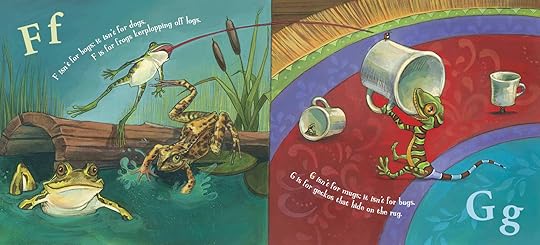
Experts know that sometimes the best way to teach a child what something is is to teach him what it isn't. Educator Wendy Ulmer applies that principle in her jaunty, out-of-the-box alphabet A isn't for Fox: An Isn't Alphabet. Running through the alphabet, beginning readers are given a letter and then told what the letter topic isn't. A isn't for box; it isn't for fox. A is for ants that crawl over your socks. Laura Knorr's colorful, engaging artwork perfectly captures the wit and whimsy behind the alphabet that isn't what it seems but is so much more!
I am the author of five children's picture books and two books of a middle grade fantasy. In my previous lives I was a music therapist, a church musician and a high school music and English teacher. I am currently writing and am also a fabric artist. I have two daughters, three stepsons, a stepdaughter , six grandsons and three granddaughters. My husband and I live near the coast of Maine with our dog, Sophie. My books are A Campfire for Cowboy Billy, A Isn't for Fox, Zero, Zilch, Nada:Counting to None, My Twelve Maine Christmas Days,One Green Tree, Ten Chickadees . The Call and The Deagons- Sept 2018, are the first two books in The Journals of Anterg Trilogy.
This book was cute, however, there were so many rhyming words that were not represented in the illustrations it made the book seem off somehow. I think this book would have been awesome if all the rhyming words had been represented. I first noticed it with D is for dragon, there is no glow or snow. Then F there is no hog or dog. It seemed hit and miss with finding the rhyming words, which took the fun out of this book for me.
I had no idea this would be a story with poetry. The author did a wonderful job, being creative to interact the alphabet using poetry. Illustrations were done beautifully, and they were as creative as the story. This would be a wonderful book to read to children! Educators who teach younger grades should read this to their students.
I love the illustrations in this. And it's really cute, too. Just made me smile throughout and I must share it in preschool storytime. On some of the pages, they can help guess fromthe pictures. And on others they'll perhaps learn about a creature they didn't know about. (Goodness--my group hadn't heard of a seahorse before! I had to rectify that wrong.) The rhyming moves along very well. This would work very well in a lap-read and read-alone as well.
1/8/14: Used in Topsy-Turvy theme. I used the felt letters and had the kids tell me the sounds as well as the letters this time. It worked so that I could say the two words in the first line and ask if they started with that letter. They picked soon that the real represented animal letter was on the page and started calling it out. We spent more time on this than usual, which was fine for the preschool crowd. But their younger toddler siblings started to get antsy and a little distracting. Around S, I just kept reading. Realized around there that I hadn't been panning well either. oops. Oh well. Kids seemed to like it. Good book to tie in with the activity (using Die-Cut to cut out letters for their names).
There's a lot of silly humor packed into the pages of this unusual alphabet book, though the rhymes don't always flow nicely. The real star is the wonderful illustrations by Laura Knorr.
Original concept for an alphabet book. Colorful pictures are cozy and warm. She is a Maine author, and many Maine items are included (bats, moose, salmon) along with lots of frolicking animals from other continents.
Very cute alphabet book. I love that it is different from other alphabet books in that it says what things don't start with that letter. The illustrations are adorable and fun. I loved the rhyming too. My son is in kindergarten and learning his alphabet and this book was so much fun for him.
I personally loved this book and the drawings in it....but I would def recommend this for reading to kiddos who already have a strong sense of their alphabet as each page has pictures with multiple animals or things that may confuse smaller kiddos!
Cute rhyming book. Each letter of the alphabet is explained with what it ISN"T first. Very cute illustrations. Great for rhyming and alphabet. Recommended for ES. Grades K - 2
Cute, but I'd recommend this book for kids who already know their alphabet and associated words because I could see this as confusing for younger kids as I read through it.
Characters: A different animal is featured for each letter of the alphabet. Setting: Some illustrations place the featured animals in natural settings, others place the featured animals upon a colored background, while a few appear to be set inside what appear to be homes. Theme: Alphabet; animals
Summary: This book works through the alphabet by first stating two objects that the letter doesn’t represent, followed by a line stating an animal with a name beginning with the focus letter. The animals identified are both real and mythical. Some of the real animals are rather obscure.
Strengths/Weaknesses: On the positive side, the illustrations are attractively rendered. The animals are realistic enough to be recognizable, but stylized enough to be visually appealing to young children. However, there are weaknesses within the text. First, each page begins with two negatives, which could be confusing for children who are just learning the alphabet. Also, not only are some of the animals obscure, but one in particular is also difficult to decode. Xenops is what they selected for the letter X, a decision that seems a bit odd, especially when the animals used switch from real to mythological. Finally, including a semicolon to separate independent clauses in an ABC book was an odd decision. While technically accurate, this usage of punctuation is beyond what is commonly known by early readers, such as those reading alphabet books.
Illustrations: As mentioned before, the illustrations are appealing. Each animal being identified is clearly identifiable on the page, and is rendered in colorful detail. The capital and lower case of the letter for each page is shown in a large font. However, I would have chosen a different font for the letters a, g, and q. It could be confusing for children just learning letter formation to be asked to identify letters printed in fonts dissimilar to what they are learning to write. The font size is appropriate, and the curve of the text isn't overly confusing.
Target Audience: Ages 3 to 6
Curriculum Ties: Alphabet books are very useful in kindergarten and early in first grade. Students could be prompted to recognize the rhyming words. The animals chosen could potentially be used in a classroom setting, but other books could be found to better reinforce this concept.
Personal Critique: Forming two negative associations with a letter before one positive was unnecessarily confusing. Mixing real animals with mythical creatures was unnecessary. I didn't like the use of semicolons in this context. As is obvious by now, I am not a great fan of this title.
Alphabet books are for all ages! If you do a survey of them at the library (or at a book group which we did last year) you'll find a wide range of them appealing to the very young to adults. You're never too old to enjoy an alphabet book. That said this is not a book for the very very young this would be more appropriate and appealing to a young child who had a fairly strong understanding of the alphabet and can understand the humor of the "isn't" and be able to pick out the creature that belongs to the letter. My son H is only 21 months but he has strong letter recognition, knows letter sounds and many examples of animals and things that start with each letter. He loved this book and thought it was super fun. His favorite was the woodpecker with the banged up beak. The rhyming is cute and the illustrations are well done. Oh and he loves the word Xenops... Which might seem obscure to some but is a very common choice for alphabet books.
I like the humorous, rhyming text. The illustrations are jovial -- my students will enjoy reading this book. Kindergarten and first grade teachers will be able to use this book to teach/review letters and letter sounds. I am going to ask my students to create a class book for each letter of the alphabet producing two items that do not begin with the letter as well as an example that does begin with the letter. Yound students will enjoy the rhyming text -- very approrpiate for intended audience.
A fun and playful alphabet book! In using the “isn’t alphabet” (letters) to set up a rhyme, which help children figure out the correct sound to finish the rhyme and match the letter to the correct animal. Each letter is presented in uppercase and lowercase, too!
Early Literacy Skills:
Letter Knowledge Phonological Awareness Print Awareness Print Motivation Vocabulary
There are so many words on each page and the actual "alphabet" word is not highlighted in any way... will be quite confusing for young beginning readers and the adults who share the book with children would have been more appreciative if there are more than one "alphabet" word on the page and with some design-assistance on those words.
The book's great illustrations and silly text make for a fun read, but it's probably not the best book to use when actually teaching the alphabet. A good one for review, I guess...
Fun side note: I had Wendy Ulmer for a teacher in high school, and she still turns up in the book shop periodically. (Well, fun side note for me, anyway.) I love local authors!
Description: Unlike traditional alphabet book, this book tells the reader what the letter isn't for. For example, "A isn't for box; it isn't for fox. A is for ants that crawl over your socks."
Illustrations: Each illustration is connected to the letter rhyme on the page.
A fun take on the typical alphabet book - Ulmer doesn't just give you what the letter is for, she also gives you what the letter ISN'T for. Kids get a kick out of it, and adult will be glad for a break from the usual.
Wendy is a local author, one of our favorites, and a regular visitor in the store. Looking for a signed copy of any of her titles? Let us know!
This large format rhyming alphabet book ISN'T what you think. The reader is told first what each letter does NOT stand for and then what silly thing the letter does stand for. For example: "A isn't for box; it isn't for fox. A is for ants that crawl under your socks." The illustrations are bright and silly too. Fun for a storytime and for learning the alphabet.
Wonderful illustrations accompany this funny alphabet book. "Using humor and the alphabet this book points out first what each letter of the alphabet is not for and then gives an example of a word that does begin with the letter"
I wasn't sure what I thought of the concept of an "isn't" alphabet, but this one worked pretty well--for each letter, a couple of "isn'ts" led to an "is," and there was a pretty catchy rhyme scheme. The fun pictures contributed, too.
This book would be very engaging for young kids. I feel that this shows a lot of letter recognition and rhyming. I enjoyed this book because it reminded me of Dr. Suess books. New readers may struggle with some of the more difficult words but could point out sight words.
This is a fun little rhyming book of alphabet silliness. Here is an example: "L isn't for dramas; it isn't for mamas. L is for llamas in fuzzy pajamas." I could see kids up to second grade enjoying this as a read-aloud by the teacher. The illustrations are fun.
The book has a great rhythm and good rhymes. I was worried when I read the title that it would unteach the alphabet, but it doesn't. For every letter we learn what it isn't, then what it is.
I got this alpahbet book for my 3-year-old as we're trying to work on the letters. I don't know that he truly understood what the book was trying to do, but it's a fun read. Rhyming.