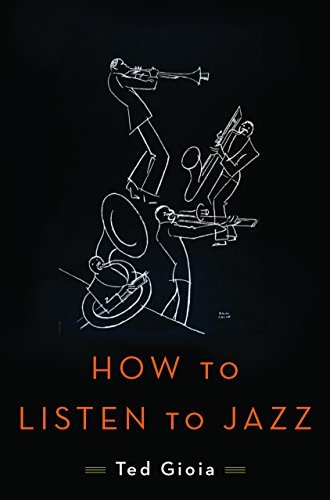
I can't really blame Ted Gioia for my disappointment with How to Listen to Jazz. I knew how it was gonna go. I've been listening to jazz with pleasure my entire adult life. Recently, though, I've been approaching my keen music fandom with the idea that putting in more work will yield more pleasure. Specifically, I want to know the elements from which music is made, so that I can afford the craft involved an adult appreciation, much as I know an elegant paragraph or a delicate pie crust in a way that's informed by experience. I've fallen down a rabbit hole of music-nerd YouTube and this title was enthusiastically recommended by uber-nerd, crush-magnet, Adam Neely, so I assumed it was somewhat rigorous, not having merited his gentle enough but not-infrequent scorn.
The problem with this book is that listening to music is a real-world skill and you can't really learn real-world skills from reading a book. Two of the chapters in How to Listen to Jazz specifically address the skill of conscious listening and attempt to do on the page what Gioia does in a classroom setting. To the uninitiated, Gioia says, jazz seems like tv wrestling, an anarchic free-for-all, when if fact it is more like a chess game "in which creative freedom is bound by rules and imagination must operate within carefully defined constraints."
I already understood the theme/variation idea in music, but the most useful thing that I learned from the "Structure of Jazz" chapter is that in order to readily distinguish the structure of a piece of music, I will have to train myself to reflexively count, which means physically listening to records, tapping my foot along and keeping track of the measures. "If you can count to thirty-two," Gioia exhorts, and keep the numbers in time with the beats of the music, you are ready to roll." Geez. When I said I was willing to work more for my pleasure, I didn't mean actual work.
Gioia then patiently walks us through several pieces of music. When reading, what would have been a seamless process in the classroom - make a statement, play a clip, show a slide, make another statement, play another clip -involved putting the book down, looking up the piece on YouTube and skipping the ads before I even began the process of counting the measures. Lazybones that I am, I found myself reading on through and telling myself I would do the counting later.
The bulk of the book is taken up with what felt like filler - a thumbnail history of jazz and a chapter in which Gioia enthuses about seminal artists. If I knew nothing at all about this music (a reasonable enough assumption for the presumed reader of this volume), these chapters might be useful, but, like I said, I've been listening for a long time. I just wanted to understand what I'm hearing. To give Ted Gioia his due, he pointed me in the right direction. He can't walk the path for me, though. Per Gioia's suggestion, I have begun listening to Jazz: The Smithsonian Anthology while reading the book-length liner notes and, when I remember, counting.