

What do you think?

Lensman #6
Children of the Lens
It was beginning to look as if no one could prevent the destruction of the Universe. For a strange intelligence was directing the destruction of all civilization from the icy depths of space.
Kim Kinnison of the Patrol was one of the few men who knew how near the end was. And in the last desperate plan to save all life, he knew he had to use his children as bait for the evil powers of the planet Ploor.
Kim Kinnison of the Patrol was one of the few men who knew how near the end was. And in the last desperate plan to save all life, he knew he had to use his children as bait for the evil powers of the planet Ploor.
292 pages, Paperback
First published January 1, 1947
About the author
E.E. "Doc" Smith
241 books339 followersEdward Elmer Smith (also E.E. Smith, E.E. Smith, Ph.D., E.E. “Doc” Smith, Doc Smith, “Skylark” Smith, or—to his family—Ted), was an American food engineer (specializing in doughnut and pastry mixes) and an early science fiction author, best known for the Lensman and Skylark series. He is sometimes called the father of space opera.
Ratings & Reviews
Friends & Following
Create a free account to discover what your friends think of this book!
Community Reviews
Displaying 1 - 30 of 108 reviews

June 27, 2014
2024 unexpected Series Read
Well, I really went to town on my review 9 years ago didn't I ?? Haha.
Okay so a bit more this time, yes it is a great series and yes this was as good as the rest, maybe slightly better, and the reality is I would give it 4.4 stars.
This is set about twenty-ish years after the last novel, and Kim and Clarissa now have 5 children, the Children of the Lens obviously. Given their parents, they have tremendous powers and are the final humans in a long Arisian breeding programme to produce really powerful beings to defeat the Eddorians. The interesting thing is that Kim and Clarrisa do not realise how powerful their children really actually are. With each of the children shadowing a stage two lensman, Kim, Worsel, Tregonsee and Nadreck, they are learning from them, but also they are unbeknownst to the second stage lensman, they are actually protecting them.
All the children revisit Arisia to get final instruction and Mentor tells them they are now ready to take on more responsibility in protecting the galaxy.
As Kim investigates further the leads to Boskone (who he thinks are the top level baddies), the Eddorians (the real top level baddies, known only to the children and the Arisians ) are realising that big things are afoot and they may have to play an active role in defending their plan to rule the universe.
A brilliantly crafted story that is easy to read but thoroughly enjoyable if you are into Space Opera.
2015 series read
As good as the rest. What a great series.
Well, I really went to town on my review 9 years ago didn't I ?? Haha.
Okay so a bit more this time, yes it is a great series and yes this was as good as the rest, maybe slightly better, and the reality is I would give it 4.4 stars.
This is set about twenty-ish years after the last novel, and Kim and Clarissa now have 5 children, the Children of the Lens obviously. Given their parents, they have tremendous powers and are the final humans in a long Arisian breeding programme to produce really powerful beings to defeat the Eddorians. The interesting thing is that Kim and Clarrisa do not realise how powerful their children really actually are. With each of the children shadowing a stage two lensman, Kim, Worsel, Tregonsee and Nadreck, they are learning from them, but also they are unbeknownst to the second stage lensman, they are actually protecting them.
All the children revisit Arisia to get final instruction and Mentor tells them they are now ready to take on more responsibility in protecting the galaxy.
As Kim investigates further the leads to Boskone (who he thinks are the top level baddies), the Eddorians (the real top level baddies, known only to the children and the Arisians ) are realising that big things are afoot and they may have to play an active role in defending their plan to rule the universe.
A brilliantly crafted story that is easy to read but thoroughly enjoyable if you are into Space Opera.
2015 series read
As good as the rest. What a great series.
May 14, 2021
Lesser Order Shocker! Arisians Breed Hairless Monkey Super Weapon! "It doesn't matter that they spent a squillion tellurian years to raise 'humans,' from the slime. There's no possible way their ultimate children's mind bolts could pierce the defensive screens of my citadel. I designed those screens myself. A work of sublime genius. A creation of utter perf-" - The All-Highest - The Eddorian Edifier.
And so the main arcs all come to a close. This is a generally well written and exuberant series filled with confidence and belief that (cough, 'genetically-engineered,' cough) lives of love, courage and wisdom can overcome the most dire evils.
While I believe that lives of love, courage and wisdom are essential to overcoming Evil, I also believe that such lives are available to all of us and that the defeat of Evil in all its guises remains available to us all - should we choose to do so.
I feel Smith's choice to valorise a genetic elite is very much a reflection of the anglo-american establishment dominant within western civilization throughout the author's life.
Beyond the consideration of such troubling themes, the story in itself is a brilliant work of the imagination, despite quite possibly the biggest DEM in fiction history. A character needs to find secret planet X. While speeding through space, they receive a distress call, investigate, help a denizen of said planet who's points to where it is and says, 'I want to go home.' ... My mind is boggled by the astronomical implausibility...
On a side note: Avoid the Amazon Kindle file (ASIN : B00N43YH1S) its been put through a word salad generator and a page shredder. Whole blocks of text are hopelessly jumbled or missing outright. A total formatting disaster and I'm sure if the Author was alive - he'd be horrified.
Check Gutenberg online. The full and complete text is now public in some jurisdictions.
Recommended. 5 'Blast 'em outa there!' stars
And so the main arcs all come to a close. This is a generally well written and exuberant series filled with confidence and belief that (cough, 'genetically-engineered,' cough) lives of love, courage and wisdom can overcome the most dire evils.
While I believe that lives of love, courage and wisdom are essential to overcoming Evil, I also believe that such lives are available to all of us and that the defeat of Evil in all its guises remains available to us all - should we choose to do so.
I feel Smith's choice to valorise a genetic elite is very much a reflection of the anglo-american establishment dominant within western civilization throughout the author's life.
Beyond the consideration of such troubling themes, the story in itself is a brilliant work of the imagination, despite quite possibly the biggest DEM in fiction history. A character needs to find secret planet X. While speeding through space, they receive a distress call, investigate, help a denizen of said planet who's points to where it is and says, 'I want to go home.' ... My mind is boggled by the astronomical implausibility...
On a side note: Avoid the Amazon Kindle file (ASIN : B00N43YH1S) its been put through a word salad generator and a page shredder. Whole blocks of text are hopelessly jumbled or missing outright. A total formatting disaster and I'm sure if the Author was alive - he'd be horrified.
Check Gutenberg online. The full and complete text is now public in some jurisdictions.
Recommended. 5 'Blast 'em outa there!' stars

November 14, 2013
More adventures in ancient science fiction—certainly Smith’s series does not stand up to today’s standards, but it certainly shows where sci fi had its beginnings. Reading it is rather like an archaeological dig, exposing the roots of the genre. I’m glad to see in this book that the female characters get to step up and show what they’re made of. Clarrisa dons her gray Lensman leathers (which still fit after having five children, including two sets of twins). Her four daughters keep all the male Lensmen (and even the Arisians) on their toes. Mind you, it’s implied that there just aren’t any men out there who will ever measure up to these women and that they better get used to a celibate life. Clarissa, after all, has been the only female Lensman and she and Kim Kinnison (Stage Two Lensman) have produced the only stage-three Lensman children. The four daughters have only their brother Kit and, to some extent, their father Kim as their male equals. Obviously the Arisians’ breeding program has come to a screeching halt unless they were planning to mate brother to sister like dog breeders. So it’s just as well that the Arisians have ridden out of town, leaving everything to the new sheriff, …er, I mean to the Galactic Patrol, by book’s end.
It is fiction of its era—matters are very black and white, characters are all good or all bad, whole scale destruction is good if it is done by the right people. Written in the years following World War II, this is hardly a surprising outlook. It’s been 100 years since the beginning of WWI, and we’re just starting to see a more nuanced history of that event starting to spread into popular culture, replacing the good guys and bad guys with military guys on both sides. Science fiction has come a long way, too, in the ensuing 50+ years and we enjoy the products of that progress.
This is my 148th book read from the NPR list of great science fiction and fantasy.
It is fiction of its era—matters are very black and white, characters are all good or all bad, whole scale destruction is good if it is done by the right people. Written in the years following World War II, this is hardly a surprising outlook. It’s been 100 years since the beginning of WWI, and we’re just starting to see a more nuanced history of that event starting to spread into popular culture, replacing the good guys and bad guys with military guys on both sides. Science fiction has come a long way, too, in the ensuing 50+ years and we enjoy the products of that progress.
This is my 148th book read from the NPR list of great science fiction and fantasy.

April 30, 2019
Although Books 3, 4 and 5 of E.E. "Doc" Smith's famed six-part Lensman series followed one another with 1 ½ to two years of time in between each, and with story lines that picked up mere seconds after their predecessors, Book 6 would eventually differ in both respects. The author's final installment in what has been called one of the greatest of all space operas originally appeared around 5 ½ years following Book 5's serialization. Like Books 3 – 5 ("Galactic Patrol," "Gray Lensman" and "Second Stage Lensman"), this culminating installment, "Children of the Lens," originally appeared in the pages of "Astounding Science-Fiction"--in this case, the November 1947 – February '48 issues--this time as a four-part serial. And as before, the first issue featured cover artwork by Hubert Rogers. Like its predecessors, the novel first appeared in book form as a $3 hardcover from Fantasy Press, in 1954, again with wonderful cover art by Ric Binkley. And, yes, at the risk of sounding repetitious, the incarnation that this reader was fortunate enough to lay his hands on was the 1983 Berkley edition, with beautiful cover artwork by David B. Mattingly. Not only did readers have to wait longer than usual for the culmination of this saga, but the time setting in this last installment would be pretty unusual, as well. "Children of the Lens" hardly picks up moments after the events of Book 5, but rather, a full 20+ years later--a greater length of time than that between the prequel Books 1 and 2, "Triplanetary" and "First Lensman," but probably not as great as the indeterminate time span between Books 2 and 3. And whereas Books 3 – 5 had concentrated their focus almost exclusively on the exploits of Lensman Kim Kinnison, "Children of the Lens" scatters its action across a half dozen parallel story lines that eventually do come together nicely.
In this setting, two decades following Kim's and Clarrissa MacDougall's marriage ceremony, which had sweetly ended Book 5, we see that the happy couple has given birth to no fewer than five redheaded children: their oldest son Chris, and two sets of fraternal twins, Kathryn & Karen and Camilla & Constance. We are made privy to the fact that these children are the ultimate products of the Arisians' millennia-long breeding program, of which Kim and Clarrissa had been the penultimates; the superrace's best hope in their 2 billion-year campaign against the evil race known as the Eddorians. Whereas Kim and Clarrissa are both possessors of extraordinary mental abilities (they are thus so-called Second Stage Lensmen), their kids have even greater talents, putting them in the L3 range...especially when the quintet combines their mental forces and becomes "the Unit." You might think of the five, hence, as some kind of proto-X-Men type of team, each with his or her own superpower. Thus, Chris is the organizer of the team; Kathryn possesses the most dynamic energy; Karen can put out an impenetrable mental block; Camilla can send her mind out to detect anything, anywhere in the two galaxies; and the youngest, Constance, can emit mental bolts of astounding lethal strength. When combined, their abilities are made even greater, gestaltwise, especially after each goes to the planet of Arisia for his or her Lens, as well as for some advanced mental training by the four-ply Arisian entity known as Mentor.
During the intervening 20 years between Books 5 and 6, the "Boskonian menace" had been quiescent, largely due to the destruction of the Eddorian puppet races--the Delgonian Overlords, the Onlonians and the Eich--in Books 3, 4 and 5. But as Book 6 commences, galaxywide problems begin to erupt again: spates of homicides, kidnappings, hallucinations and mass hysterias have been breaking out on planet after planet, and Kim and his four fellow Second Stage Lensmen decide to investigate, secretly abetted, long range, by the kids. (And when I say "long range," I don't just mean from a few miles away, but rather, thousands of parsecs!) Thus, the sextuple-story-line format previously mentioned: In the first, Kim, aided by Kathryn, goes undercover as a science fiction writer (!) named Sybly Whyte on Radelix (the planet prominently featured in Book 4); prevents a presidential kidnapping there and engages in a furious battle inside a hyperspatial tube; goes undercover again, this time as a drug runner named Bradlow Thyron, on Phlestyn II; and much later, becomes hopelessly trapped in a hyperspatial realm outside both Time and Space. (Think of the Fantastic Four's Reed Richards stuck in the Negative Zone.) Meanwhile, Nadreck, the ice-blooded Palainian, assisted by Karen, goes after the Onlonian chief Kandron, who'd escaped the devastation in Book 5. The barrel-shaped, tentacle-armed Rigellian named Tregonsee, at the same time, and assisted by Camilla, searches the galaxy, using cold logic and powers of perception, to hunt down the entity known as "X." And the dragonlike Velantian named Worsel, aided by Constance, mops up the last of those sadistic Delgonian Overlords; kicks butt on some remaining Eich; and investigates a phenomenon known as the "Hell Hole in Space." As for Clarrissa, she returns to the matriarchy on Lyrane II, rescues our old "friend" Helen after an uprising, and looks into the possibility of Boskonian "Black Lensmen" on Lyrane IX. And Chris, while all this is transpiring, goes to no less a planet than Eddore itself, to do a little reconnaissance work. As I mentioned, all these story lines do eventually converge, in three back-to-back-to-back set pieces: the defense of Arisia, the Battle of Ploor (the last of the Eddorians' puppet races), and finally, after six books of waiting, the confrontation with the Eddorians themselves!
So, I can almost hear you asking, does "Children of The Lens" serve as a suitably fitting and epic culmination to top off the almost 1,300 pages of story that had preceded it? Well, yes and no. Although I am usually a fan of those types of novels in which the author jumps from one parallel story line to another, leaving us in breathless suspense as each chapter ends, here, I found the device of using six such almost too much to follow. Smith packs an awful lot of detail into each one of his six parallel plots, to the point where when, say, the Tregonsee action picks up again, it's difficult to remember what had come before. Thus, the strictly linear plots of Books 3 – 5, featuring Kim fairly exclusively, are jettisoned here in favor of a multiple story line that is rather diffuse, to say the least.
There are other problems. The entire matter of the Black Lensmen just kind of peters out, sadly, and that's a shame, because the idea of Boskonians equal in abilities to the Galactic Patrol's best is a good one. Here, though, the Black Lensmen are used just as a means of giving Kim & Co. some additional clues as to the Boskonian menace. This reader was also disappointed by the fact that, although the existence of the Eddorians was unknown to the Galactic Patrol and all of Civilization in Books 1 – 5, here, Chris inexplicably seems to know all about them. One can only assume that Mentor clued Chris in during one of his training sessions on Arisia, but really, it would have been nice for us readers to have been privy to that momentous revelation! On a similar note, I was also a bit confused as to why the children, at the book's end, feel the necessity of covering up the vanquished Eddorians' existence from the galaxies at large. What could be the harm, once the danger has passed? And, oh...in this final installment, we learn that minor villains Prellin and Crowninshield, from Book 4, had been blue-skinned Kalonians (as had archvillain Helmuth been in Book 3); the only problem is, Smith had never described them thus, earlier. And one more thing: Has anyone else found the scene in which Chris gives his mother Clarrissa advanced mental training a bit...well, icky? After praising his Mom's looks and figure, and calling her "Gorgeous," Kit penetrates her mentally, as Smith gives us such suggestive language as "...her hands clutched his and closed in a veritable spasm...[Chris] stabbed relentlessly into the deepest, tenderest, most sensitive centers of her being...boring in and in and in, [he] knew exactly what to do...he drilled new channels everywhere...then, and only then, did [Chris] withdraw...." Oh, I don't know...maybe it's just my dirty filthy mind, but I still wish one of the four daughters had been giving Clarrissa her lesson instead!
But despite these problems, "Children of the Lens" still does deliver the requisite goods. Several scenes can stand as some of the best in the series: Kim's furious battle inside that hyperspatial tube, Nadreck's supercool killing of Kandron, and those three great battle sequences over Arisia, Ploor and Eddore. Those space battles, by this point, have advanced pretty far from the starship/space ray dukeouts of the earlier books. Here, those awesome space set-tos are more apt to feature Negaspheres (planet-devouring globes of antimatter), inertialess planets (entire worlds thrown around at the speed of light!), and the Patrol's newest trick: inertialess worlds drawn through hyperspace and cast off, essentially becoming planet-sized antimatter bombs! But this installment's greatest, newest weapon must be the five children themselves, and their mental bout with the Eddorians, if not the epic, pyrotechnic culmination some readers might reasonably have been expecting, still manages to satisfy.
The book also pleases by bringing back minor characters from Book 3 (Kim's cadet classmates) and that librarian lady from Book 4. Smith also throws in some welcome bursts of humor, such as Kim using a Yiddish word ("tokus"), and the excerpt that we get to see from Sybly Whyte's novel should make any fan of Golden Age sci-fi chuckle out loud. And speaking of choice words, "Children of the Lens" also gives us one of my favorite words, "steatopygous" (the companion word of my even more favorite "callipygous"), and who could ever dislike a book that does that? Also pleasing here is the fact that we get to see Mentor more in this book than in all the others put together, and its presence is indeed a fascinating one. And, oh, that sequence in which Kim is marooned in that otherdimensional realm after zipping down the "Hell Hole in Space" is just too trippy and psychedelic for words, almost prefiguring astronaut David Bowman's colorful journey down the Star Gate in Stanley Kubrick's "2001: A Space Odyssey." It is a sign of just how very seminal the Lensman series is that its six books hint at "Star Trek," "Star Wars," Marvel comics and "2001"; truly, a space opera for the ages, which Book 6 brings to a close.
But wait...for those wanting more of the Lensman universe, there DOES seem to exist one more volume from Smith: the 1960 short story collection "The Vortex Blaster" (aka "Masters of the Vortex"). These stories supposedly feature none of the characters from the main series, and though they are set in the same universe, they are said to be only slightly related, at best. Still, having now read what has been deemed for almost 70 years one of science fiction's greatest space operas of all time, I would surely like to experience that parenthetical volume one day.
And now, in closing, I will leave you with the ultimate blessing that one Galactic Patrolman can give to another: "Clear ether!"
(By the way, this review originally appeared on the FanLit website at http://www.fantasyliterature.com/ ... a most ideal destination for all fans of E. E. "Doc" Smith....)
In this setting, two decades following Kim's and Clarrissa MacDougall's marriage ceremony, which had sweetly ended Book 5, we see that the happy couple has given birth to no fewer than five redheaded children: their oldest son Chris, and two sets of fraternal twins, Kathryn & Karen and Camilla & Constance. We are made privy to the fact that these children are the ultimate products of the Arisians' millennia-long breeding program, of which Kim and Clarrissa had been the penultimates; the superrace's best hope in their 2 billion-year campaign against the evil race known as the Eddorians. Whereas Kim and Clarrissa are both possessors of extraordinary mental abilities (they are thus so-called Second Stage Lensmen), their kids have even greater talents, putting them in the L3 range...especially when the quintet combines their mental forces and becomes "the Unit." You might think of the five, hence, as some kind of proto-X-Men type of team, each with his or her own superpower. Thus, Chris is the organizer of the team; Kathryn possesses the most dynamic energy; Karen can put out an impenetrable mental block; Camilla can send her mind out to detect anything, anywhere in the two galaxies; and the youngest, Constance, can emit mental bolts of astounding lethal strength. When combined, their abilities are made even greater, gestaltwise, especially after each goes to the planet of Arisia for his or her Lens, as well as for some advanced mental training by the four-ply Arisian entity known as Mentor.
During the intervening 20 years between Books 5 and 6, the "Boskonian menace" had been quiescent, largely due to the destruction of the Eddorian puppet races--the Delgonian Overlords, the Onlonians and the Eich--in Books 3, 4 and 5. But as Book 6 commences, galaxywide problems begin to erupt again: spates of homicides, kidnappings, hallucinations and mass hysterias have been breaking out on planet after planet, and Kim and his four fellow Second Stage Lensmen decide to investigate, secretly abetted, long range, by the kids. (And when I say "long range," I don't just mean from a few miles away, but rather, thousands of parsecs!) Thus, the sextuple-story-line format previously mentioned: In the first, Kim, aided by Kathryn, goes undercover as a science fiction writer (!) named Sybly Whyte on Radelix (the planet prominently featured in Book 4); prevents a presidential kidnapping there and engages in a furious battle inside a hyperspatial tube; goes undercover again, this time as a drug runner named Bradlow Thyron, on Phlestyn II; and much later, becomes hopelessly trapped in a hyperspatial realm outside both Time and Space. (Think of the Fantastic Four's Reed Richards stuck in the Negative Zone.) Meanwhile, Nadreck, the ice-blooded Palainian, assisted by Karen, goes after the Onlonian chief Kandron, who'd escaped the devastation in Book 5. The barrel-shaped, tentacle-armed Rigellian named Tregonsee, at the same time, and assisted by Camilla, searches the galaxy, using cold logic and powers of perception, to hunt down the entity known as "X." And the dragonlike Velantian named Worsel, aided by Constance, mops up the last of those sadistic Delgonian Overlords; kicks butt on some remaining Eich; and investigates a phenomenon known as the "Hell Hole in Space." As for Clarrissa, she returns to the matriarchy on Lyrane II, rescues our old "friend" Helen after an uprising, and looks into the possibility of Boskonian "Black Lensmen" on Lyrane IX. And Chris, while all this is transpiring, goes to no less a planet than Eddore itself, to do a little reconnaissance work. As I mentioned, all these story lines do eventually converge, in three back-to-back-to-back set pieces: the defense of Arisia, the Battle of Ploor (the last of the Eddorians' puppet races), and finally, after six books of waiting, the confrontation with the Eddorians themselves!
So, I can almost hear you asking, does "Children of The Lens" serve as a suitably fitting and epic culmination to top off the almost 1,300 pages of story that had preceded it? Well, yes and no. Although I am usually a fan of those types of novels in which the author jumps from one parallel story line to another, leaving us in breathless suspense as each chapter ends, here, I found the device of using six such almost too much to follow. Smith packs an awful lot of detail into each one of his six parallel plots, to the point where when, say, the Tregonsee action picks up again, it's difficult to remember what had come before. Thus, the strictly linear plots of Books 3 – 5, featuring Kim fairly exclusively, are jettisoned here in favor of a multiple story line that is rather diffuse, to say the least.
There are other problems. The entire matter of the Black Lensmen just kind of peters out, sadly, and that's a shame, because the idea of Boskonians equal in abilities to the Galactic Patrol's best is a good one. Here, though, the Black Lensmen are used just as a means of giving Kim & Co. some additional clues as to the Boskonian menace. This reader was also disappointed by the fact that, although the existence of the Eddorians was unknown to the Galactic Patrol and all of Civilization in Books 1 – 5, here, Chris inexplicably seems to know all about them. One can only assume that Mentor clued Chris in during one of his training sessions on Arisia, but really, it would have been nice for us readers to have been privy to that momentous revelation! On a similar note, I was also a bit confused as to why the children, at the book's end, feel the necessity of covering up the vanquished Eddorians' existence from the galaxies at large. What could be the harm, once the danger has passed? And, oh...in this final installment, we learn that minor villains Prellin and Crowninshield, from Book 4, had been blue-skinned Kalonians (as had archvillain Helmuth been in Book 3); the only problem is, Smith had never described them thus, earlier. And one more thing: Has anyone else found the scene in which Chris gives his mother Clarrissa advanced mental training a bit...well, icky? After praising his Mom's looks and figure, and calling her "Gorgeous," Kit penetrates her mentally, as Smith gives us such suggestive language as "...her hands clutched his and closed in a veritable spasm...[Chris] stabbed relentlessly into the deepest, tenderest, most sensitive centers of her being...boring in and in and in, [he] knew exactly what to do...he drilled new channels everywhere...then, and only then, did [Chris] withdraw...." Oh, I don't know...maybe it's just my dirty filthy mind, but I still wish one of the four daughters had been giving Clarrissa her lesson instead!
But despite these problems, "Children of the Lens" still does deliver the requisite goods. Several scenes can stand as some of the best in the series: Kim's furious battle inside that hyperspatial tube, Nadreck's supercool killing of Kandron, and those three great battle sequences over Arisia, Ploor and Eddore. Those space battles, by this point, have advanced pretty far from the starship/space ray dukeouts of the earlier books. Here, those awesome space set-tos are more apt to feature Negaspheres (planet-devouring globes of antimatter), inertialess planets (entire worlds thrown around at the speed of light!), and the Patrol's newest trick: inertialess worlds drawn through hyperspace and cast off, essentially becoming planet-sized antimatter bombs! But this installment's greatest, newest weapon must be the five children themselves, and their mental bout with the Eddorians, if not the epic, pyrotechnic culmination some readers might reasonably have been expecting, still manages to satisfy.
The book also pleases by bringing back minor characters from Book 3 (Kim's cadet classmates) and that librarian lady from Book 4. Smith also throws in some welcome bursts of humor, such as Kim using a Yiddish word ("tokus"), and the excerpt that we get to see from Sybly Whyte's novel should make any fan of Golden Age sci-fi chuckle out loud. And speaking of choice words, "Children of the Lens" also gives us one of my favorite words, "steatopygous" (the companion word of my even more favorite "callipygous"), and who could ever dislike a book that does that? Also pleasing here is the fact that we get to see Mentor more in this book than in all the others put together, and its presence is indeed a fascinating one. And, oh, that sequence in which Kim is marooned in that otherdimensional realm after zipping down the "Hell Hole in Space" is just too trippy and psychedelic for words, almost prefiguring astronaut David Bowman's colorful journey down the Star Gate in Stanley Kubrick's "2001: A Space Odyssey." It is a sign of just how very seminal the Lensman series is that its six books hint at "Star Trek," "Star Wars," Marvel comics and "2001"; truly, a space opera for the ages, which Book 6 brings to a close.
But wait...for those wanting more of the Lensman universe, there DOES seem to exist one more volume from Smith: the 1960 short story collection "The Vortex Blaster" (aka "Masters of the Vortex"). These stories supposedly feature none of the characters from the main series, and though they are set in the same universe, they are said to be only slightly related, at best. Still, having now read what has been deemed for almost 70 years one of science fiction's greatest space operas of all time, I would surely like to experience that parenthetical volume one day.
And now, in closing, I will leave you with the ultimate blessing that one Galactic Patrolman can give to another: "Clear ether!"
(By the way, this review originally appeared on the FanLit website at http://www.fantasyliterature.com/ ... a most ideal destination for all fans of E. E. "Doc" Smith....)
May 19, 2025
The sixth and last of the original Lensman series has all the hallmarks of a Doc Smith story: complex interstellar politics, a cosmic struggle of good and evil, perfect but one-dimensional heroes, intrigue and espionage, mind games, and hard speculative science. But it has some fundamental differences that make it stand out.
First of all, though Smith still is not a master wordsmith, his writing has matured and advanced by miles since he wrote "Triplanetary" in 1934. Most noticeable is his language, which is less geared towards kids, and his dialogue doesn't sound like it was written for a 1930s gangster film. At the very least, it seems he invested in a thesaurus, as he throws in a fair share of grandiloquent words.
The second difference is that we no longer are only following the adventures of Kim Kinnison, the star of the previous three novels. Here we have more of an ensemble cast, where other Lensmen, including Kim's wife Clarissa, have a lot to do. And as the title suggests, we are introduced to Kinnison's children, a boy and two sets of twin girls, who are all products of a grand scheme of eugenics by formless cosmic beings to develop a race of superheroes. These children were born with mental powers of a Second-Stage Lensman, which normally requires many years of training, and are set up to be the first Third-Stage Lensmen.
Reading this final book compelled me to think about the series as a whole, and even about Doc Smith's overall philosophy in his two famous space operas. Dick Seaton, from the Skylark series, and the Lensmen are genocidal heroes. Faced with cultures so completely dedicated to evil, only complete extermination is a viable option. You can't reason with or rehabilitate cancer. Every last cell needs to be cut out or everything dies. As Smith's writing grew more nuanced over his career, he did a better job of portraying the tradegy of evil. Those who live to destroy are themselves destroyed. They are either eaten from within by unhappiness, killed by their own treacherous kind in the clamor for power, or face the consequences of those who deny them the satisfaction of enslavement and killing. For Smith, when you serve death, you receive only death, an unbreakable and universal law.
Therefore, the law applies to even the good guys. Early in this novel, the dragon-like Lensman Worsel discovers a remnant cell of Overlords who have been engaging in piracy and torture of innocent space travelers. Driven by hate and vengeance, Worsel and his crew kill every last Overlord except for the leader, who is strung up on a rack and himself tortured gleefully. This blurring of the line between good and evil is reinforced by the consequences of the protagonists' actions. Each time they develop a new, ultra powerful weapon to wipe out the bad guys, this technology then becomes usurped and mastered by the other side, or rendered neutral. As this book rightly points out, "What science invents, science can circumvent". Thus, even the Lens becomes almost obsolete as the new standards for warfare escalate to unfathomable proportions, meaning the heroes are constantly threatened with the very same means of annihilation that they created. We also see this same idea explored in the Skylark series.
All the more poignantly, Smith typically denies us any catharsis through violence. You never get a "You killed my father--prepare to die" moment, no emotional crescendo of a Luke Skywalker vs. a Darth Vader. Face-to-face battles are rare, and when they do happen, they are usually silent mind struggles that end in a whimper as the defeated mind is extinguished. Most of the time, the violence is on such all massive scale that it is impersonal. We don't get to see a villain's comeuppance in a way that gives us any satisfaction. They are just among the countless casualties as their whole world is crushed between two other planets or vaporized by a massive beam of energy from a sun. And just when you think the story has reached its climax, it twists and turns into another climax, with even bigger stakes and bigger guns. This novel continues that theme of the endless cycle of war, and confronts the audience with their own expectations of thrilling kills that pay off with a neatly wrapped-up finale.
This book showcases another groundbreaking characteristic of the series with a veracity never before seen. Women and men are treated as equally capable of effective action. Sure, Clarissa and each of her daughters are the products of a selective breeding program, but they don't just rely on their superpowers, and are given more attention as fully fleshed out characters than Kinnison, making their heroism even more believable and doubling our investment in their success. We are reminded that sometimes they act immature, or are vain, but they earned all of their abilities, have sacrificed normal youth for a higher cause greater than themselves, and can be just as deadly as any soldier.
On the negative side, Smith really tried to tie up all the loose ends created by his overly convoluted contortions to turn previously unrelated books into a series, but it only meant throwing twists into previously established lore, much of which was unnecessary and made things even more confusing and far-fetched. He does all this while trying to introduce us to not one, not two, but FIVE new protagonists. Needless to say, it's all too much, especially if you don't already know the previously established characters and lore. There is absolutely no way anyone who hasn't read the previous books would know what is going on here. I didn't--and I HAD read the whole series.
What also makes the story so confusing is that Smith tries to make it somewhat of a mystery. All the good guys are on separate missions to try to root out an ultimate mastermind with an unknown identity. But Smith sucks at writing mysteries. Clues and answers just suddenly appear out of nowhere. There will be all kinds of investigation going on, and then somebody will say, "You know who is suspicious? Bob." And then all of the good guys respond, "Bob! Yes, of course! We knew it all along!" The perplexed reader, at this point, is flipping through pages trying to figure out how they previously missed who Bob was. But Bob didn't exist as even a passing reference for six books!
Also, though I applaud the improvement in his writing style, Smith was clearly too much the aspie engineer to competently write characters. He may be an expert in physics and chemistry, but he just doesn't understand how PEOPLE work. And sometimes it comes across as downright creepy. For example, he seems to fall in love with his own fantasy heroines, and wants so badly to show off how beautiful they are to his readers. Yet, he thinks the only way to get this across is by having other characters tell the reader, and the only human characters in the story are family. Therefore, he has brothers and sisters being very inappropriate with each other, and all the children of the Lens seem to have the outright hots for their mother. The son is constantly caressing his mother Clarissa by the waist, lifting her off the ground, kissing her full on the mouth, and calling her gorgeous. Smith never really shows any other aspect of their relationship, no motherly affection or care for her children, no hint of their struggles as a family with incredible responsibilities. So, Clarissa and her son are written more like lovers than anything. In another scene, Clarissa is conducting an investigation in the nude--standard practice, of course--and her daughter Kay gawks at her and says, "All kidding aside, mums, but you're a mighty smart-looking hunk of woman."
Jesus, Doc, we get it! Clarissa's a milf! Now will you get back to the rayguns and aliens, already?
I don't think Smith meant to inject incestuous tendencies into his family of superheroes. Rather, like Stephen King, Greg Bear, Richard Laymon, and other writers who fall on the spectrum, he just didn't have any self-awareness at all when it came to how his own preoccupations translated to the page. He's like the crusty genius who starts clipping his fungal toenail claws at an executive board meeting or who sniffs the hair of his boss's daughter at the company picnic. I suspect, after he retired from food engineering, his wife just tucked him away in his workshop to tinker with his tools and write his outer space stories whenever she invited company over or had Tupperware parties.
Overall, "Lensman" is far from my favorite science fiction series, and I certainly have had my ups and downs with it. But now that I've read all the core stories, I must say that I am immensely impressed with how groundbreaking, how ambitious, and how poignant this series really is. I would not say this is one of the best of the original six books, and it is not one that really stands very well on its own, because so much world-building has taken place in the previous novels that is required to keep the reader oriented. And as I said, Smith's imagination is far more expansive than his awkward writing skills. But for those who have enjoyed any of the other entries, this one sure ends things with a great big exclamation point, and if you're like me, this book may even force you to think more carefully about the series as a whole and reread the whole thing again through this new "lens".
SCORE: 3 children of the Lens out of 5
WORD OF THE DAY: Internecine
First of all, though Smith still is not a master wordsmith, his writing has matured and advanced by miles since he wrote "Triplanetary" in 1934. Most noticeable is his language, which is less geared towards kids, and his dialogue doesn't sound like it was written for a 1930s gangster film. At the very least, it seems he invested in a thesaurus, as he throws in a fair share of grandiloquent words.
The second difference is that we no longer are only following the adventures of Kim Kinnison, the star of the previous three novels. Here we have more of an ensemble cast, where other Lensmen, including Kim's wife Clarissa, have a lot to do. And as the title suggests, we are introduced to Kinnison's children, a boy and two sets of twin girls, who are all products of a grand scheme of eugenics by formless cosmic beings to develop a race of superheroes. These children were born with mental powers of a Second-Stage Lensman, which normally requires many years of training, and are set up to be the first Third-Stage Lensmen.
Reading this final book compelled me to think about the series as a whole, and even about Doc Smith's overall philosophy in his two famous space operas. Dick Seaton, from the Skylark series, and the Lensmen are genocidal heroes. Faced with cultures so completely dedicated to evil, only complete extermination is a viable option. You can't reason with or rehabilitate cancer. Every last cell needs to be cut out or everything dies. As Smith's writing grew more nuanced over his career, he did a better job of portraying the tradegy of evil. Those who live to destroy are themselves destroyed. They are either eaten from within by unhappiness, killed by their own treacherous kind in the clamor for power, or face the consequences of those who deny them the satisfaction of enslavement and killing. For Smith, when you serve death, you receive only death, an unbreakable and universal law.
Therefore, the law applies to even the good guys. Early in this novel, the dragon-like Lensman Worsel discovers a remnant cell of Overlords who have been engaging in piracy and torture of innocent space travelers. Driven by hate and vengeance, Worsel and his crew kill every last Overlord except for the leader, who is strung up on a rack and himself tortured gleefully. This blurring of the line between good and evil is reinforced by the consequences of the protagonists' actions. Each time they develop a new, ultra powerful weapon to wipe out the bad guys, this technology then becomes usurped and mastered by the other side, or rendered neutral. As this book rightly points out, "What science invents, science can circumvent". Thus, even the Lens becomes almost obsolete as the new standards for warfare escalate to unfathomable proportions, meaning the heroes are constantly threatened with the very same means of annihilation that they created. We also see this same idea explored in the Skylark series.
All the more poignantly, Smith typically denies us any catharsis through violence. You never get a "You killed my father--prepare to die" moment, no emotional crescendo of a Luke Skywalker vs. a Darth Vader. Face-to-face battles are rare, and when they do happen, they are usually silent mind struggles that end in a whimper as the defeated mind is extinguished. Most of the time, the violence is on such all massive scale that it is impersonal. We don't get to see a villain's comeuppance in a way that gives us any satisfaction. They are just among the countless casualties as their whole world is crushed between two other planets or vaporized by a massive beam of energy from a sun. And just when you think the story has reached its climax, it twists and turns into another climax, with even bigger stakes and bigger guns. This novel continues that theme of the endless cycle of war, and confronts the audience with their own expectations of thrilling kills that pay off with a neatly wrapped-up finale.
This book showcases another groundbreaking characteristic of the series with a veracity never before seen. Women and men are treated as equally capable of effective action. Sure, Clarissa and each of her daughters are the products of a selective breeding program, but they don't just rely on their superpowers, and are given more attention as fully fleshed out characters than Kinnison, making their heroism even more believable and doubling our investment in their success. We are reminded that sometimes they act immature, or are vain, but they earned all of their abilities, have sacrificed normal youth for a higher cause greater than themselves, and can be just as deadly as any soldier.
On the negative side, Smith really tried to tie up all the loose ends created by his overly convoluted contortions to turn previously unrelated books into a series, but it only meant throwing twists into previously established lore, much of which was unnecessary and made things even more confusing and far-fetched. He does all this while trying to introduce us to not one, not two, but FIVE new protagonists. Needless to say, it's all too much, especially if you don't already know the previously established characters and lore. There is absolutely no way anyone who hasn't read the previous books would know what is going on here. I didn't--and I HAD read the whole series.
What also makes the story so confusing is that Smith tries to make it somewhat of a mystery. All the good guys are on separate missions to try to root out an ultimate mastermind with an unknown identity. But Smith sucks at writing mysteries. Clues and answers just suddenly appear out of nowhere. There will be all kinds of investigation going on, and then somebody will say, "You know who is suspicious? Bob." And then all of the good guys respond, "Bob! Yes, of course! We knew it all along!" The perplexed reader, at this point, is flipping through pages trying to figure out how they previously missed who Bob was. But Bob didn't exist as even a passing reference for six books!
Also, though I applaud the improvement in his writing style, Smith was clearly too much the aspie engineer to competently write characters. He may be an expert in physics and chemistry, but he just doesn't understand how PEOPLE work. And sometimes it comes across as downright creepy. For example, he seems to fall in love with his own fantasy heroines, and wants so badly to show off how beautiful they are to his readers. Yet, he thinks the only way to get this across is by having other characters tell the reader, and the only human characters in the story are family. Therefore, he has brothers and sisters being very inappropriate with each other, and all the children of the Lens seem to have the outright hots for their mother. The son is constantly caressing his mother Clarissa by the waist, lifting her off the ground, kissing her full on the mouth, and calling her gorgeous. Smith never really shows any other aspect of their relationship, no motherly affection or care for her children, no hint of their struggles as a family with incredible responsibilities. So, Clarissa and her son are written more like lovers than anything. In another scene, Clarissa is conducting an investigation in the nude--standard practice, of course--and her daughter Kay gawks at her and says, "All kidding aside, mums, but you're a mighty smart-looking hunk of woman."
Jesus, Doc, we get it! Clarissa's a milf! Now will you get back to the rayguns and aliens, already?
I don't think Smith meant to inject incestuous tendencies into his family of superheroes. Rather, like Stephen King, Greg Bear, Richard Laymon, and other writers who fall on the spectrum, he just didn't have any self-awareness at all when it came to how his own preoccupations translated to the page. He's like the crusty genius who starts clipping his fungal toenail claws at an executive board meeting or who sniffs the hair of his boss's daughter at the company picnic. I suspect, after he retired from food engineering, his wife just tucked him away in his workshop to tinker with his tools and write his outer space stories whenever she invited company over or had Tupperware parties.
Overall, "Lensman" is far from my favorite science fiction series, and I certainly have had my ups and downs with it. But now that I've read all the core stories, I must say that I am immensely impressed with how groundbreaking, how ambitious, and how poignant this series really is. I would not say this is one of the best of the original six books, and it is not one that really stands very well on its own, because so much world-building has taken place in the previous novels that is required to keep the reader oriented. And as I said, Smith's imagination is far more expansive than his awkward writing skills. But for those who have enjoyed any of the other entries, this one sure ends things with a great big exclamation point, and if you're like me, this book may even force you to think more carefully about the series as a whole and reread the whole thing again through this new "lens".
SCORE: 3 children of the Lens out of 5
WORD OF THE DAY: Internecine

January 27, 2013
Probably the quintessential Space Opera of its time, the Lensman series has dated - although not so badly as the work of some of his contemporaries - due mainly, in my opinion, to Smith’s rather one-dimensional characterisation, his dialogue and his depiction of female roles. Paradoxically, given the rather limited characterisation of the humans his aliens are sometimes truly alien. Indeed, the mindsets of some of the non-human protagonists are often far more skilfully depicted than their human counterparts.
Despite that, provided one bears in mind the social climate in which this was written and reads the novel in context, they can still be hugely enjoyable.
The term ‘Space Opera’ is actually used within the text at one point when Kim Kinnison – the hero of the series – goes undercover posing as a writer of the genre. Whether the alter ego was based on anyone in particular is not known.
This is the finale to Smith’s six volume saga. Smith was an early forerunner of today’s ‘Big Concept’ writers such as Greg Bear and Stephen Baxter, and though some of his scientific fabulations seem somewhat preposterous by today’s standards it was Smith and writers like him who created that ‘sense of wonder’ for many readers, not only when this was published as a magazine serial in the Nineteen Forties, but when republished in book form in the fifties and (for reasons unknown) enjoying an unexpected renaissance in the mid-seventies. The series has recently been republished by an independent publisher and hopefully will find a new generation of readers.
Smith’s strength lies in his ability to convey the vastness of Time and Space, his premise being that billions of years ago a race of humanoids – The Arisians - was born in our galaxy and evolved far beyond the point at which humanity now stands.
They learned that by observation and the calculations of their powerful minds they could predict the future to a certain degree. They knew that a galaxy was about to pass completely through their own galaxy, and that the gravitational pull of suns against each other would produce billions of new planets, upon which Life would evolve.
They also knew that another ancient race, the cruel and tyrannical Eddorians, had plans to dominate both galaxies and sate their immortal lust for power.
The Arisians only advantage was that the Eddorians were not aware of their existence, and so was set in motion a plan which was to span millions of years, taking us through the fall of Atlantis, the Roman Empire and thus through the Twentieth Century and beyond.
In essence, this is an epic war of ideologies, in that the Arisians represent democracy and free will, while the Eddorians represent a system of Hierarchical totalitarianism, enforced by a militaristic regime (In this respect it is interesting to compare the physical description of Smith’s Eddorians with Heinlein’s Puppet Masters, who themselves are a metaphor for the forces of Communism. Both are sexless, emotionless amorphous creatures, who reproduce by binary fission, with each new half retaining the memories and skills of the original).
The Arisians’ secret weapon is a selective breeding programme which has been in operation on four different planets since intelligent life evolved.
Only one of the four races can go on to produce the super-beings capable of defeating the Eddorians.
Humans, of course, win the ‘race’ race and the couple selectively bred to give birth to the Homo Superior children are inevitably white and North American.
This idea of selectively breeding humans rather puts a dent into the concept of Arisians as benign Guardians of Democracy, and although one can argue that it was the Arisians’ only option, it is never really addressed as a moral issue within the text.
The Children themselves are four girls and boy who, in their late teens, have to conceal that fact that they are the most powerful – if underdeveloped as yet – beings in the Universe. We are led to believe that the girls will ultimately become the wives of their brother, and the mothers of the race that will replace the Arisians as Guardians of Civilisation.
An oddly incestuous episode also ensues between Kit (the boy) and his mother in a strange scene where she – in need of brain-restructuring and training, for want of a better phrase - allows the mind of her son to enter hers, rather than submit to mental penetration by the Arisians (of whom she has an incurable phobia).
The description of this act is oddly violent and not a little sexual, made worse by the rather stilted professions of love between Mother and son before the procedure.
But Hell, this is Pulp Fiction. It never pretends to be Shakespeare, and despite its political incorrectness I still find it a nostalgic and stonking good read.
Despite that, provided one bears in mind the social climate in which this was written and reads the novel in context, they can still be hugely enjoyable.
The term ‘Space Opera’ is actually used within the text at one point when Kim Kinnison – the hero of the series – goes undercover posing as a writer of the genre. Whether the alter ego was based on anyone in particular is not known.
This is the finale to Smith’s six volume saga. Smith was an early forerunner of today’s ‘Big Concept’ writers such as Greg Bear and Stephen Baxter, and though some of his scientific fabulations seem somewhat preposterous by today’s standards it was Smith and writers like him who created that ‘sense of wonder’ for many readers, not only when this was published as a magazine serial in the Nineteen Forties, but when republished in book form in the fifties and (for reasons unknown) enjoying an unexpected renaissance in the mid-seventies. The series has recently been republished by an independent publisher and hopefully will find a new generation of readers.
Smith’s strength lies in his ability to convey the vastness of Time and Space, his premise being that billions of years ago a race of humanoids – The Arisians - was born in our galaxy and evolved far beyond the point at which humanity now stands.
They learned that by observation and the calculations of their powerful minds they could predict the future to a certain degree. They knew that a galaxy was about to pass completely through their own galaxy, and that the gravitational pull of suns against each other would produce billions of new planets, upon which Life would evolve.
They also knew that another ancient race, the cruel and tyrannical Eddorians, had plans to dominate both galaxies and sate their immortal lust for power.
The Arisians only advantage was that the Eddorians were not aware of their existence, and so was set in motion a plan which was to span millions of years, taking us through the fall of Atlantis, the Roman Empire and thus through the Twentieth Century and beyond.
In essence, this is an epic war of ideologies, in that the Arisians represent democracy and free will, while the Eddorians represent a system of Hierarchical totalitarianism, enforced by a militaristic regime (In this respect it is interesting to compare the physical description of Smith’s Eddorians with Heinlein’s Puppet Masters, who themselves are a metaphor for the forces of Communism. Both are sexless, emotionless amorphous creatures, who reproduce by binary fission, with each new half retaining the memories and skills of the original).
The Arisians’ secret weapon is a selective breeding programme which has been in operation on four different planets since intelligent life evolved.
Only one of the four races can go on to produce the super-beings capable of defeating the Eddorians.
Humans, of course, win the ‘race’ race and the couple selectively bred to give birth to the Homo Superior children are inevitably white and North American.
This idea of selectively breeding humans rather puts a dent into the concept of Arisians as benign Guardians of Democracy, and although one can argue that it was the Arisians’ only option, it is never really addressed as a moral issue within the text.
The Children themselves are four girls and boy who, in their late teens, have to conceal that fact that they are the most powerful – if underdeveloped as yet – beings in the Universe. We are led to believe that the girls will ultimately become the wives of their brother, and the mothers of the race that will replace the Arisians as Guardians of Civilisation.
An oddly incestuous episode also ensues between Kit (the boy) and his mother in a strange scene where she – in need of brain-restructuring and training, for want of a better phrase - allows the mind of her son to enter hers, rather than submit to mental penetration by the Arisians (of whom she has an incurable phobia).
The description of this act is oddly violent and not a little sexual, made worse by the rather stilted professions of love between Mother and son before the procedure.
But Hell, this is Pulp Fiction. It never pretends to be Shakespeare, and despite its political incorrectness I still find it a nostalgic and stonking good read.

October 5, 2015
The only five star I will give to one of the lensmens books written by the beloved Dr Smith. This has every space opera element and trope. The technology and weapons are now at the ridiculous level (super luminal planets traveling down hyper tubes from Nth space dimension to literally obliterate an entire solar system from existence). The fleet conflicts are in the billions of space ships vs billions of space ships. The children of the lens, a single male and two sets of female twins, the product of the Red and Grey lensmen marriage, form a hyper intelligent bond called "The Unit", whose powers even Mentor of Arisia cannot fathom. Using the amassed power of all of the lensmen in the two universes on rapport, the 2nd stage lensmen, the entire mental power of the Arisians, and of course, all being led by children of the lens, the Eddorian threat is finally extinguished from existence.
The Arisians themselves transcend to the next plane of existence, and a plot device that hooks readers for sequels and future books galore (that sadly never came into being) is used that left me with a warm smile at its eloquence.
A relived narrative from my childhood, I will always cherish this series.
The Arisians themselves transcend to the next plane of existence, and a plot device that hooks readers for sequels and future books galore (that sadly never came into being) is used that left me with a warm smile at its eloquence.
A relived narrative from my childhood, I will always cherish this series.

August 15, 2015
The previous book's energy and ability to surprise lagged somewhat, but this book saves the series from losing its momentum. How many stories have a loving husband and wife and their responsible children saving the galaxy? I lost track of which daughter was which, but their snappy patter and interplay make this an entertaining and worthwhile continuation of the LENSMAN series.

December 20, 2013
Only 50% of the way through this random inheritance, but I have already decided that I now need to go and purchase the whole series from the start. A new (old...?) favourite Sci-Fi author of mine, for sure.

November 21, 2024
===
Plods along with the corniest dialogue imaginable, then has a Mob Psycho-level scene where a psychic woman singlehandedly defeats a massive enemy battleship, then mind-controls her own allies into hallucinating a desperate physical battle in order to hide her power level. The whole thing feels shockingly anime-like, from the bombastic psychic powers, to the four giggling super-powered girl protagonists, to the star-annihilating superweapons, to the Power of Love transcending physics, to the strange incest undertones (I had to check that I wasn't going crazy, and other people have indeed noticed it). It makes sense then that this series is one of the few (only?) western book series to get an anime adaptation, though I've heard it isn't very good.
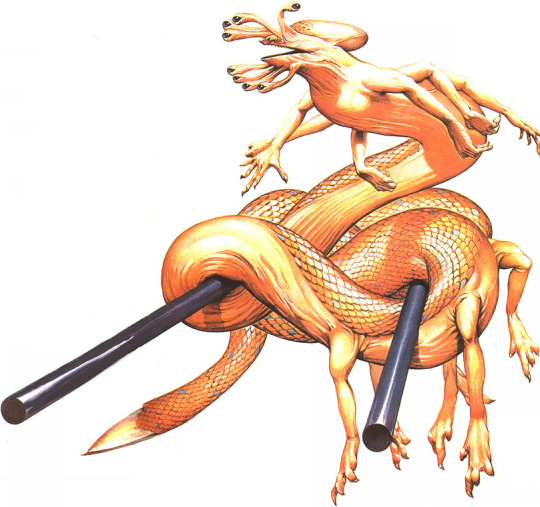
Aside from the Mother from Strange Relations, this is the only alien in Barlowe's Guide to Extraterrestrials drawn upon a surface, rather than floating in the white void of the page. This always gave me the impression it was a little guy in a cage or something, but it's actually one of the largest aliens in the guidebook (in fact, the two rods are the equivalent of a chair). Based on the recap, one of these guys is one of the psychic superhero Lensmen in the series.
The most striking part is the straining of the muscles under the left loop, compared to the smoother upper body, which is holding up less weight, and the right loop, which isn't holding up much, as the majority of the tail-end is resting on the rods, and the right merely serves to brace the left.
The sketchbook shows the large sail-like wings mentioned in the description, but they're apparently folded tightly in deep grooves in the back, and Barlowe chose not to depict them here. I'm not sure if he thought it was too difficult to find a composition that showed both the wings and the body length, or what.
Even though this is the entry listed in Barlowe's Guide for the Velantians, in fact they weren't introduced in this book, and though they appear, they play a pretty minor role. I am not reading another one of these.

September 5, 2009
I really should have started with an earlier book in the series, but this was the one in the opshop...
I have fond memories of reading some of the author's books in high school and I have to say, I think a lot of future sci-fi writers and movie/TV creators were inspired by this writer. The story arc is huge and spans generations. He has amazing ideas for species and technology that weren't even dreamed of at the time he was writing. He is a precursor to George Lucas and J.M Straczynski (is that how you spell it? Can I buy a vowel? Heheheh!) I still finished the book even though it had some pages missing and is the 6th in a series. That is high praise! It is a little dated and sexist, but what do you expect from an author born in 1890? Its still good old-fashioned space adventure!
I have fond memories of reading some of the author's books in high school and I have to say, I think a lot of future sci-fi writers and movie/TV creators were inspired by this writer. The story arc is huge and spans generations. He has amazing ideas for species and technology that weren't even dreamed of at the time he was writing. He is a precursor to George Lucas and J.M Straczynski (is that how you spell it? Can I buy a vowel? Heheheh!) I still finished the book even though it had some pages missing and is the 6th in a series. That is high praise! It is a little dated and sexist, but what do you expect from an author born in 1890? Its still good old-fashioned space adventure!

March 29, 2012
This is the final book in the series, and possibly the best. I won't lie, Triplanetary (The first) was a little rough for me at the start, and the prose of the entire series isn't all that spectacular (it's ancient space opera, what do you expect?) but for someone with a love of space opera, and all that space opera entails...
I laughed with joy reading this series. Out loud. Not a laughter of humor, or disdain, but joy at the sheer audacity of the story and characters. If you happen to be a fan of the anime Tengen Toppa Gurren Lagann, you know what this is like.
Read this series. You will never look at the word "sunbeam" the same again.
I laughed with joy reading this series. Out loud. Not a laughter of humor, or disdain, but joy at the sheer audacity of the story and characters. If you happen to be a fan of the anime Tengen Toppa Gurren Lagann, you know what this is like.
Read this series. You will never look at the word "sunbeam" the same again.
February 24, 2012
This is actually about the whole Lensman series. I found the books to be greatly engaging. I read them first as a child, then read them again in my 30's, then my 40's. Sure some (a lot) of the science is out to lunch now, but it is still a good action read.

September 4, 2012
I read this one a LONG time ago. The Lensman series is a classic which I periodically go back and reread. Love it!

January 23, 2016
The Lensman saga has always been the "Lord Of The Rings" of space to me. Grand sweeping space opera story. Excellent plot and characters. Very good read. My highest recommendation

February 3, 2025
2.5/5
This was by far the lowest-rated book in the series. This was mostly due to the book's namesake, the Children of the Lens. These five characters were overpowered yet bland and pale shadows of previous characters.
This was by far the lowest-rated book in the series. This was mostly due to the book's namesake, the Children of the Lens. These five characters were overpowered yet bland and pale shadows of previous characters.
June 27, 2010
After the painfully uneven stumbles of Second Stage, the series finishes out with not so much a bang but an absoludicrous series of them. The Arisian master breeding program for humanity has reached its culmination in the titular kids; there are five of them but I defy anyone to be able to tell them apart. (Parts where our narrator insists they have different personalities don't count. Show, don't tell!) They all get trained to Third Stage Lensmanship, which is beyond even Arisian capacities (they're more of a 2.5-stage Lens level, I suppose), which means it's time for the final throwdown with the evil shoggoths of Eddore.
The physics is good goofy nonsense fun (supernovas defy all of even Arisian science's explanation!), and the culmination of the ongoing arms race is just sublimely ridiculous in a thoroughly enjoyable way. (The effects of the final physical weapon of Civilization is "indescribability cubed!") Meanwhile, Eddore itself is finally righteously genocided by the combined and focused mental power of all of Civilization's Lensmen acting in a sort of psionic phased array, which I'm pretty sure is a seminal plot point that a shitton of genre fiction owes E.E. Smith for big time--like a lot of the elements throughout the whole affair.
Awkward bits of earlier books in the series are mostly avoided, by way of Smith for the most part avoiding anything about actual human beings interacting in a believable fashion. It's very episodic up to the end of the various characters shouting "clear ether!" cheerfully at each other and then being demigods at bad guys while the Lenskids secretly be gods to the demigods. Okay, granted, the final chapter is titled "The Power of Love" but that's mostly just amusingly goofy, plus it's balanced out by the wonderfully ludicrous nature of the final ultimate trap that Eddore tried to dispose of our main hero Kimball Kinnison with (it involved hurling him naked through a random series of alternate universes in permanent and theoretically irrecoverable exile, which of course he's recovered from by the power of loove.) It was also balanced out by relief that all the skirting and dancing about and not-subtle hints that there was to be a whole lot of incest in the Lenskids' future--being that they're the ultimate physical and mental form of humanity and all, and the kids of Adam and Eve needed to breed with someone!--was not what the concluding chapter was actually about.
The physics is good goofy nonsense fun (supernovas defy all of even Arisian science's explanation!), and the culmination of the ongoing arms race is just sublimely ridiculous in a thoroughly enjoyable way. (The effects of the final physical weapon of Civilization is "indescribability cubed!") Meanwhile, Eddore itself is finally righteously genocided by the combined and focused mental power of all of Civilization's Lensmen acting in a sort of psionic phased array, which I'm pretty sure is a seminal plot point that a shitton of genre fiction owes E.E. Smith for big time--like a lot of the elements throughout the whole affair.
Awkward bits of earlier books in the series are mostly avoided, by way of Smith for the most part avoiding anything about actual human beings interacting in a believable fashion. It's very episodic up to the end of the various characters shouting "clear ether!" cheerfully at each other and then being demigods at bad guys while the Lenskids secretly be gods to the demigods. Okay, granted, the final chapter is titled "The Power of Love" but that's mostly just amusingly goofy, plus it's balanced out by the wonderfully ludicrous nature of the final ultimate trap that Eddore tried to dispose of our main hero Kimball Kinnison with (it involved hurling him naked through a random series of alternate universes in permanent and theoretically irrecoverable exile, which of course he's recovered from by the power of loove.) It was also balanced out by relief that all the skirting and dancing about and not-subtle hints that there was to be a whole lot of incest in the Lenskids' future--being that they're the ultimate physical and mental form of humanity and all, and the kids of Adam and Eve needed to breed with someone!--was not what the concluding chapter was actually about.
This entire review has been hidden because of spoilers.

November 13, 2013
A SOLID 4 STARS - And so the last book in The Famous Lensman series, Children of the Lens - originally serialized in the magazine Astounding in 1947, comes to an end.
Marking this epic space opera, which began over Two Billion years ago as the our Galaxy collided with another, as the seminal work it appears to be.
Perhaps not as good as the penultimate book in the series, mostly because it introduces five new characters, the four daughters and one son of Kimball Kinnison & Clarissa MacDougall without much ability to add depth or texture to them before they are needed as the tools by the Arisians in their war with Eddor.
Despite spreading things a little thin, EE "Doc" Smith finds all the lose ends from the previous books and gets us on track for the final battle with Boskone.
Children weaves its way into the larger tapestry of the Lensman series with its, soon to be cliché but still immensely fun fight against the dark hands of the Eddorians.
What's interesting is that the five children's power is so immense, making one wonder how many times Frank Herbert read this series, that they have to hide the true workings of things from everyone around them.
On a different note this book does address some of, what we in the 21st Century would call, the sexism in the series as 4 out of the 5 'big guns' are women and Clarissa steps up to her role as 2nd Stage Lensman in a more equal footing. Still we can't forget what 1947 was like in the depiction of gender roles.
I guess what strikes me most is the bizarre and unfettered imagination of it all. As well as the levels of demolition mankind can reach in future wars, going as far as hurling planets at enemies with science. Six books into the first Space Opera written some aspects might seem convoluted but the ending is delivered at perfect pitch and the reader really does feel as though a great epic has come to an end. Of course, you should after 2 Billion years!
Smith, at times, is a little inadvertently creepy with his wunderkind and eugenics but if you can get past some of the pseudoscience he believed in to see this space epic for the no-holds-barred action adventure series it is and let it take you away you will love it.
Highly recommended, as is the series, to any old school space opera lover!
Marking this epic space opera, which began over Two Billion years ago as the our Galaxy collided with another, as the seminal work it appears to be.
Perhaps not as good as the penultimate book in the series, mostly because it introduces five new characters, the four daughters and one son of Kimball Kinnison & Clarissa MacDougall without much ability to add depth or texture to them before they are needed as the tools by the Arisians in their war with Eddor.
Despite spreading things a little thin, EE "Doc" Smith finds all the lose ends from the previous books and gets us on track for the final battle with Boskone.
Children weaves its way into the larger tapestry of the Lensman series with its, soon to be cliché but still immensely fun fight against the dark hands of the Eddorians.
What's interesting is that the five children's power is so immense, making one wonder how many times Frank Herbert read this series, that they have to hide the true workings of things from everyone around them.
On a different note this book does address some of, what we in the 21st Century would call, the sexism in the series as 4 out of the 5 'big guns' are women and Clarissa steps up to her role as 2nd Stage Lensman in a more equal footing. Still we can't forget what 1947 was like in the depiction of gender roles.
I guess what strikes me most is the bizarre and unfettered imagination of it all. As well as the levels of demolition mankind can reach in future wars, going as far as hurling planets at enemies with science. Six books into the first Space Opera written some aspects might seem convoluted but the ending is delivered at perfect pitch and the reader really does feel as though a great epic has come to an end. Of course, you should after 2 Billion years!
Smith, at times, is a little inadvertently creepy with his wunderkind and eugenics but if you can get past some of the pseudoscience he believed in to see this space epic for the no-holds-barred action adventure series it is and let it take you away you will love it.
Highly recommended, as is the series, to any old school space opera lover!
August 23, 2011
The climactic finale of the Lensman series, this one continues on where the others left off. Civilization is in a tremendous battle for supremacy of two galaxies. The Lensmen are the force of Civilization, and the Kinnison Family is the ultimate in evolution of the Lensmen. They are tasked with bringing the war to a successful close by eradicating all vestiges of the evil masterminds seeking to overthrow society. Only by developing their full potential and working together will they be able to conquer, but can they do it in time?
If you liked the others in the series, this one is a great climax. The book (as do the others in the series) presume a hyperspeed pace of action but include enough new ideas to keep one occupied. If you are a strict stickler for quantum physics, you will get bent out of shape about some of the proposed technologies, but it makes for a fun story.
If you liked the others in the series, this one is a great climax. The book (as do the others in the series) presume a hyperspeed pace of action but include enough new ideas to keep one occupied. If you are a strict stickler for quantum physics, you will get bent out of shape about some of the proposed technologies, but it makes for a fun story.

January 10, 2009
Fun to reread, or rather to listen to again. I own both the audiobook, and also a rather old paperback copy somewhere. This is the end of the serie. EE Doc Smith did write another book in the series, but that is not a continuation of this book, but another story in the same universe. There exist also some stories like that written by others.
Some suspension of disbelieve is needed, in this book as in the full series. Smith uses some physics, and that is clearly dated. That does not make it a bad story, just makes is light reading.
I'll probably come back to this, sometime...
Some suspension of disbelieve is needed, in this book as in the full series. Smith uses some physics, and that is clearly dated. That does not make it a bad story, just makes is light reading.
I'll probably come back to this, sometime...
September 4, 2012
My dad lent me Starship Troopers after I watched the movie with him. If I remember correctly I believe he stated "Those aren't Gorilla Suits!", followed by him dashing into the attic. Later that night, not being able to sleep due to his rummaging above my ceiling, I went up and asked him what he was doing. "Finding you the book!" was his response, and later that night I started reading my first science-fiction book. Needless to say I developed an appetite for them, and this was his next recommendation.

September 11, 2007
In true space opera style this wraps everything up just a little too neatly to be believable, but if it didnt, it wouldnt really be space opera now would it?
The things that had been impossible and unthinkable for the first 5 volumes are accomplished in a whirl by a few extra talented kids zipping around the bad guys home planets and lancing them with mental bolts too strong to be resisted. Still worthwhile to me though.
The things that had been impossible and unthinkable for the first 5 volumes are accomplished in a whirl by a few extra talented kids zipping around the bad guys home planets and lancing them with mental bolts too strong to be resisted. Still worthwhile to me though.

March 3, 2013
Sporadically enjoyable but by this point in the series the breathless style has worn out its welcome. The introduction of the children is a breath of fresh air that keeps the story from being tedious, but the revelation of the main antagonists of the series is clumsy and they go from being unknown to defeated in way too little time to feel like an imminent threat. This series was a huge influence on science fiction, but its successors in the genre really surpassed it in every respect.

December 3, 2011
"Und now, mit zere heimliche übermenschliche powers, ze all-Aryan children of ze pure Kinnison bloodline vill rid ze universe of ze plutocratic communist Jewish Eddorian scum! Jawohl, ze Final Solution! Shall I tell you vot happens? All ze, how you say, gory details?"
"Oh yes uncle Adolf... I mean E.E. Doc! Yes please!"
"Oh yes uncle Adolf... I mean E.E. Doc! Yes please!"

February 4, 2017
What there's more? You'd be forgiven for thinking that this marked the end of the Lensman series, there's still one more on my shelf to read though. Great flow in this story, somehow the last quarter or less of the book packed in more and more. I thought I was on the wind down a few times only to have another jolt. Brilliant.
This entire review has been hidden because of spoilers.

January 27, 2008
The sixth and surprisingly not last book in the lensman series brought together all of the threads from the first five books and led to the anticipated conclusion of the series. I am a little bit confused as to what the next book could add.

June 27, 2008
The sixth and last book in the Lensman series brought together all of the threads from the first five books and led to the anticipated conclusion of the series. There are lots of related books in the Lensman universe. Seek them out for more fun in space.
December 5, 2017
Best of the best
Of have all of the books E.E. Smith wrote this has to be the best. From start to finish It keeps you on the edge of your seat. Love that "unit". Dr Smith has to be the best Sci Fi author on the planet to date.
Of have all of the books E.E. Smith wrote this has to be the best. From start to finish It keeps you on the edge of your seat. Love that "unit". Dr Smith has to be the best Sci Fi author on the planet to date.
July 19, 2010
Fantastic! The series builds up to this story, and as a climax it does not disappoint the reader.
September 17, 2010
Despite its outdated scientific and social (read gender) ideas, it's still a very good read.
Displaying 1 - 30 of 108 reviews