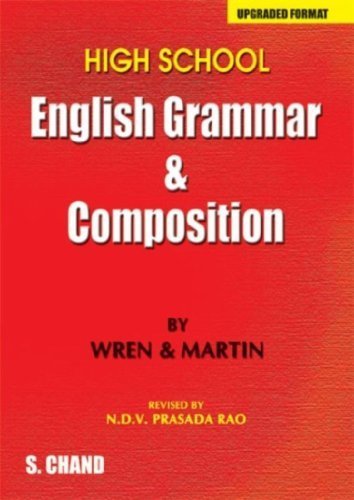
Total multicolored with 2000 illustrations. A sacred book for young students. A family book for generation to generation. A thorough systematic treatment of Grammar & Composition. Designed to help in rapid conceptualisation of English Grammar.
This book is the bible for English grammer and each comment a holy gospel.
The book was an essential part through out the high school and helped shape the understanding of the English language. Each facet of grammer was explained and was substantiated by an excersise to re-enforce the lesson learnt.
And just out of nostalgia, I have ordered a brand new copy along with the key.
I homeschool my kids, so it's natural that I've trawled through a number of textbooks in various subjects and, I have to say, "High School English Grammar & Composition" (HSEG&C) is a Textbook With Balls!
The Singapore curriculum English subject textbooks (which are better than their Malaysian equivalents) are a joke. Not a week goes by where I don't find several headscratchers or out-and-out mistakes. They contain sentences with weird inflections ("The inefficacy of their only solution has caused many neighbours to be resigned to their fates"), inconsistent mixes of UK and US English ("she got" as well as "she had gotten") and errors ("how many spoonful in this jug?"), with an unholy emphasis on materialism and punishment ("One day I asked my teacher how I could become a millionaire" / "Those convicted of tax evasion have to pay a penalty equal to three times the tax lost by IRAS").
I also think that part of the problem is that the Chinese language has no conjugations and very little complexity in the way of tenses. As a result, the so-called "educators" who write the workbooks are really trying to impart knowledge about something that is, at best, their second or even third language, all overlaid with the basic Chinese simplicity regarding verbs and grammar.
HSEG&C, however, is another matter entirely, an English subject textbook written by English-language natives (Wren & Martin) for British children residing in India, and revised by an Indian (NDV Prasada Rao). It may sound racist, but if I had to choose one Asian race that is the most erudite in English, it would have to be the Indians. So when I saw the book and checked the credentials, I had to have it!
Quite simply, it is worth its weight in gold. The dense, compact text begins with Subject/Predicate, moves onto simple sentences, complex sentences, verb patterns, punctuation, transformations and synthesis, etc., etc. and even rounds out the young pupil's English education with tips on story writing, appreciation of poetry, and letter writing, to name a few. Yes, even with an extensive revision in 1999, a lot of the text is quaint and a little old-fashioned (and the emphasis on "him" and "his" all the time does get tedious), but there's so much material there to work with that such objections pale next to the kind of solid, foundational textbook that you probably wish your child was learning right now!
As a writer, and with several English-language references at my fingertips, I was confident in the fact that I knew all the answers in the book. Wrong. Take Subject-Predicate, for example. The very first damned exercise asks the student to identify the Subject in the following:
1. The cackling of geese saved Rome.
Okay, we're talking about the cackling of the geese here, so that is obviously the Subject. But how much of it? Is the answer "the cackling"? Or is it "the cackling of geese"? Are phrases part of the Subject or not? And -- dammit! -- I should be able to solve the first damned sentence by myself, surely???
Do yourself a favour, spend the extra dollars and get the optional "key" book. It will save you a lot of frustration. There are even explanations regarding quite a number of answers.
This book has rekindled a love of the English language within me. By gads, it's complex, and technical and universes of meaning can hinge on where a simple two-letter word is placed within a sentence, but it's well worth it. And, when my son finally manages to wipe the tears from his eyes as he stares uncomprehendingly at exercises he *thought* he knew how to do, I hope he'll thank me.
As for me, I'm more than happy to go first. Thank you, Messrs. Wren, Martin and, last but not least, NDV Prasada Rao.
This is not just a grammar book—Wren & Martin is a quiet revolution in companionship. As I so tenderly phrase it, “my English teacher, my friend, my guide since Class 1.”
That one line contains the soul of a lifelong journey with language—a journey shaped as much by discipline as by devotion.
It didn’t simply teach tenses or clauses. It offered something deeper: a structural sense of language, an instinct for clarity, a moral rhythm to expression. It guided you not only in how to write, but in how to think. In every chapter, it whispered lessons in precision, logic, and lucidity—without ever raising its voice.
When I found myself wondering, “Should I use has been or had been?”, it quietly nudged you back to page 210. When a clause confused you, it explained—never condescended. You wrote your first essay—A Visit to a Zoo—under its invisible mentorship. You feared exams, but its margin notes were your solace. You stumbled over vocabulary, and its appendix reached out like a trusted friend. Later in life, when grammar became a survival tool in competitive exams, it sharpened your eye for detail. When spoken English felt like a mountain, it softly reminded you that grammar isn’t a rulebook—it’s the skeleton of expression.
And there was that one evening—Reported Speech, relentless and tangled. You shut the book, defeated. But in your mind’s eye, Wren appeared: “Change the pronoun. Shift the tense. But never distort the truth.”
Some books enlarge their pages. Wren & Martin became your quiet hero—never showy, never flamboyant, but always present. A teacher without a classroom. A friend without a face. A guide without ego.
It provides ample guidance and practice in sentence building, correct usage, comprehension, written composition and other allied areas so as to equip the student with the ability to communicate effectively in English. Table of Contents BOOK I. GRAMMAR BOOK II. COMPOSITION PART I: ANALYSIS, TRANSFORMATION AND SYNTHESIS PART II: CORRECT USAGE PART III: STRUCTURES PART IV: WRITTEN COMPOSITION
It was ok. Nevertheless, the issues with this book are plenty, such as it uses quite old English, nothing from the modern ones are mentioned; moreover, despite having a session about essay writing, nothing about linking adverbs were mentioned. Furthermore, the book Consists of 2 parts, however plenty of information from the first part you can find it repeated in the second. Besides, most of the tips which were given to write a certain thing for instance stories or essays, nothing about grammar were mentioned, those were rather tips to get prepared to write an essay and definition of an essay. Also, nothing about the American English was mentioned. On the other hand, chapters about tenses and several other chapters are quite useful; likewise, good tips were given, and common mistakes were pointed out nicely. To conclude, first part of the book is quite useful, however I wish someone would reorganize the books with better examples and filter out information which are redundant or recurrent.
Hi everyone today I am here to say my personal review on using the book high school English Grammer and composition book by the author wren. This book main course is that it gives the readers a full knowledge of English Grammer and how it is used in real sense. We can see all the topics with some clear description and examples for you to understand very easily.
As I am the user of this book to learn the best English along with correct grammer rules. I had improved a lot with this book written wren. I also suggested it to many of my friends who are very much poor in Grammer. For every part of your communication it needs a good Grammer which takes you to the higher position. This book helped me a lot in ssc exam as well some competitive exams which contained English as the subject. I was much impressed by this book.
This one of the best English Grammar Books I have ever read. I have been using this book since my college day. I am 100% sure you will learn something from this book. I highly recommended it to my students and also my friends. Check Out English Grammar MCQ Book PDF
High School English Grammar and Composition is a comprehensive and practical guide that builds strong foundations in grammar, writing, and language use. Its clear explanations, helpful examples, and varied exercises make complex concepts easy to understand and apply. A valuable resource for students aiming to improve their writing skills, confidence, and command of English.
I have also a copy of (HIGH SCHOOL GRAMMAR AND COMPOSITION) which I purchased few months ago from Karachi. I found the book very informative in respect of rules of GRAMMAR. I sincerely suggest to each and every student to study it once.
Finally revised this book 8th time and practised important exercises. Still, I find myself making some mistakes related to prepositions. I hope I'll more clarity about these concepts as my reading and writing experience expands.