Apart from three of the shorter cases of Scotland Yard's Roderick Alleyn—introduced to us as a Detective-Inspector but inevitably being promoted (over his fifty-year career) to the rank of Detective-Chief-Superintendent—this collection includes an introduction to Marsh’s life and work by Douglas G. Greene; essays by Marsh describing the “births” of Alleyn and his wife Troy; four unrelated short stories; a teleplay for a British television series called ‘Crown Court’; and what may be Dame Ngaio’s first published work: the story ‘The Figure Quoted’, which was not discovered until after the first edition of this book was issued.
Contents: Roderick Alleyn — Portrait of Troy — Death on the Air — I Can Find My Way Out — Chapter and Verse : The Little Copplestone Mystery Other Stories — The Hand in the Sand — The Cupid Mirror — A Fool About Money — Morepork — Evil Liver — The Figure Quoted
Does not include Newly discovered: The figure quoted
Dame Ngaio Marsh, born Edith Ngaio Marsh, was a New Zealand crime writer and theatre director. There is some uncertainty over her birth date as her father neglected to register her birth until 1900, but she was born in the city of Christchurch, New Zealand.
Of all the "Great Ladies" of the English mystery's golden age, including Margery Allingham, Agatha Christie, and Dorothy L. Sayers, Ngaio Marsh alone survived to publish in the 1980s. Over a fifty-year span, from 1932 to 1982, Marsh wrote thirty-two classic English detective novels, which gained international acclaim. She did not always see herself as a writer, but first planned a career as a painter.
Marsh's first novel, A MAN LAY DEAD (1934), which she wrote in London in 1931-32, introduced the detective Inspector Roderick Alleyn: a combination of Sayers's Lord Peter Wimsey and a realistically depicted police official at work. Throughout the 1930s Marsh painted occasionally, wrote plays for local repertory societies in New Zealand, and published detective novels. In 1937 Marsh went to England for a period. Before going back to her home country, she spent six months travelling about Europe.
All her novels feature British CID detective Roderick Alleyn. Several novels feature Marsh's other loves, the theatre and painting. A number are set around theatrical productions (Enter a Murderer, Vintage Murder, Overture to Death, Opening Night, Death at the Dolphin, and Light Thickens), and two others are about actors off stage (Final Curtain and False Scent). Her short story "'I Can Find My Way Out" is also set around a theatrical production and is the earlier "Jupiter case" referred to in Opening Night. Alleyn marries a painter, Agatha Troy, whom he meets during an investigation (Artists in Crime), and who features in several later novels.
Ngaio Marsh's Short Fiction 1937 to 1978 A review of the Felony and Mayhem Press eBook (July 1, 2016) of the original Intl Polygonics Ltd. hardcover anthology (December 1, 1989).
[3.9 average rating, rounded up to a GR 4 star] This was like a palate cleanser after reading Ellery Queen's freshman effort The Roman Hat Mystery (1929). New Zealander Ngaio Marsh did not write very much short fiction so this was a quick read. It includes two brief introductory memoir essays which talk about her invention of her main series characters detective Roderick Alleyn and his wife the painter Agatha Troy. They provide terrific background detail.
There was much to delight in this anthology. I especially enjoyed editor Greene's Introduction and his dissection of all the possible solutions to the crime in #9, the screenplay of "Evil Liver." There are only 3 Roderick Alleyn stories here, but two of them have some comic elements in the characters of Lord Michael in #2 and the New Zealand bookseller in #3. The #7 Morepork had a sort of inevitable doom aura in the wild bush which reminded me of Hemingway's The Short Happy Life of Francis Macomber.
All in all, a great anthology collection.
1. Death on the Air *** Originally in The Grand Magazine in 1937. Marsh’s regular sleuth Roderick Alleyn investigates a death at Christmas involving a wireless radio set. This had a clever murder device, but the ending was a bit of a letdown. I had already read this in A Surprise For Christmas: And Other Seasonal Mysteries.
2. I Can Find My Way Out ***** Originally from 1946. A friend of the Alleyns, Lord Michael Lamprey, wearing Roderick Alleyn’s clothes (with Alleyn’s Police ID card in the pocket) goes out to play a prank at a theatre where he is mistaken for the detective but ends up discovering a murder in the backrooms. Alleyn is called out to solve it all.
3. Chapter and Verse: The Little Copplestone Mystery ***** Originally from 1973. A book dealer from New Zealand arrives in the village of Little Copplestone and visits Agatha Troy Alleyn. He has a family Bible with some mysterious entries written in it and wonders if his old friend Roderick Alleyn would be curious about it as well. Later he dies after falling from the Church tower, but was it an accident or murder? Roderick Alleyn arrives back home and has to solve the case.
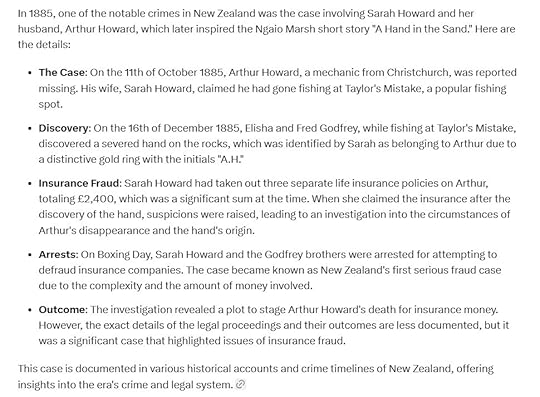
4. The Hand in the Sand **** Originally 1953. Ngaio Marsh forms the true-crime facts of the 1885 disappearance of Arthur Howard* in New Zealand into a story. A severed hand was found on the beach with a ring with the initials AH scratched on it and witnesses said that Howard had been the victim of a shark attack. Marsh says at the end that it was too bizarre to be turned into fiction. This was Marsh’s only venture into writing about true crime.
5. The Cupid Mirror *** Originally 1972. At a restaurant a man tells his companion the story of how he watched someone be murdered in the restaurant years ago. He saw it all happening behind his back but could see it reflected in a mirror.
6. A Fool About Money *** Originally 1974. A man loves to retell a story which makes fun of his wife’s handling of money. But this time he tells the story when there is a certain witness on hand to rebut it.
7. Morepork **** Originally 1978. Editor: “Marsh’s final and probably best short story”, tells of an odd trial in the forests of New Zealand. An informal coroner’s hearing takes place in the bush when a bird song recordist is apparently drowned. But his parabolic microphone may have picked up a clue as to what really happened.
8. The Figure Quoted *** Originally from ?. An auctioneer begins to hallucinate bids at an auction for a stone urn. More of a fantasy than a mystery.
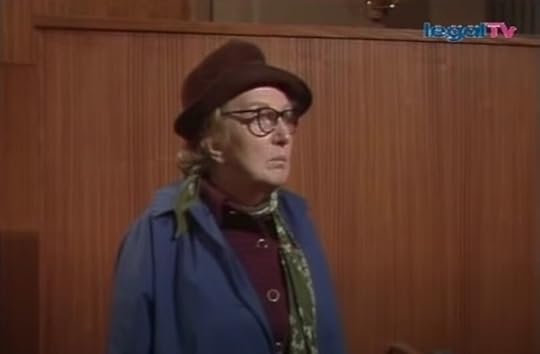
9. A Telescript (Part A): Evil Liver **** Originally broadcast in 1975. A previously unpublished TV screenplay in which the reader must act as part of the jury or as detective. A fictional poisoning case is tried with a jury of regular citizens for the program Crown Court. Joan Hickson (who later played Agatha Christie's Miss Marple) played the defendant. Two alternative ending lines were provided for use, depending on the jury’s verdict. Joan Hickson as defendant Mary Freebody in "Evil Liver". Image sourced from a YouTube screengrab.
10. A Telescript (Part B): The Case with Five Solutions ***** Written by editor Greene in 1989. The editor proposes five possible solutions to the crime in 9, regardless of whether the verdict was guilty or not guilty. The solutions detail the different motives and methods for the “Evil Liver” murderer.
Footnote * Spoiler: I asked an AI to provide the true crime facts behind the story A Hand in the Sand
Trivia and Link The "Crown Court" TV episode from 1975 which was a broadcast of Ngaio Marsh's Evil Liver screenplay is available to watch on YouTube here. In the teleplay we get only the verdict without an actual solution to the crime. This is why the book editor added the 5 possible solutions based on the possible suspects and clues which Marsh introduced during the trial testimony.
A collection of stories written by Ngaio March at the beginning of her career. Alleyn is in of a few stories. There is one with 5 Solutions. At the first part there is an a description of her life and career.
Ngaio Marsh only wrote a few short works, but they are uniformly excellent. I particularly like “Morepork,” “Death on the Air,” and “Chapter and Verse.” This has a teleplay and a couple lovely essays by Marsh on her characters.
Two essays, a script, and several short stories, only a few of which feature Roderick Alleyn, kept me entertained, but not challenged. Of the four queens of mystery, I would place Ngaio Marsh in position four. To me Agatha Christie will always be first, followed by Dorothy Sayers and then Marjorie Allingham. Still, to be any one of the four queens of mystery would be a major accomplishment. These were fun to read.
These stories, essays and script were all new to me. Some were better than others, but I enjoyed all of them. The introduction by the editor was also quite interesting. I particularly enjoyed the stories set in New Zealand.
The "short fiction" in the title refers to eight stories (three featuring Inspector Roderick Alleyn and five others) and a lengthy television script describing a trial and its aftermath. But (as in those annoying late-night commercials) "There's MORE!"
I enjoyed the introduction by American editor Douglas Greene. He tells a bit about Marsh's life (in New Zealand and in London) and gives his take on her famous mysteries. In general, I think he's spot on, although I disagree with his insistence that Roderick Alleyn started out as a poor imitation of Sayer's Wimsey and Allingham's Campion.
To me, Alleyn (even in the earliest books) is far more mature and masculine than either of the others. He's well-born and Oxford-educated and sometimes lapses into the silly jargon popular with the English upper classes in the 1920's and 30's. For all that, he's a middle-aged man, a professional policeman, and a much tougher character than Wimsey or Campion.
The stories are all good, except "Hand in the Sand" which is Marsh's retelling of a real-life Christchurch mystery. I agree with her that it wouldn't lend itself to being turned into fiction. I just wonder that she felt it worthwhile repeating it at all. "The Figure Quoted" is notable for being the first known example of Marsh's work to be published. It veers toward the paranormal and I think she was wise to move in a different direction for her future writing.
"A Fool About Money" isn't typical Marsh, but it's a delightful story about a bullying husband having the tables turned against him. It shows Marsh's ironic humor and her dislike of over-bearing men. "Morepork" is a fine story set in a New Zealand wilderness, where a group of tourists is camping so that one of them can capture the rare call of the ruru or morepork. One of them dies in what might be an accident or a clever murder. Another camping group happens along and (since they are all stranded by the flooding of the river) an informal inquest is held. In the end, the guilty party is caught not by deductive reasoning, but by a modern invention.
All three Roderick Alleyn stories are excellent, but my favorite is "Chapter and Verse" which is set in the small village where Alleyn and his wife have a country home. I love the enthusiastic, naive New Zealander who shows up seeking an explanation for the enigmatic entries in an old family bible. It seems like an innocent quest, but old sins cast long shadows and a murderer is usually willing to kill again to escape discover.
The last 25% of the book is a long television script that shows the trial of an eccentric old lady charged with attempted murder. Her motive is logical to her, bizarre to the rest of us. It seems like an open-and-shut case, but it takes some strange turns as it becomes apparent that old Miss Freebody isn't the only one who had reason to want Major Ecclestone dead. In the end, the author provides five possible decisions and lets the reader choose from them. It's a bit like a game of Clue, but entertaining.
But the absolute best parts of the book are Marsh's essays about her creation of Inspector Roderick Alleyn and his wife Troy. She's remarkable unguarded in those two essays and reveals a great deal about herself and her view of detective fiction. Reading them made me determined to find a copy of her long-out-of-print autobiography. She was an extraordinary woman for any time or place, but especially so for ultra-conservative Christchurch in the early part of the Twentieth Century. I'm so glad her books are now available in Kindle editions. They're too good to be forgotten.
Having recently wallowed in a 3-novel collection of Marsh's mysteries, I had solid expectations for this collection. None of the entries here appealed at all.Perhaps she needs the greater space of a novel to spin out her yarns, and the more intense demands of the short story are too intense. These seemed bland to me, more like "ideas for a story" than fullfledged narratives.
I never understood the appeal for Ngaio Marsh as possibly the fourth queen of crime because her writing although from aliterary point is great but her detective puzzles are lacking. I thought of gauging a view from her short stories and was disappointed out of the three Allyen stories only one( Chapter and Verse : The Little Copplestone Mystery )can even be considered a proper puzzle the first two are straightforward scientific detection stories. The best fun ironically comes from her non-crime story "a fool about money" although guessable but entertaining. The real stand out is Greene's 5 proposed solutions to Marsh's telescript which again sadly says more about Doug Greene than Marsh.
As a fan of Dame Ngaio Marsh, I thoroughly enjoyed the book. I loved the earlier short stories, and it was interesting to see the earlier, slightly unpolished version of Detective Alleyn. Later stories rounded out his character and the development and descriptions was better of course. But it was great to see him kind of come to life. I especially enjoyed the other mysteries set in New Zealand, as well as the radio play. It was a treat to hear how the author developed the character of Roderick Alleyn and how she named him and the correct pronunciation of the name. A well selected collection by the editor.
I am new to the books of Chief Detective Inspector Allyen, so I thought I would start with a book of short stories. I loved the two SA's about Rory and Troy. It gave me more depth and understanding of the characters. I loved all the Allyen short stories, really fun to read and gives you sense of their growth and they are cracking good murder mysteries. I found this series of mysteries through the TV Adaption, (which I enjoyed very much.)
I found the TV script fascinating and fun. But of the short stories without Allyen, I only like one of them. I just couldn't get into the others.
But this book is really a great read, I recommend it.
The “Evil Liver” teleplay was by far the most entertaining and well-plotted entry in this collection. As someone who was once a huge fan of Ngaio Marsh mysteries, and made a point of reading them all, I had high hopes for more readings with Roderick Alleyn. The story “chapter and verse” largely lived up to my memories of these mysteries, but the others first plodded, then finished in a rush. Really, this is only to be expected with late discoveries like these.
A short biography of Ngaio Marsh, 4 Roderick Alleyn short stories, a couple of free standing short stories and a radio play Dame Marsh did in the late 70s. It's a short but interesting collection. I'm not terrifically fond of reading plays, but it was an interesting story. So, if you run across this book somewhere and like Dame Marsh's stories, give this book a try.
Short fiction by a favorite author seemed like the perfect choice to welcome back the chance to read on a daily basis. I do enjoy this author a great deal and was certain I had not read any of her shorter stuff before. I discovered, however, that I had read one of them before-- maybe in an anthology. Still, they were enjoyable. I am hard-pressed to pick a favorite.
Enjoyed these short works with three Alleyn stories, several other stories, and a BBC teleplay featuring Joan Hickson (Christie's Marple). As a birdwatcher, I found "Morepork" fascinating and was a bit surprised that the motive was not a rivalry to identify a bird. Nice to see short Alleyns; "Chapter and Verse" was an interesting plot with Alleyn and Fox stepping in at the end to solve it.
These are good short stories and some character sketches from one of my favorite authors. Some are in the Alleyn canon, some are not. I'm not as fond of short mystery stories as I am of full length novels, but I did enjoy reading them.
It was an ok collection. I enjoyed "I Can Find My Way Out" but already knew the solution as this story was referenced in "A Night at the Vulcan" which I had previously read. Overall, not that much mystery and far too little Inspector Alleyn.
Ngaio Marsh is funny and clever, but I think novels are a better form for her stories (in my very uninformed opinion). The plots seem too contrived in this short fiction but the characters and settings are great. As a NZer who loves crime fiction, I defs need to read a couple more of her novels.
Ok. I’m not a big fan of short story mysteries and read these mostly to be an Alleyn/Troy completist. The theatrical murder reminds me of how much I dislike the blithely irresponsible Lamprey family, who Marsh (and Alleyn) unaccountably favored.
I read all the stories except the last one with no ending..I expect the author to provide an ending. I didn’t like any of them. Save your money. Buy later works by her.
As it says, this is a collection. Besides several short stories, it also includes a couple of essays and one screenplay. All were enjoyable ... it's nice to have something shortish on hand to read when you are stuck somewhere but don't have time to get deep into a full novel.
A very fun collection. Roderick Alleyn is an interesting detective. Also included is a stage play and some other stories. They are all clever and well staged, with or without Alleyn.