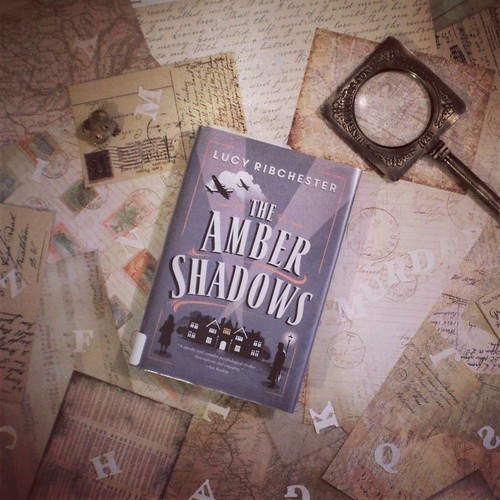
Bletchley Park typist Honey Deschamps spends her days at a type-x machine in Hut 6, transcribing the decrypted signals from the German Army, doing her bit to help the British war effort.
Halfway across the world Hitler's armies are marching into Leningrad, leaving a trail of destruction and pillaging the country's most treasured artworks, including the famous Amber Room - the eighth wonder of the world.
As reports begin filtering through about the stolen amber loot, Honey receives a package, addressed to her, carried by a man she has never seen before. He claims his name is Felix Plaidstow and that he works in Hut 3. The package is postmarked from Russia, branded with two censors' stamps. Inside is a small flat piece of amber, and it is just the first of several parcels.
Caught between fearing the packages are a trap set by the authorities to test her loyalty or a desperate cry for help, Honey turns to the handsome enigmatic Felix Plaidstow. But then her brother is found beaten to death in nearby woods and suddenly danger is all around…
Lucy Ribchester writes thrillers under the pseudonym Elle Connel.
Lucy Ribchester is a dance and fiction writer based in Edinburgh. She studied English at the University of St Andrews, and later Shakespearean Studies at Kings College London and Shakespeare’s Globe. She then embarked on a strange and waggly career path organising parties at a boutique cinema in London, working for Al Jazeera television network, freelance writing while living in Spain, and later coordinating the National Trust for Scotland’s annual cruises (where I worked onboard a ship, swam with icebergs, set foot on St Kilda, and finally learned how to ceilidh dance).
She won a Scottish Book Trust New Writers Award in 2013, and now work as a freelance dance journalist and adult education tutor, alongside fiction writing. When she's not doing any of those things she likes to make origami jewellery out of old book paper.
Lucy has a retired greyhound called Buster whom you will see a lot of if you follow her on Twitter.
It's easy to forget that during war times that danger doesn't always come from the enemy. I think I've maybe taken for granted in historical fiction about either of the Great Wars that the enemy is usually clear and obvious. Lucy Ribchester does a superb job of reminding us that isn't always the case. Not only are there spies to watch out for but also those who would be nefarious no matter what was happening around them.
I don't read lots of mystery books. Usually the ones I do have historical, sci-if or fantasy settings. So I will confess I'm easily fooled by a good mystery. And yet I'd like to think I'm not completely stupid (lol). So when I got towards the end of The Amber Shadows and realized I had gotten it all wrong, I was genuinely surprised. I believe this is because Ribchester has very persuasive writing. Each time I delved into the story I felt like I was in the mind of our lead gal and so believed what she believed; whilst she typed encrypted messages in an enigma calibrated typewriter. I won't lie, as much as Ribchester reminds us of how harsh and awful war times are (even for those not fighting on the front lines), it all held a little bit of magic for me. How exciting it must have been at times to decide the message that saves a ship, town or supply run from being bombed.
Yes I realize that is my very naive self falling into the trap of believing that another time besides my own might have been better. Let's face it, this is why so many of us read and wish to travel back in time or to dangerous unknown worlds; for the simple reason that it's not in the here and now.
I really don't want to say anything more about the content of the story as it might take away from the intrigue as it plays out. I will say if you enjoy cryptic, coded, intrigue stories you are bound to like this one. But you're also likely to enjoy it if you like historical fiction in general. Ribchester does a good job of setting the scene of WWII whilst telling us a story that will make you wonder what is truth and what is deception.
To read this and more of my reviews visit my blog at Epic Reading
Please note: I received an eARC of this book from the publisher via NetGalley. This is an honest and unbiased review.
WWII is in full swing and Honey Deschamp works as a typist in Bletchley Park. Once the code is broken for the day she is responsible for decrypting as many Nazi messages as possible before shift's end. Life is tense in the Park with the country's top secrets floating between huts and Honey is never sure who to trust. When mysterious packages containing amber begin showing up with an even more mysterious messenger she needs to figure out who is sending them to her and why.
This begins as a meandering read. As the prose bounces confusingly between every thought that Honey has I felt myself fighting to remain engaged in what should have been a quick mystery. The setting is exciting, Bletchley Park at the height of Nazi code breaking. The plot, moving in fits and bursts, was strangely difficult to follow. The pace of the novel is all over the place. While I felt immersed in the setting (well-researched) I had little interest in the characters or the plot. They seemed forced upon the circumstances. A little over halfway through the novel picks up briefly with a vengeance and then drops out again for a disappointing finale.
Nope, not for me. Gave it to chapter 6 reading properly, couldn't get into it, skimmed to the end: didn't hold my attention at all. Convoluted, and I wasn't grabbed by the style, the characters or the plot.
The downside to spending so much time on Goodreads is that my reading has gotten too over-scheduled. It's almost eliminated any spontaneity in my reading. So the last time I was at the library, I picked up a couple of books at random. The Amber Shadows was one of them.
I have been severely burnt out on WWII novels for several years now. There are too many that are too similar and always cover the same aspects of the war. But The Amber Shadows is set at Bletchley Park and has to do with the code breaking done there during the war. I’ve long been fascinated by the Enigma machine, so I made an exception to my usual avoidance of WWII novels.
The story is about a young woman named Honey Deschamps working at Blethcley Park when she starts receiving mysterious packages with codes in them.
I was worried for a minute because the prologue is written in present tense. But thankfully, the bulk of the story is in past tense. Though it really doesn’t make sense that the prologue and (as it turned out) the epilogue switched to present tense.
The historical setting was well done with a lot of little details. The plot kept me engaged and guessing the whole time even though this is definitely a slow burn story. I liked the suspenseful atmosphere. There was a lot of propaganda during the was specifically made to encourage paranoia. That went double for people working in counter intelligence. “Loose lips sink ships” wasn’t some off the cuff phrase.
But although I liked the atmosphere, I wish there had been more build up to it. When the story opens, Honey has already been working at Bletchley for a while, and her nerves are already on edge. So the first package she receives is enough to send her spiraling into full paranoia. I would have enjoyed a slower buildup to the madness.
That also doesn’t give the reader much opportunity to get to know the main character. Honey isn't the most sympathetic character. It didn't help that the reader doesn't get to know her pre-paranoia. There were times when the constant state of apprehension felt almost monotonous.
Nevertheless, for most of the book, I thought this would end up a four star rating for me. But after all that buildup, the ending felt rushed and a little anticlimactic. There was also this ongoing thing the whole book about what Honey’s real name was; the answer to that ended up being particularly anticlimactic. But while I wish the ending had been more solid, I did enjoy the book overall.
RATING FACTORS: Ease of Reading: 4 Stars Writing Style: 4 Stars Characters and Character Development: 3 Stars Plot Structure and Development: 3 Stars Level of Captivation: 4 Stars Originality: 3 Stars
Last year, next to Anna McPartlin's "The Last Days of Rabbit Hayes", Lucy Ribchester's debut novel "The Hourglass Factory" was one of my absolute Top Ten reads. I couldn't stop thinking and talking about the book, and between this thinking and talking I was impatiently waiting for Lucy's next book, and as soon as I've heard news that "The Amber Shadows" is going to be published, I started to count the days to its publication day.
And with "The Amber Shadows" Lucy Ribchester only went and proved that she's already found her fantastic, distinctive voice in historical fiction and I'd really advice you to just go and buy her books - they're brilliant! And both are really very different, which is a great thing. By different I mean that even though both novels are historical fiction, they are both set in different times, they have totally different characters and plots and I love this, because it only shows that the author can write whatever she wants and it's going to be a hooking, interesting, brilliantly researched story.
The story centres around coding, codes, ciphers and secrets. I will be honest with you, I'm really bad at such things, so seeing how this all is working made the book only better for me. It is fascinating and it is amazing how many codes there exist in the world, and how the minds of people who break them are working, and the author has described it precisely, but also in not too technical way, and even I was able to understand everything - which says something about the author's talent to write about such complicated things.
Honey was a very strong, expressive character with a very distinctive voice and I didn't have problems to warm to her from the very beginning. She works at Bletchley Park, transcribing the broken codes into messages, and I find her job fascinating. OK, maybe not as fascinating as breaking the codes itself, but nevertheless important and significant, though the author didn't emphasize the meaning of the job so much. The atmosphere in Park is weird, people can't trust other people, there are a lot of bans and orders and sometimes it made me feel really paranoid, when it was told you can't speak with other people, you can't go to other Hut and you must principally be very careful. And then Honey is handed a parcel by a strange man, a parcel that was delivered to the wrong Hut by mistake. It seems to be posted from Leningrad, even though Leningrad is currently under siege and it's impossible to send packages from there, but still, the parcel has a right stamp and Cyrillic. Honey finds a small piece of amber in there - why did she receive this parcel? How? Is it about her father? Who is sending these packages - because there are more to come. Is it connected with Honey's background that's a little complicated, what with the confusing information she gets from her mother and brother about her father? But even more confusion is going to come. Lucy Ribchester has portrayed Honey in a very believable way and she really well described all the feelings she felt, the confusion and distrust. Sure, Honey seemed a little confused and she seemed to believe in anything that was told to her, and it was only later that she started to doubt and asked questions, but she was young and she didn't have a reason not to believe in the things her family told her. She was forced to undergo a crash course in maturity, she was brave and spirited and even though I didn't feel a great connection with her, I still fell for her and kept my fingers crossed for her. Also the other characters are incredibly well written. They are all very complex personalities, not at all straightforward and I really liked it. Their presence added tons to the story and they were all very convincing and realistic in the way they acted, though I missed a little what really happened with Moira.
However, I couldn't help thinking that the story drag a little and that there is much too much about things that are not so significant for the plot. It was a very complex novel, not too straightforward, and it was really hard to find what IS the main point of it: is it Honey herself? Her discovering that her family history is one big lie? Her life and work at Bletchley Park? The mysterious parcels that she keeps getting? Sure, all the things are really brilliantly connected and they intertwine in the most comfortable, easy to follow way, but the main thing was - for me at least - too hidden, buried under the many sub - plots. But please, don't get me wrong, it was a hell of a great story, and even with the end that seemed much to rushed in comparison to the whole book, I was hooked and wanted to know what is the secret, who's sending the mysterious parcels, what do they mean and what's Honey's story. And I really appreciate the way the book was written and how well all the secrets were weaved into the story, how gently and in the right moments the author gave us a hint, how not obvious the story is and how gripping and full of suspense Lucy Ribchester made the book. I truly didn't know who can I trust and who not, and Ms Ribchester kept me in dark till the end of the story, in fact, when really all the pieces of the puzzle fit together
The other aspect of me loving historical fiction so much is the fact that I can always learn something new. The idea of Bletchley Park is not new to me however I've never heard more about it. And even though this novel is completely fictional, and the author admits that the buildings, the jobs, the codes are a part of her imagination, it still sounded so very realistic and true, and Ms Ribchester has really brought this place to life, with all the description and creating this really exceptional, full of tension and secrets atmosphere. She truly brings the details of everyday life in Bletchley, and she does it in a very convincing, realistic way, but the most fantastic thing that she did with the book is the fact that the atmosphere of secrecy, distrust, confusion is palpable through the pages and I had a feeling it's enveloping me as well.
The other thing that hit me so hard when reading the book was the fact that, even in war, you couldn't trust your own people. I also couldn't comprehend why so many secrets and why did the people make their lives even more complicated with them - it was so extreme that people working in Bletchley Park were not allowed to visit other Huts, and really, the secretive atmosphere is really well captured, and there came a moment that I really didn't know who is the bad and who is the good one, and what is happening. It's no wonder that Honey wasn't sure what's happening as well, and she didn't know with whom she can talk, as often talking to the "wrong" people and doing the "wrong" things led to very serious consequences.
I enjoyed "The Amber Shadows" very much, though not as much as "The Hourglass Factory". I'm sorry, but even though the books are very different, I can't stop comparing them - I usually don't compare books by the same author but this time it's just that "The Hourglass Factory" was one of the best books I have ever read. This debut novel was for me much more vivid and colourful and "The Amber Shadows" felt in comparison a little flatter and not as full of action and events. But altogether, Lucy Ribchester has again written a masterpiece of historical fiction and she can really incredibly well capture atmosphere of the times she sets her novels in. An exceptionally well researched and you can feel how much feeling and heart the author put in every word, "The Amber Shadows" is for sure not a book to miss - I highly recommend it to you all!
Copy provided by the publisher in exchange for a review.
Thanks to the publisher for lending me a digital review copy of the book, via Netgalley.
During World War II, Honey Deschamps works in one of the huts at Bletchley Park, helping in Britain’s code-breaking war. Everyone working there has signed a pledge of secrecy, and that’s not only outside the Park but inside as well. Different teams work in various huts and, though they may be only a few feet from each other, nobody knows what is going on in huts other than his or her own.
Like other Britons during the war, Honey lives on short rations for clothing and food. Worse yet, she is billeted with a skinflint couple who think it’s appropriate to allow her to bathe once a week in the water left over after washing oily, filthy work clothes. It’s not just patriotism that makes Honey eager to go to work each day.
On her way home one day, Honey runs into a man who introduces himself as Felix Plaidstow, a fellow Bletchley Park worker. Felix gives her a parcel that he says was misdelivered to his hut and meant for her. It’s a mysterious package, appearing to have originated in Leningrad. Inside there is a small rectangle that appears to be amber, as in the famous Amber Room, rumored to have been plundered by the Nazis invading Russia.
More packages arrive, but Honey doesn’t know who is sending them or why. There may be a coded message, but who can she turn to to ask in this village of secrets? Could the packages be from the man her older brother always told her was their father, a Russian who left them when they were children and returned to Russia to be a museum curator?
Lucy Ribchester has done her research and puts us in Bletchley during the dark of a blacked-out winter. We get a good picture of what people wear, eat and drink. We see what it’s like to live in the home of someone who doesn’t really want you there, to try to go through the village streets with no light to guide you, to work in an underinsulated, noisy hut knowing that even though you don’t understand exactly how it all works that what you are doing is a critical part of the war effort. And, on that rare night of fun, we see what it’s like to patch together the best clothing and makeup possible and cut loose at a dance with servicemen stationed nearby.
Ribchester also deftly portrays how the strict secrecy of Bletchley helps and hinders Honey in her efforts to find out who is sending the packages and what they mean. Should she tell the forbidding chief or will that lead to the kind of dire repercussions that others have suffered when doing the slightest thing that goes against the secrecy grain? Are there friends at Bletchley she can trust? The fear and uncertainty feel claustrophobically real.
Because Ribchester writes to atmospherically, it was disappointing that the mystery of the packages wasn’t up to the same standard. Honey doesn’t get much of anywhere with her amateur investigation until nearly the end of the book, when events just play out and solve the mystery, not through any particular putting together of clues by Honey.
Wow! Just Wow! I am surprised at some of the reviews for this complex, meticulously researched and yet very satisfied thriller set in Bletchley Park.
Honey Deschamps is one of many girls working in Bletchley Park, underpaid, underappreciated and lodging with horribly stingy people. Her friend Moira takes fashion seriously (beauty if your duty) and likes men. She likes men a little bit too much, perhaps though it's not her fault she has a femme fatale figure. Honey's mother, Martha is a glamerous opera singer, her stepfather owns a soap factory and her brother is a ballet dacer (he's been told by his teacher that he must not dance female roles but is drawn to the firebird ballet by Stravinsky).
There are so many really believable details- the disgusting bath-water, the gravy on their legs to look like stockings, the need to save lipstics by getting the ends of them and sticking them together carefully, the enigma machines (of course) the possibility that a woman cracked the enigma code but could not get credit for it, the pay gap, the need to get married if you are pregnant, the lies of men to women they want to bed. Honey watched Hitchcock's, Suspicion. I don't know enough about it to know whether her spidey senses (and the interpretation at the end) are based in fact or just Ribchester playing with ideas.
Overall the book is a psychological thriller in the sense that you don't know who is lying and why and what the truth may be. I guessed one of the "bad guys" but for the wrong reason. The paternalistic government are not completely innocent, and women's status as second class is part of the problem. At first because of the bleak setting I wasn't sure I was going to like it as much as the Hourglass Factory but in fact I did, or possibly even more. Impressive, though I am a little jealous of the author's ability too.
If you are sick of dull-as-ditchwater historical romances which are nothing more than cosplay heteronormativity then try this. If you just want feelgood escapism you might not like this (although it is rewarding in other ways and not overly bleak). Also there is a dog <3
This book was ... chaotic, it felt rushed, it felt unfocused and then almost too obsessive ... it took me almost three weeks to read less than 500 pages and I can say I only finished it because I received a copy from Netgalley and felt an obligation to read it to the bitter end.
Honey was a difficult character to relate to - she seemed paranoid for absolutely no reason and she seemed to become obsessed with events, almost to the point that it felt like the story didn't move along until we hit the 80% mark. And then at that point it almost felt like a completely different story emerged. One that could have been more interesting than the original, but alas, it was too little, too late.
I was initially drawn to this story because it takes place in Bletchley during the second world war, but really, this was a story about a typist who was caught up in past lies. It was muddy and simply didn't do anything for me.
Okay so, I have many problems with this book and maybe it’s because I can’t understand the complexity of a typist in world war 2 or what that life might have been like, but still. There are so many scenes in this book that just don’t have a point, and the plot twists are underwhelming. One of the main twist villains in the book isn’t even in most of the book so I can’t even remember who he is.
The love part of this story is also very rushed. They’ve known each other less then a week, been on one date, the book even says they don’t know much about each other, and yet they kiss on a train and do the dirty in a car. In one sense does that make sense? Especially when she’s questioning if she can trust him.
One scene that doesn’t make any sense to me is the girl who gets makeup all over her neck. That scene is completely useless. It’s whole purpose is to get our main character out of her bosses office. Another easy work around is to not have that office scene at all, and make the Boss knowing about the amber another twist. That would have bettered the book at least a little bit, in my opinion.
Another thing, the loose ends. It feels like they’re are too many to even care or keep track of, I know I didn’t keep track of all of them. Like the “something-or-other” character that gets brought up a few times, I thought she would show up as a nice addition to the cast, maybe to help our seemingly mentally fragile main lead, but no. We never even fully learn her name. But strangely enough the book makes a point to include a happy ending for the dog, which was not needed at all. The book would have been just the same if we did or didn’t learn that the dog was actually stolen.
There are other problems I have with this book, like how the pacing is horrible, the plot is barely noticeable, characters are introduced and forgotten about or don’t have a arch or just don’t need to be introduced at all, and the setting is very hard to grasp (again this could just be because I’m not a world war 2 typist), and I regret reading this book.
This entire review has been hidden because of spoilers.
This was an interesting, well written book with a very intriguing look at life at Bletchley Park during WWII. I liked that aspect a lot. The mystery was interesting but I don't know--it felt like there was something missing that prevented this book from being really great. I felt like the narrative style stopped me from really connecting with some of the characters and the mystery wasn't fully fleshed out. I don't know what it was but there was something that stopped me from being in love with this.
When I saw this title on NetGalley, I was first intrigued by the silhouettes on cover then I read the description and I was sold especially since I’ve just finished binge-watching The Bletchley Circle! I wanted to read a novel in that setting, Bletchley Park. The mystery spin in The Amber Shadows just made it more appealing as it is closer in description to the tv series. The differences being actual time setting and a slightly ‘mystical’ nature of the mystery.
Honey Deschamps was haunted by the mysterious and seemingly glamorous past of her parents; especially her father’s who she barely knows. So when she receives mysterious packages from Russia, she can only assume that they came from him. There were many questions surrounding the packages and many insurmountable barriers to climb to find the answers she needed to make the decision on these packages. There is a World War going on...
The author has successfully transported me into the world of time past; it was almost always dark, it was confusing, it was scary, and it was definitely not the time to be mysterious or nosy! Whilst I was left a little disappointed that the resolution wasn’t as glamorous as I’d wish it to be, it was very realistic. I guess I was just as carried away as Honey with her wishful conception of her father.
The Amber Shadows is a gripping mystery novel with a most thrilling setting. Whilst it’s not quite The Bletchley Circle and it wasn’t quite what I was looking for, it was still an enjoyable read.
Thanks to Simon & Schuster for copy eARC via NetGalley in exchange of honest review
(I received a free copy of this book from Net Galley in exchange for an honest review.)
I really wanted to like this book. It had so many elements that typically I would love. The Amber Room, WWII, Bletchly Park, Russia, a mystery...but for multiple reasons it just didn't work for me. First, I think I missed a lot by not understand British slang. I actually had to Goggle some of it because I had no idea what the characters were saying. Second, the "villain" was pretty obvious from the start. Third, the conclusion to the mystery was lacking. I mean, it concluded, but it was pretty lame. And lastly, there were entirely too many characters to keep track of, and a lot of them had similar names. Oh, and how could I forget? Our protagonist, Honey? I don't know why but she really annoyed me. Meh.
– You won’t believe what secrets lie beneath The Amber Shadows. –
I will never forget the thrill that came over me when I saw my first enigma machine on display in the Churchill War Rooms in London. I, like so many others, was captivated by The Imitation Game’s portrayal of the unsung heroes of World War II, the scholarly men and women sequestered in Bletchley Park who cracked codes throughout wartime only to be sworn to secrecy for almost a lifetime. When I saw that Lucy Ribchester (The Hourglass Factory) had written a novel based in Bletchley Park, I wasted no time in picking up a copy. (No, really - I dropped what I was doing and went straight to the bookshop. Priorities, am I right?)
In true Hitchcock fashion, the novel opens with two strangers on a train. Both men are of fighting age, yet neither are in uniform. And their train is delayed. The mystery of what was disclosed in their private conversation begins to unravel for both reader and protagonist eighteen months later, when Honey Deschamp receives a mysterious package at Bletchley Park, where she works as a typist. The package is one of several, each containing an encrypted piece of a puzzle that she is desperate to solve - but the clock is ticking.
True to Ribchester’s sparkling form, this novel was well researched and came complete with a pinterest board and playlist. Don’t you just love it when authors give you a peek into their process? I do. Her investment made it easy to fall into this world of codes and secrets, where no-one could be trusted and everyone was under suspicion. It kept me on my toes, let me tell you.
In some ways, I really hate novels like this. I want to trust someone, to have a character to rely on, but beyond Honey I couldn’t trust anyone. This is when I realised that I’d been played. Lucy, you sneaky wench: of course I can’t trust anyone - how could I when the protagonist can’t? Instead I stayed on the edge of my seat and kept flipping pages late into the night until the hairs on the back of my neck settled enough for me to temporarily close the book.
To make matters worse (or better, depending on how you look at it), I felt so close to Honey. Like me, she was from an artistic family and grew up in the theatre (and with a far-too-vivid imagination). And we both share a love for Stravinsky’s The Firebird, a ballet that features prominently in the novel. The similarities between us made her cork-heeled shoes so easy to slip into, and the false sense of security the fourth wall brings slipped uneasily away. That unsettling feeling made me rethink many of my past conversations and question previous conclusions in my life. Insecurity is, perhaps, one of the most subtle and ingenious tricks an author can play.
I suppose that’s what makes a good thriller: it could happen to anyone. It certainly never happens to someone prepared. The characters are always, in some way or another, caught off guard. Honey was just as shocked as I would have been. And so I, like the novel’s protagonist, was caught up in the mystery, suspicious of everyone and unable to entirely distance myself from the nail-biting circumstances - which made the climax all the more nerve-wracking and the conclusion that much more satisfying.
Ribchester has cracked the code on what makes a well-written historical thriller. She knows how to make the past relevant in a way that gives you goosebumps. If you’re looking to be swept up in something different, something exciting, drop what you’re doing and get yourself a copy.
Trust me.
----------
This review was first published on Narrative Muse, http://narrativemuse.co/books/the-amb..., and was written by Micah Orsetti. Narrative Muse curates the best books and movies by and about women and non-binary folk on our website http://narrativemuse.co and our social media channels.
This is another book from my Grrrl Con haul – I went to one of Lucy Ribchester’s seminars and she was a fantastic teacher. Plus, the author blurb on her book says she went to St Andrews so she must be awesome. I already have The Hourglass Factory waiting to be read but given that this book centres around a mystery taking place at Bletchley Park, I decided to leapfrog that one and start with this. I have always had a bit of a daydream about working at Bletchley during World War II even though my own personal research has left me to conclude that I would not last five minutes. It was interesting to hear from Ribchester herself that she had based her protagonist Honey Deschamps on aspects of herself – this did feel like a twenty-first century depiction of the period which did get me thinking about how we have come to mythologise the period.
Honey Deschamps is a typist in Hut 6, a lowly position within the Park and she has no illusions about her place in the food chain. She spends her days decrypting signals from the German Army. One day she is approached at the end of a shift by a man named Felix who explains that a package for her has been mistakenly delivered to his hut. The postmark is from Russia and inside are some pieces of amber. Over the coming days, Honey receives several more similar packages. Honey has her own thoughts on who might be trying to contact her but in the claustrophobic world of Bletchley Park, asking questions is strongly discouraged. There is the tale of ‘Betty’ who was hauled out for sending coded messages to a boyfriend, the girl who got hauled over the coals for showing her papers on request and then there is Honey’s friend Moira who abruptly vanishes after getting drunk after a dance, having just discovered that her lover, who also works at the Park, is married.
Ribchester manages to conjure up the mistrustful atmosphere very evocatively. Honey is attracted to Felix, who she keeps on running into, but cannot quieten her doubts about him – or quite decide whether these suspicions are no more than a natural by-product of wartime secrecy. She herself has grown up used to dealing with the unspoken – her father died a month before her birth and her opera singer mother refused to ever speak about him, marrying Henry Deschamps the soap baron quickly afterwards. Honey’s sole source of information about her father came from her elder brother Dickie, conscientious objector, ballet dancer and general story-teller. According to Dickie, their father was a Russian musician who escaped back to Russia in the previous war and who is now the guardian of the Amber Rooms. With information coming through on the decrypts about the Amber Rooms being packaged up by the Nazis, Honey wonders if these packages are in fact a message from her long-vanished father, but if so – what is he trying to tell her?
Intertwined with the novel’s plot is the film Suspicion which Honey watches at the cinema during the opening pages. Despite the film’s apparently positive outcome, Honey cannot let go of the feeling that Cary Grant will kill Joan Fontaine after the closing scenes (this was indeed the ending in the original novel). Honey’s own conflicted feelings for Felix and her unease at Bletchley mirror her concerns for these fictional characters. And indeed there is a lot for Honey to be angry about. Having asked Moira for help in working out the mystery of the amber, Honey is distraught to discover that the might of the Park has stepped forward to remove Moira from circulation. Honey believes that it is because Moira has highlighted the huge inequality in the wages paid to male and female employees within the Park but the truth is even bleaker. The once brilliant Moira has buckled beneath the strain and when the two are finally reunited, Moira can only tearfully beg Honey to remember that her work once saved a ship.
Ribchester has clearly done her research – I recognised more than a few Bletchley ‘fun facts’ over the course of the novel, the legendary stage productions ramping up in the background, the odd behaviour of Alan Turing, the ghastly appearance of the house itself. I particularly enjoyed Honey’s recollection of standing between two girls in the queue at the canteen, with one a society debutante appalled at how tacky the architecture of the house is, then the other a working class girl fresh out of the East End who was awestruck by the mansion’s glamour. For the amateur enthusiast such as myself, it was exciting to be in a novel with such a keen sense of recognition – in truth, Bletchley Park is a special kind of hideous, the sort of building that the term eyesore was originally coined for.
The main strength of The Amber Shadows lies in Ribchester’s highly effective description. There is the scene where Honey pretends to use the revolting bathwater which her landlady provides – but only after the landlord has used it post-factory-shift. The water swims with grease and Honey can hardly bear to touch it. Another set piece which really drew me was the dance, or rather the ‘hop’, where the girls all go in the hope of meeting an American soldier and scoring some black market stockings. The whole place is a sweaty mess and the pandemonium rises up from the page. Still, other than Honey, many of the characters did feel slightly nondescript which surprised me because the workshop I attended which was led by Ribchester was on characterisation – and it was brilliant. Oddly, one of the more distinct supporting players was Honey’s brother Dickie, the conscientious objecting ballet dancer, but whose appearances on the page are minimal and mainly conveyed via Honey’s recollections.
Somehow, the novel did not quite have the same intensity usually found in 1940s fiction – despite the high drama, Honey still felt strangely detached from what was going on. It is hard to bench-mark a novel about espionage in World War Two against a contemporary equivalent due to the general doctrine of Careless Talk Costing Lives but this is clearly a very different piece of work compared to Margery Allingham’s Traitor’s Purse or Agatha Christie’s N or M (don’t read it, it was awful, I had to study it and then the David Walliams series seems to have been even worse). There is less of the British jingoism, of the pride in national identity and far more emphasis on personal conflicts and insecurities. Is this a sign of a real shift – are we more concerned with personal matters rather than the national objectives now (recent weeks in politics would tend to support that theory) or was fiction written in the 1940s naturally slanted towards a more positive perspective on national mood and patriotism? It’s hard to say.
This was a fun romp, lacking perhaps the grit of Enigma but having instead an appealing heroine and enjoyable plot, full of twists and turns that will keep the reader guessing until the final pages. Ribchester is clearly a highly talented writer as well as a teacher, and reading this has definitely bumped The Hourglass Factory well up my reading list.
This book was pretty good up until the end, when it became truly truly terrible. The Bletchley Park background was interesting, and the author didn't try to cover up the realities of being a woman in England during World War II.
But the ending was terrible. Her editor should have sent the book back and told her to come up with something better.
Also, the book blurb mentions that the main character's brother is murdered, but the book is HALF OVER when that happens. That should NOT have been in the blurb.
Rounded up from 2.5 stars. It probably deserves 2 stars.
A very clever book. LR really does her research and writes to confound before enlighten. But I like her style, her unique style, which gets under your skin and makes you read on. LR never underestimates her readership and for that I am grateful. Want to get your teeth into a good book? Then read LR. Toast
I felt like it was a lot of pages for a pretty simply plot line. The climax of the book didn’t feel exciting or unexpected. While reading, I just kept thinking “Is this really all that it is?” There are a lot of Hitchcock references that I didn’t get. I probably would have appreciated the book more if I understood the references.
Sometimes when one reads a mystery one feels really confident that order will be restored. (The author of this book actually has her characters make the observation that this is the pleasure of the genre.) This book does not give one that feeling. The secrecy of Bletchley park and the feeling that one cannot trust anyone leave the heroine very much in the dark. And the reader is too. Which, it turns out, is fine in this case. I enjoyed this novel.
I was crazy about the first half of The Amber Shadows, when I thought it was ticking off all my favorite Gothic boxes, with the bonus of being set at Bletchley Park, and, even better, begins as a genuinely compelling mystery. The quality of writing stayed the same, but two things ratcheted down the enjoyment factor for me. After setting up the mystery, the writing became more observational, literary and dark. To some this would be a plus, but it didn't help me enjoy the story more. Ribchester also pulled the book in a direction I wasn't rooting for. She did it quite competently, but I stopped having as much fun. I don't want to spoil it by saying more, but it is the kind of book I would love to talk with somebody about. Hitchcock fans and BBC lovers as well as those looking for a unique puzzle to untangle would find this worth their time. I will definitely be looking for other books by her.
This was a bit of a different mystery from what I am used to reading. I enjoyed the mystery, which took place in Bletchley Park during WWII. There were moments where I felt tense and worried about the main character, which was good. I enjoyed the intrigue of code breaking, trust and keeping secrets. The one downfall of this book was repeating a couple things too many times and the story moved a bit slow. Overall, a nice mystery.
Good. Enjoyed the story but I don't think the author is for me as I read The Hourglass Factory and I didn't like the writing style on that but I thought I would give her another chance but it's just the same.
Set during WWII, Honey Deschamps is working at Bletchley Park working on decoding messages. She is alone in England and one day a young man with a greyhound comes to her home to drop off a package delivered to him by mistake. In the package is a piece of amber. A few more pieces arrive and she is desperate to know what is happening. Are they coming from her brother and who is the man with the greyhound who keeps reappearing? Good but at times I was lost in what was happening.
I received an ARC from the publisher via NetGalley in exchange for an honest review.
"She thought for the first time in her life how wretched it was to be a woman. War was ferocious to men. But when it was over the ones left would go back to their lives. For a woman, there would always be pillaged wages, affairs broken off, promises unfulfilled, family shame, babies to be hidden in unmarked graves, in wooden drawers."
Honey Deschamps is a typist at Bletchley Park, transcribing decrypted messages for the war effort, when she begins to receive packages of unknown origins containing chunks of amber bearing coded messages. Frightened by the ramifications and lacking the skill to decipher the carvings in the amber, Honey keeps the parcels largely a secret. However, the brutal murder of her brother and the loss of her closest friend pressures Honey into embarking on a journey for the truth about both her past and the mysterious packages.
A complex story of code breaking, war, family secrets, and obsession. A rather peculiar read, with a prose style that is alluring, but can require a certain level of commitment to become invested in. The Amber Shadows is slow to develop, but when the story suddenly hits it's stride it becomes impossible to look away. A sinister, sinuous narrative with a brutal twist I never anticipated. Ribchester is a master of secrets and illusion, making this well worth the read.
Honey is a typist at Bletchley park during WWII, who gets some mysterious packages in the mail. She is also a fan of Hitchcock, and in particular, the movie Suspicion. Perhaps it is her job, or maybe her penchant for suspense films, or the famous WWII phrase "Careless talk costs lives", but Honey has a high sense of paranoia and distrust. She sees these unknown packages as a mystery that needs to be solved - a strange riddle that must have an important solution.
I quite enjoyed the setting of Bletchley Park. It gave a different angle to, what is a very well written topic, of WWII. I also enjoyed the slow suspense through the book. Unfortunately,he slow pacing of the story was thrown to the wind as an ending was very quickly tied up. I was ultimately disappointed in the mystery and so it dropped the book from 4 to 3 stars for me.
Thanks to Netgalley and the publisher for providing me with a free copy of this book in exchange for an honest review.
I loved this book! The central character is young Honey Deschamps who's at Bletchley Park during WW2 transcribing decrypted messages when she receives a strange package containing a piece of amber, postmarked from Russia, and seeming to bear a coded message. We are pulled straight into the intrigue in a fast-moving complex plot that keeps you reading. Gradually we discover some of Honey's own back-story as it interweaves with her attempts in the present to make sense of the amber shadows, and to fathom her attraction to a certain man ... The book is fraught with tension. No-one is as they seem and it's impossible to know who to trust ... A great read! I really liked Lucy Ribchester's first Book 'The Hourglass Factory', but I liked this one even better!
By the time I finished reading Lucy Ribchester’s The Amber Shadows, I felt like I was neck deep in red herrings. Fitting considering that this novel centers on a young typist who works at Bletchley Park, is receiving mysterious packages of amber and being followed by a strange man. The cover led me to think this book would be cozier than it really was. There are parts of this book that are psychologically very dark. Above all, however, The Amber Shadows is about puzzles that are matters of life and death...
Read the rest of my review at A Bookish Type. I received a free copy of this book from Edelweiss for review consideration.
If you're looking for a novel about what the work was like at Bletchley Circle and the women especially who worked there then this is a good read. It's very atmospheric and detailed and shows a side to what went on that I hadn't read in this way before. I do think the novel could be shorter and not all of the threads were necessary which I think would have made it snappier and even better.
This was really focused on being atmospheric and evocative. Unfortunately it was just unclear. There was a horror of telling instead of showing, but sometimes saying "it was a square piece of amber" or "he was tall" is fine, I think. And when there were descriptions - woof! The romantic male lead is completely untempting, possibly because the POV characters lists one of his positive qualities as "gristly" (dang, what are his FLAWS?!), but the heroine is listless, uninteresting, and none too sharp, so I guess they make a pair.
The Amber Shadows imitates the neo noir style of the 20th century cinema, with stylistic imagery, seductive love interests, and a mysterious plot. Hitchcock films such as Suspicion are repeatedly discussed. The Amber Shadows carried this stylistic approach pretty well for the majority of the book, but seemed to fall apart in it's big reveal. The main character isn't the most interesting, with side characters overshadowing her. But the book maintains all the tension and mystery that a good Hitchcock film has, and a nice message about identity and humanism.