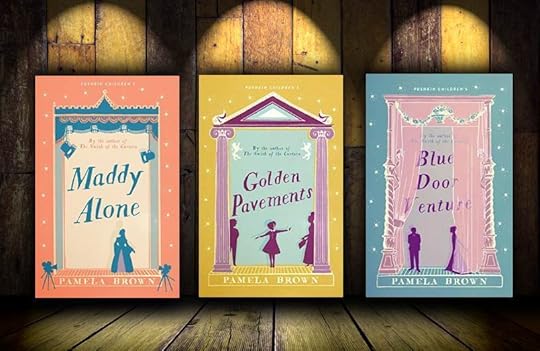
This book is the second in a series. The first book, 'The Swish of the Curtain', was one I really loved as a kid. It's about a group of children who start up their own theatre. I didn't find out until recently that Brown write it when she was 14. Even rereading it as an adult, I think the only way it shows is in the characters behaving believably and age appropriately. After reading 'The Swish of the Curtain' I desperately wanted to read the next book, but I was told that none of the rest had been reprinted (they were originally written in the 1940s) so every time I was in an antique book store I had a look for them. And then a few years ago the rest of the series began to be reprinted and I made a note to buy 'Maddy Alone' as soon as I got the chance.
In 'Maddy Alone' Maddy Fayne is looking forward to the rest of the Blue Doors coming home from theatre school for the holidays so they can put on a play together. Then she receives a letter saying only her sister Sandra is coming home, the rest of the group are taking part in a performance at the school (and Sandra would have stayed to be in it too, if her part hadn't been cut). She gets very upset, throws a tantrum, refuses to go to school and locks herself in her room. Her mother doesn't know what to do, until she meets the Bishop (an old friend of the children, he's the one who convinced their parents they should be allowed to go to drama school) while shopping and asks for his help. The bishop takes Maddy for a walk and gives her some sensible advice. He also tells her the story of Elizabeth of Fennymead, a local historical figure, who he has an interest in and has just discovered, through some old papers, was only 12 years old.
A few weeks later a film company comes to Fenchester to do a film about Elizabeth. Maddy is very interested and heads to the set to take a look. To her disgust the lead role is being played by Felicity Warren, who is 20. Maddy announces loudly 'Does he know she's only 12 years old?' There is an uproar as the director, Van Velden, who is a stickler for historical accuracy, stops production and demands the film be rewritten, while Felicity also insists she's too old to play a child. The film is duly rewritten but the director is having trouble casting the part of Elizabeth. All of the child actors he is sent details of seem fake and simpering. Then the image of Maddy pops into his mind...
I had fun reading this book, partly based on nostalgia for 'The Swish of the Curtain', which I reread a few months ago in preparation for this book, but it is an entertaining story in its own right. I did miss the rest of the Blue Doors. Maddy was always my favourite, but the group interaction was what made The Swish of the Curtain so compelling. Also I preferred the theatre as a setting. As well as loving theatre and finding it more entertaining to read about, I know what the backstage of a small, amateur theatre production is like and those descriptions in 'The Swish of the Curtain' rang true. I doubt that films are produced in the same way as described in 'Maddy Alone'.
There is a scene in this book which I recognised immediately as it goes thusly: Maddy needs to convince a rich man to allow filming in his castle. On her way to visit him she encounters a man working in the garden. He asks her errand and she tells him, managing to insult the Lord of the Manor in her explanation. She ends up not being able to see Lord Moulcester, but later that day word comes that he will allow filming in the castle after all. But Maddy gets quite a shock when she meets him, as it turns out he was the man she took for a gardener! I've seen this happen dozens of times, in countless children's books. As soon as Maddy spoke to the gardener I knew what was going on. And I loved it. Every time it happens I feel pure glee at knowing how things are going to turn out.
I also really liked that Maddy's tantrum, which in many other books would have led to her 'learning a valuable lesson' and promising never to do it again, led to a net positive effect. And even before the best parts become apparent, and she's feeling a little silly and ashamed for making such a huge fuss, she still reflects that at least she had missed arithmetic. It's also a nice link back to the first book where another piece of bad behaviour by Maddy (throwing a stone at someone who insulted her and breaking a window) lead to a good end result (finding a building to use as their theatre).
While a lot of the book feels very timeless there are a few moments where its age shows. One thing that was very out of place, both in this book and the previous one, is how much trust is placed in the Bishop. In this book he takes Maddy for a walk and then a meal. In 'The Swish of the Curtain' he takes the entire group on an overnight trip to Stratford-on-Avon, with no other adults around. I can't see that happening today. Also the idea of extras forming a union in order to demand equal pay for women was treated as a ridiculous concept, and the problem was easily solved by firing everyone and then rehiring them. They were so glad to get their jobs back they stopped complaining! It was brought up so briefly and dismissively it seemed completely out of place, and was horribly insulting to anyone who does think equal pay for women is a good idea besides.
Also unrealistic was the idea of rewriting film already in the late stages of production because of historical inaccuracies. This book in general felt less 'possible' than the last book. I can almost believe a group of very dedicated young teens could set up their own theatre, with minimal adult assistance (after all, I can believe September circumnavigated Fairyland in a ship of her own making), as the end result was of an appropriate scale and was backed by the hard work you saw them put into it. Nothing seemed impossible or unlikely, except them sticking with the work. (When I was young, every few months me and the rest of the kids in our street used to try to put on a 'stunt circus' on our roller skates and bikes, but every time arguments and boredom would derail our efforts after a few days.) This book felt much more like straight-up wish fulfilment, without much consideration for what would seem likely.
I was glad to see Mrs Potter-Smith, head of the local Ladies' Institute, return as the closest thing the book gets to a villain. Mrs Smither-Pot, as Maddy calls her, manages to cause an enormous amount of trouble with the deliberate and judicious use of gossip. Annoyed at being denied a starring role, her part as an extra taken away because she is disruptive, she makes trouble for Maddy by mentioning to Maddy's teacher how people are saying it is shameful that Maddy is missing so much school and getting so big-headed. She's such a realistic antagonist, with comprehensible motives and simplistic but effective methods.
Something that makes 'Maddy Alone' stand out from a lot of old children's books is the lack of message. The book is not at all preachy, no one improves themself, and Maddy, while a generally decent person, is no little angel. She feels like a real girl, sometimes naughty and occasionally not sorry for it. It made her much more relatable than the characters who constantly talk about the importance of honour, honesty and keeping their word. Maddy is willing to tell corking great lies and have fun doing it, and more often than not it has precisely the effect she desires.
I didn't like 'Maddy Alone' as much as 'The Swish of the Curtain', but I still enjoyed it a great deal. As a book for children, I think those who want to be actors or movie stars will love it. I am looking forward to the time when I can get my hands on 'Golden Pavements', the next book in the series.