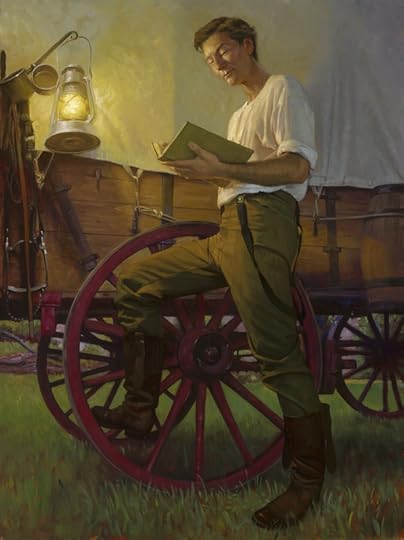
Frank Keating takes you on an ultimate tour of Abraham Lincoln’s life from boyhood to presidency in this biography, which includes stunning paintings by award-winning artist Mike Wimmer that bring the sixteenth President of the United States to vivid life.
To say Abraham Lincoln came from humble beginnings is an understatement. He was born in a Kentucky log cabin with a packed-dirt floor, rough slab roof, and leather-hinged door. He went barefoot for most of the year and wasn’t expected to amount to much. But reading was everything to him and his free time was consumed by books. Abraham Lincoln read furiously, studied law, and knew that hard work was his only path to making a change in the world. When he ran for the presidency, he stood for unity—one people and one land. He brought freedom to all citizens, ended slavery, and made the country whole again.
This visual tour de force is based on historical documents and chronicles Honest Abe’s life from boyhood to his extraordinary leadership position as the sixteenth President of the United States of America.
I'm the mother who once recited Walt Whitman's poetic tribute to Abraham Lincoln, O Captain! My Captain! to my two young daughters as they took their evening bath, so you can assume that neither of my girls is the least bit fazed by my passion for our sixteenth president.
I think all three of my kids have come to the conclusion that it's normal for one household to possess thousands of books, but even given that, I think they probably understand that most of their friends' mothers don't have a entire bookshelf dedicated to Larry McMurtry and another one dedicated solely to Abraham Lincoln.
It's not easy to explain why I would think I needed another book about Lincoln, but as soon as I saw this Mount Rushmore series offering and its stunning illustrations, I knew it wasn't worth the bother to pretend I didn't want it.
This book is focused, primarily, on Lincoln's love of reading, and, well, who doesn't want a book about that?
I jumped right in and read it to my girls, and the cool part is, they already knew I'd start crying, and I did, right after I read his words to them:
He who would be no slave, must consent to have no slave. Those who deny freedom to others, deserve it not for themselves. . . If slavery is not wrong, nothing is wrong.
The illustrations by Mike Wimmer are so damn inspiring, they belong in a museum, and when I came to the illustration on page 14 (pictured below), I held it up to my daughters and said, “Girls, do you see this? Do you see Lincoln reading? This is what we should all be looking for in our leaders, always:
Humble beginnings Compassion A person who declares, 'The things I want to know are in books.'"
Thanks to Julie Grippo for her wonderful review of this children's book. I would never have taken it out of the library without Julie's essay.
Having read it, I'm left frustrated that I can't will Lincoln back to life so I can talk to him. First, I'd like to hear anything he'd have to say about our present politics. And then, what he thinks of all the books about him. (This one is a superb introduction for children and the illustrations are luscious.) And then I'd have some serious questions for him:
In the last few decades, I've been being schooled on our real American history of genocide of the Natives, stealing their land, etc. I've read one book after another detailing the legacy of suffering that today's Native peoples are still negotiating. When I read Doris Kearns Goodwin's Team of Rivals, my frustration piqued at yet another big omission vis a vis Natives in American history. Lincoln eschewed the Mexican American war, clearly stating that it was wrong to take land from Mexico and that the war was a land grab. Yet there was nothing about what people had done to create this country and continued to do as the West was taken over by Europeans. In this book, too, there is of course his important stance on slavery. There are pictures of black people and white people next to text about "the sparkling call for equality and dignity for each person emblazoned in the Declaration of Independence . . ." yet still no recognition of the ongoing genocide of Natives. So, Mr. Lincoln, please talk to me in my dreams and tell me about this. I long to know your thoughts.
Abraham, written by former Oklahoma governor Frank Keating, is a worthwhile addition to collections. Told in first person from Lincoln’s point of view, the narrative concentrates on Lincoln’s early life but also covers his career up to the end of the Civil War. As Lincoln tells about formative experiences, primarily hard work and a passion for reading, the text effectively integrates quotes from Lincoln’s own writings. (These passages can be used as models to show students how to incorporate quotes into their own sentences.) Mike Wimmer’s illustrations of young Lincoln intriguingly show him as younger versions of the person we know from the familiar photographs taken later in life. Some of the vocabulary toward the end (emblazoned, unfettered) may be challenging for elementary readers to decode on their own, but the captivating artwork and engaging perspective successfully convey an appealing Abraham Lincoln.
Summary: This story follows Abraham Lincoln growing up and conveys his message throughout his upbringing. It shows a lot of younger Abraham, from being born in a small dirt floor cabin, to expanding their farm through hard work, to growing up and teaching himself to be a lawyer, all the way to his presidency.
Writing Traits: Word Choice - The language in this is rich, as well as often more period language as it utilizes a lot of quotations from Abraham himself to tell the story.
Classroom Integration: This would be a great book to have in a collection of text to support students kicking off preparing for History Day or a Wax Museum. This book is leveled 4.6, but appropriate for 2-5 grade. It could easily be read to younger students while learning about the history of America. It brings light of the fight for equality for all and the civil war, it would also be a great book to start talking about that subject and the role Abraham played.
Abraham by Frank Keating Paintings by Mike Wimmer PICTURE BOOK Simon & Schuster, 2017. $18. 1442493194
BUYING ADVISORY: EL (K-3) - OPTIONAL
AUDIENCE APPEAL: AVERAGE
Abraham Lincoln was born in poor circumstances, educated himself by reading lots of books and writing whenever he could. He became a lawyer without formal education. He was elected 16th President of the United States.
Mike Wimmer's paintings are wonderful! However, this is an odd biography. Told in the first person, like an autobiography, it was strange to see quotes around his actual quotes. Also, the writing style is so jumpy - almost like it's in free verse, but it doesn't really read like that either. While I loved the paintings, I was underwhelmed with the text.
Nothing new here other than the narrative is told in first person. Some of his quotes are included at appropriate spots as the text is written. I visited Lincoln's birthplace and his childhood home near Knob Creek just last summer. The cabin shown in the book looks like the Knob Creek home, not his birth cabin. The text implies it is the birth cabin. So, one has to wonder what else wavers from the line of historical accuracy. The other illustrations are mostly paintings of familiar paintings or statues (the family 'portrait' is of a set of statues at the Abraham Lincoln Presidential Library and Museum in Springfield, Illinois).
A very beautiful Picture Book biography with illustrations produced from actual oil paintings which used a person as a live model for Lincoln. The text White brief sums up well the linear progression of Lincoln’s life and uses many actual quotes of Lincoln’s to tell his story. My only dislike is the sentence about where Lincoln lived-Kentucky, Indiana, Illinois-perhaps should have come earlier in the text as the illustration where that occurs is of Lincoln as a young man. Lincoln moved from Kentucky at an early age.
One of the most boring biographies of Lincoln I've read. The prose seems too stilted and mundane. It felt like the author was putting words in Lincoln's mouth as well, although I realize exact quotes were denoted by punctuation. Compared to the impressive painting on the cover, the text was a letdown.
I don't generally like first-person biographies though this one seems not to venture into conjecture. The illustrations are gorgeous though I do question what looks like Abe clad in blue jeans (invented in 1871) in two illustrations. I'll be checking out the other biographies in this series though.