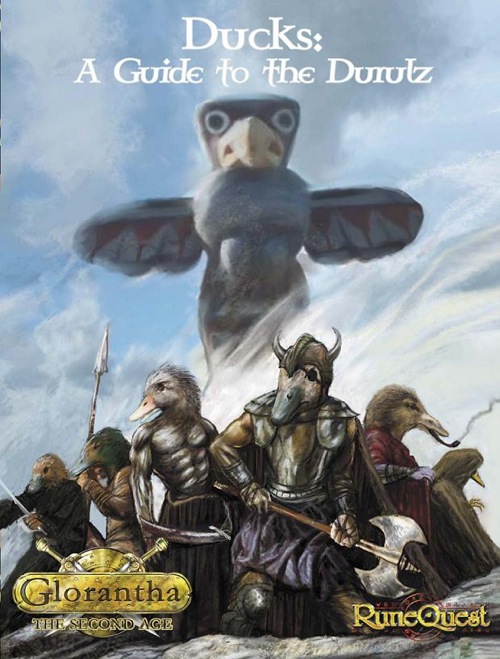
The Sixth edition of the RuneQuest rules, building on the previous RuneQuest II rules also designed by Nash & Whitaker. This book contains a complete toolkit for running a RuneQuest game, including complete rules, five different magic systems (folk, animism, mysticism, sorcery, theism), and a complete bestiary
Like most early RPGs, Runequest was originally developed because someone was unhappy with parts of D&D. Originally it was pretty closely tied to Glorantha, but this edition has decoupled itself and is a more generic fantasy system, though a lot of Glorantha's setting assumptions still carry forth into the end product.
In contrast to most fantasy RPGs, which take place in a kind of nebulous Renn Faire-esque medieval/early Renaissance period, Runequest is designed to evoke more a Bronze Age or early Iron Age feel (though it doesn't have to, as the free firearms rules available indicate), and all the examples of rules or concepts in the text are illustrated using a Greek city-state expy called Meeros.
I actually really liked the stories about Meeros and the world around it, and I found it far more interesting than most examples of game fiction usually are. Cynically, rulebooks tend to be fanfic followed by stereo instructions--that was why I found Alternity so hard to read--but Runequest actually manages to be quite readable, even though it's very long and fairly dense. Maybe it's how the examples are sidebars next to the text instead of interrupting the text itself, or maybe it's just that I'm happy for a change to hoplites in formation instead of medieval knights. Regardless, I'd buy a Meeros setting book if they ever published one.
The system is percentile, and is pretty easy to summarize: skills are rated as percentages, roll under the percentage to succeed, on opposed rolls higher numbers are better. If you've ever seen Call Of Cthulhu or Basic Roleplaying, then you already know how it works, and there aren't too many tricks here. It's very much a "roll the dice and it fades into the background" type of system. One mechanic to deal with skills above 100 that I like is that the amount above 100 is subtracted from everyone else opposing the character in contests, so there's still a reason to raise skills when they hit 100 beyond the small increase in the critical threshold.
The book is mostly a toolkit, and there's heavy emphasis throughout on including the elements that fit the individual GM's world. This is most evident in the magic chapters (about which more later), but shows up earlier as well. Character creation is filled with options, advice on how to determine where the characters come from, how to tailor the available professions to the setting of the game, how to integrate social classes and the influence of culture, and so on. The skill list is somewhat fiddly, but it avoids the problem most games with fiddly skill lists seem to have by giving the characters about ~20 skills to cover the normal things the average person can do--try to persuade people, run, climb, swim, resist physical or mental assault, and so on.
Also, boating. I wouldn't think that's an innate ability, but maybe I'm an outlier? Anyway, characters are rounded out with "Professional Skills" based on their jobs, upbringing, and any organizations they're a part of.
In one really neat change from the way most RPGs deal with combat skills, Runequest doesn't have separate skills for various weapons. Instead, they have "combat styles" that draw several weapons designed to be used together and trained with together under the same skill. These are designed to be campaign-specific and GM-created, though there are some examples given. Anathaym, the character that illustrates most of the Meeros examples, has the Meerish Infantry combat style that provides training in spear, shield, and shortsword. She also learned Meerish Slinger during her girlhood running around the hills outside the city. Each combat style also has a special trait associated with it. The first lets her lock shields to form a shield wall, and the second lets her sling while on the run. There's a full list of traits provided. All in all, it's a great way to deal with fighting that prevents a proliferation with weapon skills while providing some useful context to how each character learned to fight.
Combat itself is a gritty, brutal affair. A good hit to a character will probably cripple or kill them outright if they aren't wearing any armor, combat is typically over in three turns or less, and much emphasis is based on footwork, flanking, ganging up on your opponents, active defense, and other tactical combat measures. Though movement is mostly abstracted, there is an option to make it more tactical at the end of the book, as well as GM advice for how to pace and set up combat so that the deadliness and long healing times don't cripple the game when they come up. Finally, there's a maneuver system, including disarming, tripping, grappling, flanking, getting inside an opponent's spear range (or keeping them on the outside of your own spear range) and so on, all of which are chosen after the dice are rolled, so it prevents the usual problem where players have to choose between doing damage and doing something cool.
The whole section was like catnip for me--I love gritty, grinding, brutal combat in TTRPGs, and Runequest is that with the maneuvers section on top of that base to make sure combat stays interesting. The combat rules made me immediately want to run a combat-focused game, which almost never happens. Even though too many combats might lead to players losing limbs and accumulating masses of tissue. Then again, I love WFRP, which has similar mechanics. Maybe it helps that I'm usually running the games instead of playing?
The section on magic is the longest single section in the book, but mostly because of the toolbox approach. In addition to a basic chapter on magic, giving GM advice on how to integrate it in the game and determine the power level and prevelance of magic, there are individual chapters for Folk Magic, which is low-power common effects like starting fires, cleaning utensils, making plows or swords sharper, creating light, and so on; Animism, involving making contracts with spirits and getting them to perform effects for you; Mysticism, which is new to this edition of Runequest and covers concepts like supernatural martial arts and asceticism; Sorcery, the classic sword and sorcery magic learned from tomes or demons or ancient organizations; and Theism, which is probably the highest-powered magic since the power comes directly from a spirit or deity, but has a limited ability for the caster to replenish their magical energy.
This takes up a lot of space in the book, but it's all designed to pull whatever elements are necessary to properly create the world. This is one place where the influence of Glorantha shows through pretty strongly, because talk about the runes and their influence is woven throughout the text. There's advice on how to determine a magical school's repertoire based on their runic influence, or how the runes influence spells, and also how to ignore the runes completely if that works better with the setting.
The magic is mostly template-based. For example, there's a "Teleport" spell under Sorcery, but the examples given indicate how to tweak the spells for setting context--one example is a group of air wizards who cannot teleport unless they're not in contact with the earth, and another is the secret of shadowmancers who can flit from one patch of darkness to another.
I especially like how Theism has a spell specifically for appeasing wrathful deities. Not too many fantasy worlds include the idea of making sacrifices to the storm god to prevent lightning strikes, or to the plague god to prevent epidemics. Usually worshippers of the plague god are sociopaths, but that's not really how historical religion worked.
After that, there's an entire chapter about cults and brotherhoods, and a lot of emphasis is placed on the social connections the characters form with other individuals and with other members of their culture. As before, there's a lot of examples of different generic organizations that can be tweaked to fit the setting.
There's the usual bestiary, some parts of which are suitable for PCs if it fits the setting. The usual elves, dwarves, and halflings--with a note about how their stats can be used for, say, humanoid ducks--are there, but there are also centaurs, hawkmen, panthermen, and lizardmen. The monsters are your standard fantasy mixture with a bit of a mythic Greek twist, featuring cyclopes, gorgons (snake-women, not the D&D rockbulls), harpies, and so on, and there's also spirits to populate the world and interact with Animists.
If I can digress for a moment, the inclusion of Animism and the focus on spirits is something I really like. A lot of fantasy worlds, especially those derived or heavily-influenced by Dungeons and Dragons, will have a pantheon of deities, maybe the ghosts of the dead and other spectral entities, but basically nothing in between. Real-world cultures, especially in the Bronze Age that Runequest takes as the inspiration, tended to have a variety of local deities, nature spirits, tutelary deities, ancestral spirits, and other inhabitants of the unseen world. I always think that's a huge blind spot in most fantasy worlds, and I love that it's explicitly a part of the world here.
On another note, I'd heard a story that part of the inspiration for Games Workshop coming up with the Warhammer world, and specifically with Chaos and the Beastmen it creates, was that it used to produce Glorantha miniatures but lost the license and needed to do something with the Broo miniatures that it had. After seeing the stats for the Chaos Hybrid (Runequest's version of Broo) and the mutating influence of Chaos in the game, that story sounds pretty credible to me.
The book ends with a bunch of GM advice. More on how to tailor cults, how to deal with combat in a system where a single hit can take a combatant out of the fight or even be fatal, how to adjust for slow healing times, a way to adapt the rules for crafting to social situations, ways to structure investigative games so resolving the mystery or discovering the secret doesn't all come down to a single die roll, and how to adapt the structure of magic to fit the setting. It's pretty general, but it wraps up the toolkit approach pretty nicely.
Runequest is quite long, but in being long it's extremely comprehensive, and the toolkit approach means that you don't need to use the entire book if you don't want to. It'd be entirely reasonable to ignore almost all the creatures in the bestiary and all of the magic and run a purely historical game set in the eastern Mediterranean Bronze Age, where the PCs are members of a Mycenaean trading group, or members of Sargon of Akkad's army. Nearly half the book would be useless at that point, but it's certainly possible.
All-in-all, it's fantastic. You could get years or decades of gaming from just this book, and I'm really excited to try to use it. Two thumbs up: d(^_^)b
Runequest 6th edition aka Mythras is a very solid RPG rulebook.
It is all crunch and rules throughout it's content (no long fluff pieces breaking the main text) while it provides some side-notes with fluff to better explain the mechanics. This is a great format that allows the reader to keep a steady pace.
The rules are a bit complicated but not hard to grasp and the writing sure helps. There are a lot of options for the ST to make the game faster/more suited to their needs so this is a plus. It is interesting to note that the rules, while trying to be more generic and open to different settings, also promote a certain style of game where the characters are part of larger communities. This is a great difference to other fantasy role playing rulesets such as D&D where characters are more like drifters. Another difference is the lethal, down to earth, realistic combat. A bad roll can criple or kill a character, so it takes tactics and using different manuvres and weapon to get the advantage over your foes. It feels less WoW and more like Dark Souls. The writers know and address that to length at certain point and this gives the game a much different vibe to other systems.
I really enjoyed the fluff, the Grecian sword and Sandal setting of Myros, used as a backdrop. It strayed from the typical D&D campaign setting and it felt interesting. While barebones, the rulebook gave me a ton of ideas for the setting I was initially trying to tie to the system and helped me flesh out aspects I never thought of, and this is a definite plus.
Highly recommended for those wanting to play a historical, low magic or S&S style campaign
I played RuneQuest a lot through the 2nd and 3rd editions. The Mongoose version did nothing for me.
It turns out I should have been playing closer attention. This 6th edition of RuneQuest builds on the second Mongoose edition, while successfully evoking the atmosphere of RQ2.
Much of what an old fan would expect is here: the same stats, percentile skills, hit locations, and various magic systems. Runes and cults become central to the game once more.
To that, the designers have added Passions, which give a bonus to skills when invoked; Combat Actions, which transform combat by allowing tactical choices without the need for miniatures and battlemaps; Luck Points, which can keep characters alive through the notoriously deadly RuneQuest combats; and a host of other mechanisms.
The names of some if the magic systems have changed, and we get new ones. Folk Magic (formerly battle, spirit or common magic), miracles (formerly rune magic and divine magic) and Sorcery are joined by animism (which builds on RQ3's rules for shamans) and mysticism, which is totally new.
There's a whole section of cults, brotherhood, companies and guilds, covering everything from religious and magical societies to mercenary companies, craft guilds and more, with plenty of advice on creating your own.
As has been the norm since RQ3, this edition is a generic fantasy rules set, not tied to the world if Glorantha. A Glorantha supplement is in the works, apparently.
Nash, Whitaker & Friends should be very proud of what they have achieved. A classic RPG updated for modern gamers.
An excellent iteration of the RuneQuest rules: well polished and comprehensive. It's heavily simulationistic, like the original, but also has some more indie design elements that recognize the fact that time has gone by and the roleplaying field has grown. At times, I thought it got a little complex and at times I would have preferred it to be less of a toolkit, but those can both be overcome (the first by ignoring rules that are too complex and the second by pending supplements). Overall, terrific rules, but I'm not surprised given the excellent work Nash & Whitaker did on MRQII.