Lijia Zhang worked as a teenager in a factory producing missiles designed to reach North America, queuing every month to give evidence to the "period police" that she wasn't pregnant. In the oppressive routine of guarded compounds and political meetings, Zhang's disillusionment with "The Glorious Cause" drove her to study English, which strengthened her intellectual independence—from bright, western-style clothes, to organizing the largest demonstration by Nanjing workers in support of the Tiananmen Square protest in 1989. By narrating the changes in her own life, Zhang chronicles the momentous shift in China's economic policy: her factory, still an ICBM manufacturer, won the bid to cast a giant bronze Buddha as the whole country went mad for profit.
I am a rocket-factory-worker turned writer and social commentator. I grew up at a worker’s residential compound in Nanjing, on the bank of Yangtze River. Excelling at school, I dreamed of going to university and becoming a journalist and a writer. But at 16, I was taken out of school and put to work at my mother’s factory that produced inter-continental missiles, capable of reaching North America. Bored to death from greasing machine parts, I sought escape and enlightenment in reading and writing and began to teach myself English.
After a decade at the factory, I managed to leave China for England where my childhood dream stirred. I studied journalism. When I returned to China three years later, I started my career by assisting foreign correspondents before becoming a journalist myself.
In 1999, I co-authored China Remembers, a well-received history of contemporary China for Oxford University Press, which whetted my appetite for book writing.
My memoir “Socialism is Great!”: A Worker’s Memoir of New China was first published by Atlas and Co. in spring 2008 and then by Random House in May, 2009. It has been translated into various languages around the world and met with wide critical acclaim.
Inspired by the revelation from my grandma on her deathbed, I went on to write the novel Lotus. It follows a young prostitute in Shenzhen, known as ‘China’s capital of sins’. For me, prostitution is just an interesting widow to observe social tensions brought by the reforms and opening up police in recent decades, such as the rural-urban divide, the growing gender inequality and the tug of war between the tradition and the modernity.
Based in Beijing, I am one of the few Chinese writers and social commentators who write in English for international publications.
'Socialism Is Great' is an ironic title. It is a memoir of a young woman who grew up in an impoverished Chinese household– a household chiefly managed by women, while the men of the house are either missing or whiling away time elsewhere. Women from the young Lijia to her grandmother worked. The young girl, for instance, despite her wish, has to work in a missile factory. She hated this work but she has no other choice.
Each memoir makes us see the essence of the person. In this case, the most defining aspect of Lijia's character is her ability to imagine, and carve her own ways to shape and give direction to her private world. Even though the odds are great for a frail girl like her, but she eventually succeeds. As a young girl, she wants to educate her self, but her own mother and grandmother discourage her. Her colleagues or people who are around her make fun of her ambitions– her wanting to read English books. To avoid this sniggering, she would often read in hiding. She wants to dwell in the fictional world; it makes her bear the world around her that does not let her fly. The literature gives her the wings to soar higher and higher beyond the confines of her immediate world (she later wrote this book, and currently works as a commentator and journalist on Chinese affairs for international publications).
Another significant trope of the memoir is that it gives a glimpse into the Chinese regime of the times, and how it oppressed particularly its women. It is interesting to see how female bodies are seen as threats and therefore are constantly regulated– across histories, across cultures, in subtle and crass ways. In this context, certain scenes almost read like scenes from Orwell's 1984, however, here, sadly enough, they are real.
Many reviewers commented on her own poor writing style, but I really find this unfair. Personally, I liked her writing. I am, in fact, amazed that a self-taught person can do such a brilliant job. A few reviewers also found the book lazy because she has dwelled too much on her relationships. But I guess they are very much part of her life; additionally, these relationships are told in a way that seems to suggest that women should act smart and not be consumed by 'love' when things do not feel right. To live one's life on one's own terms.
Another persistent critique of the book is that it ends up abruptly. Yes, this might be true, but I guess it should be like this. She wrote this book at age around 40, so there is this whole yet-to-be-lived life before. So when the book finishes, her life continues, in ways that she always hoped for. So I liked the fact of this abrupt of ending.
I am so defensive about this book is because she, in some ways, is like one of us– 'A Reader.' A courageous one who read in hostile conditions, who, at last, wrote an amazing book.
This is a young woman's journal of discovery, covering the first decade of her working life. It starts as she's forced to quit school and take a factory job in 1980, and ends as the police investigate her for leading a 1989 democracy march. And this kid is just beautiful. She's honest, funny, and smart, with a drive for life like a heat-seeking rocket. She's on a quest for learning, skills, cash, potential. But most of all I think it's a drive for beauty. She teaches herself English partly out of ambition, but maybe more for the love of candor and beauty in the worlds of English literature. While mastering engineering skills at the rocket factory, she gets stronger and more beautiful all the time. Her love life gets more courageous. Her openness gets stunning.
Forget about this book If you are looking for a serious memoir with more depth and insight upon the Chinese history in the early 20th century. An interest for history is what appeals most readers to this genre but the author (albeit her current profession as a journalist) seems torpid in doing a proper research. It is perplexing to read the book without any background knowledge. The author is undoubtedly a bold and headstrong feminist of her time (probably 1970-1980), a "outlandish" character in the eyes of old China who went through love affairs, extra-marital affair, one-night-stands and abortion. I pity her plights, but her tone of pride and over-confidence really annoys me at times. Its abrupt ending leaves no epiphany, enlightenment or rumination about life whatsoever. Certainly not a masterpiece that is on par with The Wild Swan by Jung Chang.
In an effort to be objective in my assessment I have to put three things out there:
1. The book turned from memoir to harlequin romance and I don't like HR's so that raised my annoyance at the end. It smacked of 'I'm so cool but I couldn't tell my mom so this is how she'll find out about what I was up to.'
2. I got to hear the author speak in Beijing and I am a sucker for seeing authors live which irrationally raises my opinion of any book -- yes, I am groupie!
3. Zhang Lijia is fairly close in age to me so as I read I had this running reality check of what I was doing at the same time. My mother dind't make my drop out of high school to take her job when I was 16! I'm also ridiculously influenced when I am able to (albeit distantly) relate a book to ME. I also live in China so much of what she wrote I can see around me.
So, parts of this I'd give a 1.5 star (the HR parts) and others a 4 (meeting the author and then also seeing her at other literary functions in BJ)-- averaging these out, the book is a three.
Really dissapointing ending - I felt it just stopped. I can't say that I loved this book, but I found it interesting and readable all the same.
The synopsis reads "A spirited memoir by a former Chinese factory worker who grew up in Nanjing, participated in the Tiananmen Square protest, and ended up an international journalist".
Spirited: a little naive maybe. Participated in Tianamen Square: from a distance. Ended up an international jounralist: this is the story I really wanted to hear. Not about sexual partners that never quite met her hopes and dreams. The real story should have been about how she overcame and triumphed.
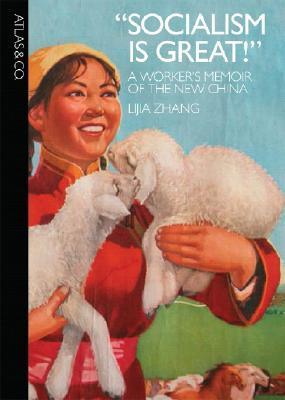
Sometimes it really is the book's cover that makes me want to read it. I was looking for a book about China, and out popped this beauty with a satirical title and goofy propaganda on the front. Sold!
This memoir details Lijia Zhang's teenage years starting from the time her mother made her leave school to take a job in the local rocket-building factory, all the way through Zhang's mid-20s. I could almost categorize it as a coming of age novel, except that it's not just about Zhang -- it's about China's coming of age too as it transitioned from communism to capitalism. An interesting parallel full of uncertainty, determination, and rebellion as the government seeks to quell any one or thing that stands out from the crowd.
In the book, Zhang finds her voice as she struggles to hold on to her student identity, help her family, and learn about the world beyond China's borders. We follow her through classes and boyfriends and the freedom she ekes out from the overbearing local government. Zhang makes herself proud with her stubbornness and resolve.
My one qualm is that Zhang doesn't write with a lot of physical description; at times, her writing is abrupt and transitions between chapters are disjointed. For example: I didn't know how much time had passed for most of the book, until she said at the end that she was 23. Her strength lies in the way she captures the people and emotions around her. I felt like I knew her grandmother, her anxious mother and her motivations, the boyfriends who came and went. Did I wish there was another chapter at the end to tie things up? Sure, but I understood why she stopped it where she did. She leaves us with doubts about her future, with a victory and a setback. I feel like we might have to muddle through some things, but I feel like that's how China felt too. Nicely done.
I'd recommend this book to someone with interest in or knowledge of China. Zhang definitely assumes you have a some background of the Cultural Revolution. A willingness to suspend disbelief is also helpful, as she doesn't go into detail about a lot of family customs and expectations of behavior among parents and children. But if you already know you like the topic and want to travel along with one young girl's life as she grows, this is the book for you.
Like other reviewers, I can attest that the structure of the story leaves something to be desired, and that Zhang often seems to focus on her romantic life at the expense of the more interesting story of her later career and activism. Even so, the book was compelling to read if only for the glimpse that it gives of working life during a very interesting period of Communist China's history. In describing her everyday interactions with the people around her in 1980's Nanjing, she reveals a fascinating interplay of human emotions. On the one side, the Chinese people in her stories show ambition, individualism, and passion for life that many of us in the West would find surprisingly familiar. On the other hand, the same people hold views on society, government, and family relations that would seem extremely deferent or strict to us. In the same vein, Zhang does a great job of introducing us to a wide range of personalities - conservative and world-weary old folks, free-thinking students, apathetic workers, wily entrepreneurs, and dutiful party hacks, among others. For me, it is this rare close-up view of Deng-era China that makes this book a four-star read despite some major flaws. It gives a human face to the often overlooked Chinese masses while also highlighting the abuses they suffer at the hands of their own government.
This book was poorly written; the story was poorly packaged, and not well thought out.
Yet despite these technical failures it was still an interesting book—it was fascinating exploring life during China's transformation over the past few decades, as well as getting insight into Chinese life, personality, and culture. I was particularly impressed by the vivid idioms scattered through out, as well as a general discussion about language (be it any of the Chinese dialects or english).
The ending was particularly absurd; it was as if the author just reached a word limit and gave up; it feels like there should be another 10 or so chapters, or perhaps there is another book coming...
If you're interested in China—and I don't think anyone can say they aren't—then have a skim through this book.
A "worker's memoir" from a woman who started life as a pressure gauge mechanic in a Chinese munitions plant, but who managed to learn English and become a journalist and best-selling author. Zhang mixes the personal with the political in this very compelling story - the dreary life in her factory, her her relentless quest for an education, the hassles and petty annoyances of life in an autocracy. Some of what Zhang describes is quite dark, but her spirit and basic good cheer come through. In a better world, this would be an Oprah Book.
A FABULOUS book. How a personal story can tell so much about 20 years of the history of 1 billion people. Lijia Zhang, living in Nanjing, tells her and her family story along the 1970s and 1980s, a period of time that may perfectly in the future be regarded as one of the most important milestones in mankind's history.
To mogła być dobra książka, ale niestety w pewnym momencie autorka przeszła z opisywania życia w Chinach lat osiemdziesiątych na opisywanie swoich doświadczeń miłosnych.
The first half or so of the book is interesting for the insights into life in socialist China and how the government controlled (controls?) every aspect of life: where you live, where you work, how long your hair can be, how wide your trouser legs can be. I liked seeing the small shifts toward capitalism that showed how strict socialism wasn't working - salary bonuses based on production and attitude, supply and demand overcoming the fixed market prices, rampant corruption and bribes, etc.
But Ms. Zhang lost me when she started sleeping around as her "rebellion" against the repressive government, culminating in an affair with a married man and then serial one-night stands. Seriously? That's your political protest? And after the promiscuity and an abortion, the book ends abruptly with no lead-in or denouement to the final scene. While initially I could sympathize with Ms. Zhang's frustration of not being able to continue her schooling and being forced into a menial job, I just didn't feel any connection to her and liked her less and less as the book went on.
Other reviewers have said this book has an abrupt ending; I have to agree. The ending is highly unsatisfying and not even very fitting. I do think Lijia Zhang had interesting experiences, and even is a good writer, but the ending just didn't work.
On the other hand, I have to disagree with the other reviewers about Zhang's emphasis on her romantic relationships. Learning what it was like for a woman in 1980s China to have romantic relationships is a very unique thing. It is similar to the anthology, "Once Iron Girls," in that these stories tell a lot more than just, "Oh, I fell in love, got my heart-broken, it sucked." If you are going to read this book you need to have an open mind and try to understand the message behind the story, or else it will seem superfluous.
I thought this was a wonderful book, offering an insight into the mysterious world of communist China before and as that country began to embrace Western economic ideas, if not Western ideas of democracy. Politics suffused everything but a major attraction of this book is that the author conveys also the importance of family and tradition. It's also a coming-of-age story as she discovers love, who she is and what the future might hold for her. My only criticism is that it ends slightly abruptly. Although I can see why she chose to end at that point, I wanted to know more about this very engaging narrator.
This book is highly readable and also a beautiful object, reminds you how satisfying it is to hold a well-designed book in your hand and slowly turn the pages.
There was quite a bit of talk about this when it first came out, but the only way I can explain it is that back then, anything coming out of China was talked about a lot. This is a fairly unremarkable memoir, just the setting of which, China's opening up in the 80's, might be interesting to you if you haven't been exposed to China a lot yet. If you've watched a little Jia Zhangke, or read a little Yu Hua, there won't be anything new for you in here.
On top of that, large parts of the book are devoted to the author's naive dalliances and delivered with all the depth and interest of a teenage romance novel. (In fact, as part of my Turkish studies I had just read a book written for early-teen girls that I was reminded of way too often.)
This is the classic ugly-duckling-turned-graceful-swan memoir of one girl's hope to break from the mold of family conventions, chastity and the constrictions of being a factory worker in '80s Communist China. The author keeps up a good pace. She queries her nation's struggle to achieve modernization while still repressing individualism. She understands the importance of education to escape the shackles of the working class. Her own search for true love casts doubt over the integrity of the men in her liaisons.
The account of Lijia Zhang's determined attempt to escape the constrictions of 1980s China is honest, frank and fascinating in its detail. To the author's immense credit, she writes in English - a tribute to her native ability and unstoppable drive to educate herself against formidable odds. The account of the rapidly changing society in China, seen from the inside, is invaluable, but I have to say that the style reads slightly awkwardly, especially in the choice of English dialect and non standard language to represent colloquial Chinese. In Mandarin, of course the problem would not exist.
This could have been a better book if the woman who wrote the book were more likeable. It was certainly interesting to read about a woman's rebellious trip through the new China. However, the premise was that she eventually ended up with a writing career - defying odds - because she was continually pushing boundaries. Maybe it's the East-West thing, but she seemed a bit more stupid than intrepid.
This memoir reveals much about growing up right after the Cultural Revolution. Giving countless examples of the author's own life and those around her, sadness is continually exposed. But it isn't a depressing read. Zhang's spirit is boosted by the example of Jane Eyre. (That book, by the way, was torn into little pieces when she was caught reading it at work.) There are love affairs (she sneaks one lover into her missile factory after hours). Full of spirit and beautifully written.
The whole book was pretty much the author recollecting on a time when she worked in the factory then it jumps to her affairs and the ending was too abrupt and short. Most of the book sounded like a huge pity party. I had really high expectations for this book, it really let me down.
Really liked this book. It inspires me being stuck, to do something. If Lijia is able to follow her dream in China, I should be able to do the same in America. Really liked it!
Ironic title, obviously. The 'socialism' referenced in the title is the demand for barrack-style conformity with whatever the party-state wants from its citizens at any given moment. But Zhang sees beyond the big picture to trace deeper roots for the oppressiveness of the society she grew up in, with the relations that prevail in the Chinese family being to the forefront.
Arm-twisted by her mother in her teenage years to abandon her hopes for success through the conventional route of high school achievement and university to take a job in a state factory which manufactured ballistic missiles, Zhang explains in a book obvi0usly geared towards non-Chinese readers in liberal western countries what hierarchy looks like and how it functions in workplaces and relations between generations. The authority of 'masters' asserts itself at every point, informally in the form of respect due to everyone who has been doing the job longer than you have, but then leveraged up by party power which bestows added capacity to coerce and control on cadres who review your work performance and your attitude for the purpose of either advancement or the stifling of those with independent viewpoints.
But what emerges from all this seems something other than the abject, hopeless oppression of an Orwellian state and looks more like a cynical game to be played by citizens and officials with the chance of progress being awarded to this who best understands its hidden rules. It is not entirely clear whether Zhang herself appreciates the dimension of sexual politics that plays a part in these processes. With a full portion of the libidinal energies that fuse status and recognition of worth with sexual gratification her personal rebelli0n takes the form of liaison with men who have things to teach her about playing the game and also providing the material for romantic fantasies. She has a series of dalliances with, in turn a university student with interesting ideas about the feudalism which has more influence on China's state than the apparent modernism of the scientific socialism espoused by the country's elites. Then a producer of TV news programmes for local networks in her home city of Nanking. And then an academic who has a tale to tell about how his wife doesn't understand him.
Discontent colours every aspect of Zhang's life during these years of her adolescence and young adulthood. But despite the picture of constant surveillance, either by state officials or busybody, judgemental acquaintances there seems to be space within Chinese society for resistance and pushback. The real barriers come at the level of personal unhappiness being the basis for social movement that might produce change. Student protest is the closest to the collectivisation of grievance but this is not the same as consciousness of the place that youth have in society, with the expectation that young people bow down to the authority of, clearly flawed parents or the 'masters' in the workplace. The sexual frustration engendered by a system which required young women to report their menstrual cycle to functionaries operating clinics at workplaces, refuses contraception to non-married and drives underground all opportunities for intimacy means that the fightback against this cruelty becomes a matter of personal resistance, laying the individual vulnerable to the charge of being a 'fox fairy' (prostitute) or a 'worn shoe' ('slut').
The idea of feminism doesn't register as a possibility for Zhang during this period of her life. The term gets one mention, with one of her lovers - the otherwise enlightened student - expressing the hope that she isn't one, to which she gives the prompt response of certainly not. Oh for a social movement which has the fightback against the repression of the young in general and women in particular - it would mean for the assertion of democratic power that all the big character poster campaigns that ever there was.
The book draws to an end at the point of the Tiananmen Square protest in 1986. Instigated by frustration on the part of citizens that a partial opening to democratic influence over the direction of the government was being closed down by a change of mood at highest levels of the CCP, Zhang found herself at the forefront of the factions in her factory workplace who wanted to show solidarity with the protesting students. As a worker, and nominally the model of what the authorities expected of their subjects, she came under the strongest pressure to recant after the movement was suppressed by the violent reaction of the military. She rushes forward to conclude the story of this segment of her life in China, brought to an end by the opportunities offered by a relationship with a visiting British citizen. A period of life as an immigrant led to the acquisition of more capital and social standing in the country of her birth that would have been the case if she had remained 'Little Zhang', factory workers whose ambitions for a more fulfilling life were always being frustrated by the feudal attitudes that had held in in check as a working class, young woman.
Lijia Zhang is a Chinese journalist and writer born in a working-class family in Nanjing (“a faded former capital on the Yangtze River). Apart from socialism is Great she has written other books such as Lotus and China Remembers: The PRC's First 50 Years, Told Through Extraordinary Personal Journeys. She is one of the very few Chinese women who has written her mind about how it was living in socialist China. She belongs to the transition period where the communist party started opening up the economy. This book is a rebellious journey of a factory worker of a state-owned enterprise to the organizer of a pro-democracy protest to an international journalist. It is her experience in a socialist country that largely deals with her personal life.
In the first few chapters, Lijia introduces her family life and her initial days of joining the factory. She has been a very ambitious woman and doesn’t want to end her life being a worker. Later on, she discusses her love affairs that shaped her political understanding and strengthened her intellectual independence. The last few chapters are about her dream to go to America and her political activism. She started preparing for TOEFL as she gets to know from her boyfriend that the only way to marry him is to settle down in America.
She also participated in a pro-democracy protest after the death of Hu Yaobang that ends up the killing of several students at Tiananmen Square by the Chinese Government. Lijia not only participated in a protest but also encouraged workers from her factory to join it. she had to face the repercussions of it as she was called for Police Interrogation, she was knowing that it would affect her career further. But now she is a Beijing-based journalist which shows that the political environment in China is a bit different now.
I'm embarrassed and a little self-annoyed to admit I waited a full ten years to read Zhang's book, because it's a flat-out fascinating look inside the life and the mind of one of the generation who led the protests against communist dictatorship in China which culminated in the Tiananmen Square slaughter of June 4, 1989.
It's not as intense as Anchee Min's "Red Azalea" or Hyeonseo Lee's harrowing tale of escape from North Korea in "The Girl With Seven Names," but a timely and essential look into the CCP's relegation of human beings - the "people" for which its glorious utopia is supposed to be built - into the status of government-herded livestock. Once you get into any of these accounts the overriding question looms large: What is all of this evil for, really? The only answer that makes any sense is that socialism, ultimately, is just raw misanthropic evil codified into a political form. The subjugation of humanity - not any mythical prosperity and social harmony - is the socialist's end in itself. The prosperity and social harmony the socialist fantasy promises (while it delivers horror,) is precisely what even the semi-capitalism of America and the West created, utterly spontaneously, from the 1950s through the 1980s. You'd think the lesson of the last century would have at last sunk through even the thickest of collectivist skulls, but... no.
My introduction to Zhang's work came via a Skype presentation she did for an LA/Santa Monica Tea Party meeting in 2014. Her live presentation about her life in 1980s China and of her involvement with what became the largest student demonstration in her hometown of Nanjing was both riveting and inspiring. Her ironically-titled "Socialism Is Great!" is a far more personal, autobiographical account of her life from childhood - being yanked out of school by her mother to take the latter's place at a state-run factory for producing ICBMs, and ultimately her intellectual growth into a dedicated freedom-fighter.
The book is at times adventure, at times romance, and feels so much like watching a movie or reading a novel that you have to remind yourself constantly that these are the real events of the life of a real person.
You see the transformation of an independently-minded youth born into a propaganda-laced childhood steeped in obedience to the State, dealing with the crushing blow that was having her dreams of going to university obliterated in favor of the drudgery of a munitions factory, yet refusing to give up on her goal of becoming a writer. Through a circuitous, often messy but always courageous route she carves out a name for herself and achieves her dreams.
There are a couple of choppy transitions late in the book that should've been revised before publication and the transition from the Tiananmen Square Massacre to the present-day (the 2009 publication,) was too abrupt, but given the importance of the book as a whole I can overlook those flaws. It would be interesting to read a revised edition with those flaws corrected, and more importantly with Zhang's insight into the Xi regime's renewed repression and apparent stab at cartoon-villain global conquest - the "belt and road" initiative combined with the CCP's saber-rattling and warmongering we've seen over the last few years.
Bottom line: Time well spent, just essential and timely reading - and a book that should be required reading in every High School in America.
I read some goodreads reviews before starting this book. The "this book turned into a Harlequin romance" review was not an exaggeration. I still enjoyed the book, though some of the romance felt out of place. (Which, looking back now, may have been the author's motive? The romances were out of place in China at the time.) I also feel that Zhang's romantic involvements are/were a significant part of what made her want to explore everything more.
This book is a memoir, but also it is a view of China from the author's perspective-- quite interesting. I found the different situations Zhang experienced throughout her life to be full of details, so much that you almost feel you are there with her.
It ended on quite a dull note, but overall, if you are interested in memoirs and/or China, it is worth checking out.
An inspiring coming-0f-age story from China’s tumultuous era of the 1980s, the memoir traces the author’s early adulthood as a factory worker. Although devoid of personal freedom and choice to stay in school, the narrator didn’t give up on her dreams. Her free spirit was also untamed by the systemic repression of women coming from her environment. The story is a perfect blend of the historical and the personal—readers get a sense of this historical juncture in China by listening in on her conversations with the interesting men she met along the road, subjects like democracy and westernization. Her family life, on the other hand, fraught with tension and drama of its own, was a typical demonstration of how ordinary lives coped with the political and social forces beyond individuals’ control. With China’s ascent to the world stage today, it is important to understand where it all started, and Lijia’s book provides a valuable account on this rarely depicted decade.
The book got rather tedious. I still have an intense interest in all things Chinese. She was a bright student, hoping for an opportunity for further education. Her mother decided she needed toquit school and work in a factory. Work was tedious, boring, lots of wasted time. The whole factory worker story in China is a modern phenomenon. Millions of people leaving the country side to work long hours for little remuneration and a lot of foolishness.
Eventually she had a chance for some further education. She got involved with protests but we all know how far that got the people of China. The writing is not very good. I was not interested in her personal life so I did not finish the book. I still wonder how she left China.
Really interesting. Picked it up on a whim, and it captured my attention immediately. Author is around my age -- so interesting to compare growing-up stories. Definitely a personal memoir, but fascinating to get a glimpse and some understanding of the political and social scene in 1970s/80s China. And impressed with author's drive to find the loopholes in the system to claw her way out what so easily could have been a dead-end conformist life. It did end a bit abruptly. Although there was a peek at what happened next, I would have liked to have a few more details at the end of the book.
An incredible tale of awakening under China’s strict approach to life.
Beautifully told with no self-consciousness, this is a hugely inspirational story – based on the age old adage of follow your heart, not your head, and you have a far more rewarding life.
The author gives us a great insight into life in China, the long reaching fingers of power and the struggles that non-conformists faced in the simplest of things.
Great writing, a superb read, buy a copy and enjoy it today.
Lijia Zhang‘s story is one of exceptional resilience, in overcoming near insurmountable obstacles to fulfill her dreams. It is an inspiration for so many people forced to deny themselves by external circumstances. The recollections of her time as a worker in a rocket factory are funny and a great read. It is also an inside story of a family navigating the massive changes in China since the late 1970s. A great read!