Nell isn't your typical great-grandmother. But in the course of this picture book from Coretta Scott King Award-winning author Vaunda Michaux Nelson, a young girl finds a way to express her affection for this prickly, independent woman.
Vaunda Micheaux Nelson loves bringing books and children together and feels lucky to have two careers that foster this. The children's librarian and author says, "It was destined from the day I was born. My mother found my name in a novel she was reading."
Vaunda's first book, Always Gramma, was selected by the Children's Book Council as a Notable Children's Trade Book in the Field of Social Studies. Mayfield Crossing won the Georgia Children's Book in 1995, and Beyond Mayfield received a 1999 Parents' Choice Gold Award. Almost to Freedom, her most recent title, received a Coretta Scott King Honor for illustration in 2004. In addition, Vaunda's poetry has been published in Cricket and Cicada magazines.
Vaunda has been a teacher, newspaper reporter, bookseller, school librarian, and twice a member of the Newbery Award Committee. She holds master's degrees from The Bread Loaf School of English at Middlebury College, Vermont, and from the University of Pittsburgh School of Library and Information Science. Her memberships include the SCBWI, the American Library Association and the Association for Library Service to Children. The Pennsylvania native is currently the young adult librarian at a public library in New Mexico, where she lives with her husband, Drew, and two cats.
In 2016 a picture book won a Newbery Award. Which is to say, a picture book was declared the best-written work for children between the ages of 0-14. After its win there was a fair amount of speculation about what precisely the Newbery committee was trying to say with their award. For that matter, there was a fair amount of speculation about what it meant for children’s literature in general. Are we, as a people, less tolerant of loquacious books? Considering the fact that a book with 592 pages was a runner-up, I think we’re doing just fine in terms of wordy titles. Just the same, I hope that if anything comes out of this surprise award it’s a newfound appreciation for the picture book’s art of restraint. A good picture book shows but doesn’t tell. Don’t believe me? Read the original manuscript of Sendak’s Where the Wild Things Are where he spells everything out for the reader. All these thoughts were in my head recently when I read the remarkable Don’t Call Me Grandma by Vaunda Micheaux Nelson. Tackling the almost nonexistent subcategory of grouchy great-grandparents, Ms. Nelson deftly encapsulates a woman’s personality and lifetime of experiences in a scant 32 pages.
“Great-grandmother Nell is scary.” You got that right, kid. She also does not hug, or kiss, or chase her great-grandchild for fun. Instead she sips an intoxicating beverage from a glass bedecked with a spider. She serves up fish for breakfast, buggy eyes and all. But she also has a vanity full of mysterious perfumes, lipstick as red as rubies, and memories as sharp and painful as the day they were made. And when her great-granddaughter sneaks a kiss, Nell is still scary. But that’s okay. “…I like her that way.”
First and foremost, this is not a fuzzy grandparent (or great-grandparent) book. There are plenty of fuzzy books out there, filled to brimming with warm snuggly feelings. If that is the kind of book you require then grab yourself the nearest Nancy Tillman and content yourself accordingly. What we have here instead is a kind of character study. Whatever expectations you carry into this book, they will be upended by the text. Nell is an amazing character, one that I’ve never seen in book of this sort. Her prickly nature may well hide that “broken heart” she mentions obliquely, but it could just as easily hide more prickles. We get three distinct memories of her past, but it’s a single wordless two-page spread that probably says more about her than anything else. As an adult, I found myself speculating about her life. How perhaps she had dreams of dancing professionally but that she put those dreams aside when she had her children at a very young age. No kid is going to read into Nell what I have. That’s what makes reading this book so dynamic. Come for the prickly relative. Stay for the enticing, unknowable back story.
What I would really like to praise in this review, if nothing else, is just how deftly author Vaunda Micheaux Nelson parses words into sentences that swell with meaning. Take, for example, the moment when our heroine enters Great-Grandmother Nell’s bedroom. She considers playing with the cloth ballerina on the best but abstains, saying, “her expression makes me think she might tell.” Later she kisses her great-grandmother in her sleep. “Even asleep, Great-Grandmother Nell is scary. But I like her that way.” The very last line? “She won’t know”. It would be fascinating to see Nelson's original manuscript. Was it just this sparse and spare? Or was it much longer and cut down to the bone in the editing process? Whichever it was, it works.
The child in this book is much like the child who will be reading it with an adult. Both she and they sense that there is more at work here than meets the eye. And it is the art by Elizabeth Zunon that backs that feeling up. Elizabeth Zunon has been a force to reckon with for years. I first noticed her when she illustrated William Kamkwamba’s The Boy Who Harnessed the Wind, though I unknowingly had already been a fan of hers when she illustrated Jeanne Harvey's My Hands Sing the Blues. In Don’t Call Me Grandma she begins with a straightforward contemporary story. Even then, her endpapers start telling the tale long before the words do (not counting the title). She fills these early pages with strings of pearls. Fat pearls, small pearls, pink and gray and white pearls. Note that in the text there is just one mention of those pearls, and it’s in the context of a lot of other things on Nell's dressing table. But Zunon is getting a grip on her personality in her own way. Because of her we get a distinct sense of Great-Grandmother’s style, poise, and dignity. There are fun little details too, like the family peering out through the window as Nell gives a singing bird what for and how to. Zunon also lends Nell a humanity on the sidelines. When her great-granddaughter looks around her room we see Nell observing affectionately from the sides (though she’d be the first to deny it if you accosted her with the evidence). Then there are the memories. Depicted as splotchy watercolors, Zunon subtly changes her style to indicate how some memories are crystal clear even as they blur and go soft around the edges. The two-page spread of objects representing other memories (everything from photographs of Civil Rights marchers to tickets to an Alvin Ailey ballet) will require giving child readers some context. Nothing wrong with that. Sit them down and explain each thing you see. Don’t recognize something? Look it up!
A woman of my acquaintance used to make a big show of objecting to any and all picture books that depicted grandmothers as white-haired, doddering old women, tottering on the very edge of the grave. To her mind, there should be at least as many books that show those women as resourceful, spry, and full of energy. Great-Grandmothers probably have few books where they’re wrecking havoc with the universe. Generally speaking they just dodder and die. There will be no doddering and certainly no dying in Don’t Call Me Grandma, though. Nell isn’t just a character. She comes off the page like a full-blown human being, warts and all (just an expression – Nell would take me to the cleaners if she heard me indicating she has any warts). Sharp and smart, this is one of those picture books I’d like to see more of. Which is to say, stories I’ve never seen before.
THIS WAS MY GRANDMA!!!!!!!!!!!!!!!!!!!! I AM SQUEALING WITH LAUGHTER. This book is hilarious!
My parents’ parents grew up in the time of Moses so by the time I came around most of my grandparents had long since passed. I only knew one grandparent. What I remember, she was mean.
1.I SWORE my “grandma” hated me growing up. You didn’t call her grandma either, she was Big Mama.
2.She would get mad if I switched her soaps (ESPECIALLY THE YOUNG AND THE RESTLESS to cartoons). <---I needed to keep up with Sailor Moon though.
3.Why was she mean? I have lotsa stories. The main one being the difference in birthday/christmas presents. As a kid, I watched my brother get Nintendo games from her and on the other hand she would give me a box of crayons.
4.My dad’s “soothing monologue” when I asked why she didn't like me: "If your grandpa was alive, he’d like you. He always had a soft spot for girls."
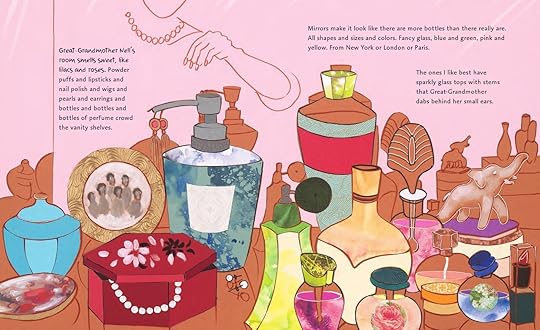
5. That vanity image is no joke. BIG MAMA HAD SO MANY PERFUMES. SO MANY.
Anyway, I have a more well-rounded view of her life (as an adult) especially how her past shaped her (just like this story). I love that Vaunda Micheaux Nelson presents this authentic child-like view that I could identify and relate to.
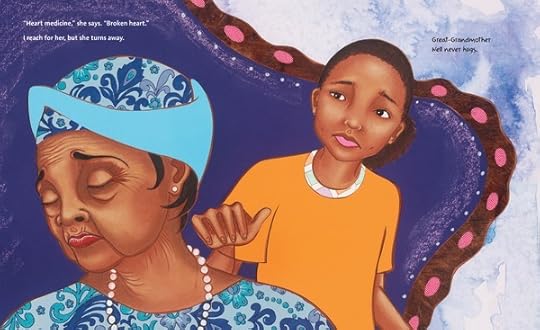
Don't Call Me Grandma is such an unusual, surprisingly deep, and touching picturebook about "scary" great-grandmother Nell, an eccentric, glamorous, and tough old lady who "fries fish and boils grits for breakfast," wears pearls, lipstick, and perfume, daily sips her "heart medicine," and never hugs nor kisses her great-granddaughter.
The strength of Vaunda Micheaux Nelson's succinct text lies in its ability to hint at the certain details without actually spelling them out. And although personally not my favorite, Elizabeth Zunon's colorful illustrations work very well in capturing the great-grandmother Nell's personality and suggesting what might have broken this proud and independent woman's heart.
Overall, I like this book and I think it fills a large gap in children's literature. However, I'm not sure how I feel about the end of the book. I understand the context, but feel it could give kids a mixed message about the important concept of consent.
I can totally relate to a relationship with a prickly person. There are people in the world who are a little more rigid and particular than others. I love that this book shares a look at a grandparent relationship that is loving, but isn't mushy, sweet and cuddly because there are so many types of relationships in the world.
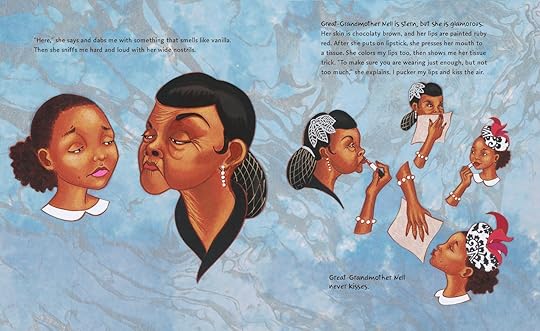
Finally, a picture book about a hard-case glamorous grandmother who doesn't want you touching her stuff (but who will teach you how to apply lipstick and let you sip out of her glass of brown 'heart medicine'). I love the complex relationship between adult and child here.
What a wonderful, insightful homage to an extraordinary great- grandma. She eats fish for breakfast, doesn't shy away from posing in a bathing suit on the beach, and sips on "something that looks like apple juice" all day to treat a "broken heart". She doesn't hug or kiss but keeps her bedroom so nice that "a princess could sleep there". Elizabeth Zunon is the illustrator and grew up in West Africa. She "draws, paints, silk screen, sews, daydreams, and makes beaded Jewelry...Elizabeth drew upon her own collection of fanciful vanity accessories and her love of unique fashions to create Nell's world." In the present, the illustrations are bold with clear lines, but when the story reflects Great- Grandma's past, the pictures blur and smear, and are less clear. Like a true memory. I could not possibly recommend this books enough. My niece wasn't into it, because she's a bit young and prefers funny, immature humor, but I think it would be great for older readers.
To quote one of the greatest CL's: "I'm not crying, you're crying!" I dismissed this book a few times based on the title. How rude! Very charming. Smitten kitten. Etc etc etc
Wow, that one was quite a surprise. I did not know what to expect at all, but the relationship between this little girl and her great grandmother was fantastically portrayed and the little hints of great grandmother we get, then her whole life through history as a double-paged spread. Soooo much more here than meets the eye. I think I will need to revisit this one many times. I LOVE when we see family relationships that go beyond what we ordinarily see in books but we see in life all the time.
We take a look at a little girl's eccentric grandma through her innocent eyes. The story seems like a nostalgic dream or memory of the someone's granny. And this book seems like an honor her memory. There isn't a moral or lesson to this story, it's just pure, frivolous, childhood memories.
Great Grandmother Nell does not have the traditional grandmother's breakfast of porridge or scrambled eggs. No, Grandmother Nell fries fish and boils grits for her breakfast. She is 96 years old, feisty and doesn't like to hug or kiss and certainly does NOT want to be called grandma. Her great-granddaughter thinks she is scary at times and at other times doesn't know what to make of her.
Grandmother dons her bathing suit and while at the beach she poses like a movie star. She has a little nip of something that looks like apple juice every day but it tastes like swill...how could she possibility drink that stuff? Yew!!! She says she drinks it daily because it's her heart medicine, you see her heart inside is broken.
Her bedroom is like a princesses. A beautiful ballerina doll sits in the middle of her bed and her vanity is covered with perfumes, nail polish, jewellery, lipsticks and wigs. Her great-granddaughter can only look with her eyes when permitted inside and never ever touch anything.
Great Grandmother Nell loves to sit and reminisce about days gone by: how long ago 14 cents got you into a double feature movie, a Hershey bar cost 5 cents and how she won first prize at the church picnic with her fabulous sour cherry pie. Some sad memories too she shares, for example how her very best friend said they couldn't be friends anymore because of her brown skin.
Although great grand-daughter finds Great Grandmother Nell aloof and unemotional she loves to sneak into her room when she is sound asleep, and snoring like a dragon, and give her a quick hug and kiss her on the cheek.
A perfect book to teach about family and the honoured position an elder family member should have in it. It's about respect and friendship too. I love the book and highly recommend it. The illustrations are truly magnificent.
The title caught my eye and so, as a Grandma myself, I had to bring it home. I ended up adoring it so much that I read it a few times. I am not much like the glamorous Great-Grandmother Nell. My grannies were round and soft and huggable. What they did do that Great-Grandmother Nell does, is tell stories about other times and love their grandchildren. Even though Nell isn't a huggable Grandma, what comes across in this book is how much love the narrator and her share. The gorgeous illustrations enhance the text. I have a few favourite pages. The first is the one of Nell with her "short, stubby glass with a picture of a spider on one side" filled with something that looks like apple juice. Great-Grandmother Nell calls it "heart medicine" for a broken heart. On another page "She remembers the time her best friend said they couldn't be friends anymore because of her brown skin." When the girl asks, "Is that when your heart got broken, Grandmother?" "She looks out the window and whispers, "The first time."
It's the two page spread with a collage of historical photographs, headlines, and watercolour images that gives us an understanding of who Great-Grandmother Nell is and what she has endured. This is the page that had me aching for my mother's mom, my Granny Alaric, who told stories of seeing Annie Oakley, Buffalo Bill's Wild West show, among many others of time long gone.
I put this book on hold because a fellow librarian expressed concern about it. At the very first page, I knew I was not personally going to like this book, so I would need to consider it from a librarian perspective to appreciate it. For the right kid, this is the right book. If you have a harsher grandparent, this may be exactly the story you need to hear to know that you're not alone and that you indeed can still love your grandparent without doting love and affection.
I am, however, rather shocked that there isn't more concern about the drinking. Particularly how it's swept under the rug with "this is how you help mend a broken heart." While that may be how the grandmother feels, what an awful thing for a kid to hear and, heaven forbid, retain. I may be being sensitive because I come from a rather safe, rule-following, loving family, but I hope this book is more than just read between parent and child but actually sparks a conversation.
I love this book. It allows readers what it is like to have lived a lifetime, and how much has happened and changed for black people. Everything that has happened this grandmother has seen, and remembers. It is clear in the way she acts, and how her great-granddaughter sees her. The different art also speaks for itself. The mixed media for present day and the water color for the past. There is just a whole page of news articles about black history too, to really send the point home. I would recommend this for older children, ones who have started to learn about black history, otherwise they will not really get the meaning behind this book. This could even be read to middle school children before they start a lesson on the civil rights movement.
I read this book because it was a CCBC book discussion book for August 2016.
This story details the life of a girl's grandmother with lots of interesting illustrations. The main thing that bothers me is when grandma pours something resembling whisky from a flat bottle and says it's "heart medicine" - "broken heart" and she allows her granddaughter to have a sip. She also never hugs the granddaughter. It feels kind of cold. The granddaughter obviously is trying to get to know her elder. The granddaughter kisses her grandma at the end and it says on the last page, "She won't know." So it leaves a reader wondering does this relationship work at all? The coldness/feeling of detachment really leaves the reader feeling bad at the end. I would not feel comfortable reading this aloud. It is a realistic story but I don't think it sends a very positive message to children. Skip it. Not recommended. Approx. reading level is 3rd-4th grade.
This entire review has been hidden because of spoilers.
Vaunda Micheaux Nelson tells a wonderful little story here about a great-grandmother who is surly, tough, and a little bit glamorous. She depicts the relationship between grandmother and grandchild wonderfully, with the young girl in the story admiring and loving her great-grandmother despite being a little bit afraid of her. She also takes a look at Great-Grandmother Nell's history and the things that shaped who she became.
Elizabeth Zunon's illustrations are beautiful. I have never read any other picture books with her illustrations before, but this definitely has my attention. The watercolour flashback scenes are delightful in the best way.
Don't Call Me Grandma is funny, charming, complicated, and touching. I definitely recommend it to anyone looking for a good picture book. I look forward to seeing more from both the author and the illustrator.
Don't Call Me Grandma tells the story of a loving granddaughter and her stern great-grandmother. Nell is not the typical, overly-sweet grandmother. She will not be called "grandma," eats fried fish and grits for breakfast, and is always found wearing pearls. Her granddaughter is determined to find out more about her and when she does she finally understands more about her past experiences.
I enjoyed this book! Though it is short, it is an easy read that many will find relatable in some capacity. For me, it reminded me of my own grandmother and I think it sends an important message to young children. Vaunda Micheaux Nelson did a wonderful job writing this story, and Elizabeth Zunon did a spectacular job with the illustrations.
I'm conflicted about this book. It's about a girl and her relationship with her great-grandmother who HATES being called Grandma. The girl views her great-grandmother as scary, glamorous and prickly, but still loves her very much. Her great-grandmother demands respect but doesn't show affection in the way she's used to. Instead of hugs and kisses, she gets taught how to put on lipstick and is allowed to look at (without touching anything) great-grandmother's bedroom.
I wouldn't use it for storytimes, but that doesn't mean I wouldn't recommend it to someone who's in a relationship where they don't fully understand the other.
Sweet story about a grandmother, even though it was different from what the title led me to expect. Grandma Nell is formal and wants her great-granddaughter to call her "grandmother." It's told by her great granddaughter who is trying to understand her great grandmother who isn't your typical warm and sweet grandmother, but who is independent and a bit thorny. Through this perspective, we meet Grandma Nell, who has lived through so much. The artwork reflects the memories of her life, even though they are a bit hazy. I'm amazed at how vividly Nell came to life and at the layers within. This book is wise and I loved the conclusion that is made, "She's old, but she's not worn out."
Great-Grandmother is not your typical picture book "grandma." She doesn't chase you, or let you kiss her. She wears heavy makeup and drinks throughout the day, medicine for a broken heart. She's tough, she's survived so many historic moments, and she's eager to share those experiences.
I was enamored with Nelson's book and may have cried just a bit (don't worry, grandma doesn't die). The book's narrator, the granddaughter, clearly loves her grandmother and everything that she does, even though it's a bit outside the box. I think anyone who had that sort of "character" of a grandma (I was lucky enough to have two) will enjoy and have a few flashbacks.
This is a story about a little girl and her eccentric grandmother who doesn't like the name "grandma" and prefers grandmother. It is written in prose and a story mostly appreciated by little girls. Grandma is kind of prickly and scary. I think the read alouds to a group of children would lead to some comparisons about grandmothers and older family members who might live with their families. The book represents a black family and storyline. More of a non-fiction read with some historical artifacts on pages about black history. I would recommend the book during black history month and the holiday in January.
The illustrations are beautiful, but the story is more of a conversation-starter than an entertainment. A little girl and her great-grandmother interact in very believable ways, but that interaction is informative rather than fun for the reader or a child being read to. The great-grandmother is very formal, in a way that modern children may not understand, and has lived experiences that are also difficult, but not explained at all until near the end of the book. So, this book will have uses, but the great-grandmother is just SO stiff that she remains difficult to like.
An interesting story about the relationship of a young girl and her great-grandmother. But this great-grandmother is portrayed as cold-hearted, and as the author puts it "prickly." This great-grandmother has experienced a lot through her life, which somewhat explains her demeanor. The two-page spread of illustrated photographs and keepsakes show a powerful and poignant time of Great-Grandmother's life- her love for theater and dance, segregation, protest for freedom and equality, etc. Love that this book displays the grand-daughter's understanding, acceptance, and unconditional love.
This is not a typical "good feeling" grandma book. In fact, great grandma is quite prickly. It is a multi layered book, that is best experienced if the child reads it with a parent. Very sparse text, but lots of meaning hidden in those words and illustrations. Adults will be thinking a lot more about the meaning of this story than children will. Children will see it as a story about a child who loves her great grandma in spite of the prickly character, but adults will be thinking about this woman 's life, civil rights, and how life experiences shape each one of us.