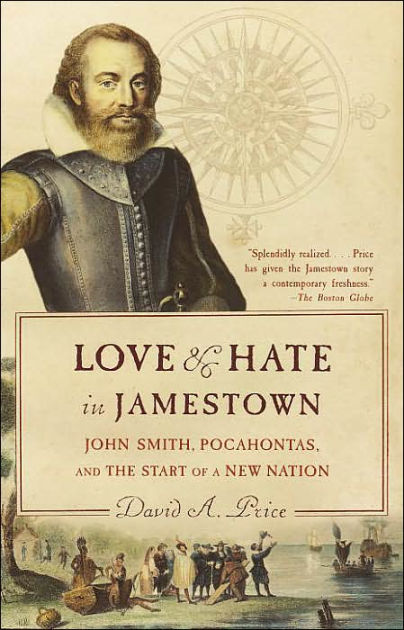
A gripping narrative of one of the great survival stories of American history: the opening of the first permanent English settlement in the New World. Drawing on period letters and chronicles, and on the papers of the Virginia Company–which financed the settlement of Jamestown–David Price tells a tale of cowardice and courage, stupidity and brilliance, tragedy and costly triumph. He takes us into the day-to-day existence of the English men and women whose charge was to find gold and a route to the Orient, and who found, instead, hardship and wretched misery. Death, in fact, became the settlers’ most faithful companion, and their infighting was ceaseless.
Price offers a rare balanced view of the relationship between the settlers and the natives. He unravels the crucial role of Pocahontas, a young woman whose reality has been obscured by centuries of legend and misinformation (and, more recently, animation). He paints indelible portraits of Chief Powhatan, the aged monarch who came close to ending the colony’s existence, and Captain John Smith, the former mercenary and slave, whose disdain for class distinctions infuriated many around him–even as his resourcefulness made him essential to the colony’s success.
Love and Hate in Jamestown is a superb work of popular history, reminding us of the horrors and heroism that marked the dawning of our nation.
This was just wonderful. Page-turning. Pretty please, can historians always write like this? I particularly admired how seriously Price took what the people at the time thought and felt and wrote down - he is no chronist.
This book connected so many threads of history for me that I had in separate compartments in my brain. And I have a new hero: John Smith. The son of an English peasant who took it upon himself to educate himself in warfare, cryptology, linguistics, navigation, diplomacy, and showed a surprising (to me) depth of practical theology. He was really an ideal "Reformation Man" (much better than the Renaissance Man, IMHO).
I read this to understand Pocahontas/Rebecca Rolfe and her cultural context more deeply. So many surprises and revelations in this book, but Pocahontas remains a bit of a cipher. It's amazing how often she took the fate of herself and others into her own hands (and that's just the times we know). Whenever her words are recorded, they are both decisive and surprisingly passionate.
I would recommend this for bright kids over 15 and I plan on putting it on our curriculum.
I give it high marks for its detailed research and for painting a clear picture of the disaster of the early colonization attempts of England in Powhatan territory. ‘Love & Hate in Jamestown’ is the title, but it was much more about ‘Hate’ than ‘Love’. This was a good read… BUT… it could have been a great one.
The book is missing just one key element. And that is a proper analysis or handling of the native american perspective in the story. It just isn’t here. John Smith and many of the English are treated as the heroes. And while that’s understandable given the “Start of a New Nation” is referring to English America… but from a native perspective, the English are the clear villains of the story. This is obvious when you take into account the sad fact that after about 80 years of the founding of Jamestown, almost all Virginia native peoples were dead or their tribes disbanded, with only about 600 survivors out of a population of at least least 35,000 pre-Jamestown.
A key example of this kind of authorial blinders, is when the author refers to Sir Thomas Gates as “tenderhearted”, yet only a few paragraphs later goes on to tell how he lures out Kecoughtan villagers with a display of music and a jester, and then proceeds to massacre them…in retaliation for the death of one englishman, supposedly by a native from that region.
The author continually takes Smith and Gates at their word (from their extensive journal entries). Couldn’t they be embellishing events for glory, or simply lying/omitting events to preserve a clean written legacy of their exploits? David Price does sometimes question the reliability of sources…but always those sources coming from the villains perspective in the story (Wingfield, Ratcliffe, etc).
I find this type of bias (almost complete lack of native american viewpoints) common, especially in earlier histories and biographies (see Samuel Eliot Morison’s book Samuel de Champlain…where the titular hero could do no wrong). Price will wax poetic about the good intentions of the English upon their arrival in Powhatan territory. But these “good intentions” are simply because the English didn’t want to outright enslave and kill off the natives (yet) as the Spanish had done in South America … all they wanted was mass land theft and ethnocide (convert the ‘savages’ to “Protestant Christianity and English culture”).
From the author’s perspective, John Smith is a hero…keeping the colony, and by extension the nascent seed of America alive, when all other settlers wanted to abandon Jamestown and return to England. I could see how Smith is a hero for any proud white American. But for natives, not so. Indeed, maybe he was the villain of the story from an objective point of view, and the natives of Virginia would have been better off had Pocahontas not saved John Smith (if she really did save him…more on that later).
Another example of this lack of native american perspective, is when Price takes Thomas Dale, the new Jamestown leader, at his word, when he writes in his journals that after they kidnapped Pocahontas to use her as leverage against her father Chief Powhatan, and kept her captive for a month, Pocahontas then decided to stay with her captors “wherefore she would still dwell with the Englishmen, who loved her”. It’s unbelievable how Price believes that story! Price goes on to describe that she fell in love with another Englishman, John Rolfe, which is why she wanted to stay. But all we have as proof are the letters from her actual captors. So what John Rolfe wrote that he was smitten by her? It was clear she was used as a pawn to end the war. Couldn’t that have been the only motive? Especially since John Rolfe wrote in another one of his letters that he didn’t find Pocahontas attractive, and then she mysteriously died a few years later (after peace had been achieved), and that Rolfe eventually abandoned Pocahontas’ sick son, and that Rolfe went off to re-marry an Englishwoman soon after.
I’m not saying we can know the truth one way or another. But I would have at least liked the author to have a discussion about these possibilities. To Price’s credit, at the end of the book he does include a Marginalia section where he discusses some open questions…but the discussion doesn’t go in depth and the rebuttals aren’t satisfactory.
In Charles Mann’s book 1493 (published in 2011), on pg 52, he notes that most historians dispute John Smith’s boastful writings. In the recent documentary ‘Pocahontas: Beyond the Myth’ (currently on Apple TV), it mentions how John Smith does not mention anything about Pocahontas saving his life in his report back to London a month after he is released from Powhatan captivity. He said they treated him well. It was only years after all the key players (including Pocahontas) were dead and no one could contradict him, that John Smith published the account of the young girl saving his life just as he was about to be executed.
The documentary goes on to interview experts who argue that being the princess of the most powerful Chief in the area, and being only 11 years old, she would not even have been present at the ceremonial execution that was supposedly taking place. They go on to say that “Smith has a history of fictionalizing his adventures”.
Couldn’t the question be asked; what could be gained by the story of Pocahontas rescuing Smith and seemingly betraying her own people, for no reason, other than to help the white colonists? The answer is good press / propaganda! David Price even notes early in the book how the colonists were instructed to write about their experience, but to exclude any negative stories. They intended to promote the settling of North America with their writings about fertile lands and friendly natives. John Smith even devoted the rest of his life to promoting colonization in North America (via his writings). Doesn’t it seem obvious that the ‘Pocahontas saving John Smith’ story is just that…a romanticized story that would capture the imaginations of people all over Europe about adventures in the “New World” (and it has, given the story’s longevity).
David Price dismisses those arguments and argues that Pocahontas really did save John Smith…that she was just “a girl acting compassionately toward the pitiable stranger in front of her”.
So why then, do I give this book three stars? I suppose because the book delivered what I needed out of it… which was to tell me the general ‘Pocahontas’ story, however biased it came off. As long as you keep in mind that you’re not really getting the full story, you do at least find out what the early settlers were up to in Jamestown. The book is packed with details and does give a good overview of all the natives tribes of Virginia and their internal politics (Iroquois tribes inland vs. the Algonkian tribes of the coast). Mutiny, double agents, treason, massacres and even cannibalism all occurred in those early years in present-day Virginia. At the very least, this is one hell of a survival story!
This book is about Jamestown, from its humble (and rough) beginnings, to its ultimate status as the first permanent English colony in America. It’s told through the lens of our main chronicler Captain John Smith, and those who deeply impacted him there like the native princess Pocahontas.
I don’t say this lightly, but I loved this book and found myself constantly wanting to pick it back up. I could go on and on with my thoughts and reactions to specific stories or give you a timeline of all the fascinating happenings throughout the colony’s history. But let it suffice for me to just tell you the main things I liked about it:
~ I loved how concise all the information is. This is not an encyclopedia on every possible thing that ever happened at or near Jamestown. This book excels at telling you what you need to know in a concise way and does it with great storytelling.
~ You can tell this book is very well researched and that the author must have spent multiple years going over all the related books, letters, maps, and all documentation and evidence left behind about what happened there. I totally trusted all of the information given including, for example, the author’s defense of John Smith’s account of when Pocahontas saved him the first time, right before he was to be executed (some have questioned the account in years past).
~ I liked that it seemed the author stayed away from speculation as much as possible. When he did speculate, he used phrases like “One imagines…” instead of “He must have…” which I appreciated.
~ Learning about John Smith’s challenges and exploits was fascinating, as well as all the insights into the Native Americans living in the area at the time and the conflicts between them. But I’d say, my favorite part of this book was in all the little details about the real Pocahontas and who she really was as a person. Such a distinct personality for her emerges and there are these little stories that illuminate parts of her life that I hadn’t heard elsewhere. It was great to get clarification as well that her relationship with Smith was entirely platonic, although he held her in the highest esteem. Their reunion in London seemed strained, and complicated, but her calling him “Father” during that last meeting I think illuminates that further. Again, there’s so many more things I could say about this.
This book made me think that there needs to be a really well done live action movie on this whole story. Although I already visited Jamestown in person just last year, I’ve now also been fantasizing about renting a kayak and starting at Jamestown and going on a journey up the James River, following in their footsteps and just being in the midst of that beautiful scenery but also this important history and imagining what once was.
If you’re interested in this kind of thing, I’d highly recommend it!
This novel first came to my attention years ago, but it remained firmly on my TBR shelf until I started reading up on Pocahontas online a few weeks back and kept seeing it referenced. After putting in a few late nights to finish the audiobook, I can see why. This is an incredibly well-written, detailed history of America’s earliest days and the people who struggled to keep it afloat. The colonial era is one that many writers shy away from, not wanting to wade into the history of how the colonists treated Native Americans or, if they do, how the natives treated them in turn. David A. Price is willing to do both, fully regaling the many gory details of war and conquest in the New World (and the Old World, and at sea). But much like war histories, Love and Hate in Jamestown reveals the duality of these stories that we, in a seemingly more enlightened age, don’t want to admit is true: that they are as enthralling as they are terrifying. Half of the book reads like an adventure novel, with John Smith—not the dreamboat of Disney cartoons, but a short, pugnacious, disaster-prone self-made man—acting as the main character, always narrowly escaping death while encountering a host of colorful and unpredictable characters.
So why did I waver between giving this three and four stars then? If you’ve read the other reviews, you’ll already know the main complaints. As engaging as the first two-thirds of the book are, once Pocahontas leaves for London, the story nose-dives, becoming less of a narrative and more of a summary of what happened next. This is particularly noticeable between the years after her untimely death in 1617 and the Indian Massacre of 1622. Neither she nor John Smith are in Jamestown by that point, but the colony is booming in size. Yet Price does little to familiarize his readers with the newcomers, so when the massacre arrives—taking up only half of a chapter—it reads more like an encyclopedia entry than a narrative history. Price is largely uninterested in the natives outside of Pocahontas and her father, Chief Powhatan (a formidable leader and standout figure), and he seems to resent all the colonists who aren’t John Smith, aside from the preacher who converts Pocahontas to Christianity, and her husband, John Rolfe (and even then only until he and Smith end up in the same room together and we need to be reminded who the real alpha dog is).
As other reviews have noted, Price has a massive man-crush on Smith, and it’s understandable, to a certain point. The man had a truly fascinating life, and he was an early example of the American ideals of self-determination and personal ambition. Having been born to a farming family, he had to overcome England’s repressive class system, as well as the other limitations placed on him because of financial straits. Price is perhaps a bit too enamored with the man, however, given his persistent characterization as the only person in Jamestown with a brain, and Price’s willingness to accept his record of events. There’s no denying that Smith formed a meaningful bond with young Pocahontas, but his story of her dramatically saving him from execution has come under suspicion in the centuries since. Price provides an argument for why he believes Smith’s telling, but he ignores Smith’s ongoing pattern of stretching the truth (albeit usually as a means of survival) that we see time and again throughout the book. Price is insistent that there was never anything romantic between them—a fact that virtually all historians agree with—yet he later claims that young Pocahontas warned Smith of an impending ambush because she had fallen for the much older man (Smith, by contrast, is depicted as somewhat asexual).
Because of how long ago this was (and because of the lack of written correspondence on Pocahontas’ part), historians must often make their own interpretation of what happened. Price does this as well, although there were a few moments where I would have liked to see more introspection. When Pocahontas and Smith meet again in London after the false reports of his death, Pocahontas is noticeably frosty to her old friend, saying he’s a liar like all the English. This is noteworthy, given how Price described the earlier years that she lived among the colonists with Rolfe as very happy, and soon after claims that she would have preferred to stay in England rather than return to Virginia. Did she like living with her nuclear family, but distrusted her neighbors? If so, why would she want to stay in England? Or was this just another of John Smith’s tall tales?
We see more of this with Pocahontas' marriage to John Rolfe, of which we learn disappointingly little. Their union helped establish peace between the colonists and the natives, and perhaps it is because of that tranquility that almost nothing of note is mentioned about those years. Rolfe is a somewhat elusive figure, a rare example of a historical man who's less well-known than his wife. This may have changed slightly in the twenty years since this book was published. For instance, Price claims that Rolfe did not meet King James alongside his wife because of James' opposition to the tobacco industry, but many historians now say that the British aristocracy was scandalized by an Indian princess marrying a "commoner" like Rolfe. Price doesn't seem quite certain whether Rolfe was closer to a gentleman or a laborer, the two main factions within early Jamestown, but this would seem to indicate the latter.
Moreover, Price does a bit of a 180 on Rolfe; for most of the book, he's characterized as a kind, hard-working, and devoted husband whose life had been marred by tragedy. Then in the last quarter of the book, Price instead paints him as callous and cowardly. Rolfe's decision to leave his son in England and return alone to Virginia is a hard one for a modern reader to understand. Most historians don't appear to view this as particularly irrational, however, and none of the Powhatans seemed to take issue with it at the time either, despite the boy being Pocahontas' only child. With that in mind, I expected Price to present a rationale for this decision, as he did time and again for Smith whenever he would do something foolhardy. Instead, he claims that Rolfe simply cared more about making money back in Virginia than he did for his son. Is that really all it was? Perhaps. But it doesn't mesh with the way he was characterized up until then, and once again I felt like Price should have dug a little deeper to better understand his subjects.
On the flip side, there were some truly fascinating bits of information included that I had never read before. Price discusses the arrival of the first black captives in American in 1619, but then puts forth the theory that they were technically indentured servants, with chattel slavery as we understand it now not being introduced until the 1640s. The English considered Native Americans "savage" because they weren't Christian, not because of their race or lifestyle; they actually thought that their darker skin tone was the result of body paint. After the 1622 massacre, the colonists got their revenge by tricking several prominent Powhatans into drinking poison. Powhatan chiefs were polygamous, and only stayed married to a woman until she bore him a child. Afterwards, the marriage was dissolved and the mother was only allowed to stay with the child until it reached a certain age, before being cast out of the tribe completely. Price speculates that this is what really happened to Pocahontas' mother, rather than her dying in childbirth, as is traditionally believed. He even entertains the theory that Pocahontas was married to a fellow Powhatan in her early-teens, whom he believes may have divorced her, rather than having died in battle.
Given that I was listening to the audiobook, I was unable to look at Price's sources, but it was small details like these that made (most of) Love and Hate in Jamestown so enjoyable to read. It also left me wanting to know so much more. How did the next generation of Virginians fare, now that they were recruiting farmers and laborers in place of the gentry? If one marriage between a native woman and an English man led to years of peace, why weren't there more of them? What became of the young boys who served as translators between the English and Powhatans? We know that European diseases proved lethal to the Native American population, so why did we see the opposite here, with the colonists frequently succumbing to disease while the Powhatans were largely unharmed? Most of all, how did the Native Americans change the colonists? We know what was taken from the native population, but historians have typically paid less attention to the influence they had on their new neighbors, beyond agriculture. Just in this book alone, we see how Christians and polytheists were required to learn to live side-by-side rather than resort to a religious war. It's so hard to get a firm reading on events from more than 400 years ago, but luckily, new research is always underway. I'll keep reading, and I look forward to seeing what else is uncovered in the years to come. (Note: I have since found the answers to some of these questions in books by Camilla Townsend, Helen C. Rountree, and Karen Kupperman.)
This book fascinated me. I'd never really taken any interest in the story of Pocahontas or John Smith or the Jamestown colony. Price sets the stage of how the colonizing process started (business investments), and how John Smith came to play such a crucial role in it. It's a shame that Americans don't revere Smith more for what he did in laying down roots in the new country. What I really liked is that Price had plenty of facts and figures, but he took great pains to make his writing un-academic. Clearly, he was interested in these people and who they were, not just as characters in a big picture drama.
This is a very well-written piece of non-fiction that I really couldn't put down. There are so many interesting details that I hadn't been exposed to before (as a history major), I couldn't get enough! Simply fascinating--read it!
It's just a straight up history of Jamestown, ignore the 'Love and Hate' part of the title. The story of John Smith is a million times more interesting than the half-assed lies and oversimplifications you get from pop culture.
Fun book on the discovery and initial years of the Jamestown colony.
I loved the not-so-subtle shade thrown towards Wingfield and Ratcliffe, and the facepalm-inducing mistakes that the colonists not named John Smith committed.
I also like how the book humanizes Pocahontas. No, contrary to the Disney movie, she and Smith never dated. Her story remains fascinating nonetheless, especially her oft untold years in London, where she was resoundingly unimpressed at English society.
I will definitely check out Price's other work, and recommend this as a good introduction to colonial American history.
I have read a half-dozen previous books on the subject of John Smith and the Jamestown settlement, and four times that many about colonial Virginia generally, but this small volume describes more details of the story than all the rest put together. The compelling narrative is supported by a most impressive list of references to seemingly every original writing from the men who were there. Writings by John Smith and about John Smith by his peers, as well as original manuscripts from most (all?) of the colony's early leaders, their scribes, and their sponsors in England support the author's personal conjecture and conclusions. This book may be the best we will ever have about what really happened in the first permanent settlement on the shores of the James River by people who would begin the experiment of creating a new kind of nation over the subsequent 200 years. I also appreciate the summary of Captain Smith's life after his departure from Virginia. He belongs in the pantheon of American heroes, and both he and the Jamestown settlement story deserve much greater emphasis in school history books.
Flaws of this volume, if there are any, might include the title, which seems more sensational than descriptive. There is certainly kindness mixed with cruelty, appreciation of the landscape and manifold efforts to peacefully prosper mixed with arrogance, avarice, laziness, and ignorance. But for the most part there was little time in Jamestown for much love, and hatred seems too strong a term even when fear and real transgressions incited the very human reactions of vengeance. I also personally dislike the author's assertions about what "he" or "she" or "they" "would have" said or done about some described occasion for which there is no apparent written record of "proof." However, I give him A+ credit for research into social practices of the time in England, and maybe another reader would enjoy the digressions. In any case, these are very minor flaws compared to the important story told here by a skilled writer, who clearly sought the truest history possible by spending what must have been a million hours to read the original—and sometimes conflicting—documents. And then he made it all beautifully readable in fewer than 300 pages for the rest of us.
I was looking for information on Samuel Collier, Stephen Hopkins, and the first African Americans. The information on Collier and Hopkins was fine, but it did not give me anything new. The section on the first African Americans was astounding.
* The first Africans brought to the English colonies started out in Angola. They were captured as part of a war against another African group who allied themselves with the Portuguese. The Portuguese slave ship was then captured by an English privateer, who traded the Africans to Jamestown in exchange for food. * The Africans came from the kingdom of Ndonga, which was more urban and had a cooler climate than Jamestown. * The legal status of the first African Americans is unknown. It is possible that they were treated as indentured servants. Some became free landowners. The first records of slavery in Jamestown date from the 1640s. * Price notes that in the censuses (even the ones done before the 1640s), all white residents are listed by first and last name regardless of social status. African American residents are listed by first name at best and often only by ethnicity.
Being a Virginian, the story of Jamestown was essential to my public education as a youth. It’s long been a fascination of mine, as it was the first permanent English settlement in the New World and the foundation stone for what would one day become the United States of America. In a nutshell, we are who we are as Americans because of the Jamestown Colony.
This is a history of the colony and its early days, but what it really is the story of John Smith, who may be the most unappreciated figures in American history. Regardless, he is without a doubt one of the most interesting.
I won’t go into the full details and minutiae of the story, as it is much too winding to recount here, but I will say that the colony certainly owed its survival to John Smith and his sheer force of will. Smith was born a commoner, had fought in wars in Europe, and had been enslaved by the Turks before escaping and somehow finding his way back to England. By the time he was in his mid twenties, he found himself in Virginia and on the council to lead the colony (much to the ire of the good and great who sat on the council with him). Smith turned out to be a practical, diligent, and tenacious leader while the others failed. He knew how to maintain coexistence with the powerful Powhatan tribe and his mantra, “Those who won’t work shall not eat” echoes down the annals of history.
He also owed his life to Powhatan’s daughter Pocahontas, who saved him from being executed by her tribe. How much of history would be different if she hadn’t saved him? Surely, the United States as we know it would be different as the Jamestown colony would have surely failed. Ultimately, Smith was injured in an explosion and forced back to England. He would never return to Virginia again.
Smith would spend the rest of his life writing, and providing posterity with maps and histories of the New World. He was also the first person to coin the term “New England” and wanted to be the leader of the Plymouth Colony. Pocahontas would marry John Rolfe, become a Christian, and die in England.
The colony, after major setbacks like the Starving Time and several massacres, would survive and ultimately flourish thanks to tobacco. Virginia would grow and expand, other colonies would spring up, and well, you know what ultimately happened in 1776, some 160 years after Jamestown was first founded.
A few other notes I found interesting:
-John Smith and Pocahontas were never romantically involved. She was a child when he met her, but they did remain friends and see each other in England when she came to live there.
-The utter ineptitude of most of the colonists is astounding. Most had no skills to survive and were considered “gentlemen” and expected to find riches immediately. The colony was founded on a swamp. Truly, it’s remarkable that it even made it.
-The English did not view the Native Americans as inferior. Rather, they saw them as “white” and “savage” who needed to be converted to Christianity and the English way of life. They did not plan to remove or exterminate them like the Spanish did to the Incas and Aztecs, they initially hoped to peacefully coexist.
-The first African slaves came to Jamestown in 1619. Or did they? They may not have been slaves in the sense of which we know them to be. Hereditary slavery evolved later in Virginia’s colonial history. Even a few Africans owned slaves themselves.
-As I said above, we owe much to John Smith in regards to his role in saving the colony and also towards his mapmaking and writings. Prophetically, John Smith saw the New World as a land of opportunity where merit and hard work could move oneself up the social ladder. I find this remarkable, as these thoughts, well before their time, are foundational principles to the United States.
All said, this is a pretty good book, it’s a bit dull and too detailed at times, but I enjoyed it.
Through rich detail and drama this book tells the story of the English coming to Jamestown, Virginia. I live only a few miles from where they landed and have visited the settlement many times but it was great to read the complete story, with all the characters. The book is extensively researched and has thorough character development of the primary players, including the Native Americans that lived in the area. John Smith and Pocahontas become real people as does the Chief of the Powhatans and his brother. The book also gives insights into the overall characters of the U.S. Americans and why we are the kind of people we are; i.e. in order to make it in the new world, you had to be very hard-working and industrious, but if you were, anyone could do it. The English had a class of "gentlemen" who did not believe in "work" and those people did not fare well in the New World. Leadership played a key role in the success of the new world as well. There are both great leaders and very poor leaders in the book. The lives of the natives are also depicted in a realistic manner; they lived in towns, grew crops and were skeptical of the new arrivals but they were not hostile, at least not initially.
As a child I had a golden book called Pocahontas and learned in simple words of her saving the life of John Smith. It is thought that one of our family lines came in on the 1607 voyage, so of particular interest to me. So wonderfully written, it expanded my understanding of that relationship and Smiths outstanding leadership in the early years of Jamestown. What an amazing man he was, so much common sense and drive. They owed him their survival though he rarely got their respect, because he was a soldier and a common man and not part of the gentry. I loved this book and picked it up eagerly each time, even chuckling a few times at the author’s turn of phrase or wit. A must read for American history buffs!
I appreciate the historical citation that clears up confusion about Jamestown and adds truthful firsthand accounts.
The language that Price uses though reads like a freshman who just found out that a higher vocab is a thing an overuses it. He tries to make things "funny" or maybe relatable, but that doesn't flow with the feel of the book. If it's historical, don't try to spice it up with cute language! It makes for a boring read.
Overall, it feels like a story with a beginning, a middle and an end. It helps speed up the pace. For class, it's a typical historical novel.
This book was relatively well written and has great accessibility to the layman who might be interested in the subject of the English American colony at Jamestown. With its plot staying at Jamestown, and not a persistent veering off into other areas of the globe for overwhelming cross-reference, it makes for a clear and successive read of irresistible history.
The three stars (3.25 would be more representative) are namely in the grain of Price’s lack of detail for some very significant events in Jamestown’s history. An example would be the Sea Venture’s shipwreck and how that affected the notions of the common people being under arbitrary control. In this case, it was castaways on Bermuda being told what to do when they no longer felt they were given safe passage to Jamestown. Here we find some of the early enlightenment ideas of self-determination and a social contract theory through Stephen Hopkins and Henry Paine. The latter of which was executed for his remarks. Another example would be the split of opinion on Smith’s leadership in Jamestown. This book paints a much larger picture of the positive during his terse tenure rather than discusses the persistent disagreements many colonists had under Smith. In all, rather than being a formidable leader and hero, Smith would be better explained as a necessary tyrant and war commander.
A remarkable success of this short history book is its punctuality in forming the clear disparity between the fantasies Disney has presented and historical reality. Pocahontas was a child in early adolescence (9 to 10 years old) at the arrival and first sighting of Smith and not at all intimate with him. She interceded several times in an odd and prescient way, saving her family and the English from being devoured by a cacophonous and unnecessary war. It was Pocahontas that was one of the first great diplomats of modern American history.
The fondest and most pertinent take away herein, at least for myself: one person can wield the wherewithal to either partition or unify differing cultures and peoples.
This entire review has been hidden because of spoilers.
Forget the Disney version! This book will give you the real deal on Pocahontas and Captain John Smith, and there wasn’t anything romantic about it. She really did save his life on at least two occasions, and they did develop a special friendship, but that was all. She was much younger than he. Their importance was as leaders. She was a princess with a sympathetic heart and an attraction to English ways. He was a commoner who rose to power in Jamestown on the merit of his pragmatic leadership, which included shrewd dealings with the natives. The “love” in the title refers to the peace each of them was able to achieve. The “hate” is what happened when they were not around, which, unfortunately, was most of the time. Pocahontas didn’t live long, and Captain Smith was deposed by people of higher birth and a much cruder understanding of the natives.
I read this book as a follow-up to Big Chief Elizabeth, which was mostly about Roanoke, but had a few chapters on Jamestown. This book was all about Jamestown, and had only a few sentences on Roanoke, so I’m glad I already had the background to know that Jamestown was built on Roanoke’s mistakes. (Also, this book asserts that Sir Walter Ralegh was much more dictatorial than Big Chief made him out to be.) As the final chapter of Love and Hate makes clear, Massachusetts Bay Colony was built on Jamestown’s mistakes, and specifically from the extensive writings of Captain Smith of what worked and what failed.
Of the two books, Love and Hate was the more readable, though it was no more novel-like than Big Chief, with the possible exception of the section on Pochahontas’ visit to England. It was also just as grisly; there’s no getting away from that in a discussion of the colonial era. Mostly, the author admires Captain Smith, and by the end of the last chapter, you will too. History doesn’t always make for easy reading, but some books are worth the effort. This is one of them.
Apart from being the first Native American to be converted to Christianity in English America, Pocahontas, this book seems to imply, was also a proto-feminist and celebrity. As a young girl, and the Powhatan Chief's favourite daughter, she saved John Smith's life by interceding with her father when he was captured during one of his many expeditions to trade for the founding colony Jamestown. Unlike other women from her tribe, she chose her destiny and went, sometimes, against her own people if it meant keeping her conscience clear. This meant putting her own life at risk by saving Smith's life a second time (this book implies she had a fascination with him, perhaps because he epitomised the type of self-made man Powhatan women were raised to find attractive) as well as warning Jamestown of a planned attack. She eventually embraced the English way, marrying a colonist then traveling to the Old World to be paraded in fashionable salons like a distinguished princess.
This award-winning book is a great introduction to the roots of America's birth and the reasons why the initial peace between colonisers and natives couldn't last. It shows how the American ideal of a man creating his own destiny with disregard to elites was cemented before the founding fathers, but also how miscommunication and greed has poisoned this spirit/myth from the start and laid down the foundations for most of the country's current problems. I found the echoes with today's War on Terror particularly interesting: when Jamestown and the surrounding plantations were massacred by the Natives, the shock in Britain and the retaliation afterwards was very much like 9/11. It's a terrible irony that the first major act of terror in America was perpetrated by the Natives against people they (rightly) perceived as invaders of their lands.
(3.5 stars) (Audiobook) This work looks at the founding of the first successful, sustained English Colony in America. In particular, the work focuses on the life of John Smith, whose leadership did much to ensure that England would gain a foothold in the “New” World and set the stage of the evolution of the American nation of today. While the title mentions Pocahontas, she played more of a supporting role to John Smith and the evolution of the Jamestown Colony. In some respects, it is remarkable that the colony survived the way that it did. The author is laudatory of Smith, but he was not the sole source of power. Many of the other Englishmen with him did much to try, deliberately or otherwise, to sabotage the success of the colony. It is telling that if the one supply convoy from England that got waylaid in Bermuda had not arrived when it did, and if another supply transport did not arrive when it did, perhaps the entire history of the New World could have a different narrative.
Yet, it is enlightening to see how Price uses documented history to try to bring to life the first critical years of the Jamestown colony. For its impact in American history, there is much that most do not know. This work brings that to life. Perhaps some would interpret in a pro-English fashion, but there is much to explain the Native American perspective on the colony. Also, for a work that predates the 1619 controversy, it does not hide from the first shipment of slaves to the colony.
Overall, there is much to learn from this account. Overall, you just marvel at how the English managed to establish a foothold in North America in spite of themselves. Smith may not be the hero of many narratives now, but he is the hero of this one. Justified or not, that is up to you, the reader. The rating is the same for audiobook as hard-copy/e-copy.
Love and Hate in Jamestown starts out strong. It makes the events of Jamestown a story filled with hopes and rivalries, as per the name. As for the writing, it makes me think the author made an attempt to synergize with the writing style of the 17th century, which I can appreciate. But halfway through, it's as though the author gives up on creating a coherent, captivating narrative, and instead, his focus is 'just getting everything that happened out.' New characters are introduced every other page, few of which have important roles, most are phased out and forgotten after a few more pages, and there's little effort made to differentiate between them. It creates a caution of forgetting everything that happened if you decide to take a break between pages. It starts to emphasize things that seem unimportant. It makes jumps between years which makes it impossible to know where you are in the story. Occasionally, it'll mention things that happen years later and effectively spoil parts of the story. If I had to give Love and Hate in Jamestown marks out of ten, this book, imho, is a 6.5/10
Picked this up because I liked The Pixar Touch, and this one is just as good. Price tells the early years of the Jamestown colony with vigor and a sly sense of humor.
The surprise of the book is John Smith, who is a total action hero. He escapes Turkish slavery by beating the slave master to death with a threshing bat, turns an Indian ambush into an opportunity to negotiate at gunpoint, wins the compassion (if not the heart) of the princess, and keeps the colony alive with a mixture of hard-nosed practicality and skillful bluffing.
Most of the rest of the colony were not on Smith's level -- a shockingly high percentage of them were useless gentleman searching for gold -- which is a major reason why people died and died and died. Survivor derives a lot of comedy value from the inability of the average American to survive in anything close to a real wilderness; what's frightening is how our supposedly hardy forefathers were just as poorly prepared.
The story of Jamestown from its founding until its charter was revoked in 1624 is, at its heart, an adventure story. A small group of ill-prepared men sailed from England seeking gold and silver and looking for a new trade route to the Orient. Instead, they found a hostile environment, unwelcoming inhabitants, disease, and hunger. Not properly prepared to deal with the these circumstances, they resorted to infighting and disorganization until Captain John Smith stepped in and took control. Price focuses on the human story of the colony, especially the interactions between differing cultures--English, Native American, and African--and presents the stories of hundreds of major and minor individuals involved. The author's extensive research is evident in the more than 200 hundred endnotes and extensive bibliography. Narrative history at its best.
A readable and interesting look at Jamestown from the perspective of key, but also overlooked players. The story of the settlement, just up the river, has been glossed over and sanitized, although good history continues to come out of the place, as happened just this week. I hadn't known how vilified John Smith was, or how useless some of the original gentlemen settlers were. The careful study of relations between the settlers and natives is the best I've seen. Folks who live in this area have a long familiarity with many of the surnames mentioned. But, who knew that Anne Burras was (briefly) the colony's only single woman! This merits a short road trip, to revisit the place.
How could I not like a book written by another Price?!!! This book held a double whammy for me since my earliest American ancestor arrived in Jamestown in1610 and endured all the travails of this book. This time told with more personal interaction and cunning than the usual history book. Truly, America was not "meant to be" as the book posits. It simply survived to reap the fantastic bounty of the land. In addition, both native and landed peoples knew how to deceive and slaughter given enough provocation. A great taste of pre-Mayflower history.
While this book expands greatly upon and is much more detailed in its account of the settlement of Jamestown, as well as a bit about settlements further north by the English, I found it to be rather pedantic and not too interesting to read. It centers upon John Smith and provides a more complete portrait of Smith as a man. That was interesting, as was the interaction of Pocahontas with the colonists. I found myself skimming a great deal during the last quarter of the book. Lots of historical detail, not much of a narrative.
I tend to fall asleep when attempting to read history books, but Price's account of early American history was written like no other history book I've read. He is able to bring the stories to life, while remaining factually correct and citing his sources. I would recommend this book to anyone curious about Jamestown as well as anyone who just enjoys a good story.
The first half of this book is riveting and contains a lot to recommend it. The book is worth reading because of this. However once Smith is sent away (around halfway) the book tends towards dullness and goes on some questionable tangents. Overall a middling account of a very interesting period in time.
I can't stop talking about this book. It's rare for me to read non-fiction, but I thought this treatment of John Smith and Pocahontas was utterly fascinating. It's a bit academic-ese-ish in parts (but I like that), but it completely changed how I think about American history. Highly recommended.