

What do you think?

The Dissociative Identity Disorder Sourcebook
Finally, a book that addresses your concerns about DID
From Eve to Sybil to Truddi Chase, the media have long chronicled the lives of people with dissociative identity disorder (DID), formerly known as multiple personality disorder. The Dissociative Identity Disorder Sourcebook serves as a much-needed bridge for communication between the dissociative individual and therapists, family, and friends who also have to learn to deal with the effects of this truly astonishing disorder.
From Eve to Sybil to Truddi Chase, the media have long chronicled the lives of people with dissociative identity disorder (DID), formerly known as multiple personality disorder. The Dissociative Identity Disorder Sourcebook serves as a much-needed bridge for communication between the dissociative individual and therapists, family, and friends who also have to learn to deal with the effects of this truly astonishing disorder.
334 pages, Paperback
First published January 1, 2001
Ratings & Reviews
Friends & Following
Create a free account to discover what your friends think of this book!
Community Reviews
Displaying 1 - 30 of 38 reviews

July 7, 2014
This book is definitely more for older parts. It's very textbook-ish but has LOTS of information. We liked the self-care notecard book idea and some of the suggestions about internal communication and the sharing letter template. But it's all very similar to things we've gotten from other sources. If you're looking for a therapist and/or a group it might be useful as a first book, but it's definitely not our favorite.

February 1, 2012
Thorough, accurate and compassionate...ideal mixture of clinical and layman's language. I've given copies of this book to my clients with DID and they have found it helpful; particularly the resources and practical healing strategies.

March 11, 2014
I came across this book when I was looking into the state of dissociation. Although I don't have Dissociative Identity Disorder myself (or know anyone with it), I found it very useful to understand the concept of dissociation and how it's present in everybody to varying degrees.

March 19, 2021
It's hard to really give a review for this since I know I am nitpicking but I will go ahead nonetheless.
I think this book is primarily good for people who know someone with DiD but do not understand even remotely. It illustrates things in a manner that people who have no idea (or worse, the Hollywood idea) of what happens or why or what DiD can even look like in people. I feel this would be an excellent read for parents or something similar, especially for someone who struggles to understand the core concepts on paper. This makes it hard for me to rate it how I personally felt about it because it's by no means a BAD book.
That being said, I do not recommend this book for a person who has the disorder and has already been in any kind of treatment. Maybe as an introduction after receiving some kind of diagnoses? But even then I do not know if I would recommend it. I took issue with how the author infantilized the disorder on frequent occasion, claiming over and over that patients will just 'randomly turn into' children as some hallmark of the disorder. I understand that this is an important issue and one that gets frequently misunderstood but it casts a very condescending stereotype, making it challenging to read.
Dissociative Identity is of course, linked with childhood and early childhood trauma but it is not defined by totally out of control turn into a toddler and state your name loudly play with stuffed animals on the floor out of nowhere to strangers. Nor should it be explained this way to people who have no concept of what dissociation looks like or feels like. I feel the sentiment of 'consult your therapist regarding your child alters' is definitely great advice and an important question to ask- but I think that could have been as far as it went. Systems can be very different in terms of needs and age regression. Healing persecutors can be just as important as giving child alters attention for example.
Outside of this issue a lot of the information and advice were already things one would know through therapy (again, not bashing just saying that for most people, by the time you receive a DiD diagnosis you've already been through years of psychiatric care). All of this aside, this feels like a heartfelt attempt to bring some better information into the (very depressing) catalogue of Dissociative Disorder literature, that I can appreciate.
I think this book is primarily good for people who know someone with DiD but do not understand even remotely. It illustrates things in a manner that people who have no idea (or worse, the Hollywood idea) of what happens or why or what DiD can even look like in people. I feel this would be an excellent read for parents or something similar, especially for someone who struggles to understand the core concepts on paper. This makes it hard for me to rate it how I personally felt about it because it's by no means a BAD book.
That being said, I do not recommend this book for a person who has the disorder and has already been in any kind of treatment. Maybe as an introduction after receiving some kind of diagnoses? But even then I do not know if I would recommend it. I took issue with how the author infantilized the disorder on frequent occasion, claiming over and over that patients will just 'randomly turn into' children as some hallmark of the disorder. I understand that this is an important issue and one that gets frequently misunderstood but it casts a very condescending stereotype, making it challenging to read.
Dissociative Identity is of course, linked with childhood and early childhood trauma but it is not defined by totally out of control turn into a toddler and state your name loudly play with stuffed animals on the floor out of nowhere to strangers. Nor should it be explained this way to people who have no concept of what dissociation looks like or feels like. I feel the sentiment of 'consult your therapist regarding your child alters' is definitely great advice and an important question to ask- but I think that could have been as far as it went. Systems can be very different in terms of needs and age regression. Healing persecutors can be just as important as giving child alters attention for example.
Outside of this issue a lot of the information and advice were already things one would know through therapy (again, not bashing just saying that for most people, by the time you receive a DiD diagnosis you've already been through years of psychiatric care). All of this aside, this feels like a heartfelt attempt to bring some better information into the (very depressing) catalogue of Dissociative Disorder literature, that I can appreciate.

June 9, 2012
I have needed to find resources to research this topic, and I count this as the top resource I have found. It's written for the layman, laying all of the information out step-by-step. The explanations are easily understood by the average person, and the reading level is also geared to the average reader. The book makes clear that this Disorder originates in the psychological and pathological realms of coping with severe, prolonged trauma, abuse, and fear. It describes exactly what this Disorder is, formerly called multiple personality disorder, how the "altars" or differing personalities may form, be like, or interact (or not), choices of therapists and therapy, learning healthy coping skills, integrating the personalities, and much more. It is a wonderful resource and guide for those who suffer from the disorder, their families and friends, and their therapists. Many therapists are not trained in treating this illness. It's an empowering message for the DID sufferer of regaining the ability to trust, moving out of therapy into stabilization, and living a life of hope and happiness. It's been a great source of information as part of my research, and, as it is meant to do, it has given me a higher awareness of the suffering of these DID individuals and compassion for them as they learn to live with the disorder in a healthy manner.p

March 5, 2026
The Many Rooms of the Mind: Deborah Bray Haddock’s Guide to Dissociation, Survival, and the Work of Becoming Whole
By Demetris Papadimitropoulos | March 5th, 2026
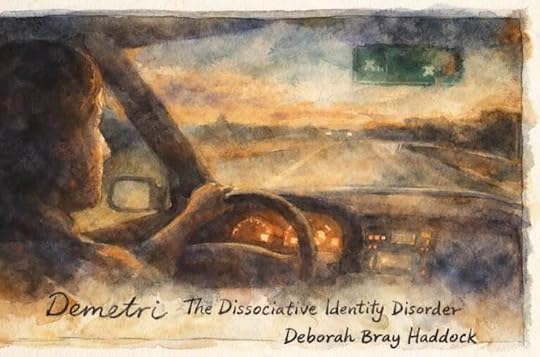
Watercolor Piece by Demetris Papadimitropoulos
Highway Hypnosis: A dusk-lit dashboard and a slipping exit sign capture dissociation’s most ordinary doorway – the mind drifting to survive.
There is a moment early in Deborah Bray Haddock’s “The Dissociative Identity Disorder Sourcebook” when the book quietly declares its true ambition. It begins not with spectacle but with the almost embarrassingly familiar: the missed highway exit, the lecture you drift through, the movie that swallows your attention so wholly you forget the room you’re sitting in. Haddock uses this common trance as a key in a lock, turning the reader away from the carnival-mirror mythology of Dissociative Identity Disorder and toward something more intimate, more unsettling, and ultimately more humane: the recognition that dissociation is not an alien visitation but a human capacity, one that can become, under pressure, a full architecture of survival.
That architecture is the real subject here. “The Dissociative Identity Disorder Sourcebook” is, on paper, a guidebook: definitions, diagnostic criteria, treatment stages, medication considerations, group therapy, self-help strategies, and advice for partners and clinicians. But the book’s lived center is ethical rather than encyclopedic. Haddock writes as if she is trying to move a frightened reader from the doorway into the room, and then farther still, into the interior corridors where shame tends to hide. The tone is gently directive, sometimes almost protective, the voice of someone who has seen how quickly “information” can become a weapon in the wrong hands, and how easily a diagnosis becomes a second injury if it is delivered without dignity.
To read this book now is to feel how insistently it is pushing back against two forces at once: sensationalism and disbelief. Haddock knows the cultural script. The long shadow of “Sybil” falls across the chapter on diagnosis; “The Three Faces of Eve” flickers in the background as a reminder that the public imagination prefers its multiplicity theatrical, abrupt, neatly labeled. Haddock does not scold the reader for arriving through those doors. Instead she replaces the lurid imagery with a quieter, more clinically plausible set of experiences: inner voices that feel internal rather than imposed, time loss that arrives like missing film in the reel of a day, headaches that function like weather systems, handwriting shifts, sleepiness mid-session, an abrupt softening of the face and voice that suggests not performance but distance traveled. If the popular DID story is about spectacle, Haddock’s is about concealment. DID, in her telling, is more likely to look like moodiness, eccentricity, high achievement haunted by inexplicable gaps, a person “fine” until they are not.
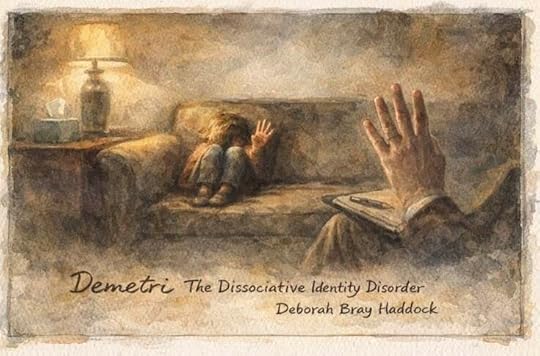
Watercolor Piece by Demetris Papadimitropoulos
The First Confirmed Switch: In a soft pool of lamp light, a small hand raises four fingers as the room quietly witnesses identity changing in real time.
The book’s first great strength is its refusal to treat dissociation as mere symptom. Haddock repeatedly returns to the idea that dissociation is, at its origin, adaptive: a creative coping mechanism that keeps the unacceptable out of sight, protects secrets, maintains attachments that might otherwise shatter a child, and separates strong, conflicting emotions into compartments the mind can bear. One can feel the author’s care in the phrasing, the deliberate attempt to remove moral judgment from the clinical vocabulary. She even flinches, briefly, at the word disorder, acknowledging how misaligned it can feel to name a lifesaving response as pathology. This is not rhetorical softness. It is clinical realism of a particular kind, the kind that understands that the first task in trauma work is often not excavation but permission: permission to understand one’s own mind without contempt.
From there, Haddock constructs her book the way many trauma-informed clinicians construct treatment: in phases, with stabilization as the nonnegotiable first principle. The structure itself becomes a lesson. Chapter by chapter, she offers a map of the therapeutic journey, careful to insist that a diagnosis is not a dramatic reveal but a process that emerges through relationship, observation, and time. She stresses differential diagnosis with a pragmatist’s emphasis on what goes wrong in real rooms with real people: the ease with which dissociation can be mistaken for psychosis, the way a broad-brush test result can point an anxious clinician toward schizophrenia or an Axis II label, the tendency of untrained professionals to either romanticize DID or recoil from it. Her diagnostic admonition is blunt enough to be memorable: until you have met an alter, it is not DID. The line lands as both safeguard and challenge. It is meant to prevent premature labeling, yes, but it also implies something more radical: that DID cannot be understood at a distance. It must be encountered, witnessed, allowed to show itself without being forced.
This insistence on encounter is what gives the book its distinct voice Haddock does not merely describe the internal system; she treats it as a community with roles, motives, and fears. Parts are not “characters” in the melodramatic sense, but functions shaped by history: the host who manages daily life, child parts who carry trauma memory or its emotions, protectors whose tactics can look irrational to outsiders but make perfect sense within the logic of threat, persecutors who may embody internalized abuse and turn it inward, idealized states built from fantasy and longing. Haddock does not romanticize these roles. She understands that the same internal ingenuity that kept someone alive can later become disruptive, even dangerous. Still, her consistent move is to translate behavior into purpose, and purpose into an invitation to work with, not against.
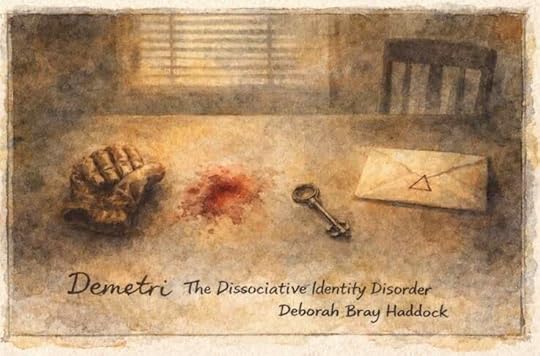
Watercolor Piece by Demetris Papadimitropoulos
The BASK Split: Four objects on a sun-washed table – glove, stain, key, sealed letter – lay out trauma’s fragments: behavior, feeling, sensation, knowledge.
Read alongside more contemporary “parts” frameworks, the book feels like an early bridge between worlds that have since become mainstream. It shares a family resemblance with Janina Fisher’s “Healing the Fragmented Selves of Trauma Survivors,” with the skills-forward pragmatism of “Coping with Trauma-Related Dissociation,” and, in a more popular register, with the cultural rise of parts language that “No Bad Parts” helped bring into everyday speech. Yet Haddock’s emphasis remains distinct: she is less interested in branding a model than in equipping a reader to survive the week. Her chapters on coping strategies, internal communication techniques, safety planning, and organizing information for family and friends are written with the implied understanding that the reader may be reading in secret, may be reading while triggered, may be reading with one eye on the door.
It is difficult to overstate how much the book’s caution matters. Haddock repeatedly reminds the reader that educational material can be activating, that trauma narratives can destabilize, that the pace must be respected. That warning, in a time when mental health content is consumed in a scroll, feels almost prophetic. We live in a culture of bite-sized therapy language, where “dissociation” is both a clinical phenomenon and a casually deployed word for boredom, where a stranger on a video can “diagnose” you in 30 seconds and offer a checklist with a link in bio. Haddock’s book is slow by design. It insists that trauma work unfolds in the body, in relationship, with consequences, and that the desire for certainty can itself become a form of harm.
The middle chapters, which outline treatment approaches and stages of therapy, are the book’s most practically valuable sections and also the ones most likely to expose its age. Haddock is writing in 2001, before the contemporary boom in trauma neuroscience, before the popularization of polyvagal theory, before the current era’s wide public discourse about complex PTSD, intergenerational trauma, and the nervous system as a daily headline. She gestures toward brain structures and trauma processing in ways that feel earnest and serviceable rather than cutting-edge. A reader steeped in today’s trauma canon, someone who has already been through “The Body Keeps the Score” or the more recent ecosystem of research-driven trauma writing, may find these discussions somewhat simplified, even quaint in their confidence. Yet the book’s clinical wisdom is not primarily housed in its neuroanatomy. It is housed in its pacing, its attention to alliance, its insistence that stabilization is not glamorous but is everything.
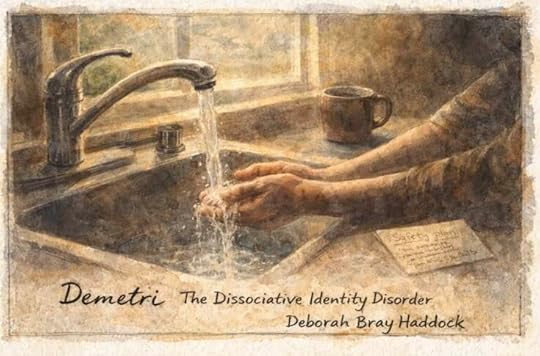
Watercolor Piece by Demetris Papadimitropoulos
Stabilization: Running water over cupped hands, tea steaming nearby, and a barely legible safety note – calm rituals that hold the body in the present.
Haddock’s best pages often concern what derails therapy. She understands the trap of longing for a “good therapist” as if that were a single trait rather than a relationship that must be built and tested. She names therapist fit, internal conflicts, defenses, fear, transitions, stress. She acknowledges how DID can itself be organized around not knowing, and how the system may resist exposure with the same rigor it once resisted danger. Her respect for defenses is one of the book’s quiet triumphs. She does not frame resistance as willful obstruction; she frames it as intelligence shaped by history. In doing so, she gives survivors and clinicians alike a language that is less adversarial, more curious.
The chapters on medication and group therapy are similarly pragmatic. Haddock is careful not to present medication as cure, but as symptom support: depression, anxiety, sleep, stabilization when needed. Her stance is conservative, almost protective of psychotherapy’s central role, which remains consistent with current best practice. Group therapy is presented as a complicated gift: an arena where trust can be rebuilt, isolation punctured, shame metabolized in the presence of others, but also a space that requires boundaries and skillful facilitation. The book is at its most socially aware here, implicitly acknowledging that trauma is not simply an interior event but a relational one, and that healing often requires new experiences of safety with other humans.
If there is a critique that a more exacting literary reviewer might make, it is that Haddock’s prose, while lucid and compassionate, is primarily functional. The writing does not aim for metaphorical daring or stylistic surprise. It aims to be understood. In a guidebook, this is not a flaw so much as a choice, but it does shape the reading experience. The book’s repetition, too, can feel both like pedagogy and like padding. Haddock returns again and again to the same keystones: dissociation as survival, safety first, shame as companion to secrecy, the need for support, the possibility of hope. For some readers, this will feel like being held. For others, it may feel like a loop.
Yet even the repetition has a therapeutic logic. Trauma fragments memory; people forget what they know under stress. A book written for dissociative readers must repeat itself the way good therapy repeats itself: not because the ideas are thin, but because the nervous system needs rehearsal. One begins to see that “The Dissociative Identity Disorder Sourcebook” is not merely delivering information but attempting to build an internal scaffold, sentence by sentence, for someone whose inner world has been forced to become a maze.
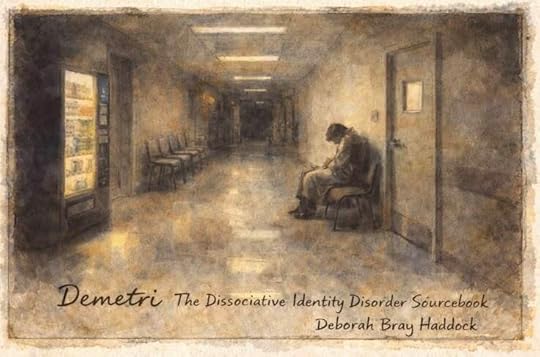
Watercolor Piece by Demetris Papadimitropoulos
When Therapy Isn’t Enough: A fluorescent corridor, a vending-machine glow, and a bowed figure show containment as architecture when crisis demands more than weekly care.
Read in our present moment, the book also becomes a quiet commentary on contemporary life. The current era’s conversations about workplace mental health, psychological safety, burnout, and the invisible costs of chronic stress have widened the audience for trauma language, sometimes responsibly, sometimes not. At the same time, the public reckoning with childhood abuse, the rise of trauma-informed practices in schools and hospitals, the ongoing debates about memory and testimony, and the slow reshaping of diagnostic culture have created a world in which Haddock’s original project feels newly relevant. Her insistence that DID is often missed because it does not look like a movie is, in the age of algorithmic attention, an insistence against caricature. Her plea for pacing is, in a culture of instant takes, a plea for care.
As a comp ecosystem, the book now sits in a recognizable constellation. It shares shelf space with Judith Herman’s “Trauma and Recovery,” with contemporary dissociation skills training manuals, with Fisher’s work on fragmented selves, and with the popular parts-therapy wave that has seeped into everyday language. But Haddock’s distinct contribution remains her bridge-building. She writes to the survivor, the therapist, and the significant other at once, as if insisting that dissociation is not a private oddity but a human phenomenon that demands communal literacy.
What, then, is the book’s final effect? It is not a “definitive” account, nor a work that will satisfy the reader seeking cutting-edge science or polemical engagement with the fiercest controversies surrounding DID. It is, instead, a compassionate instrument. It aims to reduce terror. It aims to offer a map where there has been only fog. It aims, most of all, to replace shame with a workable understanding of how a mind can splinter and still be, in its own strange way, coherent.
For a book of this kind, the fairest question is not whether it dazzles but whether it helps. Haddock’s book helps – with steadiness, with respect, with a consistent refusal to turn trauma into entertainment. It is the work of a clinician who believes that naming can heal, but only if the naming is done with humility. It is also the work of someone who understands that recovery is not a single revelation but a long practice of returning to the present. In the end, I would rate “The Dissociative Identity Disorder Sourcebook” 86/100: a sturdy, empathetic, and enduring guide whose occasional datedness and functional prose are outweighed by its clarity, ethical posture, and practical usefulness – a book that, even now, seems written with one goal: to make survival legible, and healing imaginable.
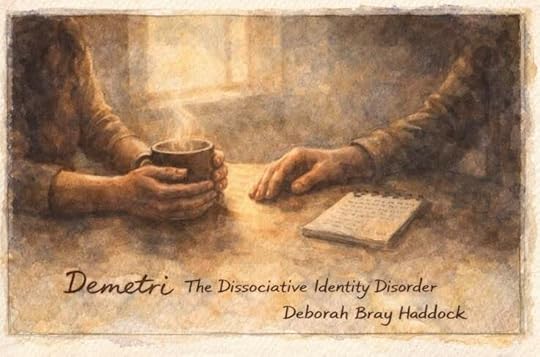
Watercolor Piece by Demetris Papadimitropoulos
The Loved One’s Role: Two hands hover across a notebook and a warm cup – close, not gripping – tenderness practiced with boundaries.
By Demetris Papadimitropoulos | March 5th, 2026
Watercolor Piece by Demetris Papadimitropoulos
Highway Hypnosis: A dusk-lit dashboard and a slipping exit sign capture dissociation’s most ordinary doorway – the mind drifting to survive.
There is a moment early in Deborah Bray Haddock’s “The Dissociative Identity Disorder Sourcebook” when the book quietly declares its true ambition. It begins not with spectacle but with the almost embarrassingly familiar: the missed highway exit, the lecture you drift through, the movie that swallows your attention so wholly you forget the room you’re sitting in. Haddock uses this common trance as a key in a lock, turning the reader away from the carnival-mirror mythology of Dissociative Identity Disorder and toward something more intimate, more unsettling, and ultimately more humane: the recognition that dissociation is not an alien visitation but a human capacity, one that can become, under pressure, a full architecture of survival.
That architecture is the real subject here. “The Dissociative Identity Disorder Sourcebook” is, on paper, a guidebook: definitions, diagnostic criteria, treatment stages, medication considerations, group therapy, self-help strategies, and advice for partners and clinicians. But the book’s lived center is ethical rather than encyclopedic. Haddock writes as if she is trying to move a frightened reader from the doorway into the room, and then farther still, into the interior corridors where shame tends to hide. The tone is gently directive, sometimes almost protective, the voice of someone who has seen how quickly “information” can become a weapon in the wrong hands, and how easily a diagnosis becomes a second injury if it is delivered without dignity.
To read this book now is to feel how insistently it is pushing back against two forces at once: sensationalism and disbelief. Haddock knows the cultural script. The long shadow of “Sybil” falls across the chapter on diagnosis; “The Three Faces of Eve” flickers in the background as a reminder that the public imagination prefers its multiplicity theatrical, abrupt, neatly labeled. Haddock does not scold the reader for arriving through those doors. Instead she replaces the lurid imagery with a quieter, more clinically plausible set of experiences: inner voices that feel internal rather than imposed, time loss that arrives like missing film in the reel of a day, headaches that function like weather systems, handwriting shifts, sleepiness mid-session, an abrupt softening of the face and voice that suggests not performance but distance traveled. If the popular DID story is about spectacle, Haddock’s is about concealment. DID, in her telling, is more likely to look like moodiness, eccentricity, high achievement haunted by inexplicable gaps, a person “fine” until they are not.
Watercolor Piece by Demetris Papadimitropoulos
The First Confirmed Switch: In a soft pool of lamp light, a small hand raises four fingers as the room quietly witnesses identity changing in real time.
The book’s first great strength is its refusal to treat dissociation as mere symptom. Haddock repeatedly returns to the idea that dissociation is, at its origin, adaptive: a creative coping mechanism that keeps the unacceptable out of sight, protects secrets, maintains attachments that might otherwise shatter a child, and separates strong, conflicting emotions into compartments the mind can bear. One can feel the author’s care in the phrasing, the deliberate attempt to remove moral judgment from the clinical vocabulary. She even flinches, briefly, at the word disorder, acknowledging how misaligned it can feel to name a lifesaving response as pathology. This is not rhetorical softness. It is clinical realism of a particular kind, the kind that understands that the first task in trauma work is often not excavation but permission: permission to understand one’s own mind without contempt.
From there, Haddock constructs her book the way many trauma-informed clinicians construct treatment: in phases, with stabilization as the nonnegotiable first principle. The structure itself becomes a lesson. Chapter by chapter, she offers a map of the therapeutic journey, careful to insist that a diagnosis is not a dramatic reveal but a process that emerges through relationship, observation, and time. She stresses differential diagnosis with a pragmatist’s emphasis on what goes wrong in real rooms with real people: the ease with which dissociation can be mistaken for psychosis, the way a broad-brush test result can point an anxious clinician toward schizophrenia or an Axis II label, the tendency of untrained professionals to either romanticize DID or recoil from it. Her diagnostic admonition is blunt enough to be memorable: until you have met an alter, it is not DID. The line lands as both safeguard and challenge. It is meant to prevent premature labeling, yes, but it also implies something more radical: that DID cannot be understood at a distance. It must be encountered, witnessed, allowed to show itself without being forced.
This insistence on encounter is what gives the book its distinct voice Haddock does not merely describe the internal system; she treats it as a community with roles, motives, and fears. Parts are not “characters” in the melodramatic sense, but functions shaped by history: the host who manages daily life, child parts who carry trauma memory or its emotions, protectors whose tactics can look irrational to outsiders but make perfect sense within the logic of threat, persecutors who may embody internalized abuse and turn it inward, idealized states built from fantasy and longing. Haddock does not romanticize these roles. She understands that the same internal ingenuity that kept someone alive can later become disruptive, even dangerous. Still, her consistent move is to translate behavior into purpose, and purpose into an invitation to work with, not against.
Watercolor Piece by Demetris Papadimitropoulos
The BASK Split: Four objects on a sun-washed table – glove, stain, key, sealed letter – lay out trauma’s fragments: behavior, feeling, sensation, knowledge.
Read alongside more contemporary “parts” frameworks, the book feels like an early bridge between worlds that have since become mainstream. It shares a family resemblance with Janina Fisher’s “Healing the Fragmented Selves of Trauma Survivors,” with the skills-forward pragmatism of “Coping with Trauma-Related Dissociation,” and, in a more popular register, with the cultural rise of parts language that “No Bad Parts” helped bring into everyday speech. Yet Haddock’s emphasis remains distinct: she is less interested in branding a model than in equipping a reader to survive the week. Her chapters on coping strategies, internal communication techniques, safety planning, and organizing information for family and friends are written with the implied understanding that the reader may be reading in secret, may be reading while triggered, may be reading with one eye on the door.
It is difficult to overstate how much the book’s caution matters. Haddock repeatedly reminds the reader that educational material can be activating, that trauma narratives can destabilize, that the pace must be respected. That warning, in a time when mental health content is consumed in a scroll, feels almost prophetic. We live in a culture of bite-sized therapy language, where “dissociation” is both a clinical phenomenon and a casually deployed word for boredom, where a stranger on a video can “diagnose” you in 30 seconds and offer a checklist with a link in bio. Haddock’s book is slow by design. It insists that trauma work unfolds in the body, in relationship, with consequences, and that the desire for certainty can itself become a form of harm.
The middle chapters, which outline treatment approaches and stages of therapy, are the book’s most practically valuable sections and also the ones most likely to expose its age. Haddock is writing in 2001, before the contemporary boom in trauma neuroscience, before the popularization of polyvagal theory, before the current era’s wide public discourse about complex PTSD, intergenerational trauma, and the nervous system as a daily headline. She gestures toward brain structures and trauma processing in ways that feel earnest and serviceable rather than cutting-edge. A reader steeped in today’s trauma canon, someone who has already been through “The Body Keeps the Score” or the more recent ecosystem of research-driven trauma writing, may find these discussions somewhat simplified, even quaint in their confidence. Yet the book’s clinical wisdom is not primarily housed in its neuroanatomy. It is housed in its pacing, its attention to alliance, its insistence that stabilization is not glamorous but is everything.
Watercolor Piece by Demetris Papadimitropoulos
Stabilization: Running water over cupped hands, tea steaming nearby, and a barely legible safety note – calm rituals that hold the body in the present.
Haddock’s best pages often concern what derails therapy. She understands the trap of longing for a “good therapist” as if that were a single trait rather than a relationship that must be built and tested. She names therapist fit, internal conflicts, defenses, fear, transitions, stress. She acknowledges how DID can itself be organized around not knowing, and how the system may resist exposure with the same rigor it once resisted danger. Her respect for defenses is one of the book’s quiet triumphs. She does not frame resistance as willful obstruction; she frames it as intelligence shaped by history. In doing so, she gives survivors and clinicians alike a language that is less adversarial, more curious.
The chapters on medication and group therapy are similarly pragmatic. Haddock is careful not to present medication as cure, but as symptom support: depression, anxiety, sleep, stabilization when needed. Her stance is conservative, almost protective of psychotherapy’s central role, which remains consistent with current best practice. Group therapy is presented as a complicated gift: an arena where trust can be rebuilt, isolation punctured, shame metabolized in the presence of others, but also a space that requires boundaries and skillful facilitation. The book is at its most socially aware here, implicitly acknowledging that trauma is not simply an interior event but a relational one, and that healing often requires new experiences of safety with other humans.
If there is a critique that a more exacting literary reviewer might make, it is that Haddock’s prose, while lucid and compassionate, is primarily functional. The writing does not aim for metaphorical daring or stylistic surprise. It aims to be understood. In a guidebook, this is not a flaw so much as a choice, but it does shape the reading experience. The book’s repetition, too, can feel both like pedagogy and like padding. Haddock returns again and again to the same keystones: dissociation as survival, safety first, shame as companion to secrecy, the need for support, the possibility of hope. For some readers, this will feel like being held. For others, it may feel like a loop.
Yet even the repetition has a therapeutic logic. Trauma fragments memory; people forget what they know under stress. A book written for dissociative readers must repeat itself the way good therapy repeats itself: not because the ideas are thin, but because the nervous system needs rehearsal. One begins to see that “The Dissociative Identity Disorder Sourcebook” is not merely delivering information but attempting to build an internal scaffold, sentence by sentence, for someone whose inner world has been forced to become a maze.
Watercolor Piece by Demetris Papadimitropoulos
When Therapy Isn’t Enough: A fluorescent corridor, a vending-machine glow, and a bowed figure show containment as architecture when crisis demands more than weekly care.
Read in our present moment, the book also becomes a quiet commentary on contemporary life. The current era’s conversations about workplace mental health, psychological safety, burnout, and the invisible costs of chronic stress have widened the audience for trauma language, sometimes responsibly, sometimes not. At the same time, the public reckoning with childhood abuse, the rise of trauma-informed practices in schools and hospitals, the ongoing debates about memory and testimony, and the slow reshaping of diagnostic culture have created a world in which Haddock’s original project feels newly relevant. Her insistence that DID is often missed because it does not look like a movie is, in the age of algorithmic attention, an insistence against caricature. Her plea for pacing is, in a culture of instant takes, a plea for care.
As a comp ecosystem, the book now sits in a recognizable constellation. It shares shelf space with Judith Herman’s “Trauma and Recovery,” with contemporary dissociation skills training manuals, with Fisher’s work on fragmented selves, and with the popular parts-therapy wave that has seeped into everyday language. But Haddock’s distinct contribution remains her bridge-building. She writes to the survivor, the therapist, and the significant other at once, as if insisting that dissociation is not a private oddity but a human phenomenon that demands communal literacy.
What, then, is the book’s final effect? It is not a “definitive” account, nor a work that will satisfy the reader seeking cutting-edge science or polemical engagement with the fiercest controversies surrounding DID. It is, instead, a compassionate instrument. It aims to reduce terror. It aims to offer a map where there has been only fog. It aims, most of all, to replace shame with a workable understanding of how a mind can splinter and still be, in its own strange way, coherent.
For a book of this kind, the fairest question is not whether it dazzles but whether it helps. Haddock’s book helps – with steadiness, with respect, with a consistent refusal to turn trauma into entertainment. It is the work of a clinician who believes that naming can heal, but only if the naming is done with humility. It is also the work of someone who understands that recovery is not a single revelation but a long practice of returning to the present. In the end, I would rate “The Dissociative Identity Disorder Sourcebook” 86/100: a sturdy, empathetic, and enduring guide whose occasional datedness and functional prose are outweighed by its clarity, ethical posture, and practical usefulness – a book that, even now, seems written with one goal: to make survival legible, and healing imaginable.
Watercolor Piece by Demetris Papadimitropoulos
The Loved One’s Role: Two hands hover across a notebook and a warm cup – close, not gripping – tenderness practiced with boundaries.

July 7, 2021
We were recently diagnosed with DID, so reading through this after diagnosis helps a lot. Some things seem outdated or geared towards mostly overt systems, but still this is a helpful guide overall.

September 15, 2019
Very, very good.
This is an underappreciated textbook that explains, once and for all, that people with mutliple personalities are not ... Gollum.

My preccccccccccccious
Wait, people with multiple personalities actually don't always ... act like Smeagul/Gollum, switching from naive and chaotically good to murderously evil? Because of a ring?
Among mental illnesses and personality disorders, multiple personality disorder (MPD) - now called Dissociative Identity Disorder (DID) - is probably the most misunderstood.
One of the reasons is, of course, the media. Movies (especially thrillers) like to portray sufferers of MPD/DID as nice people who are oblivious to their criminal DARK SIDE that just happens to roam the streets whenever the host gets a headache *ominous music*
It's a Dr. Jekyll, Mr. Hyde thing. If the host notices anything at all, he is at war with himself, cringing, screaming and rolling around until the metamorphosis to the evil self is complete *maniacal laugh*
He? Yes, why are so many portrayals of dissociators in the media male (killers)? It is a fact that most dissociators are female (if only because many males do not seek help), but that is not at all adressed by the exagerated image the illness has in the media.
This book will teach you:
- What MPD/DID really is and how the dissociator feels and where the illness originates.
- the purpose and behavior of alters
- how DID is treated
- misconceptions about the illness
- different coping techniques and therapy methods
and much more. So if you would like to know what poor Gollum is going through on the inside (coping and dissociating from the traumatic meeting with the ring) then this is the book for you!
This is an underappreciated textbook that explains, once and for all, that people with mutliple personalities are not ... Gollum.
My preccccccccccccious
Wait, people with multiple personalities actually don't always ... act like Smeagul/Gollum, switching from naive and chaotically good to murderously evil? Because of a ring?
Among mental illnesses and personality disorders, multiple personality disorder (MPD) - now called Dissociative Identity Disorder (DID) - is probably the most misunderstood.
One of the reasons is, of course, the media. Movies (especially thrillers) like to portray sufferers of MPD/DID as nice people who are oblivious to their criminal DARK SIDE that just happens to roam the streets whenever the host gets a headache *ominous music*
It's a Dr. Jekyll, Mr. Hyde thing. If the host notices anything at all, he is at war with himself, cringing, screaming and rolling around until the metamorphosis to the evil self is complete *maniacal laugh*
He? Yes, why are so many portrayals of dissociators in the media male (killers)? It is a fact that most dissociators are female (if only because many males do not seek help), but that is not at all adressed by the exagerated image the illness has in the media.
This book will teach you:
- What MPD/DID really is and how the dissociator feels and where the illness originates.
- the purpose and behavior of alters
- how DID is treated
- misconceptions about the illness
- different coping techniques and therapy methods
and much more. So if you would like to know what poor Gollum is going through on the inside (coping and dissociating from the traumatic meeting with the ring) then this is the book for you!

February 7, 2018
The most respectful and comprehensive guide I've seen. It's broad, and addresses very different audiences, which means it sometimes glosses over some things, necessarily, and I don't agree with every last piece of its advice.... but still it's an amazing accomplishment to have written something so comprehensive, that does such a great job of addressing 3 crucial audiences (people with DID, therapists, people who care about someone with DID). Well done, Ms. Haddock!

May 6, 2019
Great resource
Great resource for newly diagnosed individuals with DID, their families, friends and spouses.
This book goes into detail for therapy types and how tiger started, as well as the disorder, for those who had never received talk therapy ( or limited amounts) before.
This book was at times triggering, and did warn readers early on that it could be triggering. I recommend reading it slowly and not being afraid to coming back to it to reread.
Great resource for newly diagnosed individuals with DID, their families, friends and spouses.
This book goes into detail for therapy types and how tiger started, as well as the disorder, for those who had never received talk therapy ( or limited amounts) before.
This book was at times triggering, and did warn readers early on that it could be triggering. I recommend reading it slowly and not being afraid to coming back to it to reread.

February 24, 2019
Great book for people struggling with DID, their loved ones, and even mental health professionals. It had a lot of good information and resources. It definitely reads more like a text book, but it uses regular easy to understand information so its great for people who are not familiar with all of the technical terms.
January 18, 2010
It's rare to come across a client with DID, but because of this it's also rare to come across a lot of info about the disorder in grad school. This book is easy to read and very informative. It would be good for anyone: clinicians, family members and friends of individuals with DID.
March 1, 2015
The portions of medication and group therapy and those parts targeted towards therapists exclusively were a downside to the general reader, but otherwise an excellent book that dispels the myths associated with DID and with the more widely used name of multiple personality disorder.

July 29, 2008
Not Good. Wouldn't Recommend. Much Of This Book Is About The History Of Dissociation. We found much of the info in this book to be very basic, so if you are new to DID you may like it.
January 4, 2009
A very helpful text for the counselor dealing with clients with dissociative disorders on all spectrums.
March 12, 2015
very informative

July 28, 2016
Very informative, lots of case stories from real people. Written so that you don't need a PHD in psychology to understand it.

June 5, 2020
I have always been fascinated with psychology (I even got my degree in the subject) and had to pick up this book as it is one of the few on Dissociative Identity Disorder. This covers various therapy styles, defensive techniques, types of dissociation, and so much more. I think it is also a wonderful resource for anyone who has DID or for any family/friends who want to know more!
I only wish that they had covered/discussed more research that has been done with DID since I am most interested in that, however I still found this interesting.
I only wish that they had covered/discussed more research that has been done with DID since I am most interested in that, however I still found this interesting.

December 11, 2020
This book only confirms my suspicions that talk teraphy is a bunch of mumbo jumbo without any medical or even scientific justification. Imagine you show up at your local ER with a broken leg and the doctor says: "Oh, it's going to take 4 years to fix it and you're going to have to show up once a week and maybe even attend group therapy with other people with broken legs". Would you go for it? Not in a million years I bet.

August 15, 2025
A clear, concise, and information-packed look into dissociative identity disorder (DID) and its causes.
Highly recommend for those new to the disorder. Explains key symptoms, therapeutic interventions, and coping strategies for those recently diagnosed. Perfect for audiences with differing levels of expertise on the subject.
Highly recommend for those new to the disorder. Explains key symptoms, therapeutic interventions, and coping strategies for those recently diagnosed. Perfect for audiences with differing levels of expertise on the subject.

July 19, 2022
Fantastic book! So much information and better understanding for a person with DID and trauma and with those who are in their lives. There is also a whole resource section in the back with a lot more information about books, websites, places, etc. This book is a definite recommended read.

June 27, 2025
A general overview of many things that might impact the life of someone with DID. It is a bit general and outdated, so I didn't find it very helpful, but there were a few good ideas. Bonus points for *speaking about healing with choices (not just integration/unification as the only option)!

February 12, 2020
While the book would benefit from an updated version, there's a lot of solid information here and it remains a good resource for anyone living with a dissociative disorder, particularly DID or OSDD.
December 11, 2020
Took a course on this subject. Very interesting concept. However, in the most part, it only gives out references instead going into detail.

April 21, 2021
Useful. Thoughtful, open-minded, compassionate, realistic, supportive.

June 14, 2021
Clear and concise, this book looks at a lot of different issues that people with DID have.
August 5, 2023
Very helpful explains things so people can understand. Only downside is the resource list in the back of the book is outdated some of the resources are still available but some are not

Read
May 22, 2024i read through this whole book to (fail to) find a specific paragraph fuck me

January 12, 2025
I gave the five stars for the thorough overview as well as the tools included. Even the references in the back were interesting. It’s one I’ll keep for future reference.

January 10, 2026
I consider this to be very well written and informative. It's the book I recommend to those new to DID.
Displaying 1 - 30 of 38 reviews