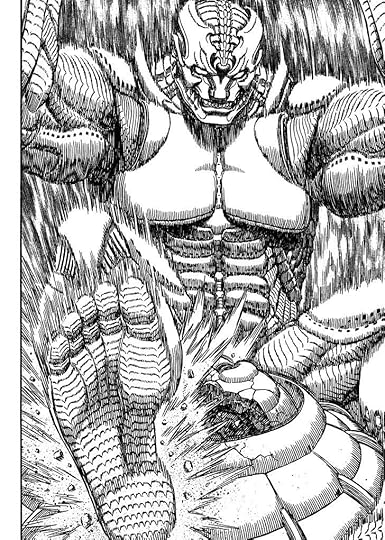
A six chapter mini-series by Miura Kentarou set 100 million years in the future, it's about an epic war between the forces led by Zeus and the nether forces led by the giant Alcyoneus.
Kentarou Miura (三浦建太郎) was born in Chiba City, Chiba Prefecture, Japan, in 1966. He is left-handed. In 1976, at the early age of 10, Miura made his first Manga, entitled "Miuranger", that was published for his classmates in a school publication; the manga ended up spanning 40 volumes. In 1977, Miura created his second manga called Ken e no michi (剣への道 The Way to the Sword), using Indian ink for the first time. When he was in middle school in 1979, Miura's drawing techniques improved greatly as he started using professional drawing techniques. His first dōjinshi was published, with the help of friends, in a magazine in 1982.
That same year, in 1982, Miura enrolled in an artistic curriculum in high school, where he and his classmates started publishing their works in school booklets, as well as having his first dōjinshi published in a fan-produced magazine. In 1985, Miura applied for the entrance examination of an art college in Nihon University. He submitted Futanabi for examination and was granted admission. This project was later nominated Best New Author work in Weekly Shōnen Magazine. Another Miura manga Noa was published in Weekly Shōnen Magazine the very same year. Due to a disagreement with one of the editors, the manga was stalled and eventually dropped altogether. This is approximately where Miura's career hit a slump.
In 1988, Miura bounced back with a 48-page manga known as Berserk Prototype, as an introduction to the current Berserk fantasy world. It went on to win Miura a prize from the Comi Manga School. In 1989, after receiving a doctorate degree, Kentarou started a project titled King of Wolves (王狼, ōrō?) based on a script by Buronson, writer of Hokuto no Ken. It was published in the monthly Japanese Animal House magazine in issues 5 and 7 of that year.
In 1990, a sequel is made to Ourou entitled Ourou Den (王狼伝 ōrō den, The Legend of the Wolf King) that was published as a prequel to the original in Young Animal Magazine. In the same year, the 10th issue of Animal House witnesses the first volume of the solo project Berserk was released with a relatively limited success. Miura again collaborated with Buronson on manga titled Japan, that was published in Young Animal House from the 1st issue to the 8th of 1992, and was later released as a stand-alone tankōbon. Miura's fame grew after Berserk was serialized in Young Animal in 1992 with the release of "The Golden Age" story arc and the huge success of his masterpiece made of him one of the most prominent contemporary mangakas. At this time Miura dedicates himself solely to be working on Berserk. He has indicated, however, that he intends to publish more manga in the future.
In 1997, Miura supervised the production of 25 anime episodes of Berserk that aired in the same year on NTV. Various art books and supplemental materials by Miura based on Berserk are also released. In 1999, Miura made minor contributions to the Dreamcast video game Sword of the Berserk: Guts' Rage. 2004 saw the release of yet another video game adaptation entitled Berserk Millennium Falcon Arc: Chapter of the Record of the Holy Demon War.
Since that time, the Berserk manga has spanned 34 tankōbon with no end in sight. The series has also spawned a whole host of merchandise, both official and fan-made, ranging from statues, action figures to key rings, video games, and a trading card game. In 2002, Kentarou Miura received the second place in the Osamu Tezuka Culture Award of Excellence for Berserk.[1]
Miura provided the design for the Vocaloid Kamui Gakupo, whose voice is taken from the Japanese singer and actor, Gackt.
Miura passed away on May 6, 2021 at 2:48 p.m. due to acute aortic dissection.
Visto che Berserk procedeva fin troppo speditamente (ma anche no) qualche anno fa Miura si è preso una pausa dal sua manga più famoso e si è dedicato a questa storia autoconclusiva (o no?) frullandoci dentro tutto quello che gli veniva in mente al momento: mitologia greca, Nausicaa nella valle del vento, l'Attacco dei Giganti (sta avendo successo, quindi posso farci soldi pure io), Final Fantasy, ecc.
In fin dei conti, l'autore aveva bisogno di una boccata d'aria dal mondo tetro e nichilista di Berserk e questa storia è stata una lettura spensierata arricchita da disegni meravigliosi (Miura è un vero Maestro), peccato che alcuni feticismi che in teoria avrebbero dovuto far ridere mi abbiano invece fatto accapponare la pelle...
Peccato, il world-building dell'ambientazione era notevole e con 4-5 volumi in più il wrestler Delos e la piccola Prome(teo) sarebbero stati due personaggi interessanti invece di una pseudo-parodia di Gatsu e Pak... ma visto il finale aperto potremmo vedere un seguito in futuro.
Possibilmente dopo la fine di Berserk, ma ormai ho davvero perso le speranze di vederne la conclusione.
From the back cover: “One hundred million years after the Great Destruction, life hangs on in the wastelands with humans, demihumans, and massive creatures fighting for survival. With the Empire of Olympus using colossal beasts to crush its adversaries, only gladiator Delos, mystic Prome, and the titan Gohra they become can hope to stem genocide and heal the shattered Earth!”
“From the immense imagination of ‘Berserk’ creator Kentaro Miura comes ‘Giganto Maxia,’ a science-fiction/fantasy manga of titanic proportions!”
Ok, well then. Yes. That about covers it. “Giganto Maxia” is a one-shot manga, written and drawn by Miura when he took a hiatus from “Berserk” in 2014. And uhhhhhh, wow…….yeah. Gotta think about it for a minute or two. The story is certainly huge. An immense, gigantic, sprawling mess. I picked it up just because I’m trying to throw some light reading into my summer schedule. Yeah, hold on…...I’m still thinking, ok? Here are a few thoughts that immediately come to mind:
First off, fans of “Berserk” were reportedly pissed when this series appeared. At first they were mad because they wanted more “Berserk,” but later they were angry because “Giganto Maxia” turned out to be a one-off project, despite the fact that Miura left the door open for more adventures.
Second off, this thing is just gorgeous to look at. It appears that Miura really wanted to work on his artistic chops, and he loads every page of “GM” with incredible detail. There are scenes early on that take place in an arena, and Miura took the time to draw unique characterizations for each of the spectators…...dozens upon dozens of them….just absolutely meticulous and obsessive in every way.
Third off, the two main characters. Delos is a manly man wrestler, a former gladiator now in league with (in service to?) a mysterious female spirit/construct named Prome. There is a symbiotic relationship between the two that never gets fully explained. But ummmmm…..Prome has to urinate on Delos to heal him, or make him drink….what’s that? Bit over the top perhaps? It’s a perfectly good kink but not necessarily YOUR kink, you say? Don’t worry, there is nothing sexual about it, thank goodness. But yeah…..she pees on him. And no need to wonder what’s in that water skin at the end of the story…..yeah, I’ll just leave that there and we’ll move on, ‘k?
Fourth off, plot? Yeah, I guess there is one somewhere here. Delos and Prome are crossing the desert, and they get kidnapped by some Beetle People. There is a big fight and Delos beats the appointed Beetle People Hero on a cage match, one fall, no time limit. Are you ready to RUMMMMMMBLE? Anyway, Delos wins and becomes the Heavyweight Beetle People Champion, or something. This endears him to the Beetle People, who only moments before were calling for him to be dismembered by the great Beetle Hero. So Prome pees on him and...ok…..stop it. That’s enough of THAT. So Delos goes on to merge with Prome and become a big Giganto dude so that he can do battle with the Empire’s big Giganto dude and restore health to the barren Beetle Desert digs. It’s an epic battle, too! Lots of wrestling moves and flames shooting out of orifices and yeah…..all of that kind of very Japanese bigmechaorganicmonster stuff going on here. And I guess there is some sort of racial/colonial subtext going on underneath as well. The Beetle People are drawn essentially as black Africans, the Empire minions as lily-white conquerors with a decidedly genocidal bent.
Fifth off, the wrestling moves are drawn with exquisite care. That suplex really LOOKS like a suplex. That’s all kind of awesome in and of itself. Look, I like pro wrestling. It’s a guilty pleasure. I won’t apologize for that. Nope. You will pry my Bullet Club tee-shirt off of my cold, dead body.
Sixth off, lots of the typical themes of honor in battle, reverence for life in all of its forms, redemption, mercy….it’s all here in one tidy package. There are actually a LOT of interesting ideas going on here, some of which hark back to classic science-fiction tropes in the best way possible. The “Road Warrior” similarities quickly get buried by bigger ideas, and WHY DIDN’T Miura just keep this thing going? I’m not a big “Berserk” fan, but I would keep buying this. Who or what is Prome? How did she and Delos become a team? How many more Empire Gigantos need to be wrestled down in a Lumberjack Match? I’ll never freaking know because this is it! There ain’t no more!!! Dammit!!
The whole thing just confused me, but it was fun while it lasted. I’m going to give it four stars just for the artwork alone, and the big ideas that were just simmering under the surface. And urine luck, I won’t mention the pee thing again. Ok, yes. I’ll stop now. Happy?
از کینتارو توقع بیشتری داشتم. داستان ساده و معموی بود. یه پساآخرالزمان دارک. هر چند تصویرگری ها خیره کننده بود و بی نقص همون طور که از کینتارو انتظار می رفت. ولی داستان اونقدرا خوب بود. هرچند پایان باز داشت و ممکنه بخواد ادامه اش بده. البته به شخصه ترجیح می دم مجموعه ی برسرک رو کار کنه و زودتر تمومش کنه تا اینکه وقتشو بذاره برای کارای معمولیی مثل گیگانتوماچیا
Short, funny and absolutely stunning. Little known side project by the most legendary mangaka. Also probably a weird love letter to wrestling. Not as dark as Berserk but similar in many other ways.
This is a one-off, single volume of six chapters. It has a neat story to it but most of the time is spent on the battles so we just don't get to know the two main characters well enough. They seem to have a cool relationship but we've got no background and don't really know anything about them. The art was good, but the story was just getting good when it ended and I'd have liked a lot more character development.
If you have read Berserk, you will be able to recognize the relationship between Guts and Puck and their personalities. I'm guessing the author wanted to try and draw different types of bodies and character designs and that's why he pulled off this one volume manga.
“Gigantomaquia” es el trabajo más reciente de Kentaro Miura, el ya reconocido autor de Bersek y nos cuenta la historia de un mundo desolado, donde la vida apenas crece y se encuentra en constante guerra. En este mundo, nuestros protagonistas se enfrentan a los gigantes para restaurar el equilibrio en la tierra. Como pueden ver, el argumento se basa en el mito de la Gigantomaquia griega y le suma toques de aventura post apocalíptica, repleta de historia actual, disfrazada de fantasía. El mundo (que considero uno de los puntos más interesante de este tomo) es fantástico, repleto de monstruos y criaturas extrañas, cuya imagen cruda y detallada se muestras perfectamente a través del minucioso dibujo del autor. Las páginas llenas de paisajes complicados, los detalles pequeños que conjugan el todo y los diseños variados de las razas humanoides completan de manera perfecta la ambientación, dotando de mucha personalidad a la obra. La historia, a pesar del planteamiento tan interesante que tiene, no es la gran cosa, pero cumple con su cometido de entretener y está bastante equilibrada en cuanto a drama, humor y acción, mientras que el ritmo de la lectura se mantiene hasta el final. Los personajes principales, aunque no puedo decir que tengan personalidades del todo contrastantes, sus idiosincrasias si que lo son y eso termina de sazonar el diálogo que nos guía a través de este mundo. Sin embargo, aunque hay mucho potencial en la obra, al final se queda en un vistazo a lo que podría ser un trabajo mucho más extenso y por supuesto, no puedo ignorar el extraño fetiche que tiene el autor con la protagonista, el cual, por cierto, nunca había visto en otro personaje antes (no se si esto es bueno o es malo, pero sí que es innecesario). En fin, “Gigantomaquia” es un tomo único que si bien no es imprescindible, se disfruta bastante y sobre todo, se lee en un suspiro. Yo le doy un 3.5/5.
Originally published between 2013 and 2014 through serialization, Miura’s standalone manga takes place nearly 100 million years in a future post apocalyptic world filled with demons and gigantic titan monsters known as giganta. We follow the journey of strong but fickle gladiator Delos and the young stoic healer Prome. They unexpectedly run into a tribe of beetle-human hybrid inhabitants who will need their assistance when they will discover a gigantic near them and it’s up to our duo to fight and weaken it before it causes destruction.
It’s a very action-packed and dark fantasy manga from the legendary man behind “Berserk”. While it’s a bit tame than that series in term of violence and bloodshed, “Maxia” still has some of the same type of fantasy lore and monsters that are so fascinating. Our brawns-and-brains duo definitely bring a lot of funny and strong teamwork together, while a few moments are very questionable. Rather a shame this didn’t become a full manga series as it really could’ve been both a funny and adventurous one.
Fans of “Berserk” and dark fantasy are sure to enjoy it as it still delivers a maximum amount of thrills.
Una historia interesante, la verdad no sabía de qué trataba y solo lo compre porque la portada se veía bonita.
Delos y Prome son dos viajeros que han viajado por el desienrto en la búsqueda de algo importante, sin embargo se cruzan con una comunidad de Myu gente mezclada con escarabajos, al principio son tratados como enemigos, sin embargo Delos prueba su valía y el pueblo lo acepta, pero el verdadero enemigo llega y aquí se demostrará quién es en realidad el más fuerte.
Ciertamente tiene un mensaje de simbiosis y perdón que debemos tomar en cuenta en nuestra sociedad actual, pues sabemos que el mundo está cambiando y si no se actúa correctamente la humanidad podrá llegar a un destino cruel
While the plot was a little lacklustre and the main reoccurring joke was a but weird, I still quite enjoyed this read. I could stare at Miura’s art for hours. Some parts of the lore weren’t really explained, possibly because Miura wanted to explore them further but never did, but I didn’t mind all that much since I liked the main characters that were introduced.
The physical volume did unfortunately have some gutter loss with the art, which kinda sucked - especially for the big double spreads. Despite that, I really can’t compliment the art enough.
Overall, a pretty good read for a 7 chapter series.
Kaiju desert adventure with nice creature and setting designs. The main characters (an increasingly young looking girl who pisses on a wrestler to keep him energized) are insanely powerful so it feels like the opposite of the immense struggle in Berserk. It seems like this could have continued if Berserk were finished or whenever Miura felt he needed a break from it. The story is a bit slight so I'm not sure how much potential it had.
Una decepción. Muy bueno. Pero inconcluso, se nota que es una propuesta de algo que no terminó. Es lo que me molesta de los autores, tienes algo finalizalo. Quieren hacer mil cosas y lo que los hizo importantes lo olvidan y ni lo demás terminan.
La historia no es gran cosa, no es como Berserk. Pero es que Berserk es mucho Berserk. Eso si, el arte es acojonantemente bueno. El nivel de detallismo e imaginación de los dibujos es deslumbrante.
Título: Gigantomaquia Autor: Kentaro Miura Demografía: Seinen Género: Acción, post-apocalíptico, gigantes Publicación original: Young Animal Editorial: Panini Manga Páginas: 232 Sinopsis:
¡La vida sigue incluso en un mundo totalmente alterado!
Existen cataclismos a gran escala que, cada cientos de millones de años, arrasan periódicamente el planeta entero. Esta historia narra el encontronazo entre diversas formas de vida en un mundo totalmente cambiado. Una sola pareja, hombre y mujer, retan a un imperio que posee gigantes mitológicos. Ella se llama Prome y él Delos. ¿Cuál será su devenir en este mundo y su sorprendente secreto y profundo objetivo...? ¡¡Se abre el telón de un increíble relato de ciencia ficción narrado con apabullante imaginación y alucinante dibujo!!
Resumen:
En un futuro post-apocalíptico donde la sociedad tal y como la conocemos llegó a su fin, la humanidad vive en un mundo muy hostil en el que unos antiguos dioses de tamaño colosal llamados Gigantes dotan de vida a la tierra y son usados como armas por un malvado imperio, determinando el poder de cada población. En este escenario, una extraña pareja formada por el grande, bonachón y bruto Delos y la pequeña e impasible Prome, vagan por el mundo encontrando distintos peligros y asentamientos de humanos con el fin de cumplir la misión que les fue encomendada.
Opinión Personal:
Tenemos aquí una de las obras cortas del famoso y reputado Kentaro Miura, autor de Berserk, obra aún más famosa a la que debe todo su prestigio (y que en breve comenzaré a reseñar), de la cual desgraciadamente lleva muchos años y especialmente toda la última década sacando capítulos a trompicones con muchos meses o incluso un año de parón entre ellos en lo que se conoce con el término de hiatus, siendo uno de los principales ejemplos de ello, ya sea por crisis creativa, por el excelso dibujo de este autor que requiere mucho tiempo, por pura vaguería o por una mezcla de todas ellas.
En este panorama, Miura anunció que Berserk tendría otro parón en 2013... pero la buena noticia es que esa vez sería para publicar de forma seguida sin fallar ningún mes hasta el final un manga corto que podría recopilarse en un tomo autoconclusivo, como respiro de la obra protagonizada por Guts. Así fue y ese es el tomo que tenemos entre manos, editado por Panini, editorial que está sacando (ya sea reedición, o primera edición como es el caso) toda la obra del maestro Miura y que con este tomo saca la única obra corta moderna de este mangaka.
Pasando a hablar ya del manga en sí, tenemos justo lo que puede esperarse: un dibujo absolutamente magnífico que aunque ya es de la época en la que Miura pasó al dibujo digital, perdiendo con ello un poco de nivel y cambiando su estilo a peor, no deja de ser excelso y de desencajar la mandíbula, en especial con esos dibujos a página completa y a doble página de los que está repleto. Un deleite visual y artístico con parajes y seres de auténtica fantasía y pesadilla que sin duda llevan su sello.
Pero más allá del dibujo, no se puede menospreciar un guion muy competente con un mundo que aunque parte de una premisa muy típica, atrapa por completo y llama mucho la atención, con una construcción de personajes protagonistas y unos diálogos que recuerdan porque Miura es un grande y que no solo de su dibujo vive este hombre, pues eso sería quedarse en lo superficial al ser un autor que destaca no solo en ese si no en todos los aspectos, cosa que aquí sigue dejando bien clara.
Se puede ver una inspiración muy clara en el género tokusatsu tan querido en Japón, consistente en enfrentamientos de seres gigantes o de seres que pueden aumentar su tamaño a nivel colosal (como en Ultraman o los Power Rangers), nos presenta este mundo tan característico sazonado con una ensalada de hostias titánicas que en ese sentido puede recordar mucho a Ataque a los Titanes, serie que quizás terminó de darle ganas a Miura de realizar esta obra.
Y aunque sorprende que plantee un mundo que podría explotarse mucho más y con bastantes posibilidades a la hora de desarrollarlo que es una lástima que se quede en un solo tomito, es cierto que también puede quedarse perfectamente en solo lo que vemos aquí y quedarse como una disfrutable e interesante historia corta ligera y de muy fácil lectura pero con cierta profundidad. Comentar también que a pesar de ser también seinen tiene un contenido mucho más suave que Berserk, sin desnudos, sexo, ni escenas grotescas ni de mucho gore.
Por mi parte, nada más que decir de un manga que aunque no va a dejarte un gran poso ni es de lectura obligatoria, sí que es una sorpresa muy agradable, notable, que entra sin problemas, se disfruta un montón, es un deleite para la vista y es 100% recomendable para los muchísimos fans de Kentaro Miura, entre los que me encuentro, y a los que ojalá nos siguiera deleitando con más cosas así de vez en cuando... o que al menos retomara Berserk con las mismas ganas y cadencia con las que realizó Gigantomaquia.
Perché se ne parla così poco? L'ho adorato. Certo, la storia è un po' fine a sé stessa e avrebbe meritato tantissimo dei volumi aggiuntivi, ma mi ha divertito un mondo ed è stata super piacevole.
When Kentaro Miura took a hiatus from Berserk, he got to work on this one-shot manga. Giganto Maxia is a sprawling story of a post-apocalyptic future where the cataclysmic Great Destruction has led to colossal bug-like beings to roam the world. The story follows the perspectives of the gladiator Delos and the mystic Prome as they attempt to heal the planet of the endless cycle of bloodshed. More sci-fi than the fantastical setting of Berserk, it was interesting to see Miura tackle a different type of story requiring a varied aesthetic. Miura's dense lines remain prevalent here so there can be no doubt that this the same artist, but the condensed nature of the story makes this take on a very different kind of pacing. The story is still quite a bit of a mess, but it's highly imaginative stuff and never boring. Miura's work always has a strong injection of creativity involved, even if it has a bit of a surface level quality in terms of the writing.
Un manga que pintaba muy bien Recuerdo que cuando el maestro Kentaro dejó en hiatus a Berserk para escribir esta obra, causó polémica. Muchos creíamos que era una pérdida de tiempo empezar un manga nuevo teniendo una gran expectativa de ver el final de Berserk. Sin embargo, creo que Gigantomachia tenía potencial, por fin íbamos a ver una faceta de Kentaro más orientada al sci-fi distópico, mitología griega, con tintes de manga de lucha a lo Baki, y esbozos de Mecha. Una premisa interesante, diseño de personajes único, buen world building, y una trama llena de acción y esperanza. La verdad es que me dejó con ganas de ver más sobre la historia de Prome y Delos :(, aunque me parece que el plan de Miura siempre fue concebirlo como un One shot. Creo que Gigantomachia merece una oportunidad de cualquier lector amante de Berserk (o de las historias con calidad).
Giganto Maxia takes the Japanese giant-robot stereotype to new levels. There are some unique angles, characters (a Japanese wrestler?) and plot unfolding. With drawings very much in the style of Kentarou Miura’s famous Berserk, there is a mixture of silliness and seriousness. As a fan of Berserk, I was a bit disappointed in Giganto Maxia. Sure, I expected crude scenes and gory details, but the whole young girl and older guy thing pushed it a bit far – I mean, peeing on his head? Really?? Even if it is magical healing pee (did I really just say that?) and even if the young girl is a mystical being that is technically older than her appearance, the Japanese “Moe” [fetish for young girls] in this story pushes boundaries. My advice to Kentarou Miura is to get back to writing more Berserk.
I received this book in the mail yesterday and read it immediately. This was a good and quick read. However, I was disappointed that it was only a single volume because I really wanted to know more about Prome and where she and Delos came from!
The artwork by Kentaro Miura is something that never ceased to amaze me!
Overall, I thought this was a fun read and I do recommend it to anyone who is a fan of the Mangaka, Kentaro Miura.
Really raw mythological material, found the concept and story to be pretty based at a cosmological level, despite the weird lolita and oppressor-savior moments. Miura is such a staggeringly skilled draftsman, positioning so many mechanical, organic, and hyperorganic bodies in complex tableaux, with evocative camera angles, and somehow it's all perfectly crisp and communicable...
An amazing one shot with stunning art and a very interesting concept. BUT! I do want to add that the whole thing with the "healing" relationship between the main characters is extremely odd and off-putting... So be careful.