Jump to ratings and reviews
Rate this book

The Last Interview

Ernest Hemingway: The Last Interview and Other Conversations

Rate this book
This extraordinary collection of interviews with the iconic Nobel Prize-winning author will make you feel like you’re having a drink with Hemingway himself.

Hemingway was not only known for his understated style, but for his public image as America’s greatest author and journalist—and for the grand, expansive, adventurous way he lived his life. The prickly wit and fierce dedication to his craft that defined Hemingway’s life and work shine through in this unprecedented collection of interviews.

96 pages, Paperback

First published December 15, 2015

59 people are currently reading
625 people want to read

About the author

Ernest Hemingway

2,229 books32.4k followers
Ernest Miller Hemingway was an American novelist, short-story writer and journalist. Best known for an economical, understated style that significantly influenced later 20th-century writers, he is often romanticized for his adventurous lifestyle, and outspoken and blunt public image. Most of Hemingway's works were published between the mid-1920s and mid-1950s, including seven novels, six short-story collections and two non-fiction works. His writings have become classics of American literature; he was awarded the 1954 Nobel Prize in Literature, while three of his novels, four short-story collections and three nonfiction works were published posthumously.
Hemingway was raised in Oak Park, Illinois. After high school, he spent six months as a cub reporter for The Kansas City Star before enlisting in the Red Cross. He served as an ambulance driver on the Italian Front in World War I and was seriously wounded in 1918. His wartime experiences formed the basis for his 1929 novel A Farewell to Arms. He married Hadley Richardson in 1921, the first of four wives. They moved to Paris where he worked as a foreign correspondent for the Toronto Star and fell under the influence of the modernist writers and artists of the 1920s' "Lost Generation" expatriate community. His debut novel The Sun Also Rises was published in 1926.
He divorced Richardson in 1927 and married Pauline Pfeiffer. They divorced after he returned from the Spanish Civil War, where he had worked as a journalist and which formed the basis for his 1940 novel For Whom the Bell Tolls. Martha Gellhorn became his third wife in 1940. He and Gellhorn separated after he met Mary Welsh Hemingway in London during World War II. Hemingway was present with Allied troops as a journalist at the Normandy landings and the liberation of Paris. He maintained permanent residences in Key West, Florida, in the 1930s and in Cuba in the 1940s and 1950s. On a 1954 trip to Africa, he was seriously injured in two plane accidents on successive days, leaving him in pain and ill health for much of the rest of his life. In 1959, he bought a house in Ketchum, Idaho, where, on July 2, 1961 (a couple weeks before his 62nd birthday), he killed himself using one of his shotguns.

Ratings & Reviews

What do you think?
Rate this book

Friends & Following

Create a free account to discover what your friends think of this book!

Community Reviews

5 stars
111 (33%)
4 stars
147 (44%)
3 stars
65 (19%)
2 stars
6 (1%)
1 star
1 (<1%)
Displaying 1 - 30 of 39 reviews
Profile Image for Rowan MacDonald.
218 reviews667 followers
September 17, 2025
This felt like sitting down with Hemingway and picking his brains on the art of writing. It contains four interviews conducted during the 1950s – including his last one with Esquire in 1958.

The interviews transport us to Cuba and enable us to step into Hemingway’s world. I came away feeling newly inspired. It was validating to know I occasionally shared similar thoughts on writing with an all-time great.

I had previously read snippets of the famous Paris Review interview. It was later revealed Hemingway carefully wrote and rewrote many of his replies to those questions, reaffirming his desire to have complete control over how the public saw him.

I thought Hemingway sometimes came across insecure and vulnerable, someone wrestling with their fame and legacy, recovering from plane crash injuries, and wanting to hide behind a mask of his own image. It was reassuring to know that someone like him found writing challenging and endured periods of self-doubt – something he would try combat by reading his own books.

“I read them sometimes to cheer me up when it is hard to write and then I remember that it was always difficult and how nearly impossible it was sometimes.”

I love learning about writers and how they approach their craft. It was interesting to learn more about Hemingway’s iceberg principle, and that he only paused writing once he knew what was going to happen next. He always wrote standing up, first in pencil, then using a typewriter. Each book apparently had a woman behind it. He was also quite the morning person, despite his relationship with alcohol.

“When I am working on a book or a story I write every morning as soon after first light as possible. There is no one to disturb you and it is cool or cold and you come to your work and warm as you write.”

I removed one star because multiple interviews were uninvited intrusions. Reporters landing on Hemingway’s doorstep made me feel sorry for him - yet I was impressed how the notoriously hot-tempered writer rolled with this, ultimately offering them drinks, making them feel welcome.

Hemingway claimed that questions tortured him – which in some ways makes this book even more remarkable. I’m grateful he participated in these interviews and stepped outside his comfort zone so we could gain further insight into his life and craft.

A most enjoyable read.

“Read anything I write for the pleasure of reading it. Whatever else you find will be the measure of what you brought to the reading.”
Profile Image for Jakob J. &#x1f383;.
280 reviews127 followers
February 14, 2025
Hemingway interviewed by Jakob J.; Goodreads

Like a burglar of the pre-satellite era, I felt as if I was casing the Hemingway Cuban estate, or conducting a heist to procure signed editions of his work seized by the Castro regime after his death. I glimpsed a figure silhouetted at the kitchen table, thinking someone beat me to it, until the front door swung open; an ethereal, barrel-chested form stood slumped at the threshold:

Hemingway: What do you want?

Jakob: I’ve always wanted to talk to you.

Hemingway: This isn’t right. I’m not doing interviews. Why do I have to swat away ten journalists a day?

Jakob: I’m not a journalist. I’m an aspiring writer.

Hemingway: Even worse. Anyway, come in for a drink.

We sauntered to his study, The Great One admonishing me for my intrusion along the way in a curiously hospitable manner:

Hemingway: Interlopers annoy me. Have a seat. Martinis.

I didn’t have the heart to tell one of my greatest literary idols that I hate martinis. They appeared in front of us like the ram for Abraham. I didn’t so much drink it as slurp it like a lime, masking my grimace with a wry smirk in hopes he’d break out a bottle of bourbon to share next.

Hemingway: So, who are you with?

Jakob: Goodreads.

Hemingway: Never heard of it. What do they pay you?

Jakob: Well, nothing. I write for free.

Hemingway: Are you some kind of imbecile?

Jakob: I think so. In fact, I think I’m being used to sell more books for Amazon.

Hemingway: What’s the Amazon got to do with it?

Jakob: Never mind. Have you still been reading? Your collection has been kept pretty well in tact. By the way, thank you for inviting me in.

Hemingway: Only because you were willing to have a drink with me. Of course I’m reading and I’ve got to be working. You have disrupted my work. You shouldn’t have been let in and I let you in.

Jakob: Should I leave?

Hemingway: No, stay a while. You’re here. Nothing to be done about it.

Jakob: What do you think about the state of modern literature? Have you read any of the popular smut of the day?

Hemingway: The sea is the only whore worth my time.

Jakob: The sea. I see.

Hemingway: Any more boring questions?

Jakob: Probably.

Hemingway: A respectable honest man. Have another drink.

And I drank with Hemingway’s ghost and nobody can prove I didn’t.

Five stars for Papa; cantankerous and intimidating yet with a gentle, gracious, and humble sway that suggests a yearning for better days past and for good company. Opinionated, but with a more affable humility than one would expect through public perception.

Three stars for the nerds interviewing him, too neurotic to relax into natural conversation; too focused on how to conduct the postmortem which would become the pieces I’m reading.
Profile Image for Alan (the Lone Librarian) Teder.
2,732 reviews262 followers
June 21, 2023
One Interview and Three Interruptions
Review of the Melville House paperback edition (2015) collecting 4 interviews and conversations previously published in The Paris Review (1958), the Atlantic Monthly (1965), the Toronto Star Weekly magazine (1958), and Esquire Magazine (1962).

”You’ve come to my house without permission,” he said quietly. “It’s not right.”
I said I was from The Star Weekly, the paper he once worked for, and that I tried to telephone.
“It’s not right,” he repeated, “I’m working on a book and I don’t give interviews. I want that understood. But c’mon in.”
- excerpt from Dropping In On Hemingway, Interview by Lloyd Lockhart, The Star Weekly Magazine, April 1958.
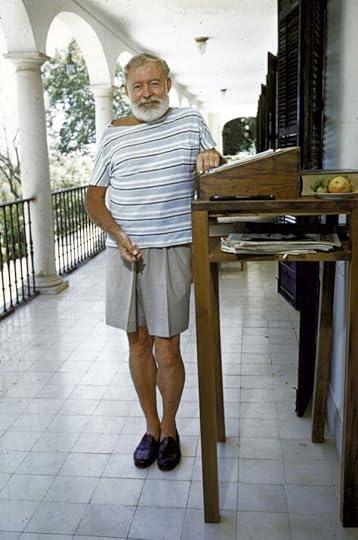
This book has only one actual "interview" with Ernest Hemingway. He finally agreed to provide answers to questions from The Paris Review in 1958, even though he felt he was just repeating his earlier statements about his writing methods. The other three "interviews" are articles resulting from the reporters simply dropping in on Hemingway at his Finca Vigia home in Cuba without invitation. Two of those apparently didn't even merit publication at the time, but became posthumous memorials after Hemingway's death in 1961. Although Hemingway was still suffering the after-effects of his African plane crash from 1954 and resented the interruptions, he receives the reporters politely for an afternoon or a day before sending them on their way.


Ernest Hemingway at his standup writing desk in his home, the Finca Vigia (Lookout Farm), near Havana, Cuba, from the late 1950s. The original photographer and exact date is unknown, but I sourced this photo from an article about Eight Famous People Who Used a Standing Desk.

Hemingway was likely working on parts of the so-called "land, sea and air" book (of which only Islands in the Stream has appeared posthumously in 1970) or the sexually adventurous The Garden of Eden (also published posthumously in 1986). The work on the Paris memoir A Moveable Feast (posthumously published in 1964) was likely done after the move back to the States and to Ketchum, Idaho after 1960.

Overall there wasn't much new to learn here about Hemingway, but it was good to know that he did enjoy some years of peace in his later life before the final mental and physical health issues led to his 1961 suicide.


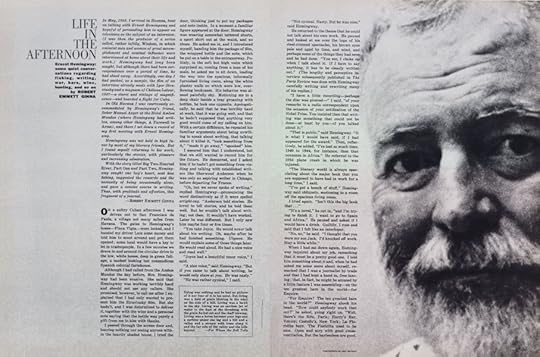
The opening pages of the article Life in the Afternoon, reproduced in this book as The Last Interview. Image sourced from Esquire Magazine, see link below.

Trivia and Links
I was able to locate 3 of the 4 interviews/articles online, all except the one for Toronto Star Weekly.

You can read Ernest Hemingway, The Art of Fiction No. 21 here, by George Plimpton, The Paris Review, Spring, 1958.

You can read Hemingway in Cuba here, by Robert Manning, Atlantic Monthly, August 1965. Robert Manning, the executive editor of The Atlantic, looks back on his 1954 visit with the Nobel Prize–winning author.

You can read Life in the Afternoon here, by Robert Emmett Ginna, Esquire Magazine, February 1, 1962. Ernest Hemingway: some quiet conversations regarding fishing, writing, war, bars, wine, hunting, and so on.
Profile Image for پیمان عَلُو.
346 reviews292 followers
April 26, 2021
+ «فرمول شما برای کسب بیشترین حد ممکن از زندگی چیست؟»


همینگوی چند ثانیه‌ای سکوت کرد و گفت :
«هیچ‌وقت دنبال شور و هیجان نباش،بگذار شور و هیجان به دیدنت بیاید.»
Profile Image for Steven R. Kraaijeveld.
563 reviews1,924 followers
January 29, 2016
“The further you go in writing the more alone you are. Most of your best and oldest friends die. Others move away. You do not see them except rarely, but you write and have much the same contact with them as though you were together at the café in the old days. You exchange comic, cheerfully obscene and irresponsible letters, and it is almost as good as talking. But you are more alone because that is how you must work and the time to work is shorter all the time and if you waste it you feel you have committed a sin for which there is no forgiveness.” (15)
This is a collection of four interviews with Hemingway, conducted in the years preceding his suicide. It ostensibly includes ‘the last one’ – although that seems more like a marketing angle than anything absolute, for one of the interviews is not even a proper interview (Hemingway strictly refused interviews when he was working, since they disturbed him; during one of these spells, an interviewer dropped in unannounced, and Hemingway courteously talked to him for a bit anyway), and I’m pretty sure that in the years between the ‘last’ interview in 1958 and his death in 1961, Hemingway talked to someone in some form of interview. Or perhaps not. It doesn’t really matter. These conversations, some more direct and/or spontaneous than others, come at the end of Hemingway’s life, and provide a glimpse (it cannot be more than that) of the man and his character, his experiences and way of life, and his writing and writing process. While reading these interviews, you can’t – or at least I couldn’t – help but feel affection for him, as well as a cool respect for his rigid work ethic. Sure, he has his flaws. But as Hemingway himself points out, in discussing Primo Carnera, Tom Wolfe, and Scott Fitzgerald, who could not take his alcohol (“it was just poison to him”):
Because all these guys had these weaknesses, it won them sympathy and favor, more sometimes than a guy without those defects would get.” (44)
Some interviews were better than others; the one in The Paris Review stood out, for instance, while I did not care much for the not-really-an-interview, because the reporter was snooty and self-important. However, even in that piece, you find yourself hanging on to Hemingway’s words, and trying to fill in a picture of him as a person and writer. As the interviews, overall, illustrate, this is not so easily done. Complexity of character is too readily attributed these days, when everyone is complication in (or because of) these ‘complicated times’. Hemingway had that depth, though, that true depth that springs from internal contradiction and countering forces; and within that depth, a kind of sensitivity that burns when it reveals itself.

The included interviews are the following:
1) Ernest Hemingway, The Art of Fiction No. 21 (The Paris Review, May 1954)
2) Hemingway in Cuba (The Atlantic Monthly, December 1954)
3) Dropping in on Hemingway (The Star Weekly Magazine, April 1958)
4) Life in the Afternoon: The Last Interview (Esquire, May 1958)

Note: There were numerous errors in the text (misspellings, duplicate words, omitted words, etc.), which is a shame. I contacted the publisher about this, and offered to send them an e-mail with the instances so that they might fix them in subsequent printings. I have not heard back yet.
Profile Image for Joseph Sciuto.
Author 11 books174 followers
August 30, 2019
Hemingway is one of my favorite writers ever. "The Sun Also Rises," and "A Farewell to Arms" both make my top ten lists. I consider him the greatest short story writer I have ever read, and his,"A Movable Feast" one of the best and touching memoirs ever written.

My one concern about Hemingway has always been that his adventurous life would overshadow his literary genius, and it is one reason I have stayed away from reading anymore biographers about his life and adventures.

My friend Frank's daughter, Alice, knowing that I am a Hemingway fan send me "Ernest Hemingway, The Last Interview" that is comprised of four interviews, by four distinguished writers, who interviewed Hemingway toward the very end of his life. Each interview gave me new insights into the writer that I did not know, and helped explain things I had wondered about for many years. As a fan of the writer, more than his adventurous life, the interviews were a telling example about what most concerned him about his writing, and his thoughts on many of the literary giants who were his friends. I truly enjoyed this book.
Profile Image for muthuvel.
256 reviews143 followers
August 20, 2016
More I came to know him, the more I'm in love with his words and simplicity. He wasn't a Philosopher, just a pretty good writer which he loved to do all his lifetime. The four Precious interviews gave me an ample amount of his personal life and his feelings. He was such a nice guy. I wish he were alive now.
Profile Image for Roula.
772 reviews220 followers
November 11, 2025
πολύ ενδιαφέρουσα σειρά βιβλίων ,πολύ ενδιαφέρουσες απόψεις για να ξεκινήσει κάποιος την επαφή του με τον συγγραφέα. .
Profile Image for Conrad Wesselhoeft.
Author 2 books54 followers
September 4, 2020
Hemingway is one of the most thoughtful writers on the topic of craft. He's also funny--something he tends to conceal in his fiction. These conversations offer a full-bodied portrait of a fascinating man and artist.
Profile Image for Sanjana.
115 reviews61 followers
Read
February 28, 2017
an honest, swell guy. probably should have saved this until after I read more of his books.

Fun Fact: He writes standing up! :)
Profile Image for Shadin Pranto.
1,484 reviews566 followers
August 31, 2022
"The Sun Also Rises'' উপন্যাসের সমাপ্তি মনের মতো হচ্ছিল না হেমিংওয়ের। তাই ঊনচল্লিশ বার কাটাকুটির পর চূড়ান্ত হয় বইটির সমাপ্তি। নিজের লেখালিখি নিয়ে অনেক কথাই বলেছেন হেমিংওয়ে। তবু কেন যেন ঠিক প্রত্যাশামতো হয়নি সাক্ষাৎকারগুলো।

হেমিংওয়ের অনুরাগীরা বইটি পড়ে দেখতে পারেন। এই কালজয়ী কথাশিল্পীর জীবন ও সাহিত্যচর্চা সম্পর্কে বিস্তর জানতে পারবেন।
Profile Image for Guy Choate.
Author 2 books25 followers
March 8, 2016
These four late-career interviews and quasi-interviews with Hemingway remind me that to be a writer, all one must do is write, write, write.
Profile Image for dkaufman .
68 reviews12 followers
February 4, 2017
Hemingway was obviously a hard guy to interview, but these attempts are insightful and interesting.
Profile Image for Andreea.
154 reviews62 followers
February 22, 2017
"'Give me a better excuse,' Hemingway said, and then thought of one himself. He saw the arrival of a visitor as an opportunity to fish on the Pilar after many weeks of enforced idleness. Bring a heavy sweater, and we'll go out on the boat, he said. 'I'll explain to Mary that you're coming down to cut me up and feed me to William Faulkner.'"

"A big man. Even after allowing for all the descriptions and photographs, the first impression of Hemingway in the flesh was size. He was barefoot and barelegged, wearing only floppy khaki shorts and a checked sport shirt, its tail tumbling outside."

"He had tried to make everything in the story real - the boy, the sea, and the marlin and the sharks, the hope being that each would then mean many things. In that way, the parts of a story become symbols, but they are not first designed or planted as symbols."

"So I finally agreed to referee for him. This was the Negro section, you know, and they really introduced me: 'And the referee for tonight, the world-famous millionaire, sports-man, and playboy, Mister Ernest Hemingway!' Hemingway chuckled. 'Playboy was the greatest title they thought they could give a man.' Chuckle again. 'How can the Nobel Prize move a man who has heard plaudits like that?"

"We'd go out and Joyce would fall into an argument or a fight. He couldn't even see the man, so he'd say, 'Deal with him, Hemingway! Deal with him!' Hemingway paused. 'In the big league it is not the way it says in the books.'"

"Hemingway - and this may surprise some people - is a shy, modest he-man. True, he has covered umpteen wars and has the wounds and medals to prove it. True, he has been gored by a bull, charged by elephants, exhausted by giant fish. True, he has conducyed vicious feuds, his consumption of alcohol is legendary, his search for adventure has covered the world. Yet - though it seems remarkable - he never uses the word 'I' with bravado, and the only time he smiles is at his failings. He even underrates his newspaper career."

"'I've changed - we all do. It has to happen,' he said. 'If I knew then what I know now I would have written my books under an assumed name. I don't want to be famous. I don't like publicity. All I ask from life is to write, hunt, fish, and be obscure. Fame embitters me. Questions torture me. I've had reporters submit lists of questions asking what I think of life... that type of thing. It would take days to answer."

"'Mr. Hemingway,' I said, 'I'm sorry I didn't get an interview but if I had, there's one question I would have asked: What is your formula for getting the most out of life?'
He thought about it for maybe a second.
'Never look for excitement - let excitement come to you,' was his answer."

"Hemingway an I talked again briefly, in New York. In the Autumn of 1959, from Spain, where he was following the bulls, Hemingway wrote, 'Take care of yourself so we can have another drink at La Floridita.' I wish it could have been that way."
Profile Image for Vishnu Brahmandam.
249 reviews48 followers
July 24, 2019
I was introduced to Hemingway earlier this year and I'm in awe at the way he spun his stories into this intricate web of words. He was such a clever, witty man.
Based on what little I've read by and of him, my favorite thing about his writing (Apart from his ability to convey so much in a few words, of course) is how much work he leaves to the reader. He really leaves a lot to the imagination. Mine is fairly overactive so there's nothing I love more than to sit there thinking about what he meant. Sure, there are times when I just stare into thin air, absolutely dumbfounded, whispering to myself, 'What on earth does he mean?!'
But there are many more moments where I can't stop grinning to myself about how brilliant he is. This is honestly a very intelligent, talented man. I enjoy reading between the lines! When the lines are great, the stuff hidden in between does well to complement them.
I came across this book of interviews while I was trying to find a good gift for a friend of mine who loves Hemingway. The book arrived in the mail the day before I was meeting the friend. I had to read it before I gifted it, of course.

He is such a character (absolutely said in a positive way). What a grounded, genuine person! His authenticity didn't surprise me but I found it reassuring. That his attitude was similar to what was shown through his writing. He was candid about the appropriate things and private about things that he did not feel were necessary to be put into the world.
I can't recall exactly what he said, but it was the way he answered a question which was based on something he said years before. It was about how he couldn't believe he'd said it and how he shouldn't have said it like that previously. His refusal at describing elements of his creative writing process was amusing. Felt like he was saying 'read between the lines' again, but about himself.

I didn't note down much because I felt like I'd end up bookmarking most of the things he said.
The one quote I had to bookmark was:

"I'm always reading books- as many as there are. I ration myself on them so that I'll always be in supply." -pg 18

True!
Profile Image for Moniek.
489 reviews22 followers
October 21, 2021
"What a question. But full marks for trying."

"I do not remember ever writing that. But it sounds silly and violet enough for me to have said it to avoid having to bite on the nail and make a sensible statement."

"I cared so much for Max Perkins that I have never been able to accept that he is dead."

"The fact that I am interrupting serious work to answer these questions proves that I am so stupid that I should be penalized severely. I will be. Don't worry."

"I'll explain to Mary that you're coming down to cut me up and feed me to William Faulkner."

"How would you like it if someone said that everything you've done in your life was done because of some trauma."

Ten zbiór był daleko na mojej liście do przeczytania, ale wczoraj przed snem miałam chwilę głębokiego niepokoju. Rozmowa z przyjaciółką owszem pomogła, ale mimo wszystko emocje nie chciały ze mnie zejść, a nie zamierzałam kłaść się spać roztrzęsiona, potrzebowałam na coś przełożyć to uczucie, a Ernest Hemingway często wcześniej przynosił mi komfort, więc kilka minut przed północą sięgnęłam po ten zbiór. W nocy przeczytałam pierwszy wywiad, dzisiaj rano pozostałe.

I pomogło. Ogromnie lubię postać Hemingwaya, przyniósł mi otuchę, zaciekawił, odwrócił moje myśli od tych moich małych lęków, rozbawił, poruszył i jak zwykle poczułam, że chciałabym, żeby został na trochę dłużej. Ten cytat o traumie dodał mi siły. Miło było spotkać się z Ernestem na te kilka stron.
Podoba mi się dobór wywiadów, bo każdy przebiegł trochę inaczej, zadawane były inne pytania, każdy dziennikarz skupiał się na innych cechach rozmówcy i Ernest, jak się zdaje, z każdym nawiązał wyjątkową, odrębną relację. Ostatni wywiad rzeczywiście najbardziej do mnie przemówił, ale to może przez komentarz o synu.
Trochę im teraz zazdroszczę.

To nie jest długa recenzja, ale to też była po prostu dla mnie specyficzna lektura, dla trochę innych celów.
38 reviews
August 21, 2018
I read, the old man and the sea when I was 15, and has been a fan of Hemingway since . The starkness of his emotions and the richness of his language has been a opium for me as a reader . However not only the writer Hemingway, but also the person Hemingway has been of immense attraction to me . A writer who smokes, drinks ,hunts , is mad about bull fight , claims is better than all his contemporaries , bashes the work of his fellow writer , wins the Nobel and kills himself with a shot gun to his mouth , how can you be anything but fascinated ? The interview shows the purity of the soul of a writer, who writes for the joy of creating and not for those deep and critical analysis which is done post his or her books come out . The way he ignores question he find boorish and doesn't hesitate to say so . The way he lets the critics find symbolism in his work or the way he demolishes the conclusion drawn about his work , reflects the genius of the man . It was a tour de force to read his view about art , literature and life in itself. After finishing it , my love has just turned deeper and more profound .
Profile Image for Anne.
Author 5 books14 followers
December 29, 2024
This is the third book of "The Last Interview and Other Conversations" series I finished reading and so far it's my least favorite one.
(The other two books being Octavia E. Butler: The Last Interview: and Other Conversations and James Baldwin: The Last Interview and Other Conversations).
I don't know if the (male) journalist weren't as good or wanted to show of their own "writing skills" instead of just printing a real interview or if Hemingway was a bad interview partner.
The interviews are more a description of the interview setting than having real content. Maybe Hemingway wasn't asked the right questions but compared to the other two books I didn't learn much about him after reading these "interviews".
Profile Image for Phil Greaney.
125 reviews12 followers
November 27, 2019
Hemingway had the 'ump for the most part, especially the first interview. Downright rude at a couple of points. But I don't blame him, in a way: he didn't like talking much about his work, in detail at least, and there is no wonder why. Artists often can't or don't want to. The art speaks for itself. And if you can't tolerate that, read the critics. Camus' epilogue to 'The Outsider' says it all: it's not my work anymore once it is published and read; it belongs to the readers.

I think I've all of these interviews although not collected here. It's a useful book to bring them all together. You can learn about the iceberg principle, which is interesting and well-understood in outline. Or perhaps his greatest lesson: he got up early in the morning to write, often while it was still cold, and wrote in pencil - and without (much) interruption.
Profile Image for Renjith R.
218 reviews20 followers
January 3, 2020
People are of different kinds. As far as I know no person is similar to other. There are numerous differences even if we found him/her same as a person we know. Hemingway was such a person, a complete different, talented character, that's what I felt reading this.

About the interviews, well explained and touching. But I feel incomplete most of the time. The first interview in this book, done by George Plimpton should particularly mentioned. The narrative part of the Hemingway's home was very catchy and inspiring to read further.

After reading this book, I decided to read 'The old man and the Sea' and 'A Moveable feast'😊💕
Profile Image for Assem Saleh.
134 reviews65 followers
July 28, 2018
اربع حوارات مع هيمنغواي خلال سنوات اقامته في كوبا في الخمسينات الميلادية. الحوار الأميز بالنسبة لي كان الحوار الذي اجراه روبرت ماننغ لدورية الاتلانتيك و هو الثاني في الكتاب. و هو حوار ممتع لأنه تم على عدة ايام اقام فيها الصحفي بمنزل هيمنغواي و تخللتها رحلة بحرية للصيد. حوار تطرق فيه لكل شيء في حياته: الصيد، الكتابة، الحرب، الشراب، القراءة، اراؤه حول بعض الادباء كعزرا باوند و جيمس جويس و فيتسجيرالد.
Profile Image for Varun.
36 reviews1 follower
March 6, 2019
Hemingway is an author that I'm terribly fond of and as much as I'd like to write about him, I believe the best tribute to pay the man would be to speak as little as one can about him (and his writing). If you understand Hemingway, savour it. If you do not, let him be.

This book made me smile a fair bit and at times I laughed out loud at the Big Man's scathing wit. I do not wish to share anymore about this experience. I intend to savour it. Thank you, Papa.
Profile Image for Spencer.
158 reviews5 followers
January 1, 2023
One book in one day to finish out my 2022 Reading Challenge. Well edited: four interviews showing multiple sides of Hemingway in his final years. He could be arrogant and cross, jovial and humble, and everything in between. He seemed to loathe the thought of interviews, yet on rare occasion welcomed the company of a journalist.
Profile Image for Chumba Tribes.
129 reviews8 followers
August 17, 2025
Μικρό μεζεδάκι ίσα ίσα για να σου ανοίξει την όρεξη να ξαναπιάσεις τον Χέμινγουεϊ. Μια απ τις συνεντεύξεις (η πρώτη και μεγαλύτερη στο The Paris Review) είναι πραγματικά ενδιαφέρουσα. Οι άλλες δείχνουν τον Χέμινγουεϊ μέσα απ τα μάτια αυτών που του μιλούν. Διαβάζεται σε μισό απόγευμα και έχεις και δύο τρεις ατάκες να θυμάσαι.
Profile Image for Kristy.
18 reviews1 follower
December 25, 2016
Hemingway comes to life: we are allowed a glimpse of a mind curt, succinct, observant, dissecting, profound, soulful, and that of one which understood the art of conveying through silence, in between the lines, like Chopin, in between the notes.
Profile Image for Yvonne.
339 reviews
June 14, 2023
I sure liked the last interview, that wasn't actually an interview. I'm not sure if the situation described actually happened, but that doesn't take away from the story. I wished I was that interviewer, then, there : - )
This entire review has been hidden because of spoilers.
Profile Image for Meagan.
81 reviews
March 29, 2020
Very quick read, but oh how I adore Hemingway. I love getting to experience a sliver of his life.
Profile Image for Ľubomíra.
43 reviews6 followers
September 19, 2021
Most of the information in this book (containing four different interview) weren’t new to me, but I still marvelled at this man’s charisma, his passion for adventure and all the good things in life despite the trauma and suffering he’d gone through. He is raw and honest, he keeps his sentences short and clear. He doesn’t pretend to be a god, but always keeps his feet on the ground expect for those times when he sails the seas… and reading this made me want to do the same.
Displaying 1 - 30 of 39 reviews

Can't find what you're looking for?

Get help and learn more about the design.