

What do you think?

A Taste of Blackberries
What do you do without
your best friend? Jamie isn't afraid of anything. Always ready to get into trouble, then right back out of it, he's a fun and exasperating best friend. But when something terrible happens to Jamie, his best friend has to face the tragedy alone. Without Jamie, there are so many impossible questions to answer -- how can your best friend be gone forever? How can some things, like playing games in the sun or the taste of the blackberries that Jamie loved, go on without him?
your best friend? Jamie isn't afraid of anything. Always ready to get into trouble, then right back out of it, he's a fun and exasperating best friend. But when something terrible happens to Jamie, his best friend has to face the tragedy alone. Without Jamie, there are so many impossible questions to answer -- how can your best friend be gone forever? How can some things, like playing games in the sun or the taste of the blackberries that Jamie loved, go on without him?
96 pages, Paperback
First published May 1, 1973
About the author
Doris Buchanan Smith
30 books19 followersDoris Buchanan Smith (June 1, 1934 – August 8, 2002) was an American author of award-winning children's novels, including A Taste of Blackberries (1973).
Ratings & Reviews
Friends & Following
Create a free account to discover what your friends think of this book!
Community Reviews
Displaying 1 - 30 of 241 reviews

October 7, 2011
I love this book, both because it is a great story, but also because the character Jamie was named after my dad.
My dad's grandmother was neighbors with Doris Buchanan Smith when my dad was little, and they were great friends. Of course my great-grandma Beard would always brag about her grandchildren and update her friends on how they were doing. While Doris was writing this story, she needed a seemingly pointless and sudden death to give it the angle she wanted. Around that time my dad's parents discovered that he was allergic to a rare type of wasp sting (but he didn't die), and my great-grandma told Doris about it. Suddenly she knew the way she would have the character Jamie die, and she named him after my dad because she borrowed his allergy for the book.
My dad's grandmother was neighbors with Doris Buchanan Smith when my dad was little, and they were great friends. Of course my great-grandma Beard would always brag about her grandchildren and update her friends on how they were doing. While Doris was writing this story, she needed a seemingly pointless and sudden death to give it the angle she wanted. Around that time my dad's parents discovered that he was allergic to a rare type of wasp sting (but he didn't die), and my great-grandma told Doris about it. Suddenly she knew the way she would have the character Jamie die, and she named him after my dad because she borrowed his allergy for the book.

July 21, 2007
This book may have saved my mother's life.
This is one of the first children's books to deal with death, and in it ***SPOILER ALERT!!!!***** the main character's best friend dies from bee stings (this book came before movies such as MY GIRL), and when I read this at a young age, I hadn't known that you could be allergic and die from something like a bee sting.
Years later when I was 12 or 13, my mother came to me at home and said she had been stung by a bee and was feeling funny. She seemed weak, and the site of the sting was also swelling up. I told her that bee stings were dangerous and it seemed like she was allergic and she should call a doctor right away. She did, was treated, and the doctor told her that I saved her life.
So, there you go. A children's book saved my mother's life.
This is one of the first children's books to deal with death, and in it ***SPOILER ALERT!!!!***** the main character's best friend dies from bee stings (this book came before movies such as MY GIRL), and when I read this at a young age, I hadn't known that you could be allergic and die from something like a bee sting.
Years later when I was 12 or 13, my mother came to me at home and said she had been stung by a bee and was feeling funny. She seemed weak, and the site of the sting was also swelling up. I told her that bee stings were dangerous and it seemed like she was allergic and she should call a doctor right away. She did, was treated, and the doctor told her that I saved her life.
So, there you go. A children's book saved my mother's life.
This entire review has been hidden because of spoilers.

August 14, 2023
✰ 4.5 stars ✰
“Do you remember," I asked Jamie in my mind, "the taste of blackberries?”
3rd Grade Treasures
1996-1997. 3rd Grade. The year Spice Girls Fever took over Lahore and my little schoolgirl heart. (Yes, I still have their entire discography memorized - don't judge me! 😅) The year I played the Ladybug in our advanced reading class' stage production of James and the Giant Peach. (I was so perfectly type-cast, no one even objected it! 😊) The year all the girls in my class waged a full-out war against me, accusing me that I enjoyed spending more time with the boys in our class than with them. (Yes, I had been - but I swear, it had never been intentional! 😣) The year the boy who had been my friend since Nursery unknowingly crushed my little crush on him; and in return, the boy who I had only known by name since Nursery became my best friend forever. (He played the Centipede to my Ladybug in our class play, and the boy who crushed my heart - well, he played Aunt Sponge - poetic justice. 😏) And, it was the year, my librarian, Ms. Helen, added three books to my library check-out card - books that even now I did not forget how much of an impact they left on me. 🥺🥺
“Did the world know that Jamie was dead? The sky didn't act like it.
It was a blue-sky and white-cloud day.”
I want to know who thought writing about a boy losing his best friend at you a young age is a right idea for a children's book.
I want to know why Ms. Helen didn't warn me about how sad this was going to be and that I should be prepared to have tissues at hand.
I want to know why that even when I'm in my mid thirties, and even now, I am still tearing up at the simple story-telling that captures with such heart the emptiness of heart at losing a friend.
“I grabbed the soap and rubbed up a lather.
The soap was my lamp and I was Aladdin. I would rub life back for Jamie.”
There is such a simple beauty to A Taste of Blackberries one that cements it's weight into your heart at how Doris Buchanan Smith spoke about the loss of losing a friend through the eyes of a young boy. He remained nameless, but his feelings reach you. 💔💔 Maybe because when I re-read it over the weekend - I knew already what would happen, but I still teared up.
“Why did he have to die?" The question lay there in the air between us.
The sound of it shocked me, but Mrs. Mullins didn't act surprised.
"Honey, one of the hardest things we have to learn is that some questions do not have answers.”
There is such a gentleness in how she weaves the story - an ordinary day shared between friends as they make plans to pick blackberries together, and followed by a not-so ordinary day where, while helping a neighbor in need, Jamie gets stung by a bee and dies, because no one ever knew he was allergic to their sting. 😥 And then how the events slowly dawn on the young protagonist's heart - the quiet disbelief, the unwillingness to accept the truth - how often are their stories that capture those immediate feelings of a child with such tender emotions? 🤧🤧
The innocent way in which she depicted how he was grieving for his best friend - how he saw it through the eyes of the ones who he left behind, how he wondered about where he was now - was he happy now? - what did he think of him - who would he play with now - those little memories that creep up on you as you look across the street - searching for the light that would reflect when Jamie would signal that your message had reached him - only to know that that light would never shine again. 😣😣
And that scene at the funeral - with tears a plenty and family member's gathered around - this little boy's thoughts - have you read anything that has ever described this sharp pain of sadness so acutely - with such ---- that while everyone is together in their shared loss - the one who is left behind, is reaching out to the friend who is gone, offering even the slightest of comfort - that he is not alone - that he is still with him in spirit - who writes like this now!!?? 💘💘
“Some were crying. I leaned my back against the door frame, thinking to Jamie.
"I'm here. I'm here, Jamie.”
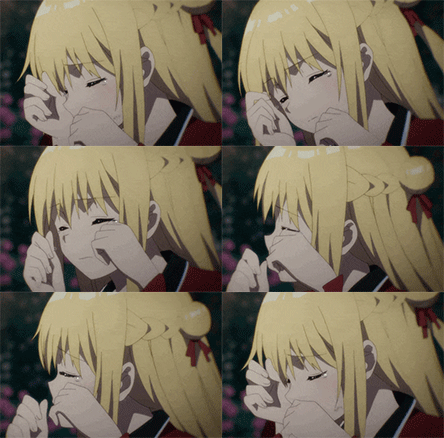
Yeah, I was a blubbering mess - I am a mess, writing this. 😭😭 The writing is vividly light and honest, but still, so powerfully heartfelt - writing from a child's point of view, as he tries to grapple with understanding as to why this had to happen to his best friend, was so very well done. And then showing us how he learns to grieve, his thoughtful and well-intended questions about death and then, still finding a healthy way to move on from it. That moment with Jamie's mother at the end - that touch of gratitude for her son's best friend's kindness. That instance when he looked at Jamie's little sister and thought how she understood more about what had happened to Jamie than the adults were able to convey. 😟😟
“How could I explain to her? Maybe it didn't make much sense but I knew I couldn't eat until after the funeral.
Everyone was talking, eating, moving—just like things were the same.
Somehow I couldn't let things be the same.”
You don't need to tell a story in so many words to capture the feelings of loneliness and grief over losing a best friend and at such a young age too. For the nameless narrator, Jamie for all his jokes and tricks and laughs, he was his best friend - even unto death, even as an angel, he would be by his side. ❤️🩹❤️🩹
I don't quite recall my feelings after reading it back then - I don't even remember returning it, because I was probably all set to get my little paws on the latest release of the Goosebumps series - I was rabid for those books!
But, I do remember so very clearly that the year after that, I was stung by a bee during fourth grade recess. And I was scrubbing furiously at the sting to go down, I remember the tears running down my cheeks - not from pain, but tears of gratitude, silently grateful that I was not allergic to their sting.
And this may have been the strangest take-away I had from it, but if that doesn't show how a book left an impression on you, then I don't know what does. 🤍 🤍
“Do you remember," I asked Jamie in my mind, "the taste of blackberries?”
3rd Grade Treasures
1996-1997. 3rd Grade. The year Spice Girls Fever took over Lahore and my little schoolgirl heart. (Yes, I still have their entire discography memorized - don't judge me! 😅) The year I played the Ladybug in our advanced reading class' stage production of James and the Giant Peach. (I was so perfectly type-cast, no one even objected it! 😊) The year all the girls in my class waged a full-out war against me, accusing me that I enjoyed spending more time with the boys in our class than with them. (Yes, I had been - but I swear, it had never been intentional! 😣) The year the boy who had been my friend since Nursery unknowingly crushed my little crush on him; and in return, the boy who I had only known by name since Nursery became my best friend forever. (He played the Centipede to my Ladybug in our class play, and the boy who crushed my heart - well, he played Aunt Sponge - poetic justice. 😏) And, it was the year, my librarian, Ms. Helen, added three books to my library check-out card - books that even now I did not forget how much of an impact they left on me. 🥺🥺
“Did the world know that Jamie was dead? The sky didn't act like it.
It was a blue-sky and white-cloud day.”
I want to know who thought writing about a boy losing his best friend at you a young age is a right idea for a children's book.
I want to know why Ms. Helen didn't warn me about how sad this was going to be and that I should be prepared to have tissues at hand.
I want to know why that even when I'm in my mid thirties, and even now, I am still tearing up at the simple story-telling that captures with such heart the emptiness of heart at losing a friend.
“I grabbed the soap and rubbed up a lather.
The soap was my lamp and I was Aladdin. I would rub life back for Jamie.”
There is such a simple beauty to A Taste of Blackberries one that cements it's weight into your heart at how Doris Buchanan Smith spoke about the loss of losing a friend through the eyes of a young boy. He remained nameless, but his feelings reach you. 💔💔 Maybe because when I re-read it over the weekend - I knew already what would happen, but I still teared up.
“Why did he have to die?" The question lay there in the air between us.
The sound of it shocked me, but Mrs. Mullins didn't act surprised.
"Honey, one of the hardest things we have to learn is that some questions do not have answers.”
There is such a gentleness in how she weaves the story - an ordinary day shared between friends as they make plans to pick blackberries together, and followed by a not-so ordinary day where, while helping a neighbor in need, Jamie gets stung by a bee and dies, because no one ever knew he was allergic to their sting. 😥 And then how the events slowly dawn on the young protagonist's heart - the quiet disbelief, the unwillingness to accept the truth - how often are their stories that capture those immediate feelings of a child with such tender emotions? 🤧🤧
The innocent way in which she depicted how he was grieving for his best friend - how he saw it through the eyes of the ones who he left behind, how he wondered about where he was now - was he happy now? - what did he think of him - who would he play with now - those little memories that creep up on you as you look across the street - searching for the light that would reflect when Jamie would signal that your message had reached him - only to know that that light would never shine again. 😣😣
And that scene at the funeral - with tears a plenty and family member's gathered around - this little boy's thoughts - have you read anything that has ever described this sharp pain of sadness so acutely - with such ---- that while everyone is together in their shared loss - the one who is left behind, is reaching out to the friend who is gone, offering even the slightest of comfort - that he is not alone - that he is still with him in spirit - who writes like this now!!?? 💘💘
“Some were crying. I leaned my back against the door frame, thinking to Jamie.
"I'm here. I'm here, Jamie.”
Yeah, I was a blubbering mess - I am a mess, writing this. 😭😭 The writing is vividly light and honest, but still, so powerfully heartfelt - writing from a child's point of view, as he tries to grapple with understanding as to why this had to happen to his best friend, was so very well done. And then showing us how he learns to grieve, his thoughtful and well-intended questions about death and then, still finding a healthy way to move on from it. That moment with Jamie's mother at the end - that touch of gratitude for her son's best friend's kindness. That instance when he looked at Jamie's little sister and thought how she understood more about what had happened to Jamie than the adults were able to convey. 😟😟
“How could I explain to her? Maybe it didn't make much sense but I knew I couldn't eat until after the funeral.
Everyone was talking, eating, moving—just like things were the same.
Somehow I couldn't let things be the same.”
You don't need to tell a story in so many words to capture the feelings of loneliness and grief over losing a best friend and at such a young age too. For the nameless narrator, Jamie for all his jokes and tricks and laughs, he was his best friend - even unto death, even as an angel, he would be by his side. ❤️🩹❤️🩹
I don't quite recall my feelings after reading it back then - I don't even remember returning it, because I was probably all set to get my little paws on the latest release of the Goosebumps series - I was rabid for those books!
But, I do remember so very clearly that the year after that, I was stung by a bee during fourth grade recess. And I was scrubbing furiously at the sting to go down, I remember the tears running down my cheeks - not from pain, but tears of gratitude, silently grateful that I was not allergic to their sting.
And this may have been the strangest take-away I had from it, but if that doesn't show how a book left an impression on you, then I don't know what does. 🤍 🤍

April 22, 2020
When our son was in the 4th grade, his teacher read this book to his class. I remember him saying that the whole class was sobbing. I was sobbing myself when I read it, just like our whole family sobbed over Charlotte's Web which my other son's second grade teacher read to them. A Taste of Blackberries read to those fourth graders probably put "death" on their radar, but no book could ever prepare them - or anyone - for the traumatic loss of a young friend or any death that you experience as a child. There are many children's books that deal with death and dying, including the death of pets. I kept a list of them at one time for teachers who would request a book for one of their students who had experienced a loss. Some are better than others at gently explaining or trying to make sense of a topic that touches us all.

November 2, 2013
"(O)ne of the hardest things we have to learn is that some questions do not have answers."
—Mrs. Mullins, A Taste of Blackberries, PP. 61-62
The list of books for younger readers dealing with issues of losing a loved one is long and illustrious, and includes many great American classics. Bridge to Terabithia by two-time Newbery Medalist Katherine Paterson is one of the best-known, an exercise so profound in its understanding of human emotion as to set it apart from all else that came before or could ever follow it. There's also The Lottery Rose by Irene Hunt, Roller Skates by Ruth Sawyer, Little Women by Louisa May Alcott, Nana Upstairs and Nana Downstairs by Tomie dePaola, Annie and the Old One by Miska Miles, Nobody's Fault? by Patricia Hermes, On My Honor by Marion Dane Bauer, Charlotte's Web by E.B. White—in all probability the greatest of them all—and a host of others too numerous to mention individually. A Taste of Blackberries is one of the shortest juvenile books on the subject of death I've ever read, just eighty-five pages of relatively large font, and it goes by so quickly you might miss the magnitude of its meaning if you aren't careful to take it slow and absorb every moment of understated brilliance it has to offer. Pound for pound, A Taste of Blackberries is within shouting distance of the greatest books I've ever read, painted in strokes of plain, simple beauty, the incredible shining light of shared human experience hidden behind actions routine and unspectacular. A spoken sentence here or there reveals the depths of a lifetime of adoration and the mourning still to come over the loss of one so special it rips our hearts out just as it does to the mother who must give her luminously endowed son back to the soil, knowing nothing in the universe can replace a one and only son. In remarkably spare, unadorned writing, Doris Buchanan Smith delivers a stunner of a novel that gets to the point and does it quickly, allowing us a glimpse, while its few pages still turn beneath our fingers, of a young life snuffed out before those around him have time to comprehend what has happened, and the aftermath of sudden tragedy as it settles back into the pitiless reality of eternity. I don't see how one could reemerge the same person after the experience of reading A Taste of Blackberries.
Jamie is a source of constant amazement to his best friend, who is never given a name in this book. Jamie is playful and unpredictable, taking chances where his friend is wary, not worried about neighborhood legends and cautionary tales to stick close to home and stay beneath the radar of grownups who are reportedly mean to kids. Jamie is the kind of boy who will sneak into the yard of the neighbor rumored to carry a gun to prevent theft from his prized apple tree, filch the shiny red fruit from the tree in question, and dash back to his friend's side with an apple for each of them, laughing about the risk he took to get it. Where Jamie is showy and attracts attention, his friend merely watches his antics in quiet astonishment, knowing he would never duplicate Jamie's actions even if he could. Who wants to always be on the brink of getting into trouble?
But Jamie's penchant for mischief backfires on him when he and a group of friends from the neighborhood agree to work for the cranky lady next door to remove beetles from her yard. No one ever knew about Jamie's particular medical vulnerability, not even Jamie, and an afternoon of paid fun rounding up herbivorous beetles in glass jars morphs in an instant into a shocking tragedy no one could have foreseen. The boy whom the word irrepressible could have been invented to describe is gone in a few minutes of fateful inaction, so quickly there's no time for his friends to fear the worst before it comes upon them. How Jamie's best friend would love to endure the anxiety of his daring escapades now, to resurrect to existence the kid whose presence changed those around him moment by moment, never allowing a careful approach to spoil the fun of any situation.
Step by step as he wanders through his normal routine, Jamie's best friend runs up against places in his life where Jamie made his mark, a far deeper mark than he'd ever noticed. It's the window he stood at flashing morse code across their yards to Jamie and receiving signals back, communicating without words as effectively as if they were speaking face to face. It's the blackberry patch that sits untouched now down by the river, luscious berries hanging ready to be picked and added to the basket, so ripe they practically fall off the stem at the faintest touch. This new silence in the neighborhood is as loud a presence as Jamie ever was, conspicuously lacking an untamed, unrepentant boy to start the party. What can Jamie's best friend do to fill the quiet of missing someone he often viewed as an exasperation to be tolerated, now that Jamie has stepped off the gangplank of this life into the ether of eternity, never to rile up the neighbors again, never to show up at his mother's door with a fresh batch of blackberries ready for baking, never to take on the world with his crazy ideas and keep everyone on their toes?
Jamie's friend has no way of knowing what he's supposed to do with the fact that Jamie is dead. Should he talk to Jamie's mother or four-year-old sister, Martha, about the boy in their life who was taken too soon? Should he know what the loss means to himself and his family, or how it affects the community, and come up with a meaningful tribute to Jamie based on that knowledge? Jamie's best friend has no idea how to handle any of this. All he has is his reaction in the present moment, dealing in the next breath with what has been lost and trying to figure out what he wants to do about it. There are no outside expectations for his response to Jamie's death, leaving him free to react naturally to the tragedy that has touched them all. And in an afternoon of dawning perception as he takes time to listen to what Jamie would say to him now, Jamie's friend comes up with a gesture of love so breathtakingly beautiful in its simplicity of expression, the most hardened readers will be unable to staunch the flow of tears as a boy lost without the friend he has known forever reunites with the spirit of the only one who could ever be a best friend in his life. The moment is fleeting and bittersweet, but its resounding emotion will never loosen its hold on the reader's heart.
"(R)ipples go on forever and ever, even when you can't see them anymore."
—A Taste of Blackberries, P. 45
The name of Jamie's best friend is withheld throughout A Taste of Blackberries, and I think that's a good thing. Rather than just reading a sad story about friends separated by the perplexing injustice of childhood death, we are invited to fill the shoes of Jamie's friend, to feel his imminent loss as our own, but only after meeting Jamie and getting to have him as our friend a little while, too. Jamie isn't perfect, and there's no need for him to be; who ever heard of a perfect friend? But he is a friend, along with everything that designation entails, and the loss of a friend forever hits much harder than the death of a paragon of kindness, fairness and virtuosity from afar. Because we are brought so close to the story by stepping into the position of Jamie's best friend, the sudden loss is much more real and emotional than it would have been, and the final moment as the story closes is as personal and intense as anything I've ever read.
A Taste of Blackberries is a master work of human emotion, perhaps the greatest novel of its size I've encountered. I can scarcely conceive how Doris Buchanan Smith was able to infuse a story of such brevity with so much power, a classic for the ages that will never lose its ability to touch hearts, no matter how much the world changes. A big part of me wants to give four and a half stars to this book, and had it won the 1974 Newbery Medal, I'm not sure I could have come up with a more deserving alternative. A Taste of Blackberries will always be one of the most memorable, meaningful books I've ever read, and its echo will never cease ringing in my heart.
—Mrs. Mullins, A Taste of Blackberries, PP. 61-62
The list of books for younger readers dealing with issues of losing a loved one is long and illustrious, and includes many great American classics. Bridge to Terabithia by two-time Newbery Medalist Katherine Paterson is one of the best-known, an exercise so profound in its understanding of human emotion as to set it apart from all else that came before or could ever follow it. There's also The Lottery Rose by Irene Hunt, Roller Skates by Ruth Sawyer, Little Women by Louisa May Alcott, Nana Upstairs and Nana Downstairs by Tomie dePaola, Annie and the Old One by Miska Miles, Nobody's Fault? by Patricia Hermes, On My Honor by Marion Dane Bauer, Charlotte's Web by E.B. White—in all probability the greatest of them all—and a host of others too numerous to mention individually. A Taste of Blackberries is one of the shortest juvenile books on the subject of death I've ever read, just eighty-five pages of relatively large font, and it goes by so quickly you might miss the magnitude of its meaning if you aren't careful to take it slow and absorb every moment of understated brilliance it has to offer. Pound for pound, A Taste of Blackberries is within shouting distance of the greatest books I've ever read, painted in strokes of plain, simple beauty, the incredible shining light of shared human experience hidden behind actions routine and unspectacular. A spoken sentence here or there reveals the depths of a lifetime of adoration and the mourning still to come over the loss of one so special it rips our hearts out just as it does to the mother who must give her luminously endowed son back to the soil, knowing nothing in the universe can replace a one and only son. In remarkably spare, unadorned writing, Doris Buchanan Smith delivers a stunner of a novel that gets to the point and does it quickly, allowing us a glimpse, while its few pages still turn beneath our fingers, of a young life snuffed out before those around him have time to comprehend what has happened, and the aftermath of sudden tragedy as it settles back into the pitiless reality of eternity. I don't see how one could reemerge the same person after the experience of reading A Taste of Blackberries.
Jamie is a source of constant amazement to his best friend, who is never given a name in this book. Jamie is playful and unpredictable, taking chances where his friend is wary, not worried about neighborhood legends and cautionary tales to stick close to home and stay beneath the radar of grownups who are reportedly mean to kids. Jamie is the kind of boy who will sneak into the yard of the neighbor rumored to carry a gun to prevent theft from his prized apple tree, filch the shiny red fruit from the tree in question, and dash back to his friend's side with an apple for each of them, laughing about the risk he took to get it. Where Jamie is showy and attracts attention, his friend merely watches his antics in quiet astonishment, knowing he would never duplicate Jamie's actions even if he could. Who wants to always be on the brink of getting into trouble?
But Jamie's penchant for mischief backfires on him when he and a group of friends from the neighborhood agree to work for the cranky lady next door to remove beetles from her yard. No one ever knew about Jamie's particular medical vulnerability, not even Jamie, and an afternoon of paid fun rounding up herbivorous beetles in glass jars morphs in an instant into a shocking tragedy no one could have foreseen. The boy whom the word irrepressible could have been invented to describe is gone in a few minutes of fateful inaction, so quickly there's no time for his friends to fear the worst before it comes upon them. How Jamie's best friend would love to endure the anxiety of his daring escapades now, to resurrect to existence the kid whose presence changed those around him moment by moment, never allowing a careful approach to spoil the fun of any situation.
Step by step as he wanders through his normal routine, Jamie's best friend runs up against places in his life where Jamie made his mark, a far deeper mark than he'd ever noticed. It's the window he stood at flashing morse code across their yards to Jamie and receiving signals back, communicating without words as effectively as if they were speaking face to face. It's the blackberry patch that sits untouched now down by the river, luscious berries hanging ready to be picked and added to the basket, so ripe they practically fall off the stem at the faintest touch. This new silence in the neighborhood is as loud a presence as Jamie ever was, conspicuously lacking an untamed, unrepentant boy to start the party. What can Jamie's best friend do to fill the quiet of missing someone he often viewed as an exasperation to be tolerated, now that Jamie has stepped off the gangplank of this life into the ether of eternity, never to rile up the neighbors again, never to show up at his mother's door with a fresh batch of blackberries ready for baking, never to take on the world with his crazy ideas and keep everyone on their toes?
Jamie's friend has no way of knowing what he's supposed to do with the fact that Jamie is dead. Should he talk to Jamie's mother or four-year-old sister, Martha, about the boy in their life who was taken too soon? Should he know what the loss means to himself and his family, or how it affects the community, and come up with a meaningful tribute to Jamie based on that knowledge? Jamie's best friend has no idea how to handle any of this. All he has is his reaction in the present moment, dealing in the next breath with what has been lost and trying to figure out what he wants to do about it. There are no outside expectations for his response to Jamie's death, leaving him free to react naturally to the tragedy that has touched them all. And in an afternoon of dawning perception as he takes time to listen to what Jamie would say to him now, Jamie's friend comes up with a gesture of love so breathtakingly beautiful in its simplicity of expression, the most hardened readers will be unable to staunch the flow of tears as a boy lost without the friend he has known forever reunites with the spirit of the only one who could ever be a best friend in his life. The moment is fleeting and bittersweet, but its resounding emotion will never loosen its hold on the reader's heart.
"(R)ipples go on forever and ever, even when you can't see them anymore."
—A Taste of Blackberries, P. 45
The name of Jamie's best friend is withheld throughout A Taste of Blackberries, and I think that's a good thing. Rather than just reading a sad story about friends separated by the perplexing injustice of childhood death, we are invited to fill the shoes of Jamie's friend, to feel his imminent loss as our own, but only after meeting Jamie and getting to have him as our friend a little while, too. Jamie isn't perfect, and there's no need for him to be; who ever heard of a perfect friend? But he is a friend, along with everything that designation entails, and the loss of a friend forever hits much harder than the death of a paragon of kindness, fairness and virtuosity from afar. Because we are brought so close to the story by stepping into the position of Jamie's best friend, the sudden loss is much more real and emotional than it would have been, and the final moment as the story closes is as personal and intense as anything I've ever read.
A Taste of Blackberries is a master work of human emotion, perhaps the greatest novel of its size I've encountered. I can scarcely conceive how Doris Buchanan Smith was able to infuse a story of such brevity with so much power, a classic for the ages that will never lose its ability to touch hearts, no matter how much the world changes. A big part of me wants to give four and a half stars to this book, and had it won the 1974 Newbery Medal, I'm not sure I could have come up with a more deserving alternative. A Taste of Blackberries will always be one of the most memorable, meaningful books I've ever read, and its echo will never cease ringing in my heart.
February 15, 2008
Oh gosh... this was the book that taught me to pre-read before reading aloud to my kid. He and I were both bawling when I read it to him. Later though, it stimulated a great talk about death and dying.
I wish this book had been around when I was in fourth grade and a friend died in a fire. That was before the days of grief counseling in schools and such, so those of us who felt the loss weren't allowed to talk about it and just had to ignore our feelings and hope they'd go away. I hope that my son never has to go through the loss of a close friend like that, but if he does, at least now we've had a talk about how mourning is normal and okay. We probably wouldn't have if we hadn't read this book together.
I wish this book had been around when I was in fourth grade and a friend died in a fire. That was before the days of grief counseling in schools and such, so those of us who felt the loss weren't allowed to talk about it and just had to ignore our feelings and hope they'd go away. I hope that my son never has to go through the loss of a close friend like that, but if he does, at least now we've had a talk about how mourning is normal and okay. We probably wouldn't have if we hadn't read this book together.

May 7, 2013
A gentle story of a boy and his larger than life best friend. I liked the way this story honestly dealt with grief, loss, and the questions we all have when dealing with the death of someone we love. I appreciate how this book never felt heavy handed, or moralizing. The questions the boy had were treated with respect, and even though the adults couldn't give him concrete answers they gave the love, support, and space he needed so he could deal with his loss, and learn how to move on without his best friend.

October 15, 2020
Very short, but powerful. Smith provided so much detail in so few pages - about the two friends, their families, other kids, neighbors, the various relationships and histories. I might wish for a book of a dozen short stories set in this town, but maybe just this little glimpse is enough.

June 30, 2011
I just saw a book category on someone's shelf named "Books that made me cry". I immediately thought of this book from my childhood and the many times I enjoyed crying over this short but touching book. Not being an expert on grief, I'm not sure if the author dealt with the topic in a clinically accepted way. To this day, I have never experienced prolonged grief at the loss of a friend or loved one. However, I think that somewhere deep in my psyche this book has become part of the way I deal with loss because I read it at such a young age. I do recommend the book for the younger set. Maybe older people will like it too, but even back when I read it at the tender age of 10, it only took an hour or so to read.

December 1, 2008
3.75 stars
Definitely a reread for me. I read this book several times as a young kid. I remember the first time I read it was actually in 5th grade, on the first day of class I think. My teacher read this book out loud to the class. She cried at the end.
My sister has always loved this book as well.
I think it’s great how the author addresses the topic of death with children and all the bi questions that come along with it.
Definitely a reread for me. I read this book several times as a young kid. I remember the first time I read it was actually in 5th grade, on the first day of class I think. My teacher read this book out loud to the class. She cried at the end.
My sister has always loved this book as well.
I think it’s great how the author addresses the topic of death with children and all the bi questions that come along with it.

June 8, 2010
Doris Buchanan Smith’s A Taste of Blackberries starts with an idyllic childhood moment: two young friends rambling through a blackberry patch, checking to see if the fruit is ripe. The lazy summer day continues with races and some mischievous apple thieving, and Jaime, the (unnamed) narrator’s friend, always vying for attention. Jaime is fun, but he’s also melodramatic and a bit of a show off, and his antics are sometimes too much for the narrator to take.
Everything changes when Jaime stirs up a bees nest that afternoon. Many of the neighborhood children get stung, including Jaime, who makes a big show of thrashing around on the ground and yelling. Or at least, everyone thinks it's a big show, until they find out that Jaime was allergic to bee stings. And the one or two stings he received were actually enough to kill him.
Conveying the senselessness of a child's death to young readers is difficult enough, but what makes A Taste of Blackberries even more tragic is the guilt that the narrator feels for ignoring his friend's cries of pain. Smith handles both aspects of this troubling situation with grace and empathy, allowing the narrator to explore a whole range of emotions and mourn in his own way (he feels like he can't eat until after Jaime's funeral).
Equally important, Smith illustrates that caring adults are present everywhere in the narrator's life. Not only his parents, but his neighbors, and even Jaime's mother are there for him as he navigates this difficult time, ready to listen or even just sit quietly with him as he begins to heal. This is an important point for children to take away from such a story--that the adults in their lives are ready and able to be there for them during difficult and painful times.
Everything changes when Jaime stirs up a bees nest that afternoon. Many of the neighborhood children get stung, including Jaime, who makes a big show of thrashing around on the ground and yelling. Or at least, everyone thinks it's a big show, until they find out that Jaime was allergic to bee stings. And the one or two stings he received were actually enough to kill him.
Conveying the senselessness of a child's death to young readers is difficult enough, but what makes A Taste of Blackberries even more tragic is the guilt that the narrator feels for ignoring his friend's cries of pain. Smith handles both aspects of this troubling situation with grace and empathy, allowing the narrator to explore a whole range of emotions and mourn in his own way (he feels like he can't eat until after Jaime's funeral).
Equally important, Smith illustrates that caring adults are present everywhere in the narrator's life. Not only his parents, but his neighbors, and even Jaime's mother are there for him as he navigates this difficult time, ready to listen or even just sit quietly with him as he begins to heal. This is an important point for children to take away from such a story--that the adults in their lives are ready and able to be there for them during difficult and painful times.

April 7, 2023
I first read this book as a kid when I was struggling to deal with a loss and learning to move on, and it perfectly encapsulated the things I was feeling. Recently picked up a copy to see if it still holds up, and yeah it sure does. Written in a time when giving children anything with adult themes was controversial, this book was immediately highly praised for its portrayals of grief.
It is not a long book, it is written beautifully, the characters are relatable, and everything from the setting to the plot to the thoughts and feelings of the main character seem extremely organic. It's a shame this book can be so hard to find these days because I think it would really resonate with a lot of people.
It is not a long book, it is written beautifully, the characters are relatable, and everything from the setting to the plot to the thoughts and feelings of the main character seem extremely organic. It's a shame this book can be so hard to find these days because I think it would really resonate with a lot of people.

May 25, 2010
When my fifth grade teacher read this to the class, I was so upset. I mean, here's this little stupid book. About some summer with these two boys. Best friends. LALALALALa. They're all happy. Then all of a sudden, some darn bee stings one of them...and, oh no!...one of them is allergic to bees. And get this...he DIES! I mean, DIESSSSSS. I mean, seriously? Then for the rest of the darn book the one boy is tying to cope. I'm not sure exactly where the blackberry thing comes in but it's in there somewhere. Anyway, what a depressing book :(

July 17, 2013
As a project for my kids, I've asked each member of my family to pick the very first book they remember making an impression on them. I will purchase the books and each of us will inscribe our choices. This was my choice. A teacher gave me this book to read when I was in the third grade (or so) and it has stayed with me all these many years since. In re-reading it, I found it just asr meaningful although I met it on a different level and from a different perspective this go-round. I am again devasted but reminded even more powerfully of the pull and power of books in my life.

December 23, 2011
A young boy learns how to deal with the death of his friend. I read this when I was a kid, yet I still remember it vividly and fondly. I can not say that about most books that I have read.

September 22, 2019
So real, so sad, so sweet.

June 11, 2021
It's hard to put the specifics into words, but I felt like this book did everything right.
I wish I'd read it when I was a kid struggling to understand loss. I'm glad I read it now.
I wish I'd read it when I was a kid struggling to understand loss. I'm glad I read it now.

February 23, 2020
"It was hard to think about God when something as small as a bee could kill your best friend." I read this one as a kid and hated it but now I can see the importance of such books. This is a tough topic, but Mrs. Mullins is a wonderful example of how to approach talking about death with a child.
"Honey, one of the hardest things we have to learn is that some questions do not have answers." I nodded. This made more sense than if she tried to tell me some junk about God needing angels.
"Honey, one of the hardest things we have to learn is that some questions do not have answers." I nodded. This made more sense than if she tried to tell me some junk about God needing angels.

August 17, 2021
3.5 stars, but I rounded up. A quick read for me, being an adult. It should come with a tissue warning, although just reading the synopsis would tell you that as well. This would be a wonderful book to read to/with a young person, I'd say anywhere from 3rd grade up, who might find themselves dealing with a sudden loss. Much the same as the movie My Girl could do. We don't always know the WHY of things that happen. Sometimes, they just do. A hard but necessary lesson we all need to learn unfortunately, Doris Buchanan Smith did a wonderful job trying to teach that lesson in as gentle a way as possible. But still, have a tissue or two.
May 5, 2025
This book is about a young boy named Jamie and his friend who love to spend time together. They spend any spare moment that they have together. However, one day Jamie got stung by a bee causing him to die. In the book it says, "The strange thing is, I wasn't crying for Jamie, I was crying for me" (53). Jamie's friend had to find a way to find happiness again after his world got crushed. I really liked how this book had a very unexpected turn at the end of the book. I didn't really like how it felt like everyday that the book explained seemed to have the same routine, so the book seemed really repetitive. I would recommend this book to anyone who enjoys sad books.
This entire review has been hidden because of spoilers.

September 1, 2008
Many of us who read often have had great exposure to quality books as children. Sometimes, there are books that have an added meaning... like this one had for me.
In 1979 I was in fourth grade -- in Mr. Stockbridge's class. It was a small community and a close one, and without a word from me or my mother and father my teacher knew that my grandfather was fighting for his life and my preoccupation with my saddness had caused my schoolwork to suffer. My young heart was still broken from the sudden death of my uncle the year before, and often I'd find a tear in my eye as my mind wandered back and forth from the great times I had had with my uncle to my fears of my grandpa's impending end as I sat in my school desk.
One morning, after first recess and before lunch, Mr. Stockbridge announced that he was going to vary our schedule and read "A Taste of Blackberries" to the class. Most of us took out drawing paper and pencils and crayons to quietly draw as he read, and as I placed mine in the center of my desk, the teacher's voice began to carry the words from the book pages to swirl around us in the room -- creating waves and waves of images and colors and smells and emotions that washed over us and between us, as we drew, scribbled, or sat silently in the eddys caused by the story's words.
I rememeber looking up at my wonderful teacher, and seeing his returned glances and knowing smiles; I understood that he was reading the book for me -- for the struggle of loss that I was going through with my grandfather and for the struggle I had lived in enveloped in the sweet and innocent saddness that only a small child can posess.
This story affected everyone in my class, even at that age. I'm sure it helped us all deal with the losses that, like all people, were bound to touch us a we got older. It was a useful tool that in the hands of a caring onlooker worked to help ease the pain I had no tools of my own to deal with.
All of us loved our teacher -- deeply -- as he took time to help other children in the same manner he had helped me. Two years after we were his students, most of us gathered at the school in the middle of the summer -- the phone call all of our families had received had simply said that Mr. Stockbridge, his beautiful girls, his lovely wife and unborn child had not survived the canyon plane crash that also took the life of the pilot. The town came together -- the adults hugged each other and the children cried... and when the time came for us to be on our own later that day, I remember that one of my friends said, "Remember that book he read to us? The Taste of Blackberries?" And even in that sad place, with heavy hearts, we smiled remembering his care for us then and the knowledge that even if he was gone he had given us a gift -- able to still teach us even in the middle of the tragedy.
In 1979 I was in fourth grade -- in Mr. Stockbridge's class. It was a small community and a close one, and without a word from me or my mother and father my teacher knew that my grandfather was fighting for his life and my preoccupation with my saddness had caused my schoolwork to suffer. My young heart was still broken from the sudden death of my uncle the year before, and often I'd find a tear in my eye as my mind wandered back and forth from the great times I had had with my uncle to my fears of my grandpa's impending end as I sat in my school desk.
One morning, after first recess and before lunch, Mr. Stockbridge announced that he was going to vary our schedule and read "A Taste of Blackberries" to the class. Most of us took out drawing paper and pencils and crayons to quietly draw as he read, and as I placed mine in the center of my desk, the teacher's voice began to carry the words from the book pages to swirl around us in the room -- creating waves and waves of images and colors and smells and emotions that washed over us and between us, as we drew, scribbled, or sat silently in the eddys caused by the story's words.
I rememeber looking up at my wonderful teacher, and seeing his returned glances and knowing smiles; I understood that he was reading the book for me -- for the struggle of loss that I was going through with my grandfather and for the struggle I had lived in enveloped in the sweet and innocent saddness that only a small child can posess.
This story affected everyone in my class, even at that age. I'm sure it helped us all deal with the losses that, like all people, were bound to touch us a we got older. It was a useful tool that in the hands of a caring onlooker worked to help ease the pain I had no tools of my own to deal with.
All of us loved our teacher -- deeply -- as he took time to help other children in the same manner he had helped me. Two years after we were his students, most of us gathered at the school in the middle of the summer -- the phone call all of our families had received had simply said that Mr. Stockbridge, his beautiful girls, his lovely wife and unborn child had not survived the canyon plane crash that also took the life of the pilot. The town came together -- the adults hugged each other and the children cried... and when the time came for us to be on our own later that day, I remember that one of my friends said, "Remember that book he read to us? The Taste of Blackberries?" And even in that sad place, with heavy hearts, we smiled remembering his care for us then and the knowledge that even if he was gone he had given us a gift -- able to still teach us even in the middle of the tragedy.

November 21, 2011
Transitional Book
This is the touching story of a young boy and his best friend, Jamie. It begins with a scene of them tasting blackberries and discovering that they are not yet ripe, then shows the two of them playing together, wrestling, and exploring. It is obvious that the two are best friends, even though Jamie can be a bit dramatic at times. However one day, while the neighborhood children are picking Japanese beetles from Mrs. Houser's grapevines, Jamie is stung by a bee. No one knows he is allergic, and he dies from the sting. After Jamie's death, the main character has to learn how to cope without his best friend, and has to deal with life's toughest questions at a young age. In the end, he realizes that it is okay to be happy, and that's what Jamie would have wanted. He agrees to spend time with Jamie's family, and picks Jamie's mother a basket of blackberries, which have ripened since the beginning of the story.
The cover of the version of this book that I read was kind of dull. I don't think it would particularly grab the interest of most children, but there are newer versions with different covers that may be more appealing. The illustrations are simple, black and white sketches of main events of the story. They are realistic, and would help the reader clarify questions that they may have about the main events of the story, so I think they would be helpful. The chapters are fairly short, but they are longer than the two- or three-page chapters that some chapter books have.
I would use this book in literature groups with third, fourth, or fifth grade students. Although the issue of death is a difficult one, I think that students need literature like this that helps them better understand it. Most students probably even have friends or family that have died suddenly, so this book would be helpful for them and would help them understand their feelings better. Although it is a sad book, it is hopeful in the end, which would be good for students going through these issues. This would also be a good book to have in a classroom library for independent reading time.
This is the touching story of a young boy and his best friend, Jamie. It begins with a scene of them tasting blackberries and discovering that they are not yet ripe, then shows the two of them playing together, wrestling, and exploring. It is obvious that the two are best friends, even though Jamie can be a bit dramatic at times. However one day, while the neighborhood children are picking Japanese beetles from Mrs. Houser's grapevines, Jamie is stung by a bee. No one knows he is allergic, and he dies from the sting. After Jamie's death, the main character has to learn how to cope without his best friend, and has to deal with life's toughest questions at a young age. In the end, he realizes that it is okay to be happy, and that's what Jamie would have wanted. He agrees to spend time with Jamie's family, and picks Jamie's mother a basket of blackberries, which have ripened since the beginning of the story.
The cover of the version of this book that I read was kind of dull. I don't think it would particularly grab the interest of most children, but there are newer versions with different covers that may be more appealing. The illustrations are simple, black and white sketches of main events of the story. They are realistic, and would help the reader clarify questions that they may have about the main events of the story, so I think they would be helpful. The chapters are fairly short, but they are longer than the two- or three-page chapters that some chapter books have.
I would use this book in literature groups with third, fourth, or fifth grade students. Although the issue of death is a difficult one, I think that students need literature like this that helps them better understand it. Most students probably even have friends or family that have died suddenly, so this book would be helpful for them and would help them understand their feelings better. Although it is a sad book, it is hopeful in the end, which would be good for students going through these issues. This would also be a good book to have in a classroom library for independent reading time.
November 12, 2012
This book is very unexpected. When reading the cover one would have no clue as to what the story is going to be about.
There are two friends Jamie and the Narrator. Jamie is a free spirit, dare devil, jokester type of kid. The narrator is best friends with Jamie, but they aren't very similar. The book describes different experiences the boys go through together and their day to day life. One day Mrs. Houser ask the boys to get Japanese beetles off her grapevines and Jamie is goofing off with a bee hole. He ends up getting stung and dies from a bee sting because he was allergic to bees. The story concludes with how the Narrator deals with his best friends death.
I loved this book. I think for young readers it may be unexpected and they may not fully understand death,but this is a great child's perspective of what death seems to be like. I would recommend it for fifth grade or older. The vocabulary isn't terribly hard, but it is a novel so it's somewhat lengthy. Also, there are a few illustration throughout the story. They are sketches with is completely appropriate given the tone of the story. The only negative about this book is that some students may then become terrified of bees, but overall I enjoyed this book
There are two friends Jamie and the Narrator. Jamie is a free spirit, dare devil, jokester type of kid. The narrator is best friends with Jamie, but they aren't very similar. The book describes different experiences the boys go through together and their day to day life. One day Mrs. Houser ask the boys to get Japanese beetles off her grapevines and Jamie is goofing off with a bee hole. He ends up getting stung and dies from a bee sting because he was allergic to bees. The story concludes with how the Narrator deals with his best friends death.
I loved this book. I think for young readers it may be unexpected and they may not fully understand death,but this is a great child's perspective of what death seems to be like. I would recommend it for fifth grade or older. The vocabulary isn't terribly hard, but it is a novel so it's somewhat lengthy. Also, there are a few illustration throughout the story. They are sketches with is completely appropriate given the tone of the story. The only negative about this book is that some students may then become terrified of bees, but overall I enjoyed this book
April 17, 2013
A Taste of Blackberries by Doris Buchanan Smith is a truly somber tale. It is the story of two best friends who embark on many adventures together. The narrator is never named, but we do know his best friend Jamie. Jamie is the jokester, who especially loves attention. The narrator at times cannot stand his friends need for attention, and sometimes takes a break from Jamie. The fun comes to an abrupt halt and the story completely shifts to a sad and upsetting resolution. This novel honestly and truly speaks for the grief and pain associated with losing a loved one or close friend.
The few illustrations by Mike Wimmer are done realistically and in grey scale. They look as if they are drawn by pencil and pay close attention to detail. They highlight important themes and events that occur in the book.
I would recommend this book to all younger readers, especially accelerated first to third grade. Since this is a difficult topic for many children to understand, it is important that the children have an adult with whom they can discuss their feelings with and talk things out.
The few illustrations by Mike Wimmer are done realistically and in grey scale. They look as if they are drawn by pencil and pay close attention to detail. They highlight important themes and events that occur in the book.
I would recommend this book to all younger readers, especially accelerated first to third grade. Since this is a difficult topic for many children to understand, it is important that the children have an adult with whom they can discuss their feelings with and talk things out.
November 28, 2012
"A Taste of Blackberries" is a heart-wrenching story about two boys who are best friends. The narrator, (who remains unnamed) admires his best friend, Jamie, and has been his partner in adventure for the duration of their childhood. One day, one of their fun pranks goes all wrong, and after a tragic accident Jamie dies. The rest of the book is about the narrator learning to live with the sadness of losing his best friend, and trying to deal with the burden of believing he could've prevented it.
The illustrations are beautiful and set the mood for the serious themes in this book. Because this book is full of such serious themes and ideas, I would suggest it for older readers of grade 4 and older. It is not a hard read, it could just be very sad and difficult to understand for younger readers. I loved this book. It was very touching. You learn to really love the characters by the end of the book. I would suggest this for mature readers, who have access to asking questions if they need to.
The illustrations are beautiful and set the mood for the serious themes in this book. Because this book is full of such serious themes and ideas, I would suggest it for older readers of grade 4 and older. It is not a hard read, it could just be very sad and difficult to understand for younger readers. I loved this book. It was very touching. You learn to really love the characters by the end of the book. I would suggest this for mature readers, who have access to asking questions if they need to.

July 30, 2013
A Taste of Blackberries is a story about two best friends. Jamie is a jokester and is not afraid of anything. The story is narrated by Jamie's best friend, who is never named. But one day Jamie is messing around a hole that bees live in. He stirs them up and gets stung. When he falls down, his best friend and everyone else just thinks he is faking. So, fed up with Jamie's antics, his best friend goes home until the bees settle down. And a bit later finds out that Jamie died from being stung.
The story does kind me somewhat of My Girl, but I know this book was out quite awhile before that movie ever came out. The book was sad, of course and even made me tear up. The book isn't very long, but still, I feel I got to know Jamie and his best friend. I felt his death and the confusion his best friend went through. So it is a good book about dealing with death and how life moves on and how the person who passed away wouldn't want you to stay sad forever, they would want you to live your life.
The story does kind me somewhat of My Girl, but I know this book was out quite awhile before that movie ever came out. The book was sad, of course and even made me tear up. The book isn't very long, but still, I feel I got to know Jamie and his best friend. I felt his death and the confusion his best friend went through. So it is a good book about dealing with death and how life moves on and how the person who passed away wouldn't want you to stay sad forever, they would want you to live your life.
January 18, 2014
A Taste of Blackberries by Doris Buchanan Smith (Harper Collins 1973) (Fiction - Children) is one of those tricky books that I remember reading as a middle-schooler that sneaked a hook into this reader that's still there many years later. It's THE book about death and dying for the young; The Bridge to Terabithia pales in comparison. A best friend dies from an allergy to bee stings. What could be more unexpected to a kid? The story teaches in the most gentle way possible that life does go on. This is a masterpiece. My rating: 7.5; finished 1973.

February 10, 2021
Read this in 2021 by myself and thought it was endearing.
Just finished it for the second time in 2026 with my daughters. This was a quick read but one that led to important discussions about death and grief. I really appreciated how the author tried to make this relatable and digestible for kiddos.
Pacing: super fast
Rating: PG (death)
Format: physical book
Category: read aloud book with girls
Recommendation source: I thought my friend (PW) recommended this to me the first time but she said she didn’t so who knows?
Just finished it for the second time in 2026 with my daughters. This was a quick read but one that led to important discussions about death and grief. I really appreciated how the author tried to make this relatable and digestible for kiddos.
Pacing: super fast
Rating: PG (death)
Format: physical book
Category: read aloud book with girls
Recommendation source: I thought my friend (PW) recommended this to me the first time but she said she didn’t so who knows?

July 17, 2013
This is a good book for parents to read with children so that they can understand someone close to them dying rather suddenly. I am not sure if I would do it as a guided reading text or not, it would depend on the level of maturity of the children. Copyrighted in 1973, I noticed some interesting vocabulary that you don't hear often which included; hitch-hiking and attention getter.
Guided Reading Level S, DRA 40, grade level equivalent 3.2, and lexile 640.
Guided Reading Level S, DRA 40, grade level equivalent 3.2, and lexile 640.
June 26, 2011
I remembered reading this back in the 1980's for a university Children's Literature course and just re-read it. A great book to broach a difficult and often frightening subject for children. Written for kids, the ending is realistic, yet uplifting and hopeful.
Displaying 1 - 30 of 241 reviews