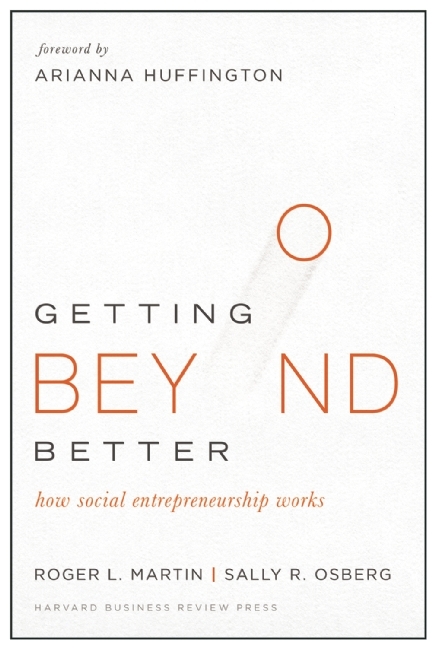
Who drives transformation in society? How do they do it? In this compelling book, strategy guru Roger L. Martin and Skoll Foundation President and CEO Sally R. Osberg describe how social entrepreneurs target systems that exist in a stable but unjust equilibrium and transform them into entirely new, superior, and sustainable equilibria. All of these leaders--call them disrupters, visionaries, or changemakers--develop, build, and scale their solutions in ways that bring about the truly revolutionary change that makes the world a fairer and better place. The book begins with a probing and useful theory of social entrepreneurship, moving through history to illuminate what it is, how it works, and the nature of its role in modern society. The authors then set out a framework for understanding how successful social entrepreneuars actually go about producing transformative change. There are four key understanding the world; envisioning a new future; building a model for change; and scaling the solution. With both depth and nuance, Martin and Osberg offer rich examples and personal stories and share lessons and tools invaluable to anyone who aspires to drive positive change, whatever the context. Getting Beyond Better sets forth a bold new framework, demonstrating how and why meaningful change actually happens in the world and providing concrete lessons and a practical model for businesses, policymakers, civil society organizations, and individuals who seek to transform our world for good.
Roger Martin is the Institute Director of the Martin Prosperity Institute and the Michael Lee-Chin Family Institute for Corporate Citizenship at the Rotman School of Management and the Premier’s Chair in Productivity & Competitiveness. From 1998 to 2013, he served as Dean. Previously, he spent 13 years as a Director of Monitor Company, a global strategy consulting firm based in Cambridge, Massachusetts, where he served as co-head of the firm for two years.
His research work is in Integrative Thinking, Business Design, Strategy, Corporate Social Responsibility and Country Competitiveness. He writes extensively and is a regular contributor to: Harvard Business Review’s The Conversation blog, the Financial Times’ Judgment Call column, and the Guardian Sustainable Business. He has written 24 Harvard Business Review articles and published 10 books: Getting Beyond Better (with Sally Osberg); Harvard Business Review Press (HBRP, 2015); Playing to Win (with A.G. Lafley) (HBRP, 2013); Fixing the Game (HBRP, 2011); The Design of Business (HBRP, 2009); The Opposable Mind (HBRP, 2007); The Responsibility Virus (Basic Books, 2002); Canada: What It Is, What It Can Be (with Jim Milway, Rotman-UTP Publishing, 2012); and Diaminds (with Mihnea Moldoveanu, University of Toronto Press, 2009), and The Future of the MBA (with Mihnea Moldoveanu, Oxford University Press, 2008). In addition, he co-edited Rotman on Design (with Karen Christensen, Rotman-UTP Publishing, 2013).
In 2013, Roger placed 3rd on the Thinkers50 list, a biannual ranking of the most influential global business thinkers, moving up from 6th in 2011 and 32nd in 2009. In 2010, he was named one of the 27 most influential designers in the world by Business Week. In 2007 he was named a Business Week 'B-School All-Star' for being one of the 10 most influential business professors in the world. Business Week also named him one of seven 'Innovation Gurus' in 2005.
He serves on a number of public service boards: Skoll Foundation, Canadian Credit Management Foundation, Tennis Canada (past chair), and Bridgespan Group (academic advisory board chair).
A Canadian from Wallenstein, Ontario, Roger received his AB from Harvard College, with a concentration in Economics, in 1979 and his MBA from the Harvard Business School in 1981.