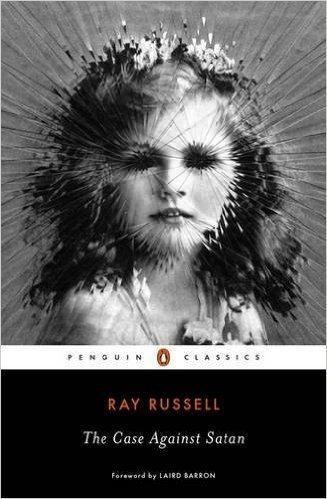
Teenager Susan Garth was “a clean-talking sweet little girl” of high school age before she started having “fits”—a sudden aversion to churches and a newfound fondness for vulgarity. Then one night, she strips in front of the parish priest and sinks her nails into his throat. If not madness, then the answer must be demonic possession. To vanquish the Devil, Bishop Crimmings recruits Father Gregory Sargent, a younger priest with a taste for modern ideas and brandy. As the two men fight not just the darkness tormenting Susan but also one another, a soul-chilling revelation lurks in the shadows—one that knows that the darkest evil goes by many names.
Ray Russell was an American editor and writer of short stories, novels, and screenplays. Russell is best known for his horror fiction, although he also wrote mystery and science fiction stories.
His most famous short fiction is "Sardonicus", which appeared in the January 1961 issue of Playboy magazine, and was subsequently adapted by Russell into a screenplay for William Castle's film version, titled Mr. Sardonicus. American writer Stephen King called "Sardonicus" "perhaps the finest example of the modern gothic ever written"."Sardonicus" was part of a trio of stories with "Sanguinarius" and "Sagittarius".
“Capture the dragon, the ancient serpent who is Satan, and send him in chains into the Abyss, that he may no longer seduce the nations.”
Susan Garth is a sweet little girl of high school age who suddenly develops an aversion to churches and a newfound fondness for vulgarity (as well as attacking the parish priest). If madness can’t explain her behaviour, the answer must be demonic possession.
If you go into this one looking for a terrifying demonic possession story, then you’re gonna have a bad time. Or you’ll just be really disappointed. BUT if you go in with an open mind, you’ll find a really thought-provoking story about one priest’s struggle with his faith.
Set in 1962, The Case Against Satan came before The Exorcist, before Rosemary’s Baby, and you can definitely see how subsequent books have been inspired by this tale. It was probably ahead of its time in terms of looking at demonic possession through a lens of “is this a possession or could it be explained by science or psychology?” It brings up lots of interesting points.
I’ve also found I really enjoy reading books that explore the Catholic church and have priests as main characters, probably due to my own upbringing and experiences, but I find them quite relatable. So this one ticked a lot of boxes in that regard!
Also, a little fun observation! I am wondering if King has read this before, as a few character names he used in his own early novels showed up (Barlow and Halloran!) But perhaps I am just reading into things too much...
Overall I would recommend this if discussion surrounding exorcisms and the potential causes is something you find interesting. Also given its subsequent influence on the horror genre, I feel like this one deserves a little more attention. There are a few creepy parts, but it won’t keep you up at night! 4 stars.
Does Satan exist? A school of thought within some theological circles is that Satan is not a real entity but rather a symbolic concept to help explain evil (little "e") in the world. Certainly, some theologians believe, God exists, but the Devil is a different matter.
Of course, another school of thought is that if one believes in God as an actual entity, then a polar opposite must exist. If God is Good (big "g"), then of course there must a Devil, which is Evil (big "e"). It is simply a natural (or supernatural) flip side of the same coin. If you believe in God, you must believe in Satan.
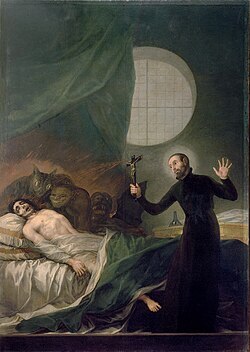
A painting by Francis De Goya of St. Francis Borgia performing an exorcism
The late Ray Russell may have been on the fence about this, as the title of his classic 1962 novel---"The Case Against Satan"---suggests. Indeed, it's difficult to classify this as a horror novel, as the horrific events described within all have plausibly scientific or psychological explanations without resorting to supernaturalism.
That said, Russell's novel is, even today, a fascinating look at a significant although still somewhat taboo subject within the Catholic faith: exorcism.
Russell's novel preceded William Peter Blatty's novel "The Exorcist" by nine years. Blatty's novel exploded on bookstore shelves with a popularity that bordered on fanatical, resulting in a phenomenal movie and spawning an interest in filmic exorcism that still exists today.
Russel's novel is probably not as sexy or exciting as Blatty's, which may explain why it's not talked about with as much passion as "The Exorcist". There's no green-pea soup vomit or head-spinning or a little girl telling a priest "Your mother sucks cock in Hell!", all of which apparently make for a bestseller. Still, Russell has the distinction of being one of the first to do it.
And, like "The Exorcist", "The Case Against Satan" is definitely a page-turner. Russell was definitely going more for the psychological aspect of exorcism, and his novel reads more like a riveting mystery crime thriller, with an intrepid but doubting priest and an older-but-wiser Bishop acting as detectives.
Fans of the wonderful TV show "Evil" will enjoy Russell's examination of science-versus-faith and thoughtful (but respectful) criticism of Catholic church doctrine.
Just so we're clear, I didn't read this book in one day, and nor did I read it just once.
I think that one of the problems in discussing this book is that a lot of readers have come to it with expectations of something along the lines of Blatty's The Exorcist, but that just isn't the case. In this novel, we are told from the outset exactly what this book is going to be about:
"a priest of the Roman Catholic Church was put on trial one harrowing weekend in the second half of the twentieth century."
Why and how he's "put on trial" is the focal point of this novel, and yet somehow, the draw for a lot of readers seems to be only the expectations of the exorcism that takes place here. And that's a shame, really, since there is a lot going on here otherwise. Even the title gives things away -- if you really think about it long enough, what happens here is a struggle between science-based reason and superstition-based faith. When a Catholic bishop wants a priest to perform an exorcism, the priest questions why he should "Drive out a medieval Devil" he has "trouble believing in." The Bishop believes he must do it, because it is the "only thing" that can save him -- it seems that our priest's faith is to be tried, since by admitting he doesn't believe in the Devil, he could be seen as a heretic, because
"If God existed, logically his Adversary existed"
so following that notion, if the modern-thinking priest doesn't believe in Satan, then he doesn't believe in the existence of God, either. It's an idea that gives this man a lot to consider.
For the encapsulated look at the rest of this story, I've posted about it here .
While I don't think it's a great book, largely because of the last chapter and a few other issues that could be construed as spoilers that I don't want to divulge, it is very much worth the time and effort I put into two readings. And yes, indeed, it is NOT Blatty's book, nor is it the film based on that novel, so it may not appeal to people who need the expectations of grossout factor in their reading to make a book work for them. If you're into more of what sort of evil there may be hidden in the course of ordinary human lives, well, then I'd recommend it for sure.
A young girl is possessed by the devil - a Catholic priest and bishop must perform an exorcism to save her!
Ray Russell’s The Case Against Satan was published in 1962, 9 years before William Peter Blatty’s The Exorcist but it’s less well-known probably because of the enormous popularity of the 1973 movie adaptation of Blatty’s book. I’m sure for audiences in 1962 this was fresh and exciting as well as influential (I wonder if Blatty and Stephen King read Russell’s novel?) but half a century later...
If you’re a horror fan and have seen many of the exorcism movies that’ve come out in the last 20 years, and of course seen The Exorcist, Russell’s novel doesn’t really offer anything new. The storyline of a possessed girl and a priest having to exorcise her at this point in time is so well-worn it’s almost a cliché!
The doubting priest, the troubled girl, the questions over whether she’s faking it or is really possessed - I know this wasn’t well-known material back then but it is today and that made it quite a predictable and unexciting read for me. I wasn’t that interested in seeing if Father Sargent’s faith would return (hence “the case against Satan”) or whether evil would be punished - I knew, like most readers of this book, they both would.
The demon possession scenes are almost cute for how tame they are. The worst Susan says is “You’re a son of a bitch, dad!” - quite different from saying “Your mother sucks cocks in hell!” while stuffing a crucifix up your vag and spewing pea soup in The Exorcist! Russell even writes a near-apologetic afterword, justifying the themes of incest and drunk priests by saying they’ve all happened in real life. Can you imagine any writer today doing anything like that? 1962 sure was a different world. Then again, it covered incest and child molestation so that’s pretty edgy for the time. You can tell it’s fiction too because an underage child tries to molest a priest and not the other way around!
It’s a very quick read though and kinda pulpy too which is why it’s surprising to see it in the Penguin Classics range (then again they published that pretentious twit Morrissey’s autobio). There’s also a comparison to Rosemary’s Baby in the blurb - ignore that, Russell’s novel has nothing in common with Ira Levin’s.
Maybe if you were/are Catholic, the story will have more of an impact on you; for an outsider like me, Catholicism’s mysticism has always looked ridiculous and hard to take seriously. All of which isn’t to say The Case Against Satan is a bad book - it’s competently written and more-or-less holds the attention - just that it hasn’t aged well because of its subject’s enormous popularity in the years after. A straightforward exorcism and possession storyline is all too familiar to be that interesting to modern horror readers versed in the subject though it might be worth a look for those curious to see the origins of this popular subgenre.
Having been a horror fiction reader and movie lover for as long as I can remember, William Peter Blatty's The Exorcist in both iterations was always the foundational example of possession horror referenced in every bit of film or genre fiction criticism that I consumed, not to mention the pervasiveness of references to the movie in all kinds of pop culture media. My own first read of the novel was probably around the age of 14 and I saw the film at an even younger age. So imagine my surprise a few years ago when I found out that there was another, earlier work of fiction about two priests struggling to free a young girl of apparent demonic possession. I had to wonder why I had never heard of The Case Against Satan in all of my horror reading years. Was it a terrible book? Poorly written? Too obscure? Maybe even considered too subversive for wide release, more controversial than Blatty's novel and the subsequent film? And then I saw the Penguin Classics edition cover and knew I had to read it to find out. And the answer to all of my questions is, well, no.
On the eve of Father Gregory Sargent taking up his new post at St. Michael's, and upon the departure of the previous parish priest Father Halloran, he is confronted by Robert Garth and his daughter Susan. Mr. Garth, a widower, is seeking the Church's help to explain Susan's recent troubling behavior, including her sudden refusal to attend Mass on Sundays and her antagonistic behavior at home. Susan, it is implied, may also have had something to do with Father Halloran's decision to leave St. Michael's after many years. Halloran has warned Sargent before his departure that the 16 year-old is subject to "fits." When a visit from Bishop Crimmings coincides with a troubling visit from Susan herself, Sargent suddenly finds himself facing a case of possible demonic possession when the Bishop is convinced the girl is in need of an exorcism.
While the set-up of The Case Against Satan is similar to The Exorcist, there are some marked differences in the stories and the writing. Russell's novel is very short and he does not spend much time at all on character development. The writing is almost clinical. This makes for some inscrutable dynamics between different characters whose motivations, background, and thought processes the reader only receives bits and pieces of. The Case Against Satan also factors in the community surrounding St. Michael's church, some members of which are already suspicious of the new priest who comes with some personal baggage from his previous parish. These suspicions grow into downright hostility and allegations of abuse against the priest during the course of the exorcism of Susan Garth.
Another interesting difference between this book and other stories of exorcism we're used to where priests and loved ones often have difficulty in securing permission from the church to perform the ancient rite of exorcism, is that here the older, powerful Bishop pretty much immediately diagnoses the teen as a case of demonic possession. But the reader may not be as convinced. The symptoms of Susan Garth's so-called possession are not nearly as theatrical, definitive, or seemingly superatural as those suffered by Regan MacNeil.
Ultimately, I think the reason that The Case Against Satan faded into obscurity while The Exorcist became the seminal work of demonic possession that it is, is likely due to timing. A decade can make a big difference. There is also the brevity of Russell's book, which feels somehow incomplete to me. I think Blatty's book is by far the better, more interesting work, but The Case Against Satan is a worthwhile read. I particularly enjoyed the discussions and debates between Sargent and Crimmings about faith and the nature of the devil.
No me atrevo a decir que es la primera novela sobre posesiones demoníacas -porque no lo se-, pero sí puedo decir que es la novela que inspiró El exorcista (entre otras novelas del género).
Si buscáis un libro de terror, de esos que te impiden dormir, o de los que hacen que tengas escalofríos, este no es vuestro libro. Terror poco. ¿Impide eso que sea una buena novela? No. El tema del exorcismo es una excusa para hablar sobre otros temas: la fe, la maldad, enfermedades mentales, abusos, etc.
La prosa del autor es buena, es un libro que se lee fácil.
Los personajes, si bien no son la gran cosa, tienen sus momentos y sus cositas. Por ejemplo, que el padre Sargeant, el protagonista del libro, tenga dudas de la existencia del diablo siendo católico (al parecer los católicos, esto yo no lo sabía, al creer en dios deben creer en el diablo).
Hay, además, un misterio en la novela, que creo que tiene más peso en la historia, y casi diría que es lo que te tiene "enganchada" al libro; aunque no creo que sea un libro de esos que no puedes soltar.
No ha envejecido muy bien, porque hoy en día hay pocas cosas que nos escandalicen, y lo que en los 60 era tabú hoy en día ya no lo es, pero es un clásico del terror y si os gusta el tema de las posesiones es un buen libro para leer.
Technically, it was Ray Russell, not William Peter Blatty, who first brought the Catholic ritual of exorcism to the broad American consciousness. Russell's book predates Blatty's by nine years and the plot lines are so similar that it's hard not to conject that Blatty "borrowed" heavily from Russell's work. Still, it was The Exorcist, not The Case Against Satan, that went on to become a blockbuster American franchise. Is that fair? Russell's rendition is certainly less profane, less obscene, and therefore less sensational. But both are well written, and both are securely anchored in actual catholic doctrines and rituals. If forced to choose, I'd rank TCAS a little higher on my horror scale solely because Russell evoked that same gut-level sense of terror and peril with less devices and contraptions ...but it's a tough call.
Did you know that this was the precursor to Blatty's, The Exorcist, and that it was published eight years before? I had no idea that this book existed.
The Exorcist and The Case Against Satan are so so similar in storyline, but this book delves more into crises of faith than the horror of possession.
A couple of years ago I read The Exorcist, and I was blown away. I saw the movie as a teenager like a lot people did. It was the movie you dared your friends to watch and then didn't sleep for a couple of nights because you watched it with them. It's the gold standard for possession/exorcism stories, and if you try to compare other stories of the same nature to it, they are never quite going to live up to its brilliance.
The Case Against Satan was written in 1962, almost a full decade before The Exorcist. I'm trying to image reading this book when it was released, without any expectations from Blatty's novel. Penguin brought Ray Russell's novel The Case Against Satan back into publication in 2015, so most people today are probably going to approach this book having read The Exorcist, and with certain expectations. To do so is a mistake, and yet I found it incredibly hard to separate the two stories and let Russell's novel stand on its own. However, they are two very different stories.
The Case Against Satan is much more about the one of the priests who performs the exorcism, rather than the girl who is possessed. Father Gregory Sargent has just been reassigned to a new parish when he learns that one of the parishioners, a 16-year-old girl named Susan, is behaving strangely and refuses to enter the church for mass. Sargent doesn't know how to help the girl, and when he learns about what occurred between her and the previous parish priest, he requests help from the bishop.
Father Sargent is a progressive thinker and a scholar. He believes that science and psychology can explain all of Susan's behavior, and yet bishop Conrad Crimmings doesn't believe that the girl is ill or insane. Once he arrives at the church he tests his theory, and immediately realizes that Susan is possessed by the devil. Father Sargent is unable to believe that actual demonic possession is real, and so he begins to question his faith and his role as a priest. Crimmings knows that Sargent needs to help Susan so that he can confront the doubt he is feeling, so the two men begin to perform the exorcism without anyone else having any knowledge of their actions, including Susan's father.
Father Sargent and his doubts are very much the focal point of this book. This is a story that uses an exorcism to to tell the story of a priest who is having an crisis of faith. The possessed girl and the reason for her possession are addressed by the end of the novel, but the story is really about Sargent and how he reconciles his faith with his scientific beliefs. Once I was able to push The Exorcist to the back of my mind, and read this novel for what it is, I really enjoyed it. It's dated in a few places, and definitely has some flaws, but overall it's an interesting and well written story.
Penguin also released a collection of Russell's stories in the Penguin Horror series, and now I really want to read those as well. I bought the entire collection because the covers are gorgeous, and the series was edited by Guillermo del Toro, so I'm excited that I already own it and can add it to next month's TBR. Horror lovers should definitely add Russell to their list of early influencers. The Case Against Satan is a must read for those who want to explore the history and influences of horror fiction.
Amo las historias sobre exorcismos, así que, ¿cómo no iba a leer la pionera? A partir de acá surgieron varias novelas icónicas sobre posesión demoníaca. Un claro ejemplo es la novela infinitamente más conocida "El exorcista", de William Peter Blatty, obra que toma mucho de "Juicio a Satán". La historia es corta, y quizá le falta un poco más de fuerza en algunas cuestiones, pero creo que está muy bien. Es de lectura ligera, y en ningún momento se torna densa con cuestiones religiosas.
Up until a few years ago, the name "Ray Russell" was only familiar to me by dint of his work as a screenwriter on such marvelous horror/sci-fi films as "Mr. Sardonicus" (1961), "The Premature Burial" (1962), "Zotz!" (also from 1962) and "X: The Man With the X-Ray Eyes" (1963). It wasn't until I noticed a highly complimentary review of his 1962 novel "The Case Against Satan," in Jones & Newman's excellent overview volume "Horror: Another 100 Best Books," that I even knew he was an author at all, but I've since run across a quote from a guy named Stephen King, calling Russell's original novella "Sardonicus" "perhaps the finest example of the modern gothic ever written"! I'd been thus trying to lay my hands on a copy of "The Case Against Satan" for some time, but to no avail. The book has been out of print for decades, and copies on eBay and Amazon either look very beat up or are prohibitively expensive. Fortunately, for all lovers of vintage horror, Penguin has come to the rescue with a brand-new edition of the Russell book. Dealing as it does with a case of satanic possession and the resultant exorcism, the story line here may seem a tad overfamiliar to audiences who, ever since the phenomenal worldwide success of William Peter Blatty's "The Exorcist," have been subjected to any number of such goings-on in both book and on film. But Russell has the honor of having gotten there first; his novel beat Blatty's to the devilish punch by a good nine years.
Admittedly, there are many similarities between the two books. In Russell's, a borderline alcoholic priest, Father Gregory Sargent, moves to his new parish in _____ (the small town is never named; call it Anywhere, U.S.A.). On his very first day on the job, a 16-year-old girl (Regan MacNeil in "The Exorcist," by contrast, was only 11), Susan Garth, is brought to his rectory by the distraught papa. It seems that not only had the formerly chaste Susan sexually assaulted and attacked Sargent's predecessor, but is now using foul language and showing an aversion to stepping into the church on Sundays. Sargent's superior, the Bishop Conrad Crimmings, immediately senses what is amiss, and his suspicions are soon confirmed when a crucifix held against Susan's arm actually burns into her skin! The bishop orders Sargent to perform an exorcism on the child, who he deems "possessed," while Sargent begins to realize that although he absolutely does believe in God, he is not so sure that he can buy into the concept of an actual Devil. Heretical thoughts! Still, the exorcism does go forward, while the girl's maniacal laughter, curses and screams make the local populace wonder, with increasing suspicion, just what is going on in the local rectory....
OK, I'm going to be honest with you: I have never read "The Exorcist," so cannot compare the respective literary merits of the two books. (I DID see the 1973 film version, which Blatty scripted to Oscar-winning effect, when it first opened, and can say that, as was the case with most people, it scared the poop out of me.) I have to take the word of two authors, thus, that Russell's is the superior work. In the Jones & Newman volume, Darrell Schweitzer tells us that it is "by far a better book than...Blatty's later, more sensational reworking of the same material." And in his introduction to the new Penguin edition, Laird Barron writes that the Blatty work "reads much like an expansion of Russell's short novel...Russell's cuts a bit closer to the bone." Although apparently much more restrained as regards language and shocks than the later book, Russell's still delivers some effective frissons. Thus, Susan DOES writhe and contort her body horrifically, at one point throwing herself clear across the room. (Don't look for any 180-degree head swivelings, however!) And for those for whom a good exorcism wouldn't be complete without the regurgitation of some horrible green bile, well, Russell does have Susan spew "jet after jet of reeking substance that covered her and splattered the wall and ran sluggishly in long viscous tendrils down to the floor." If it's shockingly foul language that you deem a mainstay of a good satanic possession, however, please know that Susan here remains fairly civil in that regard, only letting slip with an occasional "S word." What actual cursing Susan is guilty of is only referred to afterwards by the author as "filth," "epithets" and "offers...vile and...increasingly recondite." Shocks may have been what Blatty was after, but Russell seems to be more interested in the battle of wits between the incredulous modern priest and his seemingly wiser and older bishop. The author also shows us how a modern-day exorcism can engender doubt and suspicion in a community, as its residents become ever more alarmed by the eerie noises coming from the rectory. Russell, who writes elegantly and marvelously (he is especially good at rendering highly realistic dialogue), demonstrates, in addition, a keen gift for creating a claustrophobic atmosphere. The exorcism itself, taking place on a steamy September night in a locked bedroom and during a raging thunderstorm, shows that gift to a marked degree. The book is also carefully ambiguous, and all the supernatural events that we are witness to, as Sargent reminds us, just might have a prosaic, mundane explanation. (Those crucifix burns just might be psychosomatic, for example.) Still, the reader is really in no doubt as to the true state of affairs here, and by the book's conclusion, even Sargent (whose favorite apostle, he admits, is the doubting Thomas) becomes swayed.
For readers today, "The Case Against Satan" might not have the impact that it must have had in 1962. Over the past 53 years, exorcisms, the Devil, drunken priests, child molestation, incest, bad language and so on have most assuredly lost their ability to shock; we see worse on our TV screens, what with prime-time programming and the 11:00 news, every day. For readers back when, however, Russell's book must surely have carried a wallop. Still, from its ominous first chapter to its sweet and cozy Yuletide ending, the book manages to enthrall and captivate even a modern-day reader. I DO still want to read Blatty's book (especially since it was chosen for inclusion in Jones & Newman's first volume, "Horror: 100 Best Books"), but very much doubt that it will be as concise, intelligent and thought provoking as Russell's. If I may quote from Schweitzer's piece again, "'The Case Against Satan' is a model of what a good horror novel should be. It is a lost gem that cries out to be reprinted." And now, thanks to the fine folks at Penguin Classics, a new generation CAN finally discover this infernally fine work for itself. More than highly recommended....
(By the way, this review originally appeared on the FanLit website at http://www.fantasyliterature.com ... a very fine destination for all readers of this type of fare....)
"A la Iglesia le dan miedo los rebeldes, los renegados, le da miedo todo lo que no puede comprender."
Un padre muy preocupado por lo que le sucede a su hija y no queriendo llevarla al psiquiatra la lleva a un sacerdote. Susan Garth, de 16 años, sufre de "ataques", tiene conductas poco habituales en ella, una niña cercana a la iglesia y respetuosa, se ha convertido en todo lo contrario. Las conductas que realiza son extremas, tras hacerle una prueba el abispo decide que está poseída, pero le encomienda el exorcismo a otro cura, el padre Gregory, un cura muy particular con ciertas dudas, dice tener una mentalidad lógica, además de haber sido castigado por la iglésia, pero se deberá enfrentar a este caso de posesión en compañía del Obispo.
A ver, ¿se les hace conocida la historia? a los que han leído El exorcista y La semilla del diablo, grandes e icónicas dentro de la tematica de posesiones/satanismo, yo creo que si, y es justamente eso, Juicio a Satán es precursora de estas novelas, y justamente se inspiraron en esta novela, en la que durante su lectura es inevitable encontrar claras similitudes en algunos aspectos, e incluso con otros autores bien destacados en la actualidad.
Me pareció una historia buena, pero no impresionante, aún asi, tiene escenas muy destacables, a pesar de no causar miedo en ningun momento, hay momentos que me han parecido muy buenos, tiene esta lucha entre el bien y el mal, pero sobre todo entre la fe y la razón que se generan de la mano del padre Gregory, lejos de justificaciones científicas, ahí encuentro que se queda corta.
Tiene aspectos y referencias bien antiguas, pero que definitvamente se debe considerar que se creó en los 60, y al leer algo de muchos años atrás hay que contextualizarse en la época y temática, teniedo en cuenta la importancia que se les daba a los curas y a la iglesia en esos tiempos casi de forma intocable, pulcra. Y siguiendo el mismo hilo, las acciones del padre Gregory eran atrocidades, herejía, el sólo hecho de una duda sobre la existencia del bien y el mal espiritual (Dios/Satán), como también el cómo se encasillaban las acciones de Susan.
Por otro lado, todo sucede muy rápido, y ese es otro punto que considero un tanto negativo, me hubiese gustado que abordara aún más en aspectos demoníacos y en temas de cuestionamientos con mejores bases. Pero como dije, para la época en que fue escrita, creo que se le perdona, por el fanatísmo religioso de la época.
Es una novela muy corta, y que realmente merece ser leída, por su incidencia en los grandes libros de la temática, porque es entretenida, se lee rápido, y además porque ¿a quién no le gusta una historia de posesiones demoníacas?.
I thought this book started great. Intriguing and creepy. Some great short vignettes through the early chapters with interesting twists. But at the end I thought the book just tried to do too much and several of the storylines weren't sufficiently fleshed out or closed down. So the end got a little haphazard and disappointing. But better than just okay. Entertaining if nothing else.
ربما كتب طقوس طرد الشياطين والاستحواذ ليست نوعي المفضل، وبما أن هناك ربط بين هذه القصة ورواية بلاتي (طارد الأرواح) التي كرهتها حقيقة كفيلم وكرواية، خاصة بعد علمي بالتغيرات التي أدخلها الكاتب على القصة الحقيقية المستوحاة منها الرواية، وبما أن هذه الرواية سبقت رواية بلاتي بتسع سنوات تقريبا، فقد توجست منها وأرتأيت عدم تأجيل قرائتها لأن التأجيل قد يجعلني أقرر عدم قرائتها
أحب ترجمات شيرين هنائي واختياراتها وتعريفها بكتاب لا نعلم عنهم ربما لا الكثير ولا القليل احيانا، لذا فقد انتابني الفضول حول الرواية على الرغم من قلقي منها
الرواية ثقيلة وكانت الأحداث بطيئة في بدايتها ... أقرأها منذ أيام، أتوقف أحيانا ثم أعاود القراءة ... ولكنها محكمة وكذلك رسم الشخصيات محكم
ناسبني تفكير الأب جريجوري المنطقي، وربما ناسبتني الحوارات المنطقية والإشارات إلى الكتب وكذلك فكرة عقلانية ومنطقية الشك ... استمتعت بحوارات الأب جريجوري والأسقف وما يتعلق بالأب هالوران
أعجبتني الحبكة كثيرا وتصوير المجتمع المحيط وتفكيره، الرعب من الشيطان مع وساوس النفس والشك والامراض النفسية، خليط عجيب لكنه جاء متجانسا ... وهكذا فقد ناسبتني النهاية هي الأخرى
الرواية في ترجمتها سلسة وكأنها كتبت بالعربية أساسا لا تكلف فيها ولا غموض وخاصة في النصوص المسيحية التي لجأت فيها الكاتبة للإستعانة بذوي العلم
لكن، وللأسف فقد تناثرت الأخطاء الإملائية هنا وهناك ... قليلة ربما ولكنها موجودة وخطأ منها قد تكرر
قلقت من قراءة الرواية نعم ولكنني سعيدة بأنني افتتحت بها قراءات حصيلة معرض الكتاب ٢٠٢١
Una pequeña joya precursora de novelas tan icónicas del género como El Exorcista o La Semilla del Diablo. Una lectura amena, repleta de reflexiones y datos fascinantes, que además juega psicológicamente con el lector, al estilo de Una Cabeza Llena de Fantasmas, invitándonos a decidir por nosotros mismos qué es lo que realmente ha sucedido. 4,5 ⭐️
Written almost a decade before The Exorcist, this short novel focuses more on internal struggle than on sensationalist drama. The writing style and some of the dialogue feel noticeably dated, but they still contribute to an effective overall atmosphere. The pacing is really tight and effective, and lets the story focus on doubt, not spectacle. What I really appreciated, though, is that it is not the doubt typical in subsequent (Christian/Catholic) exorcist fiction, which is usually a young priest doubting his belief in God that is cured by a wise elderly priest and a run-in with the Devil. No, here the main character doesn’t ever doubt his faith in God, but he does doubt his faith in the existence of the Devil. While I don’t really think the theological argument that is used to try and uproot his doubt would hold all that much water I appreciated that the story was exploring something a little more complex than a binary faith. At the heart of the main character’s struggle is a struggle between intellect and emotion, with (blind, unerring) faith sequestered as a necessary part of the latter, not the former. This allows for a more complicated character, one who believes in and celebrates modern science without it contradicting his faith, but then feeling torn between worldly delights and rationalities, such as fame and renown, being published in scholarly articles, etc., and the actual vocation of priesthood.
Other than the main character the others are more or less sketches that are fulfilling a narrative function, but they work well here to offset different aspects of the main character. I like the continued ambiguity of the narrative, something allowed for in large part due to the lack of spectacle on the page, it adds to the character’s internal tension. I do think the resolution a little unconvincing, though. Not the resolution of the main narrative, which was something that I thought was telegraphed from the earliest chapters but then complicated and doubted and twisted and then comes back around in a satisfying way. However, the main character’s inner journey, where he finally finds himself, just feels remarkably anodyne and convenient. That said, it makes sense for this character to embrace the rationale and justifications that he does. Where he ends up may frustrate me, but that doesn’t take away from the writing; instead, it feels like it aligns with the overall ambiguity of the novel, commenting on what sort of compromises we may have to make to try and make sense of the world.
All of that praise said, some decisions in the writing did dampen my appreciation of the story a little. There was a decision to end the back half of a later chapter as a transcript of events, which allowed Russell to totally neglect sharing the characters’ actions, thoughts, emotions, and so on, which felt lazy. So much of the story is about this priest’s inner struggle, and at a moment of highest emotional drama, a moment after the physical spectacle has ended, the narrative runs away from all interiority and leaves us with this dry transcription instead. There may be a convincing artistic or thematic argument for creating this distance at this point in the story and maybe you can convince me of it, but in my first impression upon reading it felt a little lazy, like Russell was afraid of his characters’ emotional realities. Across the novel I noticed similar emotional shortcuts, some of which I chalked up to 1950s stylistic conventions while reading, but in hindsight really left me wanting and felt like a lack of authorial confidence. The writing occasionally takes emotional shortcuts that undermine the reader’s experience of the main character’s inner journey. Still, I enjoyed the story and characters and internal struggles, I enjoyed the uncommon struggle not between faith and non-faith but between emotional faith and intellectual faith, and the pacing and atmosphere are effective, to boot. The novel is definitely worth reading for those things alone, never mind its place in gothic-occult literature as one of the first western possession novels.
The Case Against Satan by Ray Russell could be consider as a horror book, a book about exorcism. The story is simple; it is about a girl’s behaviors had been being eccentric for a long time. After The Father Gregory had visited her. His report to the Bishop, Gregory got the order from the bishop that to execute the exorcism for the girl. Gregory witnessed the supernatural horror when the girl Susan was using different voice that not like hers; it is more dreadful and raspy. The voice said that it is the voice of Satan, and he was mocking priests’s faith in Catholic Church and what he believes. The story also mentions the accusation of Susan’s father had sexually abused her. But the story does not give the answer to it. Like the exorcism, in the end Gregory seemed to exorcise the demon from Susan’s body. However, it could have multiple explanations to the phenomena in Scientific way.
Overall, I think the book is interesting, but It doesn’t have dramatic climax to the ending or significant plot twists to the story. It is more a confession of the priests and Susan’s father to what they have done in their life. From the Catholic church’s side, Psychologists’s therapists are doing the same methods but not doing it In religious principles. Sciences may not explain everything in universes. Nowadays, we still see enigmatic and unreasonable things that happened in our life.
De terror no tiene nada, por lo menos no es de esos libros que te generen miedo ni tiene escenas impactantes que te dejen con el alma en vilo xd
Por lo que el mismo señala en una nota al pie de página, fue predecesor a La semilla del diablo y al exorcista. Así que imagino se tuvo que comer unas cuantas críticas.
Trata sobre un padre que llega recién trasladado a la parroquia de San Miguel, tiene una peculiaridad, es un tanto como Tomás, "ver para creer". En su llegada el padre anterior le hace un recorrido por las familias le cuenta cosas, entre ellos sobre un evento que ocurrió con Susan Garth, una niña que junto a su padre siempre han ido a la iglesia pero que en el último tiempo ella no ha entrado y bueno otras cosas más.
En general, lo mejor del libro es el misterio que envuelve a Susan, conocer que pasó con ella. Lo malo es que no hay emoción, es un libro un tanto plano. Supongo que para la época habrá sido distinto pero no es de los libros que envejecen bien.
Lo demás ya es tema personal que prefiero no comentar aquí jeje y pues eso
Did I have a wicked time with that one or what? Once you've seen The Exorcist, novels about the occult can only scare you in one way: when you can't make up your mind whether there is an explanation for what is happening or you're losing your mind. This feed riiiight into it, which is impressive since it predates The Exorcist by many years. What are the evils eating away at Susan Garth? Do they come from this world or not? The Case Against Satan might be a little portentous at times, but it delivers genuine thrills and will make you question your own beliefs. My kind of book.
Predating The Exorcist by 9-10 years, it is a well written, quick read. If you’re looking for this kind of a story (possession) but worried about the sort of gut punch that The Exorcist has, this is its tamer older cousin!
Appena si inizia I due esorcisti, pubblicato nel 1962, subito la mente va a padre Karras e padre Merrin, usciti dalla penna di William Blatty nel 1971, e non a padre Gregory Sargent e al vescovo Crimmings, i due protagonisti del romanzo di Ray Russell, definito nella quarta di copertina ‘un piccolo capolavoro ritrovato’. Sempre riprendendo la quarta, è assolutamente vero che questo libro ‘ha anticipato le atmosfere e i temi di Rosemary’s baby e L’esorcista’, ma lo ha fatto con un approccio, un rischio, un ardire meno dirompenti delle figliolanze letterarie che ha ispirato. Va altresì detto che I due esorcisti, nel suo ruolo di apripista del genere, è un’opera che non sfigura del tutto per implicita attualità, costruzione e crescente suspense della trama, ma non è oscuro, inarrestabile e avvincente come il libro insuperato di Blatty. Scopriremo cosa celano i tormenti della giovane Susan Garth e quali sono le radici del male che la affligge, per poi trovarci ancora a pensare a padre Karras e padre Merrin…
Not immediately bringing up Ray Russell’s The Case Against Satan whenever a conversation about demonic possession in horror literature pops up is one of those unpardonable crimes that are regularly perpetrated by a large percentage of horror fiction fans. The novel, which is a classic that should be read based on its merits even if it was published today for the first time, is part of the genre’s DNA in much the same way William Peter Blatty’s The Exorcist is. Elegant, fast-paced, and infused with a wonderful mixture of creepy atmosphere and uncertainty, this relatively short novel is required reading for anyone who cares about possession narratives or the history of our genre.
You can read Gabino's full review at Horror DNA by clicking here.
I saw a few minutes of a case file or documentary on this and thought, hmm, never seen that before... Which made me read this book. I read this book, one other book and some articles in a very short time, many times over-- as well as the rest of the material and i must have forgotten to record it. Or maybe it got taken off somehow by accident. #cough# Not sure. Anyway, i think a movie came out about this, maybe a few years ago. I might look into it, just to see if they did do so. I was interested because this was the first case of its kind in court. It set a precedent for spiritual matters in court, so to speak, in that, it tried to prove demon possession responsible for the actions of Susan Garth. I think, though, that this whole thing was made much more about the priest. My opinions stay in Switzerland. :)
жовтень - це непоганий місяць для читання про диявола й екзорцизми. може, не такий доречний, як листопад із довгими вечорами й густими туманами, але доволі близько. утім, про атмосферу перейматися не обов'язково, бо рей расселл підходить до сюжету про вигнання демонів із милої шістнадцятирічної дівчини, вуста якої до одержимості не знали лайки, а тепер вона каже навіть слово "лайно", із доволі несподіваного боку. сам екзорцизм у нього не дуже разючий, і навіть там, де можна було б додати екзотики латинськими формулами ритуалу, головний герой одразу в голові їх сприймає англійською, тож читачі отримують тільки перекладену версію. демони поводяться доволі демонічно, кидаючи дівчиною та змушуючи її говорити всіляке дуже страшне й непристойне як на 1962 рік, але цього добра теж небагато. авторові важливе інше: наприклад, як освіченому священикові з середини двадцятого століття повірити в середньовічного диявола; через які шпаринки вразливості залазять у душу демони; і - оце взагалі цікавезно - чи можна говорити про цілковиту таємницю сповіді, коли священик же теж людина і не може контролювати свого несвідомого. це, звісно, робить роман текстом більше про людей, ніж про надприродне, зате дає харчі для роздумів з приводу не тільки всезагальної боротьби добра і зла, а й деяких практичніших (наскільки можна вживати це слово в такому контексті) приводів.
The Case Against Satan by Ray Russell was first published in 1962 and recently republished by Penguin, with an intro by Laird Barron.
It is inevitable that this novel will be compared with The Exorcist, which was published a couple years later. There's bound to be similarities between two books in the same genre. But I wonder if William Peter Blatty read this novel. We have, for example, a young priest who has doubts about his faith. The person on the receiving end of the exorcism is an adolescent girl.
A major difference between this novel and The Exorcist is that, in this novel, there is some doubt as to whether the adolescent's violent reaction to Christian holy objects and rituals is due to demonic possession. It could be a psychiatric problem, originating in the disturbing treatment of the girl by her father.
The novel was a quick read, which attests to its the Hemingwayesque prose style---simple words, short sentences, economy of expression. This book makes flabby, door stopper horror novels look like a joke.
رواية مترجمة تانية تنضم لقراءاتي من ترجمات أ/ شيرين هنائي... رواية قضية ضد الشيطان لروائي البريطاني راي راسل، والصادرة لأول مرة فب 1962، يعني قبل الرواية الاشهر "طارد الارواح الشريرة" لوليام بيتر بلاتي بحوالي تسع سنين... لكن هنا احلى ما فيها انها مش رعب خالص زي طارد الأرواح الشريرة، بالعكس دي فلسفية جدا، بتطرح فكرة صراع الايمان والشك جوا نفس رجل الدين، وهل الاصح هو التعامل بوجهة نظر علمية ولا خوارقية تجاه قضايا الاستحواذ والمس الشيطاني، مع اتهامات واضحة داخل الرواية للكنيسة بشكل تقيل، بس عجبتني النهاية، والقرار اللي وصل له رجل الدين...وأكيد الترجمة سلسه وممتعه للقراءة كالعادة
This isn't a horror novel. I'm gonna get that out of the way first. It's a mystery with supernatural elements and some disturbing goings on. There are no head spinning antics, no spider crawling downstairs, and no barrage of profanity. It was a simple story with a simple premise that leaves the reader wondering if it was truly possession or a disturbed girl who finally got some justice at the end. That's right, there's a happy ending. That's not much of a spoiler. It was the sixties.
Susan is sick and her father is concerned about her recent behavior. She's attacked a priest and has started to say some vulgar things (pretty tame by today's standards). The old priest has been transferred, and so Susan's condition falls under the responsibility of Father Sargeant. He doesn't even believe in the devil, but the bishop in his district is convinced she's possessed. So the two go to work to free the young girl of the affliction while the imaginations of her fellow townsfolks run wild.
It wasn't a bad novel, and it wasn't horrific. I don't think I would have enjoyed it more than what it was. It starts with this ominous question and ends with a tidy answer. I guess if you're gonna qualify it as horror, you could let your buddies who are not into the genre read it. It's fairly versatile in that way that just about anyone could read it and still find something to enjoy. Except horror readers are gonna be extremely disappointed by the lack of horror that's on display here. But like I said, horror starter, good to wet the palate. Plus, the language like I said earlier is not horrible at all. Shit is the worst word uttered in the entire novel. I think there were two shits in the entire novel. And like the shits that were offered, I think that about covers it.