

What do you think?

Seeds of Deception: Exposing Industry and Government Lies About the Safety of the Genetically Engineered Foods You're Eating
Without knowing it, Americans eat genetically modified (GM) food everyday. While the food and chemical industries claim that GMO food is safe, a considerable amount of evidence shows otherwise. In Seeds of Deception , Jeffrey Smith, a former executive with the leading independent laboratory testing for GM presence in foods, documents these serious health dangers and explains how corporate influence and government collusion have been used to cover them up.
The stories Smith presents read like a mystery novel. Scientists are offered bribes or threatened; evidence is stolen; data withheld or distorted. Government scientists who complain are stripped of responsibilities or fired. The FDA even withheld information from congress after a GM food supplement killed nearly a hundred people and permanently disabled thousands. While Smith was employed by the laboratory he was not allowed to speak on the health dangers or the cover-up. No longer bound by this agreement, Smith now reveals what he knows in this groundbreaking exposé.
Today, food companies sell GM foods that have not undergone safety studies. FDA scientists opposed this, but White House and industry pressure prevailed and the agency's final policy--co-authored by a former Monsanto attorney--denied the risks. The scientists' concerns were made public only after a lawsuit forced the agency to turn over internal documents.
Dan Glickman, former Secretary of Agriculture, describes the government's pro-biotech "You felt like you were almost an alien, disloyal, by trying to present an open-minded view. . . . So I pretty much spouted the rhetoric. . . . It was written into my speeches."
In Seeds of Deception Smith offers easy-to-understand descriptions of genetic engineering and explains why it can result in serious health problems. This well-documented, pivotal work will show you how to protect yourself and your family.
The stories Smith presents read like a mystery novel. Scientists are offered bribes or threatened; evidence is stolen; data withheld or distorted. Government scientists who complain are stripped of responsibilities or fired. The FDA even withheld information from congress after a GM food supplement killed nearly a hundred people and permanently disabled thousands. While Smith was employed by the laboratory he was not allowed to speak on the health dangers or the cover-up. No longer bound by this agreement, Smith now reveals what he knows in this groundbreaking exposé.
Today, food companies sell GM foods that have not undergone safety studies. FDA scientists opposed this, but White House and industry pressure prevailed and the agency's final policy--co-authored by a former Monsanto attorney--denied the risks. The scientists' concerns were made public only after a lawsuit forced the agency to turn over internal documents.
Dan Glickman, former Secretary of Agriculture, describes the government's pro-biotech "You felt like you were almost an alien, disloyal, by trying to present an open-minded view. . . . So I pretty much spouted the rhetoric. . . . It was written into my speeches."
In Seeds of Deception Smith offers easy-to-understand descriptions of genetic engineering and explains why it can result in serious health problems. This well-documented, pivotal work will show you how to protect yourself and your family.
289 pages, Paperback
First published September 1, 2003
About the author
Jeffrey M. Smith
28 books24 followersLibrarian Note: There is more than one author in the GoodReads database with this name. See other authors with similar names.
International bestselling author Jeffrey M. Smith is the leading spokesperson on the health dangers of Genetically Modified Organisms (GMOs). He documents how the world’s most powerful Ag biotech companies bluff and mislead critics, and put the health of society at risk.
His first book Seeds of Deception: Exposing Industry and Government Lies about the Safety of the Genetically Engineered Foods You’re Eating became the world’s best-selling and # 1 rated book on GMOs. His second book, Genetic Roulette: The Documented Health Risks of Genetically Engineered Foods, is the authoritative work that presents irrefutable evidence that GMOs are harmful. It includes 65 health dangers, linking GMOs to toxic and allergic reactions, thousands of sick, sterile, and dead livestock, and damage to virtually every organ studied in lab animals. The book expertly summarizes why the safety assessments conducted by the FDA and regulators worldwide are built on a foundation of outdated science and false assumptions, and why GM foods must become the top food safety priority. Former UK environment minister Michael Meacher says the revelations in Genetic Roulette may “change the global course of events this century.”
Mr. Smith has counseled world leaders from every continent, campaigned to end the use of genetically engineered bovine growth hormone (rbGH or rbST), and influenced the first state laws in the United States regulating GMOs. A riveting keynote speaker and popular guest on TVshows worldwide, he has lectured in more than 30 countries and has been quoted by government leaders and hundreds of media outlets including, The New York Times, Washington Post, BBC World Service, Nature, The Independent, Daily Telegraph, New Scientist, The Times (London), Associated Press, Reuters News Service, LA Times, Time Magazine and Genetic Engineering News.
Former US National Institutes of Health scientist Candace Pert describes Mr. Smith as “the leading world expert in the understanding and communication of the health issues surrounding genetically modified foods.”
Mr. Smith has united leaders to support The Campaign for Healthier Eating in America, a revolutionary industry and consumer movement to remove GMOs from the US food supply. He is the executive director of the Institute for Responsible Technology, producer of the films Hidden Dangers in Kids’ Meals and Your Milk on Drugs—Just Say No!, writes an internationally syndicated column, Spilling the Beans, has a regular blog on the popular Huffington Post, is well represented on Facebook, Twitter, and YouTube. He lives with his wife in Iowa, surrounded by genetically modified soybeans and corn.
from seedsofdeception.com
International bestselling author Jeffrey M. Smith is the leading spokesperson on the health dangers of Genetically Modified Organisms (GMOs). He documents how the world’s most powerful Ag biotech companies bluff and mislead critics, and put the health of society at risk.
His first book Seeds of Deception: Exposing Industry and Government Lies about the Safety of the Genetically Engineered Foods You’re Eating became the world’s best-selling and # 1 rated book on GMOs. His second book, Genetic Roulette: The Documented Health Risks of Genetically Engineered Foods, is the authoritative work that presents irrefutable evidence that GMOs are harmful. It includes 65 health dangers, linking GMOs to toxic and allergic reactions, thousands of sick, sterile, and dead livestock, and damage to virtually every organ studied in lab animals. The book expertly summarizes why the safety assessments conducted by the FDA and regulators worldwide are built on a foundation of outdated science and false assumptions, and why GM foods must become the top food safety priority. Former UK environment minister Michael Meacher says the revelations in Genetic Roulette may “change the global course of events this century.”
Mr. Smith has counseled world leaders from every continent, campaigned to end the use of genetically engineered bovine growth hormone (rbGH or rbST), and influenced the first state laws in the United States regulating GMOs. A riveting keynote speaker and popular guest on TVshows worldwide, he has lectured in more than 30 countries and has been quoted by government leaders and hundreds of media outlets including, The New York Times, Washington Post, BBC World Service, Nature, The Independent, Daily Telegraph, New Scientist, The Times (London), Associated Press, Reuters News Service, LA Times, Time Magazine and Genetic Engineering News.
Former US National Institutes of Health scientist Candace Pert describes Mr. Smith as “the leading world expert in the understanding and communication of the health issues surrounding genetically modified foods.”
Mr. Smith has united leaders to support The Campaign for Healthier Eating in America, a revolutionary industry and consumer movement to remove GMOs from the US food supply. He is the executive director of the Institute for Responsible Technology, producer of the films Hidden Dangers in Kids’ Meals and Your Milk on Drugs—Just Say No!, writes an internationally syndicated column, Spilling the Beans, has a regular blog on the popular Huffington Post, is well represented on Facebook, Twitter, and YouTube. He lives with his wife in Iowa, surrounded by genetically modified soybeans and corn.
from seedsofdeception.com
Ratings & Reviews
Friends & Following
Create a free account to discover what your friends think of this book!
Community Reviews
Displaying 1 - 30 of 80 reviews

December 9, 2010
Do you know what you're eating?
The question is rhetorical, and I can't say that I know the answer better than anyone else. I've done research, I've thought long and hard about which ethical issues matter to me the most, and we've changed the way we buy food. But, can I say we aren't contributing to the big food companies that operate in dishonest ways in order to control the U.S. food industry? I still can't know for certain.
It works like this: Monsanto is a huge company that contributes a lot of money to political parties. Political parties (both of the big ones), as a way of saying "thank you," ignore the fact that genetically modified foods--which are on the shelves of almost every grocery store in the U.S.--haven't been scientifically tested to any reasonable extent.
This is an issue that is glossed over completely by the press in the U.S., but it isn't an issue ignored around the world. These products aren't on the shelves in numerous countries, from Canada to India to France, because they've been banned due to a lack of research. To give a sense of how tied the U.S. government is to GMO foods, emails have surfaced through WikiLeaks that show some members of the government think we should retaliate against France for not allowing Monsanto's modified products to be sold there.
In short, the very few studies that have been done on GMO foods have shown they have unpredictable nutritional value and also unpredictable side-effects in mice (including death).
So, that's one of the major health risks. Another is the fact that, once this new modified version of corn is introduced, it quickly becomes impossible to keep track of where this corn is. In other words, if we finally start investigating this food and discover side effects, it will be extremely expensive to eliminate the modified plant or animal from the food supply--if it is still possible. This isn't a theoretical problem: it has already happened. Several European countries refuse to buy modified vegetables from the U.S., and shipments of U.S. corn have been halted because it has been discovered that modified forms of corn were mixed in with the rest.
And, despite this impossibility to segregate corn crops, it is ILLEGAL FOR FARMERS TO USE MONSANTO'S SEED if they aren't paying Monsanto for it. In other words, a farmer can be sued if seeds blow from a Monsanto crop into his crop. Because of this, numerous farmers who tried to avoid using genetically modified food have been driven out of business, and then the property has been bought up by Monsanto.
Maybe it's just me, but it doesn't make sense that you can copyright something that's alive.
So, the policies of both the U.S. government and Big AgriBusiness are working together to make it easier for the food market to be monopolized in the same way as the news, Hollywood, and essentially every entertainment industry. Do you want to know why this consolidation of power is bad for us? Have you SEEN how shitty most movies and popular CDs are? Do you want your food to suck that badly?
If not, do the little research into the food you eat. Verify that I'm not just making stuff up. Read this book, learn about the food industry. It doesn't take a lot of research to realize you're taking an unknown risk when you eat food that has had untested changes performed on its DNA, and the government has declared that it's illegal for companies to advertise that they use only non-GMO products...apparently, this would be bad for business, because it would raise the question of whether modified foods are safe.
It's theoretically possible they're safe. From the tiny amount of investigation that has been done, it doesn't look like they are. This has health implications. It has ecological and economical implications. It has political implications, as another industry consolidates into the hands of the very few, pushing out family farmers and reducing variety in the supermarket.
If you want to avoid genetically modified foods, you can. But, it isn't as easy as looking for a warning label...unless you look FOR a label that says "organic." If it says organic, it's GMO-free.
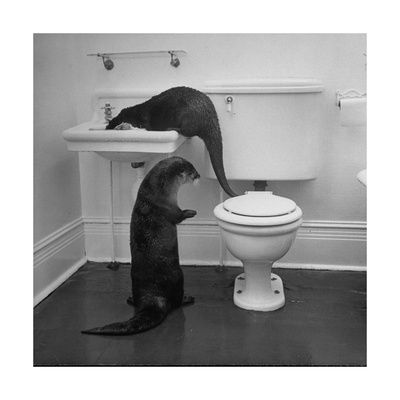
And, since you endured my whole review full of pessimism and frustration, here's a pair of otters playing in a bathroom:
And a baby trying to eat a cat:
////////////////////////////////////////////////////////
(The original "review")
So, let me tell you what kind of person Brian is. (Brian the bird, not that other Brian.) Brian is the kind of person who invites you out to lunch, and engages you in entertaining conversation for HOURS, and when the waitress brings the bill, SNATCHES it away, not even letting you buy him a BEER. (Not until later, anyway.)
Then, later on, when you're hanging around and drinking on the couch and talking some more, and the subject turns to books, he says he'll "send you a couple books." So, in your innocent, inebriated state, you give him your address.
And THEN, a couple weeks later, you get a package in the mail with "a couple books" BRAND FUCKING NEW from Amazon.
So, that should tell you what kind of person Brian is.
Correct. He's a COMPLETE ASSHOLE.
The question is rhetorical, and I can't say that I know the answer better than anyone else. I've done research, I've thought long and hard about which ethical issues matter to me the most, and we've changed the way we buy food. But, can I say we aren't contributing to the big food companies that operate in dishonest ways in order to control the U.S. food industry? I still can't know for certain.
It works like this: Monsanto is a huge company that contributes a lot of money to political parties. Political parties (both of the big ones), as a way of saying "thank you," ignore the fact that genetically modified foods--which are on the shelves of almost every grocery store in the U.S.--haven't been scientifically tested to any reasonable extent.
This is an issue that is glossed over completely by the press in the U.S., but it isn't an issue ignored around the world. These products aren't on the shelves in numerous countries, from Canada to India to France, because they've been banned due to a lack of research. To give a sense of how tied the U.S. government is to GMO foods, emails have surfaced through WikiLeaks that show some members of the government think we should retaliate against France for not allowing Monsanto's modified products to be sold there.
In short, the very few studies that have been done on GMO foods have shown they have unpredictable nutritional value and also unpredictable side-effects in mice (including death).
So, that's one of the major health risks. Another is the fact that, once this new modified version of corn is introduced, it quickly becomes impossible to keep track of where this corn is. In other words, if we finally start investigating this food and discover side effects, it will be extremely expensive to eliminate the modified plant or animal from the food supply--if it is still possible. This isn't a theoretical problem: it has already happened. Several European countries refuse to buy modified vegetables from the U.S., and shipments of U.S. corn have been halted because it has been discovered that modified forms of corn were mixed in with the rest.
And, despite this impossibility to segregate corn crops, it is ILLEGAL FOR FARMERS TO USE MONSANTO'S SEED if they aren't paying Monsanto for it. In other words, a farmer can be sued if seeds blow from a Monsanto crop into his crop. Because of this, numerous farmers who tried to avoid using genetically modified food have been driven out of business, and then the property has been bought up by Monsanto.
Maybe it's just me, but it doesn't make sense that you can copyright something that's alive.
So, the policies of both the U.S. government and Big AgriBusiness are working together to make it easier for the food market to be monopolized in the same way as the news, Hollywood, and essentially every entertainment industry. Do you want to know why this consolidation of power is bad for us? Have you SEEN how shitty most movies and popular CDs are? Do you want your food to suck that badly?
If not, do the little research into the food you eat. Verify that I'm not just making stuff up. Read this book, learn about the food industry. It doesn't take a lot of research to realize you're taking an unknown risk when you eat food that has had untested changes performed on its DNA, and the government has declared that it's illegal for companies to advertise that they use only non-GMO products...apparently, this would be bad for business, because it would raise the question of whether modified foods are safe.
It's theoretically possible they're safe. From the tiny amount of investigation that has been done, it doesn't look like they are. This has health implications. It has ecological and economical implications. It has political implications, as another industry consolidates into the hands of the very few, pushing out family farmers and reducing variety in the supermarket.
If you want to avoid genetically modified foods, you can. But, it isn't as easy as looking for a warning label...unless you look FOR a label that says "organic." If it says organic, it's GMO-free.
And, since you endured my whole review full of pessimism and frustration, here's a pair of otters playing in a bathroom:
And a baby trying to eat a cat:
////////////////////////////////////////////////////////
(The original "review")
So, let me tell you what kind of person Brian is. (Brian the bird, not that other Brian.) Brian is the kind of person who invites you out to lunch, and engages you in entertaining conversation for HOURS, and when the waitress brings the bill, SNATCHES it away, not even letting you buy him a BEER. (Not until later, anyway.)
Then, later on, when you're hanging around and drinking on the couch and talking some more, and the subject turns to books, he says he'll "send you a couple books." So, in your innocent, inebriated state, you give him your address.
And THEN, a couple weeks later, you get a package in the mail with "a couple books" BRAND FUCKING NEW from Amazon.
So, that should tell you what kind of person Brian is.
Correct. He's a COMPLETE ASSHOLE.

July 12, 2012
Author Smith attempts an expose about the biotech industry—the dangers of genetically modified foods, big seed’s manipulation of data, political collusion and intimidation. The geneses of the controversy begins with the whistle-blowing and subsequent firing of scientist Arpad Pusztai. I have not read Puztai’s research, but have been told that his research would not reject the Null Hypothesis due to inadequate sampling. He was subsequently fired for making public comments based on his own flawed experiments. Again, I have not read Pusztai, so I’ll hold on to that one.
For the most part, it is well-written. However, to me the tone is alarmist and borders on the hysterical. What can go wrong? I do not know. The author lists many.
Well, I must walk to the library to deliver this book. I could slip on a wet surface. (Has happened to many I know.) I could be attacked by a dog (Has happened before). I must cross a major highway (Three pedestrian fatalities on that highway during the past year). I cross another highway (Two pedestrian fatalities within five years, one within the past two weeks). Eighty five degree temperatures threaten heat injury, not to mention ultraviolet rays, a proven carcinogen. Maybe I should just stay in bed.
I like the idea of labeling GMO foods and also favor good testing and approval protocols. Again I must read what current protocol is to determine what I think could be added. We should also have current data on the number of allergic reactions or other related illnesses and increases in the numbers, if any.
For the most part, it is well-written. However, to me the tone is alarmist and borders on the hysterical. What can go wrong? I do not know. The author lists many.
Well, I must walk to the library to deliver this book. I could slip on a wet surface. (Has happened to many I know.) I could be attacked by a dog (Has happened before). I must cross a major highway (Three pedestrian fatalities on that highway during the past year). I cross another highway (Two pedestrian fatalities within five years, one within the past two weeks). Eighty five degree temperatures threaten heat injury, not to mention ultraviolet rays, a proven carcinogen. Maybe I should just stay in bed.
I like the idea of labeling GMO foods and also favor good testing and approval protocols. Again I must read what current protocol is to determine what I think could be added. We should also have current data on the number of allergic reactions or other related illnesses and increases in the numbers, if any.

April 13, 2013
From the very beginning, I knew this book would be a hard press by the author to align with his way of thinking. Everything from the cheesy cover to the endless quotes just produced a desperate attempt to convince people of the dangers of GM foods. And I wasn't convinced.

October 12, 2014
This book raises some valid concerns, and seems to document quite of bit of what can only be called corruption in the 80's and 90's in e.g. the FDA.
But, again and again, the appeal to emotion over reason... ugh. Again and again, the dangling indictment: "X says Y. But X once worked for Z..." A version of the genetic fallacy... how appropriate. Ugh. And the 'slam dunk' proofs of at least a handful of things haven't aged well. I went and looked into the Arpad Pusztai affair, and it sounds like his research really was incomplete (e.g., a lack of controls... which is pretty f'ing serious... especially someone the book represents as being something like an unimpeachable expert.) Ugh. And the hating on Golden Rice hasn't held up. The technology --the food-- keeps improving... which, to put it a tad harshly, is what happens when people work on something rather than bitch about it.
Sigh.
Again, some entirely valid issues raised. And the book was actually quite readable, which doesn't hurt. So two stars.
But, again and again, the appeal to emotion over reason... ugh. Again and again, the dangling indictment: "X says Y. But X once worked for Z..." A version of the genetic fallacy... how appropriate. Ugh. And the 'slam dunk' proofs of at least a handful of things haven't aged well. I went and looked into the Arpad Pusztai affair, and it sounds like his research really was incomplete (e.g., a lack of controls... which is pretty f'ing serious... especially someone the book represents as being something like an unimpeachable expert.) Ugh. And the hating on Golden Rice hasn't held up. The technology --the food-- keeps improving... which, to put it a tad harshly, is what happens when people work on something rather than bitch about it.
Sigh.
Again, some entirely valid issues raised. And the book was actually quite readable, which doesn't hurt. So two stars.

March 22, 2007
This book blew my mind. I'm prone to chalk everything up to a conspiracy by big business and our government but usually I dismiss them as founded only in my intuition and not on data but woah, Jeffrey Smith compiled FDA and EPA data as well as testimony from respected scientists, many of whom were chastised for speaking out and exposed a massive cover up by our gov. and Monsanto. Genetically engineered food (something like 80-90% of soy is GMO) has tainted our food supply. There has been no indication that it is safe, in fact animals won't eat it if given the option and when it is force-fed to them, many of them develop tumors and/or die. Journalists have been fired for trying to break the story and news has been altered because of Monsanto's clout. They're bullies! If I took your grandmother and blasted her chromosomes with some flounder DNA, would you say that there is "no reason to believe there is a difference" between the resulting animal and the woman you knew to be your grandmother?
www.seedsofdeception.com The site is a bit markety but some useful links/info.
www.seedsofdeception.com The site is a bit markety but some useful links/info.

December 30, 2016
Seeds of Deception is a completely one-sided expose damning anything and everything involving genetic engineering. Successes and achievements of GMOs are completely ignored while mishaps are relentlessly hammered upon.
The basic premise of the book is that the process of genetic engineering somehow corrupts the target organism and everything derived from it thereafter. By blasting the biotech industry and government agencies, Smith paints a picture of wanton disregard for safety issues and shifty cover-ups aimed at keeping the public ignorant. The author sort of oscillates between a tone of hysterical panic pronouncing that we're all sure to perish soon if something isn't done and a more reasonable tone that suggests further tests are needed to demonstrate the safety of GMO products. Each chapter is preceded by a cute little story about some animal or another preferring natural over GMO food. No corroboration is provided for these word of mouth stories and I'm sure that if you looked hard enough you could find examples in which animals chose GMO over non. The book concludes with a call for activism by the reader. I just pray that potential activists do not base their conclusions solely on this book.
Vague claims are used to bash biotechnology. What does it mean that only "1% of people think that GMOs are good for society"? Does this mean that 99% think that it is bad? What exactly do the "superficial government studies" entail? What is the basis for the claim that a single fruit fly gene may code for 38,000 distinct proteins? By using strong sounding but vague arguments such as these, Smith aims to convince the reader to follow his view by providing carefully selected bits of information.
Smith's explanations of molecular biology and techniques used in genetic engineering are pathetic and presented in a way to influence the reader to distrust GM products. As a molecular biologist, I can assure you that Smith's claim that "no control over how many genes, in what order, or where they are inserted" is bogus. Relatively simple and straight-forward experiments (Southern blotting and PCR) can be and are conducted to determine exactly these things.
The idea that there is some sort of conspiracy between industry, government, the media, and even independent scientists is absolutely ridiculous. Smith attributes the fact that you don't hear many scientists voicing concerns over GMO food products to some sort threat by evil and powerful men, while in reality it stems from the fact that scientists as a whole support GM technology and would generally argue in favor of its safety. Scare tactics, distorted "facts" and partial information can make a strong impression on someone not familiar with the topic of genetic engineering. Not so much on scientists well-versed in molecular biology (sorry Jeffrey).
Basically, this is a dangerous book that will influence many people to fear GMOs and may result in governments passing laws that will slow progress in a field that has so much potential to accomplish good for the world. Jeffrey Smith is certainly not an objective journalist "exposing industry and government lies", he is an activist with a singular purpose in mind: Convincing people that GMOs are harmful to them and the future of the world.
The basic premise of the book is that the process of genetic engineering somehow corrupts the target organism and everything derived from it thereafter. By blasting the biotech industry and government agencies, Smith paints a picture of wanton disregard for safety issues and shifty cover-ups aimed at keeping the public ignorant. The author sort of oscillates between a tone of hysterical panic pronouncing that we're all sure to perish soon if something isn't done and a more reasonable tone that suggests further tests are needed to demonstrate the safety of GMO products. Each chapter is preceded by a cute little story about some animal or another preferring natural over GMO food. No corroboration is provided for these word of mouth stories and I'm sure that if you looked hard enough you could find examples in which animals chose GMO over non. The book concludes with a call for activism by the reader. I just pray that potential activists do not base their conclusions solely on this book.
Vague claims are used to bash biotechnology. What does it mean that only "1% of people think that GMOs are good for society"? Does this mean that 99% think that it is bad? What exactly do the "superficial government studies" entail? What is the basis for the claim that a single fruit fly gene may code for 38,000 distinct proteins? By using strong sounding but vague arguments such as these, Smith aims to convince the reader to follow his view by providing carefully selected bits of information.
Smith's explanations of molecular biology and techniques used in genetic engineering are pathetic and presented in a way to influence the reader to distrust GM products. As a molecular biologist, I can assure you that Smith's claim that "no control over how many genes, in what order, or where they are inserted" is bogus. Relatively simple and straight-forward experiments (Southern blotting and PCR) can be and are conducted to determine exactly these things.
The idea that there is some sort of conspiracy between industry, government, the media, and even independent scientists is absolutely ridiculous. Smith attributes the fact that you don't hear many scientists voicing concerns over GMO food products to some sort threat by evil and powerful men, while in reality it stems from the fact that scientists as a whole support GM technology and would generally argue in favor of its safety. Scare tactics, distorted "facts" and partial information can make a strong impression on someone not familiar with the topic of genetic engineering. Not so much on scientists well-versed in molecular biology (sorry Jeffrey).
Basically, this is a dangerous book that will influence many people to fear GMOs and may result in governments passing laws that will slow progress in a field that has so much potential to accomplish good for the world. Jeffrey Smith is certainly not an objective journalist "exposing industry and government lies", he is an activist with a singular purpose in mind: Convincing people that GMOs are harmful to them and the future of the world.

March 12, 2012
This is a very well written book about GM foods, their real and potential hazards, the lies and dirty tricks the industry uses in promoting them, and just how corrupt and complicit our Congress, FDA, USDA, and EPA are in this debacle. It's tragic that GM, a technology that - if done correctly - could have immense benefits to us in many ways, is being misused for sheer greed. If you eat food, and especially if you have children, you will be glad you read this book, not one page of it will be wasted time. If you would like to know the answers to the following questions, this book is for you: Does GM food cause breast, prostate, and brain cancer? Did legislation have to be changed to allow far more pus content in cows milk in order for rBGH milk to be sold? Is there evidence of officials in all of the food regulatory agencies being bribed to ignore evidence that GM foods are harmful and to prevent labeling of GM foods? Is there evidence that Monsanto lied to Congress and regulatory agencies about the dangers of GM foods. Is there a revolving door between employees of Monsanto and members of the FDA? Did Monsanto also cover up and lie about the dangers of other products they developed, especially Agent Orange and PCB's? Do animals avoid GM foods when given the opportunity? Do animals frequently lose weight, become more aggressive, get more diseases, and die earlier when fed GM foods? Do GM foods cause increased allergic reactions, sometimes leading to death; and possibly create new diseases? Does GM contaminate non-GM crops irreversibly? Can humans and animals have allergic reactions to the pollen from GM crops? Are animal diseases and deaths caused by eating GM foods ignored when Monsanto evaluates GM food safety? Does Monsanto pressure universities and research institutions to fire people who tell the truth about GM foods? Do GM foods affect children more than adults? The book is easy to read and comprehensively written - it will get you up to speed on GM very quickly.

March 16, 2022
AN EXCELLENT BOOK IF YOU ARE INTERESTED IN WHAT YOU ARE INGESTING! The things we shovel into our own mouths and the mouths of our children will appall you. The politics, the greed and the downright fraud that is perpetrated in order to make a buck at the expense of the consumer. Sad at very least...disgustingly political and greedy at it's height!
The hubris of man to destroy his fellow man in order to become rich and wealthy and powerful.
The hubris of man to destroy his fellow man in order to become rich and wealthy and powerful.
September 7, 2010
I just started this book, and have two more on the same topic which is my current area of interest.
I need a break from history as it SHOULD have been taught, as it REALLY happened, not the sanitized "America is wonderful' version.
Of course, reading about genetic manipulation, the evils of Monsanto, Cargill, ADM, etc is hardly going to be light and cheerful reading!
I finished Seeds of Destruction, which is more historical.
This book is more scientific. It is equally as fascinating and appalling.
OK.....I finished it before New Year's Day, but forgot to add that info. Whereas Seeds of Destruction dealt primarily with the history of GM organisms and food, this book deals more with the science of GMO.
I recommend it!!!!
I need a break from history as it SHOULD have been taught, as it REALLY happened, not the sanitized "America is wonderful' version.
Of course, reading about genetic manipulation, the evils of Monsanto, Cargill, ADM, etc is hardly going to be light and cheerful reading!
I finished Seeds of Destruction, which is more historical.
This book is more scientific. It is equally as fascinating and appalling.
OK.....I finished it before New Year's Day, but forgot to add that info. Whereas Seeds of Destruction dealt primarily with the history of GM organisms and food, this book deals more with the science of GMO.
I recommend it!!!!
April 2, 2009
I used this book for my exhibition. It is a great resource if anyone is planning of doing genetically modified food next year, but only if you are planning on writing against genetically modified food. I like this book because it shows all kind of points of view on GM Food, but the best part is how it counter argues the good points of genetically modified food. It really helped me in my exhibition. This books talks about the allergies genetically modified food consist of, the toxicity and the anti- resistance it has in the human body. This book is highly recommended even if you are not doing GM food.

December 22, 2013
I made a New Years resolution to start reading more non-fiction, and I happened to have this on a shelf, left over as required reading for a college course, which was never actually read. It seemed interesting enough.
Frightening. Frightening is what it is. The information displayed appears credible enough, and brings forward a lot of issues concerning the FDA and biotech industry that I wouldn't have otherwise been aware. I'm not going to summarize the whole thing here, just read it yourself, trust me.. but I'm definitely going to spend the next few days thinking long and hard about the choices I make in purchasing food and how I can make more educated and healthier ones.
Frightening. Frightening is what it is. The information displayed appears credible enough, and brings forward a lot of issues concerning the FDA and biotech industry that I wouldn't have otherwise been aware. I'm not going to summarize the whole thing here, just read it yourself, trust me.. but I'm definitely going to spend the next few days thinking long and hard about the choices I make in purchasing food and how I can make more educated and healthier ones.

November 20, 2010
This book describes how the side-effects and health-risks (immune diseases, cancer, allergic reactions, and never seen before ones) of genetically modified crops, which have largely been banned in Europe, have been consistently hidden or downplayed in the US. It reminds me a lot of how the cigarette companies "worked" the research in the 1960s. Absolutely worth reading.
August 14, 2009
Monsanto is pure evil and so is everyone that works for them. I hope they all die. I think they are a bigger threat than Al Qaeda. Fuck them forever for what they have done, they are mankind's biggest enemy.

July 31, 2011
Any book that uses animal
experiments to try and substantiate an argument I won't continue to read. Animal experiments are scientific fraud - you choose the right animal and you get the answer you want.
experiments to try and substantiate an argument I won't continue to read. Animal experiments are scientific fraud - you choose the right animal and you get the answer you want.

November 19, 2014
Wow! I think my food industry-- let alone government trust, is now completely gone. This is probably one of the scariest things to consider, let alone grasp that's it's happening to us--and has been for years already. This very well is the beginning of the end of the human race.

September 30, 2017
Yes the world's population is said to be booming. Does that warrant what we are doing to natural biological systems rendering some almost poisonous to our own health? Why should the world's sovereignty on food be surrendered to a company?
A must read for anyone who seeks the truth about what is really happening in the GMO industry.
A must read for anyone who seeks the truth about what is really happening in the GMO industry.

July 1, 2017
eye opener on this earth where how we are being lied to about food approval through evil FDA and Monsanto...the collaborations of this reflecting exact the same thing with financial industry: Goldman Sachs <> government posts...milk industry especial..how about vaccine industry??

July 24, 2017
From everyone's favourite flying yogi comes his groundbreaking fantasy novel about conspiracies, genetics, food, and how to ignore several fields of science and scientists by shouting la-la-la-la. Also qualifies as a comedy due to being so laughable.

January 11, 2025
I read this book while working on a research paper for an English class. It was a very good read. I wanted to turn each page, which was surprising, considering it was for school. I learned a lot and was entertained.
March 20, 2019
It's an important book to maximize health.

December 18, 2019
good book and researched well. needs an update though. technology has changed perceptions have changed.

September 5, 2021
A good source of information about GM foods.

September 16, 2026
Very important book!!

January 8, 2017
Seeds Of Deception - Exposing Industry & Government Lies About The Safety Of The Genetically Engineered Foods You're Eating by Jeffrey M. Smith is a relentless foray into the veil of deception obfuscating genetically modified food that has been cast by Big Biotech companies like Monsanto & Co.
Smith catalogues countless examples of the many issues that genetic engineering of organisms is fraught with.
The book is chock-full of hundreds of data points that eviscerate the conventional narrative in very incisive ways.
A snippet into some of the inherent issues that plague genetically engineered foods mentioned in the book involve code scramblers, messing up the host's normal DNA, horizontal gene transfer and antibiotic resistance, gene silencing, environmental influences, turning on your genes, waking sleeping viruses, cancer and more safety issues that are highly unknown in society.
Regarding cancer, in fact, Smith elaborates:
"The CaMV light switch and other viral promoters used in GM crops can also activate other, non-viral genes in species where it "happens to be transferred," says Ho and others. "One consequence of such inappropriate over-expression of genes may be cancer." Stanely Ewen, one of Scotland's leading experts in tissue diseases, agrees. He says that CaMV promoter "could affect stomach and colonic lining by causing a growth factor effect with the unproven possibility of hastening cancer formation in those organs."[1]
Not only are the health issues involved with genetically modified organisms [GMOs] detailed at length, but the author goes beyond that to cover the downright corruption that is taking place between Big Biotech and government as best exemplified by the revolving door between Monsanto and the FDA. Coupled with that is the fact that many of the scientists that are working behind the scenes are also board members of Big Biotech companies in a classic conflict of interest scenario.
In fact, FDA corruption was so bad that hundreds of scientists either quit or retired.
Detailed below:
"FDA veterinarian Richard Burroughs described the changes he saw. "There seemed to be a trend in the place toward approval at any price It went from a university-like setting where there was independent scientific review to an atmosphere of "approve, approve, approve." He said, "the thinking is, 'How many things can we approve this year?' Somewhere along the way they abdicated their responsibility to the public welfare."[2]
FDA corruption is actually trenchantly detailed throughout the length of the book.
Not only that, but as Smith soberingly mentions:
"Research in the Journal of American Medical Association revealed that study of cancer drugs funded by non-profit groups were eight times more likely to reach unfavorable conclusions as the studies funded by the pharmaceutical companies. Or consider the case of the genetically modified sweetener aspartame: About 165 peer-reviewed studies were conducted on it by 1995. They were divided almost evenly between those that found no problem and those that raised questions about the sweetener's safety. Of those studies that found no problem, 100% were paid for by the manufacturer of the sweetener. All of the studies paid for by non-industry and non-government sources raised question. The manufacturer of the sweetener, by the way, is GD Searly, which was a wholly owned subsidiary of Monsanto during that period."[3]
Moving forward, a very much appreciated portion of the book comes at the end of it. Smith makes it a point to outline many of the resources available to individuals in regards to this disturbing topic. That just might be worth the price of the book alone given the many dangers inherent therein.
Regardless, even without that, the book showcases extensive evidence of GMO dangers that individuals should be cognizant of. This book helps individuals view what the reality is regarding this propaganda-laden topic. Not only that, but evidence continues being amassed that only buttresses Smith's concerns.
The question is now, what will you as an individual do about it?
__________________________________________________
Sources:
[1]Jeffrey M. Smith, Seeds Of Deception, pg. 65.
[2]Ibid., pg. 142.
[3]Ibid., pg. 41-42.
Smith catalogues countless examples of the many issues that genetic engineering of organisms is fraught with.
The book is chock-full of hundreds of data points that eviscerate the conventional narrative in very incisive ways.
A snippet into some of the inherent issues that plague genetically engineered foods mentioned in the book involve code scramblers, messing up the host's normal DNA, horizontal gene transfer and antibiotic resistance, gene silencing, environmental influences, turning on your genes, waking sleeping viruses, cancer and more safety issues that are highly unknown in society.
Regarding cancer, in fact, Smith elaborates:
"The CaMV light switch and other viral promoters used in GM crops can also activate other, non-viral genes in species where it "happens to be transferred," says Ho and others. "One consequence of such inappropriate over-expression of genes may be cancer." Stanely Ewen, one of Scotland's leading experts in tissue diseases, agrees. He says that CaMV promoter "could affect stomach and colonic lining by causing a growth factor effect with the unproven possibility of hastening cancer formation in those organs."[1]
Not only are the health issues involved with genetically modified organisms [GMOs] detailed at length, but the author goes beyond that to cover the downright corruption that is taking place between Big Biotech and government as best exemplified by the revolving door between Monsanto and the FDA. Coupled with that is the fact that many of the scientists that are working behind the scenes are also board members of Big Biotech companies in a classic conflict of interest scenario.
In fact, FDA corruption was so bad that hundreds of scientists either quit or retired.
Detailed below:
"FDA veterinarian Richard Burroughs described the changes he saw. "There seemed to be a trend in the place toward approval at any price It went from a university-like setting where there was independent scientific review to an atmosphere of "approve, approve, approve." He said, "the thinking is, 'How many things can we approve this year?' Somewhere along the way they abdicated their responsibility to the public welfare."[2]
FDA corruption is actually trenchantly detailed throughout the length of the book.
Not only that, but as Smith soberingly mentions:
"Research in the Journal of American Medical Association revealed that study of cancer drugs funded by non-profit groups were eight times more likely to reach unfavorable conclusions as the studies funded by the pharmaceutical companies. Or consider the case of the genetically modified sweetener aspartame: About 165 peer-reviewed studies were conducted on it by 1995. They were divided almost evenly between those that found no problem and those that raised questions about the sweetener's safety. Of those studies that found no problem, 100% were paid for by the manufacturer of the sweetener. All of the studies paid for by non-industry and non-government sources raised question. The manufacturer of the sweetener, by the way, is GD Searly, which was a wholly owned subsidiary of Monsanto during that period."[3]
Moving forward, a very much appreciated portion of the book comes at the end of it. Smith makes it a point to outline many of the resources available to individuals in regards to this disturbing topic. That just might be worth the price of the book alone given the many dangers inherent therein.
Regardless, even without that, the book showcases extensive evidence of GMO dangers that individuals should be cognizant of. This book helps individuals view what the reality is regarding this propaganda-laden topic. Not only that, but evidence continues being amassed that only buttresses Smith's concerns.
The question is now, what will you as an individual do about it?
__________________________________________________
Sources:
[1]Jeffrey M. Smith, Seeds Of Deception, pg. 65.
[2]Ibid., pg. 142.
[3]Ibid., pg. 41-42.

June 25, 2013
The most shocking thing about Seeds of Deception is that a book that is a DECADE old is still full of information that the American people were never told.
About the food they eat every day.
I was already aware of a lot of disturbing issues surrounding food production today - I've been watching every documentary Netflix has in their library - but Seeds of Deception made me aware of several things I DIDN'T already have some knowledge of. Issues that have been out there for 20 years! And I kept thinking "If I didn't know about this, then does anyone???" Not because I think I am so much more knowledgeable than other people, but because I know that it just doesn't occur to most Americans that we need to wonder about how our food was engineered.
There's a wonderful organic movement happening, regular people everywhere are beginning to realize that hormone free dairy products and locally grown pesticide free produce is better for them, and that's fantastic. But these same people don't even consider that as much as 80% of the corn and soy products they purchase were genetically modified. And we have NO idea what "genetically modified" really even means! For one thing, no long term studies have been done. But more importantly, genetic modification isn't a science, it's a game!
I used to picture genetic modification as two windows open on a computer. One window has the genetic structure of one food - a peach, for example - displayed. A full color double helix, each gene a different shade, rotating slowly, in all it's DNA glory. The other window shows a different double helix, this one for a banana, let's say. A genetic engineer carefully selects a gene or two and drags it from the banana to the peach, imparting a thicker peel, perhaps, and more potassium. Now the peaches DNA has been altered and we have a recipe for a better crop! Ta-da! (Don't ask me how that recipe is then applied - movie magic has only left me with so many scenes in my head.)
In reality some Monsanto executive jerk goes to his science department and says "We need a tomato that can withstand lower growing temperatures!" A mad scientist in a dirty lab coat is assigned to the job. So he says to himself "Well, fish in the arctic ocean can withstand low temperatures, maybe something like that will help the tomatoes." (Never mind that fish and tomatoes aren't even the same species) and he gets himself a shotgun full of fish DNA and petri dish full of tomato DNA and he just SHOOTS the one into the other. Just SLAMS it in there and hopes it sticks. No idea if the right genes made it in or what he might have displaced. Then they blast this thing with antibiotics to see what happens,because if the genes have been modified, they'll be resistant to antibiotics, and then we'll know if it's modified!
Because that sounds like it's good for us. Antibiotic resistant foods. Yum. Just keep your fingers crossed that too much of that doesn't become a part of your body when you eat those tomatoes, because it it does and you end up with a nasty infection, you might just be screwed.
It sounds like a joke because it IS. Unfortunately, it's also true.
One of the scariest things I learned in Seeds of Deception was actually NOT about the foods themselves, or even Monsanto (a company that should really just change their name to "The Evil Empire" and be done with it) but was about the FDA. Because the FDA is a nasty, nasty organization and the idea that THEIR stamp of approval means ANYTHING is laughable. Or cry-able. Depending on how you look at it.
I could go on and on - there's so very much to talk about. Read this book. It may be a decade old, but it's got tons of information that you don't know in it. And the website it up to date and a good source of information.
About the food they eat every day.
I was already aware of a lot of disturbing issues surrounding food production today - I've been watching every documentary Netflix has in their library - but Seeds of Deception made me aware of several things I DIDN'T already have some knowledge of. Issues that have been out there for 20 years! And I kept thinking "If I didn't know about this, then does anyone???" Not because I think I am so much more knowledgeable than other people, but because I know that it just doesn't occur to most Americans that we need to wonder about how our food was engineered.
There's a wonderful organic movement happening, regular people everywhere are beginning to realize that hormone free dairy products and locally grown pesticide free produce is better for them, and that's fantastic. But these same people don't even consider that as much as 80% of the corn and soy products they purchase were genetically modified. And we have NO idea what "genetically modified" really even means! For one thing, no long term studies have been done. But more importantly, genetic modification isn't a science, it's a game!
I used to picture genetic modification as two windows open on a computer. One window has the genetic structure of one food - a peach, for example - displayed. A full color double helix, each gene a different shade, rotating slowly, in all it's DNA glory. The other window shows a different double helix, this one for a banana, let's say. A genetic engineer carefully selects a gene or two and drags it from the banana to the peach, imparting a thicker peel, perhaps, and more potassium. Now the peaches DNA has been altered and we have a recipe for a better crop! Ta-da! (Don't ask me how that recipe is then applied - movie magic has only left me with so many scenes in my head.)
In reality some Monsanto executive jerk goes to his science department and says "We need a tomato that can withstand lower growing temperatures!" A mad scientist in a dirty lab coat is assigned to the job. So he says to himself "Well, fish in the arctic ocean can withstand low temperatures, maybe something like that will help the tomatoes." (Never mind that fish and tomatoes aren't even the same species) and he gets himself a shotgun full of fish DNA and petri dish full of tomato DNA and he just SHOOTS the one into the other. Just SLAMS it in there and hopes it sticks. No idea if the right genes made it in or what he might have displaced. Then they blast this thing with antibiotics to see what happens,because if the genes have been modified, they'll be resistant to antibiotics, and then we'll know if it's modified!
Because that sounds like it's good for us. Antibiotic resistant foods. Yum. Just keep your fingers crossed that too much of that doesn't become a part of your body when you eat those tomatoes, because it it does and you end up with a nasty infection, you might just be screwed.
It sounds like a joke because it IS. Unfortunately, it's also true.
One of the scariest things I learned in Seeds of Deception was actually NOT about the foods themselves, or even Monsanto (a company that should really just change their name to "The Evil Empire" and be done with it) but was about the FDA. Because the FDA is a nasty, nasty organization and the idea that THEIR stamp of approval means ANYTHING is laughable. Or cry-able. Depending on how you look at it.
I could go on and on - there's so very much to talk about. Read this book. It may be a decade old, but it's got tons of information that you don't know in it. And the website it up to date and a good source of information.

July 11, 2016
Is your food safe? Really safe?
The biotechnology industry has manipulated the government and the mainstream media, turned our food into toxic messes that are prepared with added flavorings and texturing agents to make them look and taste delicious in spite of their underlying toxicity, and put an entire generation of Americans at risk. The independence and integrity of America's food regulatory agencies and news media -- the USDA, the FDA, the SEC, and the FCC -- folded up their tents and stole away at the sight of all the bullshit and bribes from the GMO corporations thrown at Congress and the media.
This book gives you a good basic education on what you need to know about genetically modified organisms -- which Monsanto and other GMO companies won't tell the American public -- if you care about the safety of our food supply, the health of our living homeworld, and what corporations are doing to your food and your health and the health and well-being of all our descendants. From all the outrageous lies those corporations tell and the actual unpunished crimes they have committed to studies conducted by honest scientists that show how deleterious to our health and the health of the biosphere those GMO products are, to the monstrous spike in suicides among young farmers in India who can't get out from under the massive debts they owe to the GMO corporations, to the illnesses in Hawaii and elsewhere resulting from tests of ferocious herbicides and insecticides by Monsanto and other GMO companies, to the inroads upon our health and welfare that increase daily as a result of eating GMO "foods," this is a book every American should be reading, for the sake of their own and their offspring's health. From detailed descriptions of the biochemical makeup of genetically modified organisms to discussion of the ecological impact which GMO plants and animals have on the biosphere to the shenanigans which GMO Corporations pull to get away with crimes that include outright murder, this is a book that ought to be in every thinking American's personal library.
Russia, China, and many European nations have banned the Sale of GMO and related products outright. Other European nations only allow them to be sold if they are labeled with complete honesty, including inclusion of "GMP products" and similar information. We really need to do the same, for our own sakes.
The biotechnology industry has manipulated the government and the mainstream media, turned our food into toxic messes that are prepared with added flavorings and texturing agents to make them look and taste delicious in spite of their underlying toxicity, and put an entire generation of Americans at risk. The independence and integrity of America's food regulatory agencies and news media -- the USDA, the FDA, the SEC, and the FCC -- folded up their tents and stole away at the sight of all the bullshit and bribes from the GMO corporations thrown at Congress and the media.
This book gives you a good basic education on what you need to know about genetically modified organisms -- which Monsanto and other GMO companies won't tell the American public -- if you care about the safety of our food supply, the health of our living homeworld, and what corporations are doing to your food and your health and the health and well-being of all our descendants. From all the outrageous lies those corporations tell and the actual unpunished crimes they have committed to studies conducted by honest scientists that show how deleterious to our health and the health of the biosphere those GMO products are, to the monstrous spike in suicides among young farmers in India who can't get out from under the massive debts they owe to the GMO corporations, to the illnesses in Hawaii and elsewhere resulting from tests of ferocious herbicides and insecticides by Monsanto and other GMO companies, to the inroads upon our health and welfare that increase daily as a result of eating GMO "foods," this is a book every American should be reading, for the sake of their own and their offspring's health. From detailed descriptions of the biochemical makeup of genetically modified organisms to discussion of the ecological impact which GMO plants and animals have on the biosphere to the shenanigans which GMO Corporations pull to get away with crimes that include outright murder, this is a book that ought to be in every thinking American's personal library.
Russia, China, and many European nations have banned the Sale of GMO and related products outright. Other European nations only allow them to be sold if they are labeled with complete honesty, including inclusion of "GMP products" and similar information. We really need to do the same, for our own sakes.

December 28, 2011
An amazing, powerful horror story featuring the nation's biggest villain: Monsanto. If you are one of those people who doesn't want to know the filth consuming our food chain, this book is not for you. But keep in mind, just because you don't know doesn't mean it's not happening and that it's not going to hurt you and/or your family. I didn't know, and it hurt my family. My son has suffered from eczema and life-threatening allergies for years, and it all dwindles down to genetically modified (GM) foods. How on earth this chemistry experiment passed the FDA is beyond me -- actually, it isn't beyond me because everyone has been paid off and threatened by Monsanto to make sure their money-making GM seeds get through our system! But in reality, how can this "agriculture-based" company who has changed the DNA of seeds in order to guarantee that plants -1- don't die when pesticides are sprayed on them (yet the pesticide kills all of the weeds around it), and -2- kill any insect that eats it (yet again, somehow doesn't harm the plant) is impossible. Do you only buy organic? Well guess what, with GM foods, they are putting the pesticide INSIDE of the seed! And guess what: EVERY grocery product in the US with either corn or soy listed as an ingredient that does not say organic before it puts you, your children, and your family at risk, too. Read this book. Feel empowered. Then send me an email, and I'll give you all the resources you need to put this dirt behind you.

November 29, 2010
I didn't finish this book but only read the first quarter or so of it... so my 5-star rating is based on the beginning that I read.
It tells the story of the scientist Arpad Puztai (probably spelled that wrong!) who, with a team of scientists, conducted a lot of research on a genetically modified potato's effects on rats. His results were astounding! Health problems galore and smaller genitals - particularly on male rats.
His studies were not what Monsanto and some people in government wanted being published and a legal war ensued. His research was confiscated and he was forced to leave the lab and never speak about any of his findings for a period of time. However, he fought back, and many other notable scientists trusted him and not the media, and helped him gain back some of his shattered reputation.
ANYWAY, there were a lot of sources to everything said in this book, telling the awakening story of the cover-up of harmful foods.
I can hardly wait to finish this book! This was a huge eye-opener and very informative. Get it from your library!
It tells the story of the scientist Arpad Puztai (probably spelled that wrong!) who, with a team of scientists, conducted a lot of research on a genetically modified potato's effects on rats. His results were astounding! Health problems galore and smaller genitals - particularly on male rats.
His studies were not what Monsanto and some people in government wanted being published and a legal war ensued. His research was confiscated and he was forced to leave the lab and never speak about any of his findings for a period of time. However, he fought back, and many other notable scientists trusted him and not the media, and helped him gain back some of his shattered reputation.
ANYWAY, there were a lot of sources to everything said in this book, telling the awakening story of the cover-up of harmful foods.
I can hardly wait to finish this book! This was a huge eye-opener and very informative. Get it from your library!

October 2, 2011
Pretty good primer of industry, government, science, ethics, and inside info on the food industry. Kind of troubling for me because the basic viewpoint seems pretty credible to me. I was definitely aware of a lot of food issues, having seen the films, Food Inc. and King Corn, and also being familiar with Michael Pollan's publications, among many other things. But this book brings out several issues that have been afoot for about 20 years now of which I wasn't fully aware.
One issue that really sticks out for me is the use of hormones in production of meat and milk that do end up in our food supply. The problem is the hormones are created by genetically engineered bacteria and the safety of these hormones is in question, and the level at which they are in our food is not known.
Overall, I feel the book doesn't provide the answer, just the question. The reason for this is that the viewpoint is kind of 'We should be very concerned about this because we don't really know what's happening here.' But it does make a very good case as to why this question is good.
One issue that really sticks out for me is the use of hormones in production of meat and milk that do end up in our food supply. The problem is the hormones are created by genetically engineered bacteria and the safety of these hormones is in question, and the level at which they are in our food is not known.
Overall, I feel the book doesn't provide the answer, just the question. The reason for this is that the viewpoint is kind of 'We should be very concerned about this because we don't really know what's happening here.' But it does make a very good case as to why this question is good.

September 30, 2014
As a student of plant genetics and biotechnology I borrowed this book just to show "uneducated folks" that they has no real arguments against genetically modified organisms. It turned out that I was uneducated idiot. Book clearly shows that many scientists are not aware of things that can possibly go wrong. For example, CaMV promoter (sequence that is used to enable enzyme RNA polymerase to recognize inserted genes) can also amplify expression of other genes on the same, or even on the other chromosome. There is no guarantee that amplified gene won't be the one of the phytotoxins or allergenes (eg. trypsin inhibitor in soybean). Author also talks about politics behind GM organisms and influences that biotech companies has on government officials and agencies. I highly recommend it, especially to the ones that are interested in healthy food, science and biotechnology. I'm not against progress and biotechnology, but after reading this book I can also tell that GM organisms of today are far from safe.
Displaying 1 - 30 of 80 reviews