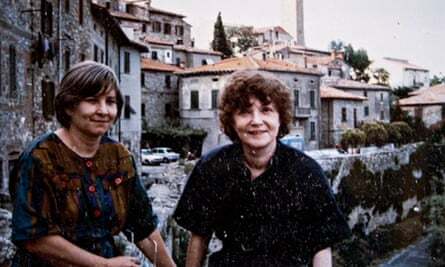
Apart from her 1992 memoir, Curriculum Vitae, Muriel Spark has remained stoically reticent about her long life. Now in her eighties she shuns interviews. But after admiring Stannard’s two volume life of Evelyn Waugh she agreed that he should be her official biographer. With access to all her papers to back up extensive interviews with Spark and her friends, Stannard has pieced together an absorbing story of the poor little rich girl from Edinburgh, who married at 20 to escape her family, had a son within a year and was divorced soon after. In the latter 1940s she lived with the poet Derek Standford who encouraged her own verse writing and also several lives of writers including Emily Bronte, Mary Shelley and John Masefield. Her first fiction came as she celebrated her 40th birthday; the novel that made her name and reputation, MEMENTO MORI, was adapted for the stage and later for TV – the first of many. But if she is to be remembered for one book it is THE PRIME OF MISS JEAN BRODIE, the story of a Scots schoolteacher. Spark has been a prolific writer since, THE MANDELBAUM GATE winning the James Tait Black Prize, THE ABBESS OF CREWE being filmed. Muriel Spark has been honoured in Britain (OBE in 1967, DBE in 1993) and in France (Commander de l’ Ordre des Arts et des lettres France). For the past thirty years she has lived in Rome.
I wanted to find out how Muriel Spark could be such a bundle of contradictions, writing very smart novels (Memento Mori, The Prime of Miss Jean Brodie, The Girls of Slender Means) and very dim-witted ones (A Far Cry from Kensington, The Driver’s Seat); and also why an intelligent independent woman would convert to the Roman Catholic church which in 1954 wasn’t the dependable defender of feminist values it is today. She was puzzling. And after 536 pages pretty much still is.
She had a family background bizarrely similar to Karl Marx – father was a non-observant Jew, mother was a gentile non-observing Christian. (Similarities kind of ended there.) She grew up poor and working class in Edinburgh. She had boyfriends, they would come round and meet her parents, drink tea and eat fruit and look at each other. They never had sex because there was nowhere to go.
She went to sedate dances with her older brother and met a guy called Sydney Spark, another non observant Jew born in Lithuania (“Glasses. Not bad looking. Not good looking.”). She was 19, he was 32, she was flattered, he was a teacher. After a year he asked her to run off with him to Rhodesia, third class, so off they went and got married when they arrived. It was a total disaster. Sydney aka Solly had not been entirely frank about his severe mental illness. He was bi-polar and was violent. By the time that became apparent she had a son (Robin). In order to get away from Solly she had to leave her son in Africa (because it was the middle of the War and children couldn’t travel). She beat it back to Scotland and hardly ever lived with her son again.
She spent 15 years doggedly chiselling away at making a career for herself as a writer, beginning with poetry and biography, not novels at all. She came from nothing and nowhere and became one of the most highly praised novelists of the last 50 years. The whole story is impressive.
But also boring, once she hits her stride, that is. Because it just becomes a whirligig of fights with publishers (“she screamed at him down the telephone, threatening court proceedings”), fights with her many friends (“Goodbye. God bless you. Please never write to me again.”) & hangers-on, mad desires to be alone and write another slim volume, more prizes, more damehoods, sudden relocations to New York or Italy; jetsetting in all but name.
And there is not much in the way of objectivity here. Martin Stannard is Muriel’s number one fan and he hardly allows one discouraging word, nay, not one slightly tilted eyebrow, about any of the 22 novels which he lovingly describes, each and every one.
Mr Stannard also never told me what I was so interested in, the religious thing. He most unhelpfully says
She did not think of herself as a Catholic when writing
But he records that on her first visit to New York she insisted on visiting the shrine of Mother Cabrini, the first American saint, and after seeing it, said
You’ll see now, something wonderful will happen because it always does when you visit a saint.
As regards her private life, and she strove to keep it private, there was never a second husband, but there was a faithful female amanuensis Penelope Jardine, who lived with her from 1968 until 2006. And when Muriel died Penelope got everything and Robin, the son, got nothing.
Recently I have re-discovered Muriel Spark’s work and have enjoyed becoming re-acquainted with her novels. Realising I knew very little about her life, I decided to read her biography and, having done so, feel it was very well researched and covered both her work, and life, well.
Muriel Camberg was born in Edinburgh in 1918, at the end of WWI. She had a Jewish father and English mother and her background, and family, was very interesting. I enjoyed reading about her early days; although her relationships as a young girl would be repeated throughout her life. With her only brother, she was never close, and she had a particularly difficult relationship with her mother, Cissy. I was also fascinated to read of her schooldays, so much of which seemed to mirror the ‘Brodie Set.’
A young, rather hasty, marriage later and Muriel became Mrs Spark; heading to Rhodesia (Zimbabwe) to join her future husband in 1937. The marriage resulted in her only son, Robin, but she had to leave him behind after the marriage failed and returned to England alone. Her relationship with Robin was difficult throughout her life and, I have to say, I found this difficult to read about. She was driven and ambitious, but, although she wanted to be with her son, they seemed destined to be kept apart and, eventually, he stayed with her mother in Edinburgh, while she tried to make a career in London. I know women should not be blamed for wanting a career, but, as a mother, I often found her desperate need, obviously really strongly felt, to be left alone to write, a little selfish.
Indeed, Spark seemed quite modern in wanting to control her career and in being very touchy about how publishers later dealt with her work and her image. As her fame increased, she often became discontented with her publishers, prized her personal space and was insistent on having that time, and space, to write. A room of her own, literally, as she spent much time in boarding houses. Indeed, one of the reasons she refused to buy a house, as she became wealthier, was the fear that family members would come to stay, or even insist on living, with her. She felt happier alone, being creative and her mantra seemed to be, ‘never apologise, never explain.’ Of course, family ties, and being a mother, rarely give you that kind of privacy…
This is an interesting account of Spark’s life and work. I enjoyed the way her novels were discussed and there is, of course, much about her conversion to Catholicism. She was close to other Catholic convent authors; most notably Evelyn Waugh, who always praised her work and supported her. I cannot, honestly, say that I warmed to her as a person, but I do feel that I understand her better after reading this. Her biographer was, possibly, a little too uncritical of her for my tastes and was a little too deferential. I know Spark, herself, did not like this biography, but I feel she had little to complain about. Rated 3.5
With much sadness, I finished this authorized bio of my favorite author this morning. It's a shame that we can read something for the first time only once. The last chapter, Dark Music, and the epilogue were particularly moving. I discovered Spark's writing just two years before she died, and as I neared the end of the Stannard bio, I felt as if I were saying goodbye to Spark all over again. As a lover of Spark's work, particularly her short stories and early novels, I thank Dr. Stannard for this wonderful gift. I disagreed with only one point of his: He refers to Spark in her pre-Catholic days as "agnostic." I don't agree.
Every year I make sure I re-read at least one of our Muriel's novels, probably more, and I also like to delve into an appreciation of her by biographers and academics....trawl any good second hand bookshop and you will be surprised at how many books there are on her life, talent and opinions.....so I was thrilled to finally get around to reading Stannard's excellent biography towards the end of last year. I had bought it back in 2009 but for some reason had not opened it until it became my breakfast book in early September.
Living alone, mealtimes are a perfectly acceptable time in which to read ( my mum is safely away in heaven so I don't need to fear her reaction to that comment) and I find biographies and histories are perfect for meals because I am less likely to be tempted to read the next chapter and the next as I might in a novel in which I am desperate to find out what happens etc etc. Therefore I leave the table at a reasonable time to set off into the day, or my next appointment or whatever.
' It is as though those who can break role are saved. The damned condemn themselves to one dimension'
This insightful line from Martin Stannard comes midway through the work and it seems to capture something of the lifetime struggle of La Spark. The one thing you could never accuse her of being would be one dimensional. He walks us through the ups and downs of her eventful life enabling us to get insights into the relationships whilst not overly sensationalizing or over sentimentalizing a woman who was quite clearly a very complex and troubled personality who, all her life, sought acclaim and success but at the same time struggled to enjoy these once they were poured into her lap.
Her pained romantic experiences were analysed but not overly so and Stannard did not take a vicious scalpel to them as some might be tempted to do. He described, he directed our attention, he opened a door slightly and left us to reflect and this made the reader use both his/her insight and empathy.
'Most men' she said 'do not like to see women as an island and attempt to land and set their flag on it'
This pushmepullme of independence/interdependence is basic to Muriel Spark's life and it affected her relationships and her work but Stannard does not belabour the point, he uses her words to set the scene and then cleverly elucidates with another insightful comment of his own later on in the narrative
but where she saw him as a guest on her island, he saw himself as co-tenant waiting to take over the lease,
Now this is a clever and unforced use of an image which sums up his style and it is a very enjoyable one to experience.
His analysis of the actual works was interesting and inventive without being clever for clever's sake or so it seemed to me and I liked the fact that he used quotations from Spark and other contributors in a way which enhanced his explanations and reflections and did not drown his reader in aphorisms and 'shining wit'. His choices enabled me to look at aspects of her work from a slightly different angle and indeed has coaxed me to think of removing 'The Driver's seat' and 'Not to disturb' from my 'never again' shelf and give them a second go. Maybe they will be my Sparkian visits of 2014.
Her Catholicism and endless journey into understanding what she was about is a continual refrain too and I love this simple yet profound thought about faith
'I am of the type of Catholic who must take recourse to the living waters of the defining mind. And what is the defining mind but the mind that 'doubts well'. There can be no definition without doubt, unless it be an intuitive definition in which case we must return to doubt in order to verify the intuition. Doubt is not a fixed principle, it moves, it can never be fixed, never at rest until it finds truth by defining
This Stannard points out is a mainstay of her writing. The necessity of doubt, of the fluidity of possibility, the essence of the 'nevertheless principle'.................is this why I find this woman's writing so fascinating and, to a greater extent, lovely to read. Is it because she is a writer to whom I can turn as a believer and live out my questioning as through an alter ego.....not sure .....but whatever the case Stannard has confirmed my love of this woman and for that I thank him.
Biography is tricky. So much depends on matters outside the biographer's control, such as the materials available to the biographer and the degree to which the subject led an interesting life. The biographer must also decide to what extent s/he will attempt to interpret the subject's work.
I felt this one had its pluses and minuses. Spark chose Stannard to write her biography and made her papers available to him, so it is based on considerable documentary evidence. As Spark died before the book was done, Stannard was somewhat freer in what he could say, too.
The book was most interesting to me when covering the years prior to Spark's fame, and when dealing with her actual books. I found I did not particularly like Spark (as portrayed), which of course is not necessarily a problem in a biography. It appeared that she could be very lively and charming, but she doesn't seem to have cared how many friends she cast out over the years, which is not an endearing trait. She seems to have been hellish to conduct business with, although I can certainly understand her frustration with publishers who lagged in book promotion.
I came out of it still mystified as to what had prompted Spark's conversion to Catholicism--which was such an important thing--and not very clear as to which aspects of Catholicism she embraced versus which ones she had no interest in. Why Catholicism rather than some version of Protestantism or Judaism? Do I enjoy all the wrong things about her books by not fully understanding what she wanted to get across in them?
I was not really at all interested in the mass of detail about her last several decades; it came across as 1) endless fights with publishers, agents, editors, etc.; 2) accounts of friendships whose importance did not really come across beyond that she liked to be around people she found intelligent and entertaining; 3) travels whose significance was often minor. On the one hand, there's a trove of detail in there that will be useful for other biographers (of her or of others), but it seemed rather dull, even though the incidents were sometimes funny or horrible.
In a way this is a biography that feels necessary so that later on someone else can do a different one.
I enjoyed reading some of Muriel Spark's novels as a teenager, and have equally enjoyed revisiting her body of work in this centenary of her birth. Her novels are dark, witty, perceptive and lively. Many of them contain autobiographical elements, albeit reimagined and distorted, so I was eager to read this biography and find out more about the woman behind the stories.
Martin Stannard has researched his subject thoroughly, analysed her words and actions with thoughtfulness and perception, and has carefully selected and described the key points from her works. However, overall I found reading this book a bit of a struggle, mainly because Muriel's experiences are rather repetitive and because I never felt engaged with the author as a person. I found the analysis of her works more engaging and enlightening than the personal details, and I believe there are two reasons for this.
First and most importantly, Muriel Spark furiously resisted any attempts to 'understand' her or to assume ownership over her identity and image. She gave contradictory interviews, censored aspects of her publishers' marketing of her, and withdrew from friendships and situations when she felt her identity threatened or vulnerable to unwanted exposure. She even sued an author who had inaccurately described an event in which she had featured. So the reader's impression of Muriel Spark always contains gaps and unresolved issues.
Second, after the compelling narrative of her early life in Edinburgh, unsuccessful marriage to a man who admitted to concealing details of serious mental health issues from her, and flight from Africa leaving her infant son behind, she devotes herself wholly to becoming a writer. So after the first few chapters, she is immersed in the literary world and everything is geared to that aim meaning that gradually personal details fade out of the narrative. There are lists of people she meets, parties and awards ceremonies she attends, and properties she rents and buys, but her reactions and thoughts about these are sketchy. Even her relationships are dealt with in a broad-brush way, leaving more frustrating questions than answers about her life.
A final point - much of Muriel's time is spent arguing and falling out with publishers and agents. Stannard does an excellent job of conveying the author's frustration at their casual reliance on personal qualities - friendship, loyalty and trust - to manage what should have been a professional business relationship, and their failure to fully appreciate her commercial as well as artistic value. However, he does assume a lot of knowledge about the detailed working of the publishing industry such as rights and options. A few sentences of explanation would have helped the layman understand exactly what was going on between the two sides at certain points.
I found the analysis of Spark's novels interesting and feel I have gained a better understanding of her artistic beliefs and aims, and more insight into her Catholicism and its impact on her work. I admired the portrayal of her fierce intelligence, determination and independence. However, overall I also feel I have learned a lot more 'what' than 'why' and that is rather disappointing and leaves me slightly dissatisfied with this biography.
I read Martin Stannard's biography of Muriel Spark over the course of a couple of weeks with much pleasure. It's not a great biography. Stannard's tendency to skip back and forth in time and to shift between first and last names when referring to the vast cast of characters made it difficult at times to figure out what exactly happened between who when. And he had theories about Spark that he sometimes presented as fact. I've got no objection to biographers putting forth theories--that's part of what makes biographies interesting to me--but I do object to those theories being presented as fact. But as the first full biography of Spark it is a must-read for fans of her work, and it is an impressive work of scholarship that is packed full of interesting detail, much of it new to me despite having read most of Spark's books and followed her career with interest for many years. And most importantly, Spark's writing, both process and product, is the central focus of the biography throughout. Stannard's thorough and thoughtful commentary on Spark's novels and stories did just what a good literary biography ought to do--send the reader back to the work itself. I've begun a grand re/read with the intention of working my way through all 22 of Spark's novels in the order in which they were published, and finishing up with the collected stories.
I speculated mildly that author Martin Stannard is perhaps being a little presumptuous by subtitling his book on Muriel Spark as The Biography rather than, say, A Biography. But the subtitle may be appropriate, since Spark herself “gave Martin Stannard full access to her papers,” and he “interviewed her many times as well as her colleagues, friends, and family members.” The result is a fairly hefty, well-researched, detail-rich biography of the life and work of a formidable writer in the post-war era of the twentieth century.
Born of Jewish parents into the gritty working class of Edinburgh, Scotland in 1918, Muriel Spark did fairly well at the James Gillespie Girls’ High School. As a budding poet at age 14, she was crowned Queen of Poetry at the Ideal Home Exhibition in Edinburgh for her poem commemorating the death of Sir Walter Scott. Arguably, the biggest takeaway from this school was the influence and character of Spark’s teacher, Miss Christina Kay, who became the model for the protagonist in one of Spark’s most successful novels, The Prime of Miss Jean Brodie.
Spark married disastrously at 19 and found herself living in Southern Rhodesia (now Zimbabwe) with an unbalanced, abusive husband. Her son, Robin, born when she was 21, was somewhat dispassionately left behind when Spark returned to England in 1943. Robin did eventually live in Edinburgh, where Spark again left him to be raised by her parents while she made her home in London. There was never any real closeness between mother and son throughout their lives.
After the war, Spark spent the 1940s and early 1950s struggling to establish herself as a respectable poet and critic. The push-factors into novel writing might have been a hallucinatory, nervous breakdown and conversion to Catholicism, which brought her calm and a commitment to celibacy. Considered a literary late-starter, The Comforters was published in 1957 when Spark was 39 (although Anita Brookner was 53 and Penelope Fitzgerald 61 when their first novels were published!). Spark’s 22-novel output, averaging a novel a year, skyrocketed her to wealth and fame with the appearance of The Prime of Miss Jean Brodie and The Girls of Slender Means in 1961 and 1963, respectively.
Spark’s steady literary output was at odds with a geographic restlessness, which had her hopping erratically from one domicile to another—England, America, and Italy. Editors and publishers would likely characterize her as a fickle, prickly writer; a suggestion for even a trivial change would cause refusal to work with a particular editor. The restlessness extended to her relationships with men, where the slightest unmet expectation would sever the friendship. None of this restlessness affected her work energy: she frequently worked simultaneously on a new novel, corrected proofs of the previous one, and oversaw another two or three others being adapted for the stage, television, and the big screen!
Spark’s fiction was drawn directly from her life and others’, and with few exceptions, her books are more novellas than novels. She spent the last three decades of her life living mostly in Italy in a house shared with her close friend, artist Penelope Jardine. She suffered poor health as she aged, but it never stopped her from writing. Her last novel, The Finishing School, was published two years before her death at 88 years old. Stannard does an excellent job of tracking and placing every one of her novels clearly in the contemporary context of her life. His overall treatment of this remarkable writer, whose work was repeatedly praised by Waugh, Greene, and Updike, is generous and thorough. Having read only half-a-dozen of Spark’s novels, Muriel Spark: The Biography strongly tempts this reviewer to read the rest.
A biography of the Scottish novelist, critic, and poet, Muriel Spark (1918-2006), whose most famous book was The Prime of Miss Jean Brodie.
Muriel Spark: The Biography is a thoroughly researched beast of a book (over 536 pages of text), but the writing takes some time to get used to and to get through. After a couple hundred pages either the writing improved or I became accustomed to it. The author was personally selected by Spark herself, and had access to her personal papers, so I can't imagine a more thorough or better researched biography for a while to come. The literary discussion of her work was not particularly helpful and seemed a bit haphazard, as if patched together from various sources. But it certainly provides a view of her work and if he had access to Spark's opinions, then worth even more than that. The author is partial to Spark, which is to be expected, and takes her side of controversies whenever possible, at times vehemently so. This did not, however, detract from the book for me as it was fairly obvious when he was being partial.
Two main themes come out of Muriel Spark: The Biography. First, is that of Muriel Spark as a strong individual with a iron point of view that rarely bent for others, even those closest to her. Her first dedication was to her writing above all, and woe to those who interrupted her while at her vocation. She converted from a Jewish childhood to Catholicism, traveled to Africa to get married and have a child, charged headlong into the male dominated London literary establishment of the '40s and '50s, and while there were setbacks, she never stopped demanding, fighting, to construct her own unique future.
Second, her novels are more autobiographical than they might first appear, but never blatantly so as she was an almost violently private person, even while often living in the public eye. In her novels, the plot, even the characters, serve to create her moral, religious, and philosophical discussions. But these discussions are never clear cut, with all the paradoxes and ambiguities of humanity reflected: there is no one point of view, contradictions are always included, her contrariness no different than simply that of life. And despite how often her discussions touched on religion, her view of the omnipotent was not that commonly imagined, far different than the anthropomorphized deity one might expect.
I haven't read any other biographies of Spark, but Muriel Spark: The Biography must be close to authoritative for the near future, only wanting more lucid writing and incisive literary analysis. [3.5 Stars]
Despite the Wall Street Journal's high regard, most critics tempered their praise by acknowledging this biography's various flaws, including Stannard's flat, cliché-ridden prose and his puzzling silence on significant experiences in Spark's life, such as her long-term relationship with artist Penelope Jardine and the effect of her religious conversion on her novels. Stannard skillfully recreates Spark's turbulent early years and places her deftly within the mid-century literary, social, and cultural milieu to which she belonged, but his narrative loses its bearings in the whirlwind of her continual travels later in life. All complaints aside, Stannard's exhaustive research and the unprecedented access he was granted to Spark's life have yielded the most comprehensive account of the prickly and superstitious author we are likely to get. This is an excerpt from a review published in Bookmarks magazine.
I love Spark's rebellious and spiky novels but I felt the biographer didn't really get to the heart of her. He deals well with her positive, ambitious traits but with her difficult traits he deploys a light touch. Biographers sometimes worry that if they are too critical of their subject, that this might devalue their genius or compromise their work. This is not so. You don't have to be perfect or even nice to create great work but it would be a con to brush over these aspects of the subject's character. I think Spark's relationship with her mother and son deserved a fuller, more honest probe. The constant identifying of the Spark-inspired character in each novel was tedious.
Excellent biography of one of the most intriguing British novelists of the 20th Century. Ms Spark's intelligence, imagination and self-possession are an inspiration to all writers, and especially women.
From BBC Radio 4 - Book of the Week: Hannah Gordon reads from Martin Stannard's biography of the acclaimed Scottish novelist, written with full access to her letters and papers.
I read about a 100 pages of this book before giving up on it. It's detailed – over 600 pages – and while it gives us an excellent picture of Spark as a person, it doesn’t say much about her writing processes, which for me are always the most interesting thing about a writer. Looking at other reviewers' notes, it seems I'm not alone in finding Stannard's writing rather humdrum in spite of the personality of his subject. Sometimes, too, his chronology is hard to follow, though admittedly it's difficult for any biographer to stick directly to a timeline.
A good, interesting read on Muriel Spark's life. An interesting, feisty, career orientated, brave, intelligent, imaginative, hard working, forward moving individual. She knew early on she was going to be a writer. Even as a young girl, she had the ability to remember characters and conversations. Her mother had a number of visitors to their house and Muriel looked forward to being around the visitors, listening to them. She left school at 16 and worked in publishing for a number of years. Married at 19, had a baby at 20 in Zimbabwe in 1938, separated from her husband a couple of years later, never to marry again, leaving Africa in 1944, publishing her first novel in 1957, with success as a writer coming when she was in her mid 40s. There is a short summary of each of her books, what Spark's private and public life were with each book published and how critics reacted to each of her books.
Martin Stannard provides detail on most of the many individuals that come into and go out of Spark's life. She consistently fought with publishers, agents and editors. We learn about her travels during nearly each year of her life, her life style, that she rarely cooked, didn't own property for a large part of her life and about her relationships with her father, mother, brother and son. She was generous with her money to family and friends, but not so generous with her time. She believed as a writer she needed time to be alone to write and this activity took precedence over all other activity. She had a number of health problems throughout her life but fought on doggedly. Overall I gained an appreciation of Spark as a person and with some of her books, a better understanding. Her books are character driven rather than plot driven. Many have elements of her life experiences and the characters she experienced in her life.
I'm really pleased to have just finished reading this biography precisely on the centenary of Muriel Spark's birthday.
This is a very well researched and very thorough biography by someone who knew her quite well in the last years of her life. For me, the book goes into a bit too much detail on the plots of each of her novels - but that's purely a question of individual taste/interest.
She was a significant public figure for pretty much all of my life up to her death, but she hadn't really registered with me as a really major twentieth century writer - so it was useful to read this to set that right.
This was presented in 5, 14-minute segments. I suppose it was okay as biographies go. Hard to judge something that should be objective without being an expert on the subject matter. I'm curious why Spark wanted to stop publication of this book. It didn't seem scandalous or particularly revealing, but perhaps anything really interesting got edited out in production.
Meticulously researched biography of the unique and idiosyncratic Muriel Spark whose slender novels burned brightly but are now perhaps a little out of fashion.
Muriel Spark The Biography by Martin Stannard - Good
Oh dear, I finished this back in January and have left it much to long to begin writing up my thoughts. It also took me six months to read - although I have an excuse for that.
I thought I would read it as a break from the novels in my #ReadingMuriel2018 quest but soon discovered that the author went into much too much detail about the novels which would have spoiled my reading of them. I didn't want his literary criticism and thoughts to colour my own perception.
So, this is a scholarly and detailed look at Muriel Spark, her life and works. He was actually invited by her to write the book and as such had access to her and her archive. Some of it was a bit dry for me and, as I said, the details about her writing could spoil their enjoyment if you haven't already read them. I also came to understand just how much of her life is used as the basis for her novels. Now that I look back at them with greater knowledge of her own life I don't think there is a single thing that she wrote that didn't have an autobiographical element. Well I guess they do tell aspiring authors to write what they know and what else would you know better than your own life..... and she certainly lived life!
I must admit, I don't think I like her. Supremely talented, eccentric, opinionated. I thinks she was a fierce friend but a fiercer enemy - you crossed her at your peril. She didn't hesitate to drop someone that she felt had slighted her or her work and any disagreement was taken as betrayal. This even extended to her son. Much as I can see that she thought she was acting in his best interests, I feel for the small boy that she left at a boarding school in South Africa while she returned to England. When she finally brought him to Britain she immediately left him with her parents in Edinburgh to bring up. Yes, she needed to work to support him, but it can hardly be a surprise that they never had a close relationship. Such a shame.
One quote from the book seems to sum it all up for me:
In 2001 she wrote: "I have learned that happiness or unhappiness in endings is irrelevant. The main thing about a book is that it should end well, and perhaps it is not too much to say that a book's ending casts its voice, colour, tone and shade over the wole work".
Muriel Spark is an amazing author and I was excited to read this biography, however I found it an unterly inhuman account of her life. While undoubtedly well researched it gave me no impression of her as a person or her motivation. It is a very traditional biography with close analysis of her books, including somewhat tedious quotes from all the reviews. Stannard uses Spark's conversion to Catholicism as a prism through which he analyses her. While no doubt a sysmic event in her life his singular focus overlooks other significant factors in favor of intellectual naval gazing. This means that more human emotional and psychological explanations are often unexplored. I also found the ordering of his account was muddled, particularly in relation to her relationships with Stanford and Sergeant. This meant that I had no clear idea of the relationships start and finish in relation to other events in her life which was frustrating. While Spark no doubt lead an interesting life I did not find that this biography did it justice.
I can't say I warmed to Muriel Spark as a person and although this biography speaks of all aspects of her life and writings it left me wanting to know more about various people and places...her husband, her son, her time in Africa...and I thought the selection of photos in this book very poor.