This book is my father's story. Like many others, my father was in the ASTP program, signing up in 1943 to become an engineer, along with the best and brightest American students, but the army decided it needed more canon fodder, so the program was cancelled and he and thousands of others were drafted into the infantry.
This is the story of the men who went over the beach on D-Day, but it is also the story of the "replacements", men like my father who came into battle a month or two later to replace the lost men from now hollowed out units.
This is the story of the Battle of the Bulge, in the Ardennes, where my father and thousands like him found themselves on the frontline in bitter cold conditions and brutal combat.
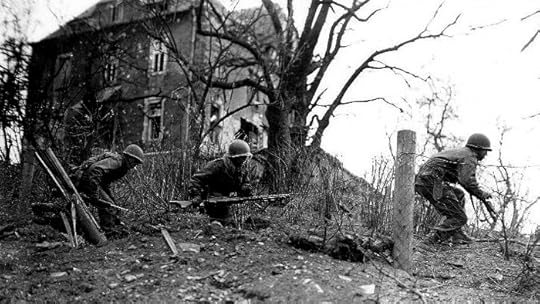
My father had trained as a rifleman, but was made an ammunition carrier in a five or six man machine gun squad. One by one the people ahead of him were killed until he was the operator of the Browning machine gun. He fought and he shot, but he also ducked and ran and was determined to get through the horror alive. He told stories of death and near-death, and of comradery and moral numbness. He told me of the long wait to find out if they would be shipped off to die invading the island of Japan. Then Hiroshima came and he fired his pistol in the air for joy because it meant he would not die in the Pacific.
Stephen Ambrose emphasizes the ordinariness of the massive American army's soldiers. Like my father these warriors had been high-school students a few months before they were engaged in combined arms assaults against German positions.
The American supply chain, with its ability to push endless fuel, food, and ammunition forward and support the troops, was perhaps the most critical factor in the American victory.
The solidarity of small units was also critical, maintains Ambrose. My father spoke of that too. He said that when you are in, your buddies are everything and you'd do anything for them. A year or two later he looked up some of the men he had fought with back in the States and found they had nothing in common and nothing to say to each other. Like the soldiers described in this vast and detailed history, he was discharged and took the GI Bill to a college education. He then moved on with life as a scientist and artist and family man, rarely mentioning the experience or looking back.
Ambrose argues that soldiers learned lessons of conformance, obedience, and joint action that defined America culturally in the 1950s, and were part of its economic success in that period. It's an argument that could be developed more deeply, but perhaps there is something to it.
For my father, a scientist and an artist, the army experience was just something to get through and move on from, and that he did, dying at 84 in 2010.
In reading this book I am able to imagine his unique experiences, different and yet deeply evoked by these descriptions.
Citizen Soldiers is a powerful story of men and an army at war.