Jump to ratings and reviews
Rate this book

Madame Tussaud's Apprentice: An Untold Story of Love in the French Revolution

Rate this book

In 1789, with the starving French people on the brink of revolution, orphaned Celie Rosseau, an amazing artist and a very clever thief, runs wild with her protector, Algernon, trying to join the idealistic freedom fighters of Paris. But when she is caught stealing from none other than the king's brother and the lady from the waxworks, Celie must use her drawing talent to buy her own freedom or die for her crimes. Forced to work for Madame Tussaud inside the opulent walls that surround Louis XVI and Marie Antoinette, Celie is shocked to find that the very people she imagined to be monsters actually treat her with kindness. But the thunder of revolution still rolls outside the gates, and Celie is torn between the cause of the poor and the safety of the rich. When the moment of truth arrives, will she turn on Madame Tussaud or betray the boy she loves? From the hidden garrets of the starving poor to the jeweled halls of Versailles, Madame Tussaud's Apprentice is a sweeping story of danger, intrigue, and young love, set against one of the most dramatic moments in history.

226 pages, Kindle Edition

First published July 4, 2014

7 people are currently reading
983 people want to read

About the author

Kathleen Benner Duble

13 books56 followers
Kathleen Benner Duble had sixteen car accidents before she was twenty-one. Being an at-home writer keeps her from hitting the road (or anyone else)! She is the author of eight books for children. Kathleen loves digging for unique historical fiction plotlines and encouraging students and lovers of books to look for great stories right in their own backyard!

Ratings & Reviews

What do you think?
Rate this book

Friends & Following

Create a free account to discover what your friends think of this book!

Community Reviews

5 stars
57 (19%)
4 stars
105 (35%)
3 stars
106 (35%)
2 stars
22 (7%)
1 star
6 (2%)
Displaying 1 - 30 of 90 reviews
Profile Image for Kelly (Diva Booknerd).
1,106 reviews294 followers
December 23, 2015
I loved it. Over the past few months, I've developed a love for young adult fiction based upon the French Revolution, and Madame Tussaud's Apprentice is among the most passionate and engaging I've read thus far. Celie is homeless, thrown out onto the streets of Paris an orphan and not being able to afford the roof over her head. Rescued by Algernon, a young man living on the streets and has taught her to steal from the wealthy to survive. Algernon seems oblivious to her feelings towards him and while he promises to protect her, Celie is caught posing as a blind girl and swindles the Comte of his gambling winnings. In a stroke of luck, Manon Tussaud has also had her prized possessions stolen and seeing Celie's rare artistry, strikes a deal with the Comte to not only take the young orphan under her wing but to rid her of a life of crime.

Celie is no Eliza Dolittle, but a girl who now feels trapped by her debt to Madame Tussaud. She constantly worries for Algernon and his survival while she is seemingly living the high life according to her companion. I liked Celie's character, she was determined but also learnt from her mistakes and her indecisiveness only stemmed from her feelings for Algernon. He on the other hand was nothing more than a controlling presence that used guilt to keep Celie loyal. I loathed him. He isn't the villain, but I found no redeeming qualities within his character. Algernon is manipulative and only truly cared about his own interests.

At the heart of Madame Tussaud's Apprentice is the French Revolution, where the ruling monarchy was overthrown in favour of a republic. Lasting ten long and brutal years, Kathleen Benner Duble vividly describes the Revolution for the younger audience. But it does feature brutality and the execution of the royal family, beheadings and the gruesome task of creating wax models from the vigilante murders of officials and those deemed against the rebellion. Just a gentle warning for those who are sensitive to violence.

'Words are weapons Celie,' Manon says, 'as are symbols. Never forget that. The power of change can come not just by force, but by speech or a peaceful marching crowd.'

I loved Manon Tussaud. She was stern but incredibly patient and despite how abrasive Celie could be. She came to love the young orphan as her own child. I would have loved to have seen more interaction with the wax museum itself as it was such a big part of Manon's life.

Madame Tussaud's Apprentice was a fantastic read that will appeal to both young adult historical readers and those with a pendence towards the French revolution. Wonderfully written, it was a vivid tale depicting the Reign of Terror. Passionate, brutal and engaging. I loved it.
http://www.divabooknerd.com/2015/12/m...
Profile Image for Tweety.
434 reviews244 followers
March 20, 2015
3 1/2

This book surprised me, I don't know what I was expecting, but sure wasn't what I got. That is a good thing in case you are wondering.

When I found that I had won this in a Goodreads giveaway I had a moment of worry. I don't usually care for YA books, and I have never liked the kind that have twenty-first century characters clothed in period dress and in a historic time since I get jolted out of the time slot by the characters' actions. But, this book didn't do that. I like that everyone acted naturally with their own flair and in the right time. Also, it was quite exciting since I don't know a great deal about Madam Tussaude or what happened to her during the Revolution.

Celie is a guttersnipe, she has been since her parents death and since then has joined forces with another urchin, Algernon. Together they steal from the wealthy to feed themselves and get back at those who stole from them. I wasn't digging their love story much, it felt a bit like Marius and Eponine's love story only in a YA book. (Les Miserables) I guess I just don't care for young adult romance, it's not my cuppa tea. Not that they were sappy, I just wasn't into their romance. I think had they been older I'd have enjoyed it more.

Madam Tussaude was a fascinating character, I wish we could have gotten closer to her and her family, the author portrayed them all in such a kindly light. I love how we were shown a bit about the wax modeling. Now my dislike(s)

Since it is the French Revolution we can expect heads to "roll" as the author puts it. That's all good, we understand that. But, when Madam Tussaude has to plaster a head I don't think it's necessary to tell us it squished like a melon, when caught. Or that when one person lost his head, (that's not shown) that blood squirted people in the front row and that it came from his neck. Let's just leave it at blood all over the blade, shall we? I'm not saying the author added tons of gory details, I'm saying she added those two spots and that I wouldn't hand it to just any YA because of those thematic aspects. I don't want to give anyone nightmares! People who went through the Terror will have had plenty of them. It wouldn't bother me in a fact book written as cold facts, but in a book of action it isn't so distant. It wasn't even detailed, but one short sentence is enough. At least leave that sort of thing to or imaginations, I don't know about you but mine works fine without that kinda detail.

One other thing, in the middle one character becomes the bad guy, by the end he is good again, but I was lost between the transaction. Maybe because it was First Person and we don't get inside the persons head, but it felt strange that this character was such a good actor and could hide such a warm heart under a cruel exterior.

This book had a middle grade feel, but I wouldn't give it to middle schoolers in general. I'm puzzled, who was the audience for this? Older grades probably won't dig the romance and younger ones probably, won't care for Madame Tussaude's wax heads on dead humans.

If you're reading this and thinking I didn't like it, I did. It may not be my favorite book of this year but I did learn something and I enjoyed the message of this book, "family is worth living for, even more than freedom is worth dying for" and I am glad the characters came to that conclusion.

Thank you for my First Reads copy! I did enjoy it. :)
Profile Image for Leta Patton.
34 reviews12 followers
November 18, 2019
Yikes with the historical information and glaring inaccuracies. YA historical fiction deserves better 😬😬😬😬
Profile Image for summer.
249 reviews318 followers
October 19, 2014
At first, I absolutely adored this book. After further contemplation and after the initial buzz settled, my love wasn't quite as strong.

Madame Tussaud’s Apprentice can easily be summarized as thus: it is a story of a girl unwillingly caught up in the midst of one of the most contentious periods in history--The French Revolution. She is torn between joining the revolutionaries and staying impassive, a choice which will ultimately determine her fate in this war.

Duble’s interpretation of the Revolution is an interesting one, but by no means untrodden upon. It’s hard to say whether Madame Tussaud’s Apprentice contributes anything fresh to the historical fiction genre, but in the end, I don’t believe that was the author’s goal. If her goal was to provide a gateway for young readers into a horribly underrated part of YA, then I’d consider her novel successful.

However, this novel is by no means flawless. I feel like I've read a very watered-down version of the French Rev that skims over the gruesome and complicated areas of the period. The book basically underestimates the intellect of young adults, so here's an FYI: Just because it's labeled "YA," does not mean you must dumb down the subject matter for your audience. 


Because I like barricading.

Moreover, the characters’ interactions with each other feels overtly immature, as if the narrator has quite a narrow scope of life characteristic of an 8-year-old. (Seriously. I don't remember being that naive last year--or since elementary school, for that matter. And she's been living on the streets, so it's not as if she has lived a sheltered life.) The main characters aren't very memorable and the writing is a bit juvenile, which causes the overall story to be somewhat forgettable.

If the novel had been a bit longer, I probably would not have as many issues with it. But I feel like everything was rushed and that there wasn't enough time for much development, plot-related or otherwise. The characters admittedly do have a lot of potential, and if the author had spent more time developing them and their relationships, this book would have had more of an emotional impact on me. And although I enjoyed joining Algernon and Celie in their shenanigans,, I can't say I care for them much after finishing the book. Which is a shame.

A sequel would be nice.

While certainly not the best of the genre, Madame Tussaud’s Apprentice is as absorbing as it is audacious, and did not once fail in capturing my attention. Duble deftly and expertly manages to balance both the historical and fictional aspects; a true testament of her manifested talent. That said, the oversimplification of the French Revolution, as well as the seemingly artificial plot developments and characterizations, were perhaps the major downfalls of this too-brief novel. I would recommend to those looking for a light historical fiction read with a dash of adventure and a sprinkling of romance.
Profile Image for Suzanne.
Author 43 books303 followers
August 9, 2014
I'm always up for a story about the French Revolution, and until now, I didn't know that Madame Tussaud had been involved. This is a well-researched, well-crafted novel. I loved the details about life at Versailles, and I found Celie a strong and appealing heroine.
Profile Image for Kirstie Ellen.
887 reviews127 followers
June 16, 2016
4.5 stars

Initial Thoughts Upon Finishing
This was brilliant and clever and I loved it. Such a clever representation of the French Revolution and utterly unique. This is one of the most interesting stories I've read in historical fiction - Madame Tussaud? Yes please.


Madame Tussaud’s Apprentice
This book was unbelievably enjoyable. The reason I first noticed it was because of its stunning cover, but then I read the title and decided that I absolutely had to have it. But then it got even better, when I found out this was set in 1789 NOTHING COULD PREVENT ME FROM READING IT. Ahem. The French Revolution occurred in 1789 for those of you less acquainted with history.

The book definitely lived up to my expectations and I’m so glad that I read it. I wish this was talked about more because, my goodness, if you’re looking for an awesome representation of the revolution then look no further, ladles and jellyspoons.


What Happens
The book follows a girl called Célie (and what a lovely name that is) who is an orphan and living on the streets with a boy called Algernon (the names are on fire, I tell you). France is in turmoil - or at least, it very almost is. The revolution is about to happen: the poor are rising up to take down the frivolous monarchy and dash away their excessive wealth. In this time the wealthy are wealthy and the poor are dying. It’s tough times and the people of France want change to happen in the country to stop the extreme divide in wealth that is occurring. If you know anything about the revolution then you’ll know it was violent and bloody - so it’s time to pop the popcorn and enjoy the show.


After a botched robbery attempt, Célie gets caught but fortune smiles on her as the lady we know as Madame Tussaud takes her in. Why is this? Well, Célie has an incredible talent when it comes to drawing and when asked to draw the other thieves everyone goes: MON DIEU ZE GURL CAN DRAW! Just like that, yes. For Madame Tussaud, or Manon, as she is called, this is excellent because Célie’s talent is rare and she needs someone to help her recreating the people and settings for her wax works museum.


Célie now faces the struggle of being in a world of luxury as Manon works for the court as Versailles: never again with she go hungry or really want for anything. But at the same time she must continue to think of the poor of France and strive to further their cause! *breaks out into Can You Hear the People Sing* Sorry. Ahem. She’s stuck between a rock and a hard place because Manon keeps her under strict supervision to ensure she doesn’t do anything wrong but Algernon, also taken in by Manon, is egging Célie on to fuel the revolution by doing some epic spying that she's not quite sure how she'll pull off. And. It. Is. Awesome.


Célie & Algernon
These two were very interesting characters - Célie was definitely my favourite of the two. She’s a really tough girl having watching her father be beaten brutally death and then her mother and brother starve. She’s come so close to death so many times but by the grace of God was saved by Algernon from rotting in a gutter. I really appreciated the struggle that she goes through between never knowing which team to swing for. She loves Algernon dearly and wants to please him and help save the people of France, but at the same time she doesn’t want to displease Manon who is quickly becoming a mother figure to her. I felt as confused as she was because you can’t possibly see how everything is going to work out, especially when your head is quite literally on the line if you make a wrong move.
". . .I have felt strangely insecure, as if I am making my way in a darkened room that I thought I knew well, only to find someone has rearranged all the furniture."
I was decidedly less keen on Algernon. I still think that he’s a bit of a cruel character who really used and manipulated Célie. She’s so in love with him, however, that she either doesn’t see or doesn’t mind it. In the beginning I thought that he was okay but for a lot of the book he seems blinded to everything else except taking down the monarchy. He constantly puts blame back on Célie that I thought was uncalled for and I think he was too hotheaded for his own good. But this being said he is just a boy and he desperately wants to help the poor who are dying. Despite his questionable ways of achieving his goals I do still admire his courage for making change happen. I can only say that I’m glad I didn’t live in France during this time.


The hardest thing as a reader when considering these two, is the fact that we get everything from Célie’s perspective (not that I think this is a fault in anyway, I’m glad it is a single perspective book). We see her transition from a beggar to a lady of the court (practically) and we also experience everything that she experiences. Through her work with Manon she meets the royals and she comes to the surprising conclusion (although not necessarily a surprise for the reader) that the royals’ lives aren’t as easy as they first appear. It’s a completely different sort of trial but she begins to see them as humans and not these elusive figures of wealthy purposefully condoning the poor and taunting them with all their food. And, of course, this makes it very difficult to put your heart into supporting their execution.
"How has this happened? How could the people kill someone and laugh about it when they have witnessed the very same things done to them? What terrible evil has been unleashed?"
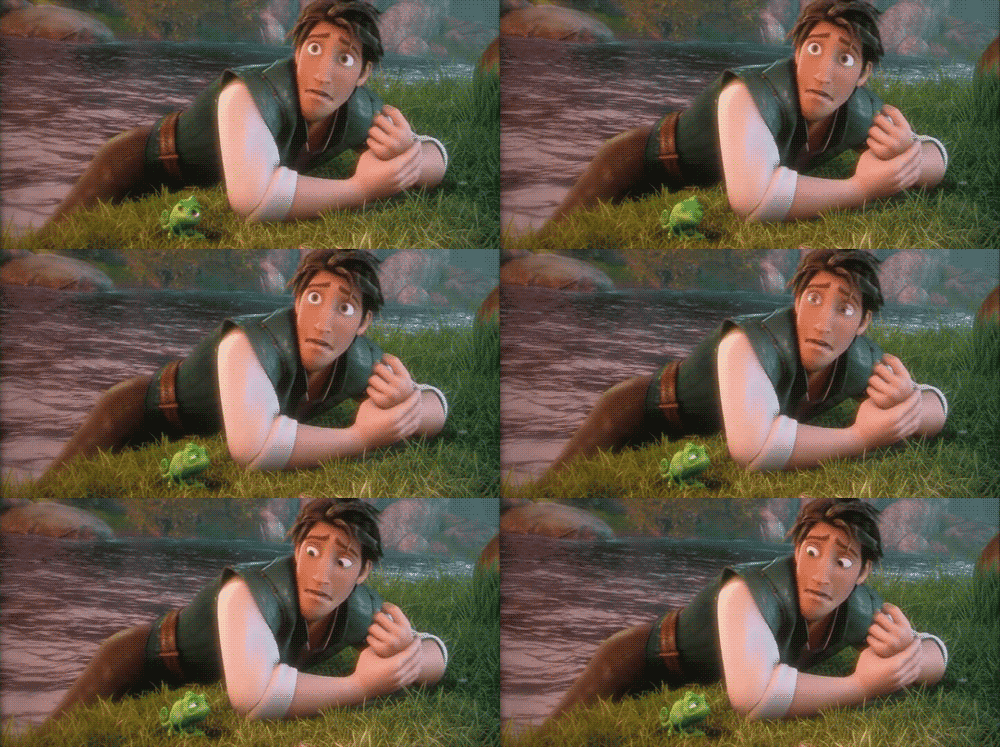
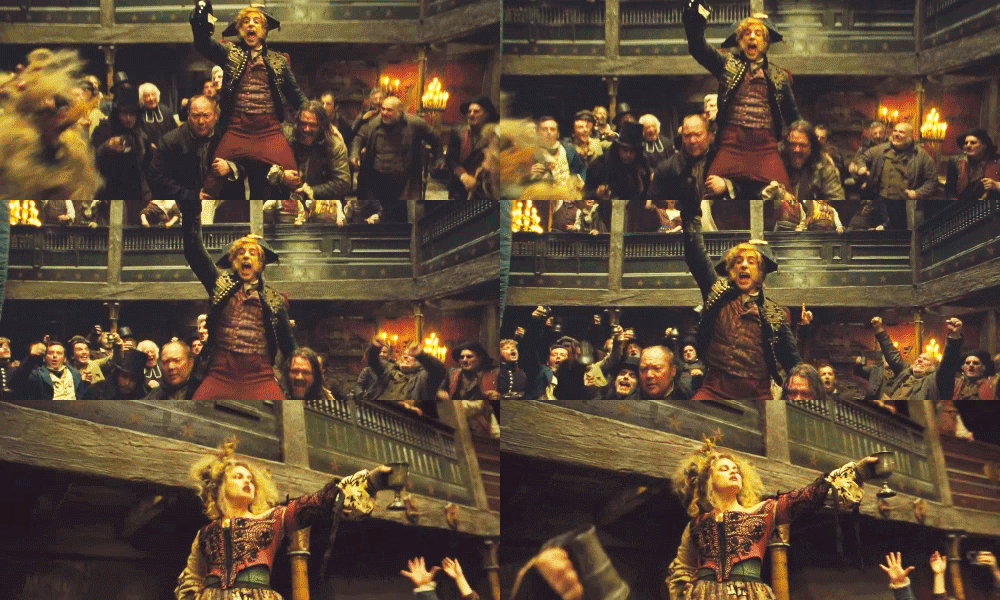
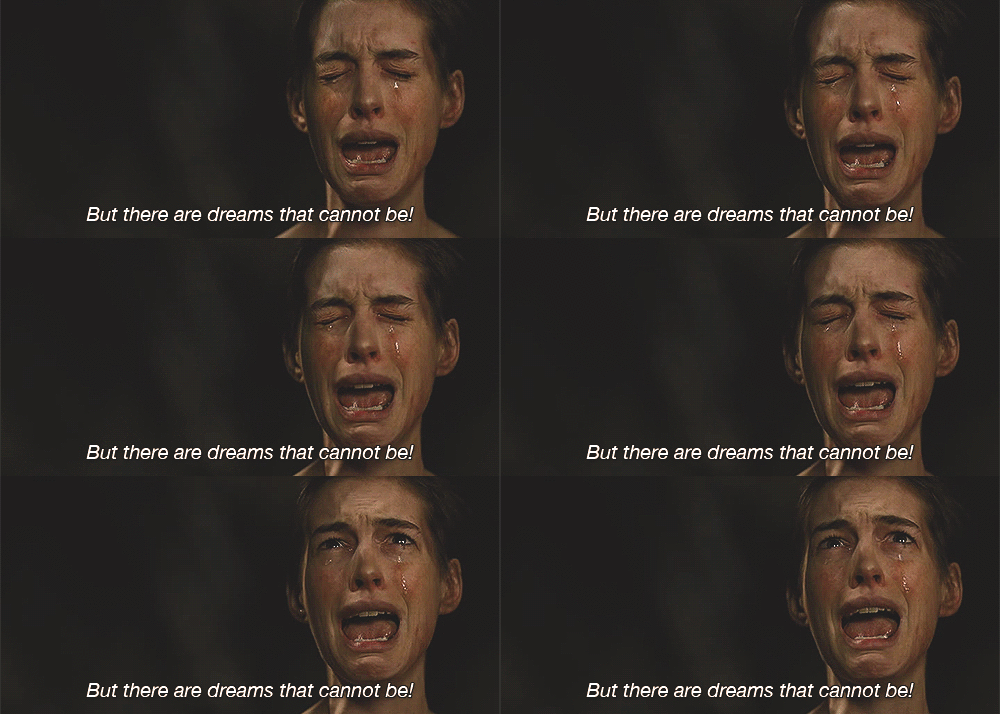
These characters do the perfect job of performing this story and presenting to the reader the nature of revenge and questioning whether it's worth it and showing us the consequences. As a quick mention, I really loved Jean-Louis' character. He was adorable and the perfect friend to Célie when she needed one the most (plus he introduced the whole lock-picking subplot which was great).

Historical Context
We get a really clear representation of atmosphere of the French Revolution through this book. If you do read this and you’re not familiar with the history just do be mindful that these events are compressed, sped up, and fictionalised in places to make a compelling novel. Duble writes an afterword in the novel to explain a few things and she also gives a timeline of Manon’s life. I loved this.


I have studied this era from several different angles and I thought this was very cleverly done. The unique character that Duble has decided to centre this story around is PERFECT for giving us that straddled position between the opposing ends of the revolution. Madame Tussaud is a commoner but because of her work she frequents the aristocratic lifestyle. I love that Duble has picked Madame Tussaud - this is unlike anything I’ve every read before and I knew nothing about her until this book. I highly recommend reading Duble’s summary of her life if you get the chance to read this one.

In the end, it really is the atmosphere of this book that wins it the cigar. You will definitely feel anxious for the characters in the hope that everyone is going to make it out okay. Heads are rolling left right and centre and the rift that forms between Célie and Algernon is tangible and painful. This is what historical fiction should be.


Perhaps We Should Talk About that Ending
Now, without spoiling anyone, I will say this: the ending of this book was what knocked that half a star off my rating. I loved everything else but there was just one element that I, personally, wasn’t quite sure about. I’m okay with it but something didn’t quite feel right.


So of course we must discuss it in a spoiler.

Summary
This is a gem of a story. I highly recommend EVERYONE reading it, especially those of you who love historical fiction. It’s a beautiful and horrifying representation of the French Revolution of 1789 and I so, so want to read more books by Duble. She clearly has a real talent for making history into a compelling story and I loved almost everything about this one. The use of Madame Tussaud to create this story was perfect and Célie is now on my list of notable characters for her heroism and strong moral compass. *waves French flag enthusiastically and sings One Day More*


*Apologies for all the Les Mis gifs, they're not quite appropriate seeing as it's about the 1832 rebellion but shush.*

Happy reading!
Profile Image for Eline.
59 reviews5 followers
January 2, 2018
Really enjoyed this interesting book. I would love to read some more historical fiction after this book. It did feel a little bit rushed at some points, but that didn't bother me since I really wanted to know how the story would continue. Overall I very much enjoyed this book :)
Profile Image for Danielle.
397 reviews76 followers
August 22, 2014
Read This Review & More Like It At Ageless Pages Reviews

2.5 stars

A moderately engaging look at the French Revolution that suffers from one of the worst romances in recent memory.

Celie Rousseau is a homeless orphan, living in the back alleys of Paris with her savior, Algernon, a boy with revolutionary dreams. They steal from the rich, through a combination of housebreaking and rigged card games, and are feeling quite proud of themselves for it. Until a fellow thief botches his take and theirs, ending with Celie imprisoned, where one of the victims demands that she draw the other criminals to spare her own life.

Celie is a world class artist with an eidetic memory, which is WAY lucky for Marie "Manon" Tussaud (*cough*Grosholtz*cough*,) since she just so happens to need an apprentice to draw the backdrops to her wax figures! The other victim, the evil Comte d'Artois, wants her hanged regardless of skill, but Manon argues for Celie. They agree to a thousand livre bet that Manon can't tame Celie's wild spirit, and the girl is remanded.

Of course, Celie immediately flings herself into the mud and dirties the Comte’s carriage to show just how little she respects royal authority.

From her time spent with Manon and working with Elizabeth at Versailles, Celie starts to realize that maybe the upper class doesn’t have the freedom she suspected. I have almost no problems with this section of the book. The characterizations of Louis and Marie are pretty non-existent, I would have liked any sort of interaction between them and the main characters, but otherwise it’s a nice but unmemorable historical fiction told from an outsider point of view.

And then there’s the goddamn romance.

Algernon is an asshole. He uses Celie for her drawing skills, rejects her advances to become more than friends, then plays the jealous lover when she starts to find friends and family of her own. He constantly berates her for her disloyalty, but never shows himself to be loyal to her. He’s abusive, manipulative slime and when it comes time for the big confrontation, the book has the audacity to play the victim card and let him wiggle out of everything he’s done.

If the worst thing about this novel was the sheer convenience of a street urchin with an eidetic memory and the world’s greatest art skills, I’d probably call it good and recommend it as a short, fun historical romp. But I can’t, because I hate this book. Every quibble is magnified into full blooded hate due to Algernon’s stupid stupidness. I hate the ending and the naivete of thinking revolution can be bloodless. I hate that Marie Tussaud, (*cough*Grosholtz*cough*,) is barely in the book but she and Celie become inseparable mother and daughter any way. I hate the kiss and the final scene on the deck and last minute character changes. There have been a lot of novels written about the French Revolution. Read them.
Profile Image for Yolanda Sfetsos.
Author 78 books238 followers
November 11, 2015
When I received this book from Bloomsbury, I didn't know anything about it. After reading the blurb, I wasn't sure if I would actually enjoy it. I haven't read many books about the French Revolution, and I'm really fussy about historical stories. But I do know who Madame Tussaud is, and the thought of her having an apprentice intrigued me.

So I decided to give it a go... and I'm glad I did.

Célie and Algernon are teenage orphans who live on the streets of Paris and survive the only way they know how--by stealing from the rich. After she lost her family, she nearly died on her way to Paris but was saved by Algernon. Not only does she owe him her life, but she's secretly in love with him.

The young girl also has a peculiar talent. She can remember every single detail she sees in front of her, and is then able to draw the scene. It's her artistic talent that gets her out of trouble after she is caught stealing.

When Manon Tussaud takes her into her care as her apprentice, she finds herself living in a comfortable home with nice, caring people who also teach her the trade of waxworks. Now she has shelter, food and a place to belong. The only thing missing is Algernon. She misses him, but he's caught up in his own cause.

Célie has always wanted equality in France, but after spending some time living in Versailles she realises that the royal family might actually be as much prisoners in their life of privilege as the poor people are in their misery. Nothing is black and white, but once she helps incite the revolution there's no going back. And as they say, heads will roll...

Wow. This book wasn't at all what I expected. In a good way.

I found myself swept up in Célie's story instantly, and couldn't wait to see where it would lead. I also really liked most of the characters. Actually, the only one I didn't like was Algernon. He was just so determined to change the world that he ends up being blinded by ambition, and often comes across as a callous user. Sometimes, when good people with good intentions attempt to shift the power away from oppressors, they become just as bad.

Madame Tussaud's Apprentice is a wonderful--yet sometimes quite bloody--coming-of-age story about a young girl trying to find her way in a miserable and dangerous city. It's also a story about finding hope after everything she cared about is taken from her, and realising that family isn't always blood. I also think that the French Revolution provided an intriguing and very violent backdrop for this timeless tale. Because this might be a historical story, but the hardship of the poor and the drama of love will never change.

I'm really glad I read this. And as soon as I finished it, I realised just how fitting the red cover is.
Profile Image for Jamie.
Author 1 book16 followers
August 28, 2015
I picked up a copy of the ARC at BEA.

Celie is an orphan, living on the streets of Paris with her partner in crime, Algernon, on the eve of the French Revolution. They stay alive by stealing from the aristocracy. When they have the chance to steal from the Comte d'Artois - the king's brother and the man responsible for the death of Celie's father - she jumps at the chance. Unfortunately, she is caught when a fellow orphan accidentally steals a bag of wax heads from the famous Madame Tussaud. Madame Tussaud witnesses Celie's talent for drawing and convinces the Comte to release Celie into her care. She will apprentice in the museum, helping Madame and her partner design the displays.

The subtitle on the cover proclaims Madame Tussaud's Apprentice to be an "untold story of love in the French Revolution", but the book is just as much about Madame Tussaud's craft and what life was like during those turbulent times as it is about love. Celie's thoughts often turn to Algernon when they are separated, but she is swept up in the lives of the wealthy when she is brought by Madame to Versailles. Not to mention that Algernon still mourns the loss of his first love, Julia, who was killed by police.

I was just as intrigued by the other plots as I was between the romance between Celie and Algernon. Truthfully, it was difficult to tell if Algernon felt the same way about Celie as she obviously does about him. At times, it seemed as if he had feelings for her, and at others it appeared as though he were using her for her talent, the same way he claimed that Madame was. The real treasure - at least for history buffs such as myself - was in the description of court life at the time of Louis XVI.

I did have an issue with the passage of time. There were parts during the novel when I thought it was the next day, but then Celie would state that it was two weeks later. (It was always two weeks.) Also the personal relationships are never really delved into with the exception of Algernon and Celie's. Madame Tussaud clearly comes to care for Celie, and Celie views Madame as a mother, but this seems to come out of nowhere when it's addressed.

Madame Tussaud's Apprentice is a fascinating tale of a girl whose hurts run deep. She desires retribution for the loss of her family - her father was shot for trespassing and her brother and mother starved as a result - but once the Revolution begins and she sees what the masses have in mind, she starts to think twice about vengeance...and maybe she was wrong about Algernon as well. I thoroughly enjoyed the story, and it was a quick read as well.
57 reviews29 followers
May 25, 2016
I considered stopping reading this book quite a few times. I didn't though, and I can't say I'm glad I stuck to it.
I was just hoping that at some point things would start kicking off and I'd be more interested in the story, but unfortunately that didn't happen.
None of the characters really impressed me or were very memorable.
The plot didn't do much for me and I felt like everything that happened in the book was rushed.
Things started to get a little better when the revolution began, and the book was okay after that, but it still didn't do much for me.
Something that also annoyed me a lot were the random French words thrown into the sentences. I understand that the book is set in France and you use French words like Monsieur or Mademoiselle, but I felt like Kathleen Benner Duble used it for too many other words, causing the French to become a bit overused. I did feel that towards the end it was used less often, or maybe it just started to grow on me by then.
Lastly, I just want to talk about the fact that the main character is called Célie Rousseau. Kathleen Benner Duble could've called Célie anything, but she chose to name her after a French philosopher. I think that is a bit trite.
Profile Image for Teresa.
429 reviews151 followers
July 20, 2015
Review to follow - great book for age 12+ with backdrop of French Revolution and that fascinating woman Mme Tussaud.
Profile Image for XXK.
520 reviews12 followers
April 4, 2016
Really cool seeing the French stuff before my trip! Yay
Profile Image for ROBYN MARKOW.
436 reviews51 followers
November 24, 2016
Even though this book is written for the YA market;adults(myself included) will probably like this interesting,rather off-beat tale about fictional 15 year old Celie Rousseau ;who goes from living by her wits and hoping to be a part of the burgeoning Revolution in the streets of 1789 Paris along with her accomplice (and unrequited love) Algernon, to working for Famed Wax-Works Artist Madame Tussaud. After they get caught by King's brother, the Comte' De Artois whom,as a result to having Celie's father killed for some minor offense leaves family penniless, causing both her mother and younger brother to starve to death. Celie almost does as well but,thanks to Algernon saving her life after discovering her in a ditch and nursing her back to health,she survives. Celie then enters into a life of petty crime with him,which helps them exist on the mean streets of Paris. However,it just so happens that The Comte' is with future Madame Tussaud at the time and she notices Celie's incredibly detailed drawings of the Palais-Royale(one of her and Algernon's favorite places to rob wealthy patrons) which she points out to the Comte'. Therefore they enter a bet that they can reform this very artistically talented young thief. Manon(as she referred as in the book) then makes an an offer to Celie,who accepts only after she promises to take in Algernon as well. In Manon's comfortable home,where she lives with Manon's kindly mother ,aunts and uncle Curtius;who taught his niece how to sculpt from wax and now shows Celie,even though she is there primarily to sketch designs for the displays in the Wax Museum they run. Celie,who is caught after an attempt to run away with Algernon, both decide to stay, mostly as jail and hanging is a very dismal alternative. Celie grows to love working for Manon,as well as having enough to eat,living with a caring, well-off family and getting to stay in Versailles for a time to sketch the palace for a display (and even seeing Marie-Antoinette playing with her children at her model farmhouse) while Manon teaches the King's sister,Madame Elisabeth,who is as far as the callous,greedy stereotype of a royal as she can imagine, how to sculpt wax. However,her feeling that she should be in the streets with Algernon,fighting for change nags at her conscious(as well as her promise to get revenge on The Comte') so when Algernon,whose helping to build the scenery(and still thieving on the side) tells her that an important head of the upcoming Revolution wants her sketches,she's feels that this her chance to use her talents for good. Then when the actual Revolution happens,it's far different and much more violent than Celie could've ever imagined. Torn between her love and loyalty to Algernon,whom leaves the employ of the Museum to be a solider, as well as her growing attachment to Manon,whose becomes like a mother to her,she has to make some important life decisions, especially when her employer is jailed and about to be be-headed for socializing with The (now-former) Royal Family. A fast,interesting read in which the French Revolution is vividly depicted but not glorified as it goes into rather gruesome detail of beheading by Guillotine and the fact that Manon (assisted by Celie in this version)was forced to cast the heads in wax. The ending was a bit simplified but I kept in mind that was YA Historical Fiction so I accepted it and hope it leads to reading more adult books about The French Revolution and the famed Madame Tussaud,whose Wax Work Museums are in every major world city.
5 reviews
February 13, 2021
I don't comment often. There's also very little chance of me rating a book with 1 Star - after all, i chose to read it because it fits my preferences and mostly there's something, that i would like a about a book. Espcially historical fiction which I just love. But this, oh this..was the most annoying read in a while.

In historical fiction, I can overlook a lot of things. Timelines get changed, people get added or left out. I'm no stickler for historical accuracy - but for the love of books, the historical part was so blatantly crude and ham handed! It's like the author googled "French Revolution", speed-read through the Wikipedia Page and chose that that is enough information to write a book about it. She would also go on and just make the historical events fit the story - not the story fit the history.

Speaking of story - it could've been SO great. But there's really nothing that helps this book make it great. The history part seems like a highschooler researched it, the characters are either non-developed stand-ins or...stupid. Yes, the protagonist is stupid. She keeps asking herself questions that are just obvious.
There are protests going on in the city!
And as our dear Celie approaches the gates she really wonders: What could've made the guards leave their station? Well, Celie, think hard.
There are instances like this every few pages and i sometimes just had to shout out loud how darn stupid this girl seems to be. I'm not talking about questionable decisions..there would be no History and no books without people making bad decisions. But this girl is just the Goofy of the bunch. She can't seem to make a normal connection between two different kinds of information that are given to her. I'm sure that if you hit her over the head with a saucepan, she would

a) Notice the saucepan and remind us, how hungry she is.
b) Notice the pain and remind us, that her mother died of hunger
c) Wonder where the pain came from.

The second part of the "Untold Story of Love" is a boy whose name i've already forgotten..and i just put the book down. He does seem handsome, because well, Celie really is smitten with him. But i'm not sure if he says anything of substance in the whole book. He seems to be a stand-in for the good-looking rebel-guy because well, we needed a love interest.

Now, you might think that at least the writing is good? No, it's mediocre at best. At the start of the book Celie often seems very exited! Or she seems sad! Explaining some very troubling things! And the only way the author can convey that, are exclaimation points! My father died! Dear me I'm hungry! He won't look at me!

I really think the author bit off more than she could chew. She seems to think that giving characters the sadest back story imaginable - Dead parents, dead fiancees., hunger, homelessness. - is enough to create 'character'. Well it's not. Putting french words in italic text into a book also does not build an atmosphere. Putting some events in a certain order (which often are wrong in this book) - does not make history.

It's actually a shame that this book is so bad. The story could've been great. But as it is, it's just bad and lacking in every part, that makes books great. I couldn't recommend this book for anyone: Romance lovers, history buffs, lovers of historical fiction,- you'll all be sorely disappointed.
Profile Image for Shannon Jade.
Author 11 books8 followers
March 9, 2021
A story of love, friendship, family, and revolution, Madame Tussaud's Apprentice is a beautifully written tale of calm and chaos, safety and brokenness. Featuring a rich 1700s Parisian setting and offering a nuanced perspective on all things revolutionary France, this story is a new favourite for the bookshelves.

Taking place in the throes of the French Revolution, Madame Tussaud’s Apprentice is never singular in its representations, always offering complex views of well-researched histories. The dirty, muddy, poverty-stricken streets contrast with the excess and luxury of Versailles, then with the blood and brutality of revolution. Kathleen Benner Duble does a fantastic job of crafting a detailed and believable world, where readers can learn and understand new layers of one of the most formative periods in France’s history.

Celie, the story’s main character, is wonderfully written. She is brave, clever, fierce, and innovative, but she is also critical of the times in which she lives. She moves from vengeful to gentle, self-sufficient to family-motivated, street girl to art apprentice. Similarly, the characters who surround Celie are multifaceted and unpredictable, making for an engaging, quickly changing story driven as much by character as by history.

Madame Tussaud’s Apprentice is a story of bravery, family, and much, much more. I’d recommend it to fans of Nemesis and the Swan by Lindsay K. Candy and All That Glitters by Gita Trelease.

Want to talk about the book? Find me on Instagram!
Profile Image for Christine.
Author 18 books20 followers
August 10, 2018
I'd been wanting to read MADAME TUSSAUND'S APPRENTICE by Kathleen Benner Duble because I studied the French Revolution in a French-language university course. I wanted to see how the author handled such a complex subject.

I write and read a lot of historical fiction. What was off-putting about this novel for me, but maybe not for young readers, was the first-person present tense (mostly the latter) that gave it a contemporay voice at times.

However, I think the story would be interesting to young teen readers. The complexity of the romance was refreshing because, imho, romance should not be just about desire and heat. Like I said earlier, the French revolution was a very complex time and I applaud the author for making the romance equally complex in mirroring divided loyalties.

Last comment regarding reviews alleging gore. First, there is no way to write about the overthrow of the French monarchy without including the beheadings. I thought the author handled it compassionately.

I would recommend this novel to teens as a primer to understanding the basics of the revolution.

I bought this book from Barnes & Noble.
Profile Image for Jenna.
569 reviews250 followers
January 14, 2016
3.5 stars. This review also appears on Happy Indulgence. Check it out for more reviews!
A copy of this book was provided by Bloomsbury Australia for review. All opinions are my own.

This was an enjoyable historical fiction novel set during the French Revolution. Even though I love my historical fiction, this is the first one that I’ve read about 18th century France, and I found it to be highly fascinating.

In this book, our protagonist, Celie, is an orphan living on the streets of Paris with Algernon, the boy who saved her and taught her to steal from the rich. Celie is a talented artist with a photographic memory and her talents come in handy during their petty thieving. Together, Celie and Algernon vow to join the rebellion and fight for equality between the rich and poor. When Celie finds herself facing execution for stealing from the King’s brother, she is saved by famed waxwork artist, Madame Tussaud, who employs Celie to be her apprentice. She then finds herself in the company of the royal family and the very people who she wants revenge against.

Do they find me of so little value that they will make decisions about my life without consent?


My favourite aspect of this book was definitely the setting and the time period of the book. The French Revolution isn’t something that I know very much about, so getting a glimpse into life during 18th century France was very interesting to me. I enjoyed being able to see the inequalities between the classes and how the people lived during that period. I got the sense the book was very well researched and I appreciated that. However, there were some anachronisms that bothered me a little bit as I read, such as the use of the word ‘tuberculosis’ when that name wasn’t used until the 19th century. My other problem with using the French Revolution as the backdrop was the timeline of the book. Because the French Revolution lasted for a really long time in history, the author had to change some things (which she acknowledges in the author’s note). The whole timeline just felt very off for me. There was lots of skipping ahead weeks and months and things just seemed to all happen and develop very quickly. I wish it could have been executed a little bit better.

Another aspect that I enjoyed was learning about the wax figures and the process of making them. I found it to be highly fascinating and I had no idea that the process was so tedious (of course it is, silly me). I learnt lots about the process, including the fact that they used real teeth for the wax figures, which made me think of Les Miserables and people selling their teeth. I also had no idea that they used the real severed heads of King Louis and Marie Antoinette to make the molds of their wax figures! The process was kind of gross though.

“Learn all you can. Draw all you can, Celie. And remember that we work for the freedom of France.”


What I didn’t enjoy as much was Celie’s character. She comes across as a little bit haughty, like “I’ve seen horrific things on the streets that you can’t even imagine, which allows me to say and do whatever I want”. She had a very smart mouth that I just wanted to her keep closed for most of the book. It annoyed me that she had absolutely no self-control and no regard for other people. She didn’t seem to know her place or how dire her situation was most of the time. I can appreciate that she wants to make a difference but there were times when she acted like she was the only one who could. And it was especially irritating because she was incredibly naive and had no idea what the rebellion actually meant and what she was standing up for. She does grow a lot towards the end of the book and I enjoyed the character development, but it all came a bit too late for me to fully change my mind about her.

I also didn’t like Algernon. He was very manipulative throughout the whole book and made me feel very uncomfortable. He didn’t seem to have Celie’s best interests at heart and I wasn’t a fan of his. He does redeem himself a little at the end, but it was another case of too little too late. As a result, I wasn’t a fan of the romance because I didn’t think they were right together or that he deserved her.

My last few criticisms are about the writing and pace of the book. The writing was very easy to read and I enjoyed it for the most part. However, what I didn’t enjoy at all was the French that was casually thrown in. When the whole book is set in France and everybody is speaking French, I didn’t think it was necessary to have little bits of the dialogue in French. Isn’t it a given? We don’t really need the reminder that these people are French. It was particularly annoying because it was also just the same words over and over – “oui”, “non”, and “n’est-ce pas” at the end of every sentence – and it seemed kind of obvious to me that the author doesn’t speak French.

The pace of the book was off for me. It was very slow-paced for more than half of the book, with nothing much happening. Suddenly, everything was mayhem and things just started all happening very quickly. There were all these changes about Paris that were suddenly revealed and it almost felt to me like the author decided randomly that it was time to get the story started. Everything developed too quickly for me and I didn’t have time to enjoy it because everything happened and was over in a span of 100 pages.

This was an interesting historical fiction novel that I enjoyed for the most part. It had a very charming setting and I enjoyed learning about waxworks and French history. Unfortunately, I wasn’t a big fan of the characters or the pace of the book but I still thought it was great and would recommend it.
Profile Image for Drucilla.
2,687 reviews52 followers
February 4, 2017
This was a good, solid historical read. Duble did a great job of showcasing each side's point of view and making each sympathetic. Placing Celie with the famous Madame Tussaud was a great touch and it was rather refreshing to have such an interesting historical figure in the mix. The book does do that thing where the author reminds you the characters are speaking another language by using words here and there in that language that the reader would know. For example, here it's oui, non, mon dieu, etc. It got annoying really quickly.
Profile Image for leila .
73 reviews16 followers
July 17, 2017
This was my first historical fiction novel and I'm not too much a fan of romance, but this book was amazing. The French included in this book was easily understood and the character growth was on point. I found that I was cheering for the couple as the story continued and when the characters felt sad or unhappy I felt the same way. I have always wondered what it was like to have some of the experiences that people had in the past and I was thrilled that the experience was immersive. I would certainly recommend this to friends or family.
Profile Image for Cece.
13 reviews2 followers
November 15, 2021
I really enjoyed this book. I love historical fiction books and I think this was one of the best ones I have ever read. This book shows you all the trials and tribulations of the French Revolution shown through the eyes of Celie Rousseau, an artist and thief. After she is caught stealing from none other than the king's brother she is saved only thanks to her amazing drawing skills. She is suddenly whisked away from her old life on the streets to the beautiful Versailles. I recommend this for 12 + because it is a little dark.
Profile Image for Megan Murphy.
245 reviews23 followers
July 16, 2025
I was intrigued by this idea. A poor girl has a chance encounter with Madame Tussaud that leads to an apprenticeship and gives her a look into the lives of royals. I liked the setting, the character of Madame Tussaud herself, and the historical insights. That said, the book is labeled a love story - and it does not deliver on that. The relationship is really underdeveloped. Apart from the violence, this read more middle grade than young adult to me.
Profile Image for Lotte.
80 reviews3 followers
July 2, 2018
Interesting time period, the french revolution! But I thought the main character Célie was pretty annoying and naïve... So dependent of others. I also thought the writing was a little repetitive at times.
Profile Image for Cym.
348 reviews39 followers
November 15, 2018
I liked it. It’s interesting and a page-turner. Even though there were some gruesome scenes, I know it’s necessary to tell of the horrors of war. My eldest daughter, who’s 11, also liked it. She may have learned a little French.
Profile Image for Ashley.
36 reviews
July 25, 2019
4.5 out of 5 stars.
I loved this book and the main character was very well written. The love interest and overall plot wrapped this story together. After finishing it, I teared up. This book is beautiful.
Profile Image for Phoebe Stone.
1 review
January 29, 2022
This book is absolutely incredible. I definitely recommend this as it is based on true event of french history though some characters may not be real the overall view of the french revolutions harshness and the death of the royals, as well as the realism of Madame Tussaud’s wax figures.
Profile Image for Kelly PT.
68 reviews2 followers
March 21, 2020
I hated Algernon. Toxic warning.

The twist at the end was a little bit WTF, like suddlenly he is good?

Displaying 1 - 30 of 90 reviews

Can't find what you're looking for?

Get help and learn more about the design.