The Black Plague. The Pestilence. Disease and death haunt every town and village across 14th century Europe and none are immune from its evil. Some see the devastation of their world as a sign from God for Man's wickedness.
But Brother Thomas Neville sees this swath of death as something much more. Neville is a man beset by demons. Or is it angels? He has had a visitation from none other than the Archangel Michael, who commands Thomas to a mission. This mission will take Neville across the length and breath of the continent in a desperate bid to find the means to stop the minions of Satan who have found a doorway out of Hell and are preparing to venture forth, to try and seize this world in preparation for an assault on Heaven itself.
As Thomas Neville encounters angels and demons, saints and witches, he comes to realize that the armies of God and Satan are arraying themselves for the final battle...and that his soul is to be the battleground.
The question is, has Neville picked the truly good side?
Douglass was born in Penola, South Australia. She attended Annesley College, in Wayville, a suburb of Adelaide. She studied for her BA while working as a Registered Nurse, and later completed her PhD in early modern English History. She became a lecturer in medieval history at La Trobe University, Bendigo. While there she completed her first novel, BattleAxe, which launched her as a popular fantasy author in Australia, and later as an international success.
Until the mid-2000s, Douglass hosted a bulletin board on her website, with the aim of encouraging creative thinking and constructive criticism of others' work. She maintained an online blog about the restoration project of her house and garden entitled Notes from Nonsuch in Tasmania.
In 2008, Douglass was diagnosed with ovarian cancer. She underwent treatment, but in late 2010 the cancer returned. She died on 27 September 2011, aged 54.
The Nameless Day by Sara Douglass chooses as its setting 14th century Europe, albeit an alternate version of it. Specifically, the story takes place mostly during the years of 1378 to 1379 and it deals with the classic battle between good and evil, angels versus demons. Except things do not seem to be quite that clear cut. The author points out in the Introduction that after the Black Plague swept through Europe, taking about a third of the continent’s population with it, mankind’s focus seemed to shift from a very spiritual and religious mindset to a more humanistic and materialistic one. With this story, she posits an alternate, supernatural basis for this paradigm shift.
It’s not uncommon for historical fiction authors to create characters who are progressive thinkers for whatever time period in which the authors choose to place them. It’s easy to root for these characters, to identify with them because they tend to espouse ideas and beliefs that fit nicely with our modern sensibilities of equality and tolerance. Sara Douglass did not choose to go that route. This story is set in medieval times and our star player, Thomas Neville, is a man whose narrow-minded and religiously strict views and opinions mesh completely with his time. The hierarchy of the church and the nobility is ordained by God, the poor masses should be thankful for their stations in life and never hold ambition for more, woman all carry the curse of Eve and are responsible for tempting good men to sin and falter in their noble works, anything that might bring joy is probably evil because one’s focus should only be on the edification of one’s soul for the next life instead of finding meaning in this one…yadda, yadda, yadda. You get the picture. Thomas is a man of his time but a backwards ass for ours. He’s arrogant, often cold, and his holier-than-thou attitude is hard to take. It does help that there are plenty of other characters who call Thomas out for his close-mindedness but it remains to be seen how much, if any, of it sinks in. And yet, we are told that he wasn’t always this way.
"…Tom was once a man of passion, warmth, a hearty laugh, of pride and impetuousity, it must be said, and yet a man of gentleness. I cannot see that man now. All I see is a cathedral.."
Once a young English Lord in the powerful Neville family, when we first meet him he’s a Dominican Friar, having taken Holy Orders some five or six years prior to the start of this book’s events. We are told that a personal tragedy sent him scurrying to the Church to seek his atonement and the details of that are doled out throughout the course of the story. What is of most importance about Thomas is that he seems to have been chosen by God to lead the ultimate battle against the spread of evil in the world. Throughout history, there has always been one select priest whose job it has been to travel to the gateway to Hell, called the Cleft, twice a year to banish demons. When the last such priest died before his successor could be named and trained, it left this duty undone for almost 30 years leaving evil to spread throughout mankind. Now God, communicating through the Archangel Michael, wants Thomas to clean up this mess. Michael is rather vague on exactly how Thomas is supposed to do this, telling him only that he must find the casket belonging to the last demon-banishing priest because its contents will tell him all he needs to know. Oh, and that he shouldn’t trust anyone because, you know, evil is everywhere and anyone can be a demon in disguise. In that sense, I can’t really fault Thomas for a certain level of paranoia.
There are other forces at work besides the angels. By the end of the book I was still trying to figure out who was working on what side…and if there might be more than two sides conspiring towards their own ends. But however many sides there turn out to be, they’re all doing their best to influence Thomas. There are hints that there are some pretty crucial omissions of information going on so, from where I sit, things are not black and white in this war between good/evil.
"Don’t you realize, Tom? Don’t you? The fate of the world will twist and turn on the outcome of Tom’s test. Choose one way and God will triumph, choose another and we will overrun earth and turn it to our will."
I found this to be a pretty interesting story despite Thomas being a real douchebag most of the time. It’s rather slow paced but I loved the writing style, which really made the story seem to flow seamlessly as it followed Thomas’ journey from Rome to Paris and then to London. Another huge treat was seeing actual historical figures incorporated into the plot in such a way that it seemed as though this could be a real and true accounting of events. Just some of the major players include John of Gaunt (Duke of Lancaster), the Black Prince (Edward of Woodstock, Prince of Wales), Hal Bolingbroke (eventually Henry IV) and we’re also privy to some important historical events, such as the Battle of Portiers. I also love it when I learn something new, when a book sends me to Google, and here my non-Catholic self learned that the papal seat moved from Rome to Avignon, France for 70 years (through seven Popes), placing it under the assumed control of the French Kings, before it eventually moved back to Rome...but not before causing a schism in the Church that saw two and sometimes three Popes existing at the same time! Not even my Catholic husband was aware of this bit of historical fact. Of course, the author has taken liberties with dates (for example, the Black Prince died in 1376 in real life but lives still in the 1378 of this alternate timeline) but it doesn’t detract at all from the historical feel. I will be continuing with the next book, for sure. I had never read anything by Sara Douglass prior to this but she has my attention now.
I first read this book when it was published in 2000 and, while I’d forgotten a great deal about it, I did recall that I really enjoyed it. Re-reading it again, however, made me appreciate not only Douglass’ story-telling style, which grabs you by the throat and doesn’t let you go, but also her skill for weaving actual history into her fictive works. The Nameless Day and, I suspect, the entire Crucible series, illustrates her mastery at this.
The Nameless Day centres on a former soldier and aristocrat, Thomas Neville who, after the grisly suicide of his paramour and murder of her children, abandons the sword for the cross, becoming a Dominican friar. Only, life isn’t going to be easy for this complex, confused man as unbeknownst to him, he’s about to play a crucial role in the forthcoming war between the angels and demons. Told he’s to inherit the mantle of a mysterious and independent friar, the marvellously named, Wynken de Word, Neville sets out to reclaim this man’s casket, said to hold the secrets Neville needs to defeat the evil about to engulf the world. But this wouldn’t be a Douglass book if the protagonist wasn’t sorely tempted to stray from the path God has laid out for him and Neville’s adventures are no exception. Temptation arrives in the form of the beautiful Meg, a woman Neville loathes with every fibre of his being…. Set against the backdrop of the schism in the Catholic church (where two popes were declared – one in Rome and one in Avignon), the Hundred Years War between Britain and France, Joan of Arc, and internal strife raging through Britain in the form of tensions between Yorks, Lancasters and the rise of the Lollard movement, Douglass also charts the rise of humanism and the early stirrings against the exclusivity and greed of the Roman Catholic church. Explaining that this book is set in a parallel universe to ours, one where it’s not unlikely that Archangels Michael and Gabriel would appear and the miracles attributed to Joan of Arc occur, this is a sweeping saga of a book with one of the most unlikeable protagonists I have ever encountered. I loathed Thomas Neville for most of this book and yet, it’s a credit to Douglass that you still want to undertake this journey with him, even if it’s only to see him eat his words and be humbled in the end. Full of bloodshed, religious bigotry, zealotry and indulgence, it’s also full of rich characters, a fabulous plot and accurate historical detail, which is beautifully woven into the fabric of the story. I finished this book and went straight onto the The Wounded Hawk. This is story-telling at its brutal, fast-paced best.
So far, I feel only sympathy for the "evil spawn". This book is about the Middle Ages, and features at first an old (70ish), unlikable friar. It then shifts to a young (35 or so), unlikable friar. In both cases the friars are overly pious, pontificating, misogynist twits. But the story is interesting if you can get past the character faults, and other than the excessive wordiness, is well planned.
The only thing I didn't like is it never really ended. It stopped. No resolution, no solution, no absolution (except for a personal guilt of the young, unlikable friar).
So why did I finish it? Part of it was a mental comparison to my memory of the history of the time frame, and part was due to the surety there was something settled. No.
This book is recommended if you need something to put you to sleep.
The Nameless Day is the first volume in Sara Douglass’s trilogy, The Crucible. While the author lists The Crucible as her favourite of all her series, many readers had mixed feelings about The Nameless Day upon its initial publication. Most of their concerns regarded the vastly different feel of this novel when compared to her previous works (such as the popular Axis Trilogy), and the unconventional choice of protagonist. Nevertheless, in my opinion, having read all three books in the series, I would still recommend The Nameless Day and consider it to be a highly worthwhile read. While it may not suit the tastes of all readers, The Crucible is probably the best historical fantasy series I have ever read, and one of the most intricately plotted and daring fantasy novels in general.
History and fantasy The story takes place in an alternate fourteenth century Europe, in the midst of the Hundred Years’ War and a great schism in the Roman Catholic church which would eventually see three popes simultaneously claim office. Former nobleman turned Dominican friar Thomas Neville is visited by the Archangel Michael who warns him that demons run rife throughout Europe and have integrated themselves into every level of society. If they are to be stopped, Thomas must find a mysterious casket, thirty years missing, and use its contents to cast the demon spawn back into the fiery pit of hell. This task, however, is more easily said than done. The demons have had decades to prepare for his arrival and do not intend to go down without a fight. Furthermore, Thomas is haunted by visions of what he suspects is a demon-woman sent for the sole purpose of tempting him from his promise. Worst of all, the concepts of good and evil may not be as clear-cut as he believes.
Essentially, Douglass interposes another, more secret battle between the rival factions of the angels and the demons, amidst and underlying the various other struggles of a particularly tumultuous period of European history. She does this with spectacular style, involving intricate period detail with fantasy elements, and hinting towards larger themes to be explored in the later books. Such include the respective roles of church, state and the individual, as well as faith and responsibility for one’s fellow man. She also explores and builds upon the origins of what would eventually become humanism. Though she does alter some dates (for example making certain individuals appear earlier or later than in historical records) and The Nameless Day is foremost a work of fantasy fiction, Douglass’s historical scholarship is generally quite thorough and demonstrates an excellent knowledge of and passion for her chosen era.
Complex characters The main protagonist, Thomas Neville, is self-righteous, misogynistic, small-minded and hypocritical. Although this may make him unrelatable to some readers, it makes him a more realistic character given the historical period. After all, the likelihood of finding a man of Thomas’s position with particularly modern or liberal views would have to be relatively uncommon in the fourteenth century. Furthermore, Thomas’s character provides many opportunities for development and, judging by the aforementioned criticism, one must conclude that Douglass has succeeded in creating a character that readers desperately want to see change as a person.
Those familiar with medieval history may recognise a myriad of notable historical figures amongst the supporting cast. These include John of Gaunt, Katherine Swynford, Henry Bolingbroke (Henry IV), Charles VII, Joan of Arc, Richard II, Geoffrey Chaucer and many others. Each character, whether historically based or entirely fictional, has their own distinct personality, a great achievement for a novel encompassing so many individuals. The ‘good guys’ are never wholly good, while the ‘bad guys’ are rarely purely evil. Alliances are ever-changing and everyone has their own agenda and hides their own secrets.
A little bit of everything (done well!) Once again, Douglass showcases her admirable talent for seamlessly blending elements of different genres into a cohesive whole. The Nameless Day incorporates fantasy, history and romance, while also containing some particularly brutal and gory moments that would put most writers of modern horror to shame. Certain sections, especially at the beginning of the novel, are very dark and reminiscent of early Gothic works such as Matthew Lewis’s The Monk, full of sinister clergy and malevolent secrets.
Why should you read this book? By the end of the novel, much is still unclear and many questions remain to be resolved in the following books. However, those who can bear the suspense will be greatly rewarded by this daring and thought-provoking series and the many shocking and unexpected developments it encompasses. All in all, The Nameless Day is definitely worth a read for any fantasy fan who isn’t particularly averse to historical fiction and would like to try something a little more daring and challenging than just another Lord of the Rings clone. However, it does contain substantial violence and various depictions of religious figures behaving badly, which may be unpalatable to some individuals. Hence, you may be wise to refrain from lending it to, for instance, your fainthearted and devoutly Catholic grandmother.
If you have any interest in medieval history this will definitely interest you. Douglass created a great alternate, inserting the character of Tom Neville, who is a down-and-out Englishman who has sent himself to Italy to be a monk. Neville stumbles upon some very interesting things, which lead him north into Austria and then west through France where he comes upon Joan of Arc and the English doing battle with the French. He then winds up back in England trying to readjust back to his old life as a lesser noble.
There is a divine presence in the form of angels and demons who interact with humans and cause more harm than good on earth. Thomas is very confused about what they want him to do and about who is right and who is evil. The story deepens and mysteries darken as the story evolves.
Great characters and great detail in this fourteenth century story.
I loved The Wayfarer Redemption series from this author, but The Nameless Day (The Crucible #1) by Sara Douglass just didn't quite hook me. Sara Douglass was an incredibly talented author and that's very clear here. However, I couldn't stand the lead character and overall the novel is quite slow going and a little overly long. I do appreciated that instead of being presented as just historical fantasy, the author sets it up as the history of a parallel universe. I haven't decided yet if I'm going to continue this series or not, but I do have a feeling that it would get better for me as it goes along.
the archangel michael informs a novice friar - formerly, a worldly noble, now doing penance for guilt over destroying the love of his life - that he has been chosen to wage war on the demons overrunning the earth. said friar must journey across 1300s europe in search of a chest belonging to his demon-fighting predecessor, which contains the means to send evil back to hell.
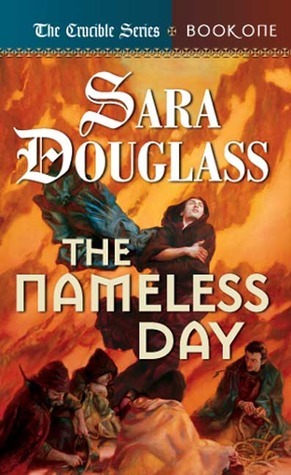
it's a good set-up, in theory, that should offer plenty of spiritual (and spirited!) battles, juicy details over that lost love from the past...but just doesn't. the major flaw with this book is that the main character is deeply unlikable. i don't mean a love-to-hate-him sort of anti-hero, nope, just a boring and annoying pompous twit. since the book is about him, after all, it's slow going while you're rolling your eyes at the latest heavy-handed holier-than-thou (literally) coming out of his mouth. the demons he's battling are likewise a match: no soul-stricken horror (as the rich cover painting would suggest) or works of EEEEVILL!!, simply creatures apparently interested in ending the rule of The Church.
what redeems this book immensely is the richness of setting and secondary characters. this book is the sort of writing that has you diving for the wikipedia articles on the real historic figures & events now that they've been described so intriguingly. it's almost as if so much love had been poured into the research and set-up that the author just didn't get around to writing a really good plot and protagonist.
it does get interesting around the last 75 or so pages, so i may pick up the 2nd in this trilogy at some point, but it's not a must-read by any means.
This was a jump into a subject that I have not thought about in a long time - History of the Church and mortal men/womyn set in the times of England and France around the time of Joan of Arc, King Charles and King Richard.I guess the fact that I went to Catholic school, I avoid books about religion, angels and the whole save-your-soul stuff. I like this author however, and when I found the three books in the series at the library, I had to read them. I had just finished The Serpent Bride by Douglass, so these seemed a good idea and they were! There's a battle pitting angels, Jesus and angel-children (yep, you got that) and the future of mankind (yes, including women) is at stake. For more than half the book, I didn't know whether the angels appearing to people were good or bad - but that's the beauty of it all. I will add the other books, but I loved how all the characters were built up one way and really were another way as you got closer to the end. I read all three books in 10 days - I could not put them down until I found out what the heaven/hell was going on!
Generally I like Sara Douglass books but this was a bit less initially motivating that the Starman (and related) series. Her general plots are often quite dark and this is no exception. I was really into it by the end of the story. Of course, however, it's an older book and the book stores don't carry it and my library has to get it from Timbuktu so it takes forever. Hopefully I'll get the next one before I forget all the details. I could just order it but then I'll have to buy the first just so I don't have half a series. anyway...back to the review. I didn't enjoy how the main character is so close-minded and (perhaps just in my sensitive mind) it seemed that he was being used as an archetype for Catholics of the time. I suppose it is quite likely true, though. It was just annoying that his "unreasonability" (katie-lish) was so blatant. He didn't seem to have much depth. At the end of this book, more dimension popped up but by then...it was over. I suppose it was a good way to get me to go on to the next book.
I truly wish I could say I liked this book but I didn't. I read it because a friend highly recommended it to me. I was annoyed with it 3 chapters in but pushed through to the end.
The main character, Brother Thomas, is totally unlikable. Self-righteous, a prick, and stupid. I could not care for his well-being and was annoyed that there was no growth to his character by the end of the book. he stayed exactly the same, self-righteous and a snob. This character made the book a slog to read.
I did like the setting but just wish that the book were more interesting and the main character followed easier to like. It did a good job of showing why the Catholic Church fell from grace during the middle ages. Greedy, corrupt, and full of "Brother Thomas'" who saw fit to pass harsh judgement on others while being corrupt and evil themselves.
This book was awesome and I loved it. Having a degree in Theology and having had to sit through many church History classes it is refreshing how accurate the Author is. This is another book however , that , over the years I have passed over for "something better" . But at least I did get back to it ....eventually. I have read The Wayfarer Series by Mrs Douglass so was familiar with her writing style and love her descriptive talents......I have a date with a read along with a friend or I would be plunging right into book 2The Wounded Hawk....however I will be reading it within the next few months I feel !! If you like Fantasy at all I highly recommend Mrs Douglass.
I found the story obtuse and somehow underwhelming - what should have been a great premise dwindled under the length of the book and the dimensionality of the characters, all of whom are exactly what the main character thinks they are. Despite the time spent - by god, the time spent! - on painting a portrait of Tom as a biased, blinkered, hateful person, his assessments of others are almost always borne out. So where's the interest? We spend nearly 500 pages with a rigid, self righteous cleric who sees angels, judges others, and abuses women - we end with a rigid, self righteous nobleman who sees angels, judges others, and abuses women. The looming spectre of a corrupt Church, so painstakingly set up in earlier chapters, rapidly fades into a shadow without claws by the end. Somehow, in a world where angels and demons are real, the church feels as corrupt, bloated, proud, and unable to ease suffering as it is in our own world. This is perhaps intentional, but in my opinion poorly executed. Among the endless suffering on show along the way is the unspeakable abuse of women. I would have hoped an author publishing with a feminine name would, in her alternative history of the middle ages, allow at last a little room for the women in the story to have agency. Unfortunately, it seems only demons do, and even that agency is minimal. The only female character that appears to have some measure of control of her life literally has to have it given to her by a (male) angel, and it happens nearly entirely off screen. The are endless descriptions of rape, assault, emotional abuse, child sexual abuse, male desire - every few chapters. When they are not explicitly happening, Tom is most assuredly thinking of some new way to verbalize his misogyny. Frankly, it is both exhausting and uninteresting. Even in historical fiction, there's only so much hatred of women one can stand, and for my part I stopped being interested in the idea 100 pages into what feels like a 700 page treatise on The Sin of Eve. Finally, arguably the most interesting portions of the story read as if they were cut straight out of the pages from a nonfiction history book. There's a wealth of information on cultural practices, architecture, war, dress, social classes, and all manner of things of the times. You can tell the author has researched the period widely. Unfortunately, the blend of the historical and fictional is clunky, and rarely contributes meaningfully to the story. It sometimes feels as if the author just really wanted to write about this period and created a slapdash story to fit around her excellent descriptors of the time and place. However, I would rather read a much shorter, more interesting fiction story set in this period, and/or a much shorter, more interesting history of this period, than this bastard child of the two. Listen, I finished the book, but I'm frankly relieved it's over and will not be reading any more of the series. I simply won't spend another second of my short life in the mind of a male religious fundamentalist and radical conservative. I don't need these men in my fiction - there's enough of them in our world.
Douglass is still the master of the prophecy and the epic trilogy. She has a way of making prophecies nuanced, interesting, and non-what-you-would expect.
However...
While I saw her writing had improved in this book compared to the Wayfarer Redemption series - as an overall work, I can't say this book was my favorite. At the same time, Douglass managed to clean up some things about her writing that had always bothered me in the past (over-describing the physical appearance of characters, over-writing, not the best dialogue). Now I found her character development lacking.
These are my main complaints: - Point of view changes are jarring and often confusing, happening from one paragraph to another - Character arcs (with the point of view into their thought processes) happen without a lot of explanation - Repetition. In sentences, character thoughts, actions.
Don't get me wrong - there a few chapters in this book that are so. Pure. gold. Not going to give it away, but there is a certain unfortunate event with kings where the metering, rhythm, and pace of the chapter is one of the best-written things I have read. And if you are very much into European history, you will love this; I think the whole point of this book was for Douglass to flex her research about this time period.
I won't be reading the rest of the trilogy, but I don't think it was time-wasted reading this book.
I'm not sure how to rate this book. It's between a 3 and 4 star rating...for me. The story is actually very interesting: a battle between good and evil. It's set in the 14th century, which makes it an instant appeal to me. I adore historical fiction and I'm always looking for something in that genre to read. This was recommended by a friend. In fact, she lent me the books in this series to enjoy. I found it to be slow and I couldn't connect in any way to the main character. He was very self-righteous and selfish. I was annoyed by him many times throughout the book and I didn't much care what happened to him. Because he was consistently annoying, it made getting through this book a bit of a chore. This may be one reason the book was difficult to get through. I enjoyed the setting and the story but found it to be slow and uneventful. It was like having a delicious-looking meal set before you that turns out to be bland. It seemed to lack...something. It was also a little too long, especially as it lacked the elements that usually keep me engaged. Nevertheless, the story interested me enough to want to read the rest of the series, which I will. Hopefully, the other books are more engaging. At the very least, the they will continue in a period of history that I particularly like reading about.
I’m incredibly split on this book. On the one hand, the world building is incredible and I was amazed at how invested I was in this pseudo historical novel, where real life history meets fantasy. On the other hand, much of the storylines and plot points established in this world have incredibly underwhelming conclusions, or should I say, rarely receive conclusions. The main character will find himself in the middle of war zones where the motivations and leaders of each side are given fantastic depth, but we never actually hear about the battle, or the conclusion to the fight.
Overall, this issue persists throughout of establishing incredibly interesting plot points with riveting characters in a brilliant world… which never receive satisfying conclusions. It’s probably the most 3 star book I’ve ever read, though it definitely had the potential to reach 5!
I do own the next two books in the series though I’m unsure as to whether I’d read them if I didn’t already own them. The overarching plot into the next still has me somewhat intrigued, as-well as the incredible world built up, but frankly I’m really concerned the next two novels will share the same issues.
‘The Nameless Day’ is the first volume in Sara Douglass’s three-part series, The Crucible. While the author lists ‘The Crucible’ as her favourite of all her series, many readers had mixed feelings about ‘The Nameless Day’ upon its initial publication. Most of their concerns regarded the vastly different feel of this novel, when compared to her previous works (such as the popular Axis Trilogy), and the unconventional choice of protagonist. Nevertheless, in my opinion, having read all three books in the series, I would still recommend ‘The Nameless Day’ and consider it to be a highly worthwhile read. While it may not suit the tastes of all readers, ‘The Crucible’ is probably the best historical fantasy series I have ever read, and one of the most intricately plotted and daring fantasy novels in general.
The story takes place in an alternate fourteenth century Europe, in the midst of the Hundred Years’ War and a great schism in the Roman Catholic church which would eventually see three popes simultaneously claim office. Former nobleman turned Dominican friar, Thomas Neville, is visited by the Archangel Michael, who warns him that demons run rife throughout Europe and have integrated themselves into every level of society. If they are to be stopped, Thomas must find a mysterious casket, 30 years missing, and use its contents to cast the demon spawn back into the fiery pit of hell. This task, however, is more easily said than done. The demons have had decades to prepare for his arrival and do not intend to go down without a fight. Furthermore, Thomas is haunted by visions, of what he suspects is a demon-woman sent for the sole purpose of tempting him from his promise. Worst of all, the concepts of good and evil may not be as clear-cut as he believes.
Essentially, Douglass interposes another, more secret battle, between the rival factions of the angels and the demons, amidst and underlying the various other struggles of a particularly tumultuous period of European history. She does this with spectacular style, involving intricate period detail with fantasy elements, and hinting towards larger themes to be explored in the later books. Such include the respective roles of church, state and the individual, faith, responsibility for one’s fellow man. She also explores, and adds upon, the origins of what would eventually become humanism. Although, she does alter some dates (for example making certain individuals appear earlier or later than in historical records ) and “The Nameless Day” is foremost a work of fantasy fiction, Douglass’s historical scholarship is generally quite thorough and demonstrates an excellent knowledge of and passion for her chosen era.
The main protagonist, Thomas Neville, is self-righteous, misogynistic, small-minded and hypocritical. Although this may make him unrelatable to some readers, it serves to make him a more realistic character given the historical period. After all, the likelihood of finding a man of Thomas’s position, with particularly modern or liberal views would have to be relatively uncommon in the fourteenth century. Furthermore, Thomas’s character provides many opportunities for development and, judging by the aforementioned criticism, one must conclude that Douglass has succeeded in creating a character that readers desperately want to see change as a person.
Those familiar with medieval history may recognise myriad notable historical figures amongst the supporting cast. These include John of Gaunt, Katherine Swynford, Henry Bolingbroke (Henry IV), Charles VII, Joan of Arc, Richard II, Geoffrey Chaucer and many others. Each character, whether historically based or entirely fictional, has their own distinct personality, a great achievement for a novel encompassing so many individuals. The ‘good guys’ are never wholly good, while the ‘bad guys’ are rarely purely evil. Alliances are ever-changing and everyone has their own agenda and hides their own secrets.
Once again, Douglass showcases her admirable talent for seamlessly interblending elements of different genres into a cohesive whole. ‘The Nameless Day’ incorporates fantasy, history and romance, while also containing some particularly brutal and gory moments that would put most writers of modern horror to shame. Certain sections, especially at the beginning of the novel, are very dark and reminiscent of early Gothic works such as Matthew Lewis’s ‘The Monk’, full of sinister clergy and malevolent secrets.
By the end of the novel, much is still unclear and many questions remain to be resolved in the following books. However, those who can bear the suspense will be greatly rewarded by this daring and thought-provoking series and the many shocking and unexpected developments it encompasses. All in all, ‘The Nameless Day’ is definitely worth a read for any fantasy fan who isn’t particularly averse to historical fiction and would like to try something a little more daring and challenging than just another ‘Lord of the Rings’ clone. However, it does contain substantial violence and various depictions of religious figures behaving badly that may be unpalatable to some individuals. Hence, you may be wise to refrain from lending it to, for instance, your faint hearted and devoutly Catholic grandmother.
I was excited to start reading this book, but I soon got weighed down with so many details of people and places. My attention span as well as memory are too short. Not the right fit for me at this time. The glossary could have helped me keep things straight, but I didn't see it until I had finished reading.
It felt like the book just stopped with no real ending. I do want to know what happened in this battle of good vs evil, but I will just skip volume 2, and go to volume 3. Is that cheating??
The Nameless Day is the first volume in Sara Douglass’s trilogy, The Crucible. While the author lists The Crucible as her favourite of all her series, many readers had mixed feelings about The Nameless Day upon its initial publication. Most of their concerns regarded the vastly different feel of this novel when compared to her previous works (such as the popular Axis Trilogy), and the unconventional choice of protagonist. Nevertheless, in my opinion, having read all three books in the series, I would still recommend The Nameless Day and consider it to be a highly worthwhile read. While it may not suit the tastes of all readers, The Crucible is probably the best historical fantasy series I have ever read, and one of the most intricately plotted and daring fantasy novels in general.
History and fantasy The story takes place in an alternate fourteenth century Europe, in the midst of the Hundred Years’ War and a great schism in the Roman Catholic church which would eventually see three popes simultaneously claim office. Former nobleman turned Dominican friar Thomas Neville is visited by the Archangel Michael who warns him that demons run rife throughout Europe and have integrated themselves into every level of society. If they are to be stopped, Thomas must find a mysterious casket, thirty years missing, and use its contents to cast the demon spawn back into the fiery pit of hell. This task, however, is more easily said than done. The demons have had decades to prepare for his arrival and do not intend to go down without a fight. Furthermore, Thomas is haunted by visions of what he suspects is a demon-woman sent for the sole purpose of tempting him from his promise. Worst of all, the concepts of good and evil may not be as clear-cut as he believes.
Essentially, Douglass interposes another, more secret battle between the rival factions of the angels and the demons, amidst and underlying the various other struggles of a particularly tumultuous period of European history. She does this with spectacular style, involving intricate period detail with fantasy elements, and hinting towards larger themes to be explored in the later books. Such include the respective roles of church, state and the individual, as well as faith and responsibility for one’s fellow man. She also explores and builds upon the origins of what would eventually become humanism. Though she does alter some dates (for example making certain individuals appear earlier or later than in historical records) and The Nameless Day is foremost a work of fantasy fiction, Douglass’s historical scholarship is generally quite thorough and demonstrates an excellent knowledge of and passion for her chosen era.
Complex characters The main protagonist, Thomas Neville, is self-righteous, misogynistic, small-minded and hypocritical. Although this may make him unrelatable to some readers, it makes him a more realistic character given the historical period. After all, the likelihood of finding a man of Thomas’s position with particularly modern or liberal views would have to be relatively uncommon in the fourteenth century. Furthermore, Thomas’s character provides many opportunities for development and, judging by the aforementioned criticism, one must conclude that Douglass has succeeded in creating a character that readers desperately want to see change as a person.
Those familiar with medieval history may recognise a myriad of notable historical figures amongst the supporting cast. These include John of Gaunt, Katherine Swynford, Henry Bolingbroke (Henry IV), Charles VII, Joan of Arc, Richard II, Geoffrey Chaucer and many others. Each character, whether historically based or entirely fictional, has their own distinct personality, a great achievement for a novel encompassing so many individuals. The ‘good guys’ are never wholly good, while the ‘bad guys’ are rarely purely evil. Alliances are ever-changing and everyone has their own agenda and hides their own secrets.
A little bit of everything (done well!) Once again, Douglass showcases her admirable talent for seamlessly blending elements of different genres into a cohesive whole. The Nameless Day incorporates fantasy, history and romance, while also containing some particularly brutal and gory moments that would put most writers of modern horror to shame. Certain sections, especially at the beginning of the novel, are very dark and reminiscent of early Gothic works such as Matthew Lewis’s The Monk, full of sinister clergy and malevolent secrets.
Why should you read this book? By the end of the novel, much is still unclear and many questions remain to be resolved in the following books. However, those who can bear the suspense will be greatly rewarded by this daring and thought-provoking series and the many shocking and unexpected developments it encompasses. All in all, The Nameless Day is definitely worth a read for any fantasy fan who isn’t particularly averse to historical fiction and would like to try something a little more daring and challenging than just another Lord of the Rings clone. However, it does contain substantial violence and various depictions of religious figures behaving badly, which may be unpalatable to some individuals. Hence, you may be wise to refrain from lending it to, for instance, your fainthearted and devoutly Catholic grandmother.
Based during the Bubonic Plague within England, this is the story of a priest who has a complicated past, yet sees death all around him. There are clashing kingdoms and he somehow finds himself in a political war.
A different style for Sara Douglass. I enjoyed it. Yet, there were some haunting scenes in this book that flash back to me today.
I would not suggest it for those suffering with PTSD. It's very graphic and not suitable for kids.
I love historical fiction and fantasy, but this was just too long, too wordy and with boring and unlikeable characters that just repeatethe same internal monologue oover and over. A struggle to finish, not motivated to read book 2.
Took a little while to get into, but got hooked as the story progressed. The expert blending of fact and fiction only enhances the story, as so many of the names, places and stories are real... Great stuff. Now to find the sequel
A time when the Nevilles were a, name to respect. Thomas Neville is torn between faith, demons and his surname. A really fast moving story that has many twists.
The Nameless Day is the first volume in Sara Douglass’s trilogy, The Crucible, and what a trilogy it is. Although it may not appeal to all readers, The Crucible is probably the best historical fantasy series I have read in a long time, and unlike other series in this genre you don’t have to plough through double digit numbers of novels to get to the end. However, if you or a member of your family is fainthearted or devoutly Catholic this may not be the book for you considering the shenanigans the religious characters get up to.
The main protagonist is a self-righteous, small-minded, hypocritical man, and although this may make him seem the type of character some readers are unable to relate to it also makes him a more realistic character given the period of time in which the novel is set. Finding someone with his modern liberal views would have been fairly uncommon for this era, but in writing this character the Author manages to make them believable but also one that readers would be drawn to. In their writing of this character the Author has managed to ensure that there is room for development and one that readers will want to see change as they progress through, not only this book but the remaining two in the trilogy. Taking place in an alternate version of fourteenth century Europe, readers will recognise many actual historical figures and, although it could so easily have turned into a book with too many characters to keep track of, the Author weaves historical fact and fiction about them together in a seamless manner giving each their own distinct personality and not leaving the reader the task of having to back track to see where they fit into the plot overall.
Taking the ultimate time long battle of Angels and Demons the Author places this a period of history that was fraught with upheaval. The author incorporates well researched historical elements in their novel and adds enough fantasy to keep the reader from feeling this is just another dry historical work of fiction. Some dates that certain historical figures appear have been slightly adjusted for the sake of the storyline, but this does not take away from the purpose of the book in anyway, and that purpose is to give a great experience to its readers. This book also manages incorporate a little bit of everything that would draw readers to it that may not otherwise pick up a novel in this genre. As I have mentioned there is the history portion, but there are also elements of romance and fantasy, and I was glad to see that the romance was not the kind that would have me laying this book aside in disgust. Added to this there are sections which are definitely dark and sinister which hint back to earlier work in the gothic genre, and the moments of gore and brutality are worthy of even the most celebrated of horror novelists.
The reason for my 4 thumbs review, as opposed to a 5 thumbs that it sounds as if I should have awarded to it is this; by the end of the book there are a lot of unanswered questions and a lot of things remain unsolved. This makes it the kind of book that would not function well as a stand-alone, so if you are going to read it, be prepared to have the remainder of the trilogy on standby. I would highly recommend this book to anyone who is looking for a good all round read, and a series that they can get their teeth into without having to expend vast amounts of time and money to complete it. I will definitely be revisiting the trilogy again and probably on numerous occasions.
It's the 14th century, mere decades after the great pestilence that so ravaged England and Europe, and a great evil has been unleashed on humanity. The archangel Michael seeks the aid of Brother Thomas to return the demons back to hell. The Dominican Friar, formerly an aristocrat, sets out in search of what he needs to combat evil but runs up against many roadblocks including his own guilt and a war between France and England. Strong historical fiction with a flavor of medieval politics and religious fervor.
In the author's note, Sara Douglass states that the 14th century was one of shifts in weather, politics, health and such in Europe, such that the very people who emerged from that 100 years were very different, spiritually. In fact, they had made an about face, going from a focus on the soul's salvation to technology, conquest.... and this series is an attempt to explain that shift.
This book sets the stage, where we have a an ex-nobleman turned Dominican Friar being given the task of ridding hte world of demons, a task set up by Archangel Michael himself! But what exactly are these demons, and are they truly creatures of evil?
This situation is then explored against the backdrop of an England close to what students of history would recognise (I didn't, NOT being a fan of history, LoL!), with its king intent on gaining the French throne. Oh, and there's murmurings within the peasant community for rights as human beings, after all "When Adam plowed and Eve span, where, then, was the gentleman?"
Like I mentioned, I am no fan of history, being the victim of atrocious teachers and syllabi in school. But if it tales like this that help kindle some spark of curiosity, that have me willing and interested to then look up key historical figures and milestones to see how the differed from Ms Douglass's alternative retelling.
Be warned that overall the tone of the book, and even the main character, by itself may not be that entertaining. But I was hooked by the idea and concept, and had a great time with this entire series.
I feel the need to review this book, not because it blew my mind or anything, but it was controversial in my own mind. I've been flying through books this year at the pace of about 1 per week, and this book brought that pace to a near halt. I wanted to read it and finish it, but it was not a page-turner.
First of all, the religiousness of the book permeates the entire story, which is by design, obviously, but it got repetitive and bulky for me.
Second, as I got closer to the end of the book, I realized that the book was written as a series with no effective conclusion or resolution. This in itself isn't normally cause for alarm. At that point, however, I knew I wasn't planning on reading any subsequent books, so it was somewhat disappointing.
This book definitely has its audience and its good points. The main character was interesting... for 75% of the book. The historical immersion is really done well. The interplay between the characters leaves you guessing right up until the end. But that's the biggest problem for me... you are almost in the same spot you started the book.
First sentence(s): "Brother Wynkyn? Brother Wynkyn? Sweet Jesu, brother, you're going to leave us now?"