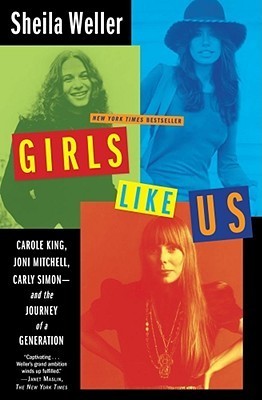
A groundbreaking and irresistible biography of three of America's most important musical artists -- Carole King, Joni Mitchell, and Carly Simon -- charts their lives as women at a magical moment in time.
Carole King, Joni Mitchell, and Carly Simon remain among the most enduring and important women in popular music. Each woman is distinct. Carole King is the product of outer-borough, middle-class New York City; Joni Mitchell is a granddaughter of Canadian farmers; and Carly Simon is a child of the Manhattan intellectual upper crust. They collectively represent, in their lives and their songs, a great swath of American girls who came of age in the late 1960s. Their stories trace the arc of the now mythic sixties generation -- female version -- but in a bracingly specific and deeply recalled way, far from cliche. The history of the women of that generation has never been written -- until now, through their resonant lives and emblematic songs.
Filled with the voices of many dozens of these women's intimates, who are speaking in these pages for the first time, this alternating biography reads like a novel -- except it's all true, and the heroines are famous and beloved. Sheila Weller captures the character of each woman and gives a balanced portrayal enriched by a wealth of new information.
Girls Like Us is an epic treatment of mid-century women who dared to break tradition and become what none had been before them -- confessors in song, rock superstars, and adventurers of heart and soul.
Sheila Weller is a bestselling author and award-winning magazine journalist specializing in women’s lives, social issues, cultural history, and feminist investigative.
Her seventh book, The News Sorority: Diane Sawyer, Katie Couric, Christiane Amanpour – and the Triumph of Women in TV News, will be a major release from Penguin-Random House on September 30, 2014.
Her sixth book was the critically acclaimed Girls Like Us: Carole King, Joni Mitchell, Carly Simon -- And The Journey of a Generation (2008). A New York Times Bestseller for 8 weeks, it is featured in numerous Women’s Studies programs at major universities, was chosen as one of the Best Books of 2008 by Library Journal, The Christian Science Monitor, Amazon.com, and Tina Brown’s DailyBeast. Girls Like Us is in active development as a motion picture with Sony.
Her 2003 family memoir Dancing At Ciro’s “makes a substantial contribution to American social history,” said The Washington Post.
Her four previous books (including the #2 New York Times bestseller Raging Heart) were well-regarded, news-breaking nonfiction accounts of high profile crimes against women and their social and legal implications.
She is a writer for Vanity Fair, has been Senior Contributing Editor of Glamour since 2002, is a former Contributing Editor to New York, a reviewer for The New York Times Book Review, and has written and writes for numerous other magazines for many years.
She has won nine major magazine awards between 1994 and 2012:
She won a record six Newswomen’s Club of New York Front Page Awards.
She won two Exceptional Merit in Media Awards from The National Women’s Political Caucus.
She was one of three winners, for her body of work, for Magazine Feature Writing on a Variety of Subjects in the 2005 National Headliners Award.
She is married to esteemed history writer John Kelly (The Graves Are Walking, about the Irish Famine, and The Great Mortality, about the Black Death).
She lives in New York City and in Berkshire County, Massachusetts.
Great material, problematic execution. Weller is an incredibly undisciplined writer, at least in this book. There's excess detail that seems to serve no purpose beyond showing off--endless anecdotes about minor, or even unrelated people, as if to show how hard the author worked and how much she found out, whether or not it actually informed her story.
And her sentence structure! Good lord, woman--INSERT A PERIOD EVERY NOW AND THEN. Because I was interested in the subject matter, I pushed through, cursing not so quietly under my breath, but I pity her poor editor. The excess in every way--material and execution--suggest a certain arrogance that I found tiresome. But perhaps I am reading too much into the situation--perhaps her editor didn't attempt to rein in the excess and focus her story. Perhaps s/he loved the material as much as Weller clearly does.
Whoever's failureit was, it was unquestionably a failure. And that's a shame, because the material is great.
This book is so painful to read that I can't stand it. But I can never give up on a book after I have read more than 50 pages. The writing is dreadful. The '70s feminism is so tiresome. I bought it because I am interested in the music business of the '60s and 70s, but boy does this stink. Even if you are interested in Joni Mitchell, Carly Simon and Carole King, the bad writing will drive you to your knees. And the book is huge, 592 pages. Stay away from this book. Save your money.
Album covers featuring their young, pretty faces were stacked next to every stereo in every funky apartment that we inhabited from ’67 to ’75 or so. Along with the Mateus-wine candelabra, the day-glow Jimi Hendrix poster, and the not-so-discreetly-hidden roaches in ashtrays on low-rise tables, the music made by these young women—Carole King was 19 when she wrote her first big hit, Joni Mitchell 21—were part of what we carried when we moved. We scattered those album covers in plain sight and played their music almost endlessly as a way of saying who we were: young, of course, but also independent—sexually if not always financially—and decidedly not ready to enter into the world of conventional responsibility occupied by our parents. A lot of it was image and wonderfully naïve self-delusion (“attitude dancing” Carly Simon would call it in a later song), but it seemed right enough for its time.
What we learn in this smart if sometimes breathlessly written book is that the music might not have happened at all. Pregnant and married at 19, Carole King was turning out hits like “Up on the Roof,” “Will You Still Love Me Tomorrow,” and “The Locomotion” in the now famous Brill Building in New York—a fairly grim sweatshop for song writing talent--baby on knee. Joni Mitchell, on the other hand, was pregnant at 21 when she was still making the rounds in the Village and in clubs around Canada. She gave the baby up for adoption, which left any number of scars, not all of them soothed when she was reunited with her daughter some 30 years later. Carly Simon, already rich pretty much beyond measure and from a family with a complicated sexual history, was a little late getting started on her own career, but she managed to have fun with just about every male star of the time that you might like to name—from Cat Stevens to Warren Beatty to James Taylor (whom she married, although not until after he had also navigated significant affairs with Carole King and Joni Mitchell while managing a fairly serious heroin addiction.) It’s gets complicated and you kind of need a scorecard.
Which is part of the problem with this guilty pleasure of a book. It’s like Simon’s “No Secrets” with footnotes. We meet just about everyone these women sleep with, then the women the men slept with before, then a fade-out explained usually by a simple, “but things didn’t work out finally.” Too much information, or rather, too much information coming at you in a rush, with little time or attention paid to what is important, to what we really need to know.
But if you were in your 20’s when these women were at their best—or even if you weren’t—you might want to take a look. If nothing else, the book took me back to the music, and now our iPod has a long playlist called “The Girls” which is rich with the music these three amazing artists gave us.
Try humming a Beatles song. Now try humming a Joni Mitchell song. With perhaps the exception of "Big Yellow Taxi" and "Both Sides Now," it's pretty hard, isn't it?
Having complex arrangments and open tunings doesn't make Joni Mitchell "better" than other musicians, but I think the fact that her songs are hard to hum is a strong testament to her mind-boggling talent with words and arrangements.
This book is centered around three women who came of age in the 60s and changed music: Joni, Carole King and Carly Simon. It combines their stories (alternating chapters and sometimes combining the three lives in one chapter) with some cultural history and feminism sprinkled in between interviews with friends and music business execs.
I liked this book not because it was about musicians I admire, but because it looks at the broader context of music and how deeply it can affect people. It takes three different lives and connects them in a way that's believable, if not amazing. Anyone wondering what the fuss is about music should reconsider and start here. As cliched as the 60s are, this was a time when music meant so much.
I was never a huge Carly Simon fan (though I love the lyrics to "You're So Vain") or Carole King (though "Tapestry" is lovely), but Weller really made me care so much about their lives that I felt like these three women were my friends by the end of the novel. I'm sad it's over because my friends have left me.
I'm slightly biased toward Joni's story (so much tension and her songs, for me, nail the complexities of not just being a woman but being human), but I think anyone with a slight interest in either feminism, music or any one of these amazing women will enjoy this book.
Girls Like Us parallels the lives and careers of three iconic women composer/performers: Carole King, Joni Mitchell and Carly Simon, while documenting the history of an era and a generation. The common threads among the three (James Taylor pops up in all three stories) were what I found most fascinating. The book is long and the writing is poor, with long, run-on sentences, including one that goes on for half a page. The author never mastered the use of footnotes, preferring to sprinkle the text liberally with asterisks. These interruptions distract and upset the flow of the narrative. While often interesting asides, they rarely contribute much to advance the "plot". The stories are fascinating but the execution is painful. At 527 pages, it's a tough read. You really have to want to plod through it. How sad!
“People were looking for a message, and she came to them with a message that was exactly what they were looking for; were aching for.”
Girls Like Us was certainly for girls like me. If you remember granny dresses, had a macramé plant hanger, and ruined your pots and pans making candles, then it may be for you too.
It’s a big hefty book that will be way too much detail for some people. But if you sat in front of the “stereo” like I did in my youth, studying the album covers and liner notes and memorizing the lyrics, and then went off and lived the songs, well, you may love this book like I did.
I meant to read this as a guilty pleasure. My girls! But it turned out to be an enlightening cultural history. Sheila Weller did massive research (documented in great detail at the end of the book), and takes us through each of these lives, tying them to the times they lived through--that they helped to shape.
There is a jaw-dropping number of love affairs. Apparently, in famous people circles, everybody knew everybody--and I mean that in the biblical sense. But there’s so much more. If you have followed their music like I have, learning how the songs came about, the impact of bands and producers, the life stories behind the lyrics, is all fascinating. And if you lived through the time, you can see yourself and your own progressions through this historical/musical/cultural lens.
These were three complex and gifted women who played a part in making me who I am today, and I appreciate Weller's deep dive into their fascinating lives--how they created and how they survived.
“And that is how it is for all three of these women--all three of these girls like us--who were born into one female culture and changed it--year by year, song by song, risk by risk--so sweepingly and daringly.”
Interest level for this book will depend on your age and personal recollections of events and music discussed. Joni, Carole, and Carly are almost a full generation ahead of me, but their music was the soundtrack for my childhood beginning around age nine or ten. Much of the info in the book went right past me, as I had no associations on which to pin it, but it's easy enough to scan past that stuff.
The subtitle, "the journey of a generation," is important if you want to know what this book is like. Of course, it revolves around the lives of these three fine and talented ladies, but there's so much more here.
Sheila Weller has an unbridled enthusiasm for all things related to this era of social upheaval and change. She can't bear to leave out any exciting tidbits she's discovered about the people, politics, war, women's rights, arts, and spiritual searching of the '60s and '70s. This results in many footnotes and parenthetical remarks. Sometimes hard to follow, but a lot of the tidbits are interesting and help to flesh out the scene in which Joni and Carly and Carole were making their personal journeys.
Weller dishes on lots of other celebrities in both the New York and L.A. arena including Graham Nash, Warren Beatty, Jack Nicholson, Bob Dylan, and Jackie O. And of course, James Taylor, who had intimate relationships with all three of these ladies.
It's clear that the author put her whole heart and soul into producing this book. It's stunning to look at the interview and research information at the back of the book. She tells how, when she would get discouraged with the project, her husband reminded her, "You're writing social history." I think that's an accurate description of this big fat triple biography.
Even though I’ve been listening to Carole King, Joni Mitchell, and Carly Simon for decades, I had no idea I would enjoy Girls Like Us so much. Sheila Weller is a pop trivia queen and had to have spent hours hunched over microfilm machines, researching the minutiae of these ladies’ lives.
The interviewees go all the way back to neighborhood playmates and school chums, and the book is filled with information about the music scene starting in the early sixties, when Carole King started plinking out the melody to “Will You Love Me Tomorrow” with her husband, Gerry Goffin, in the Brill Building.
Out of the three, it's Joni Mitchell's music I enjoy the most. Her songs are more introspective and her talent can't be matched in the female singer/songwriter genre. Her song "Little Green" off her famous Blue album hinted at the baby she gave up for adoption when she was just a 21-year-old unknown named Joan Anderson, and I was touched at just how it affected her life until she finally met her daughter as a 32-year-old woman with a child of her own.
The tidbits of information on Bob Dylan, Crosby, Stills & Nash, Neil Young, Judy Collins, and others hanging around at that time are just as titillating. And if you have any interest whatsoever in James Taylor, there's no need to reach for a biography on him. You'll learn more than you'll ever want to know in Weller's book, and will feel for Carly Simon and what she went through during her marriage to this heroin addict.
Girls Like Us and Alice Hoffman's newest book duked it out on my nightstand every night for weeks, and more often than not the Girls won the fight.
An alternative title could have been: 'It's Complicated'. In my rating system this is a three-and-a-half star book. The actual writing is three worthy, but the interviewing and research is certainly a four. I bought this book for my wife, and since she is obsessed with Elvis at the moment I thought I would divert from my typical reading in a form of rebuttal.
I almost stopped at the introduction. It seemed to wander a bit and was chaotic, but the material seemed so promising. I'm glad I stuck with it. Although the writing style was a bit rambling, it did make sense. Weller approached the representatives of each of the artists asking to interview their closest friends without interviewing the artists themselves. She also used other books, articles and media to verify and add to her information. To sift through all of that material must have been a huge undertaking.
Like most biographies, Weller starts with the childhood of each woman in separate chapters, then proceeds to following two to four year time periods. The reader gets a sense of what is going on through the lives of the three women and corresponding times. Three amazing artists who had such dissimilar childhoods. Joni--growing up in rural Canada. Carole growing up a middle-class kid in New York City, and Carly growing up in a privileged publishing family. Besides their talent, the only common factor in all three lives seems to be James Taylor.
The reason I said it could've been called, 'It's Complicated', is just tracking the personal relationships of each woman can be dizzying. The 1960s through the 1970s was a difficult time when women were just being recognized as creative equals in the music world, and attitudes towards drugs and sex were changing. It did help me as a reader that I am familiar with the three women and their music, but for a neophyte I might suggest something more basic.
One of the things I loved about the book, is the analysis of each album--similar to the quality record reviews I read by people like Robert Hilburn, Timothy Crouse, and Cameron Crowe. There is also plenty of celebrity tell all kind of material. My only real criticism is that I would sometimes lose track of who a particular source was. I would have to look back a few pages to remind myself who this 'insert first name here' was, for example. Plenty of photos, and a great bibliography round out an interesting read. If you're a fan of any of these artists I think this book would be well worth the read.
Even at 500 pages, this is a breezy fast read, full of gossip and lots of fun. Back in the Seventies I never had time for Joni Mitchell, Carly Simon or Carole King. The author does a great job describing all the challenge and heartbreak in their lives . . . including tons of love affairs with every type of sexy male imaginable. The only things I didn't like were the nagging feminist asides, and the high-society name-dropping, and the persistent, unapologetic snobbery of the author.
These three great women all have their flaws, but unfortunately the author comes across as a uniquely obnoxious individual. Sheila Weller wants to appropriate (or glom onto) all the glamor and magic of the Sixties, but she actively hates all the things that made the Sixties a special time. When Carole King writes songs for the Drifters, that's heroic. But by the end of the book, when an aging Joni Mitchell is jeering at young hip hop artists for being too young, too black, too male, and too angry . . . well, that's just how it is. This book is a fun, fast read. But it is also a sick, venal, profoundly dishonest and reactionary book that only pretends to value revolution and change.
And can we talk about James Taylor? I hated his guts when I was a kid. I thought he was a pansy. Every Saturday I would listen to American Top 40 with Casey Kasem, and Sweet Baby James would be stinking up the joint with some weak-willed remake of a legitimate classic, like "How Sweet It Is" by Marvin Gaye. Kind of like Pat Boone singing Fats Domino. Well, I had no idea James Taylor was a heroin addict. But it explains a lot. What I still can’t understand is why all three of these complex, talented, fascinating women were in love with him at one time or another.
I hated James Taylor forty years ago, and I hate him now. But now I have a whole new list of reasons to hate him! Sheila Weller lays on layers of them, lovingly. Ooh, he's so well born! Ooh, his parents are southern aristocrats! Ooh, money! Ooh, privilege! Ooh, James Taylor! My God, woman, is this man your idea of a hero?
Now my father was a real hero. My father was born in the Bronx in 1928. He was the son of Jamaican immigrants, and he had to work really hard to get an education, first at the Bronx High School of Science, then at City College of New York, and finally at Columbia University. My father came from a world Carole King would love and recognize, and indeed would fight to defend. But that's not James Taylor's world. James Taylor is from Virginia. And yet I can't say he's the bad guy. Because in the end, James Taylor and my father had one thing in common. They were both addicts. Of course my father's drugs were legal, cigarettes and alcohol. But he was still an addict. The only difference is that James Taylor got clean, and my father never did. So once again, white Virginia triumphs over the weak and broken bodies of the slaves.
But James Taylor is not to blame!
Oddly enough, the "bad guy" Sheila Weller hates the most is not a sexist pig like Hugh Hefner or Norman Mailer, who were both quite active in the Sixties. It's Grace Slick, the lead singer of the Jefferson Airplane. Sheila Weller can never mention her name without sneering. But the cause of her resentment is hard to define. Maybe it has something to do with the fact that Grace Slick was just as white and just as privileged as Joni Mitchell and Carly Simon. But unlike them, Grace Slick exposed the emptiness of her own privilege, instead of hiding it, or glamorizing it, or copping out. Sheila Weller hates the idea that revolution means risk and personal sacrifice. In her view it's only other people who have to pay. Because you see, if you're a smart, sexy, and wellborn young woman, you can have it all. And that's what the Sixties is all about . . . to her.
The biggest problem I had with this book was with the way Weller organized the book. Instead of giving us the entire Joni story or the entire Carly story, she gave us what Carly, Joni and Carole were each doing during a span of years. I understand why she did this; as readers, we were supposed to see the parallels between these women. But instead of seeing the parallels, I was just confused and annoyed. It was nearly impossible to keep track of who all these people were and what significance they had and all I really wanted to do was read all about one woman, not bounce back and forth. It seems to me that rock biographies are always difficult to read. There are a ton of people and places to keep track of and sometimes what seems like an interesting subject can get bogged down in those details. Girls Like Us sometimes has that problem but by in large, the amount of interesting details in the lives of these three women keep the book compelling.
I should begin this review by confessing some shocking ignorance. I am not in the right age group to be the prime demographic for this book. I was a young woman in the Big 80s and those times were vastly different from the heyday of Carole, Joni and Carly's music. The earth mothers had donned power suits and the free love had given way to a darker and more paranoid era sexually. The First Wave had already happened and women my age were told we could "have it all". Although we firmly believed this, not a few of us were daunted and even conflicted by the high expectations that we would "bring home the bacon and fry it up in the pan." This was the era of Superwoman.
My musical memories of Carly Simon, Joni Mitchell and Carol King mainly take place in the car where their songs were featured in heavy FM rotation during my childhood. As the scalding pleather of the bench seat in the big floating mid 70s car scalded my terry cloth or polyester shorted bottom, I might hear Anticipation, Up on the Roof or You've Got a Friend...Frankly, it sounded like music for grownups who liked to talk about relationships a lot and I was not ready for that yet.
And, by the time I was ready, I tended to gravitate toward male singers (preferably depressive and gay) when I wanted to wallow in relationship drama (It was the eighties, remember?) The consciousness raising righteous mamas of my early childhood would have probably shuddered to see me take refuge in Sinatra (the 80s were a big era for the Rat Pack retro that these women fought against so tenaciously) and gin when some guy kicked me to the curb rather than a sister who could relate to my pain.
So how does an ignoramus who mainly remembers Carly for the song in the ketchup commercial and who, for years, confused Carole King with Carole Kane (Andy Kaufmann's ditzy wife Simka in Taxi) get to this book?
It may be because my daughter has recently discovered Carly from her soundtrack work in some Winnie the Pooh movies. My preschooler really likes her songs! Or it might be my general interest in music history. It may be the pull of distant childhood memories as my own daughter is now the age I was in 1969/70. Or, it may be that these 3 women seem so cool...so real...and so interesting to me now that I am middle aged. This triumverate of female singers present a genuine face. It was still about the music and their very personal relationship to crafting songs. Compare this to someone like Madonna who must reinvent herself constantly on the external side.
I have learned a gold-mine of information about the era and the impact Carole, Joni and Carly had. This is a highly detailed book and you practically need to take notes to keep all the inter-relationships between the cast of rock luminaries featured within. Between them, these three women knew everyone who was anyone in the music scene as it was exploding in the 1960s and 1970s. If your interest extends to a desire to "know all" you will not be disappointed.
I won't suddenly relegate all my Morrissey and Bauhaus CDs to the scrap heap...I am what I am and the soundtrack to my life is on a different trajectory than someone who was 20 the year I was born. But, this book has prompted me to take a new listen to some vaguely remembered songs and, perhaps, appreciate them more this time around.
Joint bio (mostly alternating chapters, covering their whole lives chronologically) of 3 singers of about the same vintage. Some stuff I've heard a million times (Warren Beatty inspired "You're So Vain"; James Taylor was a heroin addict......), some with which I was unfamiliar (Carole King and approximately her fourth husband had a long-running legal battle with Idaho neighbors about their wish to close off a private road that previous owners had let everyone use; "Anticipation" was about a date with Cat Stevens; Joni Mitchell stayed mad at Jackson Browne for decades after their relationship ended and wrote "Coyote" after a brief affair with Sam Shepard). Mostly a very bad book, especially relative to the eventfulness of their lives. In particular......
1. The social history hook is an awkward fit, mostly relying on the occasional "comes at a time when...." graft. After 10 pages or so of who slept with whom after saying what at a party, there will be a paragraph along the lines of "And Joni's fifth album was released at a time when more and more Americans were getting divorced", and then back to how many drugs David Crosby was using.....
2. Odd and frequent use of footnotes -- unless you think your book will remain in print 500 years, there is no need to explain what a "baby boomer" is, for example. Other footnotes could easily have been integrated into text, or just omitted; the author seems to have included every fact uncovered in her research (the drummer for these sessions was X, whose stepbrother was later hospitalized with schizophrenia........) without reference to whether it actually advances the main narrative.
3. Absurdly long sentences in which she tries to smuggle in more ideas or qualifiers via prolific hyphenation (in her ladies-of-the-canyon long dress, she spoke severely to the never-trusted I'm-just-a-vagabond guitarist with a kind of no-secrets-between-old-friends knowingness.......). Whoever edited this book should return the paycheck.
4. Not a real music critic. She dutifully lists every album and some song titles from it, along with its Billboard chart rating and maybe a quote from a review, but does not seem to have any independent insight into rock or folk music.
Girls Like Us: Carole King, Joni Mitchell, Carly Simon - and the Journey of a Generation 22 hours, 53 minutes, 20 seconds
The selling Point: A groundbreaking and irresistible biography of three of America's most important musical artists -- Carole King, Joni Mitchell, and Carly Simon -- charts their lives as women at a magical moment in time.
These women were groundbreakers in writing then singing about women's sexuality, feminism, peace, so why is this such a smarmy, tupperware kissing bio?
Joni got her start in Detroit - and dated James Taylor before he married Carly? Who knew? Carole King had her first child at 17? Mick Jagger sang back up on "You're so vain" (but the song is probably about Warren Beatty, who, by the by, begged a very pregnant Carole King to have sex with him...because he wanted to have a sex with a very pregnant woman. ick.) This three-for-the-price-of-one (unless you get it free at the library like I did) biography (tri-ography?) is full of "who knew" details and not just about Joni, Carly, and Carole (Stephen Stills tried out for "The Monkees" and is a jerk... Aretha never got around to recording a song Paul McCartney gave her so the Beatles recorded the song - Let it Be - instead.) But it also is a page-turner, a gossipy, insightful cultural history of the 1960's-70's soft-rock/singer-song writer era. The title "Girls Like Us" is totally wrong though - these were groundbreaking, trendsetting,fearless women. Only wish the book had more about my favorite from those days - Laura Nyro.
This was a very good biography, well-researched and well written, and a "three-fer" to boot. But I think I may have to stop reading biographies, or at least bios of contemporary artists whose art I admire. I like Carole King's work, not so much a fan of Carly, but she did do some good pop songs; but I really like Mitchell's music. And while I still admire her as an artist, as a person, I kind of just want to smack her. Or tell her to just get over herself! All three women seem to be congenitally incapable of sustaining any kind of love relationship. Which is fine, if you set out to have an adventurous love life - go for it! But don't come whining years later about the lack of an ongoing relationship and the personal and social consequences of the life you've chosen to live. Love is hard, work is hard (even when it is creative work that you love,) life is hard. For everyone. As a relatively happy little poor girl who knows that relationships take work and care and even then sometimes can't be saved, and who published some of her work but never got to support herself as a writer, I don't have a lot of sympathy for these "poor little rich girls" who went through friends,lovers and husbands like M&Ms and sulked when they went through a period of poor sales and/or reviews.
The public is hungry to know more about these 3 fantastic women. I think this book made the best selling charts on the strength of its subjects. A better book would have been #1 and a fantastic book would have stayed there a long time. This book is a missed opportunity.
It's not that Sheila Weller hasn't done any homework. She's digested every lyric and has assembled a considerable amount of information. Unfortunately, the meat is dwarfed by gossip, name dropping, trivia (did you know that Carole King and Hettie Jones both raised young children in walk up apartments not far from each other?) and hyperbole.
The biggest strength of the author is how she interprets the lyrics that inspired many. She brings them to life in describing the each of authors' lives at the time the words were written. Another strength is the respect and understanding she gives to each woman.
It is the lack of discipline in the text and the hit or miss research that causes my 2 star assessment. The book shows the research method suggested in a footnote on p. 433 which references an unanswered email to Sue Mingus (widow of Charles) asking about Joni do you "regard each other as day for night opposites or sisters in spirit?" (What is being sought here?) On page 407 in an apparently answered email regarding an incident with Jackson Browne someone says "this is the first time a man ever hit Joni". (Of the implied second or third time, where is the follow up?)
There is a lot of fanzine style jargon and overly long sentences laden with real and stylized adjectives. As you go through the book, the hyperbole diminishes, but it never goes away. It is most absent in the parts about Carole's second marriage and Carly's son's operation which makes them two of the best parts of the book.
The lifestyles described are modest for millionaires of this period. Have they been screwed on their record deals or have they squandered the money they should have been making? The only clue that one of these women might be fabulously wealthy is Carole King saying each divorce costs her a million dollars. Financial success is a considerable element in each of these lives and should have been covered.
The book presents but does not develop these women as generational pioneers, not just in their music, but in their asymmetrical romantic relationships. Each of them had to hide their talent when it out shown their partners' and each of them suffered because their talent could not be hidden.
I believe the affection some have for this book is a reflection of the affection for the women profiled. The idea of putting these three breakthrough songwriters (despite their disparate genres) together was ambitious, but is a good one. The author clearly understands the artists, the female-restricting environment from which they rose and their art. She's obviously willing to do the work, but seems to need direction. A good editor or editing team could have made this a top flight book.
Probably more like a 3.5, but these 3 ladies' histories are really intriguing. Downright cinematic. Normally, in these kinds of books, I like the focus to be on the music, but in this case, where their songs are so distinctly personal, and their collaborators are often personally involved, I didn't mind. The book made me admire all 3 more and want to delve deeper into their catalogs. On a side note, the author should write a companion volume: What Is Up With These Dudes?: James Taylor, Warren Beatty, and Jack Nicholson.
3.5 stars. Really enjoyed reading this book, though I felt it could have used some editing. The author did exhaustive research and gives an in-depth portrayal of the lives and fortunes of these three women, relating their histories to the zeitgeist of the 60's and 70's. I was inspired to go back and listen to more music by these three singers, none of whom I know very well.
- I learned to appreciate Carole King as an incredible songwriter. I had no idea she (together with her then-husband) was the composer of "Crying in the Rain", "Natural Woman," and "Will You Love Me Tomorrow" (among many other hit songs). I also loved reading about how hard she worked as a musician when she had young children, the first of which she had at age 17. It was inspiring to read about someone who managed to have such a full and creative life while also being a mom.
- Learned a little more about cross-racial musical influences in the 50's, 60's, and 70's - I had always thought it was more of a one-way cultural appropriation street, with white musicians borrowing styles and songs from African Americans and enjoying greater commercial success. This book showed a little of how it was more complex than this - e.g. many African American recording artists became famous for interpreting songs by white songwriters. I'm curious to learn more about the nature of cross-racial collaboration and/or exploitation in music during this era.
- It was refreshing to hear about women unapologetically taking advantage of their sexual freedom. Wow, these women really got around! I've heard a lot about how the sexual revolution benefited men more than woman, and although this book definitely explored the double standard and the ways in which women could have more negative consequences from their sexuality than men, these three musicians all played the field. I have to say that in some ways, it feels like we've gone backward in the current era - it's hard to imagine a female celebrity today who wouldn't be castigated for sleeping with as many men as these women did.
- Hearing some stories behind some of the songs (like Joni Mitchell's "Little Green," about a child she gave up for adoption) makes me enjoy them in a different way.
- James Taylor really was the tortured heartthrob back then. I admit by the time I was growing up, he was an "oldie" singer of music on the "light rock" stations. I had no idea he was apparently so hot. To hear this author tell it, Carly Simon has never gotten over him.
OK, my criticisms of the book: It had a very gossipy feel at times. While reading it, my comments to my partner mostly fell into these categories: "Did you know _________ wrote ________ song about __________?" "Did you know _________ slept with __________?" At times the writing was overwrought and overly dramatic. And there was an excessive use of the future conditional tense, along the lines of: "In just a few years she would write a song about him, a song that would become the anthem for young women who would listen to it on their radios and would hear their own struggles reflected in it..." You get the idea. Finally, I think some good editing could also have helped with the unnecessary details. Some of the details were what made the book fun, but often the author spun off into stories and gossip about peripheral characters whom I couldn't keep straight and didn't really care that much about.
Stayed In Bed All Morning . . . . . . just to finish reading this book. It's a long one, especially when you devour each little word contained in the many footnotes, but worth every hour spent. Reading this thorough, well-researched, and respectful biography of three notorious singer-songwriters, Carole King, Joni Mitchell and Carly Simon, from their days as young, aspiring artists to current days as grandmothers, was like listening to their music for the first time again. I couldn't help but break out my vinyl, stored in a moving box in the attic.
Sheila Weller clearly spent years gathering facts, information and quotes from those closest to these icons, (and in some cases from the women themselves), and braids the three stories together to paint a historical account of modern folk/rock/pop music. She doesn't merely regurgitate already published material from music reviews and Rolling Stone articles, but instead offers similarities and differences that made this reader appreciate the subjects as individuals as well as their contributions and reflections on the women's movement in general.
A surprising ribbon running through this braid is James Taylor, who had profound yet differing relationships with all three. What also ultimately struck me about the book was how deeply interested I was at the beginning and how it merely passed the time toward the end. I think it's a direct reflection on the careers of these women: exciting, fresh, ultra-talented in the beginning. . .but in the end, it becomes a biography of ordinary--albeit ambitious--women who've led extraordinary lives while looking for love and fulfillment, and endured tremendous public scrutiny. One thing the critics in our society can't take from them is their recorded music--their true biographies--and I, for one, will listen to them sing for the rest of my life.
Very well written, very well done and I certainly recommend this book to fans of these musicians (as well as James Taylor, and others like Crosby, Stills, Nash and Young), and to those interested in the music scene as it developed and evolved through the 1960s-1980s.
I really wanted this to be better than it was. I love all 3 singers & Joni Mitchell, in particular, has been an off and on soundtrack in my life, but this book just didn't live up to its potential.
Weller can't seem to decide whether she's writing a social history of these women & their times or a gossipy tell-all potboiler. The book careens between these two choices & does neither well.
There's interesting material buried in here & in all 3 life stories. In particular the challenge of living outside the box, of successfully navigating a career in a challenging field & maintaining relationships with others. It's easy to forget how different times were for women then - how much more limited the choices were.
I think the thing that bugged me the most about this book was the author's tone about all 3 women. It reminded me of the kinds of girlfriends you have in high school who will say behind your back, "She is SO cool! She's my best friend! If only her ass wasn't so fat."
A fun read for the last 250 pages or so, unfortunately, this book is over 500 pages. My advice, skip the first 200 pages or so. The pop psychology of their childhoods is less interesting to me than what is behind their music, the connections between the three of them, and, without a doubt, the gossip of who slept with whom and who the songs are REALLY about. The author is not a great writer, but the book is thoroughly researched and documented. I’ve never seen so many footnotes in a music biography! This is a nice, light, summer read.
I thoroughly enjoyed this book about Carly, Carole and Joni. It was long and you have to care about the minutiae and details of their lives, but if you do, this is a fascinating journey of our times from the late 50’s through to ~ 2010.
I thought that, having listened to Joni Mitchell’s albums more times than I can remember, I knew her story. I remember listening to Carly Simon and owning several of her albums. And who, coming of age in this time, has not played and replayed Tapestry? This book is much more than their musical journey. It is remarkable for giving the reader a view into these years as experienced by our musical heroes from this period.
Loved this as an audiobook!! I really appreciated learning so much about all three women and especially the inner circles of all the music legends in the 60s & 70s. I’m excited to listen to the playlist I made of all the songs the book mentioned that led these women to fame & I’m sad I’ve finished this. I loved hearing about Joni, Carole, & Carly’s lives, their relationships, their inspirations, how they were all pioneering feminism in the music space in different ways. This was awesome. I’d recommend as an audiobook since it’s long but was so worth listening to for me!!
I really wanted to like this book, mainly because I like the music these women have created over the years. But unfortunately, I'll have to settle for continuing to like just the music.
Have you ever read a biography that shared so much information that you just didn't want to spend any more time with the subjects? This book is like that. Of course it is partly the times, but there is a lot of bed-hopping, and a lot of lousy choices for partners. One area where the book worked, was pointing out that these women were leading the pack of girl-singers with their achievements, and many, many men could not handle that. Actually, the fans were fickle too. It was just not easy for these women to make inroads and then stay there, in this field.
One aspect of the book that I find unrealistic is that while each of these women had drugs all around them, we are led to believe that they themselves never or very rarely used the stuff. Somehow that doesn't ring true to me. If you are going to write a thorough biography, why would you ignore the possibility that these women might have gotten high at times. The author certainly tells all with regard to their mates, such as James Taylor's heroin addiction or Gerry Goffin, Carole King's husband's use of a variety of substances. But maybe the author chose to leave this information alone, and not make the women any more unlikable.
I just can't recommend this book. It's pretty long, and I didn't learn anything that makes me glad I spent the time on it.
This was one of the most interesting biographies I have read about anyone in the entertainment field. First, I am a big admirer of their music - my late teens and college years were filled with Carly, Carole & Joni music. I don't know what the author had to do to get the cooperation that she got for this book, but she definitely got the inside look at these 3 women. I'd be interested in hearing what C, C & J think of the book. It really put their lives out front and in center - the good, the bad, the embarrassing! But I have to say, I gained a lot of respect for all of them for their struggle in making it as serious successful songwriters at a time when the music business was dominated by males. Of the three, I think Carole probably showed the most strength and character with her struggle as a working mother taking care of her children and a mentally unstable husband.
I truly enjoyed this book - it was interesting and fun to read. The author included an amazing level of detail but it was just the right amount.
What fun! If you came of age in the 70's this is a book that you will want to read. It belongs in a text set with BOOM! by Tom Brokaw. The songs of King, Mitchell, and Simon were the soundtrack of my youth. Weller presented these biographies in the context of world events. So in addition to learning that Carole King wrote UP ON THE ROOF and THE LOCOMOTION (Did you know that??), I also learned that the first birth control pill was never actually tested on human females and had serious side effects. I found myself bursting into song throughout the reading. It made me want to go out and replaced my copy of TAPESTRY.
“Girls Like Us” has long been on my reading list, and since this year I've finished Carly Simon’s “Boys in the Trees” and “Touched by the Sun” and James Taylor’s “Break Shot” on Audible, it was time to continue learning about this generation of musicians. Hanging on through the onerous details of the first 250 pages of "Girls Like Us" was worth it when finally Jackson Browne, “the almost too beautiful boy with the Prince Valiant hair”, made an appearance in the story. I appreciated the deep dive into the cultural changes and expectations of women during the 70's. Carly, Carol and Joni forged their path in “an era when married teachers were routinely fired when they were pregnant and some women had to show banks doctor's certifications of sterility to obtain their own mortgages.” The women's personalities are not at all alike, and they mostly traveled in different circles. Their work ethic, talent and musical collaborations with James Taylor are a few of their common links. Tighter editing would have vastly improved the book, but I’m glad that I read it despite that flaw.