What do you think?
Rate this book


Audio CD
First published January 1, 1913


 http://www.gutenberg.org/cache/epub/3...
THE SHIP OF RIO
There was a ship of Rio
Sailed out into the blue,
And nine and ninety monkeys
Were all her jovial crew.
From bo'sun to the cabin boy,
From quarter to caboose,
There weren't a stitch of calico
To breech 'em - tight or loose;
From spar to deck, from deck to keel,
From barnacle to shroud,
There weren't one pair of reach-me-downs
To all that jabbering crowd.
But wasn't it a gladsome sight,
When roared the deep sea gales,
To see them reef her fore and aft
A-swinging by their tails!
Oh, wasn't it a gladsome sight,
When glassy calm did come,
To see them squatting tailor-wise
Around a keg of rum!
Oh, wasn't it a gladsome sight,
When in she sailed to land,
To see them all a-scampering skip
For nuts across the sand!
THE BOOKWORM
'I'm tired - Oh, tired of books,' said Jack,
'I long for meadows green,
And woods, where shadowy violets
Nod their cool leaves between;
I long to see the ploughman stride
His darkening acres o'er,
To hear the hoarse sea-waters drive
Their billows 'gainst the shore;
I long to watch the sea-mew wheel
Back to her rock-perched mate;
Or, where the breathing cows are housed,
Lean dreaming o'er the gate.
Something has gone, and ink and print
Will never bring it back;
I long for the green fields again,
I'm tired of books,' said Jack.
Ere my heart beats too coldly and faintlyDespite surviving into a new Elizabethan age Walter de la Mare (1873–1956) was a true Victorian; unsurprisingly then – as is evident from this anthology of children’s poetry which first appeared just before the Great War, when George V was on the throne – the imagery, vocabulary and lifestyles evoked here may at times belie a recent publisher’s claim that it’s “an essential part of any child’s bookshelf.”
To remember sad things, yet be gay,
I would sing a brief song of the world’s little children
Magic hath stolen away.
— ‘The Truants’.
The WindowMany poems are about solitary children, with or without agency: ‘The Window’ has a youngster observing but unobserved; in ‘The Lost Shoe’ we’re led to believe that Lucy searches the world over for her missing footwear; in ‘The Dunce’ a schoolboy in disgrace sits morosely over his work; then there’s ‘poor Miss 7’ who lies abed in sickliness having ‘sour physic given’ but has good memories to bring her hope for the future. But there are also solitary adults: a widow in her garden surrounded by her wildflowers, an old soldier begging for food from door to door; a king sitting alone at his dining table; a charcoal-burner in the forest with only pigs for company.
Behind the blinds I sit and watch
The people passing – passing by;
And not a single one can see
My tiny watching eye.
They cannot see my little room,
All yellowed with the shaded sun;
They do not even know I’m here;
Nor’ll guess when I am gone.
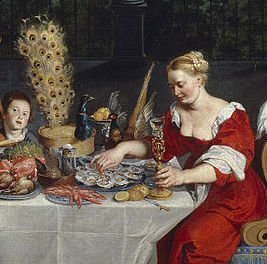
‘Lone for an end!’ cried Knight to steed,Eight pieces called a ‘song’ conclude the anthology, citing secrets, soldiers, bees, enchantment, dreams, shadows, madness and an end, a roll call as it were of many of the themes and moods highlighted in Peacock Pie. And what exactly is the collection’s title referencing? Here I’m reminded of Jan Brueghel the Elder’s 1620 painting The Senses of Taste, Hearing and Touch: one of a pair of allegorical pictures by the artist, it features off-centre a dinner table on which sits a peacock pie, formerly the elaborate centrepiece of many a medieval banquet until replaced by New World turkey pies. But ‘The Song of the Mad Prince’, the penultimate poem in the anthology which actually furnishes the title, is altogether more enigmatic:
Loosed an eager rein—
Charged with his challenge into Space:
And quiet did quiet remain.
Who said, ‘Peacock Pie?’And that’s the overall impression I get of this anthology: enigma, bolstered by nostalgia and melancholy. I loved it, for its timelessness, its seeming simplicity, and its appeal to both heart and mind. It’s a collection I intend to not only treasure but frequently revisit.
The old King to the sparrow:
Who said, ‘Crops are ripe?’
Rust to the harrow:
Who said, ‘Where sleeps she now?’
Where rests she now her head,
Bathed in eve’s loveliness’?—
That’s what I said.
Who said, ‘Ay, mum’s the word’?
Sexton to willow:
Who said, ‘Green duck for dreams,
Moss for a pillow’?
Who said, ‘All Time’s delight
Hath she for narrow bed;
Life’s troubled bubble broken’?—
That’s what I said.
TIRED TIM
Poor Tired Tim! It's sad for him.
He lags the long bright morning through,
Ever so tired of nothing to do; He moons and mopes the livelong day,
Nothing to think about, nothing to say;
Up to bed with his candle to creep, Too tired to yawn, too tired to sleep:
Poor Tired Tim! It's sad for him.