Jump to ratings and reviews
Rate this book

O divórcio

Rate this book
Reza a lenda que este livro foi escrito sob influência de A divina comédia, lida por César Aira pouco antes de concluí-lo, em 2008. Dada a espiralização de histórias cada vez mais idiossincráticas, é mesmo provável que o célebre autor argentino tenha sido impactado pelos círculos do inferno de Dante Alighieri. Dizendo assim, a novelita pode não parecer tão divertida, mas, como afirma Patti Smith em posfácio a esta edição “o brilhantismo do pesadelo o torna irresistível”.

De início, engatamos na história de um professor universitário recém-divorciado que passa férias no bairro de Palermo, em Buenos Aires. Em seguida, por uma sucessão de coincidências que põe em xeque todas as convenções literárias, acompanhamos um incêndio, um aprendiz de artista e um misterioso manual. Chegando ao fim, uma coisa é certa: fica-se totalmente transformado pelo frescor criativo da cosmologia airiana.

160 pages, Paperback

First published January 1, 2010

57 people are currently reading
1495 people want to read

About the author

César Aira

261 books1,149 followers
César Aira was born in Coronel Pringles, Argentina in 1949, and has lived in Buenos Aires since 1967. He taught at the University of Buenos Aires (about Copi and Rimbaud) and at the University of Rosario (Constructivism and Mallarmé), and has translated and edited books from France, England, Italy, Brazil, Spain, Mexico, and Venezuela. Perhaps one of the most prolific writers in Argentina, and certainly one of the most talked about in Latin America, Aira has published more than eighty books to date in Argentina, Mexico, Colombia, Venezuela, Chile, and Spain, which have been translated for France, Great Britain, Italy, Brazil, Portugal, Greece, Austria, Romania, Russia, and now the United States. One novel, La prueba, has been made into a feature film, and How I Became a Nun was chosen as one of Argentina’s ten best books. Besides essays and novels Aira writes regularly for the Spanish newspaper El País. In 1996 he received a Guggenheim scholarship, in 2002 he was short listed for the Rómulo Gallegos prize, and has been shortlisted for the Man Booker International Prize.

Ratings & Reviews

What do you think?
Rate this book

Friends & Following

Create a free account to discover what your friends think of this book!

Community Reviews

5 stars
225 (26%)
4 stars
365 (42%)
3 stars
186 (21%)
2 stars
53 (6%)
1 star
24 (2%)
Displaying 1 - 30 of 155 reviews
Profile Image for Gaurav Sagar.
203 reviews1,729 followers
September 12, 2025


In the absence of significant others, I had the liberating feeling of being absent from myself.


When you enters the world of Cesar Aira, though is still unknown to you but sense of peculiar and uncanny excitement envelops your soul since you expect and know that it would be a world of unlimited potential and unbound possibilities wherein the memories may take cosmic proportions. The author has a quirky and eccentric ability to carve out the entire world from just the seeds of probability as if he has the extraordinary faculty to envisage the structure of the entire world, which obviously he can write in a taut prose of a few words. He deftly annals weird and enigmatic coincidences, which may have been triggered by some disruptions in the stream of life and time to forge an unusual narrative of interspersed fantasy and mundanity traversing multiple timelines which may give it a surreal touch.


As you read the book you feel you are being taken by the scruff of your neck into world of celestial scope which may branch off into a nested web of multi-dimensional possibilities. Your consciousness tends to lose the track of your sojourn as if it is numbed by dazzling prospects and exciting risks associated but then the author catapults you out of the other-worldly speculations and you realize that you are standing just there where you were. The expansive possibilities of a single moment, as if entire lifetime could be lived and experienced in the very moment, make you watch and think about it with wonder that how could life progress in leaps and bounds in just a moment, as if the time has not lost the sense of continuity and has not passed at all.


source


The reader leaves himself to the mercy of chance and movement, feeling a sense of outlandish freedom, and within a span of seconds he finds himself flooded with a series of astonishing vignettes in a universe wherein fiction and reality may coexist. A cascade of exceptional possibilities opens up wherein each possibility gives birth to a new universe which in turn may sprout up the seeds of chance to spring up further new universes creating a multilevel labyrinth of multiverses which may retract anytime to realize you that you are still there in the very moment in which it all started. The narrator, Kent, chatting with a young artist, Leticia, in a café in Buenos Aires, observes a bicyclist, Enrique, completely drenched in water that drops from retraction of an overhead awning. The chance encounter of Enrique and Leticia rides upon the collaborative memory which forces the reader to watch with bated breath that a boarding school adopts the size of a miniature model in which everything shrinks to almost atomic level to escape a fire that happens to be the strange coincidence of the first meeting of the two protagonists- Enrique and Leticia whose childhood comes to quick and painless end as if the process of metamorphosis has been accelerated by the flames of maturation.


A fictional god manifests him(her)self in a childlike avatar of Krishna who affects the life of a boy whose parents abandon him to an apprenticeship with an abusive sculptor, forcing the boy to contemplate as to who is more torturous the sculptor or his parents who robbed him off his years of innocence to satiate their greed. A woman, who has been found shot because of some perceived mafia connections, lives an enigmatic series of various lives of ignorant rich girl, hardworking businesswoman, a tumultuous lover, famous mafia victim interspersed by two phases of normality and mundanity forcing her to realize that perhaps she has not had a real life. An out worldly lover affair marks the end of these magical tales, the affair in which man’s heart beats for a beautiful but perhaps unreal woman whose existence is just an apparition which evaporates to nothingness.


The structure of the book has been designed in an intriguing manner in which the principal forecasts of magical possibilities have been infused with in between brief interludes, which provide the palpitating and throbbing heart of the reader the much-needed moments of pause to take breath in this universe of magic and sublimity in which a Lilliputian microcosm may mirror a real universe scaled down to extraordinary proportions. All these exploits of chance and chaos spring up from the bicycle wheel of Enrique in just blink of an eye wherein everything happens simultaneously in multidimensional multiverses as if the time loses its quintessential characteristic of causality.


The universe of Aira is made up of exquisite paintings, mirrors, their reflections, reflections of reflections, silhouettes, memories, speculations, digressions, shadows, and exceptionality wherein all the incidents are set off by some idiosyncratic events which act as a kind of wormholes to parallel universes lying in the womb of probability. The universes are in perfect sync and unison with mother universe so much so that any temporal succession is denied, and all the events take place simultaneously across all the universes as if there is no temporal succession possible and all these probable universes somehow communicate with each other to carve out a lifetime in a moment underlining the fact that life is a series of chance encounters selected randomly of infinity. These dreamlike escapades carried out with space and time invariably reminds one of Borgesand like him, the author keeps its narrative real as if it is the only possible (multi)universe with all the probable combinations existing in it and thereby not reducing the book to just fantasy.


source


The title of the book does not much to do with the normal meaning attached to it, as one may guess that how could it be since we are not dealing with mundanity here, rather it perhaps means a sort of grand dissociation, possibly that of one's with oneself, probably of the initial tale of Enrique and Leticia, and the concluding tale of the divine affair since these are separated by parenthetic digressions of cosmic scope but happen in just a spurt of time. The narrative of the book moves at a breathtaking speed which hardly release the readers and keep them on toes right through making one to contemplate as to how this book may be categorized – is it realism with magical elements which is known as magical realism or surrealism or simply realism, perhaps it is none. It also presents another wonderful puzzle i.e., where to put this work of extraordinary possibilities since the scope of the book is so vast despite being a slender one. It is a grand demonstration of focused imagination of the author wherein magic has been infused into mundanity however the digressive prose of the book inspires one to assume that it might have been produced out of some involuntary surrealism.


When you reach the last pages of the book you feel that an eerie sense of nostalgia enwraps your consciousness as if something is getting shattered inside you, the outlandish adventure you have been on, is coming to an abrupt end as it started out of serendipity. It like an audacious escapade on which you been thrown with scruff of your neck, though to your pleasant surprise, and have been pulled inside it to play an active part in being the watchful spectator with the narrator to follow a figure that unexpectedly slips out of narrative as it was brought in. Eventually, a weird sensation of anxiety catches you that you might have missed something on this trip and thereby have to revisit it but then your consciousness becomes responsive again, and you realize and accept that you are here for the experience not for the details since they don’t matter, the sheer bliss you have been here for, which only the authors of the caliber of Cesar Aira may provide. Nonetheless, your soul feels unsatiated and unsatisfied on being cast away from the adventurous game and the soul immediately longs for another enigmatic literary conundrum which may sate your literary buds, and perhaps that’s how and why we, the readers, keep on moving.
Profile Image for Guille.
1,016 reviews3,357 followers
July 6, 2023

Me parece hasta aírico divorciarme del autor en este cuento así titulado y que, por supuesto, no trata de un divorcio.

Mi relación con César Aria empezó titubeante con La villa, mejoró bastante con esa declaración de principios que fue Cecil Taylor, pero tres novelas más tarde he decidido divorciarme de él. No ha sido una relación especialmente intensa, así que no se preocupen por mí, lo llevo bien.

¿Las razones? No es mi tipo. No aguanto ciertas cosas, y no me refiero a detalles como no levantar la tapa del váter. Por ejemplo, cuando le pregunté por esta misma novela, me dijo:
“Quise probar otras técnicas… cuatro historias independientes metidas dentro de un marco. En este caso quise empezar con una historia y seguir con otra para ver qué pasaba, hacer una especie de díptico. Nunca son cosas deliberadas, voy improvisando las novelas a medida que las voy escribiendo, sin un plan.”
Sin un plan, se dan cuenta. Uno quiere que en este tipo de relaciones haya un plan, yo al menos lo necesito. Y también quiero que los personajes signifiquen algo, que la historia esté justificada por y para los personajes. ¿Pues saben qué me dijo cuando así se lo demandé?
“Mis personajes, por lo general, no tienen psicología porque no me interesa. No me interesa la persona, me interesa la historia, la trama, los personajes tienen que ser simplemente funcionales a la historia.”
¿Trama, historia? Le dije, yo solo leo anécdotas encadenadas por un sentido que se me escapa.

¿Quieren más motivos? Hablando con uno de sus grandes amigos, alguien que le admira como yo querría, le pregunté, ¿qué significa lo que estoy leyendo? No hay respuesta, me dijo, El divorcio es un libro sobre la imposibilidad de responder a esa pregunta. Y siguió diciendo:
“Mientras que, casi por definición, la literatura, como decíamos, o la novela, es un intento por lograr que el sentido haga pie en la palabra del relato, Aira trabaja en la dirección contraria: por liberar al relato del sentido de la palabra…es como si el libro fuese el intento reiterado, frustrado y reiterado, por dar un soplo de vida a la posibilidad de lograr desprenderse de lo literario.”
Y joder, llámenme raro, pero yo necesito lo literario.
Y por último, pero no menos importante, ¿saben quién es el autor, el único autor, que sigue con cada libro que publica? Kazuo Ishiguro, ¡¡¡ Kazuo Ishiguro !!! Ya me dirán si esta no es por sí sola una razón definitiva de divorcio.
Profile Image for Jim Fonseca.
1,167 reviews8,582 followers
December 17, 2025
What the hell did I just read? That's a quote from a GR friend, however I don't remember who it was, but I thank you!

This is a fantasy from an Argentinian writer and it's clearly in homage to his countryman, the great fantasy writer Borges. The first character we meet in the story is a recently divorced Argentinian man who had been teaching in Providence RI but returns to Buenos Aires. He taught literature and lectured on Borges.

description

[Why Providence? Brown University? The home of the famous fantasy writer H. P. Lovecraft? I looked this up and found this on Wikipedia: " ‘There Are More Things’ is a short story written by Argentine writer Jorge Luis Borges in 1975. It bears the dedication ‘In Memory of H. P. Lovecraft’ and accordingly holds many parallels with Lovecraft's stories, employing similar plot devices.]

The book has fewer than 100 pages, so it's called a novella, but it stuck me more as a collection of short stories. The series of fantasy events are interconnected simply because the half-dozen characters either know each other or are related to each other. All of the stories involve various types of separation, thus the title.

One of the episodes is where a young man and woman get trapped in a college dormitory fire. In their panic they flee to the basement and become trapped in an architectural model of the building, also in flames, where their wild, panicked, sporadic moves are all repeated in miniature. The writing is so intense and detailed that I had to take a break from reading it.

There's a section about a drunken sculptor who is chosen late in life to create a monument in the city plaza. “…it wasn't meant to be a commemorative monument but a purely aesthetic venture, something to inspire and raise the spirits of the local residents which, it has to be said, were in need of some elevation.” But the main story is about his apprentice, a young boy, whom the sculptor is abusive toward.

“Memory is generous in its cruelty.”

There's an extended scene where a married couple and their young boy are responsible for taking a young man in the neighborhood on a weekly outing. The young man is considered to be the god Krishna by the local residents and he has fantastic (and annoying) powers.

description

Another story is about a 14-year-old girl who becomes the head of the board of directors of her family firm. All the other directors are senior men. She manages to make perfect business decisions for her 40-year directorship. Is it true she had a ‘manual,’ and if so, where is it? (The implication, of course, is, she's a woman, so how could she do this on her own?)

A young boy falls in love with an ‘ice woman.’ “And anyway, how could there have been an ending if the beginning was still going on?”

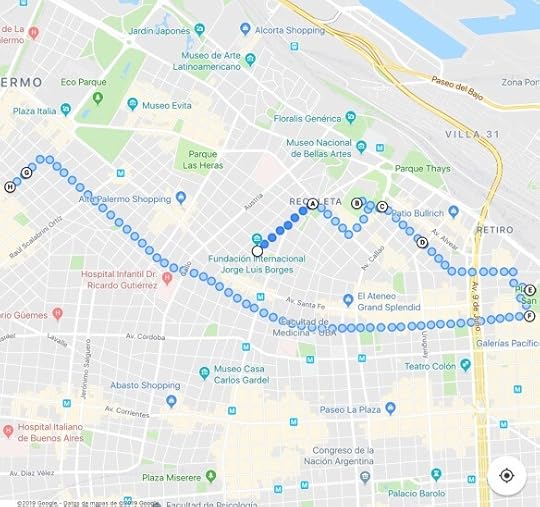
A divorced man lives in Palermo Soho in Buenos Aires, the neighborhood where Borges grew up. We get an essay on Argentina’s expanding economy, the development of China, and the superfluous things that rich people buy while “the poor remain poor.”

description

The author (b. 1949) is a prolific writer, publishing two to five novellas each year, as well as short stories. I'm not a fan of fantasy so while I enjoyed the writing, particularly what I will call the intensity of the writing. I rated this book a 3.5 and rounded up to 4.

I have read two other works by Aira with links to my reviews below:

The Literary Conference

An Episode in the Life of a Landscape Painter

There is an amazing number of good Argentinian authors. I just realized in looking at my "Argentinian author" shelf that about 15 authors are listed. It's unfortunate that a lot of the stories revolve around the terrible dictatorship and the 'disappeared' people of that era but the nation has produced quite a number of excellent writers.

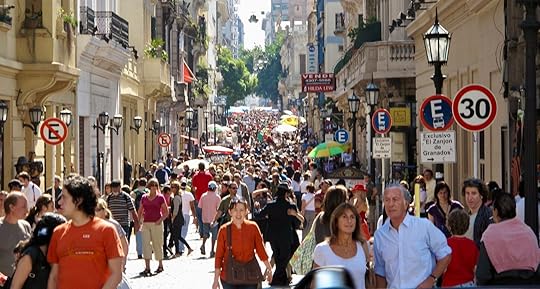
Top photo of the street Calle La Defensa in Buenos Aires from socialifeproject.org
Walking map in Borges' neighborhood by Hugo Rep on miro.medium.com
The author from channel.louisiana.dk
Profile Image for Helga چـو ایـران نباشد تن من مـباد.
1,398 reviews486 followers
May 3, 2025
Surreal, bizarre, spontaneous and chaotic, The Divorce is about chance encounters and stories about secondary characters.

After his divorce, our narrator travels to Argentina where a chance meeting sets off a series of interwoven stories and fantastical coincidences.

To be honest, the book was too metaphysical and absurd for my taste and just like Aira's 'An Episode in the Life of a Landscape Painter', I didn’t much like what I read.
Profile Image for Algernon.
1,857 reviews1,171 followers
December 23, 2021
Because they weren’t obeying instructions, it suddenly seemed like a game: they could advance and retreat, go up or down. They abandoned themselves to chance and movement; it was almost too easy. There was a sense of freedom: a clarion call marking the quick and painless end of childhood.

A divorce marks the end of an era of stability and peace of mind. It can be painful or painless, real or metaphorical, but in the end it lands the divorcee in a quandary: where do you go from here? how do you make sense of a world that has rejected you?
Cesar Aira starts his experimental novel in the most traditional way, never giving a hint to the reader of the fantastic journey he or she is about to embark on. A middle-aged man, a professor at the university of Boston Rhode Island, decides to go away from town on the eve of Christmas, in order to make sense of his divorce and of the future relationship with his alienated daughter. He decides to go as far as possible from his comfort zone and, on a whim, he changes not only the geography but also the climate, from winter in the north to the summer of a rundown Buenos Aires neighbourhood, Palermo Soho.

Playful, subtle, subversive and very, very intelligent in the construction of his arguments, Cesar Aira is every bit as good as other authors who have chosen to break apart and reconstruct the narrative form: the likes of Italo Calvino, Jorge Luis Borges or Julio Cortazar. And one of the most fascinating aspects of his art is the compactness of his novels and the amount of pure storytelling they manage to pack into such a slim frame.

This architectural simulacrum, which now really was the palace of dreams, a translucent edifice of dark moth wings, remained in place for a few seconds after the real building had fallen in, and then the great membrane burned all at once in a single blaze and disappeared.

To try to describe the plot of ‘The Divorce’ is a fruitless exercise, not because there is no plot or no characters, but because the novel is really an essay on the nature of time and on the power of stories. The author uses the image of the wheel of a bicycle that spins in place, bringing to the foreground character after character, story after story, only to push it down immediately and replace with another story, another character. It all happens simultaneously, in the present moment, on the sidewalk of a local cafe in Palermo Soho, and in the memory of the actors, through flashbacks. Since Aira also mentions Krishna, the Hindu God of protection, compassion, tenderness ( jumping and dancing, swirling his brightly colored sari, and jingling all his bracelets in the gray, livid silence of that poor neighborhood. ), I like to think of the present novel in the form of a mandala, endlessly unfolding its meaning in a circular form, drawing the eye deeper and deeper into the design the longer you look.
All you have to do, as a reader, is to divorce yourself from expectations and certainties, to enter ... a disposition to impermanence and change, which adapted itself (in good evolutionary fashion) to the mental climate of travel.

The narrator is trying to make sense of his own life after the divorce. He contemplates the stories of the people he meets in Buenos Aires, in that moment suspended in time, on the sidewalk of the cafe. His viewpoint is all encompassing, all-knowing, tracking the connections between ideas and actions, in search of a universal key to unlock the mystery of existence.

Evolution (or was it adaptation? whatever, it was the same in the end) supplied the reasons why birds sang, and plane trees lost their leaves in the autumn but also why clocks had two hands, and some people stuttered, and Jupiter was bigger than Saturn. It was the universal key, putting time to work on behalf of thought. And in their ardor to understand, the members of the club were seized by vertigo. Hadn’t it ever occurred to them that the whole world might be one giant Evolution Club, within which theirs was a scale model, a cell?

A mandala also resembles a mathematical equation, a fractal landscape from the Mandelbrot family, where the minuscule details are repeated in a macroverse, from the labyrinth of a burning school to the movement of celestial bodies. It could all be very confusing to the reader who expects a linear progression of the novel, but the author is careful to give hints about his purpose right from the start.

The center, for me, was Enrique’s guest house. It was the radiant source of life composed of ever-new, constantly changing images. Because of my personal circumstances, principally the sense of impermanence that followed the divorce, I had gone in search of some sort of eternity.

Like many a post-modernist novel, this one is also open to interpretation and actively encourages the participation of the reader in the creative act. Cesar Airo brings to the table his sense of humour, his natural skill as a storyteller and his ability to synthesize and to draw parallels to economic and social realities. Like Douglas Adams, Aira might make fun of the efforts of philosophers to find the ultimate truth, but I suspect he is in earnest about what he considers important. ( It’s only when you’re in love, he said, that you perceive the humanity of the human. ) In order to engage our attention, Aira believes we need a good shaking, a devastating fire to put our preconceptions to rest, and a couple of playful gods to roam the dull streets of our reality.

Puzzled, far more puzzled than at the outset of their quest, the five men came to the conclusion that all books were the Manual, and that everyone possessed the key with which to find instructions in them, fail-safe instructions for what to do and how to succeed in life.

... the only wealth that people could really aspire to was that of their own history.
And history and stories require a departure from the continuum of happiness. If someone had pointed this out, the youth of Palermo Soho would have asked: But how can you not be happy, even for a moment? And what is there but a moment? [...]
The constant consumption of pseudostories (immune to interruption by misfortune) has dulled the perception of reality. When the universe broke open and death came in through the crack, no one noticed.


The answers, implicit or spelled out in plain text, are not always comforting. Instead of permanence and stability, we need to become reconciled with loss and with danger, to embrace the irreversibility of time and to contemplate the cyclical rhythms of nature.

And anyway, how could there have been an ending if the beginning was still going on? Everything had happened in the blink of an eye.
Profile Image for Vesna.
239 reviews168 followers
March 8, 2023
This was the only episode that came back to her whenever she tried to sum up her past life, although she supposed, and with good reason, that many others must have been recorded somewhere in her memory. It must have been a kind of shorthand, one event standing in for all the rest. But it could not have been randomly chosen: the recollection must have been special in some way, like all the others, of course. . . . If that was where the meaning of life lay, it was very mysterious, because no two episodes can have precisely the same significance.
Time seemed to rule everything. And yet it was not so. Time was merely the mask that eternity had put on to seduce the young.
Profile Image for Suzy.
828 reviews382 followers
January 2, 2022
At the heart of this very short novella is Kent, recently divorced, who has decided to travel far away from his ex-wife and little girl for the Christmas holidays. His rationale is that it would be easier to establish a relationship and routine with her absent of the dynamics of holidays. He travels from his home in Providence, RI to Buenos Aires, Argentina and books in at a guest house to decompress and heal from the rawness of divorce.

Or . . . . maybe at the heart of this story is Enrique, the owner of the guest house in the trendy neighborhood of Palermo Soho, a philosopher who calls his guest house Evolution. Several encounters between Kent and Enrique, open doors to another dimension, magical surrealistic scenes that let the author play with time and space and expound on his philosophies, while Kent and the reader stand, mouth agape, at what we are witnessing. And maybe what we are understanding . . . or not!

Let me just say, mind blown! Like some other experimental books I've read recently (Ali Smith's Season Cycle and The Plains, I feel as if I've entered someone's hallucination where I understand everything while I'm immersed in the book and scratch my head after I've finished it.

Patti Smith is the perfect person to introduce this book.

Why I'm reading this: When I saw friend Algernon's review and this comment "Like many a post-modernist novel, this one is also open to interpretation and actively encourages the participation of the reader in the creative act.", I knew I wanted to read it. Plus, it fits neatly into my current favorite type of book - short!
Profile Image for Ana WJ.
112 reviews6,116 followers
August 29, 2021
like watching a great movie without… watching a great movie, if ya feel?
Profile Image for Andy Weston.
3,228 reviews229 followers
November 28, 2024
This is Aira in a humorous mood, writing about coincidence, or chance meetings.

The narrator flees his hometown in Rhode Island for a Buenos Aires guest house after a recent divorce dreading Christmas with his daughter and ex-wife. He sits outside a café with a friend, Leticia, a young video artist, when the café owner opens a canopy that dumps a deluge of rainwater onto an unsuspecting man, Enrique, walking down the street with a bicycle.

This simple accident sparks a number of chance meetings, each of which takes Aira a fifteen (or so) page chapter to expand upon. They are, as in many of his books, a masterly demonstration of a focused imagination. His injection of magic into the mundane is one of the great things about his writing, as even in these short passages the narrative snowballs to totally unpredictable conclusions.

For me, the best of these is the first, as a drenched Enrique recognises Leticia, the last time they saw each other was as young lovers, at 14 years old at boarding school. There is a fire and they flee, running through the corridors of the school as a sort of maze, along with the other pupils and the priests. In the basement they see their way to safety as through a small and detailed model of the school and duly shrink..

Of the priests..
Some were young, others older, elderly even, but all were animated by the same mechanical, frenetic vitality. The will to save themselves had given them wings; in the emergency, earthly existence had become more important than the hope of salvation beyond the grave or recompense for martyrdom.


And of the school..
What creature from the realm of almost nothing, with fingers a thousand times finer than a spider's leg, could have played Chopin's Nocturnes on that piano? The same thing was happening to all the contents of that magical doll's house, but the piano, a supreme feat of precision bricolage, made a stronger impression.
The gallery was so narrow that it ran in one direction only, and led to a labyrinth of dormitories. With what they charged for tuition and board, it was scandalous that the self-proclaimed progressive, liberal owners of the College had given their teaching staff, who were already underpaid, rooms so poky and stuffy that a dwarf, correction - a Playmobil figure, would have to bend double or quadruple to squeeze in.


Written in 2009, this reflects the mayhem of Argentina at that time, but is quite applicable to today’s climate anywhere in the world. The wonder of this short novel is that it is an effective pause from the fast pace of the world, a fantastical and magical moment of reflection.
Aira - as good as ever.


Profile Image for Stephanie B.
175 reviews32 followers
January 16, 2023
My second novel by Cesar Aira, and although a different ride than the first, an unequivocally marvelously wild ride through consciousness. As Patti Smith says in possibly the best introduction I’ve ever read to a novel “nothing said here could truly add to the smallest effort from the master himself. Cesar Aira is a psychedelic geometer, and it is certain that The Divorce will leave you breathless,”

Well, I concur - Gasp

This book is chock-full of seemingly non-meaningful yet somehow entirely meaningful digressions that wrap into a single moment of time, and made me think isn’t all time, can’t it all be, exactly like this? This book has left me in a marvelous glow of how simply existing inside a life, any life really, is an absolute delight of possibilities. How the story can turn, and turns again.

Is there meaning? I’ve been known to say to myself - at various points, is meaning just what you make of it at each moment? This book answered me in the most pleasing way that yes, perhaps life is just a series of leisurely riffs and perhaps nothing actually needs to have distinct rhyme or reason or closure. Perhaps all is just for the purposes of delight. It’s hard to say how many moments this book occurs inside of. It’s all within a split-second, and also simultaneously - years, entire lives.

The narrator is a recently divorced American, from Providence, Rhode Island, and for a bit I thought there must be something to the word providence lending meaning to the book, Does Providence mean everything or nothing? It’s entirely up to you. But, then Krishna shows up -as he does- as a mischievous child in Victorian-styled boots with a waxed mustache. Krishna, written in such an absurdly jocular way, I could not stop grinning.

Semi-attaching itself to my supposed spiritual theme there are also several mentions of benevolence. In a darkly (yet maybe very darkly humorous) scene a wildly abusive drunken sculptor is commissioned at the end of his life to create the “allegory of Benevolence” for the town.

There’s also reference to the Manual - the manual of all manuals which seems to be the key to all wisdom guiding a 14-year old girl to material success. The narrator himself is staying at an Evolution-themed guest house which, as it turns out, merely leads to vertigo when examined too passionately for too long.

I think this story could have a different read nearly every time you read it, and I literally went back to the first page after finishing the last.

Like becoming immersed in a painting or a single line on the page, the instruction here seems to be something I often see and encourage my own children to do, but which many adults may have forgotten how to - just follow the daydream.
Profile Image for Bert Hirsch.
182 reviews17 followers
July 16, 2021
Book review- The Divorce by Ceasr Aira

Cesar Aira the well respected and prolific Argentine novelist has added another piece to his growing multitude of strange yet engaging perspectives on literature. Famous for publishing his first drafts his work can, at times, meander yet his flow of consciousness often results in tales no one else could write.

In The Divorce he follows Kent, a divorcee, as he leaves his ex-wife and daughter in Rhode Island and rents a room in a guest house in the trendy Palermo Soho neighborhood of Buenos Aires. While chatting up a new female acquaintance, Kent observes the humorous dousing of water that befalls his landlord, Enrique.

As the tale unfolds we learn how Enrique is traumatically connected to Kent’s lunch companion, a mysterious guest in the same house named Jusepe, and finally Enrique’s mother who was an innocent victim of an attempted mafia assassination. On its face the tale appears farcical, yet Aira pulls off this tightrope performance, as he has done in prior pieces such as The Literary Conference and others.

Along the way we learn about a school fire, Jusepe’s strange upbringing and his cult of evolutionists, Enrique’s mother’s oddly acquired business acumen, and the commercialism of Palermo Soho once the childhood home of Borges.

As Enrique tells Kent about falling in love with a mysterious woman, as cool as ice, he wonders…

“...had he fallen in love with Mystery. The Mystery that he himself had fashioned, with his reticence and fantasies? If so, this might have been a symptom of megalomania, like believing that one has been chosen or is the protagonist of a story. The way stories unfolded, he thought, should have taught him some humility. Except that it hadn’t been so much an ‘unfolding’ as a ‘consumption’ of stories…Enrique lost himself in the depths of that gaze, where he felt that he would be able to find answers for which there were no questions…The story did not come to a happy end, but stories rarely do. In fact, they rarely come to an end of any kind, because the teller gets tired along the way, or bored, or fears that people will make fun of him.”

Reading the above passage, I perceived an insight into Aira’s unique storytelling technique. This is a little treasure. A brief story that “happened in the blink of an eye…how could there have been an ending if the beginning was still going on?”
Profile Image for Julio César.
858 reviews2 followers
May 27, 2011
Una pieza magistral. La compré porque la última vez que lo vi a Fogwill dijo que esta, para ese entonces la "última novela" de César Aira, era excepcional. No se equivocó.
No conozco, al menos no he leído, escritores que escriban mejor que Aira, con la excepción quizás de Roberto Bolaño. Si alguien me pregunta, cómo se escribe la buena literatura en castellano, le doy este libro de César Aira. Cada oración está perfectamente construida, en sí misma y en relación con la que le antecede y la que le sigue. Se lee lento, con el ritmo de la poesía, disfrutando de cada párrafo.
La historia, lógicamente, es lo que menos importa. Tenemos una abarrotada sarta de sucesos fantásticos, minuaturizaciones y deificaciones incluidas. Son 130 páginas, pero cómo se disfrutan.
Profile Image for Heronimo Gieronymus.
489 reviews151 followers
May 8, 2021
They don’t pay me to be coherent. In fact, they don’t pay me at all. They shouldn’t; I’m congenitally ungrateful. That being said, I do find myself in possession of the uncorrected proof of THE DIVORCE as though I were a noted tastemaker or at least a paid clutter culture dirigible. I cannot realistically be held to any standard whatsoever. THE DIVORCE is the new book from César Aira, although it is from 2010, which may sound incongruous but which will to those familiar with this great, inexhaustible Argentinean author, seem very much like a familiar sort of a spatiotemporal fold—max characteristic. Because this is an uncorrected proof I address—the book immediately before me, small and some kind of sky’s blue and perfectly handsome, currently set atop an external CD drive—strictly, I suppose, I must establish that it would at this point merely ‘appear’ to be the case that the novel is preempted by an introduction in which Legendary Happy-Go-Lucky East Village Ragamuffin Symbolist Poet Patti Smith recalls her first interaction with Aira, the ‘event’ having occurred at a literary festival in the Land of Prince Hamlet, Patti, ever the ever-ready incipient superfan, reporting with no noticeable regret having realized she had performed a bit of a blunder in enthusiastically praising AN EPISODE IN THE LIFE OF A LANDSCAPE PAINTER, which is indeed a very great book, only to have its author chastise her. “It wasn’t until I read and reviewed THE MUSICAL BRAIN that I realized why he’d been so cavalier about the merits of the book that I had fervently pedestaled. Cesar Aira [sic] is gifted with a vastly flexible, kaleidoscopic mind: he can see the equation and the proofs simultaneously. He sets one crystal in place and a whole structure manifests.” The fact that César Aira’s universe is unusually multiversal is a fact that anecdotal evidence would seem to suggest consistently dawns on his readers only progressively. It is THE MUSICAL BRAIN, her second venture, a large collection of stories from a writer more commonly revered for his startlingly many very short novels, where Patti Smith finds herself starting to espy the awe-inspiring scale of the highly vertiginous network. I started with THE MUSICAL BRAIN, then moved on to GHOSTS, which I don’t mind admitting I didn’t necessarily know exactly what to make of, before everything really seemed to lock in for me with CONVERSATIONS. The Chicago Area writer Adam Levin, with whom I was communicating a little for a bit, claims GHOSTS was his third Aira and the ultimate point of immersive recognition as concerns or concerned he, Levin, as reader of the Argentine he had finally come to prize very highly. If this is more or less what I likewise found with CONVERSATIONS, my third Aira, strictly speaking, I believe I achieved yet another supplementary plateau with the last Aira I read, the recent BIRTHDAY, which I cracked and drank heartily of in October of last year. In BIRTHDAY, the narrator is an ironic version of César Aira himself, named accordingly, and the elliptical rhetorical mode employed largely depends on a governing intelligence that thinks of itself as a thorough and monomaniacal encyclopedist, the life and body of work a seeking the totalization of this immanent substantive world encyclopedia, though the governing intelligence that's been all the while governing has been, up until shortly after its fiftieth calendrical birthday, quite ridiculously misunderstanding the phases of the moon. “The sole and ultimate aim of all my work has been to compensate for my incapacity to live, and the work has barely sufficed to keep me afloat. I have done a lot, but only just enough. Is it really so surprising that I’ve had to pay for my survival with scandalous gaps?” What we have here first and foremost is a picture of the literary encyclopedist trapped in the epistemological quagmire—not at all unlike an old-fashioned notional abyss—initiated and inaugurated by modern physics. In LETTERS AND OTHER TEXTS, a recent compendium of posthumous miscellany from Gilles Deleuze, the French philosopher responds to an inquiry about metaphysics and whether or not he has an aversion to the field in general by stating in no uncertain terms that “Bergson says that modern science did not find its metaphysics, the metaphysics it needed. I am interested in this metaphysics.” My contention is that César Aira is in his own way equally interested in this metaphysics. Before looking at the text and the texts within the text and how these complexes or tenuous assemblages would appear to collaterally function, I would like to take a moment to share three striking axioms/maxims interspersed throughout THE DIVORCE like little bits of quasi-Nietzschean bird seed scattered in unstable spaces and thickets of entanglement (or sequencing): 1) “The sign exercised a fascination”; 2) “Time was merely the mask that eternity had put on to seduce the young” 3) “It’s only when you’re in love, he said, that you perceive the humanity of the human.” The first precept, of course, suggests, just like Gilles Deleuze’s 1964 PROUST AND SIGNS, that the at least partially self-worlded worlded self is not an autonomous agent but much more the victim of the seductions of signs and of semiosis, while the second and third, reminding me of Buckminster Fuller’s assertion that love is the gravity of metaphysics, suggests that seduction and romantic coupling, however brief or fraught, might reintegrate the dissolved world, wrest it back from the brink of terminal entropy, or make it the heaven it already was but which seized as such in the light of lightning-flash revelation, makes for joy and vivid experiment. How does this metaphysics work? As in the literature of poet, autofiction pioneer, and mathematics professor Jacques Roubaud, who sees everything he does as one project and, if pressed to qualify his general area of specialty is liable to say the mathematical discipline of topoanalysis, early in THE DIVORCE we see how Aira builds unstable physical territories and the slippery preconditions that make them intelligible (or not quite intelligible). “It was as if Destiny were working with primordial blocks. Fire had separated them; and now water had brought them together. Taking air for granted, or keeping it in reserve for a later stage of their shared story, all they needed to complete the classic quartet of the elements was the ‘earth, swallow me up’ of unexpected and unwelcome encounters [...] what they were experiencing in that moment was something like the blessed consummation of memory made real.” So, yes, this is the production and showcase of a prestidigitator’s space-time, but it goes farther than this because proper domains (the so-called present, memory, the oneiric, the hallucinatory) are entangled within the overall sequencing and the local sequecing of offset regimes or narrational territorialities. Key to the metaphysic or poetic cosmology built and showcased in THE DIVORCE is the concept of the “event,” absolutely central in the philosophy of Alain Badiou, for example, but also, when combined with a comically ham-fisted over-literalization of the second law of thermodynamic (i.e. entropy), subject of a would-be 2020 Christopher Nolan Blockbuster that, if I am not mistaken, may have indirectly helped my come to believe that the hypomanic fugue I hit in March after passing through two sequential PTSD triggers, caused that Bananas Suez Canal Accident…and my belief—currently, as it happens, a man falling in love with a woman—that we are headed into a pattern amounting to something approximating ten or fifteen years of relative stability and merriment. Just try and tell me I’m wrong! The event around which the four distinct parts (or interactional assemblages) of which THE DIVORCE consists is one that would not come to be made known to us if not for the perhaps-only-temporarily ex-national Rhode Island divorcee from whom the novel’s title takes its sense, but at the centre of the event proper is Enrique, fulcrum of a pratfall involving a dousing with water distractedly released from the canvas awning of a Buenos Aires sidewalk café. We are to quickly discover that his childhood "plunged" Enrique “into the bafflement produced by doublings and parallel universes.” We will quickly be treated to the impossible topologies of impossible apparently exclusive realities and beings/signs, “conducting wires”exploding (15), “glittering bouquets [plunging] into concave obscurities, where compact, foaming glows appeared” (15-16). The divorcee, perhaps a mere Christ-like ‘gate for the sheep’ with respect to entrapment within this confounding funhouse network—seducing the young, doubtlessly, on behalf of eternity—is sitting at the sidewalk cafe with charming video artist Leticia, she the first to be hit by the evental waveform of uncanny recognition reverse-spiralling out of Enrique’s dousing. The wave then hits the male divorcee, who realizes he too knows Enrique, then a third party, Enrique’s mother, who Enrique had himself believed long dead and who has been seated behind the divorcee and Leticia, out of their eye-lines and for a considerable time unremarked upon in the moments leading up to the cosmically decisive ‘wet event.’ Where has Enrique’s mother been? Her decisive event happens to have been a creepy talismanic formation shot into her face with a gun, an event her son had believed killed her but after which she, somehow surviving, had upset the powers that be by making for a pitiful witness. “For the next forty years she managed the firm. All the rest of the family went into exile, with the excuse that their honor had been besmirched but in fact to enjoy their stolen wealth far from prying eyes. Oddly, despite the systematic embezzlement to which the firm had been subjected, it continued to function smoothly, thanks to the nature of its operations.” During his childhood, an ‘event’ removed Enrique’s mother from his space-time and relegated her to another—until such time as something like another evental portal might open. And poor, dear mother, just like the rest of us, swarmed by largely immaterial swarms, has been and is to be coopted chaotically into this or that space-time. “The normality phase turned out to be short-lived, too: it was interrupted by the brutal attack that made her briefly famous, after which she had to start building a new normality from scratch. Her friends often told her that she was lucky, in the end, to have lived a series of different lives: the coddled, ignorant rich girl; the hard-working, efficient businesswoman; the tumultuous lover; normal woman ‘number one’; the famous mafia victim; and finally normal woman ‘number two.’ The series was discontinuous, unpredictable, erratic. Her friends found all this exciting. They’d had one life, and that was it! Actually, they felt as if they hadn’t lived at all. Enrique’s mother energetically rejected this dubious admiration. What the apparent multiplicity meant, she said, was that she hadn’t had a real life (which is singular by definition).” Discontinuous, unpredictable, erratic: very much a specific field of topology/topoanalysis. The quite terrifying and disruptive force of the so-far-only-theoretically-computable-quanta-of-All presents in the ongoing destabilization of the, ahem, always already completely unstable, very tenuously grounded, and outrageously prone to catastrophe, very often on a massive scale, far more often merely unaccountably weirdly. So from Enrique’s mother back to Leticia and the burning College and the burning mini-College and a whole heaping ton of high-octane magic-lantern life-and-death confusion: “Although the glow of the little flames was intense, the moving bodies of so many children, huge by comparison, threw shadows in every direction; images appeared disjointedly on twisted, fleeting planes.” From this to the dogs a criminal child and future Evolution Club party-crasher believes totally destitute and abandoned, only to realize in coming to see one dog actively cared for, that it is truly he whose been abandoned with his cunning alone to the unforgiving steppes. “It’s not true that you came into this world,” Alan Watts tells us. “You came out of it, like a flower comes out of a plant. You’re something the whole universe is doing.” This is the stuff of the Hindu conept of Maya, the psychonaut swamp gas cosmology, and Andrei Tarkovsky’s version of the planet Solaris, out-flowering hallucinatory in all its confounding epiphenomenal mayhem. Entropy is the tendency of a system toward the loss of its own net organization (as a system, a network, a series of dizzy sequencing tangles), and in THE DIVORCE we have an animated-object version of Krishna appear in order to symbolize the indefatigability of presiding chaos, exactly like the lucid dream that gets away from you. “His [Krishna’s] attire, completed by bracelets and necklaces, was a mere eccentricity compared to his behavior, which combined an unfortunate sense of humor with the most exasperating puerility. This manner, so at odds with the conventional image of a deity, explained why the duty had been assigned to families with boys about as old as the holy guest appeared to be: the idea was that he would have someone to entertain him.” Well, right. ‘Entertainments,’ no matter whose idea of what constitutes “entertainment” we grant special credence (if we’re inclined to do that), are worlds that capture, symbol-systems that seduce and cocoon. The impregnable if implicit philosophical question around THE DIVORCE's metaphysics of the event, as the author well knows, is one of selection, as in Darwin, although here the question is: how is it events and semiosis make their selections? perform their hijackings? “It must have been a kind of short-hand, one event standing in for all the rest. But it could not have been randomly chosen: the recollection must have been special in some way, like all the others, of course…. If that was where the meaning of life lay, it was very mysterious, because no two episodes can have precisely the same significance.” We are in a situation here where pattern recognition and a desperate clinging to forms whose tangibility is always illusory at best, lead either to paranoiac catalepsy, de-selected desolation, or creative fervour. Quantum mechanics remains the impossible to which you are impossibly bound. Intelligence remains stymied by its limits. But love can definitely be your gravity. I can stare at a still image of Kim Hunter as June in Powell and Pressburger’s A MATTER OF LIFE AND DEATH (1946) while listening to Neil Young & Crazy Horse perform “Love to Burn” live on repeat knowing that this is all about the woman who will share my bed in the month of June and the ten or fifteen years I am convinced I get as a kind of birthright. Again, just try and tell me contrary. Best of luck.
Profile Image for Rachel Louise Atkin.
1,366 reviews618 followers
May 4, 2025
Sadly I did not enjoy this as much as Birthday but I am really starting to love Aira as an author. The way he constructs stories out of nothing and makes the most mundane situation feel like the most important thing on earth is incredible.

This flowed a lot less succinctly than Birthday as it delves into the life of a few different people. It still has the same introspection but it didn’t grab me as much, although I was wowed by the concept the final page of the book did hit me.
Profile Image for Jenny (Reading Envy).
3,876 reviews3,724 followers
July 25, 2021
The Divorce tells about a recently divorced man on vacation in Buenos Aires. One afternoon he encounters a series of the most magical coincidences. While sitting at an outdoor café, absorbed in conversation with a talented video artist, he sees a young man riding by on a bicycle get thoroughly drenched by a downpour of water—seemingly from rain caught the night before in the overhead awning. The video artist knows the cyclist, who knew a mad hermetic sculptor whose family used to take the Hindu God Krishna for walks in the neighborhood.

This was more whimsical than the other books I've read in translation from this author, but pleasantly so. And at only 100 pages, it's a quick read. This means I read it within a week from its arrival via the New Classics Club from New Directions, which I pay for.
Profile Image for Enea.
219 reviews43 followers
March 11, 2020
Cada novelita nueva que leo de Aira me hace pensar en las anteriores, o las primeras que leí, con más cariño. No sé si alguna se va a acercar a "El Tilo" o "Fragmentos de un diario..."

Si se puede decir algo de esta novela es que pone de manifiesto uno o varios de los "artificios Aira".

El relato parte de un escritor norteamericano que, por un divorcio y, para no hacer sufrir a su hija con visitas esporádicas, desaparece y cae en Buenos Aires.

Un día, charlando en un café con una amiga, presencia un hecho: el dueño de un bar abre un toldo y un muchacho, en bicicleta, es empapado por un torrente de agua acumulada (¿Cómo está acumulada si el dueño del bar abre el toldo, no lo cierra?) que no parece cesar (aira).

Da la casualidad, que la chica con la que el narrador está hablando, es amiga de ese muchacho: ¡Enrique! ¡Leticia! No se ven desde hace tanto tiempo... La última vez, había sido escapando de un instituto en llamas. Ahí el primer relato. La pérdida de la infancia es el motor. Enrique y Leticia se encuentran perdidos en un instituto, descubren una maqueta del mismo edificio y se escapan dentro. El mismo relato se sucede dos veces, con algunas modificaciones. (Este es 1 procedimiento).

Este se me hizo aburrido. Está increíblemente bien escrito, no voy a negar eso. Pero puede ser aburrido igual que un músico de jazz que solea durante veinte minutos. Seguramente yo no lo entiendo igual.
Dice cosas como: "Desde ese mirador sobreelevado vieron estallar en llamas todos los especímenes de la Flora encarcelada, hincharse de aire ardiente los cálices y generar explosiones globulares; sartas de alveolos incandescentes subían ondulando y quedaban suspendidos frente a sus ojos".

Aira siempre cuela frases que te hacen pensar que no habla del relato, sino de la Literatura. Y eso te hace pensar: "¿No es lo mismo? ¿No están hechas de la misma materia? Oh, Aira. ¿Qué me estás queriendo decir?".

"El Plan de Evacuación, muy ingenioso, se basaba en las seguridades que ofrecía un cambio repentino de dimensiones. Los niños vacilaron. Pero no tenían opción".

Esta digresión, escape, bifurcación, aparece muchas veces, como ingeniosos retorcijones de las posibilidades infinitas del relato.

La segunda historia, siguen las casualidades en el bar del Gallego, ocurre cuando el narrador se da cuenta de que Enrique no es otro que el dueño del hostel donde él se queda. En el Palermo más chic, hay uno dedicado a la "Evolución" con un club de fanáticos de Darwin. Eso permite muchas cosas, pero, de nuevo, la digresión.
Entramos en la vida de Jusepe uno de los miembros del club evolutivo cuya historia se entromete a fuerza de cambiar los temas de conversación del grupo del club.

De nuevo, la infancia perdida, él es obligado a malvivir con un escultor borracho de Quilmes y luego, odiado por el padre, que debe pasear a un Krishna por el barrio.

Este segundo relato es muy bueno.

Entre otras definiciones, tiene una sobre las digresiones y los restos que van quedando en las miniaturas o dimensiones que se suceden:

"Como en uno de esos trucos de prestidigitador, en los que la mano es más rápida que el ojo, la Evolución había sido reemplazada por Jusepe, donde antes había estado uno ahora estaba el otro; pero el cambio no había sido tan limpio, había quedado en el aire una especie de fantasma conceptual que se manifestaba en la historia del joven escultor".

Por ejemplo, Darwin y la evolución aparecen sugeridos en el relato sobre Jusepe en la forma de unos perros salvajes a los que teme. O los fantasmas ya habían aparecido nombrados en el relato de la institución.

El fragmento más lindo de la novelita es una idea sencilla y genial. El escultor borracho y malvado es encargado un trabajo por la municipalidad. Tiene que moldear una piedra, cosa que nunca ha hecho, y mientras lucha consigo mismo por hacerlo, Jusepe ve cómo las manos y los movimientos construyen un juego de sombras en las paredes. "Fue su única obra de arte, privada y secreta".

Claro.

(?)

El tercer relato, parte de la madre de Enrique que también estaba en el bar. Hacía muchos años no se veían. Ella sufrió tener que hacerse cargo de una empresa familiar siendo muy pequeña. de vuelta la infancia. Además, fue atacada por un grupo mafioso pero que, al parecer, la confundió con otra persona. Le dieron cinco tiros en la cara y la deformaron. ¿Cómo reconocerla ahora?

Otra digresión. Dos, en realidad. Un episodio sobre cómo encontrar un árbol de navidad en un local sin luz. Y un conjunto de empleados que quieren encontrar el Manual que de con todas las respuesta, que explique cómo la madre de Enrique pudo llevar adelante una empresa sin saber nada al respecto.
Hay varias reflexiones sobre la combinatoria y la posibilidad de contenerlo todo.

Por último, un relato de amor. Enrique, que vive en Palermo, está Borges, una Argentina en crecimiento por las commodities que compra China, la moda, Tres Planetas, el mito de Don Desviado, el misterio de una chica que no habla. Un estallido.

"¿Se había enamorado acaso del Misterio? Del Misterio que él mismo había construido, con sus reticencias y sus fantasías. Si era así, podía ser una señal de megalomanía, como creerse un elegido, el protagonista de una historia. El transcurso de las historias, pensaba, debería haberle enseñado humildad. Pero estaba el hecho de que no había habido tanto un "transcurso" como un "consumo" de historias".

Qué sé yo.

No quiero contar el final porque ya es un montón.

Ahora que escribí esto creo que me gusta bastante más. Pero la primera parte fue insoportable.

Es una explosión vista en reversa.

Del Divorcio al Amor.
Profile Image for Sarah.
42 reviews
July 5, 2021
“I was grateful for that practical help, of course, but even more so—and I reaffirm my gratitude here, in these pages—for the company, the conversation, the time those people spent with me.” ... This is not a book that explains divorce or any one divorce, but the time that people spent with him (the divorcé) during it. And also things a little more absurd. Moments just exploded!
Profile Image for Morgan.
81 reviews102 followers
September 29, 2021
aira is so playful in his use of language, reading this had me feeling like alice entering wonderland. i don't want to reenter the mundane world!
Profile Image for Guillermo Jiménez.
487 reviews363 followers
August 12, 2017
No podría decir que es como en el arte minimalista, pero, sí, algo hay. En espacios con tan poco elementos o casi sin ellos o en blanco, uno tiene que averiguar cuál es la razón o sentido de cada objeto percibible, o de la atmósfera: uno llega a esas expresiones mínimas con todo su bagage, o con la ausencia de este, para comprender y disfrutar, o para verse confrontado o ignorado y salir ausente.

Digo que difícilmente Aire podría entrar como escritor minimalista, puesto que sus obras son múltiples y múltiples las lecturas y las aproximaciones que presenta, sus interpretaciones. Y, como si esto no fuera poco, dentro de cada novelita hay un buen de historias que se bifurcan en subhistorias que parecen no tener fin, parecen solo determinar un camino posible que el lector puede seguir, pero, que aún habiendo cerrado el libro, continúa en el imaginario del lector. Y si…

El divorcio aprovecha cada resquicio de letra, cada palabra, para erigir una obra narrativa sobre la ruptura y el peso del instante.

Me recordó un poco al planteamiento de Vonnegut en Galápagos, en la que, según recuerdo, la novela inicia con algo como “es el año x [en nuestro futuro], pero, regresémonos mil años atrás en el tiempo”, a un tiempo anterior incluso a nuestro presente posible.

Algo así.

Separaciones que nunca se concretan, encuentros que desencadenan historias múltiples que van desde lo que entendemos proporción 1:1 hasta 1:100 o 1:500; un mundo de apariencias o mejor dicho, que nos deja jugar con los mundos posibles de las cosas y le otorga un peso magnífico a las apariencias y a los estereotipos y a los lugares donde vivimos.

Algunos a veces nos sentimos vivir entre las líneas, en los márgenes, de la literatura que amamos y admiramos.

Aira se afana con novelas “rusas” con gran tino, “rusas” en el sentido de las muñecas rusas en las que dentro de una encontramos otra… igual, pero más pequeña y por ende ya no igual, sino una especie de mini doble siniestro; en las novelas de Aira las historias no son similares, el primer plano ya es lo suficientemente absurdo, y no, que alguien decida viajar al romper una relación no es absurdo, que lo haga al otro lado del mundo tampoco, menos si es porque tiene amigos y conocidos; el absurdo puesto sobre la tela de juicio de una mente disparatada pero que termina dando en el blanco, ¿por qué? Porque Aira es capaz de interesarnos no solo por lo literario, sino que nunca deja fuera esa “pasión por la trama”, sabe que es relevante para la concatenación de ideas.

Digo disparatada, podemos decir improvisación también, pero, como una excelente pieza de jazz, sabemos que por encima de la fuerte carga de libertad y de jugar con la interpretación, la “obra” ya está escrita, aunque sea en la mente del escritor.
Profile Image for Freddie.
442 reviews44 followers
July 30, 2023
I guess this book is not for me. The randomness and coincidences shown in this book feels too contrived and intentional. The surrealism feels forced and inorganic, it's like someone tries too hard to be quirky. Also, bad use of scientific concepts as metaphors irks me. It only makes the writing sound pompous.
Profile Image for Richard Thompson.
2,976 reviews167 followers
October 25, 2021
Cesar Aira is brilliant writer. This is my second Aira book, and though it is perhaps not quite as insanely great as Varamo, it is still fantastic. The book starts out as if it were a standard story about the narrator’s divorce and his trip to Buenos Aires to create some distance from his daughter so as to smooth the path to a different relationship with her, but the story quickly veers off in a totally different direction. The entire book is one digression after another. That will frustrate some people, but I loved it. Mr. Aira gives us several different stories framed around the narrator’s experience in a café where he sees the landlord of his vacation rental soaked by water that had been trapped in a furled awning. This spins off in stories based on sudden recognition of other people that then lead to convoluted stories within stories. It reminded me of the old computer game The Manhole, where the player searches a room for an exit that takes you to a different world where you search again for another exit in endless circles. But there is always some connection and some sense of development around the general theme of evolution, which, not coincidentally, is also the theme of the landlord’s guest house. Then, as in Varamo, the book itself becomes in a sense the very thing that it is about, an evolving, changing experience to be lived as life is lived in twisted but connected digressive turns.
Profile Image for Jim.
2,425 reviews803 followers
June 24, 2021
Another delightful short novel by the Argentinian wizard César Aira, The Divorce works around a strange moment when four characters who know each other meet by a Buenos Aires cafe at the very moment when the young B&B operator Enrique tragically loses the love of his life, who is a very specialized goddess.

Like other Aira novels, the plot swirls around like a Roomba vacuum gone crazy -- except this one time, the story comes back to the main characters at the beginning. An unusual departure for Aira, and, as usual, great fun.
Profile Image for Mursalin Mosaddeque .
52 reviews38 followers
July 19, 2021
The vignettes that are barely interconnected are fantastical and captivating pieces on their own. They shatter our notions of what's to expect from a piece of fiction and never fails to get hold of our undivided attention in the process.
Profile Image for Darryl Suite.
720 reviews829 followers
July 25, 2021
If you’re into surrealism and “WTF did I just read?” territory, come on over. And since I’m very much into that kind of thing, I was living!!
Profile Image for Damián Lima.
596 reviews46 followers
July 10, 2024
Este es el mejor Aira, lejos. El de la novela curiosa y juguetona, del lenguaje detallista y logrado, de la estructura perfecta en la que se conectan todos los elementos de forma casi mágica, de los episodios que exploran lo tragicómico y lo increíble, de la forma que bordea el inverosímil, el absurdo y el ridículo. Creo que todo eso y mucho más está presente en las escasas páginas de El divorcio, título que no le hace honor a una novela que atrapa al lector en el laberinto de su trama y lo obliga a concluirla de una sentada. Es una novela de encuentros inesperados y de episodios maravillosos: un incendio en un colegio de curas que se replica en una versión en miniatura (¡y el momento de las polillas, uno de los más altos de la literatura aireana!); la historia del aprendiz de un escultor que jamás talló ninguna piedra; los paseos dominicales obligados junto a una deidad hindú; la búsqueda por parte de cinco hombres de un Manual como libro absoluto (a lo borgeano); todo esto a la luz de un momento a lo baldazo de agua fría que no solo desencadena encuentros de gran comicidad, sino que cerrará de forma elegante y perfecta al final de la novela.
Profile Image for Zuberino.
430 reviews80 followers
May 27, 2024
All the postmodern trickery you would expect from the lineage of Borges - incidences and coincidences abound even in the person (and the past) of one hostel landlord, Enrique. Anchored for me by a terrific centrepiece - the burning down of the private school over ten pages, then repeated and refracted in faithful miniature immediately afterwards in ten more. Bravura performance, that.

As for trying to find a cosmic message in four discrete, disjointed narratives, your mileage may vary.
Profile Image for jeremy.
1,205 reviews311 followers
February 27, 2021
there was no room for pretense between their protons and electrons, and they all fled from death at the speed of light, each for himself, with the egoism of matter, confirming, had there been any doubt, that there is no other world than this.
the eighteenth(!) of the prolific argentine's books brought into english, the divorce (el divorcio) is another gratifying outing from the master of the novella. this one starts simply enough (don't they always?!), before unfurling into something wholly unexpectable. reviewing aira can be a tough task, easy as it is to carelessly divulge a plot twist or spoil the whole, so suffice it to say a story which begins with a recent divorcé seeking a break in the sunnier climes of the southern hemisphere ends up nary a tale of matrimonial ruination at all. his storytelling, his prose, his perspective, his humor, his imagination; aira effortlessly offers it all.
time seemed to rule everything. and yet it was not so. time was merely the mask that eternity had put on to seduce the young.

*translated from the spanish by chris andrews (bolaño, almada, adimi, et al.)
Profile Image for nazareno.
23 reviews4 followers
May 6, 2018
muy buena. en esta novela confluyen varios aira, casi todos: el de pasajes melancólicos y cómicos, el sociólogo de derecha, el alter ego de escritor maduro, el delirante, el místico, el conurbano. pero no es un relato caótico (o sí, diría la faraona) ni una serie de deux ex machina encadenados de esos que profiere el pringlense cuando se aburre demasiado pronto de su propia novela, sino que aparece todo bien dosificado, en capítulos que escinden historias derivadas de un único episodio.

qué misterio (o no) el que hace que textos, no sé si "menores", pero sí efectistas, petardistas, de aira como "la guerra de los gimnasios" o "el mármol" tengan sucesivas reediciones y éste quede perdido entre la marea de su producción.
Profile Image for Pascale.
1,366 reviews66 followers
February 5, 2022
The safe and polite thing to say would be: although I understood every word, and every sentence, and every paragraph, I utterly failed to grasp what this book was about but given who I am, and who César Aira is, it must be my fault and not his. However, what I truly feel like saying is: this book is a lot of poppycock swaddled in a hefty amount of gobbledygook and stuffed with a good dose of balderdash. It gave me the impression that it stopped on page 98 because Aira's books all run approximately to that length rather than because the narrative had reached any kind of closure. That it's not about divorce (except maybe divorce from reality) may be its only redeeming feature.
Displaying 1 - 30 of 155 reviews

Can't find what you're looking for?

Get help and learn more about the design.