Oh boy. Definitely gonna be spoilers in this one.
Spoilers! Spoilers! Spoilers!
With that caveat (x3) out of the way we can dive into the analysis.
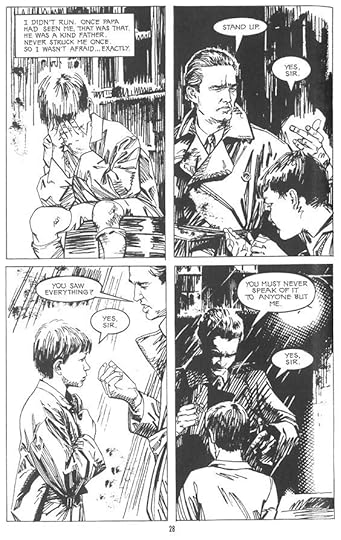
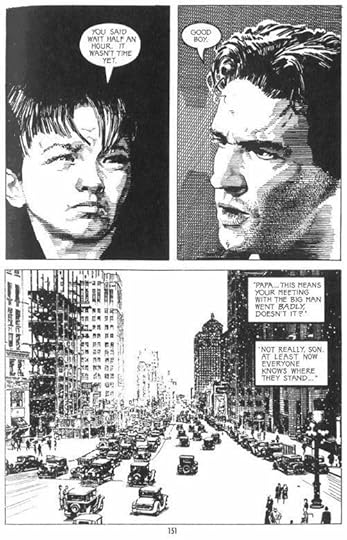
I’ve heard a lot of good things about this so, I was generally excited to dive into Collins’ work (later made into a Dumb Hanks movie). There’s definitely a lot of good here. But, there’s also a lot that falls more into the underwhelming category. The art alone (which is particularly gorgeous in its minimalist vision) pushes it toward the realm of a 4 star but, the typical comic book hi-jinks prevent it from going anywhere beyond that.
In a nutshell, we get a tale of revenge that happens for no other reason than to just to fulfill its telos. Blanched in the criminal underworld of the 1930’s, Mr. O’Sullivan, our protagonist is employed in a local crime outfit as their heaviest hitter. This soldier who shares the Biblically derived moniker of Angel of Death, finds himself betrayed by his erstwhile employer. While he survives the initial shoot-out, matricide and filicide leaves him alone in this world. Save only his first-born son (the second protagonist and narrator), vengeance becomes the predictable theme du jour.
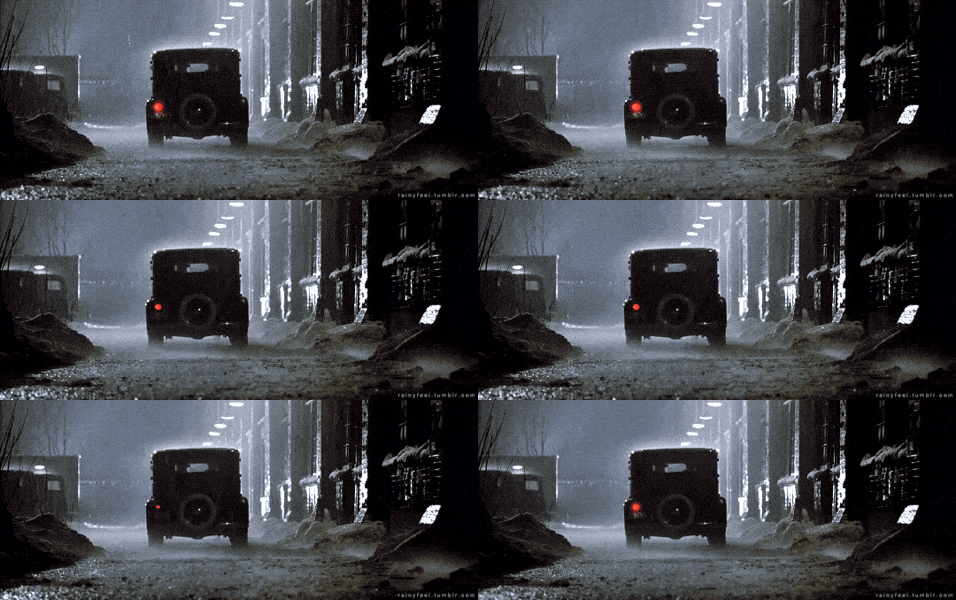
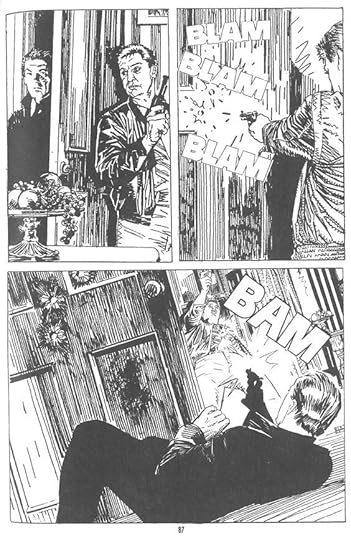
Branching all across the States, propelled by a jet-black Model T, innumerable tire treads and the bullets that follow riddle across each and every page. Featuring phenomenally intricate pencilwork, this tale becomes bathed in an artistic style that clearly has aged extraordinarily well. Your eyes will find themselves at a visual feast of sorts with beautiful landscapes and well modded depictions of historical figures, such as Capone and Looney.
The same cannot be said of the story itself, nor how it unfolds however. Featuring the typical good guy lands all his bullets, and the bad guys’ never find their marks shenanigans (almost matching a Star Wars level of silliness), the level of tension never builds up to a point of solid interest. Moreover, with a strict regimen of repetition applied to these gun-duels, the action actually gets quite stale as the story continues. Add this to the fact that our main conflict never has a rationale developed, overall it ultimately feels far more deus ex machina than a properly thought out narrative.
Whether or not the god came out of the machine, the lack of themes (nor central rationale) leave us with an uncomfortably uniform vision that could have tied so much more into it. More presentation than body, style once again trumps the substance. This is particularly damning considering the rich imagery utilized to merely cosmetic effect. Our protagonist (despite his murderous job description) is shown to devoutly worship at his historically accurate place of worship befitting of a stereotypical Irishman of his time, The Roman Catholic Church. Yet, never is the theology tied into the tale, nor the traditions of the church. It’s merely there to fulfill a historical effect that is far more cosmetic than the rich body it deserves.
The very same criticisms can be leveled at other aspects of the historical milieu, that appear well mined and (on prima facie at least) portray a strong accuracy, are woefully undeveloped. Further examples include that of the G-Men whose characters are never developed nor the political goings-ons behind the scenes. Equally lame are portrayals of the bad guys who are villainous in nature for no other reason than to perform their role in the story. Themes of poverty, corruption, and the ever changing culture of the States are absent of their furiously powerful historical dynamism. Plagued by artistic blinders, all focus is placed (for the most part) upon our (admittedly) uneven duo of protagonists.
Favoring a low level of magnetism the relationship between form and function, is actually dismayingly lacking in a department that should be so much more. Forms might match their functions (think how all the bad guys in Tarentino’s first two movies all wear black suits w/black ties) but they’re developed into anything deservingly complex. Conversely, Tarentino’s villains (in Pulp Fiction and Reservoir Dogs) are all built into thoroughly believable and enjoyable characters. Sometimes you actually can have your cake and eat it too, and Collins seemingly would have us favoring possession over a fully belly.
In either case, the truly phenomenal art-work propels it toward the gravity of a 4 star rating, so that’s where my rating will land. But, be sure to cast a critical eye uponst the pages and you’ll see more of a nude emperor than anything.
Make sure to consume on a full stomach.