

What do you think?
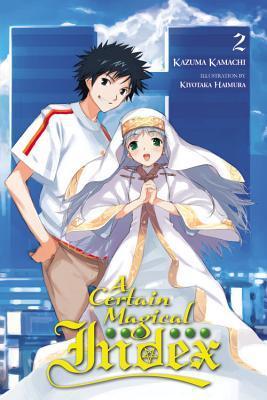
とある魔術の禁書目録 [Toaru Majutsu no Index] (Novel) #2
A Certain Magical Index, Vol. 2
In Academy City, magic and science coexist in an unwavering power struggle--and Toma Kamijo has been caught up in the middle of it ever since he met Index, a magical nun who has been implanted with 103,000 ancient texts. When Toma learns from magician Stiyl Magnus that a shrine maiden is being held captive at an Academy City cram school, and that someone from the magical realm might be involved, the one-time enemies team up to save the girl. But it isn't long before the rescue mission takes a turn--will Toma be the one who needs rescuing?!
248 pages, Paperback
First published June 10, 2004
About the author
Kazuma Kamachi
245 books155 followersKamachi Kazuma (鎌池和馬) is a Japanese-born light novel author and the original creator of the Toaru Majutsu no Index light novel series and Toaru Kagaku no Railgun, its spin-off manga series.
Ratings & Reviews
Friends & Following
Create a free account to discover what your friends think of this book!
Community Reviews
Displaying 1 - 30 of 32 reviews

November 23, 2014
There was a sense of disbelief that came over me as I read this book (it just felt unreal at times) which really worked for me considering everything that happened in it. Much like book 1 Touma wants to save a girl (this time a different girl, and is this going to be a theme each book ?), a girl called Deep Blood. A girl who can kill a certain creature many thought not to exist. The very idea of said creature existing is considered horrifying because of how sorcery works, which once I understood was pretty interesting.
But despite this this book wasn't about Deep Blood (though the two interlude chapters about her past were a nice touch), it was about Touma coming to terms with the consequences of the last book and the consequences of what Index represents. Which is fascinating, because Index is not a person yet, she is an ideal, she is the "heroine."
Some other things I really enjoyed:
- Touma's evolving relationship with Stiyl, I love who Stiyl is and how he's changing since meeting Touma, and I hope he continues to show up.
- How certain sentences were bolded, it just added something.
- This whole book was very action oriented which made it a quick easy read.
- The first confrontation between Touma and the main villain was pretty awesome.
- The final confrontation between Touma and the main villain, as well as the truth behind the acupuncture needles, was again pretty awesome. It made sense even in relation to how overpowered the main villain was.
- Touma is such a good guy, even if he's kind of a brawler. (Seriously I was surprised how violent he got, but the content leading to that made sense.) And it's not just him, Stiyl and Deep Blood, and even Aureolus were likable. Even if Aureolus did many horrible things that seemed not to have real consequences and talked oddly.
- The writing (or translation?) has really improved, well it felt like it improved.
I'm still surprised at how huge the world is in this series. I mean espers, sorcerers, and now a certain creature. It would be so easy to focus on just one of those, but Kamachi just squishes them all into the same world, and so far its working for me.
Final Thoughts: I really liked this vol, and am looking forward to the next book. There were a few things I thought odd, but I'm willing to overlook them because I had such a good time reading this. And well author growth is always awesome.
But despite this this book wasn't about Deep Blood (though the two interlude chapters about her past were a nice touch), it was about Touma coming to terms with the consequences of the last book and the consequences of what Index represents. Which is fascinating, because Index is not a person yet, she is an ideal, she is the "heroine."
Some other things I really enjoyed:
- Touma's evolving relationship with Stiyl, I love who Stiyl is and how he's changing since meeting Touma, and I hope he continues to show up.
- How certain sentences were bolded, it just added something.
- This whole book was very action oriented which made it a quick easy read.
- The first confrontation between Touma and the main villain was pretty awesome.
- The final confrontation between Touma and the main villain, as well as the truth behind the acupuncture needles, was again pretty awesome. It made sense even in relation to how overpowered the main villain was.
- Touma is such a good guy, even if he's kind of a brawler. (Seriously I was surprised how violent he got, but the content leading to that made sense.) And it's not just him, Stiyl and Deep Blood, and even Aureolus were likable. Even if Aureolus did many horrible things that seemed not to have real consequences and talked oddly.
- The writing (or translation?) has really improved, well it felt like it improved.
I'm still surprised at how huge the world is in this series. I mean espers, sorcerers, and now a certain creature. It would be so easy to focus on just one of those, but Kamachi just squishes them all into the same world, and so far its working for me.
Final Thoughts: I really liked this vol, and am looking forward to the next book. There were a few things I thought odd, but I'm willing to overlook them because I had such a good time reading this. And well author growth is always awesome.

April 12, 2015
I don't think that A Certain Magical Index will win converts to light novel fandom. It exists in an oddly specific state where it can be perfectly representative of the genre. Not every light novel checks off the same boxes, but Index seems to check off every possible box with what the author would almost certainly describe as a smile that everyone was glad to see, even if they couldn't be the one it was for.
The thing with A Certain Magical Index, then, is that, in this second novel, it proves that it can fly through its mandated 240 pages with a breeziness and expertise that I haven't seen in any other series. It doesn't have Spice and Wolf's snappy dialogue or spiderweb political plots, or Accel World's casual sci-fi world building, or Zaregoto's complexity of character. Even light novels that I've read and hated make a more compelling attempt at developing their own identities than this one does. In this case, though, it doesn't matter.
I picked up the second volume of this series at lunch yesterday and zipped through it in less than a day, while cooking several meals, attending meetings, and doing homework. I hadn't had so much fun reading a novel in ages, or been so driven to put down whatever I was doing and hop back to it. This morning, I actually got out of bed before I usually do so that I could make a cup of coffee and finish this book.
For all of A Certain Magical Index's typicality, or its never ending fight scenes, or its secondary characters that occasionally seem ripped from a list of archetypes and thrown on the page, something about it just inherently works. I would like to have the third volume now, please.
The thing with A Certain Magical Index, then, is that, in this second novel, it proves that it can fly through its mandated 240 pages with a breeziness and expertise that I haven't seen in any other series. It doesn't have Spice and Wolf's snappy dialogue or spiderweb political plots, or Accel World's casual sci-fi world building, or Zaregoto's complexity of character. Even light novels that I've read and hated make a more compelling attempt at developing their own identities than this one does. In this case, though, it doesn't matter.
I picked up the second volume of this series at lunch yesterday and zipped through it in less than a day, while cooking several meals, attending meetings, and doing homework. I hadn't had so much fun reading a novel in ages, or been so driven to put down whatever I was doing and hop back to it. This morning, I actually got out of bed before I usually do so that I could make a cup of coffee and finish this book.
For all of A Certain Magical Index's typicality, or its never ending fight scenes, or its secondary characters that occasionally seem ripped from a list of archetypes and thrown on the page, something about it just inherently works. I would like to have the third volume now, please.

February 22, 2015
So, I actually finished reading this a while ago, and just hadn't written a review yet. I guess you could say I got a case of the lazies.
Now onto the review!
Having watched the anime before reading the light novel, I came in pretty much expecting to not be surprised--and then, to my surprise, I found myself surprised.
One of the first things I discovered while reading the light novel is that the anime leaves a lot of content out. I almost feel like the anime only has about half the original content of the light novel. It makes sense, considering anime are given a certain number of episodes and therefore might not be able to show everything, but I was still surprised. That being said, it was a very pleasant surprise.
I think what I loved most about this particular volume was how we get to see more of Toma. In the last volume, Toma lost his memory at the very end. In this one, Toma is trying to recall who he was and wondering about the many connections he has. It's interesting to see, not only because he's worried about not knowing who he was before losing his memories, but also because he hasn't really changed much in personality.
Another thing that's interesting are his feelings toward Index. The bond he and she share is something he cherishes even though he doesn't know why. He wants to protect her (no surprise, considering he tries protecting everyone he can), and is worried about what would happen if she discovers that he lost his memories. This also causes him to feel guilt, stating that, whenever Index looks at him, she's looking at the Toma who retained his memories, and that he is not the Toma she remembered.
All this being said, the second volume of this series was fun to read. It had action and comedy, magic and science, and all of the things I've come to expect from the Shonen genre. Reading about it in book format as opposed to anime and manga is really just the icing on the cake for me.
Now onto the review!
Having watched the anime before reading the light novel, I came in pretty much expecting to not be surprised--and then, to my surprise, I found myself surprised.
One of the first things I discovered while reading the light novel is that the anime leaves a lot of content out. I almost feel like the anime only has about half the original content of the light novel. It makes sense, considering anime are given a certain number of episodes and therefore might not be able to show everything, but I was still surprised. That being said, it was a very pleasant surprise.
I think what I loved most about this particular volume was how we get to see more of Toma. In the last volume, Toma lost his memory at the very end. In this one, Toma is trying to recall who he was and wondering about the many connections he has. It's interesting to see, not only because he's worried about not knowing who he was before losing his memories, but also because he hasn't really changed much in personality.
Another thing that's interesting are his feelings toward Index. The bond he and she share is something he cherishes even though he doesn't know why. He wants to protect her (no surprise, considering he tries protecting everyone he can), and is worried about what would happen if she discovers that he lost his memories. This also causes him to feel guilt, stating that, whenever Index looks at him, she's looking at the Toma who retained his memories, and that he is not the Toma she remembered.
All this being said, the second volume of this series was fun to read. It had action and comedy, magic and science, and all of the things I've come to expect from the Shonen genre. Reading about it in book format as opposed to anime and manga is really just the icing on the cake for me.

July 22, 2019
This book feels like a watered-down version of the first volume, with the same setup of Touma accidentally bumping in to yet another unfortunate girl pursued for her special powers just like the first book.
Chief issue here though, is that the book feels like a long epilogue to the first volume's events with Touma coming in to terms with his amnesia of events in the first book and the antagonist's real aim being Index, with the new girl, Himegami Aisa, thrown in as a sort of red herring.
The relationship between Touma and Aisa is barely developed, unlike with Index. This, combined with other distractions, makes it a rather lame attempt to develop the "harem" that's pretty much expected of light novels.
Still, the book does bring with it some really decent fight scenes with Touma pairing up with an unexpected ally to bring down the antagonist of this book. While not the worst I've read, this book definitely feels lacking.
Chief issue here though, is that the book feels like a long epilogue to the first volume's events with Touma coming in to terms with his amnesia of events in the first book and the antagonist's real aim being Index, with the new girl, Himegami Aisa, thrown in as a sort of red herring.
The relationship between Touma and Aisa is barely developed, unlike with Index. This, combined with other distractions, makes it a rather lame attempt to develop the "harem" that's pretty much expected of light novels.
Still, the book does bring with it some really decent fight scenes with Touma pairing up with an unexpected ally to bring down the antagonist of this book. While not the worst I've read, this book definitely feels lacking.

March 24, 2015
The Internet keeps goofing up, man.
According to the world wide web, the Sword Art Online Fairy Dance volumes were awful. According to the Interwebs, Accel World was inferior to SAO as a series. Wrong on both accounts.
The Internet told me 'A Certain Magical Index' wouldn't make me want to kill myself. Plot twist: it did, many times. For many reasons.
I think this was a perfect storm of light novel tragedies. It's a second novel, and I've read enough light novel series to know these are typically the awful ones anyway. This book sidelined one of its leads, and Kamachi even apologizes for that in his afterword. The translation can't keep up with the terminology, and things get confusing. Index loses her volume 1 depth. Monologues go on for pages and pages and pages. The antagonist doesn't appear for the first half of the book.
This is before we get to the plot itself. Volume 1 was a small story, and it was a boy-meets-girl story, so it was easy to get into. Volume 2 is the main character, who has amnesia after the previous book, working together with the previous book's antagonist to defeat a sorcerer. Said sorcerer has kidnapped a girl with the power to kill vampires.
What.
The Internet tells me that Volume 3 is a return to form. Series favorite Mikoto returns, and the novel is focused on her as Kamachi's self-aware apology. We can only hope this is true. You're thiiiiiis close to getting dropped, Index series. An immense pop-cultural footprint doesn't a decent novel make.
According to the world wide web, the Sword Art Online Fairy Dance volumes were awful. According to the Interwebs, Accel World was inferior to SAO as a series. Wrong on both accounts.
The Internet told me 'A Certain Magical Index' wouldn't make me want to kill myself. Plot twist: it did, many times. For many reasons.
I think this was a perfect storm of light novel tragedies. It's a second novel, and I've read enough light novel series to know these are typically the awful ones anyway. This book sidelined one of its leads, and Kamachi even apologizes for that in his afterword. The translation can't keep up with the terminology, and things get confusing. Index loses her volume 1 depth. Monologues go on for pages and pages and pages. The antagonist doesn't appear for the first half of the book.
This is before we get to the plot itself. Volume 1 was a small story, and it was a boy-meets-girl story, so it was easy to get into. Volume 2 is the main character, who has amnesia after the previous book, working together with the previous book's antagonist to defeat a sorcerer. Said sorcerer has kidnapped a girl with the power to kill vampires.
What.
The Internet tells me that Volume 3 is a return to form. Series favorite Mikoto returns, and the novel is focused on her as Kamachi's self-aware apology. We can only hope this is true. You're thiiiiiis close to getting dropped, Index series. An immense pop-cultural footprint doesn't a decent novel make.
January 1, 2018
A Certain Magical Index Vol. 2, continues the story of the level zero esper Touma Kamijou and Index, a nun who has memorized 103,000 grimoires.
The short review:
Essentially, if you're interested in a book which feels sort of like a stand-alone book but also a series book at the same time, has a darker feel to it and a well-done story, this is a book for you.
The long review:
While the first book focused on life and being able to live it freely, the second book takes a rather sharp turn in the other direction and focuses on death instead. Given this contrast and based on the action of the last book, one would expect a darker type of story: one that deals with death, and includes a rather brutal side to it. In that respect, this book delivers.
However, as a reader, there is a rather strange feeling throughout the entire book. It's as if a cog in a machine was made incorrectly or missing entirely. While the machine certainly has the chance to still run, it will not run at its best, and that's the same exact feeling which overcame me after reading this story: something fundamentally is missing. But the funny part about this is that at the time of writing this review, having already had a few days to think about it, I cannot exactly figure out what exactly is missing. The story itself is told well, but there is something missing which would have made it great.
Essentially, if you're interested in a book which feels sort of like a stand-alone book but also a series book at the same time, has a darker feel to it and a well-done story, this is a book for you.
The short review:
Essentially, if you're interested in a book which feels sort of like a stand-alone book but also a series book at the same time, has a darker feel to it and a well-done story, this is a book for you.
The long review:
While the first book focused on life and being able to live it freely, the second book takes a rather sharp turn in the other direction and focuses on death instead. Given this contrast and based on the action of the last book, one would expect a darker type of story: one that deals with death, and includes a rather brutal side to it. In that respect, this book delivers.
However, as a reader, there is a rather strange feeling throughout the entire book. It's as if a cog in a machine was made incorrectly or missing entirely. While the machine certainly has the chance to still run, it will not run at its best, and that's the same exact feeling which overcame me after reading this story: something fundamentally is missing. But the funny part about this is that at the time of writing this review, having already had a few days to think about it, I cannot exactly figure out what exactly is missing. The story itself is told well, but there is something missing which would have made it great.
Essentially, if you're interested in a book which feels sort of like a stand-alone book but also a series book at the same time, has a darker feel to it and a well-done story, this is a book for you.

February 11, 2022
I picked up this volume from the public library because I've watched several arcs of the anime, this one included. The Misawa Cram School arc, the one with the so-called "failed heroine" Asia Himegami. I must say that it is much different from its anime adaptation.
You might say, well, of course, it is. The adaptation is always different. This one was particularly extreme in its difference. The anime shows what happens to the characters. They clash over their goals and personalities. The light novel presents the thoughts of the characters as they pursue their goals. It's not just Touma's either. It is Touma's and Stiyl's and Asia's and Aureolus's (both of them). The light novel shows the inner thoughts of five different characters, and they're all depressing. What's worse, it all appears to be pointless.
Spoilers.
Spoilers.
Spoilers ahead.
Spoilers.
Touma is basically driven by guilt. It is guilt for "deceiving" Index about his memory loss and thus feeling like a fraud, and guilt for supposedly obstructing Aisa's escape from the Misawa Cram School. He even feels guilty about not being able to save a knight who was 99% dead before he arrived on the scene. Is he like Shirou from Fate Stay Night, and have this complex about saving people?
Stiyl has this hedgehog's dilemma thing over being Index's prior partner and some other dirty work I'm assuming that he's done. It's hard to get a fix on his personality. He cares a great deal about Index, but doesn't care about making her sad by using her precious current partner as a shield and distraction. The narrative says that he doesn't feel jealousy or envy, but the things he says and does are spiteful. It's not a pleasant narration.
Asia, despite being this story's McGuffin Girl, doesn't really seem all that important. She is being used as vampire bait by Aureolus Isard, but vampires never appear, and so her esper power never comes into play. It kinda sounds like she is the subject of commodity speculation that ran ammuk. Yes, I know she has an interlude showing her power in effect, but the whole thing still feels like an over-reaction. Neither the magic side nor the science side are sure that vampires even exist.
The two Aureolus characters are pitiful. One of them is a clone with Cloning Blues, and the other is the real deal who has a mess of other mental issues. Both of them are essentially defeated by the heroes provoking them into a self-destructive mental spiral. This brings me to my next point.
The volume's story feels pointless.
I don't mean this in the sense of "filler". That word is banded about a lot, and carries a lot of different meanings, and the most general of them is "I didn't like it". No, what I mean is that this volume's story negates itself. It negates itself on multiple occassions times.
1. Touma and Stiyl go to rescue Asia from Misawa Cram School but by the time they arrive, Aureolus has already hijacked the place and made a deal with Asia. She wasn't trying to escape early in the novel. She was walking around trying to attract vampires for Aureolus in exchange for him concealing her /from/ vampires in his cram school lair the rest of the time and also for working on a more permanent solution for her. This solution is a Walking Church item like what Index used to use (or still uses, whatever). So, there was no need for a rescue mission. Asia explains this when Touma finds her walking around the school freely.
2. Aureolus did all this stuff at the cram school and with Asia to fix Index's memory problem. Yet, that problem has already been fixed. It was the subject of the previous novel. And Stiyl knew this. He knew Aureolus and what the alchemist was trying to do. Aureolus knew him as well. I don't get the sense that they were enemies outside of this particular incident. This means that We Could Have Avoided This Plot kicks in. He even explains this when he states that Aureolous will never succeed, because Touma already has.
I can only assume that Stiyl's apathy is the reason he didn't pick up a phone and call Aurelous. Surely researching the phone number of a school's principal wouldn't be too hard for the English Puritan Church.
3. Aureolus's power itself negates a good stretch of the book. Styil and Touma fight Aureolus's clone in four rounds of combat. Lots of injury. Lots of property damage. Lots of death. All of that happens before the clone finally dies. Then the real Aureolus resets everything. He reverses everything that happened as a result of the clone battles. Aureolus never mentions his clone, (not that I recall anyway) so I wonder what the purpose of it was in the narrative.
Also, Aureolus's power literally negates itself. Touma and Styil defeat him by making him doubt himself and fear Touma. Using the flaw of self-defeatism to do away with a reality warper is cheap. It is not a satisfying storyline.
Despite all of that, I can't really say that this is a bad story.
It is internally consistent. All of its rules about science and magic appear to be followed.
The motivations of the characters make sense, and the actions they take based on those actions make sense. Their emotions are clear and well developed.
Aureolus and Stiyl are set up as foils of Touma. They are Index's previous partners who failed to save her. The way they handle this fact says much about their character and guides their actions.
Asia is set up as a foil for Index herself, a girl with a valuable supernatural aspect that the science and magic sides seek to control for their own reasons. The key difference here is that she is not Locked Out of the Loop like Index was, and so she can take more informed choices about her situation.
Even Styil's inaction on informing Aureolus about Index's improved condition can make sense. By taking over a school in Academy City, Aureolus upset the balance of power between the magic side and the science side. He was basically a wanted fugitive. There is an early scene dedicated to this bit of political entanglement. Talking things out with him was evidently never an option.
I get the sense that all the pointless was the point. A theme of "how do you respond in the face of impossible desires" is what I'm getting from this book. So, while I can't say it is a "bad" story, I can say it is a "flawed" story. I can also say that it is not a "fun" story, at least not for me.
Trickster Eric Novels gives "A Certain Magical Index - light novel volume 2" a C
You might say, well, of course, it is. The adaptation is always different. This one was particularly extreme in its difference. The anime shows what happens to the characters. They clash over their goals and personalities. The light novel presents the thoughts of the characters as they pursue their goals. It's not just Touma's either. It is Touma's and Stiyl's and Asia's and Aureolus's (both of them). The light novel shows the inner thoughts of five different characters, and they're all depressing. What's worse, it all appears to be pointless.
Spoilers.
Spoilers.
Spoilers ahead.
Spoilers.
Touma is basically driven by guilt. It is guilt for "deceiving" Index about his memory loss and thus feeling like a fraud, and guilt for supposedly obstructing Aisa's escape from the Misawa Cram School. He even feels guilty about not being able to save a knight who was 99% dead before he arrived on the scene. Is he like Shirou from Fate Stay Night, and have this complex about saving people?
Stiyl has this hedgehog's dilemma thing over being Index's prior partner and some other dirty work I'm assuming that he's done. It's hard to get a fix on his personality. He cares a great deal about Index, but doesn't care about making her sad by using her precious current partner as a shield and distraction. The narrative says that he doesn't feel jealousy or envy, but the things he says and does are spiteful. It's not a pleasant narration.
Asia, despite being this story's McGuffin Girl, doesn't really seem all that important. She is being used as vampire bait by Aureolus Isard, but vampires never appear, and so her esper power never comes into play. It kinda sounds like she is the subject of commodity speculation that ran ammuk. Yes, I know she has an interlude showing her power in effect, but the whole thing still feels like an over-reaction. Neither the magic side nor the science side are sure that vampires even exist.
The two Aureolus characters are pitiful. One of them is a clone with Cloning Blues, and the other is the real deal who has a mess of other mental issues. Both of them are essentially defeated by the heroes provoking them into a self-destructive mental spiral. This brings me to my next point.
The volume's story feels pointless.
I don't mean this in the sense of "filler". That word is banded about a lot, and carries a lot of different meanings, and the most general of them is "I didn't like it". No, what I mean is that this volume's story negates itself. It negates itself on multiple occassions times.
1. Touma and Stiyl go to rescue Asia from Misawa Cram School but by the time they arrive, Aureolus has already hijacked the place and made a deal with Asia. She wasn't trying to escape early in the novel. She was walking around trying to attract vampires for Aureolus in exchange for him concealing her /from/ vampires in his cram school lair the rest of the time and also for working on a more permanent solution for her. This solution is a Walking Church item like what Index used to use (or still uses, whatever). So, there was no need for a rescue mission. Asia explains this when Touma finds her walking around the school freely.
2. Aureolus did all this stuff at the cram school and with Asia to fix Index's memory problem. Yet, that problem has already been fixed. It was the subject of the previous novel. And Stiyl knew this. He knew Aureolus and what the alchemist was trying to do. Aureolus knew him as well. I don't get the sense that they were enemies outside of this particular incident. This means that We Could Have Avoided This Plot kicks in. He even explains this when he states that Aureolous will never succeed, because Touma already has.
I can only assume that Stiyl's apathy is the reason he didn't pick up a phone and call Aurelous. Surely researching the phone number of a school's principal wouldn't be too hard for the English Puritan Church.
3. Aureolus's power itself negates a good stretch of the book. Styil and Touma fight Aureolus's clone in four rounds of combat. Lots of injury. Lots of property damage. Lots of death. All of that happens before the clone finally dies. Then the real Aureolus resets everything. He reverses everything that happened as a result of the clone battles. Aureolus never mentions his clone, (not that I recall anyway) so I wonder what the purpose of it was in the narrative.
Also, Aureolus's power literally negates itself. Touma and Styil defeat him by making him doubt himself and fear Touma. Using the flaw of self-defeatism to do away with a reality warper is cheap. It is not a satisfying storyline.
Despite all of that, I can't really say that this is a bad story.
It is internally consistent. All of its rules about science and magic appear to be followed.
The motivations of the characters make sense, and the actions they take based on those actions make sense. Their emotions are clear and well developed.
Aureolus and Stiyl are set up as foils of Touma. They are Index's previous partners who failed to save her. The way they handle this fact says much about their character and guides their actions.
Asia is set up as a foil for Index herself, a girl with a valuable supernatural aspect that the science and magic sides seek to control for their own reasons. The key difference here is that she is not Locked Out of the Loop like Index was, and so she can take more informed choices about her situation.
Even Styil's inaction on informing Aureolus about Index's improved condition can make sense. By taking over a school in Academy City, Aureolus upset the balance of power between the magic side and the science side. He was basically a wanted fugitive. There is an early scene dedicated to this bit of political entanglement. Talking things out with him was evidently never an option.
I get the sense that all the pointless was the point. A theme of "how do you respond in the face of impossible desires" is what I'm getting from this book. So, while I can't say it is a "bad" story, I can say it is a "flawed" story. I can also say that it is not a "fun" story, at least not for me.
Trickster Eric Novels gives "A Certain Magical Index - light novel volume 2" a C

December 17, 2023
So, not too long ago, I started revisiting all the older volumes of the light novels that I never got around to reading because I jumped straight to the ones after the second season of the anime. And while I got through OT1 pretty quickly and really, really enjoyed it's storytelling, I had a bit more trouble getting through OT2, but overall, I still really enjoyed the ideas it brought to the table and how it developed the characters of the series. So, I wanted to take the time once again to express my feelings on finishing the volume.
One of OT2's greatest strengths, in my opinion, is the way it sets up Touma after his memory loss, and it's probably the first major instance where one realises how poorly the anime is at depicting Touma, who seems no different before and after his memory loss in the show. In OT2, however, it is made abundantly clear how alien his older self feels to him, and how he struggles throughout the novel to actually discover what kind of person he was as opposed to the person he wants to be. Interestingly, his key to finding a connection between the "two Kamijous" is through his beliefs, which he rediscovers when he faces Aureolus and tries to save Aisa Himegami. While he may not feel the same emotional connection to the people around him, his desire to save people and leave no one behind, regardless of the personal consequences, is something that remains from his former self, and when pushed to the extreme by Aureolus, allows him to connect with an aspect of the old Kamijou.
This also helps to contextualise why Touma is so keen to save everyone around him from this point on, including most of the villains: because it's one of the only emotions and beliefs he understands from his former self - not just a knowledge of himself or the world, but an actual desire he possesses. So, it makes sense that it would take over a large part of his personality. Bear in mind that Touma was loyal to Index during OT1, but not as altruistic as he is later portrayed. He honestly considered leaving Index after Stiyl attacked him with Innocentius, but eventually found the courage to return. The way Touma is portrayed in OT2, he has little emotional attachment to the other conflicting emotions and beliefs he had before his memory loss, and thus embraces his altruistic and heroic side more rigorously, since it's the only thing he understands about his former self. I honestly regret not reading OT2 first, because it really explains Touma as a person and why he acts the way he does throughout OT and NT. Also, the way OT2 builds up the relationship between Index and Touma is extremely fascinating. Both suffer from memory loss and therefore have very few relationships with other people. However, whereas in OT1 it was mainly Touma, who had 15 years more memory than her, that acted as a cornerstone to support and guide her in a world Index barely knew and understood, in OT2 the roles are reversed. Now Index has more experience and memory of the world, and Touma suddenly has to rely on her guidance. On the one hand, this explains why they feel so attached to each other, even though they have no obvious romantic feelings yet. Each other is the only constant they have in the world and the only connection they can cling to.
On the other hand, it creates a very interesting dynamic where they both have to rely on each other to make sense of the world around them – and discover and learn about the world together, almost like two twins or siblings growing up side-by-side. It can be extremely difficult to write such a deep relationship between characters who are otherwise complete strangers to each other, especially considering that they only knew each other for a little less than two weeks at this point, without their bond feeling contrived or unrealistic. But the loss of memory makes the timeframe of their relationship irrelevant: after amnesia, your emotional attachment doesn't depend on whether you've known a person for 10 years or 10 hours. Given that Touma only has 10 days of memory, and that Index was his guide during that time, it is as if he has known her all his life. In my opinion, OT2 does a masterful job of explaining their relationship to the reader and creating a scenario in which these odd characters are bound together by fate.
There is one discrepancy I noticed, though, and I'm not sure if I've missed anything, but perhaps one of you can help me out: Stiyl tells Touma that Index used to be given to different people for a year before their memories were wiped: last year it was Touma, two years ago it was Stiyl and three years ago it was Aureolus. This doesn't really make sense to me, and seems to contradict aspects of OT1: Index wasn't with Touma all year, she only met him by chance a few days before her memory was wiped, and apparently wasn't with anyone for most of the year. Also, Stiyl always made it sound like he and Kanzaki were looking after her at the same time, not just Stiyl alone, and that the only reason they switched from building a year-long friendship to chasing her about was to make her memory loss less painful for everyone involved. So how does this statement fit in, especially when OT2 even repeats that OT1 only happened 10 days ago? Is there something I'm missing? Or a mistranslation? Or is Stiyl deliberately feeding Touma false information? Or is Kamachi just being inconsistent? If you know an answer, I would be grateful if you could help me out there.
One thing I would also like to talk about is exposition, as I feel it was a bit hit or miss in this volume. OT1 was extremely well structured in terms of how it spread its exposition over the entire length of the volume, while also moving the plot along. In OT2 we have two rather large exposition dumps at the beginning, first between Stiyl and Aleister and then between Stiyl and Touma. And, at least in my personal opinion, they drag on a bit, and I feel they throw too much information at the reader at once, forcing me to reread several pages just to keep up with all the new information. I will say that the encounter between Stiyl and Touma was a bit better, as it also included inner monologues of Touma struggling to keep his persona as the old Kamijou, but both could have been handled a bit better by embedding them more into the plot. This could be due to the fact that, as Kamachi himself says, he wrote the entire volume in 17 days, which I think shows a bit. While the story really picks up around the middle of chapter 3, the main plot before that felt a bit clunky to me once they entered the Misawa Cram School. This was mainly due to the fact that the place wasn't very clearly depicted visually, which made it confusing for me to understand where the characters were in relation to each other. The main clues the book gave us were the top or bottom of the stairs and the proximity of the lift. For me, at least, this often made it difficult to understand the exact location of the characters which is the main reason why I took a while getting through these passages. Also, the dummy Aureolus doesn't really seem to have a narrative role other than being a mid-boss that Kamachi wanted. By the end of the volume, his inclusion didn't feel necessary and was mostly a page filler until the real battle with Aureolus could take place. The Gregorian Choir, on the other hand, was an excellent way of creating tension in the middle section, while also giving necessary information that served as foreshadowing to understand how Aureolus was able to master the Ars Magna. There are a lot of really great ideas here, and I feel that with a little more time, Kamachi might have been able to rearrange them a little more to make things feel more organic and purposeful, as in OT1.
That said, the ending of the novel is excellent. The way it harkens back to OT1 and, as Kamachi himself says, creates a foil between Touma and Aurelous, where Aurelous is meant to parallel a darker side of Touma who was unable to save Index and thus went down the path he did. As I said in my review of OT1 and Jailbreaker, I really enjoy stories that don't portray characters as inherently good or evil, but rather as a result of the experiences they've had in their lives, and create cathartic moments where we can understand that if things had gone differently in their lives, they wouldn't have ended up in that situation. Creating this contrast between Touma and Aureolus works very well to help us understand and empathise with his character. Also, the whole build-up to Ars Magna was very organic. From the first rumours Stiyl talked about, where he depicted it like an academic model and explained academically why it could not be achieved; to Aureolus showing off his skills on a small scale, making the reader wonder if he actually mastered them; to Aureolus using his needles casually, creating a mystery as to why he stabs himself in the neck; to Index linking it to the Gregorian Choir that had been established and explained in detail earlier; to the way Touma finally figures out how to counter it. And what I particularly like is that Touma had the right intuition, but still needed Stiyl's help to break Aureolus' spirit, because otherwise Touma would still have died. Not only did Touma need Stiyl's help, but the volume also sends the message that it was Aureolus who defeated himself in the end. It is not easy to write a character that is as OP as "can create reality with his thoughts" and still find creative ways to resolve the conflict without making your characters seem broken or contrived. I think Kamachi succeeds here and also creates this great ambiguity with the dragons where both, the characters and the readers start to wonder whether or not it was a power Touma controlled or something Aureolus created.
All in all, while OT2 has some narrative hiccups that OT1 did not, it is still a very good volume with great characterisation, an interesting villain and an intriguing plot that organically develops the threads established in OT1 while also knitting new ones for future volumes. I also like how Kamachi took the time to explain some of the historical background that inspired him in the closing statements, and while some of it wasn't exactly historically accurate, I can certainly forgive a 16-year-old boy for not getting everything right. In general, he showed a remarkable knowledge for his age. Also, in his last sentence, he laments that Mikoto didn't have a single line. Me too, which is why I'm looking forward to OT3, but will probably cry a lot while reading it. So, see you all. And feel free to share your opinions on OT2, I would be really interested to read what you all thought of it.
One of OT2's greatest strengths, in my opinion, is the way it sets up Touma after his memory loss, and it's probably the first major instance where one realises how poorly the anime is at depicting Touma, who seems no different before and after his memory loss in the show. In OT2, however, it is made abundantly clear how alien his older self feels to him, and how he struggles throughout the novel to actually discover what kind of person he was as opposed to the person he wants to be. Interestingly, his key to finding a connection between the "two Kamijous" is through his beliefs, which he rediscovers when he faces Aureolus and tries to save Aisa Himegami. While he may not feel the same emotional connection to the people around him, his desire to save people and leave no one behind, regardless of the personal consequences, is something that remains from his former self, and when pushed to the extreme by Aureolus, allows him to connect with an aspect of the old Kamijou.
This also helps to contextualise why Touma is so keen to save everyone around him from this point on, including most of the villains: because it's one of the only emotions and beliefs he understands from his former self - not just a knowledge of himself or the world, but an actual desire he possesses. So, it makes sense that it would take over a large part of his personality. Bear in mind that Touma was loyal to Index during OT1, but not as altruistic as he is later portrayed. He honestly considered leaving Index after Stiyl attacked him with Innocentius, but eventually found the courage to return. The way Touma is portrayed in OT2, he has little emotional attachment to the other conflicting emotions and beliefs he had before his memory loss, and thus embraces his altruistic and heroic side more rigorously, since it's the only thing he understands about his former self. I honestly regret not reading OT2 first, because it really explains Touma as a person and why he acts the way he does throughout OT and NT. Also, the way OT2 builds up the relationship between Index and Touma is extremely fascinating. Both suffer from memory loss and therefore have very few relationships with other people. However, whereas in OT1 it was mainly Touma, who had 15 years more memory than her, that acted as a cornerstone to support and guide her in a world Index barely knew and understood, in OT2 the roles are reversed. Now Index has more experience and memory of the world, and Touma suddenly has to rely on her guidance. On the one hand, this explains why they feel so attached to each other, even though they have no obvious romantic feelings yet. Each other is the only constant they have in the world and the only connection they can cling to.
On the other hand, it creates a very interesting dynamic where they both have to rely on each other to make sense of the world around them – and discover and learn about the world together, almost like two twins or siblings growing up side-by-side. It can be extremely difficult to write such a deep relationship between characters who are otherwise complete strangers to each other, especially considering that they only knew each other for a little less than two weeks at this point, without their bond feeling contrived or unrealistic. But the loss of memory makes the timeframe of their relationship irrelevant: after amnesia, your emotional attachment doesn't depend on whether you've known a person for 10 years or 10 hours. Given that Touma only has 10 days of memory, and that Index was his guide during that time, it is as if he has known her all his life. In my opinion, OT2 does a masterful job of explaining their relationship to the reader and creating a scenario in which these odd characters are bound together by fate.
There is one discrepancy I noticed, though, and I'm not sure if I've missed anything, but perhaps one of you can help me out: Stiyl tells Touma that Index used to be given to different people for a year before their memories were wiped: last year it was Touma, two years ago it was Stiyl and three years ago it was Aureolus. This doesn't really make sense to me, and seems to contradict aspects of OT1: Index wasn't with Touma all year, she only met him by chance a few days before her memory was wiped, and apparently wasn't with anyone for most of the year. Also, Stiyl always made it sound like he and Kanzaki were looking after her at the same time, not just Stiyl alone, and that the only reason they switched from building a year-long friendship to chasing her about was to make her memory loss less painful for everyone involved. So how does this statement fit in, especially when OT2 even repeats that OT1 only happened 10 days ago? Is there something I'm missing? Or a mistranslation? Or is Stiyl deliberately feeding Touma false information? Or is Kamachi just being inconsistent? If you know an answer, I would be grateful if you could help me out there.
One thing I would also like to talk about is exposition, as I feel it was a bit hit or miss in this volume. OT1 was extremely well structured in terms of how it spread its exposition over the entire length of the volume, while also moving the plot along. In OT2 we have two rather large exposition dumps at the beginning, first between Stiyl and Aleister and then between Stiyl and Touma. And, at least in my personal opinion, they drag on a bit, and I feel they throw too much information at the reader at once, forcing me to reread several pages just to keep up with all the new information. I will say that the encounter between Stiyl and Touma was a bit better, as it also included inner monologues of Touma struggling to keep his persona as the old Kamijou, but both could have been handled a bit better by embedding them more into the plot. This could be due to the fact that, as Kamachi himself says, he wrote the entire volume in 17 days, which I think shows a bit. While the story really picks up around the middle of chapter 3, the main plot before that felt a bit clunky to me once they entered the Misawa Cram School. This was mainly due to the fact that the place wasn't very clearly depicted visually, which made it confusing for me to understand where the characters were in relation to each other. The main clues the book gave us were the top or bottom of the stairs and the proximity of the lift. For me, at least, this often made it difficult to understand the exact location of the characters which is the main reason why I took a while getting through these passages. Also, the dummy Aureolus doesn't really seem to have a narrative role other than being a mid-boss that Kamachi wanted. By the end of the volume, his inclusion didn't feel necessary and was mostly a page filler until the real battle with Aureolus could take place. The Gregorian Choir, on the other hand, was an excellent way of creating tension in the middle section, while also giving necessary information that served as foreshadowing to understand how Aureolus was able to master the Ars Magna. There are a lot of really great ideas here, and I feel that with a little more time, Kamachi might have been able to rearrange them a little more to make things feel more organic and purposeful, as in OT1.
That said, the ending of the novel is excellent. The way it harkens back to OT1 and, as Kamachi himself says, creates a foil between Touma and Aurelous, where Aurelous is meant to parallel a darker side of Touma who was unable to save Index and thus went down the path he did. As I said in my review of OT1 and Jailbreaker, I really enjoy stories that don't portray characters as inherently good or evil, but rather as a result of the experiences they've had in their lives, and create cathartic moments where we can understand that if things had gone differently in their lives, they wouldn't have ended up in that situation. Creating this contrast between Touma and Aureolus works very well to help us understand and empathise with his character. Also, the whole build-up to Ars Magna was very organic. From the first rumours Stiyl talked about, where he depicted it like an academic model and explained academically why it could not be achieved; to Aureolus showing off his skills on a small scale, making the reader wonder if he actually mastered them; to Aureolus using his needles casually, creating a mystery as to why he stabs himself in the neck; to Index linking it to the Gregorian Choir that had been established and explained in detail earlier; to the way Touma finally figures out how to counter it. And what I particularly like is that Touma had the right intuition, but still needed Stiyl's help to break Aureolus' spirit, because otherwise Touma would still have died. Not only did Touma need Stiyl's help, but the volume also sends the message that it was Aureolus who defeated himself in the end. It is not easy to write a character that is as OP as "can create reality with his thoughts" and still find creative ways to resolve the conflict without making your characters seem broken or contrived. I think Kamachi succeeds here and also creates this great ambiguity with the dragons where both, the characters and the readers start to wonder whether or not it was a power Touma controlled or something Aureolus created.
All in all, while OT2 has some narrative hiccups that OT1 did not, it is still a very good volume with great characterisation, an interesting villain and an intriguing plot that organically develops the threads established in OT1 while also knitting new ones for future volumes. I also like how Kamachi took the time to explain some of the historical background that inspired him in the closing statements, and while some of it wasn't exactly historically accurate, I can certainly forgive a 16-year-old boy for not getting everything right. In general, he showed a remarkable knowledge for his age. Also, in his last sentence, he laments that Mikoto didn't have a single line. Me too, which is why I'm looking forward to OT3, but will probably cry a lot while reading it. So, see you all. And feel free to share your opinions on OT2, I would be really interested to read what you all thought of it.
This entire review has been hidden because of spoilers.

November 14, 2025
Ugh. I had this sitting around for the past 2 weeks and it was painful for me to try to go back to this. The thing is, i actually enjoyed volume 1. It had a lot going for it. Main character was interesting, magic system was pretty unique, and then at the end of volume 1 he lost his memory. because of course he did. So now in volume 2 it's like an entirely new character with him having to go over and be re-explained things.
However, i could deal with that, but the biggest problem is that it's confusing and DULL. they drop a LOT of Techno-babble in this one talking about the difference between sorcerers and espers and i just don't care. The MC is also dragged into this weird quest where he has to go rescue a girl from a building and i just... not only was i confused, i just really didn't care.
I have too many books waiting to force myself to finish a book and go into a reading slump. It's sad because i really wanted to like this as the first volume was pretty fun, but MAN did this thing drop off a cliff. However, to be fair, i DID force myself to get 1/2way through. i couldn't go any further but i think 50% is far enough for me to say that i did my absolute best. Unfortunately dropping this book, and therefore the series. Many the anime will be better at explaining this and a little less violent (yes, volume 2 got WAY more violent outta nowhere compared to volume 1) also the fun whimsy is gone in this one.
You take away MC's memories, you change the tone, and you make it boring. it might as well not even be the same series anymore. Oh well. Glad i learned this pretty early on in volume 2 and didn't get hit like.. 15 volumes in. Either way, Ugh.
2/5. DNF'ed at 50%
However, i could deal with that, but the biggest problem is that it's confusing and DULL. they drop a LOT of Techno-babble in this one talking about the difference between sorcerers and espers and i just don't care. The MC is also dragged into this weird quest where he has to go rescue a girl from a building and i just... not only was i confused, i just really didn't care.
I have too many books waiting to force myself to finish a book and go into a reading slump. It's sad because i really wanted to like this as the first volume was pretty fun, but MAN did this thing drop off a cliff. However, to be fair, i DID force myself to get 1/2way through. i couldn't go any further but i think 50% is far enough for me to say that i did my absolute best. Unfortunately dropping this book, and therefore the series. Many the anime will be better at explaining this and a little less violent (yes, volume 2 got WAY more violent outta nowhere compared to volume 1) also the fun whimsy is gone in this one.
You take away MC's memories, you change the tone, and you make it boring. it might as well not even be the same series anymore. Oh well. Glad i learned this pretty early on in volume 2 and didn't get hit like.. 15 volumes in. Either way, Ugh.
2/5. DNF'ed at 50%

May 21, 2019
Although not as engaging as the first novel in terms of gripping your interest with the world and the premise of the story, I did enjoy the existence of Aureolus' character. I'm still not sure about why everyone regards Index as such an important character in their lives that they would do anything to save her since I'm one of the people that are not a fan of her, but I'll take her as the plot device that causes trouble and moves the plot lol. I liked how interesting it was to see Aureolus, Stiyl and Touma all together at one place as the past and current partners of Index, although I never really realised that somehow people took turns every year to be like her partner/protector. I guess I enjoyed the idea of this volume, where it showed how far one could go for Index, and possibly how far Touma would have gone if he hadn't saved her.
In addition, I guess it's also kind of fun and interesting to see how far Touma would go for Index that he would pretend he still has his memories when they were actually destroyed. Somehow, no matter what, regardless of everything, his motive remains that he still doesn't want Index to be sad. So it sort of solidifies Touma's driving force throughout the series as he navigates through the people who once knew him and what he does to protect Index in his own way. It's also kinda cute how his actions seem to affecting Stiyl positively, from a person who only cares about Index to someone who is becoming more considerate towards others and their lives because of Touma's righteous perception of the world of wanting no one to die.
In addition, I guess it's also kind of fun and interesting to see how far Touma would go for Index that he would pretend he still has his memories when they were actually destroyed. Somehow, no matter what, regardless of everything, his motive remains that he still doesn't want Index to be sad. So it sort of solidifies Touma's driving force throughout the series as he navigates through the people who once knew him and what he does to protect Index in his own way. It's also kinda cute how his actions seem to affecting Stiyl positively, from a person who only cares about Index to someone who is becoming more considerate towards others and their lives because of Touma's righteous perception of the world of wanting no one to die.
This entire review has been hidden because of spoilers.
February 24, 2025
A pretty good sequel I enjoyed it about as much as the first. I definitely enjoyed the development some of the characters got in this. Touma dealing with his memory list is actually really interesting and a great idea. Just completely forgetting what made you you, and then having find something to fight for was a great arc for him and great motivator for him to care about Himegami. I thought Styles was also great in this, he was pretty fun and his rival type relationship with Touma by the end was cool. Index was also cool but she didn’t get much to do. I thought Himegami was a good character and the twist with her motivations was interesting we just needed one final scene with her at the end or something because it felt unfinished but I know we will see more of her so that will be cool. I also really liked the main bad guy, his double at the start and the fight scenes was cool but the end sequence with him and finding out his motivation was great. His power was really great and the way he accomplished it I really loved. Loved the way this book expands the magical world, I thought it was really interesting, even the stuff we don’t see like vampires just makes the world so much bigger. The book maybe is a little slow near the end but that’s minor complaint overall. Good book.
October 5, 2025
The anime adaptation skips this since there's an overload of gore, magic body horror, and by the second half, nothing else. The edgy magic action is very fun. And you can pick up on Kazuma Kamachi's initial attempt at developing Index as the main heroine. Aurelious being "a Touma that failed" is a bit on the nose, it's spelled out directly. Still there's some fun epic moments here and there.
As for the internal Alchemy referenced...he mentions Jung. But mentioning Jung doesn't mean reading Jung. Western Alchemy has a lot of lore that is basically handwaved with "they were trying to scam kings" which is disappointing, but understandable.
As for the internal Alchemy referenced...he mentions Jung. But mentioning Jung doesn't mean reading Jung. Western Alchemy has a lot of lore that is basically handwaved with "they were trying to scam kings" which is disappointing, but understandable.
April 5, 2020
I flew through this book. I was invested in the first half of the story. However, to be honest, there was an underlying feeling of "Why?" Why was Touma brought into this situation? What's the purpose of the situation he's in? What's the end goal? How does it impact the story?
Luckily, during the second half, all of those questions are answered and more. It also brought a little perspective into how bad things can turn out if someone isn't careful. It also brings a new light to the life Index had before she met Touma, and how it's affected her past companions.
Luckily, during the second half, all of those questions are answered and more. It also brought a little perspective into how bad things can turn out if someone isn't careful. It also brings a new light to the life Index had before she met Touma, and how it's affected her past companions.
February 21, 2026
After reading volumes 1 and 2, I'm not entirely sure if I'll continue with Index. This is a very complex world with lots of Proper Nouns and a huge cast of characters. Unless you're 100% committed, this isn't something you can casually pick up a volume every now and again and easily get back into it. It's something I want to like, but I can't help feeling like it's slightly intentionally confusing to the point that it's masking a plot that doesn't really make sense.

January 31, 2021
Following on from the first volume, this volume decides to take a more brutal approach to magic and tackles the topic of both alchemy and vampires. These were both done very well, with the typical vampire tropes not being on display. The way in which Touma's character develops between volume 1 and volume 2 is beautiful, and the relationship that Index and Touma have has been crafted well.

November 4, 2022
this book was pretty nice. a lot more action packed and i really enjoyed it a lot more than i expected. the little twists were nice.
hinagami is also a welcome addition. and stylx was really enjoyable this volume.
sadly, as i can see the next volume has misaka and accelerator. i assume this is where the index/styxl starts taking more and more of a backseat. i'm gonna miss em a lot.
hinagami is also a welcome addition. and stylx was really enjoyable this volume.
sadly, as i can see the next volume has misaka and accelerator. i assume this is where the index/styxl starts taking more and more of a backseat. i'm gonna miss em a lot.
This entire review has been hidden because of spoilers.

July 26, 2025
MC actually becomes likable and relatable this time around. He's basically a whole different person; one that actively considers his actions for the people around him, rather than being the bigger person when push comes to shove. I wouldn't call it character growth, more like a reset, but it was for the better.

October 18, 2017
Cool, but I'm having issues with the pacing. Still, the art is pretty good so I think I'll still read it. :D
September 7, 2021
it just gets better sheeesh
September 12, 2021
After reading this book I can confidently say I'd hold my own in a philosophical argument. Probably come up with a cool codename too...

December 5, 2021
Introduces vampires as a concept into the series, vampires never show up ever again.

May 25, 2022
💖 Stiyl 💖

November 23, 2022
Aww, Stiyl 🥺
March 2, 2025
I had fun reading this as well but it was supposedly written in 17 days and it shows a bit. But I'm ready for the sisters' arc.

December 27, 2025
didn't enjoyed it as much as the first one. But we saw the Identity of the past and present protagonist finally accept themselves and continue being someone that saves the one in need.

October 28, 2018
The manga A Certain Magical Index by Kazuma Kamachi is about what happens to the magical librarian called Index. At the beginning of the story, Index wanted to run away for the religious organization she belonged to ,but failed and was helped by a boy.At the middle of the story, she became friends with the boy who understood and helped her. At the end of the story, she recovered her memories, however, the boy was nearly killed and lost his memories, so Index decided to save him. The story tells us to treasure our friends and always be helpful .
October 6, 2022
The second 'A Certain Magical Index' light novel is the Deep Blood storyline, an arc that the anime rushed through while the manga skipped it totally. The story takes place soon after the end of the first book and I did like how it handled Touma dealing with his amnesia and dealing with the craziness that enters his life.
The actual plot of the book is relatively basic but done reasonably well with some nice twists here and there. One aspect of the story that I found interesting is that the plot relies on the existence of vampires in the setting, without any vampires turning up outside of a flashback. The book also introduces the concept of alchemy to the setting with a rather interesting take on the more magical version of the subject that is popular in fiction. The characters in the book remain generally well written and I did like the new character Aisa Himegami who is wonderfully eccentric. The main antagonist, Aureolus Isard, on the other hand is a little bit of a let-down, even if he does have some interesting powers.
The artwork in the book is good, especially the colour pieces at the front (the Stiyl vs. Touma one is a particular favourite). The book also includes quite an interesting afterword by the author on alchemy.
The actual plot of the book is relatively basic but done reasonably well with some nice twists here and there. One aspect of the story that I found interesting is that the plot relies on the existence of vampires in the setting, without any vampires turning up outside of a flashback. The book also introduces the concept of alchemy to the setting with a rather interesting take on the more magical version of the subject that is popular in fiction. The characters in the book remain generally well written and I did like the new character Aisa Himegami who is wonderfully eccentric. The main antagonist, Aureolus Isard, on the other hand is a little bit of a let-down, even if he does have some interesting powers.
The artwork in the book is good, especially the colour pieces at the front (the Stiyl vs. Touma one is a particular favourite). The book also includes quite an interesting afterword by the author on alchemy.
May 16, 2025
Alright, volume 2 of the Old Testament saga. Where do I begin?
After the massive success of the first Volume, the publisher let Kamachi cook... but man he decided to put the slowest setting in the slow cooker :(
The problem? This volume in particular doesn't pay off on its own, which is sad.
Don't get me wrong, there are some cool moments here and there, but the fact that you have to wait like 20 volumes to see the consequences here is ... sad.
Also, many of the characters are wasted later on (Himegami was done dirty and became a meme in the community), which further adds the feeling of filler arc (again, many events DO have implications much later on.)
Believe in Kamachi and move forward, this is not the worst volume anyhow (looking at you Volume 7)
After the massive success of the first Volume, the publisher let Kamachi cook... but man he decided to put the slowest setting in the slow cooker :(
The problem? This volume in particular doesn't pay off on its own, which is sad.
Don't get me wrong, there are some cool moments here and there, but the fact that you have to wait like 20 volumes to see the consequences here is ... sad.
Also, many of the characters are wasted later on (Himegami was done dirty and became a meme in the community), which further adds the feeling of filler arc (again, many events DO have implications much later on.)
Believe in Kamachi and move forward, this is not the worst volume anyhow (looking at you Volume 7)

December 22, 2014
A lot better than the first volume. We get a bit more insight into how the world in this series works. The story is more focused and the pacing is much tighter than the previous volume. I do think part of the enjoyment is that Index isn't in the story a lot, since I've found her character to be a bit annoying at times.

September 14, 2016
Certainly a lot darker than the first part. The magical aspect of the world is coming a lot more to the forefront which makes it a little bit difficult to follow the story-line but still a great book with a lot of exciting things going on.
Displaying 1 - 30 of 32 reviews