Jump to ratings and reviews
Rate this book

Station life in New Zealand

Rate this book
Christchurch is very prettily situated; for although it stands on a perfectly flat plain, towards the sea there are the Port Hills, and the town itself is picturesque, owing to the quantities of trees and the irregular form of the wooden houses; and as a background we have the most magnificent chain of mountains--the back-bone of the island--running from north to south, the highest peaks nearly always covered with snow, even after such a hot summer as this has been.

277 pages, Paperback

First published January 1, 1870

24 people are currently reading
136 people want to read

About the author

Lady Barker

27 books3 followers
Born Mary Anne Stewart in Spanish Town, Jamaica, she was the eldest daughter of Walter Stewart, Island Secretary of Jamaica. She was educated in England, and in 1852 married Captain George Robert Barker of the Royal Artillery, with whom she would have two children. When Barker was knighted for his leadership at the Siege of Lucknow, Mary Anne became "Lady Barker". Eight months later Barker died. On 21 June 1865, Mary Anne Barker married Frederick Napier Broome. The couple then sailed for New Zealand, leaving her two children in England. The couple's first child was born in Christchurch in February 1866, but died in May. By this time, they had moved to the sheep station Steventon, which Broome had partnered with H. P. Hill to buy. They remained there for three years; they lost more than half their sheep in the winter of 1867, and in response Broome sold out and the couple returned to London. Both Mary Anne and her husband then became journalists. Still calling herself "Lady Barker", Mary Anne Broome became a correspondent for The Times, and also published two books of verse, Poems from New Zealand (1868) and The Stranger from Seriphos (1869). In 1870, she published her first book Station Life in New Zealand, a collection of her letters home. The book was reasonably successful, going through several editions and being translated into French and German. Over the next eight years, Lady Barker wrote ten more books, including A Christmas Cake in Four Quarters (1871), a sequel to Station Life entitled Station Amusements in New Zealand (1873), and First Lessons in the Principles of Cooking (1874). This last title led to her being appointed Lady Superintendent of the National Training School of Cooking in South Kensington. When Frederick Broome was appointed Colonial Secretary of Natal in 1875, Lady Barker accompanied him there. Broome's subsequent colonial appointments had him traveling to Mauritius, Western Australia, Barbados, and Trinidad. Drawing on these experiences, Lady Barker published A Year's Housekeeping in South Africa (1880) and Letters to Guy (1885). Frederick Broome was knighted on 3 July 1884, and thereafter Mary Anne called herself "Lady Broome". She published the last of her 22 books, Colonial Memories under this name. After Sir Frederick Broome's death in 1896, Lady Broome returned to London, dying there on 6 March 1911.

From Wikipedia

Ratings & Reviews

What do you think?
Rate this book

Friends & Following

Create a free account to discover what your friends think of this book!

Community Reviews

5 stars
42 (21%)
4 stars
71 (36%)
3 stars
66 (33%)
2 stars
15 (7%)
1 star
3 (1%)
Displaying 1 - 30 of 34 reviews
Profile Image for Carol, She's so Novel ꧁꧂ .
976 reviews849 followers
March 15, 2023
4.5★

I think it is important to judge this book by the times it was written - & by these standards Mary Anne Barker was a remarkable woman, adventurous, relatively free spirited with a very happy, positive nature! And she was born in Jamaica, but her parents sent her to live in Europe when she was very young. So it would have seemed quite normal to Lady B to leave her two children in boarding school & go off with her second husband on her travels & to manage a sheep station in NZ. The two boys aren't mentioned at all, but she writes with real grief about the death of her baby in NZ. & at least she is sad about the slaughter of wekas to accommodate introduced birds!

There are many highlights (like a coach trip with a drunk, reckless coachman) & things that had me in awe.

& some of her writing is quite beautiful.

"... and finish my letter by telling you of Ilam's chief outdoor charm: from all parts of the garden and grounds which I have told you of, and my bedroom window has a perfect panoramic view of them. I watch them under all their changes of tint, and find each new phase the most beautiful. In the very early morning I have often stood shivering at my window to see the noble outline gradually assuming shape, and finally standing out sharp and clear against a dazzling sky, then as the sun rises, the softest rose-coloured and golden tints touch the highest peaks, the shadows deepening by contrast."


Lady Barker is also amusing and self deprecating about her cooking ability (or lack of it!)

The ending is quite abrupt - probably because Lady Barker doesn't want to say that her husband Frederick Broome (the title came from her first marriage & she called herself Lady Barker until her second husband was knighted - then she called herself Lady Broome!) wasn't a success as a stationmaster & was often quite churlish. they left for England where both wrote - Broome wrote poetry & Lady Barker wrote this book in the style of a series of letters.

If you want to read about early New Zealand settlers, this is a very good book to start with!

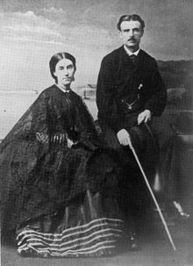
The Broomes Photo - in the Public Domain


Profile Image for Sally906.
1,460 reviews3 followers
June 8, 2011
Written in 1870, STATION LIFE IN NEW ZEALAND is a fascinating account of the time Lady Mary Anne Barker lived on a sheep station on the south island of New Zealand. It is just a series of letters that she wrote back to her family in England, starting with her arrival in MelbourneAustralia en route to Christchurch. It gives the reader a real insight into life as a settler in the 1860s, with all its highs and lows.

I gripped my chair in sympathy as she is careened at high speed along the highway by a drunken passenger coach driver. I chuckled at her first attempts at cooking and I cried with her when her naughty dog has to be put down and when she has to help dig dead lambs from a snowdrift after a huge blizzard. Mary Anne writes in a light-hearted style, and she vividly portrayed the lives of genteel sheep farmers (and the not so genteel) the weather and the beautiful scenery and wildlife.

Born in Jamaica, educated in England, her first husband Lord George Robert Barker was knighted for his role at the Siege of Lucknow in India. He died 8 months after receiving his title, however when Mary Anne arrived in New Zealand she was with her second husband, Frederick Broome. For her writing Mary Anne retained her Lady Barker title although later in life her second husband was knighted and she became Lady Broome. During her life Mary Anne lived in England, India, New Zealand, South Africa, Mauritius, Australia and Trinidad. A well travelled lady with some eighteen published works.

STATION LIFE IN NEW ZEALAND is considered the best of the settlers’ tales from the years of colonization of New Zealand, and is a classic of early New Zealand literature.
Profile Image for Erica.
472 reviews39 followers
August 29, 2025
Thoroughly enjoyed this epistolary story of Lady Barkers few years on a station in Canterbury, NZ. They certainly had some adventures, the ups and downs of colonial life. Felt like I got great insight into what it just have been like. A few anecdotes had me chuckling.
Profile Image for William.
8 reviews
December 13, 2013
Lady Barker provides a glimpse into 19th century colonial life in Canterbury, New Zealand. Her numerous excursions, adventures, and encounters with New Zealand's treacherous weather and wildlife are well covered which makes for an engaging read. I enjoyed how at some points Lady Barker is an extremely civilised and refined upper middle class English lady, then suddenly is roughing it with the gentlemen on a dangerous journey or showing astounding audacity.
Highly recommended to those interested in NZ history, particularly the Canterbury region.
Profile Image for Debbie.
828 reviews15 followers
July 21, 2018
This is a fascinating account of life in colonial New Zealand between 1865 and 1868. The author, Mary Anne Barker has written this as a series of letters back home to her sister in England, beginning with her arrival after the long sea voyage, landing firstly in Melbourne, Australia and shortly thereafter onto New Zealand.

Because she's writing for someone who has never set foot in New Zealand she provides fantastic descriptions of all the things that are new to her, such as flora, fauna and landscape, as well as entertaining observations on the differences between life in England and life in colonial New Zealand. These include the bold attitude of servants in New Zealand who do not seem to be as obsequious and deferential as their English counterparts.

For anyone with an interest in history or wanting to understand what life was like for their pioneering ancestors this is a great read, but Mary Anne Barker is such a good writer that even someone with no interest whatsoever in the subject matter would still find this an entertaining and enjoyable book.


148 reviews2 followers
June 29, 2018
This was a good, easy book written in an engaging style. The narrative is composed of letters sent by Lady Barker as she travelled to New Zealand and took up life with her husband on a station in Canterbury. It was nice to get a woman's perspective, as so much of what I read from early settler times in New Zealand comes from men. Lady Barker was of course a little more well off than the average immigrant so her perspective is coloured by that, though this does lead to a comical and endearing scene in which she tries her hand at baking and...it doesn't go so well.

She was also pretty adventurous and like a lot of women writers from past times she emphasises feminine fragility while taking on challenges that many modern-day people, male or female, might hesitate to confront. She bush-bashes, climbs hills, rescues sheep, and participates in burn-offs (the last maybe a little too enthusiastically).
Profile Image for Matt Vickers.
Author 1 book8 followers
April 7, 2009
A fantastic account of one brave woman's experience of travelling to New Zealand and making a life in Canterbury between 1866 and 1868. Through her letters back to England it details her home life and her vivid accounts of excursions into the surrounding countryside.

What I found fascinating was not so much her story, but the unwritten one: the constant charade her husband and other male companions would have had to have maintained in order to shelter this woman from the abyssal reality that surrounded her. Floods, starvation, getting lost, meeting lone strangers in the woods were all presented with a cheerful naivety, and maybe I see a darker cast to our history than is truly accurate, but she writes of herself facing the dangers of colonial life with such an admirable and tenacious spirit that it makes you wonder if she had any sense of mortality at all.
Profile Image for Marie Greaney.
176 reviews2 followers
March 10, 2023
I really enjoyed this book. It is a refreshing diary of an English woman who comes to NZ in the 1860s with her new husband who has already spent some years in the new “colony”. She comes with a sense of adventure and a can-do attitude which means that although she has a couple of servants, she fights fires and breeds chickens, fords frozen rivers and literally rolls up her sleeves, tucks in her skirts and relishes every new challenge. She writes with clarity and humour, and the book is a great look at Canterbury settler life of the time.
Profile Image for Isen.
274 reviews6 followers
June 4, 2018
Station Life in New Zealand is a collection of letters the Lady Barker wrote to London detailing her life on a Canterbury sheep station in the 1860s, although presumably there was some editing in between as some letters seem to foreshadow the future ones.

The style is pleasant and engaging. The author strikes a good balance of describing the landscape in enough detail to convey exactly how it looks, especially to someone familiar with New Zealand, without falling too deep into nature porn. It's main appeal would be to New Zealanders, as it is some of the earliest writing we have about daily life in the country, and it is amusing to draw comparisons with the present -- Nelson is described as picturesque yet dull, and the temperature in the houses is said to be more or less the same as outside. So much for 150 years of progress. A secondary appeal of this book is as a travel/adventure story, describing the perceptions of a wild and untamed land from the perspective of an Englishwoman. This is certainly present in the first few letters, but after she gets established into a boring, daily routine on the farm it gets a bit dull.

The heroine is interesting as it is the norm for authors of the period to portray Victorian women as daintly, fragile creatures serving only as window dressing and dispensers of morality, while modern authors writing about the nineteenth century tend to fall into the trap of painting strong, independent stereotypes into a setting where they just did not exist. Lady Barker's description of herself strikes closer to the truth: she does faint occasionally, but for good reason (once in this book, after dislocating her arm, as opposed to Emily's 10 swoons in Udolpho for barely any reason at all); she's not as courageous as her husband when it comes to feats of horsemanship or perilous journeys, but she recognises this as a weakness and tries to deal with it; she certainly does see herself as a guardian of morality, especially vis-a-vis the common people, but at the same time has a fairly realistic perception of what people are like and what drives them, rather than falling into the dualistic simplifications of the Christian worldview.

Overall a nice read for a New Zealander, probably not so much for anyone else.
Profile Image for Carol.
403 reviews10 followers
October 25, 2024
I have a methodical pattern to my reading where I follow an adult book with the enjoyment found in a child’s book. I had just finished a Harlequin that was set in New Zealand. I remembered I had bought this book. Perfect segue, I thought. You see, I had found this book in the children’s section but that was due to the childlike cover of my version and not its content. I considered choosing another but I am glad that I did not.

This is a true story of life on a sheep station as told through letters written by Mary Anne Barker, otherwise known as Lady Barker, to her sister in England. Mary was married to George Robert Barker who was knighted for his military service in India.
Lady Barker writes affectionately, descriptively, and sometimes humorously about her life during the early colonial days of New Zealand. Although her and her husband were only in New Zealand for three years, they came to love the kindness of the people, the beauty and the challenges of the land along with the demands and heartbreak of the work.

In keeping with the theme, afterward there was a movie playing in the theatre that took place in New Zealand. I was elated to experience the vast wilderness and the steep terrain, all with the comforts of home.
Profile Image for Kris Dersch.
2,371 reviews25 followers
July 1, 2022
I like this. Yes, it's old writing and there are for sure places where it is problematic...in descriptions of the Maori people and in the environmental degradation, ugh. So it's old. But it's super interesting, love her descriptions of the outdoors and outdoor adventures.
I found the scene where her (SPOILERS) baby dies very strange...she doesn't seem to have a reaction to that that a human would have. I feel like that is an indication that her experience is heavily filtered for publication. But overall I found it interesting.
This entire review has been hidden because of spoilers.
Profile Image for Kirsten Edwards.
69 reviews3 followers
November 14, 2023
This book is a very well-known New Zealand classic, originally published in 1870. Lady Barker came from England with her husband to manage a sheep station in Canterbury for three years. The account is written in the form of letters back to her sister in England. Lady Barker is a fascinating woman and much has been written about her. You can read her biography here and more about her here.

For a full review with photos please visit here:
https://livingpublications.wixsite.co...
Profile Image for Caitlyn.
75 reviews28 followers
November 2, 2024
A splendid adventure into a land that holds a large part of my heart. I am quite impressed with the author.
50 reviews7 followers
September 25, 2014
I picked this book up because it was referred to in an economic history text. Of course, when you go into reading personal letters expecting insights on settler societies - you might be a bit disappointed.

There is a lot humor in Lady Barker's writings but the overall tone seems withdrawn - a characteristic of the words of the colonized. A bit of scoffery is evident as well - for example when she notes that you need to tell "how" things are done in New Zealand- ordering something to be done like she did in England is not enough. Apart from the hardships of terrain, economy and the trouble with natives, such were the inconveniences of life in New Zealand.

But overall Lady Barker provides a humane and compassionate record of the society of the colonies. I think this is a work of importance for any postcolonial study.
Profile Image for Randall.
63 reviews
April 16, 2012
Written as letters to her sister, Lady Barker's very specific point of view filters her experiences in New Zealand only 16 years after the colony was established. She mostly relates the day-to-day of her home life on a sheep farm devastated by a hard winter, travels around the countryside on horseback and carriage, and visits with the locals, and only spares 2 sentences on the birth and death of a child. Her privilege is made tolerable by her wit and honest perspective. My favorite passage was about the poor state of society and balls in hillbilly towns. I just picked up her next book "Station Amusements in New Zealand."
Profile Image for Jake Goretzki.
752 reviews156 followers
January 13, 2013
I picked this up in a Virago edition from the 80s.

A light but charming little social document for the NZ-lit fan, with no shortage of literary merit (the vocabulary is apparently authentic and her descriptions of nature are really rather good).

I was only disappointed that she didn't actually end up staying in New Zealand - as I had her down pretty quickly as a sort of proto-feminist, proto-Kiwi. She's often pretty amusing (and much more spirited than her husband). She's less uptight than the stiffs she'd be writing home to; she's outdoorsy and have-a-go. Surely, there's an emerging national archetype in there for the grabbing.

Profile Image for Phyllis Leigh.
33 reviews
August 4, 2016
True. Letters home. Lady Barker spent 3 years with her husband on a station in the South Island. Some lady! Went places and did things few of us would have been brave enough to try. Fascinating look at what pioneering life was like back in the 1860s. Sounds like (according to her - maybe in comparison with London at that time?) they were a pretty healthy lot, although childhood mortality was pretty high. She had a child and lost it to some childhood illness but doesn't dwell on it. Worth reading if you have any interest in history at all!
Profile Image for Connie.
116 reviews18 followers
March 12, 2013
Little did I know when I picked this interesting book up at a book sale that I would embark on a trip to New Zealand that basically covered the same places lady Barker traveled, but over 100 years before. I read the book while I was traveling in New Zealand, and what a fun perspective on what her life must have been like! It is also a love story, and adventure story, and a study in perseverance, to survive in the wilds of New Zealand at that time in history.
Profile Image for Marty.
50 reviews
February 24, 2015
Letters home to England by a woman journalist who, with her husband, spent three years raising sheep on a station in New Zealand and traveling to see the country. The station was not a success due to an epic blizzard that killed most of the sheep and an epic rainy season that cut the station road, making it nearly impossible to provision. The author took particular joy from mingling with settlers of all social classes and the spectacular landscape.
This entire review has been hidden because of spoilers.
Profile Image for Nancy Lewis.
1,689 reviews58 followers
December 3, 2011
The author tells of her three-year stay on a New Zealand sheep farm. She leaves NZ loving it, in spite of all the trials she faced there, including nearly starving to death after being snowed in by a horrible blizzard. Sadly, the sheep were not all as lucky as she.
Profile Image for Meghan.
232 reviews
December 29, 2013
Fascinating letters from a British colonial lady to her sister about tending sheep stations in New Zealand between 1865 and 1868. All the more interesting after reading The Luminaries, which is set in 1866 in one of the gold rush port towns she mentions in her journey.
Profile Image for Sue Webber.
208 reviews
June 24, 2015
A very interesting book, I would have liked to have read a little more about the actual sheep station operations. However her very descriptive writing gave a vivid and clear insight of life in New Zealand in it's infancy.
Profile Image for Eloise.
30 reviews
June 23, 2010
I reread this after rereading Green Dolphin Street because its author actually traveled to New Zealand and its the same time period.
Profile Image for Gretchen.
88 reviews
September 21, 2011
I enjoyed the authors voice, she seems so willing, able, active. It is jarring to see her photograph, in the dress of the time, with corsets and all.
Profile Image for Mandy.
3,652 reviews336 followers
November 15, 2012
Good fun to read, very evocative and all told with a light touch.
Profile Image for James.
256 reviews3 followers
April 2, 2013
Interesting look into the life of a well-to-do English lady during her three years on a New Zealand sheep station. (Must enter info concerning the hardcover copy edition I have.)
Displaying 1 - 30 of 34 reviews

Can't find what you're looking for?

Get help and learn more about the design.