Jump to ratings and reviews
Rate this book

Dedalus Books of Decadence #1

The Dedalus Book of Decadence Moral Ruins

Rate this book
The Dedalus Book of Decadence looks south to sample the essence of fine French decadent writing. It succeeds in delivering a range of writers either searching vigorously for the thrill of a healthy crime or lamenting their impuissance from a sickly stupor. Andrew St George in The Independent "An invaluable sampler of spleen, everything from Baudelaire and Rimbaud to Dowson and Flecker. Let's hear it for 'luxe, calme et volupte'." Anne Billson in Time Out

292 pages, Kindle Edition

First published January 1, 1990

10 people are currently reading
399 people want to read

About the author

Brian M. Stableford

883 books135 followers
Brian Michael Stableford was a British science fiction writer who published more than 70 novels. His earlier books were published under the name Brian M. Stableford, but more recent ones have dropped the middle initial and appeared under the name Brian Stableford. He also used the pseudonym Brian Craig for a couple of very early works, and again for a few more recent works. The pseudonym derives from the first names of himself and of a school friend from the 1960s, Craig A. Mackintosh, with whom he jointly published some very early work.

Ratings & Reviews

What do you think?
Rate this book

Friends & Following

Create a free account to discover what your friends think of this book!

Community Reviews

5 stars
28 (40%)
4 stars
28 (40%)
3 stars
10 (14%)
2 stars
3 (4%)
1 star
0 (0%)
Displaying 1 - 11 of 11 reviews
Profile Image for Glenn Russell.
1,520 reviews13.3k followers
July 20, 2021


The late 19th century literary movement known as Decadence received inspiration from Parisian poet and essayist Charles Baudelaire (1821-1867).

For anyone interested in the late 19th century literary movement known as Decadence, centered in Paris and then spreading overseas, this brief collection of 36 short stories and poems from France: Baudelaire, Lorrain, Verlaine, Rachilde, Rimbaud, de Groumont, Mendès and England: Wilde, Beardsley, Swinburne, Dowson, Lee-Hamilton, Gilchrist, Johnson, Stenbock, Davidson, Flecker, Lee can be read in the course of a week. Also, Brian Stapleford provides a most informative and engaging 80-page introduction covering the cultural, social and historical framework of the movement along with key themes and ideas of its leading proponents.

More specifically, from Brian’s Introduction, we read: “The ideal type of the Decadent personality is an artist who rejoices in his power to analyze and display his own curious situation; life itself must become for him a kind of art work.” And again, “If the flame of his ashen spirit is to be reignited he must have recourse to new and more dangerous sensations; the essentially artificial paradises of the imagination. He is likely to seek such artificial paradises by means of drugs – particularly opium and hashish, but also absinthe and ether – but he remains well aware that the greatest artifice of all is, of course, Art itself.”

Some of the Decadent writers were over-the-top mad, bad and dangerous, some lived socially respectable lives, but all of these Decadents luxuriated in lavish, rich, sensual language and followed German philosopher Arthur Schopenhauer in cultivating heightened sensitivity and refined aesthetic tastes as a way of transcending the narrow-mindedness and conventional values of the common mass of humanity. For a small slice of this creamy Decadent cake, here are three poems along with my comments on two short stories from the collection, two stories, that is, by Catulle Mendès, one of my very favorite authors of all times.

Spleen (beginning section) – Charles Baudelaire

Had I lived a thousand years I could not remember more.
An enormous chest of drawers could not hold in store,
Despite that it be crammed with love-letters, verses, tales,
Hanks of hair and records of obsolete entails,
More secrets than I harbor in my wretched mind.
It is a pyramid, a space by stone confined,
Where the bodies of the dead are vilely pressed.
-I am a cemetery by the moon unblessed
Where graveworms carry the slime of dim remorses
Relentlessly into the heart of cherished corpses.

Old Furniture – Catulle Mendès
After a particularly vigorous round of lovemaking during their secret rendezvous, beautiful, fair-skinned, rosy-cheeked, petite Roberta chides her lover, “Look at that! I ask you what will they think of me when they see it tomorrow, with the mattress in that state and everything else you have managed to do? This is a respectable hotel! It must be said, sir, that your treatment of me has been singularly brutal.”

After the couple takes time out to repair the bed to her satisfaction, they begin round two of their lovemaking on a chaise lounge. Darn! Same result: similar to the bed, the broken chaise lounge looks as if it witnessed a bout of modern-day ultimate, extreme cage-fighting . Again, rosy-cheeked Roberta fumes. And again the couple takes time out to repair the damage. What happens next might lead a reader to suspect fair, petite Roberta had a more active role in breaking the furniture than she would like to admit, even to herself.

The Black Nightgown – Catulle Mendès
Ever the true aesthete, Fabrice stretches out on a couch in his morning-coat and Turkish slippers awaiting the return of the ever-faithful love of his life, Geneviève. The chambermaid walks in with the laundry and sets the basket down on a table next to Fabrice. Fabrice’s highly refined eyes cast a glance at Genevieve’s clean clothing and he reflects: “That nightgown of Indian muslin, so nearly transparent, with the short sleeves and the trimmings of Valencienne – wasn’t that the one which he had seen sliding down from her lovely shoulders to reveal the length of her perfectly svelte and perfectly smooth young body, on that evening when, for the first time, Geneviève had surrendered her maidenly virtue?

He remembered the rapt feeling inspired in him by the sight of her rounded, rose-tipped breasts, and the way he had hesitated before enfolding her in his arms, fearful of sacrificing in the intimacy of their kisses the delightful sight of her.” But then crisis. Fabrice catches sight of a unrecognized black nightgown. Ahh! Clear evidence of Genevieve’s betrayal!

When Geneviève finally returns, Fabrice is in a fury. He confronts her with the evidence: “I must congratulate you on your exquisite taste, Madame, what a fine contrast the blackness of the material must make with the delicate whiteness of your sinful flesh! Clad in silk so dark, you might seem to be a flake of snow which falls in the dark night, or the feather of a turtle dove between a raven’s wings. Miserable wretch! I wish I could put a bullet or a swordpoint into each of your white-rimmed eyes! Let us have it, if you please – your explanation!”

You will have to read the story to find out what happens next but let me simply note how these Decadents understood quite well that in matters of passion and emotion men are the amateurs and women are the pros.

Spleen – Paul Verlaine

The roses were so very red.
And the ivy so intensely black.

My love, you have only to turn your head
And all my hopelessness floods back!

The vault of the sky was so deeply blue,
The sea so green and the air so mild.

I fear and hope to win from you
A curse that I might be defiled.

Of the gloss upon the holly leaf,
And the sunlit bush I can take no more.

Through all my far-flung fields of grief,
Your memory has passed before.

Theoretikos - Oscar Wilde

The mighty empire hath but feet of clay:
Of all its ancient chivalry and might
Our little island is forsaken quite:
Some enemy hath stolen its crown of bay,
And from its hills that voice hath passed away
Which spake of Freedom: O come out of it,
Come out of it, my Soul, thou art not fit
For this vile traffic-house, where day by day
Wisdom and reverence are sold at mart,
And the rude people rage with ignorant cries
Against a heritage of centuries.
It mars my calm: wherefore in dreams of Art
And loftiest culture I would stand apart,
Neither for God, nor for his enemies.


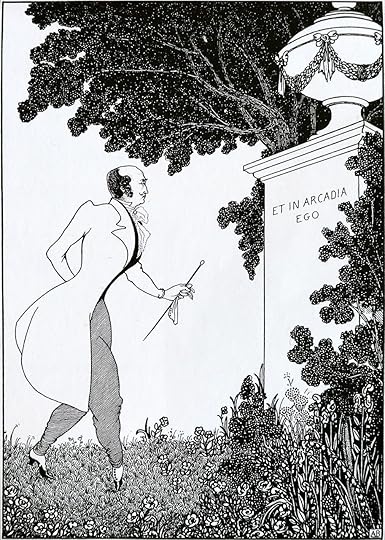
Illustration by one of the key artists of the Decadent movement - Aubrey Beardsley
Profile Image for Nate D.
1,662 reviews1,258 followers
November 3, 2012
More Dedalus excellence. Contents:

Introduction :: Brian Stableford's concise but semi-exhaustive prologue to the Decadent movement worldwide, though with focus on the French 1880s and English 1890s which were apparently foremost and so collected in this volume. I wouldn't generally have wanted to read 80 pages of nonfiction to reach the first of the actual stories, yet this was totally useful and interesting. Arthur Rimbaud, in particular, seems to have lead a pretty bizarre and compelling life. I guess his entire output dates from his teen-delinquent times, ages 17 to 20 or so, before he renounced literature and became a gun-runner in the far East, seeking more immediate adventure. (tell me more)

"To the Reader" (Charles Baudelaire) :: I'm not a great fan of Baudelaire, but he always has an entertaining extravagance, as on display in this invitation/insinuation/condemnation to his readers.

"The Glass of Blood" (Jean Lorain) :: Origins of the amazing sensualized abattoir scene in Jean Rollin's Fascination? Quite possibly. Also the first of several recurring lady-at-the-window scenes.

"Languor" (Paul Verlaine) :: standard morbid decadent poetics.

"The Grape-Gatherers of Sodom" (Rachilde) :: Quick and vicious, the beginnings of a fall are charted. Rachilde, born Marguerite Vallette-Eymery, was a prominent and prolific female decadent, which casts the "fallen" women here in a somewhat different light from that of the typical decadent story. It seems like it could be the men who cast their women out (under rather ambiguous circumstances), rather than the maligned women, who bring eventual destruction upon their city.

"After the Deluge" (Arthur Rimbaud) :: Here, at last, a decadent poem I truly love. Is all Rimbaud this good, this image-glimmered and fantastic, like a hallucinatory fairy-tale? The same bit is referenced, with good reason, by book titles both Marie Redonnet and Gilbert Sorrentino.
Madame X set up a piano in the alps. Church services and first communions were celebrated at the hundred thousand altars of the cathedral. Caravans departed. And the Hotel Splendide was built out of the chaos of ice and polar darkness.

Incidentally, also, this is by far the finest translation of this poem I've seen, out of several others kicking about online. Editor/translator Brian Stableford seems pretty top-notch all around.

"Danaette" (Remy de Gourmont) :: A young women reflects with boredom on a coming tryst, but is overtaken by the fascination of the snows outside her window, spirited away into dream. The most glidingly poetic (and actually rather restrained) example so far:
Ever and anon the snow fell, penetrating so profoundly into the depths of her enraptured being, that she had no room in her for any other sensation than that of dying of the cold, and being buried beneath the adorable kisses of the snow, and being embalmed by the snow - and at last of being taken up and away by the snow, carried aloft by a wayward breath of of turbulent wind, into some distant region of eternal snows, over infinite ranges of fabulous mountains...where all the dear little adulteresses, eternally beloved, were endlessly enraptured by the impatient and imperious caresses of the angels of perversity.

"Litany to Satan" (Charles Baudelaire) :: A sort of adorable parodically-liturgical invocation of the devil, ending in a prayer. It's a more playful (okay, morbidly-playful) Baudelaire than I'm used to, rather more endearing than his usual manner.

"The Black Nightgown" (Catulle Mendes) :: A sort of middling example. My love is undyingly faithful! Or is she? Or is she? Or is she? It's not all that interesting, really, but the writing and translation are crisp, anyway, which seems largely the case here.

"The Double Room" (Charles Baudelaire) :: In this progression of Baudelaires, the finest encountered yet, a prose account of altered perception and demeanor as laudanum withdrawal sets in. Nice ends for his florid description in a parallel structure viewing the same living space twice. And who doesn't love antiquated addictions?

"The Possessed" (Jean Lorain) :: A kind of paranoid monologue on not being able to board the tram because the faces of the other passengers have begun to seem unspeakably repulsive, unnatural, and animal-like. it's kind of timeless actually, it reminds me of descriptions I've heard of watching television on acid, and getting freaked out by Gary Busey's face or whatever (though, granted, who isn't freaked out by Gary Busey's face?)
Sitting between two others of the same kind, right in front of me, there was a cigarette-smoking hag with a long, mottled neck like a stork's, and hard, widely-spaced teeth set in a mouth that gaped like the mouth of a fish. The pupils of her staring,startled eyes were extraordinarily dilated. That foolish women seemed to me to be the archtype of an entire species, and as I looked at her, an unreasoning dread took hold of me that if she should open her mouth to speak, no human language would emerge, but only the clucking and cackling of a hen. I knew she was a creature from the poultry-yard, and I was seized by a great sorrow and an infinite grief that a human being might degenerate so. To cap it all, she wore a hat of purple velvet, secured by a cameo broach. I had to get off!


"Spleen" (Paul Verlaine) :: All the decadent poets had to write a poem called "Spleen". At least one, maybe about six if they were Baudelaire. Here's Verlaine's, a seething obsessing on a lost love. Notably opens with
The roses were so very red,
And the ivy so intensely black.
My love you have only to turn your head
And all my hopelessness floods back.
which seems either great or terrible depending on how ridiculous you find it that this tired old love-poem form was apparently already old and familiar enough for Verlaine to be messing with it here. Or how willing you are to take this in a seemingly serious poem. Or how willing you are to take any of this stuff seriously. I don't, really; I find this amusing but essentially trivial.

"The Faun" (Remy de Gourmont) :: The recurring erotic satyr, soon to turn up to even weirder effect across the channel in Arthur Machen's The Great God Pan. I'm not sure exactly what folkloric tradition produced this stuff, but the Faun seems to be a representation of a kind of self-disgust/thrill at the pleasure-seeking drive. Not especially stand-out.

"The Drunken Boat" (Arthur Rimbaud) :: Tumultuous hedonism as ocean-travel, the vicissitudes, etc. It's good though. What I've learned, and this is important, is that Rimbaud is by far the best of the big decadent poets, more fun, with bolder imagery, a kind of fantastic narrative sense. I should really read a full collection of his poetry, something I would never expect I'd want to do normally.

"The Leopard" (Rachilde) :: A story to be read aloud, before an audience, supposedly, so I did, to M on the subway last night. Like the circus crowds presented here, we were expecting something exciting, instead, this gets flipped back on us -- our fellow audience is made up of blood-thirsty brutes and we separate in regret to follow the tragedy of this innocent animal. Then the whole is wrapped up in a snappy ending. This is a good one. I especially like the audience-baiting, of course.

"Spleen" (Charles Baudelaire) :: And one of Baudelaire's Spleens, a lamentation of life being all but past and stuffed with regrets. I intend to do a comparison proving that Baudelaire is way more readable and good in Brian Stableford's translation, so I typed this one in, to be paired with the version in M's archaic-voiced Fleurs du Mal later. Stableford's:
Had I lived a thousand years I could not remember more.

An enormous chest of drawers could not hold in store,
Despite that it be crammed with love-letters, verses, tales,
Hanks of hair and records of obsolete entails,
More secrets than I harbour in my wretched mind.
It is a pyramid, a space by stone confined,
Where the bodies of the dead are vilely pressed.
- I am a cemetery by the moon unblessed
Where graveworms carry the slime of dim remorses
Relentlessly into the heart of cherished corpses.
I am an ancient bedroom decked with faded blooms,
Scattered with outdated gowns and tattered plumes,
Where only faded prints and painted faces,
Remain to breath the perfumed air and graces.

Nothing is as tedious as the limping days,
When snowdrifts yearly cover all the ways,
And ennui, sour fruit of incurious gloom,
Assumes control of fate's immortal loom.
- Henceforth, my living flesh, thou art no more,
Than a shroud of unease about a stony core,
Listlessly sunk beneath the desert sand;
A sphinx forgotten by the innocent and bland,
Banished from the map that she might gaze
Silently upon the setting sun's last rays.


"Old Furniture" (Catulle Mendes) :: None of these are without their entertainment, I find, and even the really trivial ones, as here, have a good sense of not overstaying their welcome.

"Don Juan in Hell" (Charles Baudelaire) :: More Baudelaire, better than I would have expected, still would have gladly swapped him for more Rimbaud.

"Don Juan's Secret" (Remy de Gourmont) :: An ambiguous fable wherein Don Juan steals pieces of all he seduces, only to have even more taken back from him in the end. Gourmont is two for three on these, I should see what else he's written.

From here, we delve into the so-called British decadents, though most of their section of the historical introduction is actually spent explaining why they weren't really decadent (too idealist, too pressed by late-Victorian morality to really bask in degeneration and decay. Perhaps because of this, they seem mostly to operate in more of a modified fairy tale vein -- a protective unreality to their prodding at the conventions of their time. Whether decadent or not, and while often obviously less revolutionary than their French forebears, this still introduces a strong set of interesting writers. I'm gonna skip over discussion of the poems, but here are the stories:

"The Court of Venus" (Aubrey Beardsley, 1897)
Mythic opulence from an unfinished novel by the great artist and illustrator. There's an enjoyable sumptuousness to the whole slew of feasting and pleasures here, but it's also kind of overwhelmingly empty, at least outside of its novel-context. Does that make it arguably more decadent?

"The Dying of Francis Donne" (Ernest Dowson) :: Stableford's somehwat self-undermining introduction noted that Dowson was more depressive than decadent. So it is in this description of final decline.

"The Basilisk" (R. Murray Gilchrist) :: A macabre myth of pleasure lost and won and lost. Excels mostly in its baroque hypervividness, perhaps, but that is quite enough.

"The Other Side" (Count Stanislaus Ernest Stenbock) :: Another in the the quasi-fairy-tale vein, again underscoring (forbidden) desire in mythic terms, here those of lycanthropy. It resolves somewhat over-conventionally, but the preceeding is really what matters here. I thin I was falling asleep on the train when I read it, so my memory is a little unfairly hazy on the precise detials, which were much sharper drawn than that suggests. Another highlight, and I should really re-read it.

"A Somewhat Surprising Chapter" (John Davidson) :: Beyond the understatement of the chapter title, this bit of Davidson's The Wonderful Mission of Earl Lavender is a pretty ridiculous romp through a mores-breaking subterranean secret society. The Earl's mission seems to have been deciding that he was the perfect product of natural selection via some half-understood and half-baked darwinism, which probably wasn't so far fetched for the time, really. I'd be curious to read more of this.

"Pope Jacynth" (Vernon Lee) :: Another in the vein of a fable, here a Job-esque wager between god and devil. Not one of the most memorable.

"The Nightengale and the Rose" (Oscar Wilde) :: Perfecting the fairy-tale style and form to lavish cynic/romantic ends. I obviously need to read more Wilde, who this is really my first brush with besides some interest in his life and a few quotations in Too Much Flesh and Jabez.

"The Last Generation" (James Elroy Flecker, 1908) :: post-industrial anti-progress angst in the cautionary vein of Wells' already decadent-riffing The Time Machine, succinctly rendering an elaborate and vivid total collapse of civilization in 20 pages. A highlight, even if outside decadence (too late, clearly addressing social ills) by any definition. (Which I can't say bothers me. Hysterical reformist Edwardian sci-fi is fine with me as well.
"For centuries and centuries we endured the March of Civilization which now, by the weapons of her own making, we have set out to destroy. We, men of Birmingham, dwellers in this hideous town unvisited by sun or moon, long endured to be told that we were in the van of progress, leading Humanity year by year along her glorious path. And, looking around them, the wise men saw the progress of civilization, and what was it? What did it mean? Less country, fewer savages, deeper miseries, more millionaires, and more museums. So today we march on London."

Profile Image for Eadweard.
604 reviews520 followers
May 17, 2016
Read this for the british samples since I had read most of the french ones already (I read them again anyway).

I love Remy de Gourmont's Danaette and The Faun, two of my favorite short stories ever.

I hadn't read Rachilde before, nice to finally come across a female decadent, I enjoyed her two stories.

Baudelaire, Rimbaud, Lorrain, Mendes... good stuff.


Probably because of "victorian prudeness" (a sham), most of the british works were less of a 'decadent' nature and more "fairy tale-like / fantastical". My favorite one was Aubrey Beardsley's The Court of Venus; as a fan of his art, I had no idea he also wrote, shame on me.
Profile Image for Kezia.
223 reviews37 followers
December 23, 2019
Many selections here are excerpts, and I should pay more attention to that before buying a book (and publishers should be more clear). Compounding my annoyance is that Stableford's introduction reads like a high school essay for an interdisciplinary humanities class. On top of that, why do editors who write introductions to Decadent fiction seem to hate the movement? Oh, except Baudelaire: if you don't worship Baudelaire, you can't call yourself an intellectual.

This edition is riddled with typos and even a few layout errors.
Profile Image for Michael Samerdyke.
Author 63 books21 followers
April 8, 2024
A three-and-a-half star if possible.

I really enjoyed the Dedalus Book of Russian Decadence. That was one of my favorite books of last year. I did not especially enjoy "Moral Ruins."

There was a lot of poetry in this book, and it mostly left me cold. Both the poetry and the prose seemed super-heavy on description with very (very) little forward motion on plot. Judging from this book, the Decadents were into description and had very little interest in story.

However, there were six stories I liked. From the French, "The Grape-Gatherers of Sodom" and "The Panther" by Rachilde struck a satisfying balance between lush description and action. "Old Furniture" by Catulle Mendes seemed like an elegant dirty joke. From the English, "The Basilisk" by R. Murray Gilchrist was haunting & doom-laden. Oscar Wilde's "The Nightingale and the Rose" was elegantly told and bitterly ironic. The best English story, however, was "The Other Side" by Count Stanislaus Eric Stenbock, which is an outstanding werewolf story. It is so much better than Stenbock's boring and obvious vampire story that I can't believe I'm only reading the werewolf story for the first time. Why wasn't it reprinted sooner?
Profile Image for Kelly Lemieux.
Author 16 books7 followers
April 21, 2022
I have just finished reading volume one of editor Brian Stableford's Decadence study, which includes the editor's essays, and short stories and poetry of various contributors from the Turn-of-the-Century (1900 a.d.) arts and literatures movement. I am bowled over by this amazing school of thought that I first encountered in 1981 as a young gay library visitor, and was emotionally moved at times by the texts, something that usually happens with high stories, not genre productions. So, these tomes are in-between those two zones, like discussions of apathy and perversity and (this lit is called Aestheticism in the U.K.) all the rest, leading to Ben Hecht and The Wizard of Oz.
Profile Image for reveurdart.
687 reviews
August 27, 2018
Brilliant selections and a solid introduction. Brian Stableford is a treasure to us Decadent readers. I ended up re-reading certain stories while I was reading this collection, so I'm very much looking forward to reading through the rest of Dedalus' backlist.
"...Paris, the one and only true home of all true Decadents."
Overall, the translations were excellent. I have great admiration for the female decadent author, Rachilde, and hers really shine here. It's always interesting to see how something translates into another language.
Profile Image for Blake.
7 reviews
February 20, 2023
A book about decadence that doesn't like or enjoy decadence.
Boring. How the hell do you make about decadence boring?
Bloodless.
Displaying 1 - 11 of 11 reviews

Can't find what you're looking for?

Get help and learn more about the design.