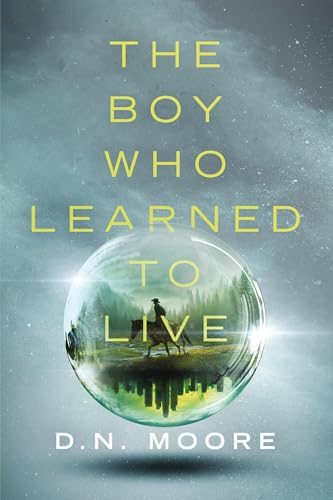
Seventeen-year-old Oliver Mc’Neil has never been outside. Like everyone else in the Fifth City in the year 2085, he and his mother live in an apartment where the air and water are sterile, their food is couriered to them, and all their activities—work, school, exercise, entertainment—are done indoors on sims, machines that simulate life using computer monitors, virtual reality headsets, and holograms.
When Oliver wakes up in the middle of the woods drugged and delirious, he has no idea how he got there, but he is certain it is a death sentence. He is taken in by the rugged and beautiful Autumn, whose family is loud, rambunctious, and three children over the legal birth limit. They are outlaws, living with thousands of others in a network of underground caves, where modern technology is forbidden and secrecy is paramount. Oliver must learn to survive in a land that is wild and dangerous, while battling voices in his head that haunt him day and night. He doesn’t know if the hallucinations are due to withdrawals from the mind-numbing medication he has taken every day of his life, or if he truly is the monster he appears to be. One thing he is certain of: he will do whatever it takes to protect Autumn, the girl who saved his life.
Cave sentries begin to go missing, leading to a series of disasters and growing suspicion about Oliver's appearance in the caves. Now his choices will either save or endanger his friends. Will he ever be able to trust himself in this strange new life?
D.N. Moore was born in Vancouver, British Columbia, and now lives in Florida with her family. Formerly a teacher, it is her passion to cultivate a love of reading in children – in her students, her own children, and now her readers.
“I greatly admire the vivid imagination that most children have, and I believe that books are the key to unlocking that,” says Moore. “Some of my fondest memories are of teaching a child to read and watching them fall in love with a good story, so much that they forget that they are even in a classroom. I hope to create the same effect with my own books.” Moore writes for Young Adults.
Moore spent a lot of time traveling throughout Canada as a child, as her mother was driven by wanderlust, and she was exposed to a wide variety of settings. From the snow-capped Rockies and the lazy rivers of the Okanagan to the historic cathedrals of Montreal, Moore was immersed in the beauty and cultural diversity of Canada. She brings all of this to life in her books.
“I have been inspired by so many authors over the years, I’ve lost count,” says Moore. “It began with Avi, C.S. Lewis, L.M. Montgomery, Roald Dahl and Tolkien. In High School, I devoured Ayn Rand, George Orwell, Ray Bradbury, Louis L’Amour, and many classics like Jane Austen, Dickens, Bronte and Shakespeare. Every book has been a treasure to me, something that has shaped me into the person I am today, and I am eternally grateful to those men and women who took the time to craft such beautiful and timeless stories. This is one of the reasons I write.”
Moore’s writing has been described as “lyrical” and "chilling." She was awarded Silver Honorable Mention by the Writers of the Future for her short story “The Blandford Fly” in 2019.
This YA dystopian novel transports readers into a future where only 10 cities remain, surrounded by vast wilderness. Life inside these cities is strictly controlled—everything from the air to the food is regulated, and inhabitants spend most of their lives in their apartments, relying on virtual simulations to experience the outside world.
The story follows 17-year-old Oliver, who is used to life in the 5th city. His routine is shattered when he wakes up in a forest, disoriented and drugged, only to be rescued by a group of mysterious cave dwellers. As he regains his clarity, Oliver begins to adapt to this hidden community that seems to hold secrets about his life—and the world he thought he knew.
While the book has some gripping moments, it often leans more toward intriguing concepts than deep exploration. Ideas like dehumanization, control, and eugenics make for a promising backdrop, but they aren’t fully unpacked and often are introduced very abruptly, which may leave older readers wanting more depth. However, younger readers—especially those transitioning from middle-grade to YA—might find the book’s pacing and ideas engaging without feeling overwhelmed.
The characters, though occasionally prone to delivering lines that seem out of character for the sake of sounding profound, still offer moments of connection. Oliver’s journey from confusion to self-discovery in a world that is more than it seems makes for an interesting story, even if some parts feel a bit underdeveloped.
Oliver Mc’Neil lives in a high tech society where everything is experienced indoors through computer simulated “sims” ever since the outdoors was deemed too dangerous. What happens when Oliver, completely disoriented, wakes up in the middle of the woods with no idea how he got there?
This was a quick and interesting dystopian read! I didn’t feel like the city’s world building was fleshed out so much, but I don’t really think that was the point of the story. Seeing Oliver experience so many things first hand and seeing him well and truly live for the first time and trust himself was heartwarming.
Without giving anything away, the glimpses we did get of the dystopian city had me so intrigued and I thought they were woven into the story really well.
I’d give this a solid 4 stars! This was a great concept that was well executed. Thank you to NetGalley for an advanced copy in exchange for an honest review!
In this compelling YA dystopian novel, readers will find themselves drawn into a world that echoes the intense survival themes of The 100.
The pacing is fast. Each chapter propels the story forward, ensuring that there’s never a dull moment. Character development stands out as one of the novel’s strengths.
The Boy Who Learned to Live by D.N. Moore is a gripping, thought-provoking dystopian thriller that pulls you in from the very first page. Set in a chillingly believable future, the story masterfully explores what it means to truly live rather than merely exist. Oliver Mc’Neil is a compelling, emotionally complex protagonist, and his sudden plunge from a sterile, controlled city into a raw, dangerous wilderness is both terrifying and transformative.
Moore skillfully blends survival, psychological tension, and moral dilemmas, keeping the suspense high while delving deep into Oliver’s fractured mind. The contrast between the cold Fifth City and the vibrant, outlaw cave community is vivid and immersive, making every scene feel urgent and real. Autumn is a standout character, bringing warmth and strength to the story. With echoes of The Giver and The Maze Runner, this novel delivers originality, heart, and intensity. A powerful, unforgettable read that lingers long after the final page.
This YA dystopian novel was fantastic…IF there are plans for it to be a series.
This story is about a future where it seems everyone is afraid of the outside world and of illness and disease. The government has its citizens convinced it is better to stay inside and interaction with the world is done via a virtual simulation. Our main character, Oliver, somehow finds himself outside and taken in by a group of people who have deflected and live outside the city limits sans technology. The writing is easy to read and flows seamlessly, the characters are memorable and relatable, the plot is exciting and engaging.
This is definitely on the younger side of YA, which is not bad. I did have an issue with the fact that one of the characters falls in love after a matter of months, especially with this being a YA/Middle Grade book but that isn’t something new. There were a lot of holes, but that isn’t necessarily a problem if this is intended to be a series which I think it is. In fact, I hope it is a series, because this has so much potential!
I definitely recommend this to those who like younger YA books. At just over 200 pages, this book flew by. Bonus, the cover is awesome. It is YA, so if you go into this expecting literary fiction or adult science fiction, you will be disappointed. But, for what it is, it’s wonderful and I really enjoyed it. I will be purchasing this for my kids. ***Thank you NetGalley, Avonlea Publishing, and D.N. Moore for an advanced copy in exchange for an honest review.***
The year is 2085. He and his mother live in an apartment. Food and water are delivered to the door. The outside world is not good to live in. One day he mysteriously wakes up in a forest. He is drugged. He knows that this is not for good. His life is different. He has to survive. This sci fi novel gave me a roller coaster ride kind of feel. I loved this type of page turners. Overall very good story. The world building could have been better.
I love dystopian books so I was really excited to read this one, and it did not disappoint! Really easy to read and I was very invested in everything happening. I loved all the characters, and specially loved Oliver’s growth. I definitely recommend this one!
It's an interesting concept. Zoomed into the future, how will people act? Technology? Family?
It's told from the perspective of a young boy as he goes on an adventure. There's an interesting setting, set way in the future and people are confined indoors and prescribed food and nutrition, tailored to them.
I like how many characters there are and how the characters have well-developed relationships and social structure.
It is a book for children. I would estimate that the intended age would be 12-15 years old.
There are some things I didn't love. The scene where Oliver is bitten by the bear doesn't have a realistic timeline. He's injured, he's rushed to medical. Then it's infected? But wouldn't that take time? You wouldn't get an injury and then it's immediately infected. You would clean the wound, maybe worry about the risk of infection. It isn't clear how much time has passed and there isn't a lot of detail given about the injury (possibly because it's a children's book) but it needs more details with regards to timeline.
Oliver's recovery from his "surgery" was laughably quick for anyone who has ever had anaesthetic. Several minutes after unhygienic brain surgery, he's running away from police?
The ending felt disjointed and unrealistic. It felt very stereotypical that Oliver - who had never swum before in his life - could spontaneously save his love interest from drowning. Also, why did they get in the water during a lightning storm? Wouldn't they get electrocuted?
Overall, it's an engaging read. It's not a literary masterpiece, but it's a fun piece of escapism.
Thank you to Netgalley for an advance copy of this e book.
This entire review has been hidden because of spoilers.
Ok so this is going to be a bit of an out there review. I received this book as an ARC from Netgalley (many thanks) and it really gave me a lot to think about, but I sort of spiraled a bit and ended up with more negative (and some almost paranoid) things to say about this book - 'bear' with me. I'm always hesitant to include too much negativity in an ARC review as it seems bad form, so please keep in mind that overall The Boy Who Learned to Live is a totally fine read - it just has some flaws that IMHO hold the book back from being a lot better, and if you stay till the end of this review I have some out there criticisms that may be more about my terminally online brain - you decide.
Firstly the positives. This book has an absolutely excellent premise. The idea of an MC who has been living in a futuristic overly sterile, overly simulated society (an only slightly exaggerated version of today's western society) finding himself in the wild and being taken in by 'outlaws' and having to detox and be accepted by the basic but wholesome society - is really compelling and interesting.
The way Fifth City and 'modern' society is kept relatively mysterious for much of the book - information is drip fed to us from Owen and sometimes other characters - made for a genuinely tense setup. Overall the pacing is pretty good, no really boring moments and so on.
However here is where some of my critiques come into play. This story could have been a great setup for Owen having to choose between live in Fifth City or as an Outlaw. Instead pretty much right from the get go the Outlaw lifestyle is presented as idyllic and wholesome and there isn't really much genuine tension about Owen fitting in, maybe a few chapters of questioning it and then he's basically in a relationship and putting on Shakespeare plays??
The real problem is though that once the wider 'City' society is revealed they are unambiguously evil, practically mustache twirling bad-guys. There is a mid-point scene where Owen is (I kid you not) randomly mauled by a bear and requires treatment elsewhere (more on this later) and it seems like its a bit of a setup for pointing out how, despite the apparent ideal life of the Outlaws, the risk and injury were things that would have been easily treated in Fifth City.
What I'm getting at is this could have been an actually quite amazing book about a young man exposed to both societies and eventually having to choose between the two - instead the 'Outlaw' lifestyle is so shamelessly presented as good and Fifth City as completely evil, that the message of the book is very diluted and boring (nature good, screens bad).
A couple of straight up weaknesses of the book - Owen has the classic protagonist problem where he doesn't really have any agency, he just reacts to the various situations that are thrown at him. Now, its okay to have a story about an MC with a lot of incidents thrown their way, but you really need to find a way to show their character or agency within these events. Owen kinda just does the most sensible/brave thing that makes sense in each scenario. When he is brought into the Outlaws at the start he works through his detox, learns to live with them and so on - he worries about some past programming from his days in Fifth City but again this isn't character development - its just stuff thrown his way that he deals with.
Even just a simple decision like the Outlaws offered Owen the chance to return to society because they now trust him not to reveal their location - that would add some agency and tension to his decisions. Perhaps his bear mauling could have (and should have) resulted in permanent damage that he wanted to get treated in The City. It felt like the name of the book was a bit too literal and Owen really does just learn a lot of self-sufficiency! It doesn't actually feel like he learns to "live" (other than some cringe pseudo deep thoughts like 'Shakespare didn't just write stories he wrote Truth')
Finally (and this is where things might get a little weird) the Science of this book is just SOOO Bad. I'm sorry, but Owen gets bitten by a Bear is rescued and taken back to their cave and the others are like "It's infected" - injuries don't get infected within moments. Yes you could say its GOING to get infected and should be treated as such. But then, even more ??? they decide to send Owen to a farm because they "have penicillin". Sorry what? The thousands of people in interconnected caves are operating without antibiotics but an isolated farm family is sitting on some - did they purify it themselves? Pretty sure most farmers don't have the time or equipment to make their own penicillin, but even more importantly you've got a society including printing presses but you don't have a plan to distribute the most important medicine known to humankind?
I'd probably let that go but there is also weird stuff like tiny computers operated by "magnets" that have been injected into characters...
Is this less bad science and more pushing an ideology?
Honestly reading this book which is slathered in stereotypes about farm living "I was born here, Ima die here" started to sound a lot like prepping fanfiction - which isn't actually intolerable its more just the endless nods to current mis and disinformation.
Going back to the computer injections - like its 2024, anyone with access to the internet knows that there are (ridiculous) conspiracy theories about Covid vaccines having a microchip in them and/or turning people magnetic. It seems very very odd to include this trope (or very very close to it) in a book, its fiction there could have been a thousand ways to explain this technology - why that?
It doesn't end there - Owen is described as detoxing from anti-anxiety medication specifically, again this could have been written with any number of drugs and on its own could have just been a trope. But it seems a bit pointed especially when you consider the sort of modern take on society as everyone being on screens and not having real connection - at first it sorta just sounds like an interesting Black Mirror take on some modern problems - but then you include stuff like society having 'one child policies' and 'just wanting to control everyone', and 'lying about the air being poisonous' it goes from cartoonish to rather blunt commentary.
Even the bear feels super meme inspired. There's even a scene where Owen is hesitant to handle a gun because he doesn't feel capable of being safe and gets a lecture from an adult that sounds just a little odd, like maybe a bit 'guns don't kill people' type thing.
Honestly at first I thought I was just reading a bit much into this book, but there is a lot of subtle and unsubtle messaging. The over-idealized outlaw society versus the demonic city society was perhaps just poor writing but intentionally adding anti-medication and nodding to anti-vaccine conspiracy makes this book a bit weird to me. Very interested to hear what other people think, I'm not alone in the 'bad science' take based on other reviews.
D.N. Moore’s The Boy Who Learned to Live is a gripping blend of dystopian survival, coming-of-age self-discovery, and emotional depth. Set in a meticulously crafted future world, the novel explores the cost of sterile safety, the power of human connection, and what it truly means to live.
Plot Overview
The story begins in 2085 in the Fifth City, where humanity survives in isolated apartments, sustained by sterile environments and simulated realities. Seventeen-year-old Oliver Mc’Neil has never experienced the outside world until he inexplicably wakes up in the wilderness, a place he was raised to fear. Rescued by Autumn and her outlaw family, Oliver is thrust into a life filled with real danger, emotion, and unpredictability. As he grapples with hallucinations and the possibility of a dark past, his arrival sparks distrust among the cave-dwelling outlaws, particularly when mysterious disappearances threaten their fragile safety.
Strengths
Moore’s world-building is immersive, vividly contrasting the cold sterility of Oliver’s old life with the raw, vibrant chaos of the outlaw community. The dynamic between Oliver, who must relearn everything about survival, and Autumn’s fiercely independent family is heartwarming and poignant, with each character adding depth to the narrative.
Oliver’s internal conflict is the emotional core of the novel. His struggle to reconcile his artificial upbringing with the realities of a world he barely understands is handled with nuance, as is his battle against the haunting voices in his mind. The novel’s exploration of identity, trust, and what it means to truly live is thought-provoking and deeply relatable.
The pacing is tight, with a steady escalation of tension as Oliver fights to prove his worth while mysterious disappearances threaten the outlaws’ fragile peace. The eventual revelations about Oliver’s past are both shocking and satisfying, adding depth to his character arc.
Themes
The novel masterfully tackles themes of freedom versus control, the cost of living authentically, and the human need for connection. It also delves into mental health, with Oliver’s hallucinations and self-doubt mirroring the broader tension between his sterile, medicated upbringing and the raw, unfiltered reality of the outside world.
Critique
While the story’s central mystery is compelling, some secondary characters, particularly Autumn’s family, could have been given more development. Additionally, the resolution, while satisfying, feels slightly rushed, leaving some questions about the broader dystopian world unanswered. A deeper exploration of the Fifth City’s government and its motives might have enriched the narrative further.
Conclusion
The Boy Who Learned to Live is an engrossing and emotionally resonant tale of survival, identity, and self-discovery. D.N. Moore’s vivid prose and thought-provoking themes make it a standout addition to the dystopian genre. With its balance of action, mystery, and heartfelt moments, this novel is a must-read for fans of stories that challenge the boundaries between safety and freedom, control and chaos, and fear and courage.
The Boy Who Learned to Live, by D.N. Moore, is a gripping dystopian novel set in the year 2085, centering around a boy named Oliver McNeil who escapes the highly controlled, artificial environment of City 5. As Oliver navigates the wilderness beyond the city, he encounters a group of people living off the grid, far removed from the simulated, sterile life he’s known. The book explores Oliver’s psychological struggles, his withdrawal from medication, and his search for a deeper sense of reality. As he confronts the rawness of this new world, the story grapples with questions of identity, freedom, and what it really means to live.
Moore's writing style is vivid and immersive, especially in the way she describes Oliver's disorientation in the beginning. The prose has a dreamlike quality, reflecting Oliver’s fragile mental state as he moves from the highly medicated, simulated city life into the wild unknown. Oliver’s confusion is sharply illustrated in the opening scene when he questions if the world around him is a black-and-white movie. This surreal narration effectively draws the reader into his headspace. What stood out most to me was the tension between the simulated world and the raw, unpredictable wilderness Oliver is thrust into. The idea that society has retreated so far into artificial comfort, leaving behind the very essence of what it means to be human, is haunting. When Oliver struggles to explain “sims”—the all-encompassing simulations used for school, exercise, and even socializing—to Autumn, one of the characters who helps him, it’s a chilling reminder of how disconnected people in the city have become from reality. Moore does a great job of making the reader feel the weight of this disconnection.
The relationship that builds between Oliver and Autumn’s family is complex, full of mistrust, and laden with Oliver’s fears about being a danger to others. There’s a poignant moment when Oliver, feeling unworthy of their help, asks to be put in a holding cell. It captures how deeply entrenched his sense of helplessness is. But it’s also these human connections that push him forward. The emotional beats are handled well, especially the way Oliver’s interactions with the younger children, like Jesse, reveal a softer, more vulnerable side of him.
The Boy Who Learned to Live is a thought-provoking novel that delves into timely themes of isolation, the consequences of over-reliance on technology, and the rediscovery of what it means to be alive in a world that has lost touch with its roots. The novel is perfect for readers who enjoy dystopian fiction with a psychological edge, especially those who are fans of books like The Giver or The Maze Runner. Moore's characters are relatable and the story’s emotional core makes it worth the read.
“The Boy Who Learned to Live” by D.N. Moore is a dystopian-style novel, written for young adults, full of adventure, mystery and romance.
This is the story of Oliver, a teenager who has lived his whole life in the city under surveillance, constantly living within simulations and finds himself lost and disorientated, within the city’s border. Oliver is saved by Autumn, a young girl, who takes him through the woods to meet her family and the cave people.
Oliver is having difficulty adjusting himself to a life without technology and medication, and finds himself constantly sick and with withdrawals. Oliver must fight to survive the hallucinations and real life scenarios, not as accustomed, behind a fabricated screen. Autumn’s family do not trust Oliver’s motives and believe he is placing them at risk.
Oliver learns that Autumn’s family has gone off-grid to escape the tyranny imposed by the new world order, where people are medicated with micro-chips, not allowed to create families and live compelled by technology, as their new master.
Together they must all learn to cohabit in the hope of surviving constant threats and their personal struggles, in a world ruled by fear.
The plot, character arc and message, behind the novel is brilliantly crafted, with the premise of finding yourself within a world where we are constantly been told what to think and feel. This fast-paced novel will have you on the edge of your seat.
Moore’s passion for reading and literature shines throughout the book and very cleverly, subdues the reader with Shakespeare and his works for literacy, in a fun and interesting way.
These are a few of my favourite passages throughout the book, giving light to the importance of story-telling:
“In one’s darkest moments, they remind you of who you are, wouldn’t you agree? Stories give you back pieces of yourself.”
“But to me, the stories were a reminder of an earlier time and place, when people had adventures and fought for loyalty and fell in love. They satisfied a craving for a world in which I would much rather live than my four-walled prison in the city.”
“Stories are a reflection of one’s soul.”
Highly recommend this novel which will get young readers thinking about their future with the over-use of technology and their freedom.
Book contains a chapter on questions for class discussions.
The Boy Who Learned to Live by D.N. Moore is a mesmerizing dive into a dystopian future, and I couldn’t put it down. Set in 2085, this novel follows seventeen-year-old Oliver McNeil, who’s spent his whole life in City 5, where everything from school to socializing happens through computer simulations called “sims.” In this world, people rarely, if ever, go outside—it’s just too dangerous, or so they’ve been told.
Then, out of nowhere, Oliver wakes up in the wilderness, completely disoriented and terrified. He’s rescued by a group of people living off-grid who’ve rejected city life entirely. This underground community couldn’t be more different from what Oliver’s used to: here, people interact face-to-face, rely on nature, and live by their wits rather than on any technology. Autumn, a young woman with a fierce heart, takes him in, and her family becomes Oliver’s anchor in this strange, raw world. Watching Oliver, who’s used to a sterile, medicated existence, learn to trust himself and truly experience life for the first time was incredibly moving.
Moore’s prose is so vivid, and I felt immersed in Oliver’s perspective—his confusion, his awe, and his growing attachment to these people who live with such authenticity. Moments where he tries to explain “sims” to Autumn are chilling reminders of how deeply disconnected his old life was from reality. Oliver’s bond with Autumn is one of my favorite parts; she’s his guide but also someone who challenges his every assumption, and their relationship adds an emotional layer that really made the story for me.
For fans of The Giver or The Maze Runner, this book is an incredible mix of dystopian suspense and emotional depth. If I had one wish, it would be for a little more backstory on City 5, but ultimately, I think the focus on Oliver’s personal growth makes the story even stronger. Moore’s exploration of what it means to really live, connect, and rediscover humanity in a world bent on control feels both powerful and eerily relevant.
The Boy Who Learned to Live is a beautifully crafted story about breaking free and finding yourself, and it’s one that will definitely stick with me. Huge thanks to NetGalley and Bindery Books for the ARC—this is a book I’ll be recommending for a long time.
From simulated life to being brought to the woods after a blackout, Oliver's life changes perspective very much.
This story between the contrast of a wild natural world and a sterile technology-based one causing a blindness to the world around people sends a powerful message through the eyes of the protagonist.
Awaking in the woods couldn't have been easy. Skills are unlocked, new perspectives are reached, and truths are detected.
We see an olden days type of situation throughout the time in the cave and a bit of a Western movie style feeling when out of it. Not much in the means of a distopia and I wish that we had seen more of the interesting concepts of the cities people like Oliver come from. There wasn't enough focus on the people of the apartment complexes but plenty of focus on The Forgotten.
There was quite an emphasis on the relationships within the story but I'd like to see more about the brilliant message that was playing a role throughout the whole thing. There have been some excellent quotes and I hope that the author can understand how important those statements are to me as a reader.
I do love the old time machinery concepts. When they use the printing or ink press to get news out. Or the emotional construct conveyed from the music on the record player. Though it did bring quite a bit of realistic nature to the idea of it being set in the future.
It's definitely a good emphasis on the the way that I bet the government can be a force used to keep people complacent. An example of how reading is political in nature, especially when reading Dystopian books though sci-fi and fantasy also have such themes.
During the middle portion of the book I have to say I was a bit skeptical, but the pace was quick and the last 40 pages of the book really solidified the entire thing for me.
A well-written,fast-paced book.
Copy recieved was an ARC. My opinion is my own and is left voluntarily.
Welcome to a very different future, a future where only 10 cities remain, surrounded by vast wilderness. Life inside these cities is strictly controlled, even the air you breathe and the food you eat is regulated. People’s lives exist inside their apartments where they experience life of the outside world through virtual simulations, called SIMS. The story follows 17-year-old Oliver, who is used to and satisfied with the artificial life as he has ever known in the 5th city. Everything suddenly changes when he wakes up in a forest, disoriented and drugged, only to be rescued by a group of mysterious cave dwellers.
He is taken in by the beautiful, rough around the edges, Autumn. Oliver is not accustomed to her family who are loud, rambunctious, and is shocked to learn, Autumn’s parents have three children over the legal birth limit. These folks are considered outlaws, living with thousands of others in a network of underground caves, where modern technology is forbidden and secrecy is imperative. Oliver is not equipped, yet is faced to survive in a land that is wild and dangerous. Adding to his difficulties are his hallucinations which may be due to withdrawals from the mind-numbing medication he has taken every day of his life, or maybe he is just simply a monster he thinks he may be. Autumn is his rock, and he will do whatever it takes to protect the girl who saved his life.
Can Oliver adapt to this hidden community that seems to hold secrets about his life, and the former familiar world? The dystopian novel is a thought provoking adventure, a story that will leave readers thinking long after the final page is turned.
₊⋆⊹ ┊𝐩𝐥𝐨𝐭 ⋆˚࿔ .ᐟ ⋆₊ ⤷ The story portrays a seventeen-year-old boy, Oliver Mc’Neil who lives in the Fifth City in the year 2085. All of his daily activities like school, exercise, entertainment are done indoors on sims, machines that simulate life using computer monitors, virtual reality headsets, and holograms. However, when Oliver wakes up in the middle of the woods drugged and confused, he is taken in by Autumn and her loud, rambunctious family. They are outlaws, living with thousands of others in a network of underground caves, where modern technology is forbidden and secrecy is paramount. Oliver must learn to survive in a land that is wild and dangerous, while battling voices in his head that haunt him day and night. He doesn’t know if the hallucinations are due to withdrawals from the mind-numbing medication he has taken every day of his life, or if he truly is the monster he appears to be.
₊⋆⊹ ┊𝐭𝐡𝐨𝐮𝐠𝐡𝐭𝐬 ᯓᡣ𐭩 ⋆₊ ⤷ Oliver’s self discovery was impactful and relatable. The author takes you through his entire journey from a programmed zombie to a lively teenage boy. Although, the concepts and ideas the author was expressing was very appealing but they were never fully unpacked. A strong claim would be presented but would be dismissed as quick as it came. The story The blooming romance between Oliver and Autumn felt predictable and cliche but it also felt underdeveloped. At one point, he liked her and in the next they’re in love with each other. I couldn’t say I enjoyed this book but I would recommend this to middle schoolers, it’s a lighter read compared to other dystopian novels.
Thank you so much D.N. Moore and Netgalley for a copy of this e-ARC in exchange for an honest review.
Moore’s latest novel is a taut and compelling exploration of identity and freedom, set against the backdrop of a dystopian future. Seventeen-year-old Oliver McNeil is torn from the sterile confines of Fifth City and thrust into a dangerous wilderness. His chances of survival are slim until he meets Autumn, a fierce, resourceful young woman living with her family in an underground network of caves. As their bond deepens, Oliver is forced to confront his inner demons and unravel the mystery behind his sudden escape.
The story moves fluidly between moments of intense action and introspection, drawing readers deeper into Oliver's evolving psyche as he grapples with the brutal realities of his new life. His relationship with Autumn shifts from reluctant friendship to something far more profound, challenging him to confront his fears, question his past, and embrace change.
The novel's tension stems from the stark contrast between the rigid control of Fifth City and the vibrant underground community. In a society ruled by technology and conformity, Oliver finds salvation in human connection and nature. Moore deftly portrays his internal struggle and transformation, crafting a haunting journey that asks not just how we survive in a fractured world, but how we rediscover ourselves within it. Simply un-put-downable.
D.N. Moore delivers an intriguing and thought-provoking dystopian novel in The Boy Who Learned to Live. The story follows a young protagonist who is forced to step beyond the only world he has ever known, confronting new realities that challenge his understanding of life, freedom, and identity.
The novel’s strength lies in its immersive storytelling, offering vivid descriptions and an engaging narrative that keeps readers invested. Moore skillfully builds tension as the main character navigates unfamiliar experiences, creating moments of introspection and growth. The writing is both atmospheric and emotionally compelling, making it easy to connect with the protagonist’s journey.
While the book is engaging, certain elements could have been explored in more depth, particularly in character development and world-building. However, the pacing and emotional depth make up for these minor gaps, ensuring a satisfying reading experience.
Overall, The Boy Who Learned to Live is an insightful and well-crafted story that invites readers to question the nature of reality and personal growth. It’s a great choice for those who enjoy dystopian fiction with a reflective, character-driven narrative.
This entire review has been hidden because of spoilers.
Seventeen-year-old Oliver Mc’Neil has never been outside, living in a sterile, simulated world until he wakes up drugged and delirious in the middle of the woods. Rescued by Autumn, a girl from an outlaw community that rejects modern technology, he struggles to survive while battling haunting voices in his head. As cave sentries vanish and suspicion grows, Oliver must decide whether he is a threat to his new home or its only hope.
This had a great set-up for a dystopian adventure series. I like how we followed Oliver from the start. Everything we see is from his point of view. His confusion when he finds himself outside the city. His fear as he detoxes from the drugs used in the city. And his fascination as he begins to learn about the people who live outside the cities.
The book built up the world so well, it left me wanting to know more. Are all the cities the same? Are there other pockets of people not in cities? What’s the deal with the doctor who treated Oliver? It feels a bit of a letdown that this is a standalone novel.
Overall, it was interesting. At times, it was a bit jumpy, going from experience to experience. Readers who enjoy dystopian YA will enjoy this one. I received an advance reader copy via NetGalley and all opinions expressed are my own.
this is a dystopian novel set in 2085. Oliver McNeil, a 17-year-old from City 5, disappears and finds himself in an off-the-grid community, free from technology. As he adapts, he uncovers shocking truths about his past, his psychiatrist, and a hidden resistance movement, learning what it means to live freely.
D.N. Moore crafts a thought-provoking dystopian narrative exploring freedom, control, and self-discovery. With meticulous detail, Moore creates an immersive world contrasting rigid city life with the raw wilderness, highlighting tensions between conformity and individuality. It follows Oliver, a complex protagonist whose character development is expertly woven throughout the novel. As Oliver navigates newfound freedom, he undergoes a transformative journey, grappling with profound truths about identity, autonomy, and place. Through Oliver's struggles, the author raises essential questions about freedom, control, and the human spirit's resilience.
However, the novel’s pacing slows down in certain sections, especially during introspective moments, and I felt that some side characters, like Jesse and Diana, could be further developed to add depth to their roles.
Overall, it is an engaging, character-driven dystopian novel that challenges readers to question societal control and what true freedom really means. Recommended to fans of The Giver, The Maze Runner, and the like.
Thanks to Booktasters for the ecopy in exchange for an honest review.
I enjoyed this book, we got to explore a lot of this world with Oliver and grow with him, the book starts in a bit of mystery, because Autumn found him in the middle of the woods and its more or less adopted by hers family, but I wont give spoilers, we get to know the outside of the cities, and the cruelty of the cities, and even believe that something really wrong is happening with Oliver, you know what, the ending while it is complete, it feels that we could dive even further, and maybe try to overtake the cities, but that is a story of another time…
I recommend this book for fans of Young adult books, its very mild in part of the love interest, so I can recommend it for younger teens as well, that wish to read a dystopian world in where the main character tries to break free. In the end you’ll get a couple of questions that will be super usefull for a book club so it even gives more value to this book
Thank you NetGalley and Avonlea Publishing, for the free ARC and this is my honest opinion.
This was a short, but beautifully written book. I never knew where the author was going to go with the plot.
I loved the characters, Autumn and Oliver were so cute. But also the older folks, especially Bill.
This book will make you think about our own digital lives and what do we believe when we only get our news, friends, sources from online.
Oliver wakes up in a ball of hurt and confusion. He is no longer in his sterile environment. What is going on? He is found by Autumn and taken to the caves. The caves are full of people who have turned their back on technology and government interference.
This is a great novel and I would recommend it to anyone who wants a slight dive into digital realities and for young adults.
Thank you to Netgalley and the publisher for the ARC in exchange for this honest review.
I’m a sucker for a good love story and this one hit the spot for me. I also enjoyed the commentary on the pitfalls of becoming more and more reliant on technology and living in the virtual world. It’s dystopian for a reason- the more technology evolves, the more control we give up and the less we live in the real world.
Oliver was a very relatable protagonist for me, and I enjoyed seeing him interact with the real world, finding love and friendship and overcoming his “demons.”
The only negative about the book, for me, was Emer and how her story ended. There never was any real payoff to her storyline, and we never found out her motivations for betraying Oliver, or her character in general. If this is a standalone, as it seems to be, then Emer's storyline was definitely unfinished and left me disappointed.
This entire review has been hidden because of spoilers.
A YA dystopian novel that was unlike any I have read. The descriptions of the towns, the simulations, and the life of the unknown were all very well written. I enojoyed how the main character is taken from one of those areas and tries to live in another.
Oliver and Autumn had a connection and friendship that made the storyline solid. This was a quick read for me as it was difficult to put down. I wanted to continue to see what was going to happen with all the members of the families involved. You, as the reader, quickly become connected with them.
I will recommend this book to the middle school and high school levels in my district once it is available for purchase.
Thank you, NetGalley and Avonlea Publishing for the ARC.
This is one of those books that stays with you long after you close the cover. Moore’s prose is raw and evocative, drawing you into a deeply personal journey of growth and self-discovery without ever feeling preachy. The characters feel real and relatable, each step in their journey resonating on a human level. I do wish the author had dived a little deeper into exploring some of the harder concepts on this book, because it felt like a lot was just surface level, but it doesn’t take away from the book too much. If you’re looking for a thoughtful, beautifully written exploration of life’s ups and downs, this book is a must-read.
Many thanks to Netgalley, the publisher, and the author for providing me with an ARC and allowing me to provide my honest review
Oliver has never been outside of the city of sterile air, food, water- and a life that is 100% simulated.
Suddenly he’s doped up in the woods being rescued by the FMC autumn and a hidden community living in a network of underground caves where he throws up a microchip && realizes exactly how much these people don’t trust the government.
As he’s detoxing, he keeps hearing wicked voices in his head and he tries to figure out if they are withdrawal symptoms or if he’s the monster behind the words
Guards start disappearing and dyeing, people don’t trust him-hell he doesn’t even trust himself.
This book was a wild ride- so that’s all I’m going to say about it. But I’m not disappointed in this book.
This was an engaging and quick read with a concept that showed a lot of potential. However, I felt like the worldbuilding and character development could have been more worked out. Initially, I found it challenging to get into the story due to the writing style, but after a few chapters, I grew used to it.
The book explores important themes of resilience and self-discovery, which I appreciated, but I found the execution to be somewhat uneven.
That said, this book stands out for its originality. The ideas were truly unique—occasionally leaning toward the bizarre—but in the realm of science fiction, anything is possible, and that added to its charm.
This was a different read for me as it’s a dystopian thriller or a future where we are either living our lives in virtual reality and in a drugged and monitored state or trying to get by as a forgotten on the street. When Oliver wakes up in barbed wire he has no idea what has happened to him or where he is nursed back to health by Autumn and her family he starts to see that maybe the real world is not what he has been told it is but is he safe and can he really trust himself. This is dark and a bit scary of a view of a way the world could be moving to if we are not careful but I loved it and really routed for Oliver!
Before I started reading this, I thought about the book's title, which seemed a little ambiguous to me, and I wondered what kind of book this might be. I think I expected a kind of lighthearted adventure, but what I read was quite different.
This is a young adult futuristic novel which falls into the dystopian genre. The author is a skilled storyteller; this came to life in my mind as I was reading, and I felt somehow that I experienced everything from the perspective of the protagonist, Oliver.
I'd say it was somewhat darker and grittier than I first anticipated, but it was a page turner, and easy to read in one sitting too.
I loved this book! I am a very big fan of dystopian novels, so whenever I can get my hands on one I am happy. :) I’ve read similar stories- 1984, Atlas Shrugged, etc. this is very similar to that book but for young readers. I am 19 years old, and I loved it. But I could see how younger people would like it as well. Using modern slang like “simp” and “I’ll get the tea from her” made me laugh, and I think younger kids would laugh too. But it definitely has a moral, and teaches a story as well. Watching Oliver grow was definitely amazing, and I loved Autumn as well! Love it!!! :)