On Mexico's Day of the Dead, the skeletons jump for sheer joy. And no wonder: they've been cooped up the whole year and now they're ready to party. Watch the calaveras shake, rattle, and roll as they celebrate the biggest event of the graveyard's social calendar!
A company of skeletons cavort and play in this entertaining picture-book romp from Mexico, enjoying the Day of the Dead that the living have put on for them. The bilingual text is a rhyming, rhythmic celebration of their joyful dance, and is accompanied by author/artist Luis San Vicente's colorful, energetic illustrations, that ably capture the humor and fun of the day. An extensive afterword gives instructions on creating one's own altar for a deceased loved one, as well as recipes for Pan de Muerto (bread of the dead) and sugar skulls...
Originally published in Mexico as El Festival de las calaveras, and then translated into English by John William and Bobby Byrd for this bilingual American edition, this picture-book offers an entertaining and cheerful celebration of the joy that Day of the Dead represents for those who celebrate it. I found the text engaging, and the artwork quite appealing. That said, I was a little uncomfortable with the afterword, and with the instructions for creating an altar. Keeping an altar of any kind is, after all, a religious custom, even if it is also a cultural one, and some families might not believe in such practices. I think the intent here was probably benign - an attempt to share a meaningful cultural practice - but some parents might interpret the inclusion of this section, which encourages children to engage in a (partly) religious practice, as a form of proselytizing. I'd still recommend this one to picture-book readers looking for fun Day of the Dead titles, but with the caveat that adult readers should preview the afterword, and see if it fits with their own family's practices and beliefs.
This book is stellar!! The illustrations are fabulous, and the reading rhythm and flow of the English portion of the book is fawless. At the end of the story the author explains the traditions of The Day of the Dead, and there are activities and recipes included, for having your own celebration. I cannot champion this book enough! I was given access to this book via Edelweiss in return for an honest review. I will definitely be featuring this book on my Children's blog today.
The pictures are gorgeous! The story is written in English with the Spanish next to it. A great book for learning about Día de los Muertos and for learning Spanish at the same time!
The YouTuber behind the online Tale Foundry videos posted a video about the mutating viewpoint we have of skeletons. Skeletons used to be scary. The image was that of a grim harbinger of death. But they’re not spooky any longer. They’re rattling bones. They’re dancing remains. They wear a perpetual grin. They can take off their head and recite Shakespearean quotations.
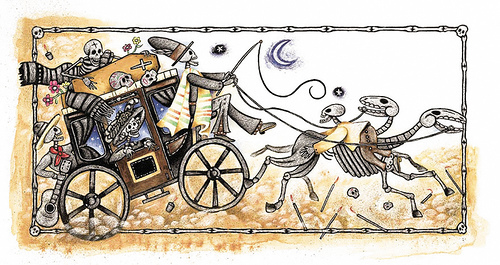
This little children’s book celebrates that Mexican holiday El Día de los Muertos by showing us the other side of death. This is not a funeral; this is a party! The festive illustrations show these hollow-eyed bone creatures as having the times of their unlives. In this book, the skeletons dance and sing during El Festival de las Calaveras: The Festival of Bones. They defy gravity as they fly. They dance on the moon. These are happy creatures indeed! As all that remains of the once-living people (and animals) they were, they have no cares or worries.
This is a fine introduction to this annual festival, with helpful notes in the back on how to make your own ofrenda, bake the pan de muertos and make your own sugar skulls. Curious adults and gleeful children (the ones who like to dress as skeletons on Halloween, e.g.) will find this book very entertaining.
Most of the book is taken up with some pretty awesome illustrations of skeletons cavorting - the author heavily channels José Guadalupe Posada. The text is occasionally nonsensical, but makes for one of the creepier Dia de los Muertos books I've read:
The kids are asking for the baby skeleton, With her scary mask And her box with the little candle.
Oh, they want to catch me. To that ugly skeleton . . . They want to marry me. The last section of the book is a text-heavy explanation of the holiday, and the way it is celebrated. There is a bit on building an altar, and also recipes for making sugar skulls and Pan de Muerto.
Though the book may be a bit scary for younger readers, it certainly captures the spirit of the festivities.
I read this book to my students from Kindergarten all the way to eighth grade every year around the day of the dead. I really like this book because it’s bilingual and it really captures the essence of what day of the dead is. Many students often confuse the day of the dead with Halloween and this book walks them through what it is people do during the celebration of the day the dead. The book has humor in it to lighten up the mood about death and invites the readers to celebrate their loved ones who have passed away. It does this through poetry both in English and Spanish.
I really wanted to love this book, because I love Dia de los Muertos, but it didn’t make much sense. It rhymed at times and then it didn’t. The translation, was okay. I also picked up this book because it’s bilingual. I love bilingual books. It does have recipes in the back and a little bit of history in the author’s note (back matter).
Very nice introduction to Dia de los Muertos. This book really looks into the traditions that are part of this celebration. I have read several books where this holiday was 'melding' with Halloween; while I can see similarities I think it is important to look at Dia de los Muertos from the perspective of family and religion. This book does that wonderfully.
I love that the entire text is in both English and Spanish. The factual information at the end about when and how el Dia de los muertos is celebrated is great too.
Read this one like song and wiggled as we read. We enjoyed the tips and recommendations on how to set up an alter and recipes on pan de muerto and sugar skull.
This book describes the Day of the Dead, or el Dia de los Muertos, a holiday celebrated in Mexico from October 31 to November 2. It is written in two parts: poetry and non-fiction essay. The works of Mexico City artist Luis San Vicente have been exhibited in Mexico, Venezuela, Europe, and the United States. He won UNESCO’s 11th (1998) prestigious NOMA Encouragement Concours Prize for Illustration, and UNESCO honored his work (1997, 1998, and 1999) in their prestigious Youth and Children’s Catalog of Illustrations.
The author invites children join the celebration as they watch the skeletons rock, rattle, and roll those long old bones as they get ready for the biggest event of their social calendar. Directed toward emerging readers, a short essay, filled with activities, explains this important Mexican holiday. It is billed as an early reader. I find the poetry fits this description easily, rhythmic and repetitive. The essay, on the other hand, might need an adult to build context for the narrative.
Interest Level: K-5rd Age: 5-10yrs Genre: Non-Fiction Subject: Award
From Publishers Weekly – Originally published in Mexico, this bilingual primer on the Day of the Dead may be best suited to those already familiar with the festival. For the uninitiated, an afterword explains that Mexicans celebrate el d!a de los muertes from October 31 to November 2. Feasts, music and visits to gravesites help the living honor the dead, who are believed by many to return for the festivities. Vicente, a respected Mexico City artist, creates charming skeletal characters; their playfulness accentuates the holiday's merriment. Rendered in a style reminiscent of scratchboard illustrations, his bony subjects dance in top hats and ride bicycles amid a fetchingly surreal world. For "Pascual's skeleton sings a song/ Without any pain or dread/ Although half a leg is really gone/ Still a flower sits upon his head," he pictures the skeletal fellow balanced on one leg atop a crescent moon and a wide-eyed owl as his audience. But for norte$os, the macabre content may not translate well. The text abruptly begins with a deceased guitarist crooning, "The skeletons are going along the road to the graveyard.... These are the dead. How happy they are." They may be further confused by a shifting narrative voice and non sequitur conclusion. But for those immersed in Mexican culture, this neatly designed square volume offers a fresh look at a familiar subject. Ideas on how to honor the dead and recipes for the holiday feast are included. Ages 4-10. (Sept.) Copyright 2002 Cahners Business Information.
Ann Welton, Grant Center for the Expressive Arts, Tacoma, WA Copyright 2002 Cahners Business Information. – Criticas – PreS-Gr 3-Oodles of dancing skeletons have returned to celebrate the Dia de los muertos, or the Day of the Dead. They come and they go, all of them happy and intending to have a good time. The simple, rhythmic text (definitely catchier in Spanish than in English) mimics the meter of a dance, and San Vicente's b&w artwork with touches of warm color look slightly shivery. The book concludes with information on the Day of the Dead, along with instructions for making "pan de muertos" (the special bread made on the Day of the Dead), "calaveras de azucar" ("sugar skulls"), "papel picado" ("paper cut-outs"), and an altar. This book will be a hot pick for library or home reading around that holiday and Halloween.
The Festival of Bones / El Festival de las Calaveras is a colorful bilingual children’s book dealing with the subject matter of the Day of the Dead. The book is illustrated with happy looking skeletons as they gather together in preparation for the festival. The general tone of the book is one of excitement and expectation, although what is shown in the book is preparation for the gathering, not the actual gathering itself. The narrative itself is a little discordant and hard to follow, which might be the result of the lyrical poetry being translated from Spanish into English. If you’re looking for a plot heavy narrative, you won’t find it here.
After the story in the back of the book there is a section explaining what exactly the Day of the Dead is, and how it is traditionally celebrated. This section is clearly educational and appears geared towards parents in order to help explain this cultural holiday. The book also includes directions on how to build an altar to deceased ancestors, and recipes for Pan de Muerto (Day of the Dead bread) and sugar skulls – all traditional aspects to properly celebrating the Day of the Dead, but definitely something most children will need adult supervision in putting together.
Overall, The Festival of Bones / El Festival de las Calaveras is a decent attempt to share and educate an aspect of Mexican culture with children. While the story in the book falls short, the illustrations are stylistically lovely, and the educational material in the back of the book is informative and interesting.
The Festival of Bones Luis San Vicente Cinco Puntos Press 978-1-941026-03-8 $7.95, 32 pgs
The Festival of Bones, written and illustrated by Luis San Vicente, is The Little-Bitty Book for the Day of the Dead, a bilingual early reader, translated from the Spanish by John William Byrd and Bobby Byrd of Cinco Puntos Press. Luis San Vicente is a Mexico City artist whose work has been exhibited in Mexico, Venezuela, Europe and the United States. He is a winner of UNESCO's NOMA Encouragement Concours Prize for Illustration.
Originally published in Mexico in 1999, Festival is a poem, song, cookbook, history and craft how-to all rolled into one enchanting package. An ancient Aztec tradition that has been incorporated over hundreds of years into the Catholic tradition, El Día de los Muertos is a holiday celebrated in Mexico from October 31st through November 2nd. It is a joyful time when family and friends gather together to remember the dead. They're coming and they're going
And you see them passing by. They're dancing over here, They're chatting over there... It's their day And they're going to have a good time.
The illustrations in Festival, in Mexican folk-art style, depict a happy celebration of the lives of the dead as they make their way to the graveyard, singing and dancing, rollerskating and riding bicycles.
Included in the text is a simple history of the holiday and ideas for your own celebration, including suggestions for building an altar and recipes for pan de muerto (a sweet bread) and sugar skull candies. Festival is a charming book that would be a great addition to every little Texan's library.
I first learned about the Day of the Dead when I lived in Texas. My father was the director Laguna Gloria, the art museum in Austin, and I saw some artwork from local Mexican-American artists that depicted the traditional skeleton seen in Day of the Dead art. My father then told me about the holiday and since then I have been quite intrigued with it. San Vicente’s story is a great introduction to the (kind of creepy) holiday, its history, and traditions. The text is in verse with a catchy rhythm and the illustrations are so lively AND it is bilingual. I loved seeing the text in Spanish and English. Then, the afterword further informs the readers about the holiday filling in any gaps left by the story.
This little book is half dual language English-Spanish poems and half informative mini-essays. The nonfiction portion includes back and a brief description of the holiday the Day of the Dead, how to celebrate the Day of the Dead, how to build a Day of the Dead altar, and easy versions of traditional recipes for pan due Muerto and sugar skulls. The illustrations are lavish and fun, and the poetry is short, sweet, and written for small children.
Young readers may enjoy this short introductory bilingual text describing the Festival of Bones because of its descriptions of some of the customs surrounding the Day of the Dead. The illustrations will inspire a smile or two because of the activities of the skeletons. What's more, readers can learn how to make an altar, prepare sweet bread, and make sugar skulls to celebrate the special day typically celebrated in Mexico.
Short poems explain different skeletons approaching the cemetery for the celebration. Not much rhyming in either language, but illustrations are fun. Text is hard to read on the all black and white middle spread however. Information about the celebration and recipes are included in the back, only in English.
I wish I could understand this book in Spanish, because I feel like it probably didn't undergo the most lyrical translation. The book was OK, but the back informational section was pretty robust for a "little bitty book for the Day of the Dead."
This is a great bilingual book that talks about The Day of the Dead. It gives the history and good information about what this holiday is. It also gives information on how to make an alter for loved ones and has fun recipes in it.
A fun little book about the Day of the Dead. Ridiculously cute drawings of skeletons and delicious-sounding recipes for pan de los muertos and skull candy.
Good book to use to talk about Day of the Dead with students. Also there are activities for the children and recipes children can make to help celebrate the day.