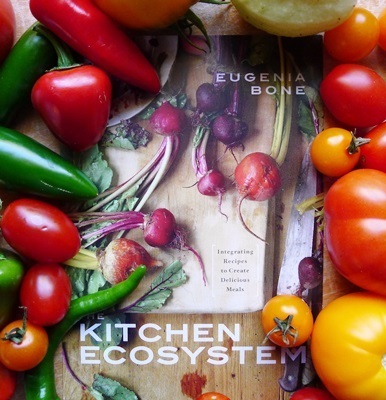
Paradigm-shifting, The Kitchen Ecosystem will change how we think about food and cooking. Designed to to create and use ingredients that maximize flavor, these 400 recipes are derived from 40 common ingredients--from asparagus to fish to zucchini--used at each stage of its "life cycle": fresh, preserved, and in a main dish.
Seasoned cooks know that the secret to great meals is the more you cook, the less you actually have to do to produce a delicious meal. The trick is to approach cooking as a continuum, where each meal draws on elements from a previous one and provides the building blocks for another. That synchronicity is a kitchen ecosystem.
For the farmers market regular as well as a bulk shopper, for everyday home cooks and aspirational ones, a kitchen ecosystem starts with cooking the freshest in-season ingredients available, preserving some to use in future recipes, and harnessing leftover components for other dishes. In The Kitchen Ecosystem , Eugenia Bone spins multiple dishes from single homemade ricotta stars in a pasta dish while the leftover whey is used to braise pork loin; marinated peppers are tossed with shrimp one night and another evening chicken thighs and breast simmer in that leftover marinade. The bones left from a roast chicken bear just enough stock to make stracciatella for two. The small steps in creating “supporting ingredients” actually saves time when it comes to putting together dinner.
Delicious food is not only a matter exceptional recipes—although there are an abundance of those here. Rather, it is a matter of approaching the kitchen as a system of connected foods. The Kitchen Ecosystem changes the paradigm of how we cook, and in doing so, it may change everything about the way we eat today.
Eugenia Bone, a veteran food writer who has published in many national magazines and newspapers, is also a cookbook author. She has contributed to many cookbooks and a few literary journals, been nominated for a variety of food writing awards and participated in radio, interactive and online interviews, in addition to appearing multiple times on television. Eugenia teaches and lectures about food preservation. She lives in New York City and Crawford, Colo.
This cookbook rocks my little foodie heart. I know I'm going to bore you guys to death with my foodie side-but you gotta eat!
I'm one of those people who garden. So yes, I stuff bags of squash on my neighbors porches when they won't answer the door for me anymore-because I just took them a bag the day before. I'm a giver. Plus, I get so tired of squash..until that next spring.
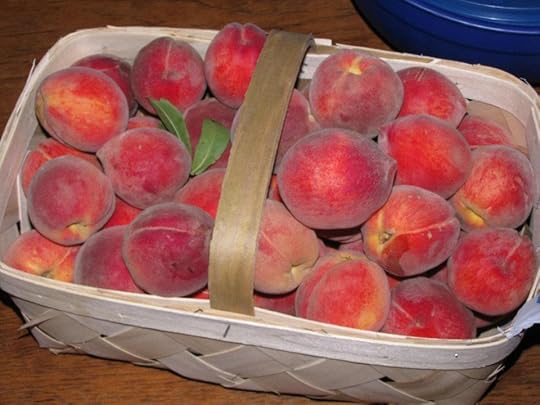
Anyways, this book is really good about giving you recipes for the item, then tells you how to preserve some of the leftovers, then how to use the preserved foods and THEN even tells you what to do with any leftover scrap items. SO MUCH WIN! I'm cheap and hate to waste anything-at least that's what my husband says. The truth is I hate waste. I worked hard on growing that food. I hate to see anything go to waste. Now when I get a trip to my local peach orchard I can have different ways to use these beauties. (yes-that's my own peaches-I love the south)
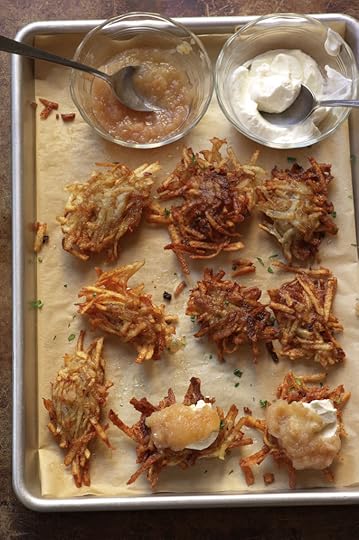
Homemade applesauce with Potato pancakes.
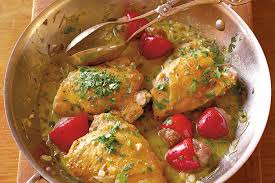
Chicken with pork stuffed cherry peppers
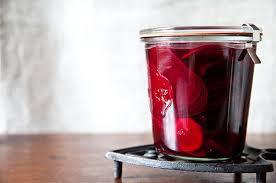
Canned beets
The ingredients in this book are not hard to find. That seems to be a trend in some of the newer cookbooks-in that the recipe looks good and then throws in some food that either costs the whole house payment or you just can't find in my area. I hate that. This book doesn't do that. So it gets all the stars. I'm gonna go cook some of this stuff!
I received an copy of this book in exchange for an honest review from blogging for books. Thank you!
The back cover of Kitchen Ecosystem observes that “Seasoned cooks know the paradox of great meals is this: the more you cook, the less you actually have to do to produce delicious food.” This is a premise I can embrace. Who wouldn’t want to produce delicious food while doing less? I was imagining simple, fresh recipes that I could work up when I get home from my commute at the end of a work day.
Unfortunately, there’s little in this book that will meet that need. What “do less” means in this context seems to be “do a whole lot of work using ingredients you already did a whole lot of work to produce.” In other words, the work seems doubled, not halved.
Perhaps I’m being unfair. The idea is that when one buys something fresh—a fruit, a vegetable, a cut of meat—one can use some of it fresh, preserve some of it, cook later recipes with the preserves, and whip up interesting concoctions (usually cocktails) using scraps. And the organization of the recipes is useful. They’re clustered alphabetically by key ingredients: Apples, Apricots, Artichokes, Asparagus, etc.
For someone like me who lives on the west coast, ingredients like these are easy to get fresh. Other key ingredient choices seem more quixotic: Currants (fresh, not dried), Duck, Figs, Lobster, Mussels. I don’t know which part of the country has fresh currents or where one can buy a duck one hasn’t shot one’s self. I’ve never had such a surfeit of lobster that I needed multiple recipes to use up the extra.
The Kitchen Ecosystem also presupposes a remarkably well-equipped kitchen, with recipes that call for canning jars (and know-how), food dehydrators, stovetop smokers, and several pounds of potter’s clay (for chicken baked in clay with onion sauce, which appears in the Onion chapter, not the Chicken one). Even if I had the time and desire to prepare them, many of these recipes would be out of my reach without several hundred dollars’ investment in new equipment.
The logic of the book also breaks down in places. In the Beef chapter there are recipes for Filet Mignon with Gorgonzola Sauce (sounds good, though not a new idea), Braised Beef Cheeks with Cloves, Veal Tail Stew with Potatoes, Canned Beef, Beef Cannelloni, Canned Beef Pot Pie, Beef Stock, Beef Stock with Poached Eggs and Meatballs, and a Bullshot Cocktail. But recipes for filet, beef cheeks, and veal tail all seem to presuppose that not only have I picked up fresh, grass-fed beef at the local farmers’ market, I’ve decided to splurge and buy half a cow, as well as the back end of a calf.
I have highlighted some recipes that seem reasonably straightforward and yummy: pestos made from asparagus, mushrooms, and carrot greens, procini salt and porcini butter. However, most of these are sides, condiments, or small bites; they won’t work as entrees and would require buying ingredients in very small quantities.
Bottom line: if you’re an adventurous cook with a cutting-edge kitchen and you enjoy devoting hours to getting a complicated dish just right, you’ll enjoy this book. If you’re someone looking for fresh, fast meals for yourself and your family, you’re only going to find about a quarter of the book’s 400+ pages useful.
This is a cookbook that will rock a foodie or gardener’s heart! I love the concept of The Kitchen Ecosystem because it is all about using every bit of food you have, and letting none of it go to waste. Often nowadays, beginners in the kitchen, or those who do not even know what to do with the scraps, will simply toss them in the garbage rather than using them. Many of the scraps that get discarded are actually full of nutrients!
In the beginning of the book, the introduction goes into discussion on not letting any bit of food go to waste, whether it is using up leftovers, or scraps from each meal. Canning is a part of this cookbook, which is something I have wanted to start doing, but didn’t know where to start. The cookbook has four sections, such as Eat Some Fresh, and Use the Scraps. There were quite a few recipes that I will be trying in the near future, but also a handful that I wouldn’t think twice about making out of personal preference. One section that I was most looking forward to happened to be Preserving and Recipe Techniques because it had such valuable information that could be put to use. Overall this entire cookbook had important information that everyone could put to use in their kitchen and day-to-day meal planning, prep, and cooking.
While this concept, and cookbook, isn’t for everyone, I do think that we all can gain some insightful knowledge, and bring some of it into our kitchens. Too often food goes to waste when it is perfectly good to use, and eat. It’s definitely something to think about, and decide, and I think this is a great reference for anyone interested.
Disclaimer: I received this cookbook through Blogging for Books for reviewing purposes.
Less waste in the kitchen! Alphabetical listings of common ingredients from Apples to Zucchini (oddly the only squash listed?) a section in the back on making condiments and another on preserving and cooking techniques.
Let me begin by saying that I love the concept of The Kitchen Ecosystem. I love the idea of using every bit of what you have, a sort of nose to tail idea that also includes fruits and vegetables. Just the other day, I was chopping off some broccoli florets to roast and I was chucking the big stalks into the compost bucket. I thought to myself, "this could be diced in a stir fry or pulsed into a pesto or used in a soup." I didn't do any of those, but at least I composted it.
This book begins with an introduction the concept of using everything, using the leftovers, by-products, and scraps. One concept that I took away from this is the idea of canning one or two jars of something. Frequently the author will can something at the same time is using another part of the ingredient in a recipe. This is a great idea and I think once you got in the habit of doing it, it would be easily doable.
After the introduction, the book is divided alphabetically, mixing fruits, vegetables, and proteins. So that beef is between asparagus and beets, and chicken is between cherries and corn. Each recipe section is divided into four sections: Eat Some Fresh, Preserve Some, Use the Preserves, and Use the Scraps. For example: Apples has Apples, Smoked Pork Butt, and Onion Saute; Stewed Apples with Red Cabbage; and Baked Apples with Bread Pudding under Eat Some Fresh. Under Preserve Some are Applesauce and Lady Apple Basil Jelly. Under Use the Preserves are Potato Pancakes with Applesauce and Applesauce Cake with Raisins and Walnuts. Under Use The Scraps are Apple Peel Jelly Stock and Apple Juice Granita. The recipes are listed in a flow chart fashion - the Apple Juice Granita comes off of the Applesauce box because you use the juice left over from making applesauce to make the granita.
After the list of recipes there is a final section called Preserving and Recipe Techniques. This is where the author covers everything from canning, to smoking, to preparing pasta and crepes. This section is around twenty pages and contains a wealth of valuable information.
There are so many recipes that I marked to try, here are just a few: Braised Chicken with Apricots and Tarragon, Asparagus Pesto, Beet Jam, Shrimp and Corn Casserole, Pickled Fennel, and Ginger Syrup.
I love this book. I realize the concept might not be for everything, but I have always felt like there was more that I could do with our food. Even if I am making a recipe from another cookbook, I will check this book to see if there is anything extra that I can do with the ingredients.
This was an excellent book. My wife loves to cook, and I love to eat her food. I am a reader, and I love books in general. So one thing I have started doing, is getting different cookbooks for my wife. I often find random cookbooks that I normally wouldn't get her, except for the fact that its kinda "our thing" (I know, weird).
When I saw THE KITCHEN ECOSYSTEM by Eugenia Bone, I took a look at it. I was amazed at what I saw. This was like no other cookbook I have seen. The first thing I noticed was the amazing pictures that are in this book. They actually engaged me as I was looking through it. The second thing I was drawn to, was the concept of this book. The concept of this book is simply to use ALL of the food you can, to eliminate waste. This is crucial for my wife and I, as she is finishing up her teaching degree, and I am a youth pastor (living on a tight budget is how we role). SO this concept was fascinating to me.
As I sat and read through this book, I love the depth of the book. I mean I am fairly new to the kitchen, but even I could follow these instructions. I think what I liked the most about this book, is the idea of using up ALL of the ingredients, and stocking up the pantry and what have you with things that will get used several times. On a more personal note, what this really means for me, is that no longer will I have to eat left overs for days! Rather, we can just reuse some of the meat or what not for a completely different meal, and it will be awesome! I can't wait til Christmas when I get to give this to my wife. She is going to be so happy.
I got this book for free for this review from blogging for books.
I think when I say I "read" what is essentially a cookbook it means something slightly different. I spent several hours studying it fairly closely.
This is a really intriguing book. Some of the ideas the author presents will certainly change some of my practices. For instance, she used to do canning/pickling on a large scale. As she points out, this means it is tons of work, you end up with a whole lot of one thing, and if it isn't good, you've got a lot of what isn't good. Why not do canning in small batches--even (as she calls them) nanobatches. if beets are good, then buy a bit extra and put up a few jars of beets. That's all you really need, after all.
In general the idea here is to catch food at its best, to use what you can right away and then to find ways to preserve the remainder. It's a simple idea and she makes it even easier by giving you the recipes to used the preserved remainders in the same part of the book--it's organized by ingredients. So for apples, there are fresh apple recipes, recipes for preserving apples, and then recipes using the preserved apples.
Her goal is to waste nothing--so she saves the water she cooked vegetables in for another use later in the week. And she saves the scraps and trimmings. And here, too, she tells you how to use them. Lots of things like shrubs and other beverages.
Finally, she makes her own condiments--like mustard. Why not? I really enjoyed reading it and I think I'll actually take something from it, which isn't always true.
Good, fresh recipes for people who want to use everything they bring into the kitchen. But, if you don't want to can or preserve or save pickle juice. . . it might not be as interesting. Recipes start with the "regular" part of the ingredient and then reduce to the stems and broths and juices, etc.