Francis Scott Key Fitzgerald, widely known simply as Scott Fitzgerald, was an American novelist, essayist, and short story writer. He is best known for his novels depicting the flamboyance and excess of the Jazz Age, a term he popularized in his short story collection Tales of the Jazz Age. During his lifetime, he published four novels, four story collections, and 164 short stories. Although he achieved temporary popular success and fortune in the 1920s, Fitzgerald received critical acclaim only after his death and is now widely regarded as one of the greatest American writers of the 20th century. Born into a middle-class family in Saint Paul, Minnesota, Fitzgerald was raised primarily in New York state. He attended Princeton University where he befriended future literary critic Edmund Wilson. Owing to a failed romantic relationship with Chicago socialite Ginevra King, he dropped out in 1917 to join the United States Army during World War I. While stationed in Alabama, he met Zelda Sayre, a Southern debutante who belonged to Montgomery's exclusive country-club set. Although she initially rejected Fitzgerald's marriage proposal due to his lack of financial prospects, Zelda agreed to marry him after he published the commercially successful This Side of Paradise (1920). The novel became a cultural sensation and cemented his reputation as one of the eminent writers of the decade. His second novel, The Beautiful and Damned (1922), propelled him further into the cultural elite. To maintain his affluent lifestyle, he wrote numerous stories for popular magazines such as The Saturday Evening Post, Collier's Weekly, and Esquire. During this period, Fitzgerald frequented Europe, where he befriended modernist writers and artists of the "Lost Generation" expatriate community, including Ernest Hemingway. His third novel, The Great Gatsby (1925), received generally favorable reviews but was a commercial failure, selling fewer than 23,000 copies in its first year. Despite its lackluster debut, The Great Gatsby is now hailed by some literary critics as the "Great American Novel". Following the deterioration of his wife's mental health and her placement in a mental institute for schizophrenia, Fitzgerald completed his final novel, Tender Is the Night (1934). Struggling financially because of the declining popularity of his works during the Great Depression, Fitzgerald moved to Hollywood, where he embarked upon an unsuccessful career as a screenwriter. While living in Hollywood, he cohabited with columnist Sheilah Graham, his final companion before his death. After a long struggle with alcoholism, he attained sobriety only to die of a heart attack in 1940, at 44. His friend Edmund Wilson edited and published an unfinished fifth novel, The Last Tycoon (1941), after Fitzgerald's death. In 1993, a new edition was published as The Love of the Last Tycoon, edited by Matthew J. Bruccoli.
The story follows the narrator who, in order to protect his childhood friend, chases a mysterous man who turns out to be a... train ghost. The ghost will have to encounter the resistance fuelled by the power of love.
Set amongst the old-money elites that Jay Gatsby courts (albeit Minnesota rather than Long Island), this Fitzgerald story surprises with suggestions of the supernatural: “There was a contagion of evil in the air.”
It opens with Eddie (aged 19), home for the Christmas holidays, saying of Ellen: “She had flowered suddenly and I, being a man and only a year older, hadn’t flowered at all.” The print version I read, adds: “She was nearly complete, yet the dew was still on her.” Hmmmm.
They've been neighbours since childhood, but his sense of entitlement, tingled with lust, and increasingly disguised as concern, permeates the story in uneasy ways.
There are glitzy parties, and Ellen has many admirers, but Eddie is especially perturbed by one: “A hard thin-faced man of about thirty-five with an air of being scarred, and a slight sinister smile. His eyes were a sort of taunt to the whole human family - they were the eyes of an animal, sleepy and quiescent in the presence of another species. They were helpless yet brutal, unhopeful yet confident. It was as if they felt themselves powerless to originate activity, but infinitely capable of profiting by a single gesture of weakness in another.”
Eddie is ostensibly concerned for Ellen, but his feelings are more complex. What follows is a white-knuckle exploration of the ethics of enforced protection, based on a hunch. It would make an excellent film.
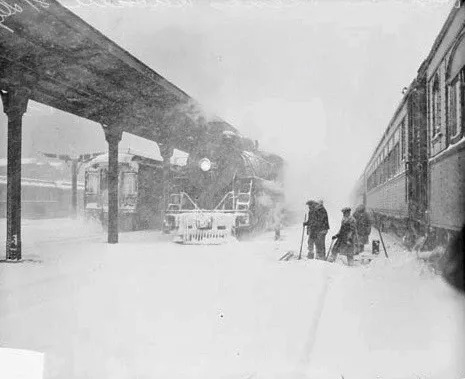
Image: A locomotive train pulls into Chicago station in the 1920s. (Source)
The final paragraph might have been seen in a positive way in 1927, but verges on the creepy now: “Of course she's coming out this fall, and I have two more years at New Haven; still, things don't look so impossible as they did a few months ago. She belongs to me in a way - even if I lose her she belongs to me.”
Quotes
• “His voice was muffled as though he were speaking through a silk scarf, and it seemed to come from a long way off.”
• “There began a slow, calculated assault on me, wordless and terrible. I felt what I can only call a strangeness stealing over me--akin to the strangeness I had felt all afternoon, but deeper and more intensified. It was like nothing so much as the sensation of drifting away.”
3.5★ "…she had flowered suddenly and I, being a man and only a year older, hadn’t flowered at all, had scarcely dared to come near her in the week we'd been home."
Home from college for the Christmas holidays, Eddie and Ellen are no longer the little school pals they once were; they are young adults, and they and their friends ae making the most of it. A family chauffeur is driving a group of them to a dance – or that was the plan anyway.
Eddie seems to have only just realised how much he cares for Ellen "blooming away, filling the room with ‘sex appeal’ – a wretched phrase to express a quality that isn’t like that at all."
Suddenly, Ellen darts back into the house as if she's forgotten something, and then a maid hands her a note. That's it – she's gone. The maid tells the boys Ellen says she'll meet them at the party.
"Already she was sliding into another world – the world of Joe Jelke and Jim Cathcart waiting for us now in the car. In another year she would pass beyond me forever."
At the dance, they see Ellen arrive in a car with a man.
"Seated in the coupé – he had not dismounted to help Ellen out – was a hard thin-faced man of about thirty-five with an air of being scarred, and a slight sinister smile. His eyes were a sort of taunt to the whole human family – they were the eyes of an animal, sleepy and quiescent in the presence of another species. They were helpless yet brutal, unhopeful yet confident. It was as if they felt themselves powerless to originate activity, but infinitely capable of profiting by a single gesture of weakness in another."
I picture him as a classic gothic villain, obviously handsome and charming and extremely appealing to an eighteen-year-old debutante who's just beginning to feel her power over men.
The young people could be from Fitzgerald's Gatsby party, but the emphasis is more on the Svengali-like hold this thirty-five-year-old stranger seems to have on Ellen and Eddie's determination to save her from herself.
"I began to notice that when she was concerned with this man her eyelids fell a little, shutting other things – everything else – out of view."
It begins as a straight-forward tale of a yearning young man whose friend is outgrowing him, but heads in quite a different direction, one I wasn't expecting. I enjoyed it.
This is one of the many stories in Flappers and Philosophers, a collection of forty-five stories from other collections. Thanks to my library for getting good books, and thanks to the Goodreads Short Story Club Group for selecting it.
This short story had some autobiographical elements, reminders of a few "The Great Gatsby" characters, and a man that seemed too possessive even for the times. There was also a strange supernatural element in the work. "A Short Trip Home" kept my interest, but it was not F Scott Fitzgerald at his best.
Written by an American prose master, this is an old fashioned story mining deep-seated anxieties, and delineating some of our deepest, darkest fears.
There is an ominous sense here, of inevitability — vague but palpable.
I can't say too much about this story without giving it away, so I'll just leave it alone. Suffice it to say, F. Scott Fitzgerald has a reputation, and for good reasons.
Eddie finds out his friend's girlfriend, Ellen, has been under the spell of a sinister man with supernatural abilities. He decides to save her. According to the blurb, "A Short Trip Home" was Fitzgerald's first supernatural tale. He got it posted in the Sunday Evening Post, but they were reluctant to publish it at the time. There is an eeriness and mixed with Fitzgerald's writing to this short story that was appealing to me. It wasn't super scary, but it was unsettling and tense. Eddie's loyalty and love for Ellen is enduring and his bravery is admirable. It was fun to get a short story that had a supernatural element.
Well I'm not a fan of Fitzgerald so my rating probably reflects that. Read as part of the Black Water 2: More Tales of the Fantastic. I can see why Alberto Manguel included this story in his collection. It's very psychologically heavy to the point of obsession and supernatural claustrophobia in an atmosphere that becomes increasingly menacing. For Fitzgerald fans I'd give it a solid 3*s.
Touted as a ghost story but the ghost is only uncovered in the very last paragraphs of the story. I didn’t feel any hovering spirit before the end. Read with the GR Short Story Club (I recommend).
Eddie is infatuated with the illusive (double entendre?) Ellen, whom he has known and loved his whole life. She is also his neighbor. Eddie, Ellen, and the rest of their HS classmates have returned home for a visit during their college winter break. Everyone appears to be rich beyond their needs with few concerns other than who will escort whom to a dance or be invited to one affair or another. Oversize raccoon coats are in abundance (in case you weren’t sure of the period and/or the author). Eddie has placed his ideal, perfect Ellen on a pedestal and is completely confounded by her strange, atypical behavior since arriving home. She is evasive, distant, and at times appears to be in a trance. A gruff older man has been escorting her around, and she is defensive and secretive about who the man is, how she met him, etc. The gruff stranger is menacing and threatening (not just in his hold over Ellen, but also physically so). Joe Jelke, another one of Ellen’s not-so-secret admirers, decides to take on the stranger, also called Joe (I wonder what that’s all about), and goes down for the count when Joe Stranger punches him out with his brass knuckles – outside the posh club where the gang is attending a big bash/dance,
Now Eddie has growing concern for Ellen’s welfare and good name. He is protective to the point of smothering – although probably good in the instant case, it is just not socially correct in our day and age. When Ellen leaves a day early before returning to college, Eddie correctly deduces that she is lying to her parents and friends to cover up her true intentions. With much cunning he catches up with her and basically imprisons her so that she cannot follow through with her planned tryst.
So who is this mystery stranger and what is his hold over Ellen? Well this is (drum roll please) , of course. Somehow, Eddie has figured this out and has figured out how to deal with it.
Not much of the story made sense to me…however, the prose was good, as was the hoity toity and menacing atmospheres, accordingly. I thought the story nicely portrayed the unbearable lightness of entitlement especially where youth was concerned, Also macho v demure. Was this a social commentary or merely a portrait of the period as seen through the eyes of the artist/author?
And most important of all, did Eddie get the girl in the end? I’m not sure. Maybe for that brief moment in time left to the visit.
I read this strange offering from F. Scott Fitzgerald earlier in the year in an "Alfred Hitchcock Presents" collection and again now for my GR short story group.
"A Short Trip Home" might call to mind a lovestruck Nick Carraway figure back in St. Paul from Yale for the holidays who has an unsettling encounter with the supernatural. Despite being a ghost story of sorts, this different kind of story from the author shares a number of his common themes and motifs familiar to fans of Gatsby and other more famous works: the move from the safety of the Midwest to the dangers of the East, the corrupting influence of capitalism on the soul, and the seductive yet sinister nature of blossoming sexuality. We’ve also got the naive simpleton in over his head here, but our narrator in "A Short Trip Home" seems to triumph in a way that would be unimaginable to Nick Carraway or Fitzgerald's other broken, disillusioned Midwestern characters.