

What do you think?

Infamy: Pearl Harbor and its Aftermath
Investigates the military, political, and historical ramifications of the bombing of Pearl Harbor, examining the unpreparedness of the United States, the cover-up following the disaster, and other important aspects of the attack and its effects
397 pages, Mass Market Paperback
First published January 1, 1982
About the author
John Toland
36 books202 followersLibrarian Note: There is more than one author by this name in the Goodreads database.
John^Toland - 17th century theologian, Philosopher & Satirist
John^^Toland - American writer and historian (WWII & Dillinger)
John^^^Toland - Article: "The Man who Reads Minds"
John Willard Toland (June 29, 1912 in La Crosse, Wisconsin - January 4, 2004 in Danbury, Connecticut) was an American author and historian. He is best known for his biography of Adolf Hitler.[1]
Toland tried to write history as a straightforward narrative, with minimal analysis or judgment. This method may have stemmed from his original goal of becoming a playwright. In the summers between his college years, he travelled with hobos and wrote several plays with hobos as central characters, none of which achieved the stage.[2] At one point he managed to publish an article on dirigibles in Look magazine; it proved extremely popular and led to his career as a historian.
One exception to his general approach is his Infamy: Pearl Harbor and Its Aftermath about the Pearl Harbor attack and the investigations of it, in which he wrote about evidence that President Franklin Roosevelt knew in advance of plans to attack the naval base but remained silent. The book was widely criticized at the time. Since the original publication, Toland added new evidence and rebutted early critics. Also, an anonymous source, known as "Seaman Z" (Robert D. Ogg) has since come forth to publicly tell his story.
Perhaps his most important work, for which he won the Pulitzer Prize in 1971, is The Rising Sun. Based on original and extensive interviews with high Japanese officials who survived the war, the book chronicles Imperial Japan from the military rebellion of February 1936 to the end of World War II. The book won the Pulitzer because it was the first book in English to tell the history of the war in the Pacific from the Japanese point of view, rather than from an American perspective.
The stories of the battles for the stepping stones to Japan, the islands in the Pacific which had come under Japanese domination, are told from the perspective of the commander sitting in his cave rather than from that of the heroic forces engaged in the assault. Most of these commanders committed suicide at the conclusion of the battle, but Toland was able to reconstruct their viewpoint from letters to their wives and from reports they sent to Tokyo. Toland died in 2004 of pneumonia.
While predominantly a non-fiction author, Toland also wrote two historical novels, Gods of War and Occupation. He says in his autobiography that he earned little money from his Pulitzer Prize-winning, The Rising Sun, but was set for life from the earnings of his biography of Hitler, for which he also did original research.
http://en.wikipedia.org/wiki/John_Tol...
John^Toland - 17th century theologian, Philosopher & Satirist
John^^Toland - American writer and historian (WWII & Dillinger)
John^^^Toland - Article: "The Man who Reads Minds"
John Willard Toland (June 29, 1912 in La Crosse, Wisconsin - January 4, 2004 in Danbury, Connecticut) was an American author and historian. He is best known for his biography of Adolf Hitler.[1]
Toland tried to write history as a straightforward narrative, with minimal analysis or judgment. This method may have stemmed from his original goal of becoming a playwright. In the summers between his college years, he travelled with hobos and wrote several plays with hobos as central characters, none of which achieved the stage.[2] At one point he managed to publish an article on dirigibles in Look magazine; it proved extremely popular and led to his career as a historian.
One exception to his general approach is his Infamy: Pearl Harbor and Its Aftermath about the Pearl Harbor attack and the investigations of it, in which he wrote about evidence that President Franklin Roosevelt knew in advance of plans to attack the naval base but remained silent. The book was widely criticized at the time. Since the original publication, Toland added new evidence and rebutted early critics. Also, an anonymous source, known as "Seaman Z" (Robert D. Ogg) has since come forth to publicly tell his story.
Perhaps his most important work, for which he won the Pulitzer Prize in 1971, is The Rising Sun. Based on original and extensive interviews with high Japanese officials who survived the war, the book chronicles Imperial Japan from the military rebellion of February 1936 to the end of World War II. The book won the Pulitzer because it was the first book in English to tell the history of the war in the Pacific from the Japanese point of view, rather than from an American perspective.
The stories of the battles for the stepping stones to Japan, the islands in the Pacific which had come under Japanese domination, are told from the perspective of the commander sitting in his cave rather than from that of the heroic forces engaged in the assault. Most of these commanders committed suicide at the conclusion of the battle, but Toland was able to reconstruct their viewpoint from letters to their wives and from reports they sent to Tokyo. Toland died in 2004 of pneumonia.
While predominantly a non-fiction author, Toland also wrote two historical novels, Gods of War and Occupation. He says in his autobiography that he earned little money from his Pulitzer Prize-winning, The Rising Sun, but was set for life from the earnings of his biography of Hitler, for which he also did original research.
http://en.wikipedia.org/wiki/John_Tol...
Ratings & Reviews
Friends & Following
Create a free account to discover what your friends think of this book!
Community Reviews
Displaying 1 - 30 of 42 reviews

December 15, 2024
The infamy of Pearl Harbor, as far as historian John Toland is concerned, goes beyond the Imperial Japanese forces’ sneak attack on the U.S. Pacific Fleet on December 7, 1941, the “day of infamy.” In Toland’s view, there was plenty of infamous behavior before and after that, much of it taking place in the corridors of power in Washington, D.C. Such is the thesis of Toland’s 1982 book Infamy: Pearl Harbor and Its Aftermath – a controversial work that fearlessly dips deep into the waters of conspiracy theory.
Toland won the Pulitzer Prize in History for his book The Rising Sun: The Decline and Fall of the Japanese Empire (1970) – a work that told Japan’s World War II-era story with a degree of nuance that had generally been lacking. Toland did not shy from chronicling the atrocities perpetrated by the Imperial Japanese regime, but he also pointed out where he felt that military and political leaders of Imperial Japan had behaved honorably. Against the atmosphere of Orientalism that had often characterized American historians’ writing about the Japanese Empire, Toland’s work provided a welcome and helpful corrective.
In a foreword, Toland describes how his views of Pearl Harbor grew and changed over the time when he wrote But Not in Shame: The Six Months After Pearl Harbor, and then The Rising Sun, and then after. He speaks of seeing plenty of room for blame on both the Japanese and U.S. sides for what happened at Pearl Harbor, and then adds that “At that time I saw no villains of heroes on either side and could not, above all, believe that President Roosevelt knew ahead of time that a Japanese striking force was approaching Pearl Harbor” (p. xv).
Whoa! Now that is quite an assertion. Perhaps it is for that reason that Toland subsequently takes his own sweet time getting back around to his claims that President Franklin D. Roosevelt knew, in advance, that Pearl Harbor was to be attacked.
After totting up the terrible human and material costs of the Pearl Harbor attack – 2403 Americans killed and 1178 wounded; 6 ships sunk and 13 other ships damaged; 188 aircraft destroyed and 159 others damaged – Toland proceeds to a consideration of the United States Government’s attempts to establish who bore ultimate responsibility for the failure of U.S. forces to anticipate the attack.
Students of Pearl Harbor history are already familiar with what has come to be known as “the Kimmel-Short thesis.” This interpretation holds that the responsibility for U.S. intelligence and military failures rests ultimately with those who held supreme naval and military command at Pearl Harbor on the morning of December 7, 1941 – respectively, Admiral Husband E. Kimmel and General Walter Short.
Such a claim might seem reasonable, on its face. You hold command on a battlefield, and your side lost the battle; therefore, you’re responsible. Victory has a thousand fathers, and defeat is ever an orphan. And yet, as Toland aptly points out in some of the stronger passages of Infamy, it’s a more complicated matter than that – in large part because of security concerns related to American success breaking Japanese military codes.
More specifically, through what were known as the Magic intercepts, U.S. intelligence had successfully cracked Imperial Japan’s Purple code, and was deeply concerned about not letting the Japanese know of this success. Such concerns meant that no commander in Hawaii – not Kimmel and not Short – had access to Japanese military messages that might have indicated to them that an attack was imminent.
Within that context, one particular message that may or may not have been sent takes on particular importance. The message Higashi no kaze ame (“East wind, rain”), delivered within a weather report, would have indicated an immediate break in diplomatic relations between Japan and the United States – the closest thing to a declaration of war that would have been delivered before an attack.
Yet was the “East wind, rain” message ever sent? Toland believes so – and spends a great deal of time chronicling the testimony of military officers who claimed to have seen this particular intercept. Yet there was no, and is no, solid evidence that such a message was ever sent by the Japanese or intercepted by the Americans. With this book, as with works of conspiracy theory generally, the key piece of evidence that will supposedly prove the theory correct is always one folkloric remove away. Someone saw the intercept, but they don’t have a copy of it. Someone has absolute proof in their diary, but the diary can’t be published until after they die. That sort of thing.
Where Toland’s Infamy achieves its greatest successes is in those passages where Toland examines the way responsibility gets fixed – justly or unjustly – after a nation suffers a war-time defeat. The first commission investigating Pearl Harbor, one that was chaired by U.S. Supreme Court justice Owen Roberts, fixed blame squarely and uncompromisingly upon Kimmel and Short, in a manner that Toland finds hasty, ill-considered, and profoundly unfair: “There need have been no wasteful investigations of Pearl Harbor if Roosevelt had called upon the people in 1941 to await all judgements, in the national interest, until victory was won. But the Administration had felt it necessary to fix blame, and made scapegoats of two good men” (p. 84).
Subsequent inquiries by the Army and Navy contradicted the findings of the Roberts Commission, creating a political and military crisis. Toland describes this turn of events by writing that “At the Pentagon…there were anger, indignation, and consternation. The repercussions were felt even more at the White House. With the Roberts report so dramatically turned about by both the Army and Navy inquiries, the new findings would have to be suppressed until they could be refuted. And in little more than two weeks, the nation would go to the polls to elect a President” (p. 108). The use of words like “suppressed” provides a good example of how the conspiratorial mindset of this book intensifies as the book goes on.
Perhaps part of why Toland leans into this conspiracy-theory interpretation of Pearl Harbor is because, with his appreciation for both Japan and the United States, he feels that the Pacific War was very much a repressible conflict. After pointing out influential factors like a shared fear of communism and Japanese anger at racist U.S. immigration policies, Toland makes this bold suggestion:
There were no heroes or villains on either side. Roosevelt, for all his shortcomings, was a man of broad vision and humanity; the Emperor was a man of honor and peace. Both were limited – one by the bulky machinery of a great democracy, and the other by training, custom, and the restrictions on his rule….The villain was the times. Japan and America would never have come to the brink of war except for the social and economic eruption of Europe after the Great War and the rise of two great revolutionary ideologies – Communism and Fascism. (p. 276)
What Toland calls “A war that need not have been fought” (p. 276) may have been more inevitable than Toland likes to think. There need not have been a vast, all-encompassing, and still all-but-undiscoverable conspiracy, with President Franklin D. Roosevelt at the top of it all, for Pearl Harbor to happen. All that was needed was for there to be two important and powerful nations that, at a crucial inflection point in history, failed to understand one another.
On the Japanese side, there was, as Toland points out, a “concept of achieving decisive victory by a single surprise blow [that] lay deep in the Japanese character”, something that can be seen in how “the outcome in judo, sumo, and kendo, after long preliminaries, [is] settled by a single stroke” (p. 253). In this way of thinking, a single well-struck blow convinces the adversary that further fighting would be unnecessarily costly, and the two sides can proceed to negotiations in an outcome that, in the long run, saves many lives.
But Americans don’t tend to see war-making that way. American culture is the culture of the duel at dawn, in the streets of the Western frontier town, with both duellists knowing in advance what is coming, and with the outcome to be decided in a fair fight. The clever and ultimately life-saving surprise blow, from the Japanese perspective, becomes, from the American perspective, a dastardly shot in the back.
From such significant differences in cultural outlook, a terrible war could and did emerge.
There is an old Native American saying, to the effect that the truth requires only a few words to say. And there is a much simpler reason for the Americans to have failed to anticipate the possibility of a Japanese attack like Pearl Harbor. Vice Admiral William Pye provided a good example of the U.S. strategic and tactical thinking of that time when he responded to Lieutenant Commander Edwin Layton’s concerns that the Japanese might strike south toward the Philippines by saying, “Oh, no….The Japanese won’t attack us. We’re too strong and powerful” (p. 300).
I do not like the conspiracy-mongering of Infamy; it is not worthy of an historian of Toland’s caliber. But the book does provide an interesting look at the machinations that occur in the top political and military circles of any government after a major defeat.
Toland won the Pulitzer Prize in History for his book The Rising Sun: The Decline and Fall of the Japanese Empire (1970) – a work that told Japan’s World War II-era story with a degree of nuance that had generally been lacking. Toland did not shy from chronicling the atrocities perpetrated by the Imperial Japanese regime, but he also pointed out where he felt that military and political leaders of Imperial Japan had behaved honorably. Against the atmosphere of Orientalism that had often characterized American historians’ writing about the Japanese Empire, Toland’s work provided a welcome and helpful corrective.
In a foreword, Toland describes how his views of Pearl Harbor grew and changed over the time when he wrote But Not in Shame: The Six Months After Pearl Harbor, and then The Rising Sun, and then after. He speaks of seeing plenty of room for blame on both the Japanese and U.S. sides for what happened at Pearl Harbor, and then adds that “At that time I saw no villains of heroes on either side and could not, above all, believe that President Roosevelt knew ahead of time that a Japanese striking force was approaching Pearl Harbor” (p. xv).
Whoa! Now that is quite an assertion. Perhaps it is for that reason that Toland subsequently takes his own sweet time getting back around to his claims that President Franklin D. Roosevelt knew, in advance, that Pearl Harbor was to be attacked.
After totting up the terrible human and material costs of the Pearl Harbor attack – 2403 Americans killed and 1178 wounded; 6 ships sunk and 13 other ships damaged; 188 aircraft destroyed and 159 others damaged – Toland proceeds to a consideration of the United States Government’s attempts to establish who bore ultimate responsibility for the failure of U.S. forces to anticipate the attack.
Students of Pearl Harbor history are already familiar with what has come to be known as “the Kimmel-Short thesis.” This interpretation holds that the responsibility for U.S. intelligence and military failures rests ultimately with those who held supreme naval and military command at Pearl Harbor on the morning of December 7, 1941 – respectively, Admiral Husband E. Kimmel and General Walter Short.
Such a claim might seem reasonable, on its face. You hold command on a battlefield, and your side lost the battle; therefore, you’re responsible. Victory has a thousand fathers, and defeat is ever an orphan. And yet, as Toland aptly points out in some of the stronger passages of Infamy, it’s a more complicated matter than that – in large part because of security concerns related to American success breaking Japanese military codes.
More specifically, through what were known as the Magic intercepts, U.S. intelligence had successfully cracked Imperial Japan’s Purple code, and was deeply concerned about not letting the Japanese know of this success. Such concerns meant that no commander in Hawaii – not Kimmel and not Short – had access to Japanese military messages that might have indicated to them that an attack was imminent.
Within that context, one particular message that may or may not have been sent takes on particular importance. The message Higashi no kaze ame (“East wind, rain”), delivered within a weather report, would have indicated an immediate break in diplomatic relations between Japan and the United States – the closest thing to a declaration of war that would have been delivered before an attack.
Yet was the “East wind, rain” message ever sent? Toland believes so – and spends a great deal of time chronicling the testimony of military officers who claimed to have seen this particular intercept. Yet there was no, and is no, solid evidence that such a message was ever sent by the Japanese or intercepted by the Americans. With this book, as with works of conspiracy theory generally, the key piece of evidence that will supposedly prove the theory correct is always one folkloric remove away. Someone saw the intercept, but they don’t have a copy of it. Someone has absolute proof in their diary, but the diary can’t be published until after they die. That sort of thing.
Where Toland’s Infamy achieves its greatest successes is in those passages where Toland examines the way responsibility gets fixed – justly or unjustly – after a nation suffers a war-time defeat. The first commission investigating Pearl Harbor, one that was chaired by U.S. Supreme Court justice Owen Roberts, fixed blame squarely and uncompromisingly upon Kimmel and Short, in a manner that Toland finds hasty, ill-considered, and profoundly unfair: “There need have been no wasteful investigations of Pearl Harbor if Roosevelt had called upon the people in 1941 to await all judgements, in the national interest, until victory was won. But the Administration had felt it necessary to fix blame, and made scapegoats of two good men” (p. 84).
Subsequent inquiries by the Army and Navy contradicted the findings of the Roberts Commission, creating a political and military crisis. Toland describes this turn of events by writing that “At the Pentagon…there were anger, indignation, and consternation. The repercussions were felt even more at the White House. With the Roberts report so dramatically turned about by both the Army and Navy inquiries, the new findings would have to be suppressed until they could be refuted. And in little more than two weeks, the nation would go to the polls to elect a President” (p. 108). The use of words like “suppressed” provides a good example of how the conspiratorial mindset of this book intensifies as the book goes on.
Perhaps part of why Toland leans into this conspiracy-theory interpretation of Pearl Harbor is because, with his appreciation for both Japan and the United States, he feels that the Pacific War was very much a repressible conflict. After pointing out influential factors like a shared fear of communism and Japanese anger at racist U.S. immigration policies, Toland makes this bold suggestion:
There were no heroes or villains on either side. Roosevelt, for all his shortcomings, was a man of broad vision and humanity; the Emperor was a man of honor and peace. Both were limited – one by the bulky machinery of a great democracy, and the other by training, custom, and the restrictions on his rule….The villain was the times. Japan and America would never have come to the brink of war except for the social and economic eruption of Europe after the Great War and the rise of two great revolutionary ideologies – Communism and Fascism. (p. 276)
What Toland calls “A war that need not have been fought” (p. 276) may have been more inevitable than Toland likes to think. There need not have been a vast, all-encompassing, and still all-but-undiscoverable conspiracy, with President Franklin D. Roosevelt at the top of it all, for Pearl Harbor to happen. All that was needed was for there to be two important and powerful nations that, at a crucial inflection point in history, failed to understand one another.
On the Japanese side, there was, as Toland points out, a “concept of achieving decisive victory by a single surprise blow [that] lay deep in the Japanese character”, something that can be seen in how “the outcome in judo, sumo, and kendo, after long preliminaries, [is] settled by a single stroke” (p. 253). In this way of thinking, a single well-struck blow convinces the adversary that further fighting would be unnecessarily costly, and the two sides can proceed to negotiations in an outcome that, in the long run, saves many lives.
But Americans don’t tend to see war-making that way. American culture is the culture of the duel at dawn, in the streets of the Western frontier town, with both duellists knowing in advance what is coming, and with the outcome to be decided in a fair fight. The clever and ultimately life-saving surprise blow, from the Japanese perspective, becomes, from the American perspective, a dastardly shot in the back.
From such significant differences in cultural outlook, a terrible war could and did emerge.
There is an old Native American saying, to the effect that the truth requires only a few words to say. And there is a much simpler reason for the Americans to have failed to anticipate the possibility of a Japanese attack like Pearl Harbor. Vice Admiral William Pye provided a good example of the U.S. strategic and tactical thinking of that time when he responded to Lieutenant Commander Edwin Layton’s concerns that the Japanese might strike south toward the Philippines by saying, “Oh, no….The Japanese won’t attack us. We’re too strong and powerful” (p. 300).
I do not like the conspiracy-mongering of Infamy; it is not worthy of an historian of Toland’s caliber. But the book does provide an interesting look at the machinations that occur in the top political and military circles of any government after a major defeat.

Did Not Finish
March 16, 2021Did not finish: this book was not what I expected (which was my mistake). This book is about the subsequent controversy that evolved after the Japanese attack on Pearl Harbour and is packed with descriptions of court hearing procedures and committees. Not what I wanted and certainly not a critique to this well established historian.

October 7, 2015
This book is not much about the Japanese 'surprise' attack on Pearl Harbor. It is about the several hearings about who was responsible for U.S. military on the island being unprepared for the attack.
The mainstream view is that army commander Short and naval commander Kimmel, as well as their commands in the Army and Navy, were genuinely surprised, such indications of Japanese intentions as were known having been tied up, lost or misdirected in the weeks, days and hours before the attack. Toland's view, amply documented herein and in agreement with such earlier revisionists as Charles Beard, is that a number of persons high up in the U.S. military and civilian command, including the president, were well aware that a Japanese attack was imminent and decided not to forewarn Short and Kimmel so as to galvanize domestic support against the Japanese aggressor and to ensure entry into the European war as well. Furthermore, but without much argument, Toland suggests that the Pacific war might have been entirely avoided, at least so far as the U.S.A. was concerned.
While I generally enjoy Toland, this book was a bit tedious as here he is arguing a case and, so doing, he amasses a heck of a lot of detail in order to be convincing. The arguments are therefore strong, but the narrative flow suffers.
The mainstream view is that army commander Short and naval commander Kimmel, as well as their commands in the Army and Navy, were genuinely surprised, such indications of Japanese intentions as were known having been tied up, lost or misdirected in the weeks, days and hours before the attack. Toland's view, amply documented herein and in agreement with such earlier revisionists as Charles Beard, is that a number of persons high up in the U.S. military and civilian command, including the president, were well aware that a Japanese attack was imminent and decided not to forewarn Short and Kimmel so as to galvanize domestic support against the Japanese aggressor and to ensure entry into the European war as well. Furthermore, but without much argument, Toland suggests that the Pacific war might have been entirely avoided, at least so far as the U.S.A. was concerned.
While I generally enjoy Toland, this book was a bit tedious as here he is arguing a case and, so doing, he amasses a heck of a lot of detail in order to be convincing. The arguments are therefore strong, but the narrative flow suffers.

December 20, 2016
Were we surprised by the attack on Pearl Harbor...No. Were we surprised by the damage it did...yes. I read this book starting December 7th. The 75th anniversary of the attack. How fitting a day to start a book. The day of World War II for the United States. We knew the Kido Butai had set sail. We had cracked all their codes. We heard their radio dispatches. Our allies even warned us based off of their intelligence. Best to let the attack come to solve that isolationist problem of ours.
What we were dead wrong about was the effectiveness of the Imperial Japanese Navy. We assumed the "backwards" oriental would be no match for us. The Japanese air arm was fantastic. Their pilots among the highest quality in the world. Their torpedoes, the dreaded Long Lance, was the finest and set to run easily in the shallow waters of Pearl Harbor. The bomb that smashed through and detonated the magazine of the ARIZONA was a falling battleship round. Their Navy specially trained to sail in stormy conditions and night time would continue to deal death and destruction in the Solomons and other areas.
Japan would be defeated but it would be a Long Island hopping war. It would end in Atomic fireballs. Pearl Harbor was the result of arrogance. No one would dare attack us. The U.S. is far too powerful. Have we heard this before? I am still amazed to this day to live on Ford Island, epicenter of the attack. I actually have bullet holes in front of my house. I wonder if the pilot survived what was to come.
Rest In Peace sailors and Marines from Pearl Harbor.
What we were dead wrong about was the effectiveness of the Imperial Japanese Navy. We assumed the "backwards" oriental would be no match for us. The Japanese air arm was fantastic. Their pilots among the highest quality in the world. Their torpedoes, the dreaded Long Lance, was the finest and set to run easily in the shallow waters of Pearl Harbor. The bomb that smashed through and detonated the magazine of the ARIZONA was a falling battleship round. Their Navy specially trained to sail in stormy conditions and night time would continue to deal death and destruction in the Solomons and other areas.
Japan would be defeated but it would be a Long Island hopping war. It would end in Atomic fireballs. Pearl Harbor was the result of arrogance. No one would dare attack us. The U.S. is far too powerful. Have we heard this before? I am still amazed to this day to live on Ford Island, epicenter of the attack. I actually have bullet holes in front of my house. I wonder if the pilot survived what was to come.
Rest In Peace sailors and Marines from Pearl Harbor.

November 20, 2017
خواندن یک کتاب تاریخی آن هم تماما درباره صحنههای جنگ ممکن است به نظر نه تنها جالب نیاید بلکه خستهکننده و اعصابخورد کن هم باشد. اما پرلهاربر اینچنین نیست. این کتاب که با دقت فراوان تمامی صحنهها و اتفاقات و شخصیتهای تاریخی دخیل در حملهی ژاپنها به پرلهاربر را توصیف میکند، زبانی ساده و روایتگونه دارد. به شکلی که تمام ماجرا را مانند یک داستان هولناک، جذاب و زیبا درمیآورد. چیزی که بیش از همه جذاب است این است که نویسنده از جانبداری میپرهیزد. درست است که در کتابهای تاریخی و مستند حق جانبداری وجود ندارد با اینحال این حرف در کلام راحت و در عمل بسیار سخت است. اما جان ویلارد تولاند توانسته از این امتحان سربلند بیرون آید. خواندن پرل هاربر برای من تبدیل به خاطرهای موفق شد زیرا که نه تنها اطلاعاتی فراوان از حوادث جنگ پرل هاربر و اتفاقاتی که موجب دخالت آمریکا در خاورمیانه و شرق پس از این جنگ شد، بلکه لذت خواندن متن تاریخی را به من داد.

July 17, 2016
The accepted theory of the "surprise attack" by the Japanese on Pearl Harbor which plunged the US into WWII, is that it indeed was a surprise. Pulitzer Prize winner John Toland tells us that it may not have been exactly as we have believed all these years and that the hierarchy in Washington, including President Roosevelt, were aware it was coming and did not warn the Pearl Harbor Army and Navy commanders, Short and Kimmel.
Toland has done an immense amount of research and was often stonewalled by the authorities as he searched records and communications which proved that there was more to the "surprise" element than was reported. It was a convoluted operation that would allow the Japanese to strike the first blow, allowing the US to declare war which would then also bring the country into the European conflict which was the prime objective. Confused?.......it certainly smacks of "conspiracy theory" but Toland presents very conclusive evidence that Short and Kimmel were sacrificial lambs and that the government/military were well aware that the attack was about to take place.
The book concentrates mainly on the commissions and hearings that were held after the end of the war and it is extremely detailed with much testimony quoted verbatim. That tends to slow down the narrative quite a bit but is still fascinating. Several careers were ruined and politics played a major part in the conclusions of those hearings. But, there is no denying that there is something very wrong about the use of the word "surprise" when speaking of the Pearl Harbor attack. Toland convinced me.
Toland has done an immense amount of research and was often stonewalled by the authorities as he searched records and communications which proved that there was more to the "surprise" element than was reported. It was a convoluted operation that would allow the Japanese to strike the first blow, allowing the US to declare war which would then also bring the country into the European conflict which was the prime objective. Confused?.......it certainly smacks of "conspiracy theory" but Toland presents very conclusive evidence that Short and Kimmel were sacrificial lambs and that the government/military were well aware that the attack was about to take place.
The book concentrates mainly on the commissions and hearings that were held after the end of the war and it is extremely detailed with much testimony quoted verbatim. That tends to slow down the narrative quite a bit but is still fascinating. Several careers were ruined and politics played a major part in the conclusions of those hearings. But, there is no denying that there is something very wrong about the use of the word "surprise" when speaking of the Pearl Harbor attack. Toland convinced me.

December 7, 2019
Since I have been reading books about the attack on Pearl Harbor for decades, I was aware of this book, Infamy: Pearl Harbor and its Aftermath by John Toland practically since it was published. I couldn't remember whether I had already read it. And because it was published in 1984, I wondered if it would be worth reading (or re-reading) since so many books have been published since based on "newly released" information. But upon further scrutiny, I realized that where most books on this topic present details about the military planning and execution as well as readiness to attack or defend, Infamy is mostly focused on what happened to the military leaders in Hawaii after the attacks. For example, General Stark, who commanded the Army forces, and Admiral Kimmel who was in charge of the Naval forces, were both immediately let go from their commands and the overall blame for the failures that allowed such horrendous loss of lives and equipment. Even though they were not provided with the latest intelligence that was known in Washington that may have led them to take more defensive action. The author presents this as a cover up and a way to foist the blame on the commanders in Hawaii and protect the leaders in the capitol. Although Kimmel and Stark were threatened with court marshal, it didn't happen because what was known when and by whom would have to come out. So they were forced into retirement. Later in the book and years after the attack Kimmel and Stark were able to force a court marshal so that they had the opportunity to call witnesses and testify themselves in an attempt to clear their names. Much came out during these hearings and court testimony that exposes the way they appeared to have been scapegoated and took the blame when it probably belonged much higher up, including, perhaps, Roosevelt himself. If you've read many books about the Pearl Harbor attacks but not this one, you might want to consider adding it.

October 7, 2022
"Yesterday, December 7, 1941 — a date which will live in infamy — the United States of America was suddenly and deliberately attacked by the naval and air forces of the Empire of Japan."
There are dozens of books called Infamy, most of them about Pearl Harbor. December 7, 1941 remains one of the most famous dates in American history, bigger than anything but 9/11 until 9/11.
I read this book because I had previously read John Toland's Pulitzer Prize-winning The Rising Sun: The Decline and Fall of the Japanese Empire, 1936-1945. Toland is a thorough, meticulous historian, and while some of the material in Infamy repeats things he wrote in Rising Sun, this is not just a collection of excerpts. He did independent research in tracking down the truth behind Pearl Harbor, including interviewing American and Japanese officials involved in the decision-making (many of whom were still alive when he wrote this in 1982), talking families into giving up old papers and letters, and sending FOIA requests to the NSA and the Department of the Navy.
Infamy is not about the Pearl Harbor attack itself (Toland describes it very briefly), but about what led up to it, and the aftermath.
The Blame Game
There are many obvious parallels between Pearl Harbor and 9/11. In both cases, the American public was stunned by a shocking, unprovoked attack on American soil, experienced a brief moment of national unity, and then fell to demanding someone be held responsible. In both cases, there were, in hindsight, many steps that led to the attack, many warnings ignored, and many balls dropped that could have prevented it. And in both cases, there are conspiracy theories that persist to this day accusing people in high places — all the way up to the President himself — of being complicit.
Toland makes a convincing case that there was plenty of blame to go around and that most of it didn't fall on the right people.
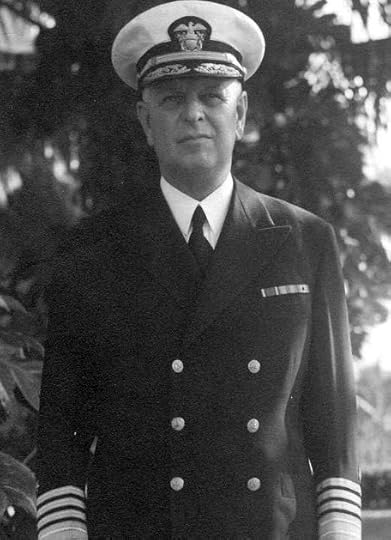
Kimmel stood by the window of his office at the submarine base, his jaw set in stony anguish. As he watched the disaster across the harbor unfold with terrible fury, a spent .50 caliber machine gun bullet crashed through the glass. It brushed the admiral before it clanged to the floor. It cut his white jacket and raised a welt on his chest. "It would have been merciful had it killed me," Kimmel murmured to his communications officer, Commander Maurice "Germany" Curts.
Admiral Husband Kimmel was in command of Pearl Harbor on the day of the attack. He watched the bombs falling and knew his career was over even before the fires were put out. Toland writes a poignant account of Kimmel walking into his office, taking the four stars of his temporary rank off his shoulders, and replacing them with his previous "official" rank of two stars, bringing a young serviceman almost to tears.
Kimmel knew he'd shoulder responsibility for the Pearl Harbor attack. It didn't matter whether he was really to blame: in the Navy, if something goes wrong under your watch, it's your fault. That's just the way it is. But in the aftermath, the cries for heads grew louder, and it soon became apparent that those heads would be Admiral Kimmel and General Short, the US Army commander at Pearl Harbor. Kimmel was willing to accept responsibility for his failure, but he wasn't willing to accept charges of dereliction, ineptitude, and negligence. He received death threats. People wrote letters to newspapers asking why he hadn't been court martialed and stripped of his pension, or demanding that he do the "honorable" thing and kill himself. His sons, also naval officers, caught some of the flack. As Kimmel saw himself made a scapegoat, with the threat of formal charges being held over his head, he began to fight back, starting by demanding a formal court martial. The Navy didn't actually want a court martial, because that would allow him to ask embarrassing questions on the public record, but they also didn't want to say they weren't going to court martial him, because that would outrage the public.
Kimmel was shuffled off to a desk job until he retired the following year, but he spent the rest of his life trying to clear his name.
The Knox Report
"I think the most effective Fifth Column work of the entire war was done in Hawaii with the exception of Norway."
The first official report was compiled by Secretary of the Navy Frank Knox, who went to Hawaii to conduct an investigation personally. Knox, who had been agitating to round up all Japanese immigrants even before Pearl Harbor, not only blamed the military for being unprepared, but claimed that local Japanese fifth columnists had aided the attack. Though these accusations were never substantiated, the Knox report was a bombshell that did much to shape public opinion. Knox spent the rest of the war trying to get all the Japanese in Hawaii interred.
The Roberts Commission
The Roberts Commission was the first of nearly a dozen investigations into Pearl Harbor in the years that followed. Headed by US Supreme Court Justice Owen Roberts, it found Admiral Kimmel and General Short guilty of "dereliction of duty" by failing to prepare adequately for a Japanese attack.
The Knox Report and the Roberts Commission absolutely threw Kimmel and Short under the bus, and following the Roberts Commission, Kimmel became one of the most hated men in America.
Notably, both reports hid the fact that Washington had received credible information from a number of sources that a Japanese attack was imminent; information that was withheld from the Hawaiian commanders.
Toland comes down on the side of most historians, who in retrospect do not consider Kimmel and Short singularly responsible for their ill-preparedness. It's true that by December of 1941, everyone believed war with Japan was inevitable, and the US had contemplated the possibility of a Japanese attack on Hawaii as early as the 1930s. Toland also cites several high-ranking US officers who had previously written about Japan's penchant for "sudden, devastating surprise attacks." So an attack on Pearl Harbor wasn't actually unthinkable, though most military experts considered it such a long shot, with severe logistic and strategic challenges, that Japan would be foolish to attempt it.
They weren't wrong. But they weren't counting on Admiral Isoroku Yamamoto, a military genius, a Japanese naval officer who'd spent time in the U.S., and an inveterate gambler.
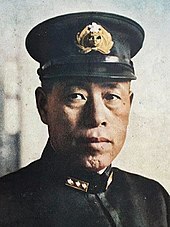
Possibly no one else could have pulled off the Pearl Harbor attack. Yamamoto caught the Americans fully unprepared.
The Cover Up
The question of "Did anyone actually know Pearl Harbor was going to happen before it happened?" is a complicated one, and here is where Toland's book shines, as he goes into great detail about individual people and events. In some cases, Toland personally tracked them down for interviews, or delved into archived State Department and Navy records.
He makes a compelling argument that there were many people who knew the Japanese were about to attack, and that they would probably strike at Pearl Harbor. The Pearl Harbor attack was obviously a "secret," but it was a rather open one in Japanese military circles; you can't send a carrier fleet across the Pacific to start a war without word getting around. So there are accounts of Dutch diplomats passing on information overheard to American consular officials, a Korean-American agent who had definite intelligence on the Kidō Butai fleet and sent it on, confident that he had warned America in time to give the Japanese a "hot reception." There were intercepted diplomatic communications that set off alarm bells for the translators and decoders, but which somehow didn't make their way to the desks of the President or the Secretary of the Navy until too late. There are even credible accounts of military personnel from Alaska to Hawaii picking up radio signals that, with hindsight, should have told them what was afoot. There was a message to the Japanese consulate in Honolulu asking the officials there to map out Pearl Harbor and its ships on a grid for the obvious purpose of bombing, a message that was decrypted and passed on to the Navy but not forwarded to Kimmel and Short.
The story Toland assembles is a convincing one: there was plenty of information available that, had anyone put it together, made it obvious what was about to happen. Of course hindsight is 20/20 and some things are obvious only after the fact, but clearly mistakes were made.
So, Kimmel knew that the Japanese might attack Hawaii "soon," but he didn't have concrete information about an imminent attack, concrete information that actually existed. He was not the only one who was outraged, after the war, to find out that intelligence had not been passed on to him that would certainly have altered his readiness posture.
Why wasn't he given all the information? Part of it was a cover-up that persisted until well into the war: the Japanese code used to encrypt diplomatic communications had been broken, but the US obviously didn't want the Japanese to know their code had been broken. But some of the messages weren't passed on because of skepticism, or because intelligence officers ruled their domains jealously and possessively.
This comes up a lot in Toland's book: the Washington bureaucracy hid things, there was infighting between Naval offices and between the Army and the Navy, and intelligence was treated as a prize to be jealously held onto, not, like, shared with people who actually need it.
Toland, however, does a pretty thorough debunking of one of the more outrageous theories that still has some adherents: that FDR himself knew about the imminent attack on Pearl Harbor, and deliberately failed to warn the commanders there because he wanted Japan to attack so that the U.S. could enter the war.
Prelude to War
In the last part of the book, Toland turns from the multiple reports and commissions that followed the attack on Pearl Harbor to the history that led up to it. This is ground he covered more thoroughly in Rising Sun, but in short: Japan was in a tough spot. They wanted to be a first-class power, but Japan had few natural resources, so realistically, they could only join the other great powers by engaging in colonialism like everyone else had. Unfortunately for them, Europe and America didn't want to see the rise of Japan as a rival. This was for a variety of reasons, of which racism was certainly one, but Japan's invasion of China had been met with severe disapprobation, and the US was threatening to cut off their oil. This would strangle the Japanese economy and all their imperial ambitions. The choice they were given was essentially: give up on being a world power, or go to war.
Toland talks a lot about the diplomatic maneuvers in the years and then the weeks before the Pearl Harbor attack. It's another tale of unfortunate mistakes and misunderstandings. Secretary of State Henry Stimson was a Japanophobe who was outright hostile to them; he took a hard line in situations where a softer approach might have left more room for negotiations. On the other hand, the Japanese had their own internal problems that often prevented them from giving a straightforward answer to American proposals. Worse, sometimes their responses were translated badly, in a way that gave the impression they were being duplicitous when they weren't.
Right up until the night before the attack, Japan's envoys in Washington were still trying to negotiate a way out of armed conflict, unaware that the Kidō Butai fleet was on its way.
I've read a lot of books about World War II now, and John Toland stands out for his research and his detail. Infamy isn't a completely objective recitation of historical facts; Toland is opinionated at times, though moderate in how he expresses it. But he did a lot of independent research and legwork, and he clearly believes that the Washington bureaucracy was more to blame for the Pearl Harbor attack than the unfortunate commanders in charge. FDR himself comes off as being somewhat mendacious and scheming, as he really did want America to join the war against Germany, which before Pearl Harbor was not something he could sell to the American people. So did he want, even expect, that Japan would give him the excuse he needed? Quite possibly. But Toland's description of his reaction in the aftermath is not of a man who had prior information. It was more that of a man who had received bad news he'd been dreading.
Some other ignoble episodes in the book include the Census Department being put to work literally the night of December 7 assembling a list of every single Japanese name in North America and Hawaii; a task that census officials later denied they had ever worked on. There was also the shoddy treatment of men like Commander Laurance Safford and Captain Joseph Rochefort, Naval cryptographers who embarrassed their superiors by being right and had their careers derailed because of it.
If you are interested in WWII history, not from the perspective of battles and campaigns, but the politics and causes, I would really recommend Toland's magnum opus, Rising Sun, but Infamy is an excellent investigation into how it started.
April 26, 2021
A WORTHY READ, BUT FAILS TO CONVINCE THIS READER
I think it’s best to start by saying what this book is not: John Toland’s “Infamy” is not a blow-by-blow telling of the Japanese attack on Pearl Harbor, nor is it an appropriate introduction to Pearl Harbor. (1) On the contrary, the reader will get the most out of this book if he is familiar with the battle, people, and events surrounding it – the more familiar the better (more on that later). So, with that in mind, let’s get on with the review.
Toland drops a literary bomb on the accepted Pearl Harbor narrative. He posits that Washington, specifically the President of the United States, the Chairman of the Joint Chiefs of Staff, and other high-ranking officers withheld information that the Japanese were going to strike Pearl Harbor on December 7th from the Commander of the U.S. Army’s Hawaiian Department, Lieutenant General Walter C. Short and Admiral Husband E. Kimmel, Commander-In-Chief Pacific. That they did this deliberately to hasten the United States’ entry into World War II and to stifle the significant percentage of the country who supported the antiwar movement. These are bold accusations, but John Toland was a big boy when he wrote Infamy, he had already won a Pulitzer Prize in 1971 for The Rising Sun, and his Adolf Hitler biography also received widespread acclaim. So, he knew a controversial and divisive book such as this would draw microscopic scrutiny – the result of which could tarnish if not destroy his reputation.
A nano-second after most Americans learned of the disaster that unfolded at Pearl Harbor, they wanted blood from Japan and the heads of those responsible. According to award-winning military historian and the National World War II Museum Senior Researcher (2) Robert Citino, “no less than nine investigations took place between 1941 and 1946, alone…” (3) Soon after Japan’s surrender, Congress formed the Joint Congressional Committee on the Investigation into the Pearl Harbor Attack to uncover the events and circumstances surrounding the Japanese attack – THESE INVESTIGATIONS ARE WHAT JOHN TOLAND’S “INFAMY” IS CENTERED AROUND – i.e. what was the status of the diplomatic talks between Japan and Washington in 1941? Were Adm. Kimmel and Lieut. Gen. Short privy to the status of that diplomacy? What was the intelligence and counterintelligence apparatus in place before Pearl Harbor? What information was collected? Where was it collected? How? By whom? And when? What was done with the information? By whom? What information was given to Adm. Kimmel and Lieut. Gen. Short? How was information sent from Hawaii to Washington and vice versa? Was all known intelligence passed to Hawaii? And ultimately, did anybody in Washington deliberately withhold information? Also, and just as important, based on their orders and the information available to them, did Adm. Kimmel and/or Lieut. Gen. Short properly prepare their forces for the threat? Many, many admirals and generals testified, many, if not most had served longer than three or four decades and were friends with Kimmel or Short. At the conclusion of the investigation, the committee generated a rather hefty report comprising some 39 volumes, each 500 – 2000 +/- pages in length. (4)
After all that, one would think the case would be closed. But it’s not. Every so often, usually at the behest of the Short or Kimmel families, Washington or the Pentagon is petitioned to reinvestigate Pearl Harbor. More recently, in 1995 Strom Thurmond, the Democrat turned Republican Sen. of South Carolina and Chairman of the Senate Armed Services Committee was petitioned by the public relations firm representing the family of Adm. Kimmel to re-examine Pearl Harbor. Sen. Thurmond acquiesced and tapped the DoD to open “yet another” (5) investigation into the culpability of Adm. Kimmel and Lieut. Gen Short. A quick five weeks later – presto, investigation finished – no changes! Further inquiries into the matter were denied by the HW Bush, Clinton, and the George W. Bush administrations. (6)
BIDEN ADMIN. MIGHT BE SHORT, KIMMEL’S LAST CHANCE
A 2016 article entitled “Let Obama-Biden set the record right for scapegoated Pearl Harbor officers” by Sam Waltz, appearing in the Delaware Business Times makes a “last chance” appeal to then VP Joe Biden to nudge Pres. Obama to reinstate Rear Admiral Kimmel and Brig. Gen. Short to their highest wartime ranks of four and three stars, respectively. Obviously, that never happened prior to Pres. Obama leaving office, but with Joe Biden now in the White House, it looks like the now long deceased officers’ chance to restore their reputation just got a new lease on life – till at least 2024. (7)
E-BOOK OR AUDIOBOOK?
Like most of my reviews, I look at both the e-book and the audiobook. In this case, I read the 12 hr 50 min audiobook first. I enjoyed listening to narrator Traber Burns, whose voice matches the topic perfectly. However, even though I am very familiar with the battle itself, I sometimes found myself a bit behind just trying to keep everybody straight. This is one reason why I recommend no less than general familiarity with the battle and the players involved – specifically FDR, Gen. Marshall, Henry L Stinson, Cordell Hull, Adm. King, Lieut. Gen. Short, Rear Adm. Kimmel, Adm. Stark, Frank Knox, Adm. Spruance, and Adm. Forestall. Becoming familiar with the battle and the men listed above will allow the reader to focus on the dialogue instead of stopping to remember who’s who in the zoo.
This is why I recommend actually reading (vice listening to) Infamy. Because, while the plot is straightforward enough, quickly linking a particular person with his job/title and his opinions, stance, or actions can be difficult if you are not familiar with them – meanwhile the narrator just keeps on going.
When writing his Pulitzer Prize-winning book The Rising Sun, Toland moved to Japan for six years so he could interview everyone “from high-ranking military officers, low ranking enlisted men, government officials, diplomats yet and housewives.” With that in mind, I was interested to look at his sources. (8)
SOURCES
When an author charges the President of the United States and several military officers of standing by and allowing thousands of Americans to die just to get into a war, he had better have his ship together!
Toland’s sources consist of several “Interviews and Correspondence,” some of which he conducted in person, via correspondence (letters, assumedly) or telephone. But with all the principal participants deceased – Pres. Roosevelt died in office, Lieut. Gen. Short down died in 1949, (9) Secretary of War Stimson in 1950, (10) and Adm. Kimmel died in 1968 (11) – Toland was forced to utilize what he refers to as, “tape” (which I take to mean “taped interviews”), which account for a full 50% of his interviews and correspondence. He also turned to university and presidential library archives for “personal and professional papers,” which mainly consisted of letters, “Documents, Diaries, Records and Reports,” including “Congressional Records” and formerly” Classified Files.” (12)
I also wanted to know how much material Toland consulted. Not knowing what constituted “a lot” of sources, I decided to compare Infamy with the last book I finished, Richard Frank’s Tower of Skulls. Toland devoted 7%, 7 pages of notes and bibliography to 93 pages of Infamy. (13) In Contrast, Frank, devoted a whopping 27%! (14)
THE VERDICT
Here is my verdict on the two most compelling questions:
1. Are Adm. Kimmel and Lieut. Gen. Short responsible for the destruction at Pearl Harbor? As much as it pains me to say it, yes they are.
This is to take nothing away from the nearly 4 decades of faithful service each man gave to the United States. But when you are in command, you are responsible for everything that happens or fails to happen to your unit. Every officer has had that pounded into their head from day one. Gen. Short and Adm. Kimmel, being the senior Army and Navy commanding officers in Hawaii, tasked with protecting Hawaii and the fleet, are responsible. But not just because they were in command, that would be merely a rubberstamp.
As conditions of the Japanese and American diplomatic talks reached an all-time low, Secretary of State Cordell Hull messaged Tokyo stating that their “conditions were unacceptable” to the United States. The very next day, the Secretary of War and the Chief of Naval Operations sent a message to Adm. Kimmel and Lieut. Gen. Short stating that the talks with Tokyo “had ceased” – the very first sentence in that dispatch was “THIS DISPATCH IS TO BE CONSIDERED A WAR WARNING” (15)
Nor was the bombing of Pearl Harbor a novel idea. Author Craig Nelson reminds us, “In 1925, London Daily Telegraph naval correspondent Hector C. Bywater published The Great Pacific War, reviewed by the New York Times Book Review on its front page with the headline ‘If War Comes in the Pacific.’ Bywater’s novel described a Japanese surprise attack on the American fleet in Pearl Harbor, with simultaneous assaults on Guam, and on the Philippines at Lingayen Gulf and Lamon Bay.” (16)
It’s mind-boggling that a mere 10 days after Adm. Kimmel received his war warning, it seems no one at Pearl Harbor was remotely on the lookout for nefarious activity. It’s hard to fathom that the officers and men aboard the fleet in Pearl Harbor be so completely unprepared, even given liberty the night before. Even after the destroyer USS Ward attacked and sank a submarine operating in a restricted area outside Pearl Harbor – Adm. Kimmel did not bring the fleet to general quarters. Had he done so, the sailors at Pearl Harbor would have had 20 minutes to prepare for battle!
The same holds true for Lieut. Gen. Short. I just don’t see the logic in having your aircraft parked close to each other for any reason, especially if you are concerned with sabotage. Tactics never support bunching up in combat – be it men or airplanes. Just like a grenade or mortar landing amongst bunched-up men, what could a single satchel charge do to a group of airplanes? Spread everything out, it does not take a lot of men to guard airplanes.
One of the things that turned me off the most was: as Adm. Kimmel stood there watching Japanese pilots pommel Battleship Row, he coolly disappeared into an interior room and, when he emerged, he was wearing Rear Admiral shoulder boards. Apparently, amidst the destruction of America’s Pacific Fleet, as sailors were drowning and burning alive, all he thought about was himself, his career, and the fact that he would surely be relieved of command and revert to a two-star Admiral. (17)
2. Was intelligence deliberately withheld from Adm. Kimmel or Lieut. Gen. Short by Washington? No.
True, Kimmel and Short were not privy to all information – they were not aware of Purple and Magic, the Japanese codes and their decipherment. But rarely does a commander have all the information before they must make a decision. Purple and Magic were so secret that, besides the intelligence community, the number of people who were aware of their existence was probably in the single digits. Case in point: Harry Truman was unaware of the Manhattan project until he was sworn in as president.
But for me, it’s just too much of a stretch to believe that the President of the United States or the Chairman of the Joint Chiefs of Staff would deliberately allow the United States to purposefully fall into war.
THE FINAL ANALYSIS
Most people have heard that Roosevelt knew the Japanese were going to strike Pearl Harbor so, I’m glad John Toland wrote this book – INFAMY IS A WORTHY READ – and must be the most comprehensive pro-conspiracy theory book out there. So, if you read this and you are still not convinced that Washington was involved in Pearl Harbor, then it’s pretty safe to say you will never be convinced. If you’re on the fence, Toland provides plenty of notes and a good bibliography to help you with further research. In the final Analysis, John Toland is an excellent and convincing writer and he makes a good case. Infamy is an engrossing and informative book worthy of reading if for no other reason than to be aware of the details surrounding this conspiracy theory behind the Japanese attack on Pearl Harbor.
NOTES
1. For a superb introduction to Pearl Harbor, one need not look further than Craig Nelson, Pearl Harbor: From Infamy to Greatness (New York: Scribner, 2017).
2. “Meet the Team,” The National WWII Museum | New Orleans, accessed April 16, 2021, https://www.nationalww2museum.org/war....
3. Robert Citino, “WWII Book Review: Kimmel, Short, and Pearl Harbor,” HistoryNet, September 9, 2019, https://www.historynet.com/wwii-book-....
4. United States., Pearl Harbor Attack. Hearings before the Joint Committee on the Investigation of the Pearl Harbor Attack, Congress of the United States, Seventy-Ninth Congress, First Session, Pursuant to S. Con. Res. 27, 79th Congress, a Concurrent Resolution Authorizing an Investigation of the Attack on Pearl Harbor on December 7, 1941, and Events and Circumstances Relating Thereto ... (Washington: U.S. Govt. print. off., 1946), https://catalog.hathitrust.org/Record....
5. Citino, “WWII Book Review.”
6. History com Editors, “Former U.S. Senator Strom Thurmond Dies,” HISTORY, accessed April 10, 2021, https://www.history.com/this-day-in-h....
7. “Let Biden-Obama Set the Record Right for Scapegoated Pearl Harbor Officers,” Delaware Business Times (blog), December 5, 2016, https://delawarebusinesstimes.com/new....
8. “Historian John Toland Dies,” Washington Post, January 6, 2004, https://www.washingtonpost.com/archiv....
9. “Lieutenant-General Walter C. Short and Pearl Harbor – Pearl Harbor Reservations,” accessed April 23, 2021, https://pearlharbor.org/lieutenant-ge....
10. “Henry L. Stimson Dies at 83 In His Home on Long Island,” accessed April 23, 2021, https://archive.nytimes.com/www.nytim....
11. Anthony Summers and Robbyn Swan, “The Admiral Who Took the Fall for Pearl Harbor,” Wall Street Journal, December 2, 2016, sec. Life, https://www.wsj.com/articles/the-admi....
12. John Toland, Infamy: Pearl Harbor and Its Aftermath (New York: Anchor Books, 2014), 215 – 237, http://search.ebscohost.com/login.asp....
13. Toland, 215 – 238.
14. Richard B. Frank, Tower of Skulls: A History of the Asia-Pacific War, First edition (New York: W. W. Norton & Company, 2020), 358 – 527.
15. Toland, Infamy, 17.
16. Nelson, Pearl Harbor, page 25.
17. Toland, Infamy, 19
I think it’s best to start by saying what this book is not: John Toland’s “Infamy” is not a blow-by-blow telling of the Japanese attack on Pearl Harbor, nor is it an appropriate introduction to Pearl Harbor. (1) On the contrary, the reader will get the most out of this book if he is familiar with the battle, people, and events surrounding it – the more familiar the better (more on that later). So, with that in mind, let’s get on with the review.
Toland drops a literary bomb on the accepted Pearl Harbor narrative. He posits that Washington, specifically the President of the United States, the Chairman of the Joint Chiefs of Staff, and other high-ranking officers withheld information that the Japanese were going to strike Pearl Harbor on December 7th from the Commander of the U.S. Army’s Hawaiian Department, Lieutenant General Walter C. Short and Admiral Husband E. Kimmel, Commander-In-Chief Pacific. That they did this deliberately to hasten the United States’ entry into World War II and to stifle the significant percentage of the country who supported the antiwar movement. These are bold accusations, but John Toland was a big boy when he wrote Infamy, he had already won a Pulitzer Prize in 1971 for The Rising Sun, and his Adolf Hitler biography also received widespread acclaim. So, he knew a controversial and divisive book such as this would draw microscopic scrutiny – the result of which could tarnish if not destroy his reputation.
A nano-second after most Americans learned of the disaster that unfolded at Pearl Harbor, they wanted blood from Japan and the heads of those responsible. According to award-winning military historian and the National World War II Museum Senior Researcher (2) Robert Citino, “no less than nine investigations took place between 1941 and 1946, alone…” (3) Soon after Japan’s surrender, Congress formed the Joint Congressional Committee on the Investigation into the Pearl Harbor Attack to uncover the events and circumstances surrounding the Japanese attack – THESE INVESTIGATIONS ARE WHAT JOHN TOLAND’S “INFAMY” IS CENTERED AROUND – i.e. what was the status of the diplomatic talks between Japan and Washington in 1941? Were Adm. Kimmel and Lieut. Gen. Short privy to the status of that diplomacy? What was the intelligence and counterintelligence apparatus in place before Pearl Harbor? What information was collected? Where was it collected? How? By whom? And when? What was done with the information? By whom? What information was given to Adm. Kimmel and Lieut. Gen. Short? How was information sent from Hawaii to Washington and vice versa? Was all known intelligence passed to Hawaii? And ultimately, did anybody in Washington deliberately withhold information? Also, and just as important, based on their orders and the information available to them, did Adm. Kimmel and/or Lieut. Gen. Short properly prepare their forces for the threat? Many, many admirals and generals testified, many, if not most had served longer than three or four decades and were friends with Kimmel or Short. At the conclusion of the investigation, the committee generated a rather hefty report comprising some 39 volumes, each 500 – 2000 +/- pages in length. (4)
After all that, one would think the case would be closed. But it’s not. Every so often, usually at the behest of the Short or Kimmel families, Washington or the Pentagon is petitioned to reinvestigate Pearl Harbor. More recently, in 1995 Strom Thurmond, the Democrat turned Republican Sen. of South Carolina and Chairman of the Senate Armed Services Committee was petitioned by the public relations firm representing the family of Adm. Kimmel to re-examine Pearl Harbor. Sen. Thurmond acquiesced and tapped the DoD to open “yet another” (5) investigation into the culpability of Adm. Kimmel and Lieut. Gen Short. A quick five weeks later – presto, investigation finished – no changes! Further inquiries into the matter were denied by the HW Bush, Clinton, and the George W. Bush administrations. (6)
BIDEN ADMIN. MIGHT BE SHORT, KIMMEL’S LAST CHANCE
A 2016 article entitled “Let Obama-Biden set the record right for scapegoated Pearl Harbor officers” by Sam Waltz, appearing in the Delaware Business Times makes a “last chance” appeal to then VP Joe Biden to nudge Pres. Obama to reinstate Rear Admiral Kimmel and Brig. Gen. Short to their highest wartime ranks of four and three stars, respectively. Obviously, that never happened prior to Pres. Obama leaving office, but with Joe Biden now in the White House, it looks like the now long deceased officers’ chance to restore their reputation just got a new lease on life – till at least 2024. (7)
E-BOOK OR AUDIOBOOK?
Like most of my reviews, I look at both the e-book and the audiobook. In this case, I read the 12 hr 50 min audiobook first. I enjoyed listening to narrator Traber Burns, whose voice matches the topic perfectly. However, even though I am very familiar with the battle itself, I sometimes found myself a bit behind just trying to keep everybody straight. This is one reason why I recommend no less than general familiarity with the battle and the players involved – specifically FDR, Gen. Marshall, Henry L Stinson, Cordell Hull, Adm. King, Lieut. Gen. Short, Rear Adm. Kimmel, Adm. Stark, Frank Knox, Adm. Spruance, and Adm. Forestall. Becoming familiar with the battle and the men listed above will allow the reader to focus on the dialogue instead of stopping to remember who’s who in the zoo.
This is why I recommend actually reading (vice listening to) Infamy. Because, while the plot is straightforward enough, quickly linking a particular person with his job/title and his opinions, stance, or actions can be difficult if you are not familiar with them – meanwhile the narrator just keeps on going.
When writing his Pulitzer Prize-winning book The Rising Sun, Toland moved to Japan for six years so he could interview everyone “from high-ranking military officers, low ranking enlisted men, government officials, diplomats yet and housewives.” With that in mind, I was interested to look at his sources. (8)
SOURCES
When an author charges the President of the United States and several military officers of standing by and allowing thousands of Americans to die just to get into a war, he had better have his ship together!
Toland’s sources consist of several “Interviews and Correspondence,” some of which he conducted in person, via correspondence (letters, assumedly) or telephone. But with all the principal participants deceased – Pres. Roosevelt died in office, Lieut. Gen. Short down died in 1949, (9) Secretary of War Stimson in 1950, (10) and Adm. Kimmel died in 1968 (11) – Toland was forced to utilize what he refers to as, “tape” (which I take to mean “taped interviews”), which account for a full 50% of his interviews and correspondence. He also turned to university and presidential library archives for “personal and professional papers,” which mainly consisted of letters, “Documents, Diaries, Records and Reports,” including “Congressional Records” and formerly” Classified Files.” (12)
I also wanted to know how much material Toland consulted. Not knowing what constituted “a lot” of sources, I decided to compare Infamy with the last book I finished, Richard Frank’s Tower of Skulls. Toland devoted 7%, 7 pages of notes and bibliography to 93 pages of Infamy. (13) In Contrast, Frank, devoted a whopping 27%! (14)
THE VERDICT
Here is my verdict on the two most compelling questions:
1. Are Adm. Kimmel and Lieut. Gen. Short responsible for the destruction at Pearl Harbor? As much as it pains me to say it, yes they are.
This is to take nothing away from the nearly 4 decades of faithful service each man gave to the United States. But when you are in command, you are responsible for everything that happens or fails to happen to your unit. Every officer has had that pounded into their head from day one. Gen. Short and Adm. Kimmel, being the senior Army and Navy commanding officers in Hawaii, tasked with protecting Hawaii and the fleet, are responsible. But not just because they were in command, that would be merely a rubberstamp.
As conditions of the Japanese and American diplomatic talks reached an all-time low, Secretary of State Cordell Hull messaged Tokyo stating that their “conditions were unacceptable” to the United States. The very next day, the Secretary of War and the Chief of Naval Operations sent a message to Adm. Kimmel and Lieut. Gen. Short stating that the talks with Tokyo “had ceased” – the very first sentence in that dispatch was “THIS DISPATCH IS TO BE CONSIDERED A WAR WARNING” (15)
Nor was the bombing of Pearl Harbor a novel idea. Author Craig Nelson reminds us, “In 1925, London Daily Telegraph naval correspondent Hector C. Bywater published The Great Pacific War, reviewed by the New York Times Book Review on its front page with the headline ‘If War Comes in the Pacific.’ Bywater’s novel described a Japanese surprise attack on the American fleet in Pearl Harbor, with simultaneous assaults on Guam, and on the Philippines at Lingayen Gulf and Lamon Bay.” (16)
It’s mind-boggling that a mere 10 days after Adm. Kimmel received his war warning, it seems no one at Pearl Harbor was remotely on the lookout for nefarious activity. It’s hard to fathom that the officers and men aboard the fleet in Pearl Harbor be so completely unprepared, even given liberty the night before. Even after the destroyer USS Ward attacked and sank a submarine operating in a restricted area outside Pearl Harbor – Adm. Kimmel did not bring the fleet to general quarters. Had he done so, the sailors at Pearl Harbor would have had 20 minutes to prepare for battle!
The same holds true for Lieut. Gen. Short. I just don’t see the logic in having your aircraft parked close to each other for any reason, especially if you are concerned with sabotage. Tactics never support bunching up in combat – be it men or airplanes. Just like a grenade or mortar landing amongst bunched-up men, what could a single satchel charge do to a group of airplanes? Spread everything out, it does not take a lot of men to guard airplanes.
One of the things that turned me off the most was: as Adm. Kimmel stood there watching Japanese pilots pommel Battleship Row, he coolly disappeared into an interior room and, when he emerged, he was wearing Rear Admiral shoulder boards. Apparently, amidst the destruction of America’s Pacific Fleet, as sailors were drowning and burning alive, all he thought about was himself, his career, and the fact that he would surely be relieved of command and revert to a two-star Admiral. (17)
2. Was intelligence deliberately withheld from Adm. Kimmel or Lieut. Gen. Short by Washington? No.
True, Kimmel and Short were not privy to all information – they were not aware of Purple and Magic, the Japanese codes and their decipherment. But rarely does a commander have all the information before they must make a decision. Purple and Magic were so secret that, besides the intelligence community, the number of people who were aware of their existence was probably in the single digits. Case in point: Harry Truman was unaware of the Manhattan project until he was sworn in as president.
But for me, it’s just too much of a stretch to believe that the President of the United States or the Chairman of the Joint Chiefs of Staff would deliberately allow the United States to purposefully fall into war.
THE FINAL ANALYSIS
Most people have heard that Roosevelt knew the Japanese were going to strike Pearl Harbor so, I’m glad John Toland wrote this book – INFAMY IS A WORTHY READ – and must be the most comprehensive pro-conspiracy theory book out there. So, if you read this and you are still not convinced that Washington was involved in Pearl Harbor, then it’s pretty safe to say you will never be convinced. If you’re on the fence, Toland provides plenty of notes and a good bibliography to help you with further research. In the final Analysis, John Toland is an excellent and convincing writer and he makes a good case. Infamy is an engrossing and informative book worthy of reading if for no other reason than to be aware of the details surrounding this conspiracy theory behind the Japanese attack on Pearl Harbor.
NOTES
1. For a superb introduction to Pearl Harbor, one need not look further than Craig Nelson, Pearl Harbor: From Infamy to Greatness (New York: Scribner, 2017).
2. “Meet the Team,” The National WWII Museum | New Orleans, accessed April 16, 2021, https://www.nationalww2museum.org/war....
3. Robert Citino, “WWII Book Review: Kimmel, Short, and Pearl Harbor,” HistoryNet, September 9, 2019, https://www.historynet.com/wwii-book-....
4. United States., Pearl Harbor Attack. Hearings before the Joint Committee on the Investigation of the Pearl Harbor Attack, Congress of the United States, Seventy-Ninth Congress, First Session, Pursuant to S. Con. Res. 27, 79th Congress, a Concurrent Resolution Authorizing an Investigation of the Attack on Pearl Harbor on December 7, 1941, and Events and Circumstances Relating Thereto ... (Washington: U.S. Govt. print. off., 1946), https://catalog.hathitrust.org/Record....
5. Citino, “WWII Book Review.”
6. History com Editors, “Former U.S. Senator Strom Thurmond Dies,” HISTORY, accessed April 10, 2021, https://www.history.com/this-day-in-h....
7. “Let Biden-Obama Set the Record Right for Scapegoated Pearl Harbor Officers,” Delaware Business Times (blog), December 5, 2016, https://delawarebusinesstimes.com/new....
8. “Historian John Toland Dies,” Washington Post, January 6, 2004, https://www.washingtonpost.com/archiv....
9. “Lieutenant-General Walter C. Short and Pearl Harbor – Pearl Harbor Reservations,” accessed April 23, 2021, https://pearlharbor.org/lieutenant-ge....
10. “Henry L. Stimson Dies at 83 In His Home on Long Island,” accessed April 23, 2021, https://archive.nytimes.com/www.nytim....
11. Anthony Summers and Robbyn Swan, “The Admiral Who Took the Fall for Pearl Harbor,” Wall Street Journal, December 2, 2016, sec. Life, https://www.wsj.com/articles/the-admi....
12. John Toland, Infamy: Pearl Harbor and Its Aftermath (New York: Anchor Books, 2014), 215 – 237, http://search.ebscohost.com/login.asp....
13. Toland, 215 – 238.
14. Richard B. Frank, Tower of Skulls: A History of the Asia-Pacific War, First edition (New York: W. W. Norton & Company, 2020), 358 – 527.
15. Toland, Infamy, 17.
16. Nelson, Pearl Harbor, page 25.
17. Toland, Infamy, 19

October 6, 2011
So we all know the basics of Pearl Harbor, right? On December 7, 1941, that “date that will live in infamy,” the Japanese attacked Pearl Harbor, taking it totally by surprise and killing thousands, and also launching the U.S. into World War II.
Only, what if that wasn’t exactly what happened? What if FDR knew that the Japanese would be attacking Pearl Harbor, but didn’t pass that information along to the commanders there? Why on earth would he do that, you ask? Perhaps he saw Japan developing as a power that would threaten Western civilization, yet felt the American public neither fully appreciated this threat nor were prepared to go to war against it. But, if that power attacked them in a major way — they might then support going to war.
That’s the premise of “Infamy,” and it’s not just John Toland’s speculation; he backs it up with various committee hearings and reports, none of which are common knowledge today (at least that I know of).
And there is plenty here to read: officers’ changed testimonies, tales of FDR telling relatives at dinner on December 6 that we would be going to war the next day, etc. Upon hearing of FDR’s death, General MacArthur comments, “”Well, the Old Man has gone; a man who never told the truth when a lie would suffice!”
Despite this book being filled with dozens of commanders and military high-ups, most of which I never could keep straight, I found it fascinating to peer back into history and contemplate that much of what we “know” may, in reality, be far from the truth.
Only, what if that wasn’t exactly what happened? What if FDR knew that the Japanese would be attacking Pearl Harbor, but didn’t pass that information along to the commanders there? Why on earth would he do that, you ask? Perhaps he saw Japan developing as a power that would threaten Western civilization, yet felt the American public neither fully appreciated this threat nor were prepared to go to war against it. But, if that power attacked them in a major way — they might then support going to war.
That’s the premise of “Infamy,” and it’s not just John Toland’s speculation; he backs it up with various committee hearings and reports, none of which are common knowledge today (at least that I know of).
And there is plenty here to read: officers’ changed testimonies, tales of FDR telling relatives at dinner on December 6 that we would be going to war the next day, etc. Upon hearing of FDR’s death, General MacArthur comments, “”Well, the Old Man has gone; a man who never told the truth when a lie would suffice!”
Despite this book being filled with dozens of commanders and military high-ups, most of which I never could keep straight, I found it fascinating to peer back into history and contemplate that much of what we “know” may, in reality, be far from the truth.
November 28, 2015
Excellent book by an excellent researcher. I refer to Toland's article in a military journal about his research for this book (and how the FBI for years stonewalled his request for information) in my own book, Into the Lion's Mouth. Toland's account what the FBI did is almost comical, except that it's true.
May 31, 2024
A remarkable book that overturns the idea that the Pearl Harbour attack was a surprise, or at least it was a surprise to all but a few very select, very powerful individuals in the Roosevelt Administration.
Yolanda’s thesis is mainly that the top officials of the Administration knew that an attack was coming, and in fact had taken the steps to help make it happen. The reason is because this was the only way to them to have the United States become involved in the war, and for them to aid Britain. Prior to Pearl Harbor the officials were agonising over the best way to bring a very reluctant public with strong isolationist sentiments onboard, and to them it was only when something clearly provocative and obvious is carried out that their objective can be achieved. That something would be the US Pacific Fleet anchored in Pearl Harbor. And it explains why the two commanders of the US Navy and Army - Kimmel and Short were never made aware of the approaching Kido Butai and the eventual attack on 7th Dec.
Toland’s account is eminently readable, and backed up with much evidence, that it is impossible to be persuaded otherwise. Once you have gone through this book, it is difficult to look at the attack on Pearl Harbor without considering it.
The third part of the book where the inquiry into Kimmel and Short’s role and responsibility for the attacks was probably where the narrative slows down a bit, but Toland was still able to write with great skill - one can feel the tensions and even able to imagine being present at the inquiry.
This is a fairly old book - almost as old as I am, but I think it stands as a classic, and one that needs to be read alongside Walter Lord’s classic account of the Pearl Harbor attack for a full picture on what transpired on that day and its aftermath. I would likely add Eri Hota’s 1941 to the list as well.
Highly recommended for all, especially military history buffs.
Yolanda’s thesis is mainly that the top officials of the Administration knew that an attack was coming, and in fact had taken the steps to help make it happen. The reason is because this was the only way to them to have the United States become involved in the war, and for them to aid Britain. Prior to Pearl Harbor the officials were agonising over the best way to bring a very reluctant public with strong isolationist sentiments onboard, and to them it was only when something clearly provocative and obvious is carried out that their objective can be achieved. That something would be the US Pacific Fleet anchored in Pearl Harbor. And it explains why the two commanders of the US Navy and Army - Kimmel and Short were never made aware of the approaching Kido Butai and the eventual attack on 7th Dec.
Toland’s account is eminently readable, and backed up with much evidence, that it is impossible to be persuaded otherwise. Once you have gone through this book, it is difficult to look at the attack on Pearl Harbor without considering it.
The third part of the book where the inquiry into Kimmel and Short’s role and responsibility for the attacks was probably where the narrative slows down a bit, but Toland was still able to write with great skill - one can feel the tensions and even able to imagine being present at the inquiry.
This is a fairly old book - almost as old as I am, but I think it stands as a classic, and one that needs to be read alongside Walter Lord’s classic account of the Pearl Harbor attack for a full picture on what transpired on that day and its aftermath. I would likely add Eri Hota’s 1941 to the list as well.
Highly recommended for all, especially military history buffs.
November 9, 2022
This book thoroughly surprised me, not only from the fact that I was intending to read 'day of infamy' and ordered the wrong book (I didnt realise until a few chapters in) but also because this covers aspects of the Pearl Harbor attack that i was unaware of.
The book looks at the failings of the US government in both intelligence and communication in the lead up to the japanese attack. Majority of the book covers various investigations and testimony regarding what occurred.
I found the detail around the 'Winds' message and 'Bomb Plot' to be particularly interesting and worth further study.
The impressive amount of ground covered leads through the winding path of arse covering, blame game, national security, incompetence and then draws one to the conclusion of a possible intentional cover up to drag the US into the war.
The layout is somewhat confusing and could've been better structured, but where I find the cover up conclusion difficult to support, I definitely believe that at a minimum there was gross neglegence and dereliction of duty and will never look at the Pearl Harbor attack the same again.
The book looks at the failings of the US government in both intelligence and communication in the lead up to the japanese attack. Majority of the book covers various investigations and testimony regarding what occurred.
I found the detail around the 'Winds' message and 'Bomb Plot' to be particularly interesting and worth further study.
The impressive amount of ground covered leads through the winding path of arse covering, blame game, national security, incompetence and then draws one to the conclusion of a possible intentional cover up to drag the US into the war.
The layout is somewhat confusing and could've been better structured, but where I find the cover up conclusion difficult to support, I definitely believe that at a minimum there was gross neglegence and dereliction of duty and will never look at the Pearl Harbor attack the same again.

June 18, 2023
Not the story of the Pearl Harbor attack but instead of the government investigations into the performance of the military that day. Makes a strong case that the Roosevelt administration knew that Japan was going to attack, but did nothing to warn the commanders at Pearl Harbor. The aim being that such an incident would overcome public opposition to participation in World War II, which is what happened.
The book has a backwards structure. The first half covers the three investigations, from 1942 to 1946, into the attack. The second half details the many warnings, from various sources, that the government received in late November and early December 1941 that Japan was moving against Pearl Harbor. As you would expect from John Toland, a well written account.
The book has a backwards structure. The first half covers the three investigations, from 1942 to 1946, into the attack. The second half details the many warnings, from various sources, that the government received in late November and early December 1941 that Japan was moving against Pearl Harbor. As you would expect from John Toland, a well written account.
September 28, 2024
Detailed account of the controversies that followed the day of infamy. The last chapter briefly details the Japanese side of the attack. The book gets lost in the minutiae of trials and accusations and refutations. The author also recklessly posits in several places that the war between Japan and the US could have been avoided had the US…given Japan the resources it needed to conquer is “co-prosperity sphere?” Not come to the aid of the UK or Dutch as the Japanese conquered their colonies? Abandoned the Chinese nationalists? It’s not clear but Toland is convinced war could have been avoided because the emperor and FDR were both good men.

November 29, 2023
If you want a book strictly about the Pearl Harbor attack and lead up to it, this isn’t quite that. The actual attack is pretty much glossed over in favor of going into the investigations into if there was a way to see the attack coming before it happened, so keep that in mind if you’re going into this.
It’s interesting to hear a side of this time period of American history that barely gets mentioned by most accounts of World War II, so if that sounds interesting to you, then this ends up being a solid read.
It’s interesting to hear a side of this time period of American history that barely gets mentioned by most accounts of World War II, so if that sounds interesting to you, then this ends up being a solid read.

December 31, 2023
Still trying to absorb all this, and feeling like I've just scratched the surface. I hear the book got grilled pretty hard when it came out, and some thought Toland was losing his touch... but it didn't feel like this in the reading. It's hard to escape the idea that some people didn't like seeing their WWII heroes brought down a notch (or three).
I would like to know how (if at all) the questions that Toland raises ever got addressed elsewhere.
My estimation of 4 stars doesn't mean I buy into all the points raised, but rather that I was most glad to see the issues brought forward.
I would like to know how (if at all) the questions that Toland raises ever got addressed elsewhere.
My estimation of 4 stars doesn't mean I buy into all the points raised, but rather that I was most glad to see the issues brought forward.

September 4, 2023
Got about two thirds of the way through before deciding that I couldn't take any more blow-by-blow committee interrogations. We often assume that extreme partisanship, manipulation of records, lying under oath, and other flagrantly unethical behaviours by politicians and civil servants are relatively new, or at least weren't as common in the good ol' days as they are now. But we're wrong, and this book was way more of a reminder than I could manage.

August 8, 2017
Very in depth book about the true events surrounding the tragedy in Pearl Harbor. A must read for any one with an interest in the events around WWII. Pearl Harbour could have EASILY been avoided, and it's not as easy as pointing the finger at one person...

February 3, 2021
Toland continues on his sketch of the morally ambiguous USA and its involvement in WWII. This is good historical work, and highlights the problems that arise when democracies are called upon to resist hegemonic competitors. This idea seems to stretch back to Themistocles.
June 15, 2022
Not what I expected
I expected the book to be about the attack and its aftermath i.e. the physical effect on the fleet. It was more about proving a conspiracy theory. Excruciatingly detailed findings, testimony and conclusions of the various post attack inquiries.
I expected the book to be about the attack and its aftermath i.e. the physical effect on the fleet. It was more about proving a conspiracy theory. Excruciatingly detailed findings, testimony and conclusions of the various post attack inquiries.
January 29, 2024
I've read several books on the Attack on Pearl Harbor, and this one, though not new, is the best one I've read to date on the subject. It's controversial, and that's one of its more endearing and intriguing factors; Toland isn't afraid to not tow the party line!
January 30, 2026
Excellent and revealing. Pearl Harbor and the devastation and death could have been stopped but it was not. All due to political machinations and a reason for the US to enter the war. Read this book - it is well worth it.

May 5, 2021
Incredibly descriptive and revealing towards the true nature of WWII and how exactly the US got involved. Everyone should read this book.
September 24, 2023
Tells the truth about the events leading up to Pearl Harbor.

January 26, 2024
The classic account of the Japanese attack on Pearl Harbor.

January 23, 2011
The December 7, 1941 attack on Pearl Harbor was hardly over before the public began to wonder how the US could have been caught so unawares. The Roberts Commission investigation (Dec 18, 1941 to Jan 23, 1942) concluded that General Short (Army) and Admiral Kimmel (Navy) were derelict in their duty and blamed them. But almost immediately questions arose about facts that didn't add up. By the end of May, 1946 a total of 9 investigations had taken place with differing and alternating conclusions each time, and yet questions still abound today.
John Toland looks at each of the investigations and discusses the evidence and testimonies presented. He focuses on a large amount of evidence that many in Washington knew beforehand that an attack was "imminent" and also that it would occur at Pearl Harbor. Some evidence pinpointed the exact date and other evidence the location of the "missing" Japanese fleet. He even presents communications that foreign dignitaries passed on information, and that those in top levels of American government had more than enough knowledge beforehand that could have prevented (or at least minimized) the attack. The only ones who knew almost nothing were Short and Kimmel.
This book was originally published in 1982 so it's possible there may be newer information, and apparently it is a bit controversial in its conclusions. Toland claims that Admiral Stark (Chief of Naval Operations) and General Marshall (War Dept. Chief of Staff) in Washington had enough corroborated information that - at a minimum - a clear warning should have been sent to the commanders in Hawaii. He speculates that part of the reason they might not have intervened was because they didn't want the Japanese to know the US had broken their code and were reading all their messages (but he also presents evidence that the Japanese suspected as much). And while he doesn't directly condemn President Roosevelt, he certainly casts a shadow by claiming that FDR also had access to the information. He cites speculation that FDR allowed the attack to happen as a way to win support from the American public, over half of which opposed intervention into the war in Europe, but his criticism seems somewhat muted.
Although this book is nearly 350 pages it's a much quicker and easier read than that number might suggest. It was also more interesting than a dry and detailed accounting of the investigations might sound. Toland obviously places an emphasis on exonerating Kimmel and Short but does a good job piecing together the chronology of the intelligence that was gathered and known in the weeks and days leading up to the attack (he doesn't cover the attack itself). He discusses those who changed their testimonies as well as the documents which appear to have disappeared (such as the infamous "winds" message). For the most part Toland keeps the information from becoming overly tedious, but the main difficulty I had was with the VERY extensive "Cast of Principal Characters." They are listed at the beginning of the book but my interest was more casual and I didn't make the effort to keep everyone as straight as I might have. Still, I found it to be an interesting read and disappointing to know that maybe there was more "infamy" behind the scenes than we were led to believe.
John Toland looks at each of the investigations and discusses the evidence and testimonies presented. He focuses on a large amount of evidence that many in Washington knew beforehand that an attack was "imminent" and also that it would occur at Pearl Harbor. Some evidence pinpointed the exact date and other evidence the location of the "missing" Japanese fleet. He even presents communications that foreign dignitaries passed on information, and that those in top levels of American government had more than enough knowledge beforehand that could have prevented (or at least minimized) the attack. The only ones who knew almost nothing were Short and Kimmel.
This book was originally published in 1982 so it's possible there may be newer information, and apparently it is a bit controversial in its conclusions. Toland claims that Admiral Stark (Chief of Naval Operations) and General Marshall (War Dept. Chief of Staff) in Washington had enough corroborated information that - at a minimum - a clear warning should have been sent to the commanders in Hawaii. He speculates that part of the reason they might not have intervened was because they didn't want the Japanese to know the US had broken their code and were reading all their messages (but he also presents evidence that the Japanese suspected as much). And while he doesn't directly condemn President Roosevelt, he certainly casts a shadow by claiming that FDR also had access to the information. He cites speculation that FDR allowed the attack to happen as a way to win support from the American public, over half of which opposed intervention into the war in Europe, but his criticism seems somewhat muted.
Although this book is nearly 350 pages it's a much quicker and easier read than that number might suggest. It was also more interesting than a dry and detailed accounting of the investigations might sound. Toland obviously places an emphasis on exonerating Kimmel and Short but does a good job piecing together the chronology of the intelligence that was gathered and known in the weeks and days leading up to the attack (he doesn't cover the attack itself). He discusses those who changed their testimonies as well as the documents which appear to have disappeared (such as the infamous "winds" message). For the most part Toland keeps the information from becoming overly tedious, but the main difficulty I had was with the VERY extensive "Cast of Principal Characters." They are listed at the beginning of the book but my interest was more casual and I didn't make the effort to keep everyone as straight as I might have. Still, I found it to be an interesting read and disappointing to know that maybe there was more "infamy" behind the scenes than we were led to believe.

March 3, 2015
Yes, the United States did foresee war with Japan during WWII.
Admiral J.O. Richardson: The admiral said he was going to tell a story that the lieutenant could regard as a parable. "Assume", Richardson said, "you were the leader of the greatest nation in the world, and assume that you saw, in another hemisphere, the development of a power which you regarded, and with reasonable support, as a total threat to Western civilization as you knew it. Supposing, however, for various reasons, your conception of the danger was not shared by your constituents, your own people. And you saw the total destruction of western civilization in the hands of this adversary, and your detected in your own people, at the time, on the basis of everything they knew, a lack of appreciation of the problem. Assume you saw that the only salvation of Western civilization was to repel this particular power but that required you to enter a foreign war for which your people were not psychologically or militarily prepared. Assume that what was needed to galvanize your own people for a unified approach towards this basic danger to civilization was an incident in which your posture was clearly of passive non-aggression, and apparent unpreparedness; and the incident in question was a direct act of aggression which had no excuse or justification. Assume that you saw this potentiality developing on the horizon and it was the solution to the dilemma, as you saw it, of saving civilization and galvanizing your own people. It is conceivable, is it not, that you might be less disposed to create a situation in which there might be no doubt as to who struck the first blow"...."It's a fable. You just think about that fable as you study some of this material. And, it's conceivable that it might have some enlightening factors."
That about explains the United States allowing the Japanese to attack her.
Admiral J.O. Richardson: The admiral said he was going to tell a story that the lieutenant could regard as a parable. "Assume", Richardson said, "you were the leader of the greatest nation in the world, and assume that you saw, in another hemisphere, the development of a power which you regarded, and with reasonable support, as a total threat to Western civilization as you knew it. Supposing, however, for various reasons, your conception of the danger was not shared by your constituents, your own people. And you saw the total destruction of western civilization in the hands of this adversary, and your detected in your own people, at the time, on the basis of everything they knew, a lack of appreciation of the problem. Assume you saw that the only salvation of Western civilization was to repel this particular power but that required you to enter a foreign war for which your people were not psychologically or militarily prepared. Assume that what was needed to galvanize your own people for a unified approach towards this basic danger to civilization was an incident in which your posture was clearly of passive non-aggression, and apparent unpreparedness; and the incident in question was a direct act of aggression which had no excuse or justification. Assume that you saw this potentiality developing on the horizon and it was the solution to the dilemma, as you saw it, of saving civilization and galvanizing your own people. It is conceivable, is it not, that you might be less disposed to create a situation in which there might be no doubt as to who struck the first blow"...."It's a fable. You just think about that fable as you study some of this material. And, it's conceivable that it might have some enlightening factors."
That about explains the United States allowing the Japanese to attack her.

September 19, 2022
This is a masterly work by a brilliant military historian, John Toland. It presents the case that Pearl Harbor and possibly the war in the Pacific with the Empire of Japan could have been avoided. The author carefully and meticulously processes all the available information from that murderous day. This includes written records from the official government inquires and investigations including Army and Navy boards of inquiry and the extensive Congressional hearings that followed through the mid 1940s. Author Toland also searched and presented statements and records of individuals around the Pacific environs who were aware of naval movements and secret Japanese messages that were read once their code had been broken. Many compelling facts were brought out which led to conradictions by US authorities in the information that was given to the public after the naval attack at Pearl Harbor and other more stunning information regarding Japanese intentions that were denied to the army and naval commanders at Pear Harbor. It is a sad and yet eye-opening story which makes one wonder about how information in the current and recent history of the US has been distorted and withheld from the public and our pertinent poltical leaders. This is a volume to be read and though it is a publication from the 1980s it needs to be revisited by todays readers.

January 6, 2016
It was a surprise to me just how suspicious FDR's political opponents (Republicans) were about who knew what and when about the attack on Pearl Harbor - right from the beginning. Contrary to my previous beliefs, the country was hardly unified in going to war, even after Pearl Harbor, and that questions were asked as to how the upper reaches of the administration could not have known SOMETHING was going to happen. Japan really was egged on into war. The 'winds execute' messages were picked up, but no action was taken and the officers on the ground at Pearl Harbor were made the fall guys. This would make a great movie, but who wants to tarnish the event that made 'the greatest generation' great? There would be no takers for this tale in Hollywood. As for the writing, it was tough at times with many names to keep track of and not much narrative flow. Not Toland's best, but an eye-opener and well worth your time and a must for WWII history readers.
Displaying 1 - 30 of 42 reviews