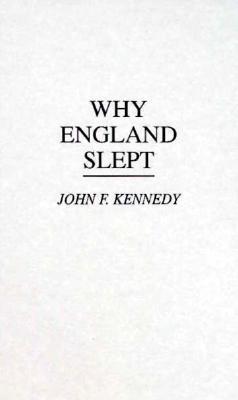
Written by John F. Kennedy in 1940 when he was still in college and reprinted in 1961 when he was president, this book is an appraisal of the tragic events of the thirties that led to World War II. It is an account of England's unpreparedness for war and a study of the shortcomings of democracy when confronted by the menace of totalitarianism.
Librarian Note: There is more than one author in the Goodreads database with this name.
John Fitzgerald Kennedy, also known as JFK, was the 35th president of the United States, serving from 1961 until his assassination in 1963. He was the youngest person elected president. Kennedy served at the height of the Cold War, and the majority of his foreign policy concerned relations with the Soviet Union and Cuba. A Democrat, Kennedy represented Massachusetts in both houses of the United States Congress prior to his presidency. Born into the prominent Kennedy family in Brookline, Massachusetts, Kennedy graduated from Harvard University in 1940, joining the U.S. Naval Reserve the following year. During World War II, he commanded PT boats in the Pacific theater. Kennedy's survival following the sinking of PT-109 and his rescue of his fellow sailors made him a war hero and earned the Navy and Marine Corps Medal, but left him with serious injuries. After a brief stint in journalism, Kennedy represented a working-class Boston district in the U.S. House of Representatives from 1947 to 1953. He was subsequently elected to the U.S. Senate, serving as the junior senator for Massachusetts from 1953 to 1960. While in the Senate, Kennedy published his book, Profiles in Courage, which won a Pulitzer Prize. Kennedy ran in the 1960 presidential election. His campaign gained momentum after the first televised presidential debates in American history, and he was elected president, narrowly defeating Republican opponent Richard Nixon, the incumbent vice president. Kennedy's presidency saw high tensions with communist states in the Cold War. He increased the number of American military advisers in South Vietnam, and the Strategic Hamlet Program began during his presidency. In 1961, he authorized attempts to overthrow the Cuban government of Fidel Castro in the failed Bay of Pigs Invasion and Operation Mongoose. In October 1962, U.S. spy planes discovered Soviet missile bases had been deployed in Cuba. The resulting period of tensions, termed the Cuban Missile Crisis, nearly resulted in nuclear war. In August 1961, after East German troops erected the Berlin Wall, Kennedy sent an army convoy to reassure West Berliners of U.S. support, and delivered one of his most famous speeches in West Berlin in June 1963. In 1963, Kennedy signed the first nuclear weapons treaty. He presided over the establishment of the Peace Corps, Alliance for Progress with Latin America, and the continuation of the Apollo program with the goal of landing a man on the Moon before 1970. He supported the civil rights movement but was only somewhat successful in passing his New Frontier domestic policies. On November 22, 1963, Kennedy was assassinated in Dallas. His vice president, Lyndon B. Johnson, assumed the presidency. Lee Harvey Oswald was arrested for the assassination, but he was shot and killed by Jack Ruby two days later. The FBI and the Warren Commission both concluded Oswald had acted alone, but conspiracy theories about the assassination persist. After Kennedy's death, Congress enacted many of his proposals, including the Civil Rights Act of 1964 and the Revenue Act of 1964. Kennedy ranks highly in polls of U.S. presidents with historians and the general public. His personal life has been the focus of considerable sustained interest following public revelations in the 1970s of his chronic health ailments and extramarital affairs. Kennedy is the most recent U.S. president to have died in office.
One of the reasons I've always felt a pull towards JFK is because, as a leader, he had a keen intellect and a profound sense & understanding of history. WHY ENGLAND SLEPT was written by the future 35th President of the United States as a historical thesis when he was a 22 years old Harvard student. It was first published in 1940. I was able to obtain a 1961 edition of this book, published soon after Kennedy was elected President.
When this book was first published, England had just been pulled into WWII through Hitler's aggression. America was still at peace when John F. Kennedy was a senior at Harvard writing WHY ENGLAND SLEPT. Within its pages, JFK outlined the varying factors that led to England's ill-preparedness in the years that led up to the Second World War. It is clear through his writing that Kennedy had a firm grasp on the leaders, conditions, circumstances, and culture of England at the time. Following the trajectory of events that followed the First World War, JFK made the case in detail for why that war-weary nation turned a blind eye to the vulnerabilities and dangers that enveloped it and for which were a harbinger of things to come.
At the time of its writing, John F. Kennedy understood that his father, as former ambassador to England, had landed on the wrong side of history when he argued for appeasement with Hitler and Germany. Through his own understanding of history, JFK believed that while those like his father argued for peace at all costs, history had proven that the necessity to prepare & fight certain wars demanded a wider scope and reflected the dangers and implications of narrow-minded naivete.
As a thesis, John F. Kennedy's WHY ENGLAND SLEPT deserves five stars. I chose to give it four because I read it as a novel. A thesis, by its nature is to go into depth in its summations. For example, Kennedy wrote at length of armaments which, as a thesis, led him to justifications of his points. As a novel, that sort of detail slows the pace of an otherwise fantastic read. In reading WHY ENGLAND SLEPT, it was obvious that an intense study of research was achieved. It's also clear that Kennedy had a powerful grasp of language. He was able to lead the reader to understandable summations of complex issues that delved deeper than the surface ones that history now notes as the key English failures in the years leading up to WWII. JFK pointed out multiple facts for consideration. He wrote of the reasons why England neglected to prepare to defend itself from the likes of Hitler and why, when it finally 'awoke' it was not as easy for that nation to kick into high gear of mass production as America was able to do a year later. Finally, John F. Kennedy made clear in his thesis that he wrote this study in the hopes that his own country would learn from the lessons that England had come to realize through its own failures in judgment.
JFK was an astute writer and student of history. It's clear after reading WHY ENGLAND SLEPT why historians consistently rank John F. Kennedy's leadership during the Cuban Missile Crisis in his own presidency as a fine example of calm, thoughtful action; action that may very well have saved the world from its own destruction. In the age of Trump, we find ourselves living in a post-factual world where history and facts are ignored. In reading WHY ENGLAND SLEPT, we can see the advantage a President might have to lead based on his knowledge of the past as well as understanding of present day world events. John F. Kennedy displayed a intellectual depth and insight from a young age as evident in his first serious turn at historical study and writing. WHY ENGLAND SLEPT is a more than worthy read.
Written, I assume in 1940, Kennedy's book examines the reasons why England was so slow to re-arm before WWII, with many quotations and facts and figures. He resists the temptation to lay all the blame on Baldwin or Chamberlain, but instead analyses the differences between a totalitarian state and a democracy in the way a nation makes its decisions. It is all the more poignant being written without the benefit of hindsight or of knowing the outcome of a war against a well armed foe. We would do well to reflect on some of his conclusions, today, considering the nature of some of the growing threats that surround us. Ignoring the arguments about who actually wrote the book, it is, none the less, thoroughly researched drawing on a wide range of sources and, at only 234 pages, is very readable. The roles of the National Government, the Labour Party, the Conservative Party and the electorate all come under considerable analysis. In particular, I enjoyed the following: “No discussion on Britain's psychology would be complete unless some mention were made of the natural feeling of confidence, even of superiority, that every Englishman feels and to which many Americans object. This feeling, while it is an invaluable asset in bearing up under disaster, has had a great effect on the need Britain felt for rearming. The idea that Britain loses every battle except the last has proved correct so many times in the past that the average Englishman is unwilling to make great personal sacrifices until the danger is overwhelmingly apparent. This notion that God will make a special effort to look after England, and that she will muddle through, took a great toll of the British rearmament efforts of the 'thirties.” and “We can't escape the fact that democracy in America, like democracy in England, has been asleep at the switch. If we had not been surrounded by oceans three and five thousand miles wide, we ourselves might be caving in at some Munich of the Western World. To say that democracy has been awakened by the events of the last few weeks is not enough. Any person will awaken when the house is burning down. What we need is an armed guard that will wake up when the fire first starts, or, better yet, one that will not permit a fire to start at all. We should profit by the lesson of England and make our democracy work. We must make it work right now. Any system of government will work when everything is going well. It's the system that functions in the pinches that survives.”
This is an extraordinary book not only because it was written as a college thesis by a future president but the lessons learned 75 years ago are still apt today. And not just as they relate to the international scene. JFK discusses how easy it is for a totalitarian regime to impose its will on a nation, particularly with a rigid state run media in support. A democracy, on the other hand is slower to react because it responds to the will of the people and can find itself behind when a crisis occurs. We can see this in the dictatorial actions of Obama who pushed the hated Obamacare through Congress which the majority of Americans oppose and in his stance on immigration which the vast majority of the country is against. We see it in his constant use oF Executive Orders for issues that he could not possibly get through Congress. All this with the acquiescence of a fawning, stenographic press. At the very least this book demonstrates that JFK had a better handle on issues and would have been a better president at the age of 24 than Obama would be at any age.
Although quite idealistic in some ways, this is an impressive look at what issues England faced in the years leading into WWII. Kennedy wrote with a sharp sense of what it takes to maintain a free world within the complexities of capitalism and amidst threats of dictatorships, totalitarian regimes, and political hubris.
Pretty interesting historical document of a young JFK sizing things up before Pearl Harbor. Of course, considering what we now know about Cuba and Vietnam, you have to think about the old saying about people in glass houses.
A few weeks back, as we entered the umpteenth round of “peace negotiations” with Putin, I found myself wondering what history might teach us about the consequences of appeasing an ambitious dictator. You can only imagine the Grinch grin that spread across my face when I remembered that not only does that book exist……………..it was written by one of my all-time favorite people: a 22-year-old JFK………………
Extraordinary work for a college student in the middle of the early days of the war. Lessons can still be learned by Britain’s unilateral dearmament and slowness in rearming. A couple of chapters get bogged down by budget numbers, but the concluding chapters are outstanding and still hold up more than 80-years after publication
The impulse behind this book: "I believe it is one of democracy's failings that it seeks to make scapegoats for its own weaknesses." And then the layout of which politician said what when, numbers, all very thesis orientated as indeed it was Kennedy's thesis and was published in order to promote his career goals. Reading it made me wonder about Mrs. Kennedy's soul searching inquiry "Do you think a wife should let her husband think he's smarter than she is?" Still a highly competent analysis of the 1930's wherein it is clear that disarmament vows hampered rational thinking about Germany, ruined, who further multiplied its debt to raise an military prowess and arms, keeping inflation at bay, and was obviously getting ready to wage war as the economic situation was not likely to be kept safely under wraps for long. Come to think about the scenario it reminds me a little bit of the USA the 1980's under Reagan. Did the USA go to war in the 90's?
I never new John F Kennedy had such good analytical sense. This book is about the 1930s in England: international relations, local politics and national defense. It asks why England did not prevent German aggression, and why they pursued a policy of appeasement (they did not have the power to back up any threats). On a larger level it is about the relative merits and weaknesses of democracy compared to totalitarian government.
I did not give this book more stars, because even though it is informative, it is still dry and academic. I would recommend to certain people (history buffs) but not for everybody. Also it is not as good as "The Hobbit".
JFK's evaluation of why it took England so long to realize the threat posed by Germany's rearmament and increasing belligerence during the 1930's. His basic conclusion is that while a democratic and capitalistic system is superior over the long term, a dictatorship is more effective in preparing for and prosecuting war at the outset. An interesting study, especially when one considers it was written well before the outcome of WWII was known.
This book should be required reading for all government leaders in a democracy. John Kennedy shows how smart, perceptive, and thoughtful he is at a very young age ( in 1940) when he wrote this book. It was very difficult to find a copy of it to read, which is sad. More Americans should read it, as he speaks very thoughtfully and forcefully about the strengths and weaknesses of a democracy when it comes to waging war.
This was Kennedy's thesis paper at Harvard, on why England did not rise sooner to confront the forces of totalitarianism that led to the second World War. It is an interesting little book, not particularly well-written, but nonetheless useful in generating ideas about a subject we should be thinking more about today.
It is a good lesson about being prepared and being blinded, even guided by what others might think or do when we make a decision. I enjoyed the matter of fact way John Kennedy wrote.
I'm not going to rave over a "book" just because someone [who subsequently became] famous wrote it. So, he wrote this in 1940 and then came WWII. Hindsight is 20/20.
This book is awesome to me. JFK was at Harvard in 1940 and wrote his senior thesis about "Appeasement at Munich." It would be published later that year as a book titled "Why England Slept." His father Joseph Kennedy pulled strings with his connections in high places to get it published, sensing it was a good PR and political move.
The title "Why England Slept" was a nod to Winston Churchill's 1938 book, "While England Slept." — a collection of 41 speeches Winston Churchill gave warning of Germany's rearmament, in the face of the Treaty of Versaille, which imposed strict limitations - which Hitler was now defying - on Germany's military arsenal, for the bad behavior of starting World War 1.
I read a significant amount of this book while working at Enterprise in the summer of 2017, waiting for more care to come in to wash.
JFK's point was that democracies take longer to act than totalitarian states.
Germany swiftly rearmed when Hitler came to power.
The Brits were wary of war, rightfully so, and shell-shocked still from the terrors of World War 1. Getting a majority of Parliament on board to fund a huge arms program in response to the Germans was slow work.
The British did not want to accept the stark reality that Hitler was creating a mechanized juggernaut of a military, the likes of which the world had never seen, whether they liked it or not. Winston Churchill tried to warn them. But England "Slept" and allowed it to happen.
The structure of the writing in Why England Slept was not the best. You could tell a 20 year old wrote it. But a brilliant 20 year old with a real grasp on international affairs, with foresight even greater than that of his father.
As a clear admirer of Churchill's, and being from the American version of an aristocratic family, a career in writing like Churchill's early war correspondence and commentary on his country's affairs of would've appealed to John F. Kennedy.
His brother Joe was the one being groomed for politics, with his dad envisioning a run at the presidency like Lavar Ball manifested his sons' NBA careers.
JFK was set to use his with and position to coast and have an easy philandering playboy life. Sadly for him, his big brother died in World War II in 1944 on mission as a Navy pilot in Europe. There has been speculation that after JFK became publicly recognized as a war hero, his brother volunteered for a risky mission to try and make a name for himself.
JFK emerged from World War 2 a war hero, with new responsibilities on his shoulder, expected to be his family's crown prince - the consequences of would have a dramatic effect on the history of the world.
- Hitler was hated because the way he did things, rather than what he did
- A big reason why England remained not to the war was prior to the conflict, its immense feeling that military would cause a war, not defend the war - thus England simply has no manpower when Germany attacked
- it was a concensus at the time for the leaguer of nations to disarm, the fact was that only England and the US did so (they felt confident that they can't be invaded given their geographical advantage. Thus they only invested on their navies)
- The concensus of the English at the time was that they are simple surprior and anything that happens to other nation would not happen to England because the God would protect the land
- War never start with anything full blown: Germany's invasion was gradual, and Japan's invasion started with taking over Manchuria was seen as a regional matter and was not really taken seriously (in fact, people at the time believed China was weak)
- The general public are often divorced from reality and seek to do something that's irrational even self-harmful: while Hitler's Germany was gearing up to war, England on the other hand, seek to disarm even more, believing such move would be sincerely enough for the Germans to void their movement
- Churchill's consistent warning of the potential warfare was not well received (until the war actually happened). Instead, people saw him as dangerous at first. Ironically he became the man England thought was only capable of leading the nation after the war started
- Hitler's propaganda was not only successful domestically, it was also successful in foreign land: people were sympathetic of Germany because other nation did not disarm like they agreed in the treaty of Versailles
- Things move back and forth at times: while Germany was fast building its military power, in 1935 the world oddly seems peaceful even though the crisis is only around the corner
- People who are in power are often afraid of the war - so much that they're so ill prepared for the war that it gives their opponent a tremendous amount of leg up
- Things like "The League of Nation" are simply a fassade: it doesn't work. It's the wizard of Oz
- Democracy, while slow to react, reacts firmly when it wants to fight a war (in a totalitarian regime many people would be less convicted for war, but can move more swiftly but less firmly than the democratic counterpart
This book is an expansion of a college thesis written by the future President focusing on the question of why England was not prepared to fight a war with Nazi Germany. Among the subset of issues it examines are why England failed to rearm and rebuild its military capabilities during the 1930s as the threats created by Hitler came into focus, and why it acceded to the Munich Pact in 1938. It also looks at the impact of democratic versus totalitarian forms of government on these issues. It ends by drawing lessons from England’s experience that may be applicable to the United States in the lead up to the Second World War.
This book is valuable as a contemporaneous document scrutinizing current events using publicly available sources. It provides the insights and views of those who have lived through and experienced the events since it was published in 1940, rather than a revisionist history based upon access to documents and memoirs written long after the events in question, as well as government documents and correspondence that were once kept secret. It offers lessons for modern day politicians, leaders and citizens as we face crisis in Ukraine, the Middle East and elsewhere for which we can draw analogies to the crises facing leaders in the run up to World War II.
It loses a star for its lack of consistency in presenting data and typographical and grammatical errors, which could readily have been corrected through the use of a good editor.
I do wish people writing understand that ‘England’ is not a country on its own and when writers not from the UK write they do not fully understand the geography of the island, nor it’s seems it’s people. There is no ‘England’ here, it is the UK or Great Britain. The UK is 4 kingdoms, Scotland, England, Wales and Northern Ireland (Ireland is her own county in her own right). Great Britain is Scotland, England and Wales. One did not exist without the other in War time and so it’s always very misleading when described as ‘England’. No wonder people outside of the UK, still to this day do not understand what the UK, or GB represents.
Very informative and even though written in 1940, and as a college thesis it does develop into why the UK was slow to realise the under hand way Hitler was arming Germany. It’s easy to look at this study now in hindsight but the UK was not wanting another costly war. Not just with the cost on the economy but on her people who did understand the immense cost of having lived the through WW1 or as a young person still living with the outcomes in both industry, living costs and its own history.
First point is to welcome the fact that this book is available. Copies of JFK's "Profiles in Courage" are easy to come by (for example in the store at the JFK Presidential Library); this book not so. Although there are a few minor glitches in this particular edition (e.g. the book spine incorrectly calls it "While England Slept"), the text is clearly reproduced and therefore worth the investment.
It is also worth the investment for two other reasons. First, it is an important insight into JFK's personality and perspectives which were build upon over the next twenty three years. Although JFK's family connections helped to get the book published from his honours thesis, the student of JFK's life and career will find "Why" an invaluable guide. Secondly, the book itself is well argued. Coming as it did during the summer of 1940 when Britain was fighting for its life, JFK's account of the political and societal factors which governed Britain's approach to rearmament is well founded and convincing. JFK's latest biographer, Fredrik Logevall, attests to this and for its importance in the historiography of inter-war Britain.
Kennedy does a very nice job making an argument about why England was simply not prepared to go to war against the Germans in WWII. Kennedys primary argument is that it takes longer for a democracy to prepare for war than it does a totalitarian or dictatorship. The issue is usually one of money for armaments that has to be agreed upon by various special ineterest groups in a democracy whereas in a dictatorship... there are no arguments. Kennedy makes a solid case for his argument and in the afterward states how he wanted to study England so that America could learn and not repeat the same mistakes.
Extraordinary that he wrote this as a college thesis. Brings up some good points, like we should look at defense spending in comparison to our enemies. In that regard, our defense makes sense and why Europe should pay more for theirs. That said, was England truly unprepared for WW2? Can any nation ever be fully prepared for war? Democracies, by nature, struggle to justify large defense expenditures during peacetime, and war in Ukraine shows how quickly modern conflicts can deplete armaments. Given the scale of U.S. defense spending, were we actually prepared for a major war?
Ultimately, I’m not entirely convinced his thesis holds up under closer scrutiny.
This book is an interesting historical snapshot. Written when JFK was a young man, you can see the seeds of how he viewed foreign affairs already taking shape. It is also a unique perspective from someone not looking back on WWII as we would now but rather as someone who was living through it and what led up to it. The only downside is the book is heavy with statistics which make the overall point not flow too well.
You would have no idea the man was a college senior at the time this book was written. It’s a testament to the genius of the late President and his profound capacity for reflection on the most pressing events of his time that would later be seen when he was the commander of the free world. A truly astonishing book that every American should read and feel a sense of pride that we were once led by such an extraordinary human being.
Letto dopo aver visitato una mostra temporanea su JFK dalle mie parti, l'ho trovato nel complesso interessante nonostante la scrittura (del 1940) e la traduzione (del 1964) abbiamo reso la lettura del libro spesso pesante e macchinosa. Vengono analizzati aspetti che prima non conoscevo sul ritardo della risposta inglese alle mire espansionistiche e belligeranti di Hitler. Colpisce molto la giusta lettura di molti avvenimenti a lui contemporanei
Will have to meditate further over my review on this. Initial reaction is I'm satisfied--it has a strong thesis for armaments policy applicable to a democratic country when faced with war-mongering dictatorships. What I'm not impressed with is JFK's construction of his paragraphs. Umm hello, editors?
Written as a college senior and before we saw the later glimpses of greatness from John F. Kennedy, this is a thoughtful study of world affairs in the 1930s. It seems to be a fair and comprehensive summary of England's politics, opinions and conduct. Much more readable than "When England Slept" by Churchill, however the two books should be used together for more thorough insights.
Good summary of how the world responded to the Great War(WWI). England and the United States depended on isolationism for protection--JFK did great to point that out. Charts are included that show the dollars each county spent on defense through the years after the Great War and as the world awoke to Hitler's build up.
Pretty readable. I haven't read it in years, but I recall he was a little repetitive in some of his points. One can tell it's a thesis paper stretched a bit to book-length. Still, it was pretty educational for me when I read it as a young person. Kennedy compares and contrasts prime ministers Baldwin, Chamberlain, and Churchill, and differences in their approaches to foreign policy with Germany. I seem to remember this was the first place I'd read some details about the abdication of Edward VIII.
Este libro te explica de manera muy detallada la situación de Reino Unido antes de la segunda guerra mundial, y te explica el porqué de falta de preparación para la guerra, es muy entretenido de leer, se explica muy bien, te da datos concretos y cita discursos, periódicos, personas… aprendes muchísimo con este libro.