From back Stonewall Jackson - his very name evokes the image of the solid, immovable Confederate general, whose sobriquet, earned at the Battle of First Manassas no longer requires quotation marks.
But no one has labeled Thomas Jonathan Jackson a "marble man," as impenetrable as the statues which commemorate his valor, because his pious Christian character, his service to the church and teaching vocation, his unwavering commitment to duty, his affectionate role as husband and father, as well as his magnificent service to Virginia and the Southern Confederacy were carefully recorded by his close friend and confidant Robert Lewis Dabney.
Dr. Dabney understood, far better than most subsequent biographers, the animating principles of Stonewall Jackson's life - his personal faith in Jesus Christ and his absolute trust in the Providence of God. Labeled by some a religious fanatic, General Jackson was simply a consistent biblical Christian who lived out his faith every day, seriously and without compromise.
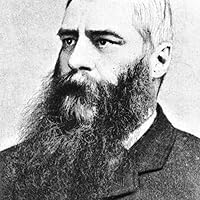
Robert Lewis Dabney (March 5, 1820 – January 3, 1898) was an American Christian theologian, a Southern Presbyterian pastor, and Confederate Army chaplain. He was also chief of staff and biographer to Stonewall Jackson. His biography of Jackson remains in print today.
Dabney studied at Hampden-Sydney College and the University of Virginia (M.A., 1842), and graduated from Union Theological Seminary in 1846. He was then a missionary in Louisa County, Virginia, from 1846 to 1847 and pastor at Tinkling Spring, Virginia from 1847 to 1853, being also head master of a classical school for a portion of this time. From 1853 to 1859 he was professor of ecclesiastical history and polity and from 1859 to 1869 adjunct professor of systematic theology in Union Theological Seminary, where he later became full professor of systematics. In 1883, he was appointed professor of mental and moral philosophy in the University of Texas. By 1894 failing health compelled him to retire from active life, although he still lectured occasionally. He was co-pastor, with his brother-in-law B. M. Smith, of the Hampden-Sydney College Church 1858 to 1874, also serving Hampden-Sydney College in a professorial capacity on occasions of vacancies in its faculty. Dabney, whose wife was a first cousin to Stonewall Jackson's wife, participated in the Civil War: during the summer of 1861 he was chaplain of the 18th Virginia regiment in the Confederate army, and in the following year was chief of staff to Jackson during the Valley Campaign and the Seven Days Battles. After the Civil War Dabney spoke widely on Jackson and the Confederacy. He continued to hold racial views typical in the South before the Civil War, and his continued support of slavery in speeches and a book published after the war and his strong loyalty to the Confederacy until the 1890s made him a visible figure in the post-war South (Hettle, 2003). While at the University of Texas he practically founded and maintained the Austin School of Theology (which later became Austin Presbyterian Theological Seminary), and in 1870 was Moderator of the General Assembly of the Presbyterian Church in the United States.
Major works
Memoir of Rev. Dr. Francis S. Sampson (1855), whose commentary on Hebrews he edited (1857); Life of General Thomas J. Jackson (1866) A Defense of Virginia, and Through Her, of the South, in Recent and Pending Contests Against the Sectional Party (1867), an apologia for the Confederacy. Lectures on Sacred Rhetoric (1870) Syllabus and Notes of the Course of Systematic and Polemic Theology (1871; 2nd ed. 1878), later republished as Systematic Theology. Systematic Theology (1878) Sensualistic Philosophy of the Nineteenth Century Examined (1875; 2nd ed. 1887) Practical Philosophy (1897) Penal Character of the Atonement of Christ Discussed in the Light of Recent Popular Heresies (1898, posthumous), on the satisfaction view of the atonement. Discussions (1890-1897), Four volumes of his shorter essays, edited by C. R. Vaughan.
One of the difficulties in reviewing a biography is resisting the temptation to write a summary of a summary. This is made more difficult when the author has no specific purpose in writing the biography. Robert Lewis Dabney, however, wrote with a clear goal in mind-to vindicate the cause for which his hero, Lt. General Thomas J. "Stonewall" Jackson, fought. Dabney's motives were two-fold: to use Jackson's Christian character as an example of hope and perseverance to Jackson's defeated countrymen (vi., all citations and summarizations will be cited by page numbers within parentheses). Secondly, Dabney sought to vindicate the cause for which the South fought-the doctrine of state's rights as Dabney interpreted it. Dabney attempted, not so much to narrate Stonewall Jackson's life, but to give reasons for why Jackson faced each situation, during war-time and peace-time, and the influences that drove Jackson.
Review
Stonewall Jackson's life is described by hardship, courage, and fidelity. Jackson was born on 21 January, 1824 in Clarksburg, VA. Within the first six years of his life Jackson's sister and mother die, forcing him to live with relatives. Although he experienced hardship with his relatives, at the same time he began to cultivate diligence and devotion to family and country; it was at West Point that the diligence would come to full fruition. Jackson was by no means intellectually prepared to study at West Point. This was evident by his finishing his first year ranked 71st in the class. His diligence paid off as he graduated in the top third of his class.
After finishing at West Point, Jackson would soon head to Mexico to serve in the Mexican War. This proved to be a crucial period in Jackson's life as he distinguished himself as competent artillery man and began an interest in Christianity. After exploring the different denominations Jackson was baptized in the Presbyterian Church in the early 1850's (60-61, he did not actually join the church until he moved back to Virginia). It could be argued (and Dabney takes its truth for granted) that one cannot understand Stonewall Jackson without understanding his Christianity which occupied every moment of his existence. In fact, Dabney uses Jackson's religious convictions to tie in all other themes in his life: "As God's nature and will were to him the standard of that which is right, and the fountain-head of obligation, so, whenever he found a fellow-creature clothed by the sanction of right, with legitimate authority over his conscience, he honored and obeyed him within his proper sphere, as a bearer of a delegated portion of the majesty of heaven; and his respect became a religious sentiment" (87). This mentality above all else would be the force that drove Jackson into war; having sworn fidelity to Virginia and seeing her cause as God's cause, he could then fight for Virginia and the South as he was fighting for God.
In speaking of the cause for Secession and Jackson's belief in it, Dabney is at his literary best. Dabney described Jackson as a "States'-Rights' Democrat" and spends the next thirty pages describing the implications of that view. Dabney argued that the right of a state, primarily Virginia, accepted the Constitution on one condition: that she could retire from the Union if she found the situation to be unsatisfactory to her sovereignty (130). Although this part of the book shows Dabney at his best, it is hard to see how much of these thoughts are Dabney's and how much are Jackson's. Dabney briefly mentions slavery and that it was "not the cause, but only the occasion, of the Southern resistance" (163).
Understanding the political and religious convictions of Jackson, Dabney then applied this understanding to the Civil War. Jackson fought each battle with the same intensity with which he lived every other aspect of his life: a religious devotion to God coupled with a fervent desire to his superiors. Although Dabney never explicitly phrased it this way, Jackson saw himself as a soldier fighting in the army of God. The Southern Cause was God's cause, or so Jackson thought. As a result, Jackson could attribute each victory in battle to the blessing of God, as his letters to his wife show (229).
Critique
Although one may fault Dabney with writing a biased account of the Civil War and his hero in particular, Dabney would have freely admitted as much. Dabney was privy to much personal information about Jackson and had the advantage of serving as his chief-of-staff for a year in 1862, giving him key insight into important battles. Although his prose was laborious at times, having warmed up to his subject he could reach elegant literary heights. A fine example is his defense of Virginia in response to President Abraham Lincoln's call for an invasion of the South, "But when the tyrant tried the perilous experiment, he was startled by a result as unexpected as that which followed the touch of Ithuriel's spear. She, whom he thought a patient, hesitating...paralytic, flamed up...like a pyramid of fire, and Virginia stood forth again in her immortal youth, the unterrified Commonwealth of 1776...wielding that sword which has ever flashed before the eyes of aggressors, the Sic Semper Tyrannis" (157). Civil War studies have moved beyond Dabney's time, but his work has rightly gained the title of a classic.
I knew Stonewall Jackson was an incredible man, but I did not know just how incredible he was - until I read this book. I thank God for R.L. Dabney preserving the history of Jackson's life in an incredible volume. Stonewall was a man who carried a strong sense of duty to God - he understood that all areas of life fell under the authority of God, this belief greatly impacted every detail of his life and the way he served his country. At the end of the book, I wept with the many southerners who, despite not having met this great man, mourned his passing in 1863. He was - and still is a hero. Wouldn't it be absolutely life-changing if every little boy today looked up to men like Stonewall as their hero? I believe we'd be in a different world.
Loved it. Highly recommend ... Dabney early in the book pulls the reader into the mindset of many southerners and copperheads in that era. Lots of technical information ... he is extremely descriptive.
I loved this book. Of course, I love Stonewall to begin with, but this gave me a much better understanding of him. Dabney writes well, and makes his points clear. Very inspiring story.
This is a very challenging biography of the Confederate general Stonewall Jackson by his contemporary, Robert Dabney, a theology professor at Union Seminary in Richmond, Virginia. However this book is more than a mere biography of Stonewall Jackson; it is also Dabney's apologetic for the Southern cause and a defense of slavery. This book is very challenging because it confronts the reader with an unpopular viewpoint. After being initially challenged, I ultimately came to a firm Biblical understanding that Robert Dabney, and the Southern cause was wrong, and Biblically sinful. However helpful it is to have our views challenged, it is even better to have them conform to the word of God. Both Dabney & Jackson now know the truth . . . in heaven; praise God for his gracious mercies!
What a great book. It's a wonderful piece of history that is well written. The man himself is amazing, but Dabney does a great job presenting him. Dabney isn't tainted by modern notions of being politically correct. Instead he tells the tale with deep love and honesty. Excellent, excellent book.
I enjoyed this book. It did a really good job explaining the military strategy of the Civil War and how the battles worked. Some very interesting insights to why the South lost the Civil War. I loved learning more about the personal life of Stonewall Jackson. The details that the author provided were a very good insight to the character of Stonewall Jackson. But I do wish this biography was more objective. It felt very biased not giving the Union credit for literally anything. At times it felt like a poetic book seeking to justify the South instead of a objective biography that simply looked at the facts which is what in my opinion good biographies should be. They can pick a side but they should seek to be at least objective. I do not necessarily disagree but I wish the author had at least attempted to understand the Union side. This biography felt very one sided. I still enjoyed it because of the interesting military details and I really appreciated learning more about the great life that Stonewall Jackson lived.
This entire review has been hidden because of spoilers.
"Let us pass over the river, and rest under the shade of trees" was the last words spoken by Stonewall Jackson. I recommend this book to all interested in learning more about not only his military background and wars but about the man who knew and trusted the Lord. The beginning was a little hard to read with so much background regarding why the South went to war with the North. I do not agree with the stance on slavery but do appreciate the reasons why. The language is a little difficult but once you started reading it, you get more accustomed to it and it becomes easier to read. There are a number of errors in the book that do make it a challenge. I learned a lot about Stonewall Jackson and his character and see much personally I can apply to my life.
It is difficult to "rate" a book that is nearly entirely a first-hand account and memoir written by one of the Chaplains on the Staff of General Jackson. It was started in 1863 and finished right after the war. It does come across as a bit of "Protestant" hagiography, and at 740 pages, this took awhile to read. The writing quality is excellent, but I didn't read this for the "Lost Cause of the South" that has spread up around this. I will say I do think Gen. Jackson himself was a far cry better in virtue and character than many if not all the general officers of the U.S. military in 2022.
I'd only recommend this book for someone who wants to dig into primary source materials.
This will absolutely be one of the most unique biographies that you will ever read. First and foremost, it is written like a piece of literature in which the author puts literary flourishes on every piece of information. Secondly, it was written by a pastor who focuses particularly on Stonewall Jackson's faith through his many trials and tribulations. It's not the best biography that I've ever read, but it's well worth your time.
Amazing and well detailed look into the life and campaigns of Stonewall Jackson. Written by someone who lived during the War Between States, it gives a first hand view. Dabney does a great job of gathering information about Jackson, his family, and his time in the army.
Would recommend this to anyone who wants to broaden their knowledge of Jackson and the War Between States.
I understand that Mr. Dabney lived in the 19th century and therefore probably had a really sinful blind spot about what "biblical slavery" means, and overall, this is a great biography written pretty recently after Jackson's death. That said, it would have been a much better biography had the author excised his own personal sermons on the beauty of owning kidnapped slaves and the saintly perfection of the South from the story, and instead focused more on Jackson's own views. The bias in some areas made it difficult to digest the better parts of the book.
On the plus side, as Jackson's aide-de-camp, Dabney had front row seats to the campaigns and to how Jackson led them. He also had unfettered access to Jackson, allowing him to see firsthand the type of man Jackson was. All of this allowed Dabney to write a very detailed book and to convey the character of Jackson. The downside is that the parts dealing with the campaigns got a bit tedious to read. This could be because I am less interested in the battles of the war than I am the reasons why and the bios.
Mostly skimmed while I read this in conjunction with Robertson's biography of Jackson. I own a first edition of this book. This was the edition I skimmed - since it is a collector's item I didn't use it as a reading copy.
While a great plethora of information, I found this hard to read. The publisher could have helped the readers by adding page numbers and separating the text better.
The first "authorized" biography of Stonewall Jackson written in 1866. As a minister and associate of Jackson, Dabney goes to great lengths emphasizing Jackson's religious character.