I have heard of the 50-page rule; that is, give a book 50 pages before you decide if you want to finish. I gave Stuart Diamond’s book Getting More 30 pages (32 to be exact, so a bonus two pages) to convince me. Why? Because not only is it reasonable to expect a book about negotiation to present the hook within the first 30 pages, but as a meta-object, the book itself has one job: to entice. As a product of capitalism, I’m expected to see that book on the shelves and feel a stirring, a seed of curiosity, a reaching out of the hand, which may lead to a skim, an opening to a random page, and then the end goal (“know your goal” is the most important bullet point according to Stuart, after all) of purchase. As the all-caps claim screams on the front of the book, THE NUMBER ONE BESTSELLER, and “get what you want every time”, framing itself almost as a book on witchcraft than negotiation, echoing Rhonda Byrne’s The Secret. The message is clear: learn this skill, and the world is your oyster.
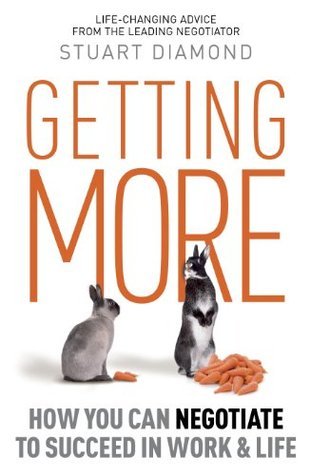
To begin, the book’s very own advertising is gender-coded. The bunnies on the front suggest a masculine dog-eat-dog world in which prey dynamics are the subliminal message powering negotiation. That we are taming our more wild, violent, aggressive nature down to a more productive, methodical negotiation tactic. The bunny with more carrots is straight and tall and facing you, standing on two feet as a mimicry of humanness echoed in the dramaticism of Animal Farm or Planet of the Apes, while the bunny with fewer carrots has their back to you, on all fours, more subdued, looking up with awe and envy at their more well-fed counterpart. “If only I could be you,” that bunny says. “If only I could do that unnatural pose, mimicking humans more than bunnies, with all those yummy carrots.” Be someone who you aren’t, the cover says. Someone please tell Stuart that bunnies also eat their own feces, which are rich in nutrients. So that bunny with seemingly less? They’ll be fine.
Perhaps the most glaring absence in these first 32 pages is Stuart’s failure to properly address the role of fear in negotiation, as it pertains to women. At least not in the first 32 pages, which is necessary for engagement. I was taught to fist my keys between my fingers as I walked to my car in middle school, before I could even drive or had thoughts of driving. Through entertainment and news, and for decades, if not centuries, if not thousands of years, we have witnessed disproportionate global violence towards women, sometimes for a plot point and sometimes as a war tactic and sometimes, yes, as a negotiating tactic between two men. (See: mass-rapes of Jewish women on and since Oct 7th.)
This book is written from the point of view of a man who is far removed from the daily negotiations women have to deal with every day. Maybe he should have co-authored this book with a woman, but I’m not sure he would know how to negotiate well enough to do so. The deficit with which he approaches modern day negotiation in 2025 for women makes reading Getting More more like an out-of-touch manifesto. Perhaps Diamond forgot the most important role of negotiation from a woman’s point of view (not a huge blind spot, only half the population of the world and thus his readership), which is: how one negotiates is largely dictated by the position that person is starting from, or perceives they are starting from, in relation to fear. Stuart has attempts at this, with bite-sized, easily digestible popcorn-bullet-points, like “embrace differences” and “don’t deceive people.” Tell me, Stuart, how does a woman negotiate as she stands in front of her superior, alone in his office, as he indicates that her eligibility for upward mobility is tied to the frequency and level of sexual favors she is willing to give him? Knowing that reporting him will get her fired, and pressing charges will lead to not only public humiliation and backlash, but loud skeptics who don’t think it even happened? Tell me, Stuart, in a situation involving a gendered power dynamic that you literally will never be in, how can you help me? How can you “put yourself in the other’s shoes,” as you say, when you can’t even walk in heels?
I can walk in heels. And I can spot a man who can’t, trying to tell me how to walk. I know how to negotiate as it pertains to being a woman in 2025. Women are born into a culture that unequally puts the burden of cooperation, negotiation, and likability on women, teaches women to put their interests on the back burner for the furtherment of others, frames female-to-male servitude as a virtue, and values women by how selfless they can be. We see this in modern day relational dynamics. Women constitute the majority of household labor, childcare labor, decision fatigue, mental load, etc. in their marriages, even while expected to financially contribute 50/50 with their husband as a sign of modern day "equality." Women carry most of the emotional labor in contrast to a generation of men who are incapable of emotionally communicating. I am “bitchy” while a man has “leadership skills.” I am “pushy” while a man is “driven.” I am “difficult” while a man is “headstrong.” The same values you try and apply to both genders are not interpreted in the same way. Women couldn’t own credit cards until 1974, a husband could legally rape his wife up until 1993, and today, you can damn a 14 year old girl to motherhood by banning abortions while adoption agencies require full home inspections, criminal background checks, financial stability, proof of adequate housing, etc. Stuart, can you help us negotiate getting our rights back? Have you ever even known what that’s like? Spoiler alert, there are zero laws that govern the rights of male bodies. So, *checks notes*, no.
The same gripe I have with Stuart’s view of negotiating is the same one Holly Whitaker had towards Alcoholics Anonymous in her book Quit Like A Woman (2019), which outlines how Alcoholics Anonymous not only was made for men but has coded sobriety from a male perspective. That is, framing sobriety as only achievable through steps pertaining to humility, the acceptance of powerlessness, and the shedding of self-aggrandizing ego. It’s no surprise that AA was formed in the 1930s by upper-middle-class Protestant white men who were sick from wielding too much power, and packaged a spirituality based on shedding that machismo. In other words, Whitaker writes, “those who wrote the rules were those who sat (and still sit) at the top of society- a society made in their image and designed to protect them. They enjoyed unquestioned authority and unchecked power… For an ego like this, the Twelve Steps make sense. To be reminded you are not God, to become right-sized, to refrain from questioning rules, to humble yourself, to admit your weakness. They are in essence instructions on how to be a woman, and to those men, the rules were medicine. To act in this manner was a crazy, new way of being, and felt like freedom. But to a woman or any other oppressed group, being told to renounce power is just more of the same shit. It’s what made us [women] sick in the first place.” (pg 114-115)
In the first 30 pages of Stuart’s book, let’s look at how he claims he has helped people through negotiation, organized by gender. These are incomplete lists of every time a person is mentioned and what relevant details Stuart thought was necessary to include.
Men:
- Ilan Rosenberg, a “seasoned attorney” (pg 26)
- Bob Woolf, a “retired sports agent superstar” (pg 27)
- Michael Phelps, “Olympic swimming champion” (pg 26)
- Lance Armstrong, “seven-time Tour de France winner” (pg 26)
- Diego Etheto, who called an airline thirteen times to get a refund (pg 27) (When a woman does this, she’s emotional, but when a man does this, he’s proactive? Hm.)
- Jack Callahan, an NYU executive MBA student (pg 27)
- Evan Claar, a hedgefund manager in New York (pg 30)
- Alexei Lougovtsov, a trader for Merill Lynch in London, cited Diamond’s classes as allowing him to have a “much happier and healthier life, a more successful career and better relationships.” (pg 30) When diving into how it helped in his relationships, Diamond cites Lougovstov convincing his girlfriend to go with him to boxing camp for a week. “His girlfriend works on Wall Street, and her friends were making fun of her for not standing up to her boyfriend and demanding, say, Barbados and beaches.” Clears throat. Stuart. This is mild sexism if not full-blown absurdity, as a woman who hates the beach (me) and who could knock a guy out if I had to. He convinced her by saying the boxing camp had “resume value”, without explanation or proof, basically saying his girlfriend, who already works on Wall Street and may be as successful, if not more, than him, needs a resume booster by putting her around violent men hitting stuff would somehow benefit her career. Oh but here we go, the justification: “Her horizons were broadened.” (pg 31) Forgive the female scientist here asking for proof but, huh? Sorry, I meant, how? Was this self-reported, or reported by the boyfriend who seemed to consistently ignore what his girlfriend wants enough for her friends to step in and suggest she stand up for herself?
Women:
- Diamond describes a female student as “slight” and “very timid at first,” framing these as an inherent personality trait rather than a genetic slimness/shortness and learned behaviors from very real-world problems. “She avoided most negotiations and had a hard time meeting her goals.” Interesting that ineptitude is framed as wholistic, while the male examples had specific challenges they were overcoming.
- Colleen Sorrentino “got the confidence to tell her husband, without nagging, that he promised to go food shopping so she could study.” Before we go further in Stuart’s description, let’s stop here. The term “nag” is female-coded up the wazoo, almost abusive and a tactic in domestic violence conflicts. Didn’t Stuart just praise a man for trolling an airline by calling them 13 times? Interesting. Secondly, no wife is “nagging” when they remind their doofus husband to go grocery shopping. Reminding someone of a promise they made (to feed their family, no less) is not a nag, not a wife’s responsibility, and *checks notes again* not her problem. The problem here is her husband, who needs reminding of his promises (responsibilities) and who apparently forgets to feed his family. “ ‘I didn’t argue, and for once, I didn’t get emotional… I always tended to feel guilty when I asked for something,’ said Colleen, now a managing director at her family’s brokerage firm, Wall Street Access.” (pg 28) I’m sorry, what fresh bullshit is this? Framing women as almost hysterical but Stuart’s wisdom helped her, “for once” not getting emotional? Leaning into a woman’s insecurity about an unequal marriage, all so she can study? And let’s not move too quickly past the part where she is now a director of a brokerage firm? (Stuart felt the need to include that it’s her family’s, and therefore downplay her accomplishment, was unnecessary. Just say she’s a director of a brokerage firm without letting your own male insecurity get in the way. You certainly don’t do it for any of the males you mention.) Diamond makes sure to add her current ‘empowering’-sounding job with the buzz word ‘Wall Street’ included, to insinuate that she was a naggy, needy wife before his wisdom and now she has her big girl pants on doing a big girl job. In reality, no wife shouldn’t have to remind a husband of his own promise to go food shopping, and if that is considered a high stakes negotiation, Colleen, file for divorce please. And please don’t hire Stuart to be your mediator.
- Sharon Walker, whose mother was dying of breast cancer and who was planning for a family, needing to negotiate asking her mother to record herself reading children’s books. (pg 28)
- Colleen McDermott used the tools in this book to disconnect from her cable TV company, negotiated a discount at her local florist, got food at a restaurant, reconnected with two friends, convinced her boyfriend to come to her house for thanksgiving, learned to not become flustered during tense negotiations… all while she was a Wharton student” (pg 30) (About the fifth time he has plugged Wharton and Penn. We get it, Stu, you worked there).
Stuart’s conclusion: The negotiating goals of women are domesticity, and the goals of men are specifically career-coded. I.e. the struggles for women are familial and non-monetary, almost trad-wifey, while the struggles of men are around championships, money, and corporate ascendency.
Stuart tries, and for that, I give him a pat on the head and a cookie. On page 23, he puffs out his feminist chest and claims, “Women stereotypically tend to be better negotiators than men. First, women listen more. They collect information. And more information leads to better persuasion and better results. Second, women try a lot harder to learn the tools in Getting more. That’s because we still live in a male-dominated world. Women have less raw power, and this is too often used against them.” (Cue le sigh.) Women do not “listen more.” We are steamrolled, bulldozed over, interrupted, spoke over, ignored, and conversationally cut out by big loud children in suits. I listen to those men like I listen to a screaming child who just needs a nap. I patiently wait until they wear themselves out. Men are perfectly capable of listening as much as women, and coding this ability to listen to others as gendered female is not only untrue, it excuses men’s continued resistance to listening (especially to women). Next: “they collect information.” This vaguely conspiracy-theory-sounding claim about women speaks to male discomfort/mockery with women gathering, gossiping, and exchanging information. Everything from women being mocked for going to the bathroom in groups to the Taliban’s current ban in Afghanistan for women speaking in public all lends itself a conspiratorial distrust spanning centuries framing the words of women as dangerous and powerful, a la Lady-Macbeth-vibes. Stuart, do you think I have a secret little box where I collect my secret little information? Is there something about collecting information that don’t see men able to do and thus color code this as female? Is “collect information” a fancy way of saying… women actually listen? This weird claim of his also ignores the need for women to collect information as a personal safety tactic, taught to us as far back as middle school, as I mentioned before (Stuart, were ya listening?). Perhaps female students’ ability to ace Stuart’s classes more than male students, as he reports, has less to do with women “trying harder” and more about the fact that we arrive at these classes already ahead. We already know a lot of what Stuart is about to teach the male students. Stuart’s flavor is basically constructive empathy, useful empathy, empathy that’s worth it, that gets you something, verses empathy that’s not worth it if it doesn’t add to your goal, and frames empathy for its own sake as a waste at best and a personal danger at worst. And this is where my own theory about men comes in so, Stuart, time to do that very female-thing called listening: for men, the dangling carrot of individual gains is the only thing that makes the hard work of interpersonal empathy worth it. While women have been forced to build their empathy from safety concerns, unequal expectations of likeability and not-rocking-the-boat, internalizing their emotions for the betterment of those around them, etc., men are starting from near scratch and the only incentive to put yourself in someone else’s shoes is literally personal gain. I’ll say the quiet part out loud: that is embarrassing. Stuart, you negotiated this morning when you bought your first cup of coffee? Cool, I negotiated last weekend by using a series of learned, complex maneuvers in a bar to avoid being touched, prodded, petted, and harassed by men, and avoid getting my drink poisoned with Rohpnol and GHB. I negotiated by buying a nail polish that, when dipped in your cocktail, changes color in the presence of a date-rape drug. I negotiated by, when on the phone with my father, I was aggressively harassed by a man on the sidewalk and turned around and yelled “F*ck you!” In fact, that was my fastest negotiation, apart from running away. My most successful negotiations are ones in which I stopped negotiating. I look forward to Stuart Diamond’s next book, Stop Negotiating: For Women. That is, if he’s been listening.